International Economics, 10e (Krugman/Obstfeld/Melitz)
Chapter 5 Resources and Trade: The Heckscher-Ohlin Model
5.1 Model of a Two-Factor Economy
1) In the 2-factor, 2 good Heckscher-Ohlin model, an influx of workers from across the border
would
A) move the point of production along the production possibility curve.
B) shift the production possibility curve outward, and increase the production of both goods.
C) shift the production possibility curve outward and decrease the production of the labor-
intensive product.
D) shift the production possibility curve outward and decrease the production of the capital-
intensive product.
E) shift the possibility curve outward and displace preexisting labor.
2) In the 2-factor, 2 good Heckscher-Ohlin model, the two countries differ in
A) tastes and preferences.
B) military capabilities.
C) the size of their economies.
D) relative abundance of factors of production.
E) labor productivities.
3) One way in which the Heckscher-Ohlin model differs from the Ricardo model of comparative
advantage is by assuming that ________ is (are) identical in all countries.
A) factor endowments
B) scale of production
C) factor intensities
D) technology
E) opportunity costs
4) If a country produces good Y (measured on the vertical axis) and good X (measured on the
horizontal axis), then the absolute value of the slope of its production possibility frontier is equal
to
A) the opportunity cost of good X.
B) the price of good X divided by the price of good Y.
C) the price of good Y divided by the price of good X.
D) the opportunity cost of good Y.
E) the cost of capital (assuming that good Y is capital intensive) divided by the cost of labor.
5) The Heckscher-Ohlin model differs from the Ricardian model of Comparative Advantage in
that the former
A) has only two countries.
B) has only two products.
C) has two factors of production.
D) has two production possibility frontiers (one for each country).
E) has varying wage rates.
6) “A good cannot be both land- and labor-intensive.” Discuss.
7) “No country is abundant in everything.” Discuss.
8) In the 2-factor, 2 good Heckscher-Ohlin model, the country with a relative abundance of
________ will have a production possibility frontier that is biased toward production of the
________ good.
A) labor; labor intensive
B) labor; capital intensive
C) land; labor intensive
D) land; capital intensive
E) capital; land intensive
9) In the 2-factor, 2 good Heckscher-Ohlin model, the country with a relative abundance of
________ will have a production possibility frontier that is biased toward production of the
________ good.
A) capital; capital intensive
B) labor; capital intensive
C) land; labor intensive
D) land; capital intensive
E) labor; land intensive
10) In the 2-factor, 2 good Heckscher-Ohlin model, the production possibility frontier is kinked
when
A) there is no factor substitution in production.
B) the opportunity cost of production is constant.
C) there are unemployed factor resources.
D) a country does not engage in trade.
E) transportation costs are very high.
11) The assumption of diminishing returns in the Heckscher-Ohlin model means that, unlike in
the Ricardian model, it is likely that
A) countries will not be fully specialized in one product.
B) countries will benefit from free international trade.
C) countries will consume outside their production possibility frontier.
D) comparative advantage will not determine the direction of trade.
E) global production will decrease under trade.
12) In the Heckscher-Ohlin model, countries are assumed to differ only in terms of their
A) factor endowments.
B) tastes and preferences.
C) available technologies.
D) factor productivities.
E) physical size.
1) In the 2-factor, 2 good Heckscher-Ohlin model, trade will ________ the owners of a country’s
________ factor and will ________ the good that uses that factor intensively.
A) benefit; abundant; export
B) harm; abundant; import
C) benefit; scarce; export
D) benefit; scarce; import
E) harm; scarce; export
2) According to the Heckscher-Ohlin model, the source of comparative advantage is a country’s
A) factor endowments.
B) technology.
C) advertising.
D) human capital.
E) political system.
3) In the 2-factor, 2 good Heckscher-Ohlin model, trade will ________ the owners of a country’s
________ factor and will ________ the good that uses that factor intensively.
A) harm; scarce; import
B) harm; abundant; import
C) benefit; scarce; export
D) benefit; scarce; import
E) harm; scarce; export
4) According to the Heckscher-Ohlin model
A) the gainers from trade could compensate the losers and still retain gains.
B) everyone gains from trade.
C) the scarce factor gains from trade and the abundant factor loses.
D) a country gains from trade if its exports have a high value added.
E) only the country with the more advanced technology gains from trade.
5) In the Heckscher-Ohlin model, when two countries begin to trade with each other
A) the relative prices of traded goods in the two countries converge.
B) relative factor prices in the two countries diverge.
C) benefits from trade are evenly distributed between the two countries.
D) all factors in both countries will gain from trade.
E) all factors in one country will gain, but there may be no gains in the other country.
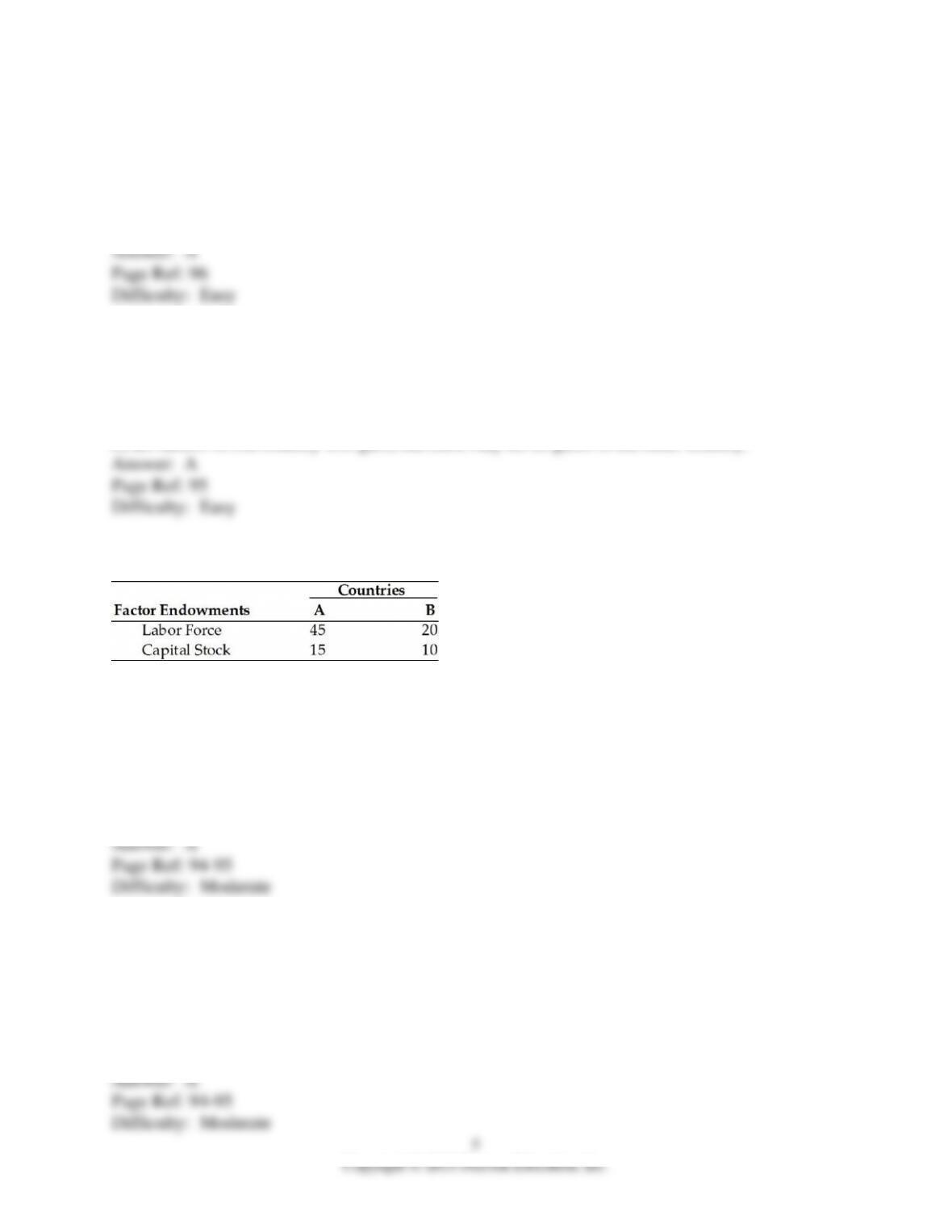
Assume that only two countries, A and B, exist.
6) Refer to the table above. If good S is capital intensive, then following the Heckscher-Ohlin
Theory
A) country B will export good S.
B) country A will export good S.
C) both countries will export good S.
D) trade will not occur between these two countries.
E) both countries will import good S.
7) Refer to the table above. If you are told that Country B is very much richer than Country A,
then the correct answer is
A) country B will export good S.
B) country A will export good S.
C) both countries will export good S.
D) trade will not occur between these two countries.
E) both countries will import good S.
8) Refer to the table above. You are told that Country B is very much larger than country A. The
correct answer is
A) country B will export good S.
B) country A will export good S.
C) both countries will export good S.
D) trade will not occur between these two countries.
E) both countries will import good S.
9) Refer to the table above. You are told that Country B has no minimum wage or child labor
laws. Now the correct answer is
A) country B will export good S.
B) country A will export good S.
C) both countries will export good S.
D) trade will not occur between these two countries.
E) both countries will import good S.
10) If a good is labor intensive it means that the good is produced
A) using relatively more labor than goods that are not labor intensive.
B) using labor as the only input.
C) using more labor per unit of output than goods that are not labor intensive.
D) using labor such that the total cost of labor is greater than the total cost of capital.
E) using labor such that the cost of labor is more than 50% of total cost.
11) In the Heckscher-Ohlin model, when there is international-trade equilibrium
A) the relative price of the capital intensive good in the capital rich country will be the same as
that in the capital poor country.
B) the capital rich country will charge less for the capital intensive good than the price paid by
the capital poor country for the capital-intensive good.
C) the capital rich country will charge more for the capital intensive good than the price paid by
the capital poor country for the capital-intensive good.
D) workers in the capital rich country will earn more than those in the poor country.
E) the workers in the capital rich country will earn less than those in the poor country.
12) If a good is capital intensive it means that the good is produced
A) using relatively more capital than goods that are not labor intensive.
B) using capital as the only input.
C) using more capital per unit of output than goods that are not capital intensive.
D) using capital such that the total cost of capital is greater than the total cost of labor.
E) using capital such that the cost of capital is more than 50% of total cost.
13) The Heckscher-Ohlin model predicts all of the following EXCEPT
A) the volume of trade.
B) which country will export which product.
C) which factor of production within each country will gain from trade.
D) that relative wages will tend to become equal in both trading countries.
E) that trade increases a country’s overall welfare.
14) If Australia has relatively more land per worker, and Belgium has relatively more capital per
worker, then if trade began between these two countries
A) the relative price of the land-intensive product would increase in Australia.
B) the relative price of the capital-intensive product would increase in Australia.
C) the relative price of the land-intensive product would increase in Belgium.
D) the relative price of the capital-intensive product would decrease in Belgium.
E) relative product prices would diverge between Australia and Belgium.
15) If Australia has more land per worker, and Belgium has more capital per worker,then if trade
began between these two countries
A) the real income of landowners in Belgium would decline.
B) the real income of capital owners in Australia would increase.
C) the real income of labor in Australia would decline.
D) the real income of labor in Belgium would decline.
E) the real income of labor in both countries would decline.
16) If Japan is relatively capital rich and the United States is relatively land rich, and if food is
relatively land intensive then trade between these two, formerly autarkic countries will result in
A) an increase in the relative price of food in the U.S.
B) an increase in the relative price of food in Japan.
C) a global increase in the relative price of food.
D) a decrease in the relative price of food in both countries.
E) an increase in the relative price of food in both countries.
17) Trade benefits a country by
A) increasing available consumption choices.
B) reducing the need for specialization in production.
C) reducing the relative price of the exported good.
D) increasing the real income of all resource owners.
E) increasing the wage rate.
18) If Gambinia has many workers but very little land and even less productive capital, then,
following the Heckscher-Ohlin model, we predict that Gambinia will export
A) labor-intensive goods.
B) capital-intensive goods.
C) both capital- and land-intensive goods.
D) land-intensive goods.
E) both labor- and land-intensive goods.
19) If Gambinia has many workers but very little land and even less productive capital, then,
following the Heckscher-Ohlin model, in order to improve the country’s economic welfare, the
Gambinian government should
A) engage in free trade.
B) protect the capital-intensive product.
C) protect the land-intensive product.
D) protect the labor-intensive product.
E) discontinue all international trade.
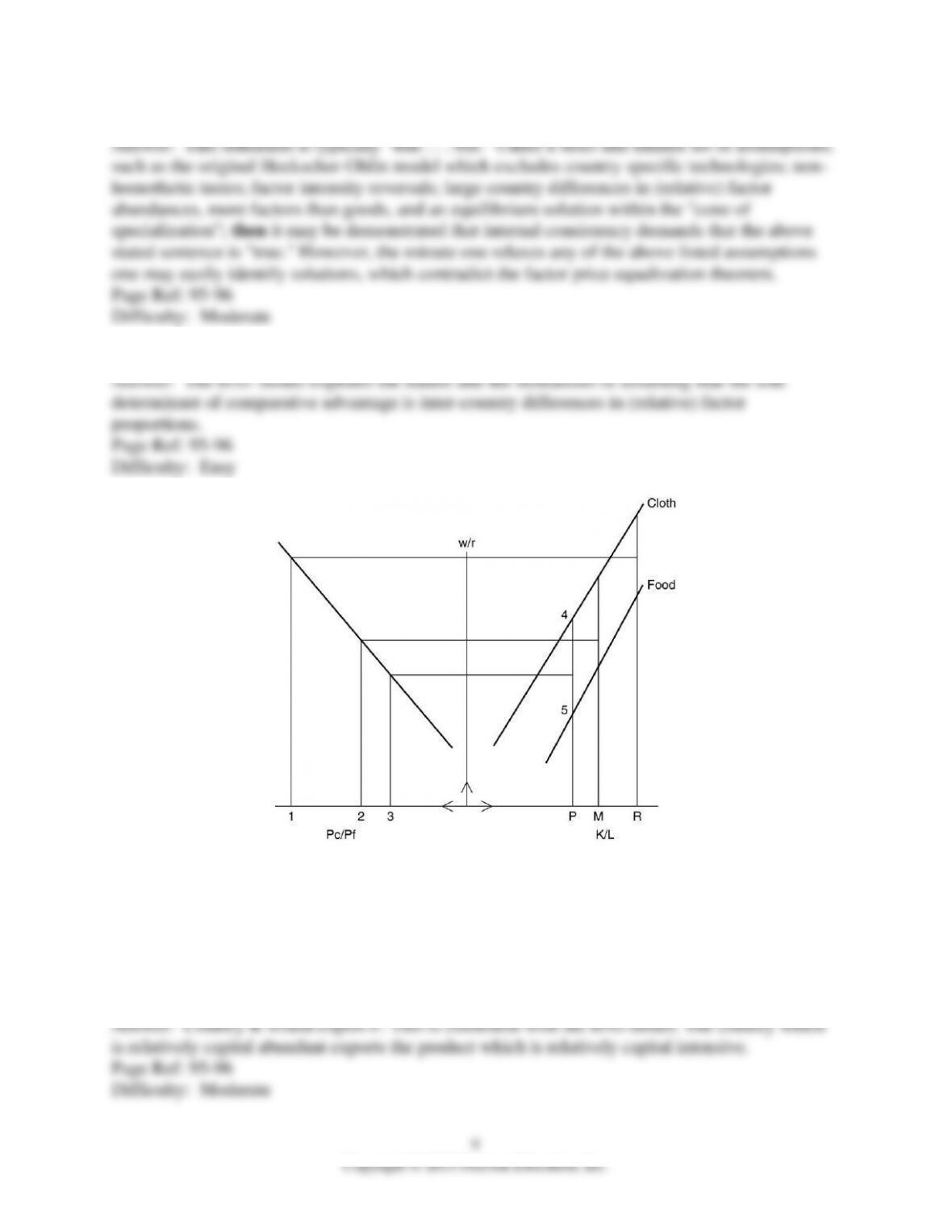
20) International trade leads to complete equalization of factor prices. Discuss.
21) Why is the H.O. model called the factor-proportions theory?
22) Refer to above figure. Two countries exist in this model, P and R. P is relatively labor (L)
abundant, as is evident in the bottom right horizontal axis. If Country P were to be completely
specialized in the labor-intensive product, C, it would be producing at point 4. In fact, it produces
both C and P, at point 5. The (autarky) relative price of C (in terms of F) of Country P is at point
3; and of Country R at point 1. If trade were to open up between these two countries, which
would export C and which would export F? Is this consistent with the Heckscher-Ohlin model?
Explain.
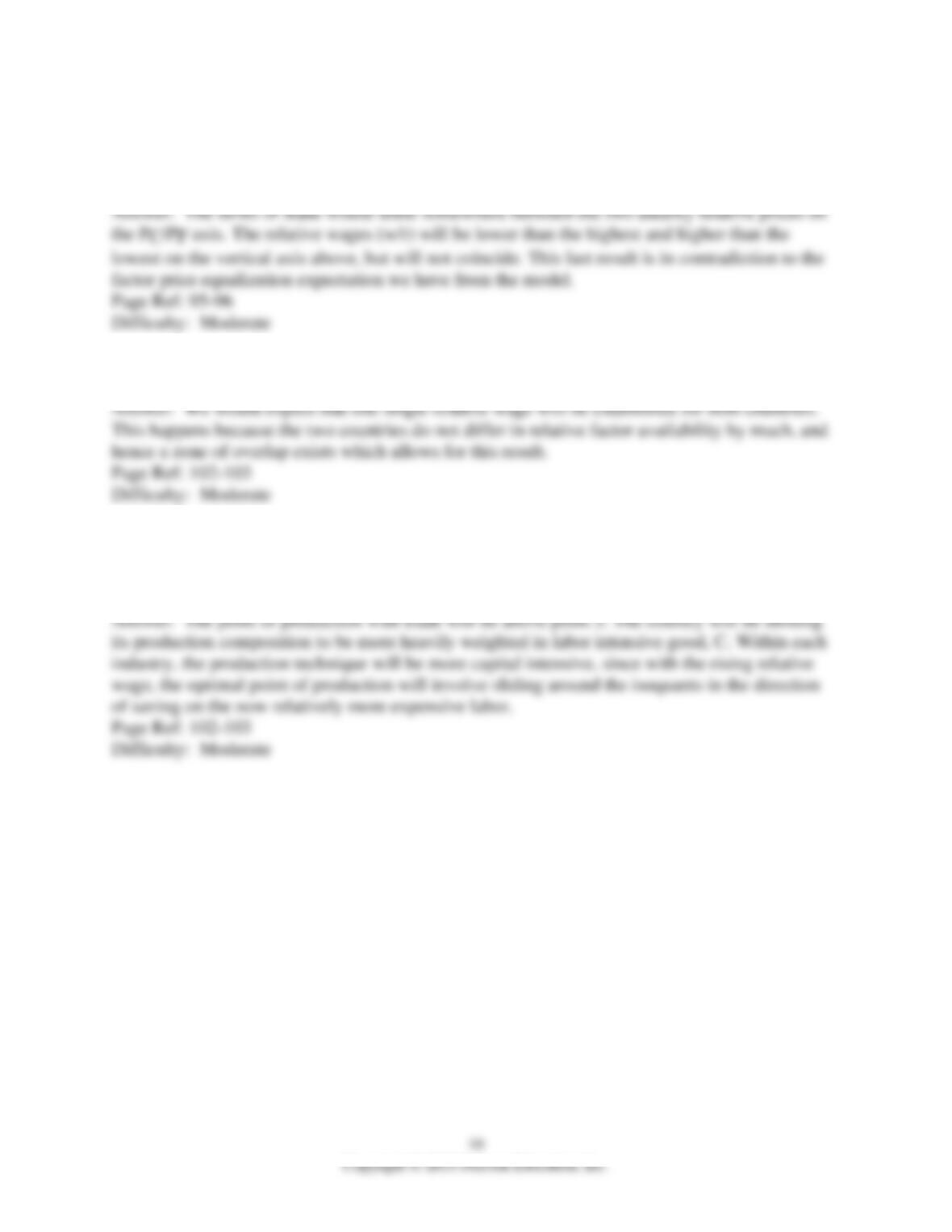
23) Refer to above figure. If trade were to open up between P and R, where would the world
terms of trade locate in the figure above (somewhere on the PC/PF axis)? Would relative wages
(w/r) in the two countries become equal? Is this consistent with the Heckscher-Ohlin model?
Explain.
24) Refer to above figure. Would you expect to find that the real wages become equalized in
both countries? Explain the reason for any differences you note.
25) Refer to above figure. In autarky, Country P was producing at point 5. With trade, would its
production point be found above or below point 5? Explain why. What must happen in the K/L
intensity ratio in the production of each of the products in this country when moving from
autarky to free trade?
26) One of the commonly used assumptions in deriving the Heckscher-Ohlin model is that tastes
are homothetic, or that if the per capita incomes were the same in two countries, the proportions
of their expenditures allocated to each product would be the same as it is in the other country.
Imagine that this assumption is false, and that in fact, the tastes in each country are strongly
biased in favor of the product in which it has a comparative advantage. How would this affect the
relationship between relative factor abundance between the two countries, and the nature (factor-
intensity) of the product each exports? What if the taste bias favored the imported good?
12
Copyright © 2015 Pearson Education, Inc.
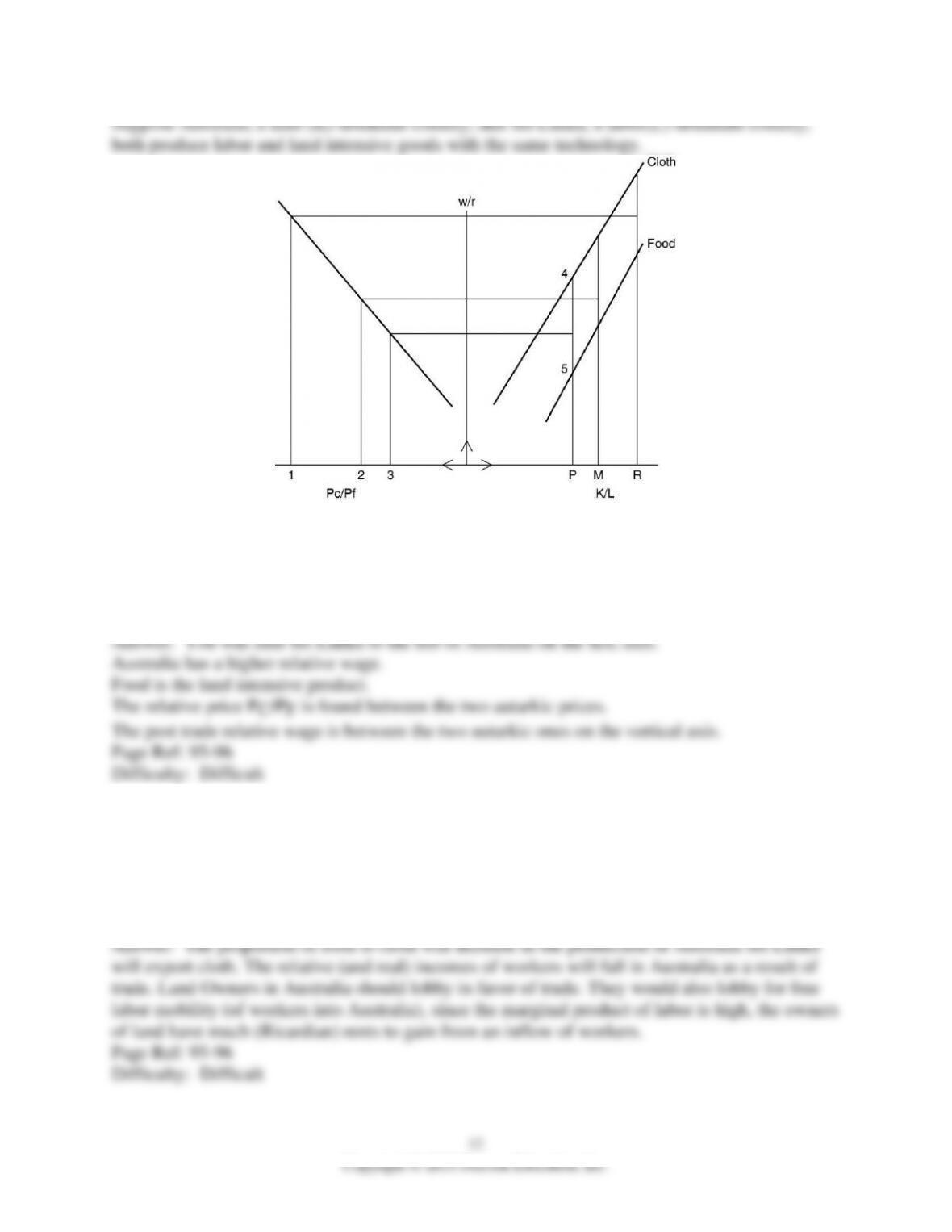
Suppose Australia, a land (K)-abundant country, and Sri-Lanka, a labor(L)-abundant country,
both produce labor and land intensive goods with the same technology.
27) Use the diagram above to identify the pre-trade situation for Australia and Sri-Lanka. Where
on the K/L axis will you find each of the two countries? Which of the two countries has a higher
relative wage, w/r? Which product is the labor intensive, and which is the land intensive one?
Show where the relative price of cloth to food will be found once trade opens between these two
countries. Show where the relative wages of each will appear.
28) Using the figure above, demonstrate what happens to the composition of production (that is
quantity of cloth per 1 unit of food) in Australia once trade is established between the two
countries. Which country will export cloth? What happens to the relative income of workers in
Australia as a result of trade? Does it increase or decrease? Would land owners in Australia
lobby for or against free trade? Would land owners in Australia lobby for or against free
admittance of immigrant workers?
29) Refer to above figure. Imagine that the relative capital abundance of Australia was so much
greater than that of Sri-Lanka, that we would have to locate Australia far to the right on the K/L
axis. If this were so far to the right that there was no area of overlap on the w/r axis, then what
product would Australia export? Which product will each of the trade partners export? Will the
relative wages as calculated now be the same or different in both Australia and Sri Lanka?
30) Starting from an autarky (no-trade) situation with Heckscher-Ohlin model, if Country H is
relatively labor abundant, then once trade begins
A) wages should rise and rents should fall in H.
B) wages and rents should rise in H.
C) wages and rents should fall in H.
D) wages should fall and rents should rise in H.
E) rent will be unchanged but wages will rise in H.
31) Suppose that there are two factors, capital and land, and that the United States is relatively
land endowed while the European Union is relatively capital-endowed. According to the
Heckscher-Ohlin model
A) European capitalists should support U.S.-European free trade.
B) European landowners should support U.S.-European free trade.
C) all capitalists in both countries should support free trade.
D) all landowners should support free trade.
E) the U.S. should compensate European countries once trade commences.
32) International trade has strong effects on income distributions. Therefore, international trade
A) will tend to hurt some groups in each trading country.
B) is beneficial to everyone in both trading countries.
C) will tend to hurt one trading country.
D) will tend to hurt everyone in both countries.
E) will be beneficial to all those engaged in international trade.
33) Factors tend to be specific to certain uses and products
A) in the short run.
B) in countries lacking comparative advantage.
C) in capital-intensive industries.
D) in labor-intensive industries.
E) in countries lacking fair labor laws.
34) If the price of the capital intensive product rises more than does the price of the land
intensive product, then
A) the relative price of the capital intensive product will fall to some point between the pretrade
relative prices.
B) demand will shift away from the capital-intensive product, and its production will decrease.
C) demand will shift away from the capital-intensive product, and its production will decrease
relative to that of the land intensive product.
D) the production of the capital-intensive product will decrease, but by less than production of
the land-intensive product.
E) the country that exports the capital-intensive good will lose its comparative advantage.
35) If trade opens up between the two formerly autarkic countries, Australia and Belgium, then
A) the real income of both countries may increase.
B) the real income of Australia and of Belgium will increase.
C) the real income of Australia but not of Belgium will increase.
D) the real income of neither country will increase.
E) the real income of both countries will increase.
5.3 Empirical Evidence on the Heckscher-Ohlin Model
1) The Leontief Paradox
A) failed to support the validity of the Heckscher-Ohlin model.
B) supported the validity of the Ricardian theory of comparative advantage.
C) supported the validity of the Heckscher-Ohlin model.
D) failed to support the validity of the Ricardian theory.
E) proved that the U.S. economy is different from all others.
2) The Leontief Paradox
A) refers to the finding that U.S. exports were more labor intensive than its imports.
B) refers to the finding that U.S. Exports were more capital intensive than its exports.
C) refers to the finding that the U.S. produces outside its Edgeworth Box.
D) still accurately applies to today’s pattern of U.S. international trade.
E) refers to the fact that Leontief—an American economist—had a Russian name.
3) The 1987 study by Bowen, Leamer and Sveikauskas
A) supported the validity of the Leontief Paradox.
B) supported the validity of the Heckscher-Ohlin model.
C) used a two-country and two-product framework.
D) demonstrated that in fact countries tend to use different technologies.
E) proved that the U.S.’s comparative advantage relied on skilled labor.
4) Empirical observations on actual North-South trade patterns tend to
A) support the validity of the Heckscher-Ohlin model.
B) support the validity of the Leontief Paradox.
C) support the validity of the Rybczynski Theorem.
D) support the validity of the wage equalization theorem.
E) support the validity of the neo-imperialism exploitation theory.
5) The Case of the Missing Trade refers to
A) the fact that factor trade is less than predicted by the Heckscher-Ohlin theory.
B) the 9th volume of the Hardy Boys’ Mystery series.
C) the fact that world exports does not equal world imports.
D) the fact that the Heckscher Ohlin theory predicts much less volume of trade than actually
exists.
E) the fact that the Heckscher Ohlin theory never applies to China-U.S. trade practices.
6) Countries do not in fact export the goods the H.O. theory predicts. Discuss.
7) Why do we observe the Leontief paradox?
8) Why are prices of factors of production NOT equalized?
9) The Heckscher-Ohlin model is famous for being elegant and mathematically sophisticated, yet
failing to describe reality. One manifestation of this fact is Trefler’s Case of Missing Trade.
Explain what exactly is missing. In what sense is it missing? How would you explain why it is
missing? How can a relaxation of the identical production functions explain the case of the
missing trade? How did the results obtained by Davis and Weinstein strengthen support for the
validity of the HO model?
10) Factor-intensity reversals describe a situation in which the production of a product may be
land-intensive in one country, and relatively labor intensive in another (at given relative wage
levels). For example, cotton may be land intensive in the U.S., and labor intensive in Egypt
where land is relatively scarce and expensive. Suppose factor-intensity reversals were common.
How would that affect the conclusion that a country in which land is relatively scarce will not be
the country with a comparative advantage in the land-intensive product?
11) Why is it that North-South trade in manufactures seems to be consistent with the results or
expectations generated by the factor-proportions theory of international trade, whereas North–
North trade is not?
12) Why do you suppose that South-South trade does not conform in volume, but does conform
in pattern with expectations generated by the Heckscher-Ohlin model?
13) If two countries are very different in relative factor abundance, then empirical support for
which of the following would less likely?
A) the Factor Price Equalization Theorem
B) the Heckscher-Ohlin Theorem
C) the Law of One Price
D) the Law of Demand
E) the Gravity Theorem
14) Which of the following empirical studies cast the most doubt on the Heckscher-Ohlin model?
A) the study by Wassily Leontief
B) the study by Bowen, Leamer, and Sveikauskas
C) the study by David Ricardo
D) the study by Adam Smith
E) the study by Davis and Weinstein
15) Which of the following empirical studies provided the most support for the heckscher-Ohlin
model?
A) the study by Wassily Leontief
B) the study by Bowen, Leamer, and Sveikauskas
C) the study by David Ricardo
D) the study by Adam Smith
E) the study by Davis and Weinstein
16) Empirical support for the Heckscher-Ohlin model was weakest when the study applied
A) all of the assumptions of the model.
B) all of the assumptions of the model except that regarding technology.
C) all of the assumptions of the model except those regarding technology, goods and shipping
costs.
D) all of the assumptions of the model except those regarding technology, shipping costs and
gravity.
E) all of the assumptions of the model except those regarding shipping costs.
5.4 Appendix to Chapter 5: Factor Prices, Goods Prices, and Production Decisions
1) Which of the following is an assertion of the Heckscher-Ohlin model?
A) The wage-rental ratio is determined by relative product prices.
B) An increase in a country’s labor supply will increase production of both the capital-intensive
and the labor-intensive good.
C) In the long-run, labor is mobile and capital is not.
D) Factor price equalization will occur only if there is costless mobility of all factors across
borders.
E) Factor endowments determine the technology that is available to a country, which determines
the good in which the country will have a comparative advantage.
2) Which of the following is an assertion of the Heckscher-Ohlin model?
A) The wage-rental ratio determines the capital-labor ratio in a country’s industries.
B) An increase in a country’s labor supply will increase production of both the capital-intensive
and the labor-intensive good.
C) In the long-run, labor is mobile and capital is not.
D) Factor price equalization will occur only if there is costless mobility of all factors across
borders.
E) Factor endowments determine the technology that is available to a country, which determines
the good in which the country will have a comparative advantage.

3) Which of the following is an assertion of the Heckscher-Ohlin model?
A) An increase in a country’s labor supply will increase production of the labor-intensive good
and decrease production of the capital-intensive good.
B) An increase in a country’s labor supply will increase production of both the capital-intensive
and the labor-intensive good.
C) In the long-run, labor is mobile and capital is not.
D) Factor price equalization will occur only if there is costless mobility of all factors across
borders.
E) Factor endowments determine the technology that is available to a country, which determines
the good in which the country will have a comparative advantage.