38) The following normal account balances were found on the general ledger before closing entries were
prepared:
Revenue $700
Cash $600
Expenses $400
Accounts Receivable $400
Capital $7,500
Withdrawals $1,000
After closing entries are posted, what is the balance in the Capital account?
A) $7,800
B) $7,500
C) $6,800
D) Closing entries do not affect the Capital account.
39) The following normal account balances were found on the general ledger before closing entries were
prepared:
Revenue $600
Cash $500
Expenses $400
Accounts Receivable $350
Capital $7,500
Withdrawals $1,000
After closing entries are posted, what is the balance in the Cash account?
A) $800
B) $0
C) $300
D) Closing entries do not affect the Cash account.
40) The entry to close the Withdrawal account was entered in reverse—the Withdrawal account was
debited and Capital credited. The result of this error is that:
A) before closing it, Income Summary will have a credit balance.
B) before closing it, Income Summary will have a debit balance.
C) the end of period capital will be understated.
D) the end of period capital will be overstated.
41) The entry to close Income Summary (net loss) was entered in reverse—Income Summary was debited
and Capital was credited. This error will cause:
A) Income Summary to have a credit balance.
B) Income Summary to have a debit balance.
C) the assets to be overstated.
D) the liabilities to be overstated.
42) Which of the following is a real account?
A) Cash
B) Fees Earned
C) Utilities Expense
D) Income Summary
43) Which of the following is not a temporary account?
A) Wages Expense
B) Service Fees
C) Rent Expense
D) Capital
44) The entry to close Income Summary (net loss) to Capital was omitted. This error will cause:
A) the ending capital to be overstated.
B) the ending capital to be understated.
C) no error in the ending capital balance.
D) None of these are correct.
45) When Income Summary has a credit balance and the account is closed:
A) Capital is decreased.
B) Capital is increased.
C) Withdrawals is increased.
D) None of these are correct.
46) When revenue is closed:
A) Owner’s Capital will be debited.
B) Income Summary will be debited.
C) Income Summary will be credited.
D) None of these are correct.
47) When the expenses are closed:
A) Owner’s Capital will be debited.
B) Income Summary will be debited.
C) Income Summary will be credited.
D) None of these are correct.
48) When the Withdrawals account is closed:
A) Owner’s Capital will be debited.
B) Income Summary will be debited.
C) Income Summary will be credited.
D) None of these are correct.
49) The Income Summary account debited and the expense accounts credited would be the result of:
A) closing the Income Summary account—there is a net income.
B) closing the revenue accounts.
C) closing the Income Summary accounts—there is a net loss.
D) closing the expense accounts.
50) The Capital account debited and the withdrawals credited would be the result of:
A) closing the Income Summary account—there is a net income.
B) closing the withdrawal account.
C) closing the Income Summary account—there is a net loss.
D) closing the expense accounts.
51) The revenue accounts debited and the Income Summary account credited would be the result of:
A) closing the Income Summary account—there is a net income.
B) closing the Income Summary account—there is a net loss.
C) closing the revenue accounts.
D) closing the expense accounts.
52) When closing the Income Summary account when there is a net income:
A) Capital would increase.
B) Capital would decrease.
C) Capital would remain the same.
D) None of these are correct.
53) When closing the Withdrawal account:
A) Capital would increase.
B) Capital would decrease.
C) Capital would remain the same.
D) None of these are correct.
54) The entry to close the Depreciation Expense account would cause:
A) the Capital account balance to increase.
B) the Capital account balance to decrease.
C) the Depreciation Expense account balance to decrease.
D) None of these are correct.
55) When closing the Income Summary account when there is a net loss:
A) Capital would increase.
B) Capital would decrease.
C) Capital would remain the same.
D) None of these are correct.
56) The entry to close the Fees Earned account would cause:
A) the Capital account balance to increase.
B) the Capital account balance to decrease.
C) the Fees Earned account to decrease.
D) None of these are correct.
57) The beginning capital balance is $900; there are no additional investments or withdrawals by the
owner during the accounting period. The period’s revenue is $500 and expenses total $450. What is the
ending capital balance (after closing entries)?
A) $950
B) $1,500
C) $1,450
D) $50
58) The beginning capital balance is $5,350, there are no additional investments but the owner did
withdraw $500 during the accounting period. The period’s revenue is $5,000 and expenses total $6,500.
What is the ending capital balance (after closing entries)?
A) $5,350
B) $2,850
C) $5,850
D) $3,350
59) There are 7 closing entries.
60) The Withdrawals account is closed to Income Summary.
61) The Withdrawals account is closed to the Owner’s Capital account.
62) Real accounts are those accounts with balances that are brought forward to the next accounting
period.
63) Nominal accounts are called temporary accounts because their balances are not carried forward to the
next accounting period.
64) Revenues and expenses are closed to the Income Summary account.
65) Closing entries are found in the adjustment columns of the worksheet.
66) Depreciation Expense is closed to Income Summary, but Accumulated Depreciation is not closed.
67) The income statement and balance sheet sections of the worksheet provide the information needed to
prepare the closing entries.
68) Each individual revenue account is debited when closing, and the total of all the revenue accounts is
transferred to Income Summary.
69) Each individual expense account is debited when closing, and the total of all the expense accounts is
transferred to Income Summary.
70) The balance in Income Summary after posting all revenues and expenses for the period is equal to net
income/loss.
71) A nominal account is the same as a permanent account.
72) A real account is the same as a permanent account.
73) After posting adjusting entries, the temporary accounts will be set back to zero.
74) Closing entries will update the Capital account to the same figure that is on the balance sheet for that
date.
75) Income Summary does not have a normal balance.
76) The goal of closing is to clear all temporary accounts and update Capital.
77) The first entry to close accounts is to debit Revenue and credit Income Summary.
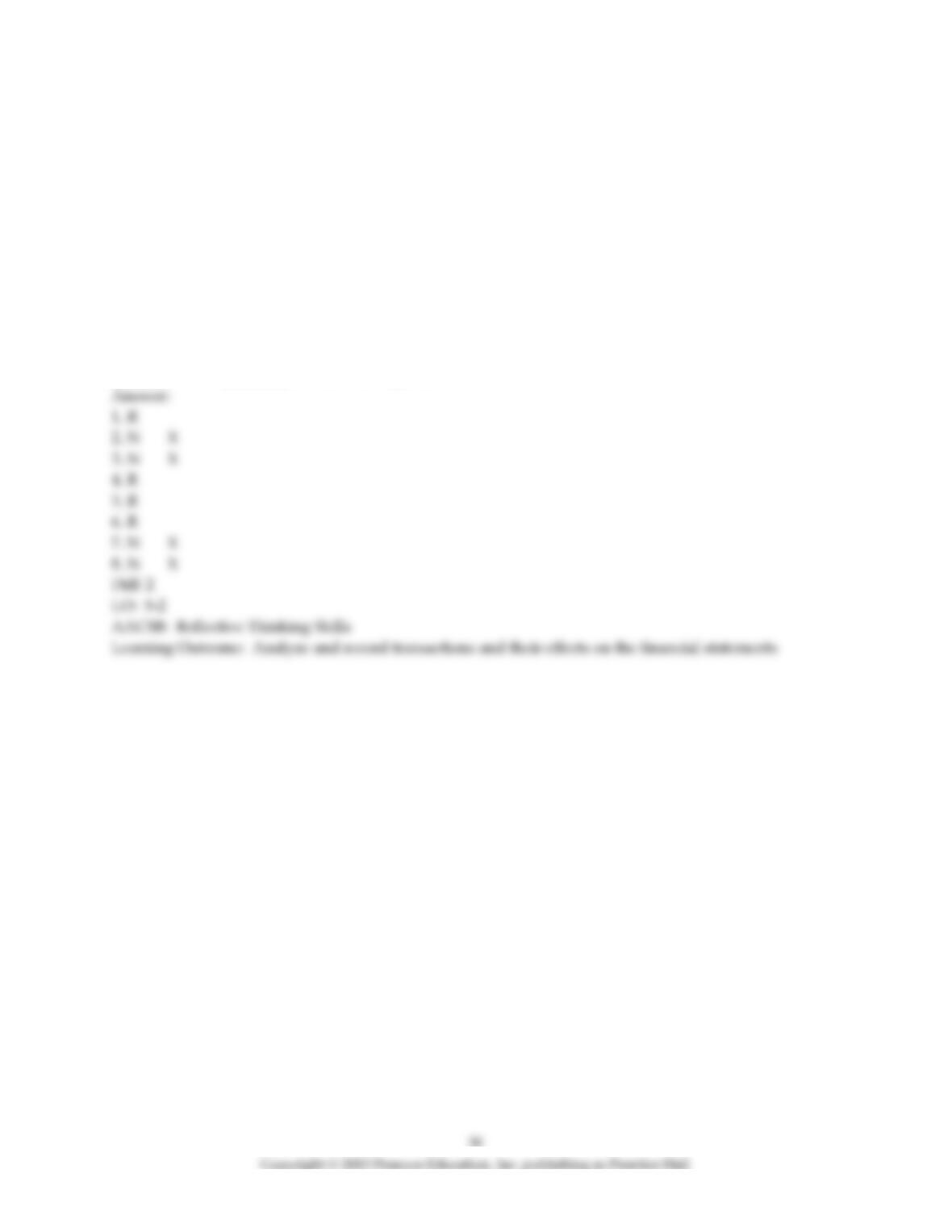
78) In the first space below, indicate whether each account is a real or nominal account using (R) Real
Account and (N) Nominal Account. In the second space below, indicate by an (X) if the account should be
closed.
N X 0. Advertising Expense
________ ________ 1. Prepaid Insurance
________ ________ 2. Service Fees
________ ________ 3. Depreciation Expense
________ ________ 4. Accumulated Depreciation
________ ________ 5. Salaries Payable
________ ________ 6. Prepaid Rent
________ ________ 7. Income Summary
________ ________ 8. Insurance Expense
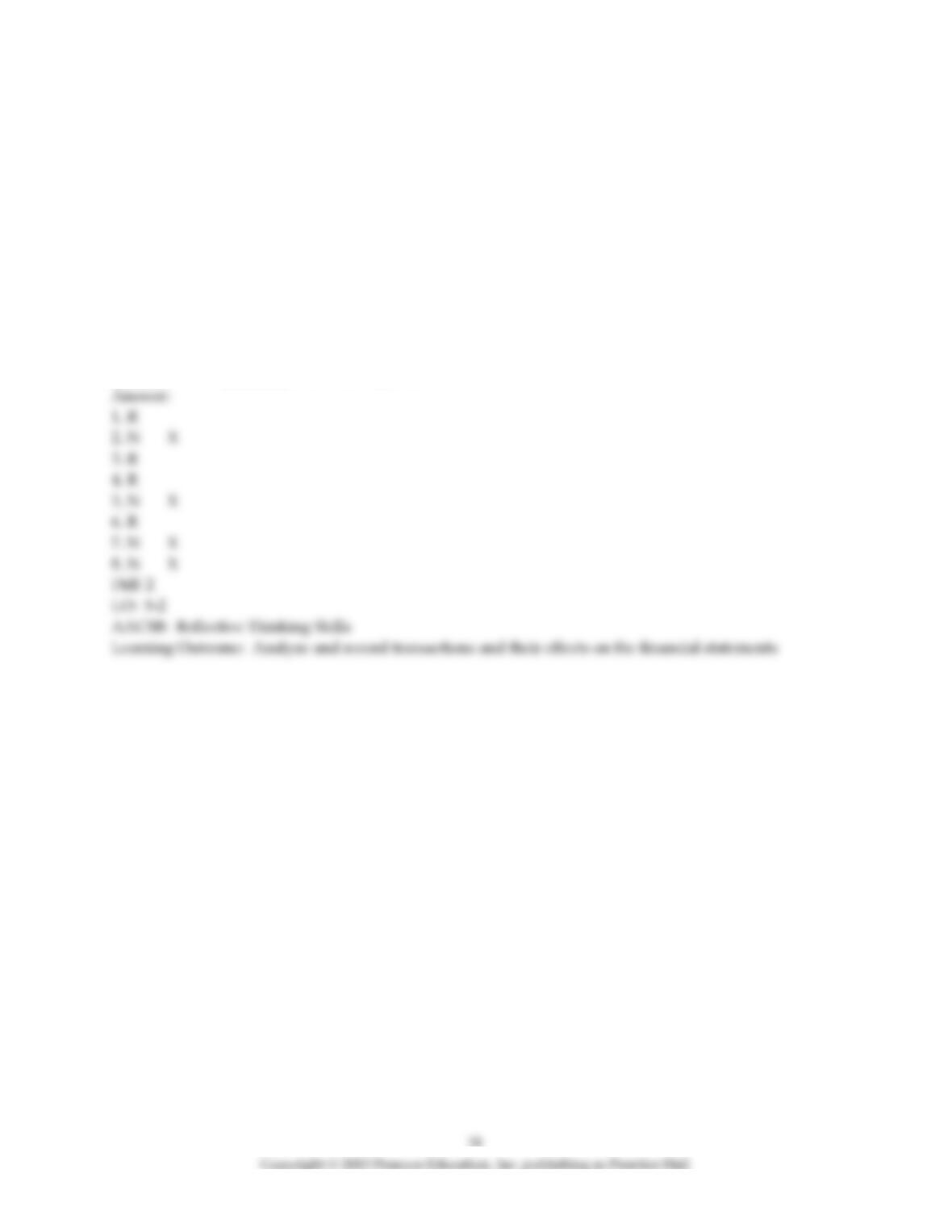
79) In the first space below, indicate whether each account is a real or nominal account using (R) Real
Account and (N) Nominal Account. In the second space below, indicate by an (X) if the account should be
closed.
N X 0. Advertising Expense
________ ________ 1. Cash
________ ________ 2. Tennis Fees
________ ________ 3. Accounts Receivable
________ ________ 4. Accumulated Depreciation
________ ________ 5. Withdrawals
________ ________ 6. Prepaid Rent
________ ________ 7. Income Summary
________ ________ 8. Utilities Expense