College Accounting, 12e (Slater)
Chapter 5 The Accounting Cycle Completed
5.1 Learning Objective 5-1
1) Adjusting journal entries:
A) need not be journalized since they appear on the worksheet.
B) need not be posted if the financial statements are prepared from the worksheet.
C) are not needed if closing entries are prepared.
D) must be journalized and posted.
2) Journal entries that are needed in order to update account balances for internal business transactions
(such as supplies and prepaid rent) at the end of the period are:
A) closing entries.
B) adjusting entries.
C) sales entries.
D) None of the above are correct.
3) The adjusting entry to record depreciation for the company automobile would be:
A) debit Accumulated Depreciation, Automobile; credit Depreciation Expense, Automobile.
B) debit Accumulated Depreciation, Automobile; credit Automobile.
C) debit Depreciation Expense, Automobile; credit Accumulated Depreciation, Automobile.
D) debit Depreciation Expense, Automobile; credit Automobile.
4) The adjusting entry to record the expired rent would be to:
A) debit Prepaid Rent; credit Rent Expense.
B) debit Cash; credit Prepaid Rent.
C) debit Prepaid Rent; credit Cash.
D) debit Rent Expense; credit Prepaid Rent.
5) The adjusting entry for accrued salaries is to:
A) debit Salaries Expense; credit Salaries Payable.
B) debit Salaries Expense; credit Cash.
C) debit Salaries Payable; credit Salaries Expense.
D) debit Cash; credit Salaries Expense.
6) Each adjustment affects:
A) the income statement.
B) the balance sheet.
C) the cash account.
D) Both A and B are correct.
7) Mark’s Tree Service depreciation for the month is $600. The adjusting journal entry is:
A)
Equipment
600
Accumulated Depreciation
600
B)
Depreciation Expense
600
Accumulated Depreciation
600
C)
Depreciation Expense
600
Equipment
600
D)
Accumulated Depreciation
600
Depreciation Expense
600
8) Tim’s Electrical Service purchased tools for $4,000. They have an expected life of 20 months and no
residual value. The adjusting journal entry for the month is:
A)
Depreciation Expense
200
Equipment
200
B)
Depreciation Expense
200
Accumulated Depreciation
200
C)
Accumulated Depreciation
200
Depreciation Expense
200
D)
Accumulated Depreciation
200
Equipment
200
9) Samantha’s Design Studio showed office supplies available of $800. A count of the supplies left on
hand as of June 30 was $500. The adjusting journal entry is:
A)
Office Supplies
300
Office Supplies Expense
300
B)
Office Supplies Expense
500
Office Supplies
500
C)
Office Supplies
500
Office Supplies Expense
500
D)
Office Supplies Expense
300
Office Supplies
300
10) Tina’s Event Planning bought a computer worth $3,500 with an expected life of 5 years and a residual
value of $750. What is the adjusting journal entry after the first year?
A)
Computer
550
Depreciation Expense
550
B)
Computer
550
Accumulated Depreciation, Computer
550
C)
Depreciation Expense
550
Accumulated Depreciation, Computer
550
D)
Depreciation Expense
550
Computer
550
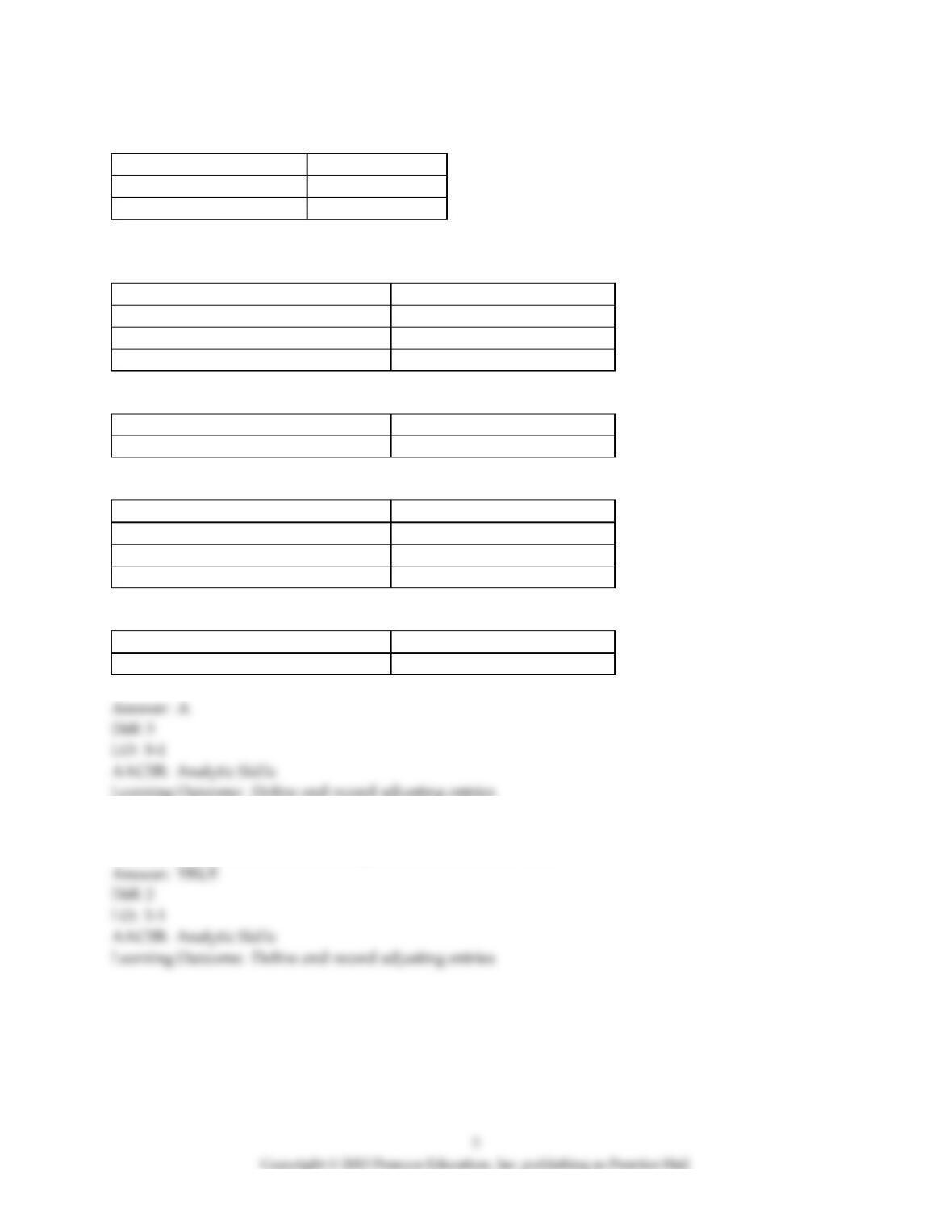
11) The income statement debit column of the worksheet showed the following expenses:
Supplies Expense
$600
Depreciation Expense
400
Salaries Expense
300
The journal entry to close the expense accounts is:
A)
Income Summary
1,300
Supplies Expense
600
Depreciation Expense
400
Salaries Expense
300
B)
Income Summary
1,200
Capital
1,200
C)
Supplies Expense
500
Depreciation Expense
400
Salaries Expense
300
Income Summary
1,200
D)
Capital
1,200
Income Summary
1,200
12) The ending balances in the ledger after posting the adjusting entries, will be the same amounts that
are found on the worksheet in the adjusted trial balance column.
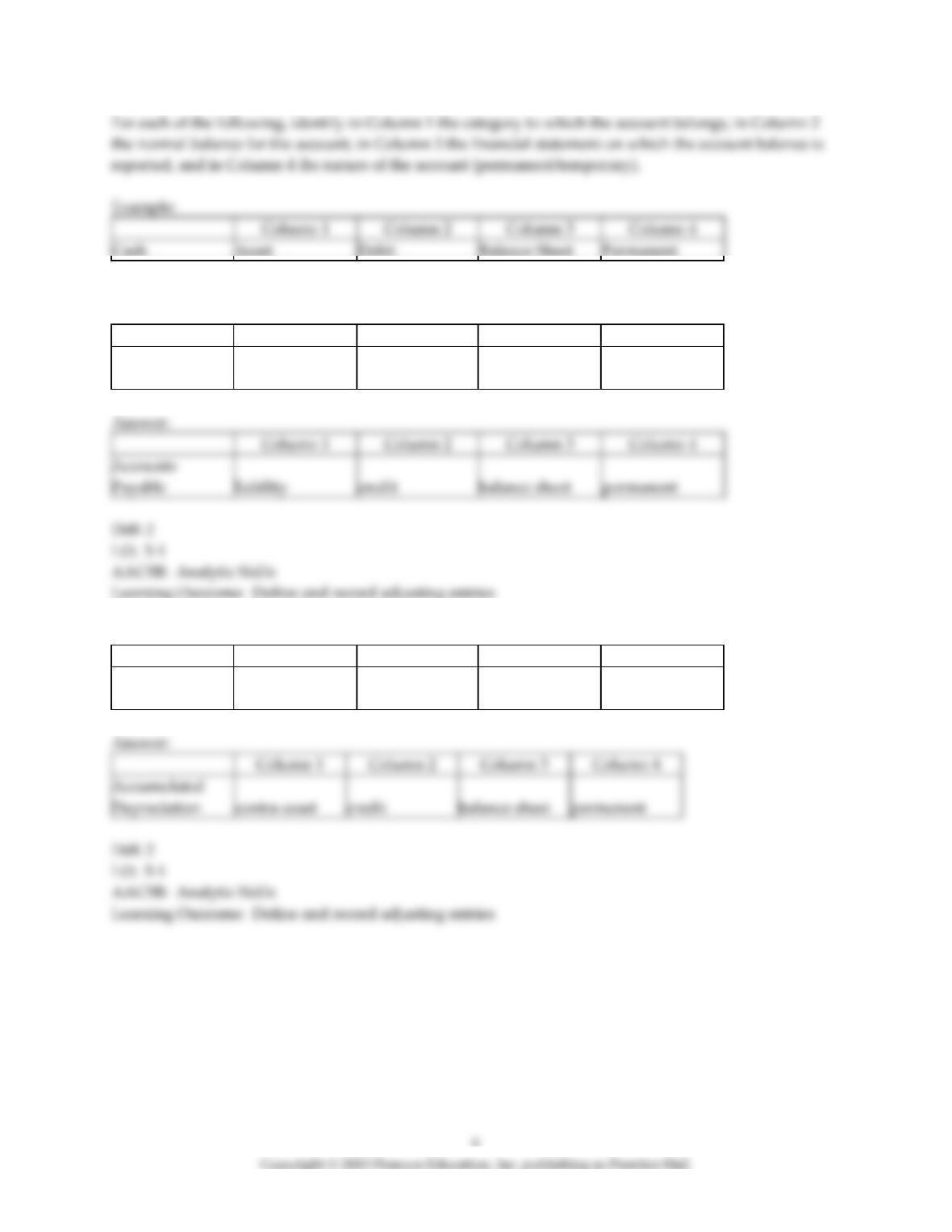
Column 1
Column 2
Column 3
Column 4
Cash
Asset
Debit
Balance Sheet
Permanent
13)
Column 1
Column 2
Column 3
Column 4
Accounts
Payable
Column 1
Column 2
Column 3
Column 4
Accounts
Payable
liability
credit
balance sheet
permanent
14)
Column 1
Column 2
Column 3
Column 4
Accumulated
Depreciation
Accumulated
Depreciation
contra-asset
credit
balance sheet
permanent
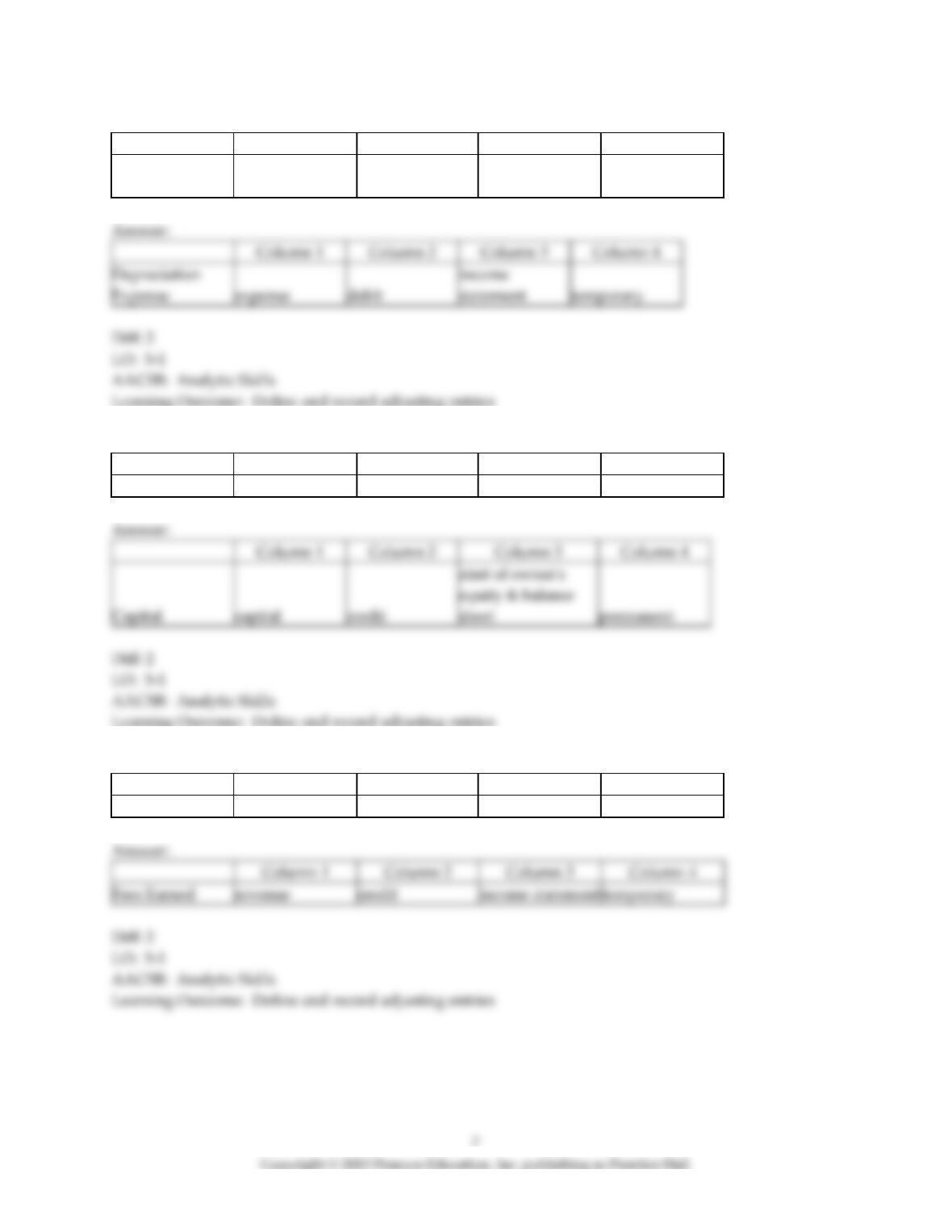
15)
Column 1
Column 2
Column 3
Column 4
Depreciation
Expense
Depreciation
Expense
expense
debit
income
statement
temporary
16)
Column 1
Column 2
Column 3
Column 4
Capital
Capital
capital
credit
equity & balance
sheet
permanent
17)
Column 1
Column 2
Column 3
Column 4
Fees Earned
Column 1
Column 2
Column 3
Column 4
Fees Earned
revenue
credit
income statement
temporary
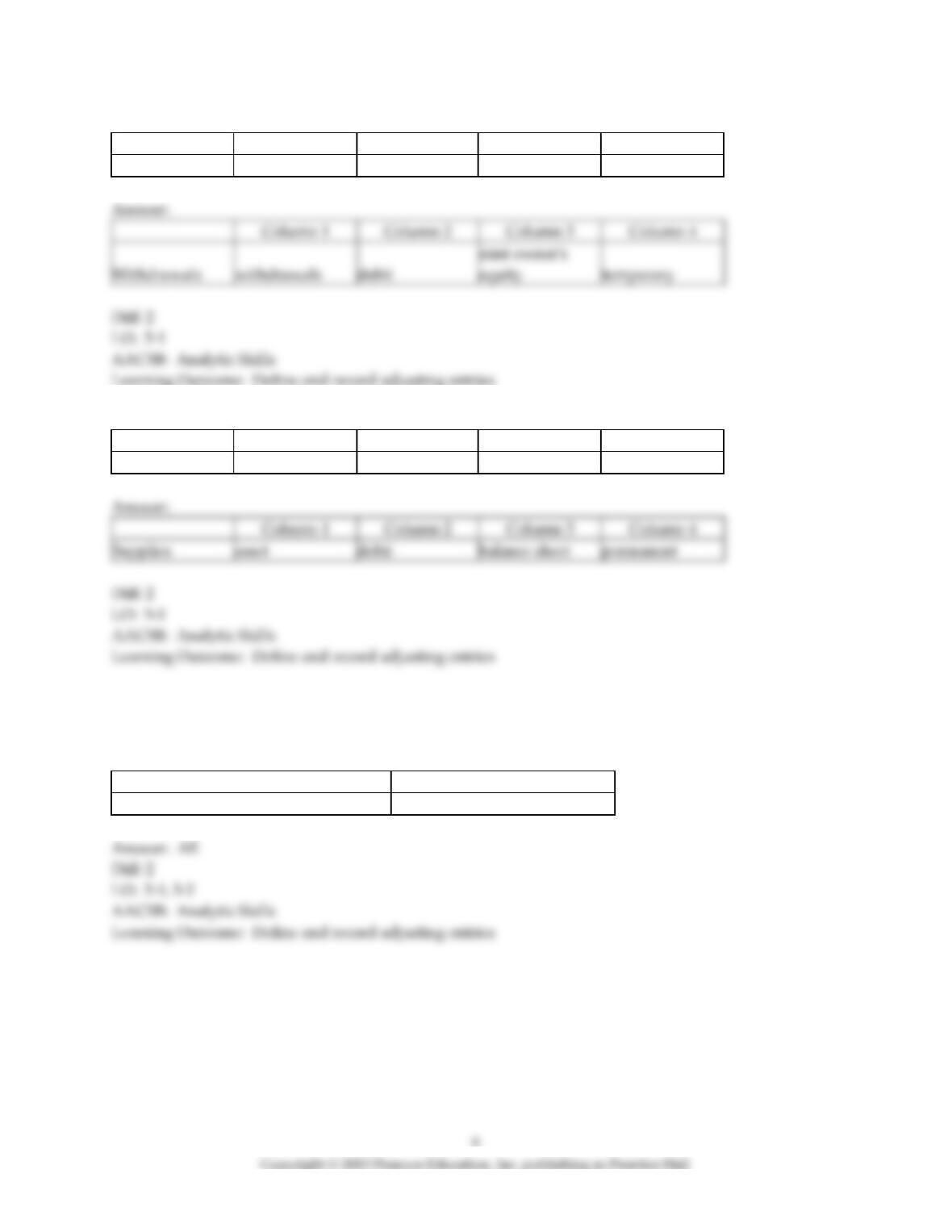
18)
Column 1
Column 2
Column 3
Column 4
Withdrawals
Column 1
Column 2
Column 3
Column 4
Withdrawals
withdrawals
debit
equity
temporary
19)
Column 1
Column 2
Column 3
Column 4
Supplies
Column 1
Column 2
Column 3
Column 4
Supplies
asset
debit
balance sheet
permanent
Identify whether the entries below are an adjusting entry (AE) or a closing entry (CE).
20) ________
Insurance Expense
$1,100
Prepaid Insurance
$1,100
21) ________
Wages Expense
$500
Wages Payable
$500
22) ________
Income Summary
$800
Utilities Expense
$800
23) ________
Fees Earned
$18,000
Income Summary
$18,000
24) ________
Capital
$11,000
Withdrawals
$11,000
25) ________
Depreciation Expense
$300
Accumulated Depreciation
$300
1) Closing entries are prepared:
A) to clear all temporary accounts to zero.
B) to update the Capital balance.
C) at the end of the accounting period.
D) All of the above are correct.
2) Income Summary:
A) is a temporary account.
B) is a permanent account.
C) summarizes revenue and expenses and transfers the balance to Capital.
D) Both A and C are correct.
3) Which of the following accounts is not a temporary account?
A) Withdrawals
B) Fees Earned
C) Cash
D) Income Summary
4) Which of the following accounts would not be considered a permanent account?
A) Accounts Receivable
B) Salaries Expense
C) Accounts Payable
D) Office Supplies
5) An account in which the balance is not carried over from one accounting period to the next is called a:
A) permanent account.
B) real account.
C) temporary account.
D) zero account.
6) Accounts in which the balances are carried over from one accounting period to the next are called:
A) real accounts.
B) nominal accounts.
C) temporary accounts.
D) zero accounts.
7) Closing entries:
A) need not be journalized since they appear on the worksheet.
B) need not be posted if the financial statements are prepared from the worksheet.
C) are not needed if adjusting entries are prepared.
D) must be journalized and posted.
8) Closing entries will affect:
A) total assets.
B) Cash.
C) Owner’s Capital.
D) total liabilities.
9) Which of the following accounts should not be closed to Income Summary at the end of the fiscal year?
A) Salaries Expense
B) Fees Earned
C) Utilities Expense
D) Withdrawals
10) To close the Withdrawals account:
A) debit Withdrawals; credit Capital.
B) debit Capital; credit Withdrawals.
C) debit Withdrawals; credit Income Summary.
D) debit Income Summary; credit Withdrawals.
11) The correct order for closing accounts is:
A) revenue, expenses, income summary, withdrawals.
B) revenue, income summary, expenses, withdrawals.
C) revenue, expenses, capital, withdrawals.
D) revenue, capital, expenses, withdrawals.
12) To close the Fees Earned account:
A) debit Income Summary; credit Fees Earned.
B) debit Fees Earned; credit Capital.
C) debit Fees Earned; credit Income Summary.
D) debit Capital; credit Fees Earned.
13) Which of the following accounts will be directly closed to Capital at the end of the fiscal year?
A) Salaries Expense
B) Fees Revenue
C) Withdrawals
D) Depreciation Expense
14) When the balance of the Income Summary account is a credit, the entry to close this account is:
A) debit Capital, credit Income Summary.
B) debit Income Summary; credit Revenue.
C) debit Income Summary; credit Capital.
D) debit Revenue; credit Income Summary.
15) When the balance of the Income Summary account is a debit, the entry to close this account is:
A) debit Capital; credit Income Summary.
B) debit Income Summary; credit Revenue.
C) debit Revenue; credit Income Summary.
D) debit Income Summary; credit Capital.
16) When the balance in the Income Summary account is a debit, the company has:
A) incurred a net loss.
B) incurred a net income.
C) had more revenue than expenses.
D) made an error in their closing entries.
17) Which of the following columns of the worksheet are referred to when preparing closing entries to the
Income Summary?
A) Adjusted trial balance columns
B) Balance sheet columns
C) Adjustments columns
D) Income statement columns
18) After posting the closing entries, which of the following accounts is most likely not to have a zero
balance?
A) Prepaid Insurance
B) Advertising Expense
C) J. Smith, Withdrawals
D) Medical Fees
19) When the balance in the Income Summary account is a credit, the company has:
A) incurred a net loss.
B) incurred a net income.
C) had more expenses than revenue.
D) made an error in their closing entries.
20) How do you close a revenue account?
A) Debit Capital; credit Revenue
B) Credit Capital; debit Revenue
C) Credit Income Summary; debit Revenue
D) Debit Income Summary; credit Revenue
21) How do you close the expense accounts?
A) Debit Capital; credit the expense accounts
B) Credit Capital; debit the expense accounts
C) Credit Income Summary; debit the expense accounts
D) Debit Income Summary; credit the expense accounts
22) All permanent accounts can be found:
A) on the Income Statement.
B) on the Statement of Owner’s Equity.
C) on the Balance Sheet.
D) Permanent accounts do not appear on the financial statements.
23) Closing entries will:
A) increase the Owner’s Capital.
B) decrease the Owner’s Capital balance.
C) either increase or decrease Owner’s Capital.
D) not affect the Owner’s Capital balance.
24) On Flex Company’s worksheet the revenue account had a normal balance of $3,800. The entry to close
the account would include a:
A) debit to Income Summary for $3,800.
B) credit to Income Summary for $3,800.
C) debit to Flex, Capital for $3,800.
D) credit to Revenue for $3,800.
25) The Rent Expense account had a normal balance of $1,100. The entry to close the account would
include a:
A) debit to Rent Expense, $1,100.
B) debit to Income Summary, $1,100.
C) debit to Capital, $1,100.
D) credit to Income Summary, $1,100.
26) M. Smuts showed a net income of $6,000. The entry to close the Income Summary account would
include a:
A) debit to M. Smuts Capital, $6,000.
B) credit to M. Smuts Capital, $6,000.
C) debit to Income Summary, $6,000.
D) Both B and C are correct.
27) J. Oros showed a net loss of $3,200. The entry to close the Income Summary account would include a:
A) debit to Oros, Capital, $3,200.
B) debit to Income Summary , $3,200.
C) credit to Oros, Capital, $3,200.
D) credit to Cash, $3,200.
28) The balance in the J. Higgins, Withdrawals account was $4,200. The entry to close the account would
include a:
A) debit to Income Summary, $4,200.
B) credit to Income Summary, $4,200.
C) debit to J. Higgins, Capital, $4,200.
D) debit to J. Higgins, Withdrawals, $4,200.
29) The balance in the Rent Expense account on the worksheet was $120. The journal entry to close the
Rent Expense account is:
A)
Rent Expense
120
Prepaid Rent
120
B)
Rent Expense
120
Income Summary
120
C)
Rent Expense
120
Capital
120
D)
Income Summary
120
Rent Expense
120
30) B. Benson’s worksheet showed the revenue account, Rental Fees, $1,300. The journal entry to close the
account is:
A)
Rental Fees
1,300
Income Summary
1,300
B)
Benson, Capital
1,300
Rental Fees
1,300
C)
Rental Fees
1,300
Benson, Capital
1,300
D)
Income Summary
1,300
Rental Fees
1,300
31) The Income Summary account shows debits of $19,000 and credits of $10,000. This results in a:
A) net income of $29,000.
B) net loss of $29,000.
C) net income of $9,000.
D) net loss of $9,000.
32) After closing the revenue, expense, and withdrawal accounts, the capital increased by $2,000. Which
of the following situations could have occurred?
A) The company had a net income.
B) The owner invested an additional amount.
C) The owner made a withdrawal.
D) All of these answers are correct.
33) The income statement credit column of the worksheet showed the following revenues:
Catering Fees
$500
Cleaning Fees
800
The journal entry to close the revenue accounts is:
A)
Income Summary
1,300
Catering Fees
500
Cleaning Fees
800
B)
Catering Fees
500
Cleaning Fees
800
Income Summary
1,300
C)
Capital
1,300
Income Summary
1,300
D)
Catering Fees
500
Cleaning Fees
800
Capital
1,300
34) The business failed to close any of the revenue accounts. The result of this error is that:
A) revenues will be understated.
B) capital will be understated.
C) the assets will be overstated.
D) the liabilities will be overstated.
35) The entry to close the expense account(s) was entered in reverse—Income Summary was credited and
the expense account(s) was/were debited. The result of this error is that:
A) before closing it, Income Summary will have a credit balance.
B) before closing it, Income Summary will have a debit balance.
C) the assets will be overstated.
D) the liabilities will be overstated.
36) The entry to close the revenue account(s) was entered in reverse—Income Summary was debited and
the revenue account(s) was/were credited. The result of this error is that:
A) before closing it, Income Summary will have a credit balance.
B) before closing it, Income Summary will have a debit balance.
C) the assets will be overstated.
D) the liabilities will be overstated.
37) The following normal account balances were found on the general ledger before closing entries were
prepared:
Revenue $800
Cash $500
Expenses $400
Accounts Receivable $350
Capital $7,500
Withdrawals $1,000
After closing entries are posted, what is the balance in the Revenue account?
A) $800
B) $0
C) $300
D) Closing entries do not affect Revenue.