International Economics, 7e (Gerber)
Chapter 4 Comparative Advantage and Factor Endowments
4.1 Introduction: The Determinants of Comparative Advantage
1) There are no questions for this section.
Topic: Introduction: The Determinants of Comparative Advantage
4.2 Modern Trade Theory
1) A production possibilities curve that is bowed out represents the case of
A) constant costs.
B) increasing costs.
C) decreasing costs.
D) external costs.
2) A production possibilities curve that is a straight line represents the case of
A) constant costs.
B) increasing costs.
C) constant opportunity costs but increasing real costs.
D) constant opportunity costs but decreasing real costs.
3) The straight-line production possibilities curve
A) does not show increasing opportunity costs.
B) fails to reflect tradeoffs.
C) fails to benefit trading nations.
D) refutes the principles of comparative advantage.
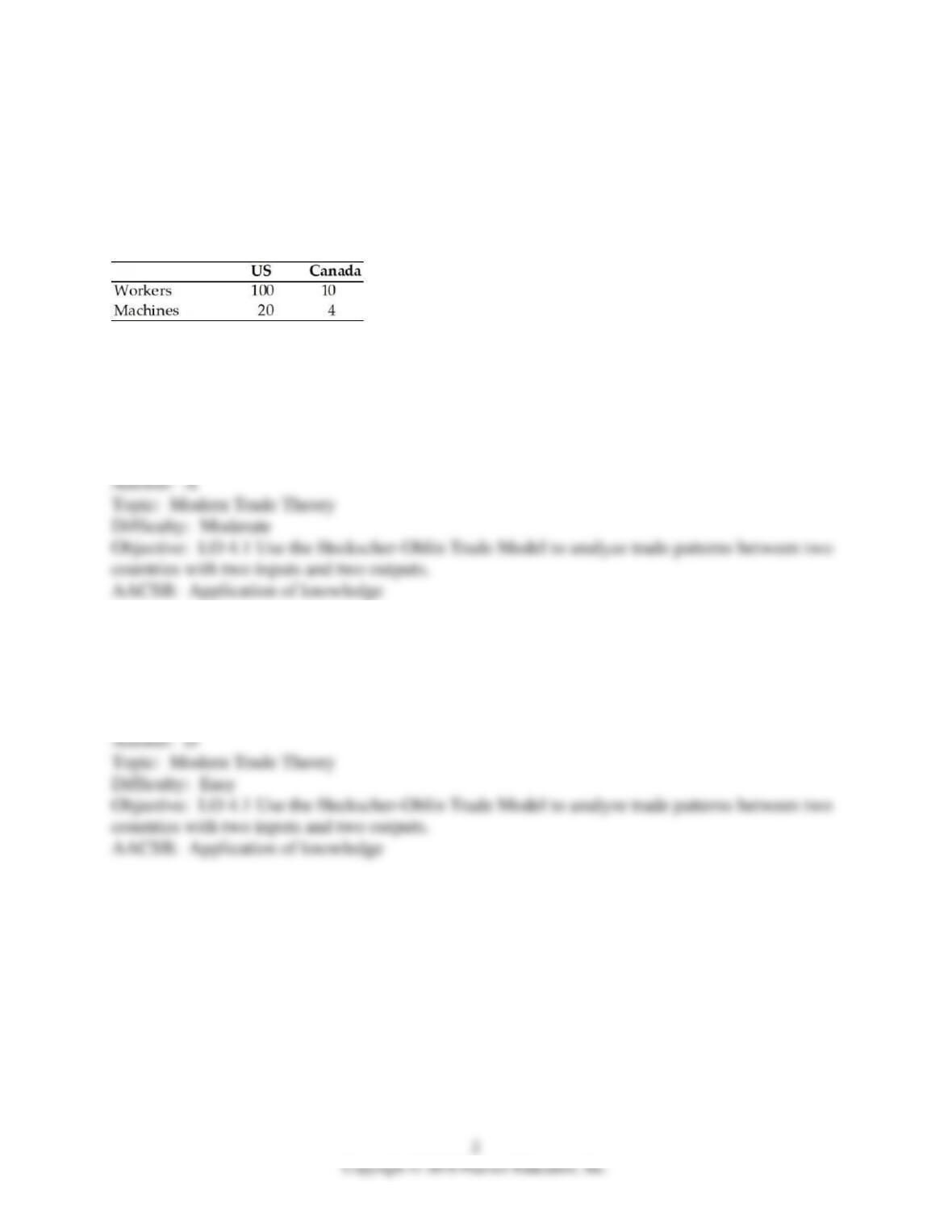
Use the table for the following question(s).
Suppose that all goods are made with two factors—labor and capital. The table below shows the
total endowments of each factor in the United States and Canada.
Table 4.1
Endowment of Labor and Capital
4) Based on Table 4.1, according to the Heckscher-Ohlin Theorem, U.S. exports should be goods
that
A) intensively use labor input.
B) intensively use capital input.
C) use capital and labor in about equal proportions.
D) use either labor or capital input, depending on the good.
5) The Heckscher-Ohlin Theorem predicts
A) who benefits and who loses from trade.
B) which factors are abundant.
C) the income distribution effects of trade.
D) which goods will be exported.
6) Suppose that a country is producing on its PPC at a point to the left of the tangency between
the trade line and the PPC. At the production point,
A) the opportunity cost in production of the good on the horizontal axis is less than its trade
price.
B) the opportunity cost in production of the good on the horizontal axis is more than its trade
price.
C) the opportunity cost in production of the good on the vertical axis is less than its trade price.
D) the opportunity cost in production of the good on the horizontal axis may be either less than
or more than its trade price.
7) If a country is currently producing at a production point such that the trade line has a slope
that is flatter than the slope of the PPC at the same point, then
A) the country can get greater gains from trade if it moves production away from the good on the
vertical axis.
B) the country can get greater gains from trade if it moves production toward the good on the
vertical axis.
C) the country cannot improve on its gains from trade.
D) There are no gains from trade in this example.
8) Which of the following is NOT a proposition of the Heckscher-Ohlin model?
A) A country has a comparative advantage in the production of that commodity which uses more
intensively the country’s more abundant resource.
B) The effect of international trade is to tend to equalize factor prices between the trading
nations.
C) If the United States is a skilled labor abundant country, then the United States has a
comparative advantage in the production of goods that use skilled labor more intensively.
D) Countries will completely specialize in the product in which they have a comparative
advantage if free trade is allowed to occur.
9) Suppose that Brazil is capital abundant and Chile is natural resource abundant. If timber is
natural resource intensive and computers are capital intensive, then
A) Chile will produce more computers after trade begins with Brazil.
B) Brazil will produce more timber after trade begins with Chile.
C) Chile will produce more timber after trade begins with Brazil.
D) Brazil will completely specialize in computers once trade begins with Chile.
10) Suppose that Brazil is capital abundant and Chile is natural resource abundant. If timber is
natural resource intensive and computers are capital intensive, then according to the Heckscher-
Ohlin Theorem, Chile should export goods that
A) intensively use labor input.
B) intensively use capital input.
C) intensively use natural resources.
D) use capital and labor in about equal proportions.
11) Using the HO model, assume that the United States is capital abundant and Mexico is labor
abundant. If soybeans are capital intensive and avocados are labor intensive,
A) Mexico will produce more soybeans once trade is introduced.
B) the United States will produce more avocados once trade is introduced.
C) avocado prices in the United States will fall once trade begins.
D) soybean prices in Mexico will rise once trade begins.
12) Using the HO model, assume that the United States is capital abundant and Mexico is labor
abundant. If soybeans are capital intensive and avocados are labor intensive, it would be
reasonable to expect the United States to
A) specialize completely in soybean production.
B) specialize completely in avocado production.
C) increase soybean production, but still produce some avocados.
D) increase avocado production, but still produce some soybeans.
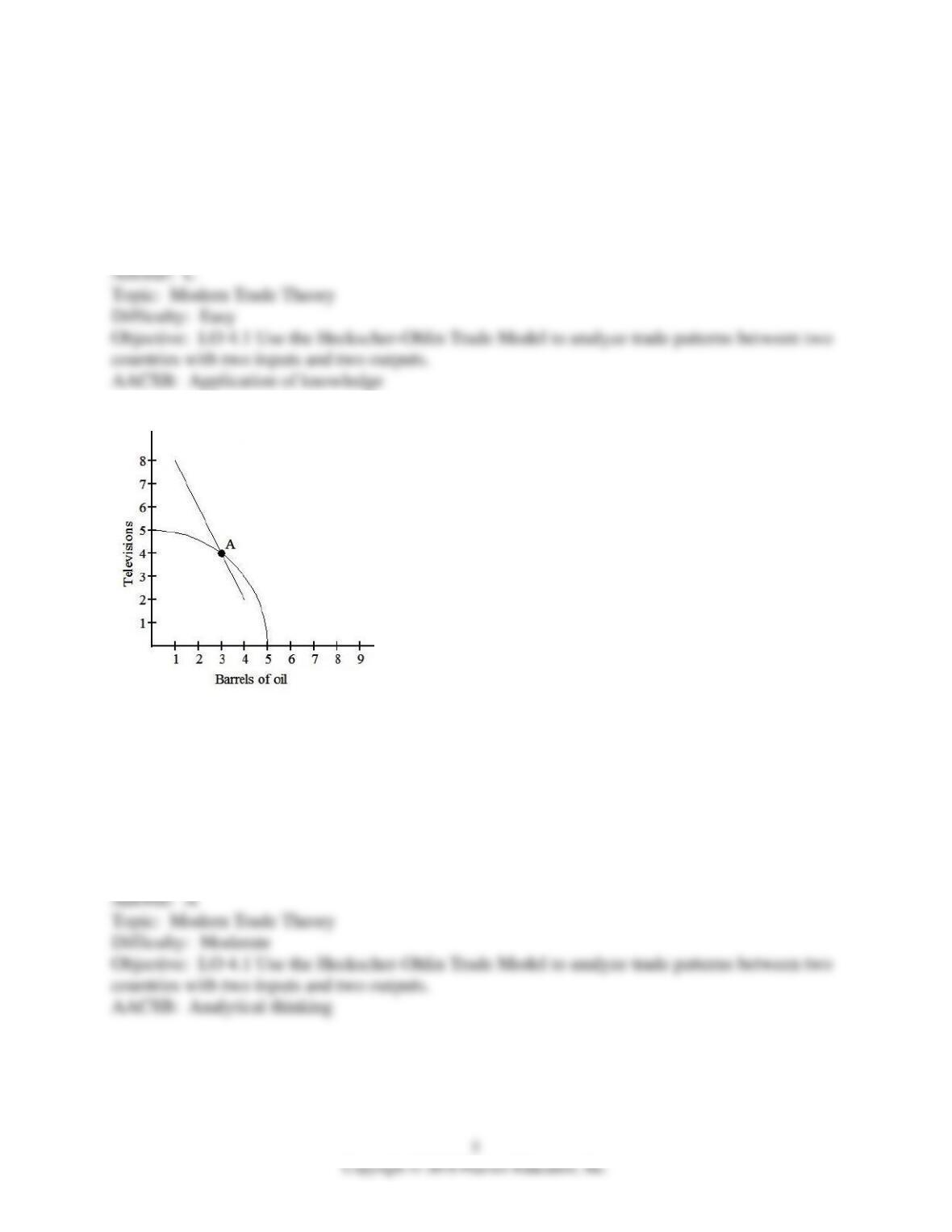
13)
The graph above shows the PPC for a country that can produce oil or televisions.
The straight line is the trade line and CPC if production is at Point A.
Which of the following is a true statement?
A) This country should produce relatively more oil and relatively fewer televisions.
B) This country should produce relatively more televisions and relatively less oil.
C) This country should produce more of both goods.
D) This country is producing the optimal mix of oil and televisions to maximize its income.
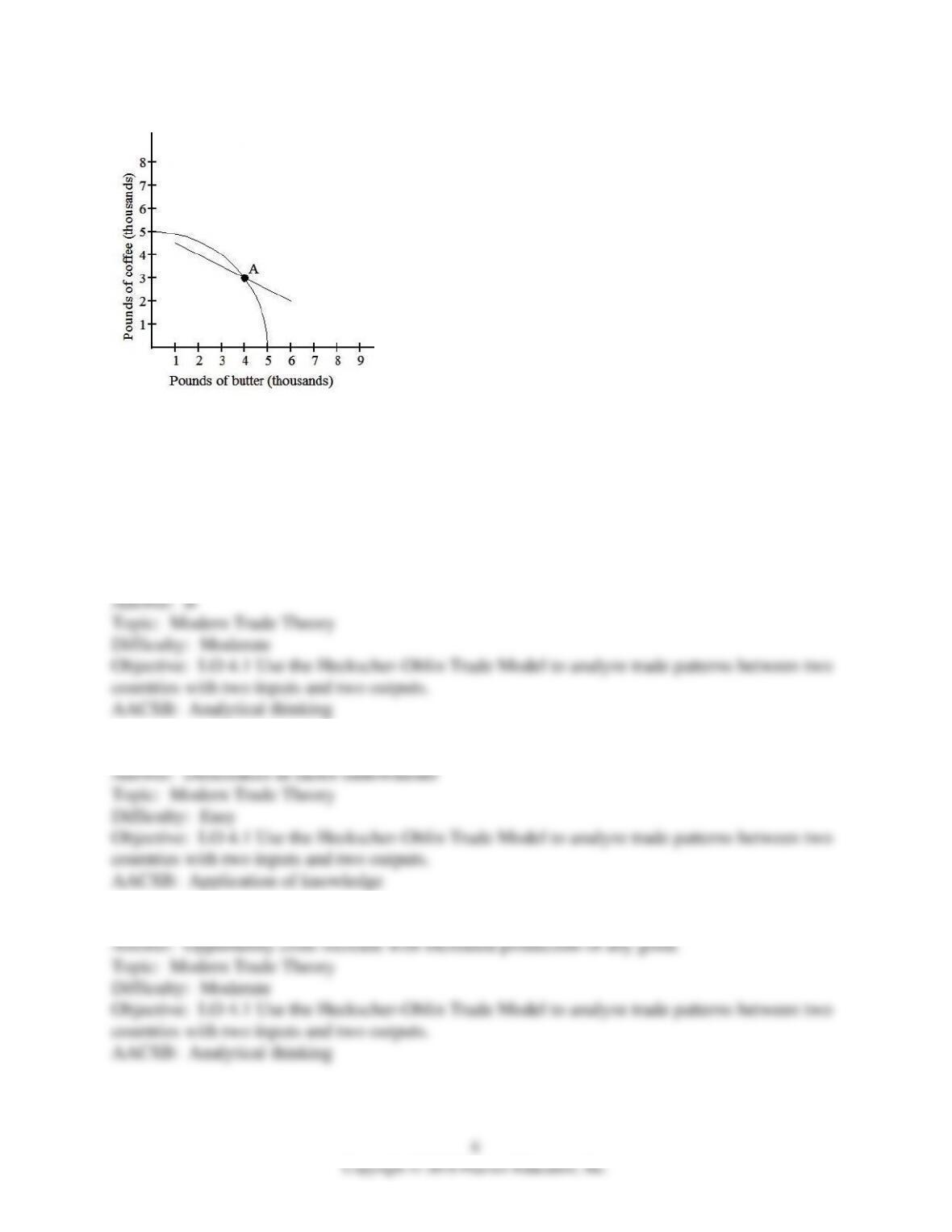
14)
The graph above shows the PPC for a country that can produce oil or televisions.
The straight line is the trade line and CPC if production is at Point A.
Which of the following is a true statement?
A) This country should produce relatively more butter and relatively less coffee.
B) This country should produce relatively less butter and relatively more coffee.
C) This country should produce more of both goods.
D) This country is producing the optimal mix of butter and coffee to maximize its income.
15) What is the source of comparative advantage in the Heckscher-Ohlin model?
16) In the Heckscher-Ohlin model, what assumption is made about opportunity costs?
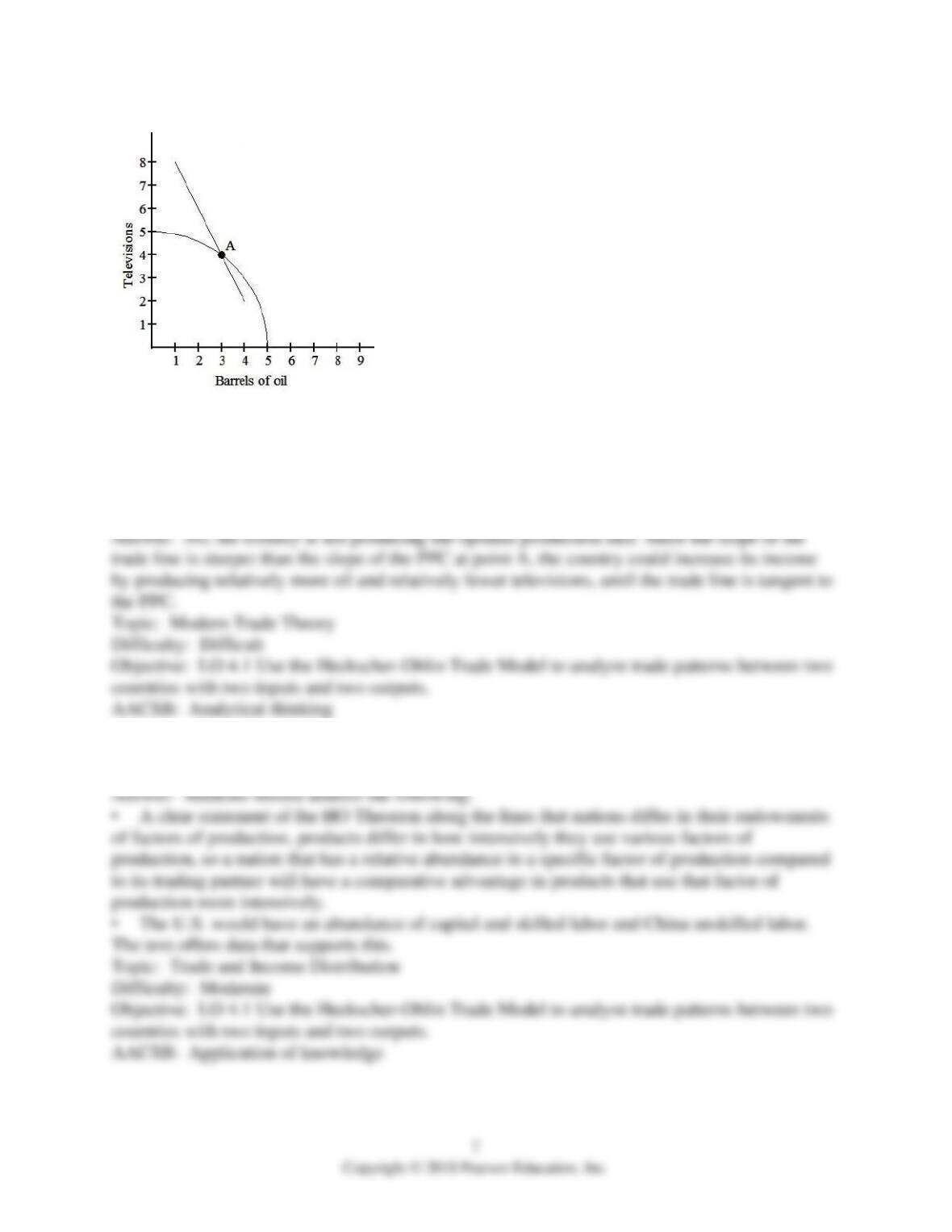
17)
The graph above shows the PPC for a country that can produce oil or televisions.
The straight line is the trade line and CPC if production is at Point A.
Is this country producing the optimal mix of oil and televisions to maximize its income?
Carefully explain how you know.
18) What is the Heckscher-Ohlin theorem? Using the case studies in the chapter on U.S. trade
with China describe the theory and the resulting trade patterns that would support it.
4.3 Trade and Income Distribution
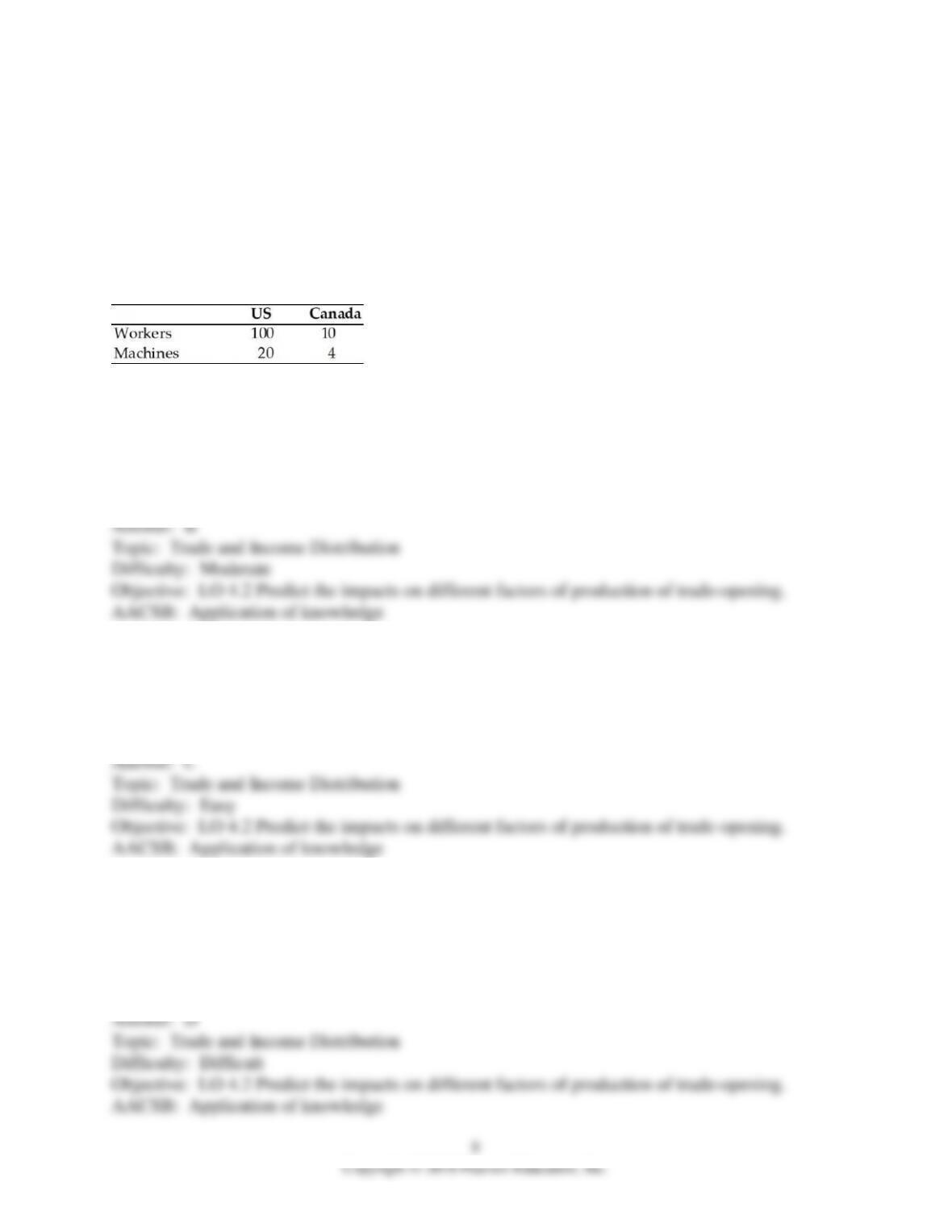
Use the table for the following question(s).
Suppose that all goods are made with two factors—labor and capital. The table below shows the
total endowments of each factor in the United States and Canada.
Table 4.1
Endowment of Labor and Capital
1) Based on Table 4.1, according to the Stolper-Samuelson Theorem, the income distribution
effects of free trade in the United States are likely to favor
A) capital.
B) labor.
C) either capital or labor, depending on U.S. productivity.
D) neither capital nor labor.
2) The Stolper-Samuelson Theorem predicts
A) the level of productivity in export industries.
B) which factors are abundant.
C) the income distribution effects of trade.
D) which goods will be exported.
3) If the price of a good rises, then the effect on the income of the factors that are used
intensively in its production will be
A) to raise income by an absolute amount that is less than the rise in prices.
B) to raise income by an absolute amount that is more than the rise in prices.
C) to raise income by a smaller percentage than the rise in prices.
D) to raise income by a greater percentage than the rise in prices.
4) After trade opens, the short run impact on the income of the variable factor will be
A) a decrease.
B) an increase.
C) zero.
D) indeterminate, depending on the consumption pattern of the owners of the variable factor.
5) After trade opens, the short run impact on the income of the specific factor that is relatively
scarce will be
A) a decrease in its income.
B) an increase in its income.
C) no change in its income.
D) indeterminate, income effects are not possible to know.
6) Suppose that Brazil is capital abundant and Chile is natural resource abundant. If timber is
natural resource intensive and computers are capital intensive, then according to the Stolper-
Samuelson Theorem, the incomes of the owners of ________ are likely to rise in Brazil after
trade with Chile begins.
A) capital
B) labor
C) natural resources
D) It is impossible to determine which will be favored.
7) Using the specific factors model, assume that strawberry production requires the specific
factor of land, tractor production requires the specific factor of capital, and labor is variable. If
the United States is capital abundant compared to Mexico, and Mexico is land abundant
compared to the United States, then in the short run with trade we would expect
A) the income of U.S. land owners to increase.
B) the income of U.S. workers to increase.
C) the income of Mexican workers to increase.
D) the income of Mexican land owners to increase.
8) Using the specific factors model, assume that strawberry production requires the specific
factor of land, tractor production requires the specific factor of capital, and labor is variable. If
the United States is capital abundant compared to Mexico, and Mexico is land abundant
compared to the United States, then in the short run with trade, which of the following is true?
A) Mexican wages will rise more than the increase in the price of tractors in Mexico.
B) U.S. wages will rise less than the fall in the price of tractors in the United States.
C) The owners of capital in the United States will see a larger increase in their incomes in
percentage terms than the increase in the price of tractors.
D) The owners of land in Mexico will see a smaller increase in their incomes in percentage terms
than the increase in the price of strawberries.
9)
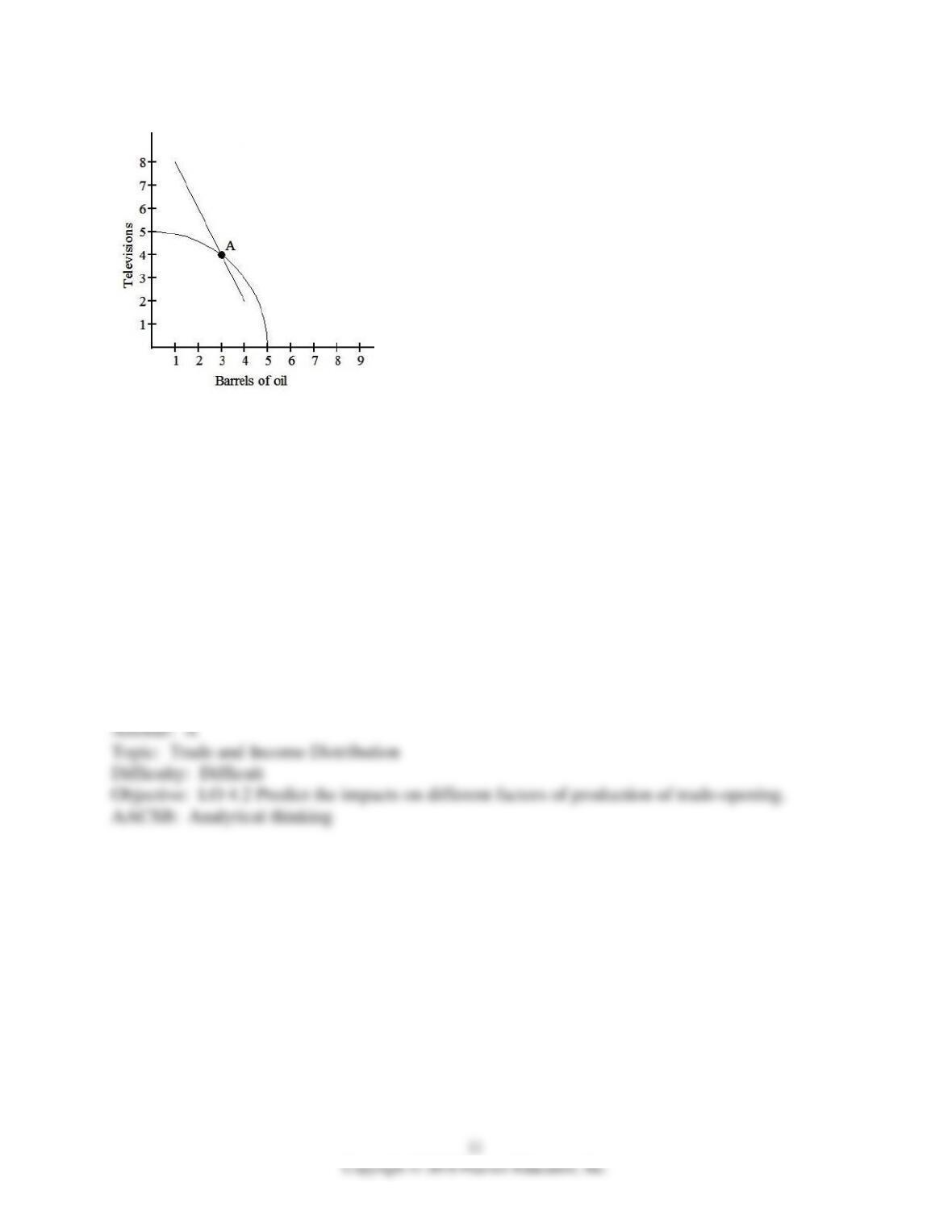
The graph above shows the PPC for a country that can produce oil, which is labor intensive, or
televisions, which are capital intensive.
The country is currently producing at point A and not trading with the rest of the world. With
trade, the world price can be represented by slope of the straight line through Point A.
Which of the following is a true statement?
A) When this country produces the optimal amount with trade, workers in this country will be
better off.
B) When this country produces the optimal amount with trade, capital in this country will be
better off.
C) When this country produces the optimal amount with trade, both factors of production will be
better off.
D) When this country produces the optimal amount with trade, the income of factors of
production will not change.