d.
$100
58. Consider Table 4.1. After the tariff, domestic value added equals:
a.
$25
b.
$50
c.
$75
d.
$100
59. Consider Table 4.1. The effective tariff rate equals:
a.
11.1 percent
b.
16.7 percent
c.
50.0 percent
d.
100.0 percent
60. If the domestic value added before an import tariff for a product is $500 and the domestic value added
after the tariff is $550, the effective rate of protection is:
a.
5 percent
b.
8 percent
c.
10 percent
d.
15 percent
61. When a tariff on imported inputs exceeds that on the finished good,
a.
The nominal tariff rate on the finished product would tend to overstate its protective effect
b.
The nominal tariff rate would tend to understate it’s protective effect
c.
It is impossible to determine the protective effect of a tariff
d.
Tariff escalation occurs
62. The offshore assembly provision in the U.S.
a.
Provides favorable treatment to U.S. trading partners
b.
Discriminates against primary product importers
c.
Provides favorable treatment to products assembled abroad from U.S. manufactured
components
d.
Hurts the U.S. consumer
63. Arguments for U.S. trade restrictions include all of the following except
a.
Job protection
b.
Infant industry support
c.
Maintenance of domestic living standard
d.
Improving incomes for developing countries
64. For the United States, a foreign trade zone (FTZ) is
a.
A site within the United States
b.
A site outside the United States
c.
Always located in poorer developing countries
d.
Is used to discourage trade
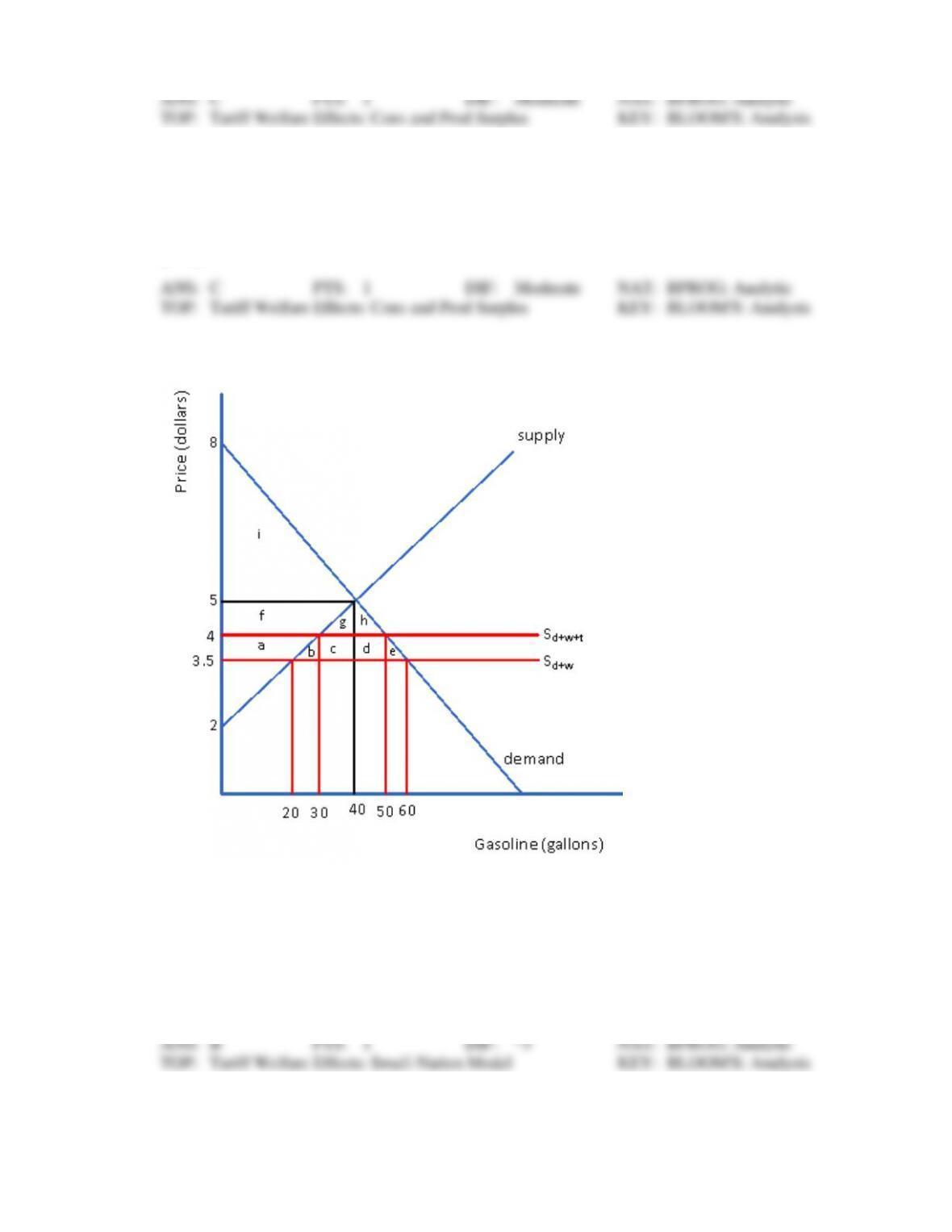
Figure 4.3 Domestic Market for Gasoline in the United States
65. Figure 4.3 represents the domestic market for gasoline in the United States. What is the consumer
surplus in this market?
a.
60 gallons of gasoline
b.
$120
c.
$60
d.
$3
66. Figure 4.3 represents the domestic market for gasoline in the United States. What is the producer
surplus in this market?
a.
60 gallons of gasoline
b.
$120
c.
$60
d.
$3
Figure 4.4 Market for Gasoline in a Small Nation
67. Figure 4.4 represents the market for gasoline in a small nation. The free trade world price of gasoline
is $3.50. Suppose this small nation imposes a tariff on gasoline of $.50 per gallon. The change in
producer surplus would be
a.
area a + b
b.
area a
c.
area a + b + f
d.
area a + b + f + g + h
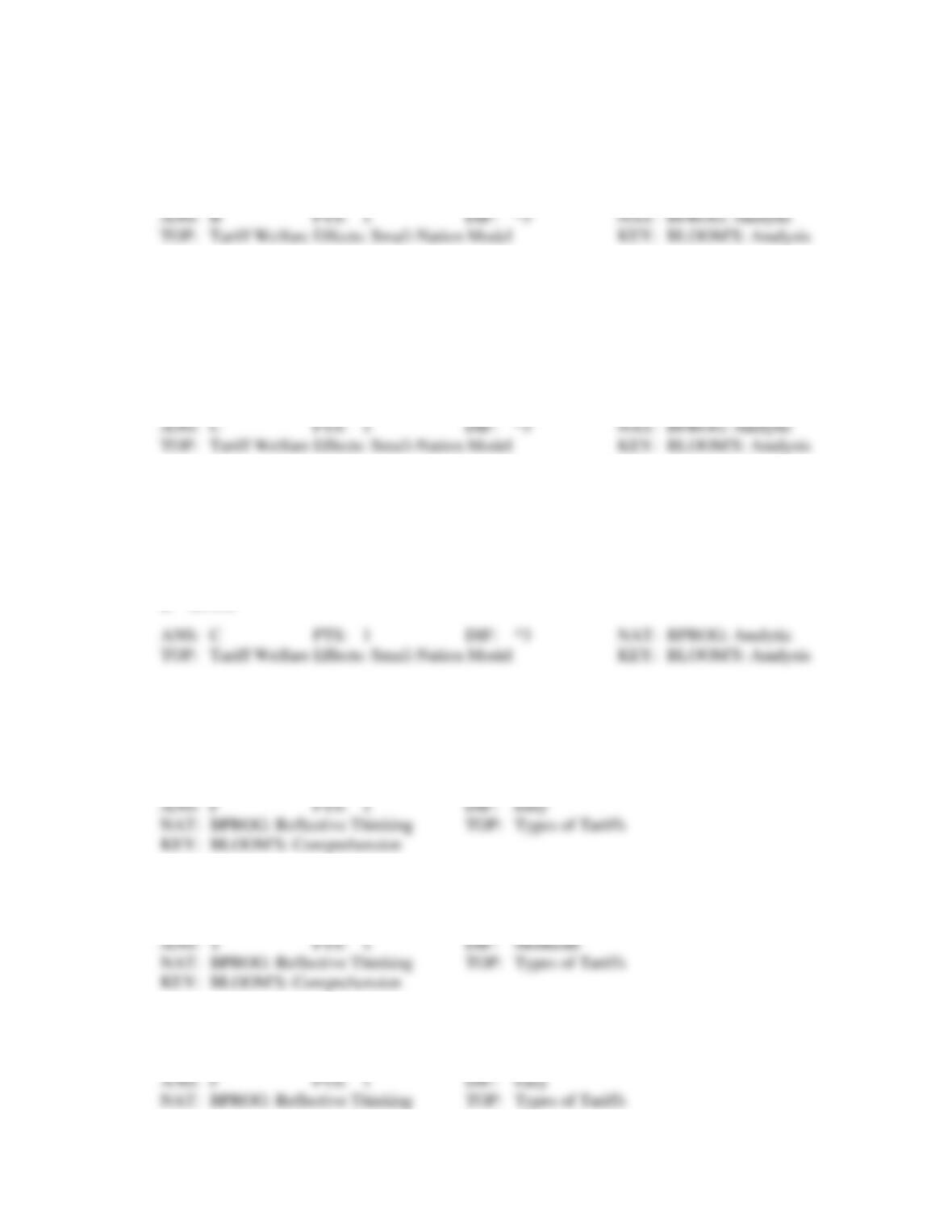
68. Figure 4.4 represents the market for gasoline in a small nation. The free trade world price of gasoline
is $3.50. Suppose this small nation imposes a tariff on gasoline of $.50 per gallon. The change in
producer surplus would be
a.
$15
b.
$12.5
c.
$47.50
d.
$57.50
69. Figure 4.4 represents the market for gasoline in a small nation. The free trade world price of gasoline
is $3.50. Suppose this small nation imposes a tariff on gasoline of $.50 per gallon. The change in
consumer surplus would be
a.
area a + b
b.
area a
c.
area a + b + c + d + e
d.
area a + b + f + g + h
70. Figure 4.4 represents the market for gasoline in a small nation. The free trade world price of gasoline
is $3.50. Suppose this small nation imposes a tariff on gasoline of $.50 per gallon. The change in
consumer surplus would be
a.
$15
b.
$12.50
c.
$27.50
d.
$57.50
TRUE/FALSE
1. To protect domestic producers from foreign competition, the U.S. government levies both import
tariffs and export tariffs.
2. With a compound tariff, a domestic importer of an automobile might be required to pay a duty of $200
plus 4 percent of the value of the automobile.
3. With a specific tariff, the degree of protection afforded domestic producers varies directly with
changes in import prices.
4. During a business recession, when cheaper products are purchased, a specific tariff provides domestic
producers a greater amount of protection against import-competing goods.
5. A ad valorem tariff provides domestic producers a declining degree of protection against
import-competing goods during periods of changing prices.
6. With a compound duty, its “specific” portion neutralizes the cost disadvantage of domestic
manufacturers that results from tariff protection granted to domestic suppliers of raw materials, and the
“ad valorem” portion of the duty grants protection to the finished-goods industry.
7. The nominal tariff rate signifies the total increase in domestic productive activities compared to what
would occur under free-trade conditions.
8. When material inputs enter a country at a very low duty while the final imported product is protected
by a high duty, the result tends to be a high rate of protection for domestic producers of the final
product.
9. According to the tariff escalation effect, industrial countries apply low tariffs to imports of finished
goods and high tariffs to imports of raw materials.
10. Under the Offshore Assembly Provision of U.S. tariff policy, U.S. import duties apply only to the
value added in the foreign assembly process, provided that U.S.-made components are used by
overseas companies in their assembly operations.
11. Bonded warehouses and foreign trade zones have the effect of allowing domestic importers to
postpone and prorate over time their import duty obligations.
12. A nation whose imports constitute a very small portion of the world market supply is a price taker,
facing a constant world price for its import commodity.
13. Graphically, consumer surplus is represented by the area above the demand curve and below the
product’s market price.
14. Producer surplus is the revenue producers receive over and above the minimum necessary for
production.
15. For a “small” country, a tariff raises the domestic price of an imported product by the full amount of
the duty.
16. Although an import tariff provides the domestic government additional tax revenue, it benefits
domestic consumers at the expense of domestic producers.
17. An import tariff reduces the welfare of a “small” country by an amount equal to the redistribution
effect plus the revenue effect.
18. The deadweight losses of an import tariff consist of the protection effect plus the consumption effect.
19. The redistribution effect is the transfer of producer surplus to domestic consumers of the
import-competing product.
20. As long as it is assumed that a nation accounts for a negligible portion of international trade, its
levying an import tariff necessarily increases its overall welfare.
21. Changes in a “large” country’s economic conditions or trade policies can affect the terms at which it
trades with other countries.
22. A “large” country, that levies a tariff on imports, cannot improve the terms at which it trades with other
countries.
23. For a “large” country, a tariff on an imported product may be partially absorbed by the domestic
consumer via a higher purchase price and partially absorbed by the foreign producer via a lower export
price.
24. If a “large” country levies a tariff on an imported good, its overall welfare increases if the monetary
value of the tariff’s consumption effect plus protective effect exceeds the monetary value of the
terms-of-trade effect.
25. If a “small” country levies a tariff on an imported good, its overall welfare increases if the monetary
value of the tariff’s consumption effect plus protective effect is less than the monetary value of the
terms-of-trade effect.
26. A tariff on steel imports tends to improve the competitiveness of domestic automobile companies.
27. If a tariff reduces the quantity of Japanese autos imported by the United States, over time it reduces the
ability of Japan to import goods from the United States.
28. A compound tariff permits a specified amount of goods to be imported at one tariff rate while any
imports above this amount are subjected to a higher tariff rate.
29. A tariff can be thought of as a tax on imported goods.
30. Although tariffs on imported steel may lead to job gains for domestic steel workers, they can lead to
job losses for domestic auto workers.
31. Relatively low wages in Mexico make it impossible for U.S. manufacturers of labor-intensive goods to
compete against Mexican manufacturers.
32. According to the infant-industry argument, temporary tariff protection granted to an infant industry
will help it become competitive in the world market; when international competitiveness is achieved,
the tariff should be removed.
Exhibit 4.2
33. Refer to Exhibit 4.2. As a result of the tariff, the price of imported motorcycles equals $13,000 and
imports total 4 cycles.
34. Refer to Exhibit 4.2. The tariff leads to an increase in Canadian consumer surplus totaling $11,000.
35. Refer to Exhibit 4.2. The tariff’s redistribution effect equals $7,000.
36. Refer to Exhibit 4.2. The tariff’s revenue effect equals $6,000.
37. Refer to Exhibit 4.2. All of the import tariff is shifted to the Canadian consumer via a higher price of
motorcycles.
38. Refer to Exhibit 4.2. The tariff leads to a deadweight welfare loss for Canada totaling $1,000.
39. Unlike a specific tariff, an ad valorem tariff differentiates between commodities with different values.
40. A limitation of a specific tariff is that it provides a constant level of protection for domestic
commodities regardless of fluctuations in their prices over time.
41. A tariff quota is a combination of a specific tariff and an ad valorem tariff.
42. A specific tariff is expressed as a fixed percentage of the total value of an imported product.
43. The protective effect of a tariff occurs to the extent that less efficient domestic production is
substituted for more efficient foreign production.
44. A tariff can increase the welfare of a “large” levying country if the favorable terms-of-trade effect
more than offsets the unfavorable protective effect and consumption effect.
45. If the world price of steel is $600 per ton, a specific tariff of $120 per ton is equivalent to an ad
valorem tariff of 25 percent.
46. An import tariff will worsen the terms of trade for a “small” country but improve the terms of trade for
a “large” country.
47. Suppose that the tariff on imported steel is 40 percent, the tariff on imported iron ore is 20 percent, and
30 percent of the cost of producing a ton of steel consists of the iron ore it contains. The effective rate
of protection of steel is approximately 49 percent.
48. There is widespread agreement among economists that import tariffs increase overall employment in
the levying country.
49. Assume that the United States imports VCRs from South Korea at a price of $200 per unit and that
these VCRs are subject to an import tariff of 20 percent. Also assume that U.S. components are used in
the VCRs assembled by South Korea and that these components have a value of $100. Under the
Offshore Assembly Provision of U.S. tariff policy, the price of an imported VCR to the U.S. consumer
after the tariff has been levied is $220.
50. Assume that the United States imports televisions from Taiwan at a price of $300 per unit and that
these televisions are subject to an import tariff of 25 percent. Also assume that U.S. components are
used in the televisions assembled by Taiwan and that these components have a value of $100. Under
the Offshore Assembly Provision of U.S. tariff policy, the price of an imported television to the U.S.
consumer after the tariff has been levied is $375
SHORT ANSWER
1. Can import duties have unintended side effects?
2. What happens to effective protection when the value added by the domestic producer declines?
ESSAY
1. Is it possible for a low nominal tariff rate to understate the effective rate of protection? What is tariff
escalation?
2. How can tariffs be justified?