Copyright Cengage Learning. Powered by Cognero.
Page 1
1. The imposition of tariffs on imports results in deadweight welfare losses for the home economy. These losses consist of
the:
a.
Protective effect plus consumption effect
b.
Redistribution effect plus revenue effect
c.
Revenue effect plus protective effect
d.
Consumption effect plus redistribution effect
ANSWER:
a
POINTS:
1
DIFFICULTY:
Moderate
QUESTION TYPE:
Multiple Choice
HAS VARIABLES:
False
NATIONAL STANDARDS:
United States – BUSPROG: Analytic Reflective Thi – BUSPROG: Reflective Thinking
United States – BUSPROG: Promotion – BUSPROG: Analytic
STATE STANDARDS:
United States – PA – DISC: Gains from trade, speciali – DISC: Gains from trade,
specialization and trade
TOPICS:
Tariff Welfare Effects: Consumer Surplus and Producer Surplus
KEYWORDS:
BLOOM’S: Understand
DATE CREATED:
6/22/2016 3:18 PM
DATE MODIFIED:
6/23/2016 4:23 AM
2. Suppose that the United States eliminates its tariff on steel imports, permitting foreign-produced steel to enter the U.S.
market. Steel prices to U.S. consumers would be expected to:
a.
Increase, and the foreign demand for U.S. exports would increase
b.
Decrease, and the foreign demand for U.S. exports would increase
c.
Increase, and the foreign demand for U.S. exports would decrease
d.
Decrease, and the foreign demand for U.S. exports would decrease
ANSWER:
b
POINTS:
1
DIFFICULTY:
Moderate
QUESTION TYPE:
Multiple Choice
HAS VARIABLES:
False
NATIONAL STANDARDS:
United States – BUSPROG: Analytic Reflective Thi – BUSPROG: Reflective Thinking
United States – BUSPROG: Promotion – BUSPROG: Analytic
STATE STANDARDS:
United States – PA – DISC: Gains from trade, speciali – DISC: Gains from trade,
specialization and trade
TOPICS:
Tariff Welfare Effects: Consumer Surplus and Producer Surplus
KEYWORDS:
BLOOM’S: Understand
DATE CREATED:
6/22/2016 3:18 PM
DATE MODIFIED:
6/22/2016 3:18 PM
3. A $100 specific tariff provides home producers more protection from foreign competition when:
a.
The home market buys cheaper products rather than expensive products
b.
It is applied to a commodity with many grade variations
c.
The home demand for a good is elastic with respect to price changes
d.
It is levied on manufactured goods rather than primary products
ANSWER:
a
Copyright Cengage Learning. Powered by Cognero.
Page 2
POINTS:
1
DIFFICULTY:
Challenging
QUESTION TYPE:
Multiple Choice
HAS VARIABLES:
False
NATIONAL STANDARDS:
United States – BUSPROG: Analytic Reflective Thi – BUSPROG: Reflective Thinking
United States – BUSPROG: Promotion – BUSPROG: Analytic
STATE STANDARDS:
United States – PA – DISC: Gains from trade, speciali – DISC: Gains from trade,
specialization and trade
TOPICS:
Tariff Welfare Effects: Large-Nation Model
KEYWORDS:
BLOOM’S: Understand
DATE CREATED:
6/22/2016 3:18 PM
DATE MODIFIED:
6/22/2016 3:18 PM
4. A lower tariff on imported aluminum would most likely benefit:
a.
Foreign producers at the expense of domestic consumers
b.
Domestic manufacturers of aluminum
c.
Domestic consumers of aluminum
d.
Workers in the domestic aluminum industry
ANSWER:
c
POINTS:
1
DIFFICULTY:
Moderate
QUESTION TYPE:
Multiple Choice
HAS VARIABLES:
False
NATIONAL STANDARDS:
United States – BUSPROG: Analytic Reflective Thi – BUSPROG: Reflective Thinking
United States – BUSPROG: Promotion – BUSPROG: Analytic
STATE STANDARDS:
United States – PA – DISC: Gains from trade, speciali – DISC: Gains from trade,
specialization and trade
TOPICS:
Tariff Welfare Effects: Consumer Surplus and Producer Surplus
KEYWORDS:
BLOOM’S: Understand
DATE CREATED:
6/22/2016 3:18 PM
DATE MODIFIED:
6/22/2016 3:18 PM
5. When a government allows raw materials and other intermediate products to enter a country duty free, its tariff policy
generally results in a:
a.
Effective tariff rate less than the nominal tariff rate
b.
Nominal tariff rate less than the effective tariff rate
c.
Rise in both nominal and effective tariff rates
d.
Fall in both nominal and effective tariff rates
ANSWER:
b
POINTS:
1
DIFFICULTY:
Easy
QUESTION TYPE:
Multiple Choice
HAS VARIABLES:
False
NATIONAL STANDARDS:
United States – BUSPROG: Analytic Reflective Thi – BUSPROG: Reflective Thinking
United States – BUSPROG: Promotion – BUSPROG: Analytic
STATE STANDARDS:
United States – PA – DISC: Gains from trade, speciali – DISC: Gains from trade,
Copyright Cengage Learning. Powered by Cognero.
Page 3
specialization and trade
TOPICS:
Effective Rate of Protection
KEYWORDS:
BLOOM’S: Understand
DATE CREATED:
6/22/2016 3:18 PM
DATE MODIFIED:
6/22/2016 3:18 PM
6. Of the many arguments in favor of tariffs, the one that has enjoyed the most significant economic justification has been
the:
a.
Infant industry argument
b.
Cheap foreign labor argument
c.
Balance of payments argument
d.
Domestic living standard argument
ANSWER:
a
POINTS:
1
DIFFICULTY:
Easy
QUESTION TYPE:
Multiple Choice
HAS VARIABLES:
False
NATIONAL STANDARDS:
United States – BUSPROG: Analytic Reflective Thi – BUSPROG: Reflective Thinking
United States – BUSPROG: Promotion – BUSPROG: Analytic
STATE STANDARDS:
United States – PA – DISC: Gains from trade, speciali – DISC: Gains from trade,
specialization and trade
TOPICS:
Arguments for Trade Protection
KEYWORDS:
BLOOM’S: Remember
DATE CREATED:
6/22/2016 3:18 PM
DATE MODIFIED:
6/22/2016 3:18 PM
7. The redistribution effect of an import tariff is the transfer of income from the domestic:
a.
Producers to domestic buyers of the good
b.
Buyers to domestic producers of the good
c.
Buyers to the domestic government
d.
Government to the domestic buyers
ANSWER:
b
POINTS:
1
DIFFICULTY:
Moderate
QUESTION TYPE:
Multiple Choice
HAS VARIABLES:
False
NATIONAL STANDARDS:
United States – BUSPROG: Analytic Reflective Thi – BUSPROG: Reflective Thinking
United States – BUSPROG: Promotion – BUSPROG: Analytic
STATE STANDARDS:
United States – PA – DISC: Gains from trade, speciali – DISC: Gains from trade,
specialization and trade
TOPICS:
Tariff Welfare Effects: Consumer Surplus and Producer Surplus
KEYWORDS:
BLOOM’S: Understand
DATE CREATED:
6/22/2016 3:18 PM
DATE MODIFIED:
6/22/2016 3:18 PM
8. Which of the following is true concerning a specific tariff?
Copyright Cengage Learning. Powered by Cognero.
Page 4
a.
It is exclusively used by the U.S. in its tariff schedules.
b.
It refers to a flat percentage duty applied to a good’s market value.
c.
It is plagued by problems associated with assessing import product values.
d.
It affords less protection to home producers during eras of rising prices.
ANSWER:
d
POINTS:
1
DIFFICULTY:
Easy
QUESTION TYPE:
Multiple Choice
HAS VARIABLES:
False
NATIONAL STANDARDS:
United States – BUSPROG: Analytic Reflective Thi – BUSPROG: Reflective Thinking
United States – BUSPROG: Promotion – BUSPROG: Analytic
STATE STANDARDS:
United States – PA – DISC: Gains from trade, speciali – DISC: Gains from trade,
specialization and trade
TOPICS:
Types of Tariffs
KEYWORDS:
BLOOM’S: Understand
DATE CREATED:
6/22/2016 3:18 PM
DATE MODIFIED:
6/22/2016 3:18 PM
9. The principal benefit of tariff protection goes to:
a.
Domestic consumers of the good produced
b.
Domestic producers of the good produced
c.
Foreign producers of the good produced
d.
Foreign consumers of the good produced
ANSWER:
b
POINTS:
1
DIFFICULTY:
Moderate
QUESTION TYPE:
Multiple Choice
HAS VARIABLES:
False
NATIONAL STANDARDS:
United States – BUSPROG: Analytic Reflective Thi – BUSPROG: Reflective Thinking
United States – BUSPROG: Promotion – BUSPROG: Analytic
STATE STANDARDS:
United States – PA – DISC: Gains from trade, speciali – DISC: Gains from trade,
specialization and trade
TOPICS:
Tariff Effects: An Overview
KEYWORDS:
BLOOM’S: Understand
DATE CREATED:
6/22/2016 3:18 PM
DATE MODIFIED:
6/22/2016 3:18 PM
10. Which of the following policies permits a specified quantity of goods to be imported at one tariff rate and applies a
higher tariff rate to imports above this quantity?
a.
Tariff quota
b.
Import tariff
c.
Specific tariff
d.
Ad valorem tariff
ANSWER:
a
POINTS:
1
DIFFICULTY:
Easy
Copyright Cengage Learning. Powered by Cognero.
Page 5
QUESTION TYPE:
Multiple Choice
HAS VARIABLES:
False
NATIONAL STANDARDS:
United States – BUSPROG: Analytic Reflective Thi – BUSPROG: Reflective Thinking
United States – BUSPROG: Promotion – BUSPROG: Analytic
STATE STANDARDS:
United States – PA – DISC: Gains from trade, speciali – DISC: Gains from trade,
specialization and trade
TOPICS:
Types of Tariffs
KEYWORDS:
BLOOM’S: Remember
DATE CREATED:
6/22/2016 3:18 PM
DATE MODIFIED:
6/22/2016 3:18 PM
11. Assume the United States adopts a tariff quota on steel in which the quota is set at 2 million tons, the within-quota
tariff rate equals 5 percent, and the over-quota tariff rate equals 10 percent. Suppose the U.S. imports 1 million tons of
steel. The resulting revenue effect of the tariff quota would accrue to:
a.
The U.S. government only
b.
U.S. importing companies only
c.
Foreign exporting companies only
d.
The U.S. government and either U.S. importers or foreign exporters
ANSWER:
a
POINTS:
1
DIFFICULTY:
Challenging
QUESTION TYPE:
Multiple Choice
HAS VARIABLES:
False
NATIONAL STANDARDS:
United States – BUSPROG: Analytic Reflective Thi – BUSPROG: Reflective Thinking
United States – BUSPROG: Promotion – BUSPROG: Analytic
STATE STANDARDS:
United States – PA – DISC: Gains from trade, speciali – DISC: Gains from trade,
specialization and trade
TOPICS:
Tariff Welfare Effects: Small-Nation Model
KEYWORDS:
BLOOM’S: Analyze
DATE CREATED:
6/22/2016 3:18 PM
DATE MODIFIED:
6/22/2016 3:18 PM
12. When the production of a commodity does not utilize imported inputs, the effective tariff rate on the commodity:
a.
Exceeds the nominal tariff rate on the commodity
b.
Equals the nominal tariff rate on the commodity
c.
Is less than the nominal tariff rate on the commodity
d.
None of the above
ANSWER:
b
POINTS:
1
DIFFICULTY:
Moderate
QUESTION TYPE:
Multiple Choice
HAS VARIABLES:
False
NATIONAL STANDARDS:
United States – BUSPROG: Analytic Reflective Thi – BUSPROG: Reflective Thinking
United States – BUSPROG: Promotion – BUSPROG: Analytic
STATE STANDARDS:
United States – PA – DISC: Gains from trade, speciali – DISC: Gains from trade,
specialization and trade
TOPICS:
Effective Rate of Protection
Copyright Cengage Learning. Powered by Cognero.
Page 6
KEYWORDS:
BLOOM’S: Understand
DATE CREATED:
6/22/2016 3:18 PM
DATE MODIFIED:
6/22/2016 3:18 PM
13. Developing nations often maintain that industrial countries permit raw materials to be imported at very low tariff rates
while maintaining high tariff rates on manufactured imports. Which of the following refers to the above statement?
a.
Tariff-quota effect
b.
Nominal tariff effect
c.
Tariff escalation effect
d.
Protective tariff effect
ANSWER:
c
POINTS:
1
DIFFICULTY:
Moderate
QUESTION TYPE:
Multiple Choice
HAS VARIABLES:
False
NATIONAL STANDARDS:
United States – BUSPROG: Analytic Reflective Thi – BUSPROG: Reflective Thinking
United States – BUSPROG: Promotion – BUSPROG: Analytic
STATE STANDARDS:
United States – PA – DISC: Gains from trade, speciali – DISC: Gains from trade,
specialization and trade
TOPICS:
Tariff Escalation
KEYWORDS:
BLOOM’S: Understand
DATE CREATED:
6/22/2016 3:18 PM
DATE MODIFIED:
6/22/2016 3:18 PM
14. Should the home country be “large” relative to the world, its imposition of a tariff on imports would lead to an
increase in domestic welfare if the terms-of-trade effect exceeds the sum of the:
a.
Revenue effect plus redistribution effect
b.
Protective effect plus revenue effect
c.
Consumption effect plus redistribution effect
d.
Protective effect plus consumption effect
ANSWER:
d
POINTS:
1
DIFFICULTY:
Moderate
QUESTION TYPE:
Multiple Choice
HAS VARIABLES:
False
NATIONAL STANDARDS:
United States – BUSPROG: Analytic Reflective Thi – BUSPROG: Reflective Thinking
United States – BUSPROG: Promotion – BUSPROG: Analytic
STATE STANDARDS:
United States – PA – DISC: Gains from trade, speciali – DISC: Gains from trade,
specialization and trade
TOPICS:
Tariff Welfare Effects: Large-Nation Model
KEYWORDS:
BLOOM’S: Understand
DATE CREATED:
6/22/2016 3:18 PM
DATE MODIFIED:
6/22/2016 3:18 PM
15. Should Canada impose a tariff on imports, one would expect Canada’s:
a.
Terms of trade to improve and volume of trade to decrease
b.
Terms of trade to worsen and volume of trade to decrease
Copyright Cengage Learning. Powered by Cognero.
Page 7
c.
Terms of trade to improve and volume of trade to increase
d.
Terms of trade to worsen and volume of trade to increase
ANSWER:
a
POINTS:
1
DIFFICULTY:
Moderate
QUESTION TYPE:
Multiple Choice
HAS VARIABLES:
False
NATIONAL STANDARDS:
United States – BUSPROG: Analytic Reflective Thi – BUSPROG: Reflective Thinking
United States – BUSPROG: Promotion – BUSPROG: Analytic
STATE STANDARDS:
United States – PA – DISC: Gains from trade, speciali – DISC: Gains from trade,
specialization and trade
TOPICS:
Tariff Effects: An Overview
KEYWORDS:
BLOOM’S: Understand
DATE CREATED:
6/22/2016 3:18 PM
DATE MODIFIED:
6/22/2016 3:18 PM
16. A beggar-thy-neighbor policy is the imposition of:
a.
Free trade to increase domestic productivity
b.
Trade barriers to increase domestic demand and employment
c.
Import tariffs to curb domestic inflation
d.
Revenue tariffs to make products cheaper for domestic consumers
ANSWER:
b
POINTS:
1
DIFFICULTY:
Moderate
QUESTION TYPE:
Multiple Choice
HAS VARIABLES:
False
NATIONAL STANDARDS:
United States – BUSPROG: Analytic Reflective Thi – BUSPROG: Reflective Thinking
United States – BUSPROG: Promotion – BUSPROG: Analytic
STATE STANDARDS:
United States – PA – DISC: Gains from trade, speciali – DISC: Gains from trade,
specialization and trade
TOPICS:
Tariff Welfare Effects: Large-Nation Model
KEYWORDS:
BLOOM’S: Understand
DATE CREATED:
6/22/2016 3:18 PM
DATE MODIFIED:
6/22/2016 3:18 PM
17. A problem encountered when implementing an “infant industry” tariff is that:
a.
Domestic consumers will purchase the foreign good regardless of the tariff
b.
Political pressure may prevent the tariff’s removal when the industry matures
c.
Most industries require tariff protection when they are mature
d.
Labor unions will capture the protective effect in higher wages
ANSWER:
b
POINTS:
1
DIFFICULTY:
Moderate
QUESTION TYPE:
Multiple Choice
HAS VARIABLES:
False
NATIONAL STANDARDS:
United States – BUSPROG: Analytic Reflective Thi – BUSPROG: Reflective Thinking
Copyright Cengage Learning. Powered by Cognero.
Page 8
United States – BUSPROG: Promotion – BUSPROG: Analytic
STATE STANDARDS:
United States – PA – DISC: Gains from trade, speciali – DISC: Gains from trade,
specialization and trade
TOPICS:
Arguments for Trade Protection
KEYWORDS:
BLOOM’S: Remember
DATE CREATED:
6/22/2016 3:18 PM
DATE MODIFIED:
6/22/2016 3:18 PM
18. Tariffs are not defended on the ground that they:
a.
Improve the terms of trade of foreign nations
b.
Protect jobs and reduce unemployment
c.
Promote growth and development of young industries
d.
Prevent overdependence of a country on only a few industries
ANSWER:
a
POINTS:
1
DIFFICULTY:
Easy
QUESTION TYPE:
Multiple Choice
HAS VARIABLES:
False
NATIONAL STANDARDS:
United States – BUSPROG: Analytic Reflective Thi – BUSPROG: Reflective Thinking
United States – BUSPROG: Promotion – BUSPROG: Analytic
STATE STANDARDS:
United States – PA – DISC: Gains from trade, speciali – DISC: Gains from trade,
specialization and trade
TOPICS:
Arguments for Trade Protection
KEYWORDS:
BLOOM’S: Understand
DATE CREATED:
6/22/2016 3:18 PM
DATE MODIFIED:
6/22/2016 3:18 PM
19. The deadweight loss of a tariff:
a.
Is a social loss since it promotes inefficient production
b.
Is a social loss since it reduces the revenue for the government
c.
Is not a social loss because society as a whole doesn’t pay for the loss
d.
Is not a social loss since only business firms suffer revenue losses
ANSWER:
a
POINTS:
1
DIFFICULTY:
Moderate
QUESTION TYPE:
Multiple Choice
HAS VARIABLES:
False
NATIONAL STANDARDS:
United States – BUSPROG: Analytic Reflective Thi – BUSPROG: Reflective Thinking
United States – BUSPROG: Promotion – BUSPROG: Analytic
STATE STANDARDS:
United States – PA – DISC: Gains from trade, speciali – DISC: Gains from trade,
specialization and trade
TOPICS:
Tariff Welfare Effects: Consumer Surplus and Producer Surplusrp
KEYWORDS:
BLOOM’S: Understand
DATE CREATED:
6/22/2016 3:18 PM
DATE MODIFIED:
6/22/2016 3:18 PM
Copyright Cengage Learning. Powered by Cognero.
Page 9
20. Which of the following is a fixed percentage of the value of an imported product as it enters the country?
a.
Specific tariff
b.
Ad valorem tariff
c.
Nominal tariff
d.
Effective tariff
ANSWER:
b
POINTS:
1
DIFFICULTY:
Easy
QUESTION TYPE:
Multiple Choice
HAS VARIABLES:
False
NATIONAL STANDARDS:
United States – BUSPROG: Analytic Reflective Thi – BUSPROG: Reflective Thinking
United States – BUSPROG: Promotion – BUSPROG: Analytic
STATE STANDARDS:
United States – PA – DISC: Gains from trade, speciali – DISC: Gains from trade,
specialization and trade
TOPICS:
Types of Tariffs
KEYWORDS:
BLOOM’S: Remember
DATE CREATED:
6/22/2016 3:18 PM
DATE MODIFIED:
6/22/2016 3:18 PM
21. A tax of 20 cents per unit of imported cheese would be an example of:
a.
Compound tariff
b.
Effective tariff
c.
Ad valorem tariff
d.
Specific tariff
ANSWER:
d
POINTS:
1
DIFFICULTY:
Easy
QUESTION TYPE:
Multiple Choice
HAS VARIABLES:
False
NATIONAL STANDARDS:
United States – BUSPROG: Analytic Reflective Thi – BUSPROG: Reflective Thinking
United States – BUSPROG: Promotion – BUSPROG: Analytic
STATE STANDARDS:
United States – PA – DISC: Gains from trade, speciali – DISC: Gains from trade,
specialization and trade
TOPICS:
Types of Tariffs
KEYWORDS:
BLOOM’S: Understand
DATE CREATED:
6/22/2016 3:18 PM
DATE MODIFIED:
6/22/2016 3:18 PM
22. A tax of 15 percent per imported item would be an example of:
a.
Ad valorem tariff
b.
Specific tariff
c.
Effective tariff
d.
Compound tariff
ANSWER:
a
POINTS:
1
DIFFICULTY:
Easy
Copyright Cengage Learning. Powered by Cognero.
Page 10
QUESTION TYPE:
Multiple Choice
HAS VARIABLES:
False
NATIONAL STANDARDS:
United States – BUSPROG: Analytic Reflective Thi – BUSPROG: Reflective Thinking
United States – BUSPROG: Promotion – BUSPROG: Analytic
STATE STANDARDS:
United States – PA – DISC: Gains from trade, speciali – DISC: Gains from trade,
specialization and trade
TOPICS:
Types of Tariffs
KEYWORDS:
BLOOM’S: Remember
DATE CREATED:
6/22/2016 3:18 PM
DATE MODIFIED:
6/22/2016 3:18 PM
23. Which type of tariff is not used by the American government?
a.
Import tariff
b.
Export tariff
c.
Specific tariff
d.
Ad valorem tariff
ANSWER:
b
POINTS:
1
DIFFICULTY:
Easy
QUESTION TYPE:
Multiple Choice
HAS VARIABLES:
False
NATIONAL STANDARDS:
United States – BUSPROG: Analytic Reflective Thi – BUSPROG: Reflective Thinking
United States – BUSPROG: Promotion – BUSPROG: Analytic
STATE STANDARDS:
United States – PA – DISC: Gains from trade, speciali – DISC: Gains from trade,
specialization and trade
TOPICS:
Types of Tariffs
KEYWORDS:
BLOOM’S: Remember
DATE CREATED:
6/22/2016 3:18 PM
DATE MODIFIED:
6/22/2016 3:18 PM
24. If we consider the impact on both consumers and producers, then protection of the steel industry is:
a.
In the interest of the United States as a whole, but not in the interest of the state of Pennsylvania
b.
In the interest of the United States as a whole and in the interest of the state of Pennsylvania
c.
Not in the interest of the United States as a whole, but it might be in the interest of the state of Pennsylvania
d.
Not in the interest of the United States as a whole, nor in the interest of the state of Pennsylvania
ANSWER:
c
POINTS:
1
DIFFICULTY:
Moderate
QUESTION TYPE:
Multiple Choice
HAS VARIABLES:
False
NATIONAL STANDARDS:
United States – BUSPROG: Analytic Reflective Thi – BUSPROG: Reflective Thinking
United States – BUSPROG: Promotion – BUSPROG: Analytic
STATE STANDARDS:
United States – PA – DISC: Gains from trade, speciali – DISC: Gains from trade,
specialization and trade
TOPICS:
Tariff Welfare Effects: Large-Nation Model
KEYWORDS:
BLOOM’S: Understand
Copyright Cengage Learning. Powered by Cognero.
Page 11
DATE CREATED:
6/22/2016 3:18 PM
DATE MODIFIED:
6/22/2016 3:18 PM
25. Which trade policy results in the government levying a “two-tier” tariff on imported goods?
a.
Tariff quota
b.
Nominal tariff
c.
Effective tariff
d.
Revenue tariff
ANSWER:
a
POINTS:
1
DIFFICULTY:
Moderate
QUESTION TYPE:
Multiple Choice
HAS VARIABLES:
False
NATIONAL STANDARDS:
United States – BUSPROG: Analytic Reflective Thi – BUSPROG: Reflective Thinking
United States – BUSPROG: Promotion – BUSPROG: Analytic
STATE STANDARDS:
United States – PA – DISC: Gains from trade, speciali – DISC: Gains from trade,
specialization and trade
TOPICS:
Tariff Welfare Effects: Large-Nation Model
KEYWORDS:
BLOOM’S: Understand
DATE CREATED:
6/22/2016 3:18 PM
DATE MODIFIED:
6/22/2016 3:18 PM
26. If I purchase a stereo from South Korea, I obtain the stereo and South Korea obtains the dollars. But if I purchase a
stereo produced in the United States, I obtain the stereo and the dollars remain in America. This line of reasoning is:
a.
Valid for stereos, but not for most products imported by the United States
b.
Valid for most products imported by the United States, but not for stereos
c.
Deceptive since Koreans eventually spend the dollars on U.S. goods
d.
Deceptive since the dollars spent on a stereo built in the United States eventually wind up overseas
ANSWER:
c
POINTS:
1
DIFFICULTY:
Moderate
QUESTION TYPE:
Multiple Choice
HAS VARIABLES:
False
NATIONAL STANDARDS:
United States – BUSPROG: Analytic Reflective Thi – BUSPROG: Reflective Thinking
United States – BUSPROG: Promotion – BUSPROG: Analytic
STATE STANDARDS:
United States – PA – DISC: Gains from trade, speciali – DISC: Gains from trade,
specialization and trade
TOPICS:
Tariff Effects: An Overview
KEYWORDS:
BLOOM’S: Understand
DATE CREATED:
6/22/2016 3:18 PM
DATE MODIFIED:
6/22/2016 3:18 PM
27. The most vocal political pressure for tariffs is generally made by:
a.
Consumers lobbying for export tariffs
b.
Consumers lobbying for import tariffs
c.
Producers lobbying for export tariffs
Copyright Cengage Learning. Powered by Cognero.
Page 12
d.
Producers lobbying for import tariffs
ANSWER:
d
POINTS:
1
DIFFICULTY:
Moderate
QUESTION TYPE:
Multiple Choice
HAS VARIABLES:
False
NATIONAL STANDARDS:
United States – BUSPROG: Analytic Reflective Thi – BUSPROG: Reflective Thinking
United States – BUSPROG: Promotion – BUSPROG: Analytic
STATE STANDARDS:
United States – PA – DISC: Gains from trade, speciali – DISC: Gains from trade,
specialization and trade
TOPICS:
The Political Economy of Protectionism
KEYWORDS:
BLOOM’S: Understand
DATE CREATED:
6/22/2016 3:18 PM
DATE MODIFIED:
6/22/2016 3:18 PM
28. If we consider the interests of both consumers and producers, then a policy of tariff reduction in the U.S. auto industry
is:
a.
In the interest of the United States as a whole, but not in the interest of auto-producing states
b.
In the interest of the United States as a whole, and in the interest of auto-producing states
c.
Not in the interest of the United States as a whole, nor in the interest of auto-producing states
d.
Not in the interest of the United States as a whole, but is in the interest of auto-producing states
ANSWER:
a
POINTS:
1
DIFFICULTY:
Moderate
QUESTION TYPE:
Multiple Choice
HAS VARIABLES:
False
NATIONAL STANDARDS:
United States – BUSPROG: Analytic Reflective Thi – BUSPROG: Reflective Thinking
United States – BUSPROG: Promotion – BUSPROG: Analytic
STATE STANDARDS:
United States – PA – DISC: Gains from trade, speciali – DISC: Gains from trade,
specialization and trade
TOPICS:
Tariff Welfare Effects: Small-Nation Model
KEYWORDS:
BLOOM’S: Understand
DATE CREATED:
6/22/2016 3:18 PM
DATE MODIFIED:
6/22/2016 3:18 PM
29. Free traders point out that:
a.
There is usually an efficiency gain from having tariffs
b.
There is usually an efficiency loss from having tariffs
c.
Producers lose from tariffs at the expense of consumers
d.
Producers lose from tariffs at the expense of the government
ANSWER:
b
POINTS:
1
DIFFICULTY:
Moderate
QUESTION TYPE:
Multiple Choice
HAS VARIABLES:
False
NATIONAL STANDARDS:
United States – BUSPROG: Analytic Reflective Thi – BUSPROG: Reflective Thinking
United States – BUSPROG: Promotion – BUSPROG: Analytic
STATE STANDARDS:
United States – PA – DISC: Gains from trade, speciali – DISC: Gains from trade,
specialization and trade
TOPICS:
Tariff Welfare Effects: Small-Nation Model
KEYWORDS:
BLOOM’S: Understand
DATE CREATED:
6/22/2016 3:18 PM
DATE MODIFIED:
6/22/2016 3:18 PM
30. A decrease in the import tariff will result in:
a.
An increase in imports but a decrease in domestic production
b.
A decrease in imports but an increase in domestic production
c.
An increase in price but a decrease in quantity purchased
d.
A decrease in price and a decrease in quantity purchased
ANSWER:
a
POINTS:
1
DIFFICULTY:
Moderate
QUESTION TYPE:
Multiple Choice
HAS VARIABLES:
False
NATIONAL STANDARDS:
United States – BUSPROG: Analytic Reflective Thi – BUSPROG: Reflective Thinking
United States – BUSPROG: Promotion – BUSPROG: Analytic
STATE STANDARDS:
United States – PA – DISC: Gains from trade, speciali – DISC: Gains from trade,
specialization and trade
TOPICS:
Tariff Welfare Effects: Small-Nation Model
KEYWORDS:
BLOOM’S: Understand
DATE CREATED:
6/22/2016 3:18 PM
DATE MODIFIED:
6/22/2016 3:18 PM
Copyright Cengage Learning. Powered by Cognero.
Page 14
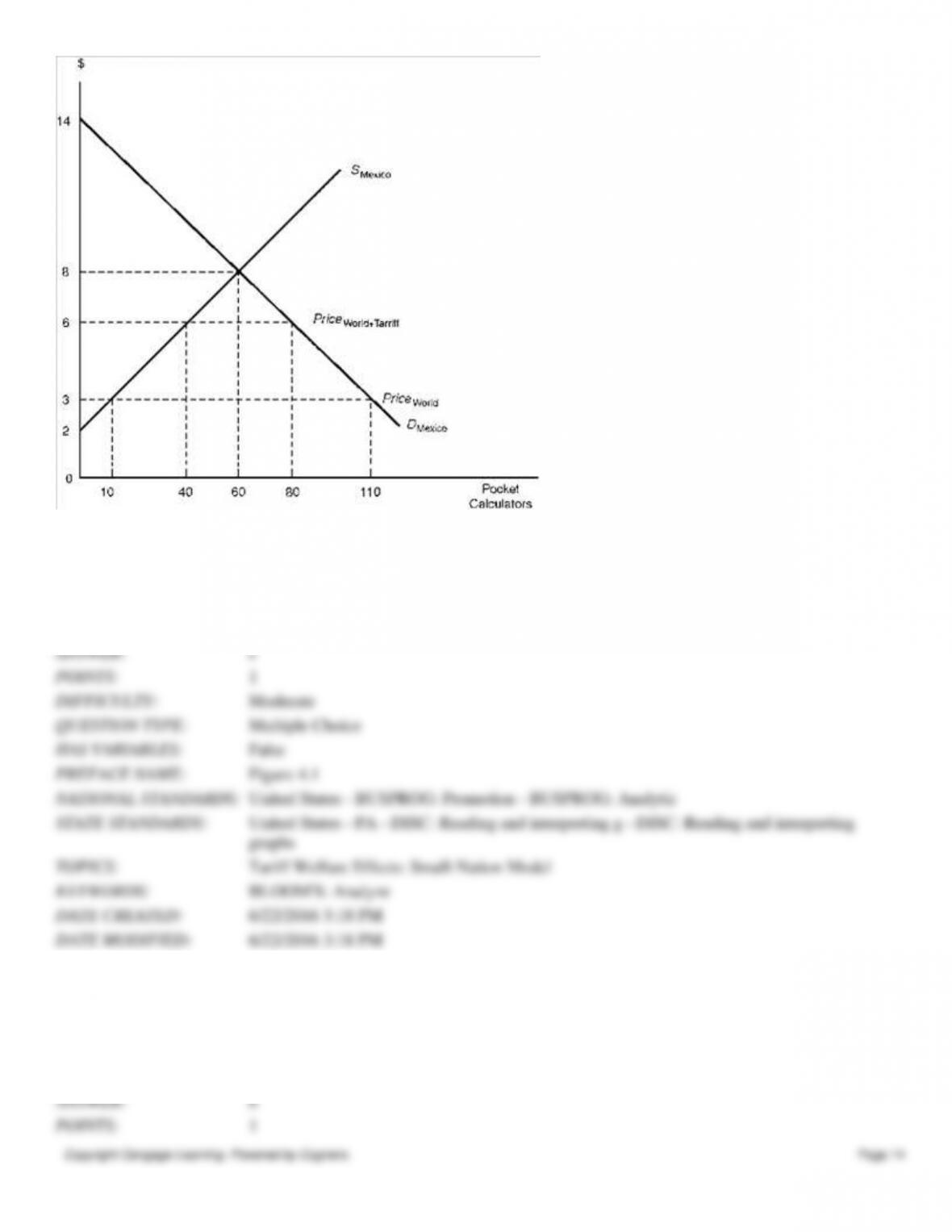
31. Consider Figure 4.1. In the absence of trade, Mexico produces and consumes:
a.
10 calculators
b.
40 calculators
c.
60 calculators
d.
80 calculators
ANSWER:
c
POINTS:
1
DIFFICULTY:
Moderate
QUESTION TYPE:
Multiple Choice
HAS VARIABLES:
False
PREFACE NAME:
Figure 4.1
NATIONAL STANDARDS:
United States – BUSPROG: Promotion – BUSPROG: Analytic
STATE STANDARDS:
United States – PA – DISC: Reading and interpreting g – DISC: Reading and interpreting
graphs
TOPICS:
Tariff Welfare Effects: Small-Nation Model
KEYWORDS:
BLOOM’S: Analyze
DATE CREATED:
6/22/2016 3:18 PM
DATE MODIFIED:
6/22/2016 3:18 PM
32. Consider Figure 4.1. In the absence of trade, Mexico’s producer surplus and consumer surplus respectively equal:
a.
$120, $240
b.
$180, $180
c.
$180, $320
d.
$240, $240
ANSWER:
b
POINTS:
1
Copyright Cengage Learning. Powered by Cognero.
Page 15
DIFFICULTY:
Challenging
QUESTION TYPE:
Multiple Choice
HAS VARIABLES:
False
PREFACE NAME:
Figure 4.1
NATIONAL STANDARDS:
United States – BUSPROG: Promotion – BUSPROG: Analytic
STATE STANDARDS:
United States – PA – DISC: Reading and interpreting g – DISC: Reading and interpreting
graphs
TOPICS:
Tariff Welfare Effects: Small-Nation Model
KEYWORDS:
BLOOM’S: Analyze
DATE CREATED:
6/22/2016 3:18 PM
DATE MODIFIED:
6/22/2016 3:18 PM
33. Consider Figure 4.1. With free trade, Mexico imports:
a.
40 calculators
b.
60 calculators
c.
80 calculators
d.
100 calculators
ANSWER:
d
POINTS:
1
DIFFICULTY:
Moderate
QUESTION TYPE:
Multiple Choice
HAS VARIABLES:
False
PREFACE NAME:
Figure 4.1
NATIONAL STANDARDS:
United States – BUSPROG: Promotion – BUSPROG: Analytic
STATE STANDARDS:
United States – PA – DISC: Reading and interpreting g – DISC: Reading and interpreting
graphs
TOPICS:
Tariff Welfare Effects: Small-Nation Model
KEYWORDS:
BLOOM’S: Analyze
DATE CREATED:
6/22/2016 3:18 PM
DATE MODIFIED:
6/22/2016 3:18 PM
34. Consider Figure 4.1. With free trade, the total value of Mexico’s imports equal:
a.
$220
b.
$260
c.
$290
d.
$300
ANSWER:
d
POINTS:
1
DIFFICULTY:
Moderate
QUESTION TYPE:
Multiple Choice
HAS VARIABLES:
False
PREFACE NAME:
Figure 4.1
NATIONAL STANDARDS:
United States – BUSPROG: Promotion – BUSPROG: Analytic
STATE STANDARDS:
United States – PA – DISC: Reading and interpreting g – DISC: Reading and interpreting
graphs
TOPICS:
Tariff Welfare Effects: Small-Nation Model
Copyright Cengage Learning. Powered by Cognero.
Page 16
KEYWORDS:
BLOOM’S: Analyze
DATE CREATED:
6/22/2016 3:18 PM
DATE MODIFIED:
6/22/2016 3:18 PM
35. Consider Figure 4.1. With free trade, Mexico’s producer surplus and consumer surplus respectively equal:
a.
$5, $605
b.
$25, $380
c.
$45, $250
d.
$85, $195
ANSWER:
a
POINTS:
1
DIFFICULTY:
Moderate
QUESTION TYPE:
Multiple Choice
HAS VARIABLES:
False
PREFACE NAME:
Figure 4.1
NATIONAL STANDARDS:
United States – BUSPROG: Promotion – BUSPROG: Analytic
STATE STANDARDS:
United States – PA – DISC: Reading and interpreting g – DISC: Reading and interpreting
graphs
TOPICS:
Tariff Welfare Effects: Small-Nation Model
KEYWORDS:
BLOOM’S: Analyze
DATE CREATED:
6/22/2016 3:18 PM
DATE MODIFIED:
6/22/2016 3:18 PM
36. Consider Figure 4.1. With a per-unit tariff of $3, the quantity of imports decreases to:
a.
20 calculators
b.
40 calculators
c.
50 calculators
d.
70 calculators
ANSWER:
b
POINTS:
1
DIFFICULTY:
Moderate
QUESTION TYPE:
Multiple Choice
HAS VARIABLES:
False
PREFACE NAME:
Figure 4.1
NATIONAL STANDARDS:
United States – BUSPROG: Promotion – BUSPROG: Analytic
STATE STANDARDS:
United States – PA – DISC: Reading and interpreting g – DISC: Reading and interpreting
graphs
TOPICS:
Tariff Welfare Effects: Small-Nation Model
KEYWORDS:
BLOOM’S: Analyze
DATE CREATED:
6/22/2016 3:18 PM
DATE MODIFIED:
6/22/2016 3:18 PM
37. According to Figure 4.1, the loss in Mexican consumer surplus due to the tariff equals:
a.
$225
b.
$265
c.
$285
Copyright Cengage Learning. Powered by Cognero.
Page 17
d.
$325
ANSWER:
c
POINTS:
1
DIFFICULTY:
Moderate
QUESTION TYPE:
Multiple Choice
HAS VARIABLES:
False
PREFACE NAME:
Figure 4.1
NATIONAL STANDARDS:
United States – BUSPROG: Promotion – BUSPROG: Analytic
STATE STANDARDS:
United States – PA – DISC: Reading and interpreting g – DISC: Reading and interpreting
graphs
TOPICS:
Tariff Welfare Effects: Small-Nation Model
KEYWORDS:
BLOOM’S: Analyze
DATE CREATED:
6/22/2016 3:18 PM
DATE MODIFIED:
6/22/2016 3:18 PM
38. According to Figure 4.1, the tariff results in the Mexican government collecting:
a.
$100
b.
$120
c.
$140
d.
$160
ANSWER:
b
POINTS:
1
DIFFICULTY:
Moderate
QUESTION TYPE:
Multiple Choice
HAS VARIABLES:
False
PREFACE NAME:
Figure 4.1
NATIONAL STANDARDS:
United States – BUSPROG: Promotion – BUSPROG: Analytic
STATE STANDARDS:
United States – PA – DISC: Reading and interpreting g – DISC: Reading and interpreting
graphs
TOPICS:
Tariff Welfare Effects: Small-Nation Model
KEYWORDS:
BLOOM’S: Analyze
DATE CREATED:
6/22/2016 3:18 PM
DATE MODIFIED:
6/22/2016 3:18 PM
39. According to Figure 4.1, Mexican manufacturers gain ____ because of the tariff.
a.
$75
b.
$85
c.
$95
d.
$105
ANSWER:
a
POINTS:
1
DIFFICULTY:
Moderate
QUESTION TYPE:
Multiple Choice
HAS VARIABLES:
False
PREFACE NAME:
Figure 4.1
Copyright Cengage Learning. Powered by Cognero.
Page 18
NATIONAL STANDARDS:
United States – BUSPROG: Promotion – BUSPROG: Analytic
STATE STANDARDS:
United States – PA – DISC: Reading and interpreting g – DISC: Reading and interpreting
graphs
TOPICS:
Tariff Welfare Effects: Small-Nation Model
KEYWORDS:
BLOOM’S: Analyze
DATE CREATED:
6/22/2016 3:18 PM
DATE MODIFIED:
6/22/2016 3:18 PM
40. According to Figure 4.1, the deadweight cost of the tariff totals:
a.
$60
b.
$70
c.
$80
d.
$90
ANSWER:
d
POINTS:
1
DIFFICULTY:
Moderate
QUESTION TYPE:
Multiple Choice
HAS VARIABLES:
False
PREFACE NAME:
Figure 4.1
NATIONAL STANDARDS:
United States – BUSPROG: Promotion – BUSPROG: Analytic
STATE STANDARDS:
United States – PA – DISC: Reading and interpreting g – DISC: Reading and interpreting
graphs
TOPICS:
Tariff Welfare Effects: Small-Nation Model
KEYWORDS:
BLOOM’S: Analyze
DATE CREATED:
6/22/2016 3:18 PM
DATE MODIFIED:
6/22/2016 3:18 PM
41. Consider Figure 4.1. The tariff would be prohibitive (i.e., eliminate imports) if it equaled:
a.
$2
b.
$3
c.
$4
d.
$5
ANSWER:
d
POINTS:
1
DIFFICULTY:
Moderate
QUESTION TYPE:
Multiple Choice
HAS VARIABLES:
False
PREFACE NAME:
Figure 4.1
NATIONAL STANDARDS:
United States – BUSPROG: Promotion – BUSPROG: Analytic
STATE STANDARDS:
United States – PA – DISC: Reading and interpreting g – DISC: Reading and interpreting
graphs
TOPICS:
Tariff Welfare Effects: Small-Nation Model
KEYWORDS:
BLOOM’S: Analyze
DATE CREATED:
6/22/2016 3:18 PM
DATE MODIFIED:
6/22/2016 3:18 PM
Copyright Cengage Learning. Powered by Cognero.
Page 19
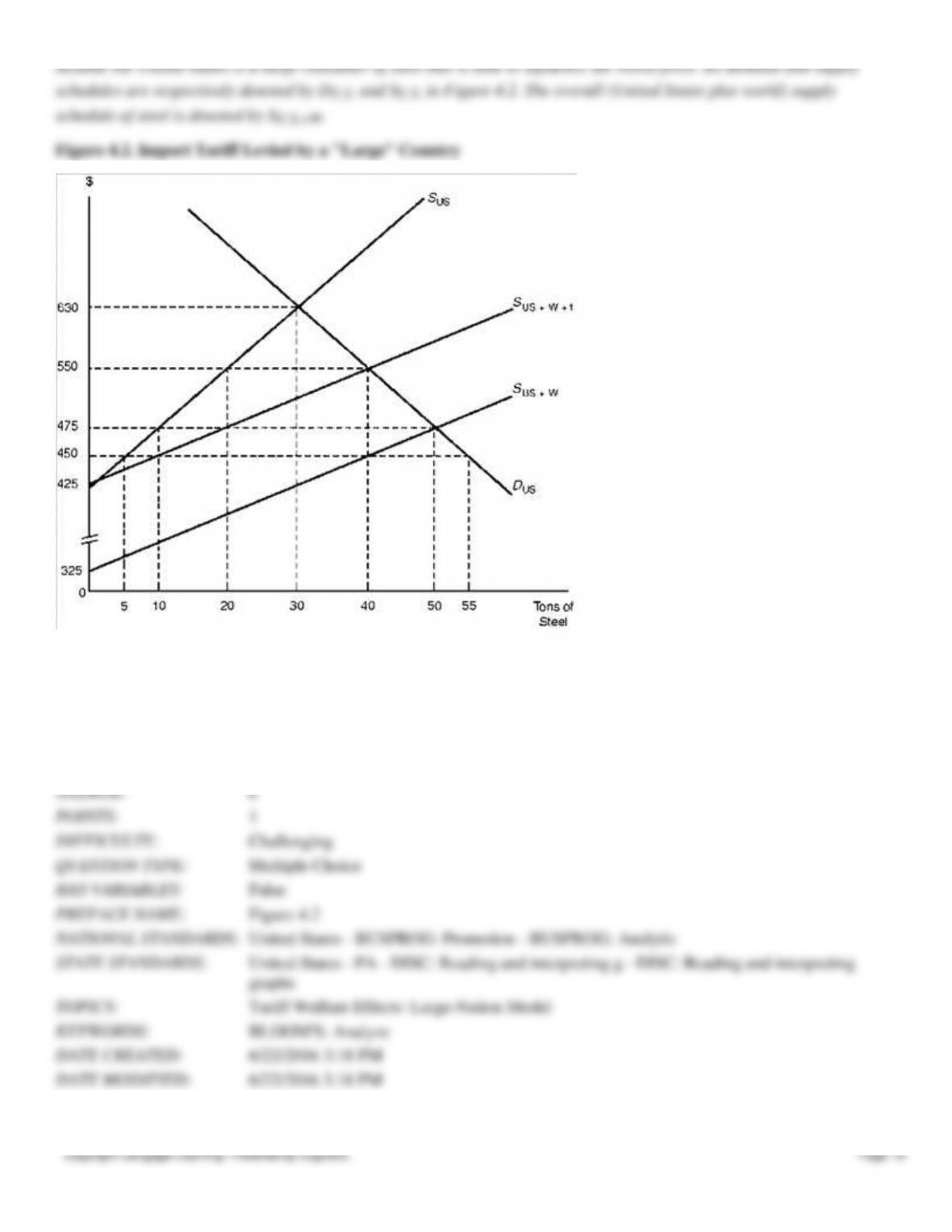
Assume the United States is a large consumer of steel that is able to influence the world price. Its demand and supply
schedules are respectively denoted by DU.S. and SU.S. in Figure 4.2. The overall (United States plus world) supply
schedule of steel is denoted by SU.S.+W.
Figure 4.2. Import Tariff Levied by a “Large” Country
42. Consider Figure 4.2. With free trade, the United States achieves market equilibrium at a price of $____. At this price,
$450, 5 tons, 60 tons, 55 tons
b.
$475, 10 tons, 50 tons, 40 tons
$525, 5 tons, 60 tons, 55 tons
d.
$630, 30 tons, 30 tons, 0 tons
ANSWER:
b
POINTS:
1
DIFFICULTY:
Challenging
QUESTION TYPE:
Multiple Choice
HAS VARIABLES:
False
PREFACE NAME:
Figure 4.2
NATIONAL STANDARDS:
United States – BUSPROG: Promotion – BUSPROG: Analytic
STATE STANDARDS:
United States – PA – DISC: Reading and interpreting g – DISC: Reading and interpreting
graphs
TOPICS:
Tariff Welfare Effects: Large-Nation Model
KEYWORDS:
BLOOM’S: Analyze
DATE CREATED:
6/22/2016 3:18 PM
DATE MODIFIED:
6/22/2016 3:18 PM
43. Consider Figure 4.2. Suppose the United States imposes a tariff of $100 on each ton of steel imported. With the tariff,
Copyright Cengage Learning. Powered by Cognero.
Page 20
the price of steel rises to $____ and imports fall to ____ tons.
a.
$550, 20 tons
b.
$550, 30 tons
c.
$575, 20 tons
d.
$575, 30 tons
ANSWER:
a
POINTS:
1
DIFFICULTY:
Challenging
QUESTION TYPE:
Multiple Choice
HAS VARIABLES:
False
PREFACE NAME:
Figure 4.2
NATIONAL STANDARDS:
United States – BUSPROG: Promotion – BUSPROG: Analytic
STATE STANDARDS:
United States – PA – DISC: Reading and interpreting g – DISC: Reading and interpreting
graphs
TOPICS:
Tariff Welfare Effects: Large-Nation Model
KEYWORDS:
BLOOM’S: Analyze
DATE CREATED:
6/22/2016 3:18 PM
DATE MODIFIED:
6/22/2016 3:18 PM
44. Consider Figure 4.2. Of the $100 tariff, $____ is passed on to the U.S. consumer via a higher price, while $____ is
borne by the foreign exporter; the U.S. terms of trade:
a.
$25, $75, improve
b.
$25, $75, worsen
c.
$75, $25, improve
d.
$75, $25, worsen
ANSWER:
c
POINTS:
1
DIFFICULTY:
Challenging
QUESTION TYPE:
Multiple Choice
HAS VARIABLES:
False
PREFACE NAME:
Figure 4.2
NATIONAL STANDARDS:
United States – BUSPROG: Promotion – BUSPROG: Analytic
STATE STANDARDS:
United States – PA – DISC: Reading and interpreting g – DISC: Reading and interpreting
graphs
TOPICS:
Tariff Welfare Effects: Large-Nation Model
KEYWORDS:
BLOOM’S: Analyze
DATE CREATED:
6/22/2016 3:18 PM
DATE MODIFIED:
6/22/2016 3:18 PM
45. Referring to Figure 4.2, the tariff’s deadweight welfare loss to the United States totals:
a.
$450
b.
$550
c.
$650
d.
$750
ANSWER:
d
POINTS:
1