International Economics, 9e (Krugman et al.)
Chapter 4 Specific Factors and Income Distribution
4.1 The Specific Factors Model
1) The Ricardian model of international trade demonstrates that trade can be mutually beneficial. Why,
then, do governments restrict imports of some goods?
A) Trade can have substantial effects on a country’s distribution of income.
B) The Ricardian model is often incorrect in its prediction that trade can be mutually beneficial.
C) Import restrictions are the result of trade wars between hostile countries.
D) Imports are only restricted when foreign-made goods do not meet domestic standards of quality.
E) Restrictions on imports are intended to benefit domestic consumers.
2) The Ricardian two-country two-good model predicts that there are potential benefits from trade, but
not
A) the effect of trade on income distribution.
B) the mechanism that determines which country will specialize in which good.
C) when one country has an absolute advantage in the production of both goods.
D) when one country has significantly lower wages than the other country.
E) when both countries have the same types of technology available.
3) International trade can have important effects on the distribution of income because
A) some resources are immobile in the short run.
B) of government corruption.
C) the more powerful country dictates the terms of trade.
D) rich countries take advantage of poor countries.
E) different countries use different currencies.
4) The Ricardian model of international trade demonstrates that trade can be mutually beneficial. Why,
then, do governments restrict imports of some goods?
A) Trade can have significant harmful effects on some segments of a country’s economy.
B) The Ricardian model is often incorrect in its prediction that trade can be mutually beneficial.
C) Import restrictions are the result of trade wars between hostile countries.
D) Imports are only restricted when foreign-made goods do not meet domestic standards of quality.
E) Restrictions on imports can have significant beneficial effects on domestic consumers.
5) International trade can have important effects on the distribution of income because
A) different industries employ different factors of production.
B) of government corruption.
C) the more powerful country dictates the terms of trade.
D) rich countries take advantage of poor countries.
E) different countries use different currencies.
6) Japan’s trade policies with regard to rice reflect the fact that
A) japanese rice farmers have significant political power.
B) Japan has a comparative advantage in rice production and therefore exports most of its rice crop.
C) there would be no gains from trade available to Japan if it engaged in free trade in rice.
D) there are gains from trade that Japan captures by engaging in free trade in rice.
E) Japan imports most of the rice consumed in the country.
7) The specific factors model was developed by
A) Paul Samuelson and Ronald Jones.
B) Adam Smith and David Ricardo.
C) Richard Nixon and Robert Kennedy.
D) C.B. deMill and Gordon Willis.
E) Bill Clinton and Monica Lewinsky.
8) In the specific factors model, labor is defined as a(an)
A) mobile factor.
B) specific factor.
C) fixed factor.
D) variable factor.
E) intensive factor.
9) In the specific factors model, which of the following is treated as a specific factor?
A) Land
B) Labor
C) Cloth
D) Food
E) Technology
10) In the specific factors model, which of the following is treated as a specific factor?
A) capital
B) labor
C) cloth
D) food
E) technology
11) A factor of production that cannot be used outside of a particular sector of an economy is a(an)
A) specific factor.
B) mobile factor.
C) variable factor.
D) import-competing factor.
E) export-competing factor.
12) A factor of production that can be used in any sector of an economy is a(an)
A) mobile factor.
B) specific factor.
C) variable factor.
D) import-competing factor.
E) export-competing factor.
13) The specific factors model assumes that there are ________ goods and ________ factor(s) of
production.
A) two; three
B) two; two
C) two; one
D) three; two
E) four; three
14) The degree of a factor’s specificity is directly related to
A) the amount of time required to redeploy the factor to a different industry.
B) the cost of the factor as a proportion of the long-run total cost of production.
C) the mobility of the factor, with more mobile factors having more specificity.
D) technology differences between two countries, with a more advanced technology resulting in more
factor specificity.
E) factor quality, with higher quality factors having a higher level of specificity.
15) The degree of a factor’s specificity is inversely related to
A) the mobility of the factor, with more mobile factors having less specificity.
B) the amount of time required to redeploy the factor to a different industry.
C) the cost of the factor as a proportion of the long-run total cost of production.
D) technology differences between two countries, with a less advanced technology resulting in less
factor specificity.
E) factor quality, with lower quality factors having a lower level of specificity.
16) A worker who has invested in ________ skills will be ________ mobile than would otherwise be the
case.
A) occupation-specific; less
B) occupation-specific; more
C) ethical; less
D) ethical; more
E) occupation-nominal; less
17) In the specific factors model, a country’s production possibility frontier is ________ because of
________.
A) a straight line; diminishing marginal returns
B) a curved line; diminishing marginal returns
C) a straight line; constant marginal returns
D) a curved line; constant marginal returns
E) a curved line; a limited supply of labor
18) In the specific factors model, a country’s production function is ________ because of ________.
A) a straight line; diminishing marginal returns
B) a curved line; diminishing marginal returns
C) a straight line; constant marginal returns
D) a curved line; constant marginal returns
E) a curved line; a limited supply of labor
19) In the four-quadrant diagram of the specific factors model, the graph in the upper right quadrant is a
country’s
A) production possibility frontier.
B) labor allocation constraint.
C) production function for food.
D) production function for cloth.
E) labor supply curve.
20) In the four-quadrant diagram of the specific factors model, the graph in the lower right quadrant is a
country’s
A) production function for cloth.
B) production possibility frontier.
C) labor allocation constraint.
D) production function for food.
E) labor supply curve.
21) In the four-quadrant diagram of the specific factors model, the graph in the upper left quadrant is a
country’s
A) production function for food.
B) production possibility frontier.
C) labor allocation constraint.
D) production function for cloth.
E) labor supply curve.
22) In the four-quadrant diagram of the specific factors model, the graph in the upper right quadrant is a
country’s
A) labor allocation constraint.
B) production possibility frontier.
C) production function for food.
D) production function for cloth.
E) labor supply curve.
23) The slope of a country’s production possibility frontier with cloth measured on the horizontal and
food measured on the vertical axis in the specific factors model is equal to ________ and it ________ as
more cloth is produced.
A) -MPLF/MPLC; becomes steeper
B) -MPLF/MPLC; becomes flatter
C) -MPLF/MPLC; is constant
D) -MPLC/MPLF; becomes steeper
E) -MPLC/MPLF; is constant
7
24) The slope of a country’s production possibility frontier with cloth measured on the horizontal and
food measured on the vertical axis in the Ricardian model is equal to ________ and it ________ as more
cloth is produced.
A) -MPLF/MPLC; is constant
B) -MPLF/MPLC; becomes steeper
C) -MPLF/MPLC; becomes flatter
D) -MPLC/MPLF; becomes steeper
E) -MPLC/MPLF; is constant
25) Under perfect competition, the equilibrium price of labor used to produce cloth will be equal to
A) the marginal product of labor in the production of cloth times the price of cloth.
B) the average product of labor in the production of cloth times the price of cloth.
C) the ratio of the marginal product of labor in the production of cloth to the marginal product of labor
in the production of food times the ratio of the price of cloth. to the price of food.
D) the slope of the production possibility frontier.
E) the price of cloth divided by the marginal product of labor in the production of cloth.
26) When a country’s labor market is in equilibrium in the specific factors model, the wage rate
A) will be the same in both sectors.
B) will be higher in the export-competing sector.
C) will be higher in the import-competing sector.
D) will be higher in the sector where product price is higher.
E) will be higher in the sector where product price is lower.
27) In the specific factors model, which of the following will increase the quantity of labor used in food
production?
A) an increase in the price of food relative to that of cloth
B) an increase in the price of cloth relative to that of food
C) a decrease in the price of labor
D) an equal percentage decrease in the price of food and cloth
E) an equal percentage increase in the price of food and cloth
28) In the specific factors model, which of the following will increase the quantity of labor used in cloth
production?
A) an increase in the price of cloth relative to that of food
B) an increase in the price of food relative to that of cloth
C) a decrease in the price of labor
D) an equal percentage decrease in the price of food and cloth
E) an equal percentage increase in the price of food and cloth
29) In the specific factor model, the effect of an increase in the productivity of labor in the production of
cloth will cause a(an) ________ in the quantity of labor used to produce cloth, a(an) ________ in the
quantity of labor used to produce food and a(an) ________ in the wage rate.
A) increase; decrease; increase
B) decrease; increase; increase
C) increase; decrease; decrease
D) decrease; increase; no change
E) increase; increase; no change
30) In the specific factor model, the effect of an increase in the productivity of labor in the production of
food will cause a(an) ________ in the quantity of labor used to produce cloth, a(an) ________ in the
quantity of labor used to produce food and a(an) ________ in the wage rate.
A) decrease; increase; increase
B) increase; decrease; increase
C) increase; decrease; decrease
D) decrease; increase; no change
E) increase; increase; no change
31) The slope of a country’s production possibility frontier is equal to ________ and the optimal
production point is located where the slope is equal to ________. Assume that output of good Y is
measured on the vertical axis, output of good X is measured on the horizontal axis, MPL is the marginal
product of labor with a subscript indicating which good, P is the price of a good, and w is the wage rate.
A) -MPLY/MPLX; -PX/PY
B) -PX/PY; -MPLY/MPLX;
C) -PX/w; -PY/w
D) -MPLY/w; -MPLF/w
E) –MPLX/MPLY; -PX/PY
32) In the specific factors model, a 5% increase in the price of food accompanied by a 5% increase in
the price of cloth will cause wages to ________, the production of cloth to ________, and the
production of food to ________.
A) increase by 5%; remain unchanged; remain unchanged
B) increase by less then 5%; decrease; increase
C) increase by more then 5%; increase; remain unchanged
D) remain constant; increase; increase
E) remain constant; decrease; decrease
33) In the specific factors model, a 5% increase in the price of food accompanied by a 0% increase in
the price of cloth will cause wages to ________, the production of cloth to ________, and the
production of food to ________.
A) increase by less then 5%; decrease; increase
B) increase by 5%; remain unchanged; remain unchanged
C) increase by more then 5%; increase; remain unchanged
D) remain constant; increase; increase
E) remain constant; decrease; decrease
34) In the specific factors model, a 0% increase in the price of food accompanied by a 5% increase in
the price of cloth will cause wages to ________, the production of cloth to ________, and the
production of food to ________.
A) increase by less then 5%; increase; decrease
B) increase by 5%; remain unchanged; remain unchanged
C) increase by more then 5%; increase; remain unchanged
D) remain constant; increase; increase
E) remain constant; decrease; decrease
35) In the specific factors model, a 5% increase in the price of food accompanied by a 5% increase in
the price of cloth will cause ________ in the welfare of labor, ________ in the welfare of the fixed
factor in the production of food, and ________ in the welfare of the fixed factor in the production of
cloth.
A) no change; no change; no change
B) an increase; an increase; an increase
C) a decrease; an increase; an increase
D) an increase; a decrease; a decrease
E) a decrease; a decrease; a decrease
36) In the specific factors model, a 5% decrease in the price of food accompanied by a 5% decrease in
the price of cloth will cause ________ in the welfare of labor, ________ in the welfare of the fixed
factor in the production of food, and ________ in the welfare of the fixed factor in the production of
cloth.
A) no change; no change; no change
B) an increase; an increase; an increase
C) a decrease; an increase; an increase
D) an increase; a decrease; a decrease
E) a decrease; a decrease; a decrease
37) In the specific factors model, a 5% increase in the price of food accompanied by a 10% increase in
the price of cloth will cause ________ in the welfare of labor, ________ in the welfare of the fixed
factor in the production of food, and ________ in the welfare of the fixed factor in the production of
cloth.
A) an ambiguous change; a decrease; an increase
B) an ambiguous change; an ambiguous change; an ambiguous change
C) a decrease; an ambiguous change; an ambiguous change
D) an increase; a decrease; an increase
E) an ambiguous change; an increase; a decrease
38) In the specific factors model, a 5% increase in the price of food accompanied by a 1% increase in
the price of cloth will cause ________ in the welfare of labor, ________ in the welfare of the fixed
factor in the production of food, and ________ in the welfare of the fixed factor in the production of
cloth.
A) an ambiguous change; an increase; a decrease
B) an ambiguous change; a decrease; an increase
C) an ambiguous change; an ambiguous change; an ambiguous change
D) a decrease; an ambiguous change; an ambiguous change
E) an increase; a decrease; an increase
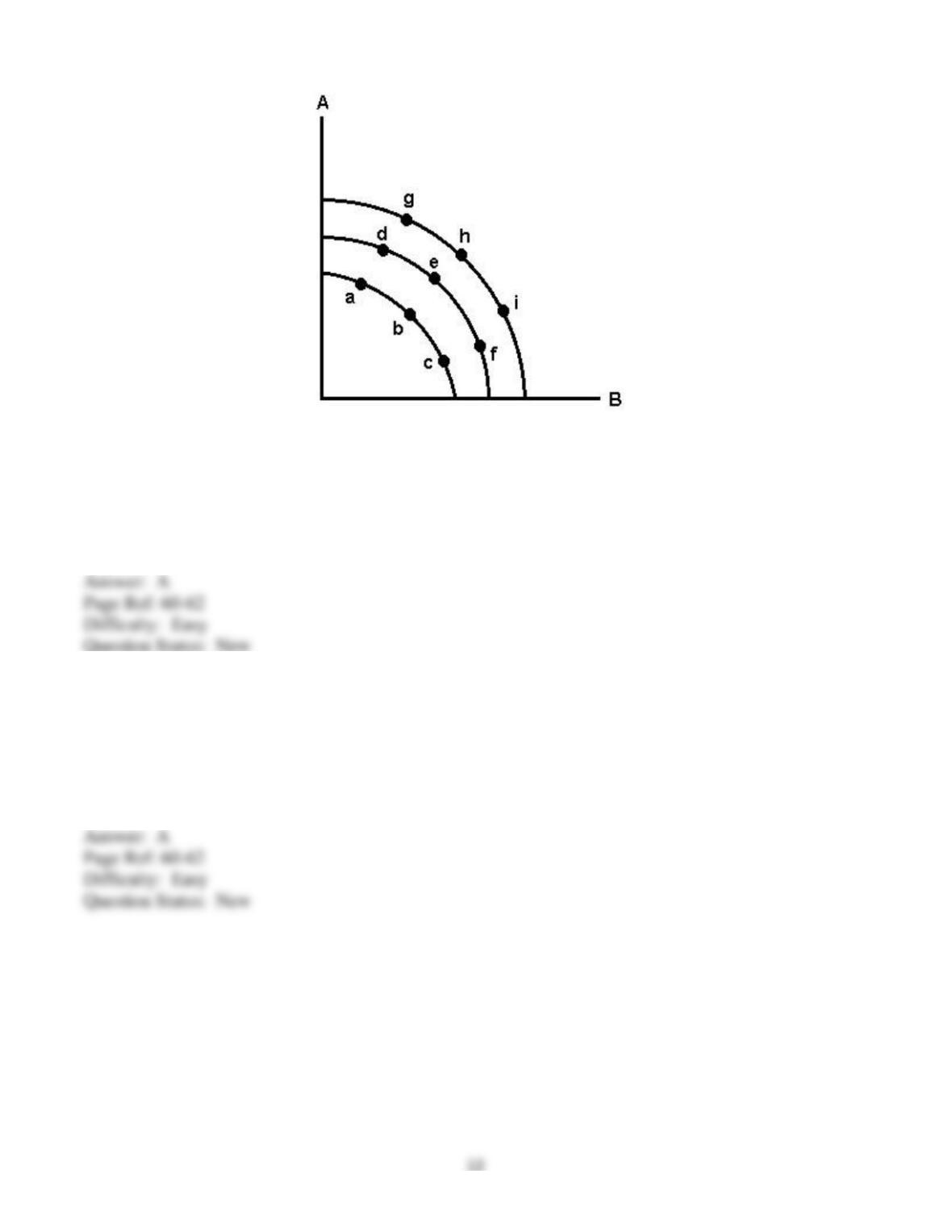
39) Refer to the production possibility graph above. Assume that the economy is in equilibrium at point
e. If there is an increase in the wage rate, the new equilibrium is most likely to be
A) point e.
B) point d.
C) point f.
D) point h.
E) point b.
40) Refer to the production possibility graph above. Assume that the economy is in equilibrium at point
e. If the price of good A increases, the new equilibrium is most likely to be
A) point d.
B) point e.
C) point f.
D) point h.
E) point b.