19) With trade, the slope of the Consumption Possibilities Curve (CPC) is equal to
A) the world price of the good on the horizontal axis.
B) the world price of the good on the vertical axis.
C) the opportunity cost of the good on the horizontal axis.
D) the opportunity cost of the good on the vertical axis.
20) Assume that both the United States and Germany produce beef and computers. The U.S. can
produce 200 computers or 1,000 pounds of beef per day. Germany can produce 500 computers or
250 pounds of beef per day.
What is the opportunity cost of beef and computer chips in each country? In which good does
each country have a comparative advantage? What is the range for mutually beneficial trade in
computers?
21) Assume that both the United States and Germany produce beef and computers. The U.S. can
produce 200 computers or 1,000 pounds of beef per day. Germany can produce 500 computers or
250 pounds of beef per day.
Graph the PPCs for each country, putting computers on the horizontal axis. Then identify the
slopes of the PPCs. What does the slope represent?
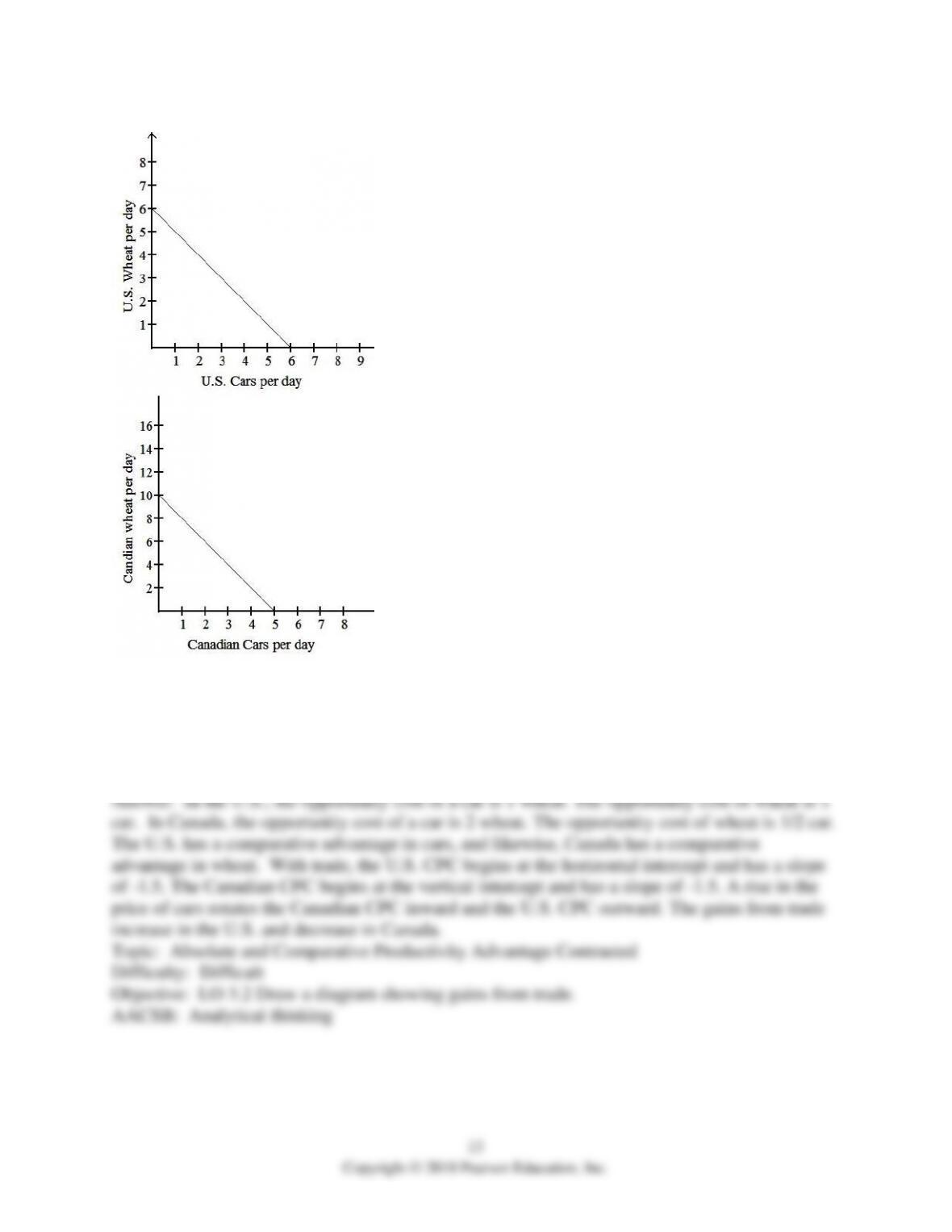
22)
The graphs above show the production possibilities curves for the U.S. and Canada, which both
produce cars and wheat.
Determine comparative advantage for each country, and then draw the CPC for each country,
assuming that the world price of cars is 1.5 wheat. (Assume that wheat is measured in thousands
of bushels.) How would the gains from trade change if the price of cars rose to 1.75 wheat?
3.3 Absolute and Comparative Productivity Advantage Contrasted
1) The United States’ comparative advantage over Japan in the production of rock-n-roll music
implies that (for a similar quality of music) the
A) opportunity cost of production is less in Japan.
B) absolute cost of production is less in the United States.
C) absolute cost of production is less in Japan.
D) opportunity cost of production is less in the United States.
2) If one nation is able to produce a good at a lower opportunity cost than another, it has
A) an absolute advantage in that good.
B) a comparative advantage in that good.
C) a productivity advantage in that good.
D) a technological advantage in that good.
3) The basis for free trade is the concept of
A) absolute advantage.
B) differences in natural resources and climate.
C) differences in nominal wages.
D) comparative advantage.
4) In our simple trade model, having a comparative advantage in a product implies that a country
will specialize completely in the product
A) with the highest opportunity cost.
B) with the lowest opportunity cost.
C) where total output is lower per worker-hour.
D) where total output is greater per worker-hour.
5) A country possesses a comparative advantage in the production of a product if
A) the opportunity cost, in terms of the amount of other products that it gives up to produce this
product, is lower than it is for its trading partners.
B) it possesses an absolute advantage in the production of this good compared to its trading
partners.
C) it is able to produce less of this good per worker than its trading partners.
D) it can produce more of this good per hour than its trading partners.
6) The gains from trade rely on overall productivity (absolute advantage).
7) A nation must have an absolute advantage in order to have a comparative advantage in
producing a good or service.
8) Explain how a country with no absolute advantage can gain from trade.
3.4 Gains from Trade with No Absolute Advantage
1) If a nation has no absolute advantage, then it
A) cannot gain from trade.
B) still gains from trade.
C) can only gain from trade if it raises its productivity levels.
D) can only gain from trade if it produces outside its production possibilities curve.
2) Which of the following statements is FALSE?
A) Comparative advantage is the principle upon which trade patterns are based.
B) Opportunity cost measures the real cost to a country of producing a certain product.
C) The gains from trade are the result of differences in opportunity cost and comparative
advantage.
D) A country that possesses an absolute advantage will always have a comparative advantage.
3) If a country has lower overall productivity levels than its trading partners, then it will
A) be unable to export.
B) have a trade deficit.
C) not be able to obtain gains from trade.
D) have a lower standard of living than its trading partners.
4) If two countries agree to specialize and trade based on comparative advantage, which of the
following is most likely to be true?
A) Both of the countries will consume outside their respective production possibilities curves.
B) One of the countries will end up receiving all of the gains from trade.
C) One of the countries will both consume and produce on its production possibilities curve.
D) Only one of the countries will produce on and consume outside its production possibilities
curve.
5) If the world price for a good is above a nation’s pre-trade equilibrium price, then the nation
A) will export the good.
B) will import the good.
C) will neither export nor import the good.
D) cannot gain from trade.
E) Both C and D.
6) When did the Republic of Korea change its economic policies?
7) What results has the Republic of Korea experienced from its change in policies?
8) Given the Republic of Korea’s experience, what can we conclude about comparative
advantage?
9) If a nation is more productive than a trading partner, can it still gain from trade with that
partner? Use the concepts of absolute and comparative advantage to explain.
3.5 Comparative Advantage and “Competitiveness”
1) Certain kinds of tropical fruits are impossible to grow outdoors in the United States. Suppose,
however, that in order to create jobs in Wyoming, the U.S. government offered extensive
subsidies to firms to produce bananas. With the subsidies, firms could build greenhouses and
offer the fruit at world prices.
A) The United States now has a comparative advantage in bananas.
B) The United States has a comparative advantage, but is not competitive.
C) The United States is competitive, but does not have a comparative advantage.
D) The United States has a comparative advantage and is competitive.
2) Competition between the United States and Mexico is
A) equivalent to the competition between two giant corporations.
B) a struggle over which country will get the best jobs.
C) unfair if wages in Mexico are lower than in the United States.
D) not a meaningful way to analyze trade.
3) A country that creates competitive advantage where there are not comparative advantages
misallocates its resources and has lower national well-being.
4) Explain why government actions that make industries more competitive do not create
comparative advantage.
3.6 Economic Restructuring
1) Economic restructuring that takes place as a result of opening to trade with other countries
A) contradicts the idea of gains from trade.
B) causes some trading activity to be zero sum.
C) worsens the nation’s allocation of resources.
D) improves the nation’s allocation of resources.
2) All of the following are true EXCEPT
A) trade between two nations reduces their opportunity costs.
B) trade makes nations dependent on each other.
C) trade between nations will not benefit all citizens.
D) the principle of comparative advantage does not apply to countries with limited resources.
3) When economists talk about the gains from trade they mean that
A) no one ever gets hurt by trade.
B) the benefits of trade outweigh the losses.
C) business firms benefit from trade but not necessarily individuals.
D) trade increases government revenue through taxes on imports.
E) economic restructuring is usually quick and painless.
4) Based on the theory of comparative advantage, nations maximize their well-being when they
A) create more jobs.
B) allocate resources more efficiently.
C) increase trade surpluses.
D) increase exports.
5) The nation as a whole is better off from trade as long as the gains from the winners exceed the
losses from the losers.
6) All individuals and firms in a country must gain from trade in order for it to be beneficial to
the nation.
7) Comparative advantage can change over time.
8) A country is likely to be better off in the long run if it pursues self-sufficiency.
9) Free trade may be good for a nation, but not for everyone in the nation. Explain why free trade
is controversial and the list the justifications that proponents of trade adjustment assistance offer
in support of those policies.
10) Describe some of the key controversies regarding global cotton trade between high cost and
low cost cotton producers.