11
CHAPTER 3
THE CLASSICAL WORLD OF DAVID RICARDO
AND COMPARATIVE ADVANTAGE
B.
M
Mu
ul
lt
ti
ip
pl
le
e–
–C
Ch
ho
oi
ic
ce
e
Q
Qu
ue
es
st
ti
io
on
ns
s
7. In the following Classical-type table showing the output per 10-days of labor input in
each of the two commodities in each of the two countries,
Cameras Wine
France 100 units 40 units
Germany 150 units 50 units
a. Germany has a comparative advantage in both goods.
8. Given the following Ricardo-type table shows the labor input required per unit of output
in each of the two industries in each of the two countries:
Shirts Brandy
United States 4 days 12 days
France 6 days 12 days
Which one of the following statements is correct?
d. France will export shirts after trade begins.
9. In the situation in Question #8 above, if the countries engage in trade at posttrade prices
(terms of trade) of 1 shirt = 0.5 brandy, then
d. the two countries share equally in the gains from trade.
10. The assumption of constant costs of production in the Classical model results in a
__________ production possibilities frontier, and, in the case of a “small” country,
12
__________ specialization in production when trade takes place.
a. linear; incomplete
11. Which one of the following is NOT an assumption contained in the Classical/Ricardo
trade model?
a. Factors of production (labor) are completely mobile within a country.
12. Given the following Ricardo-type table shows the labor input required per unit of output
in each of the two industries in each of the two countries:
SteelCloth
United Kingdom 4 days 8 days
Germany 6 days 9 days
Which one of the following statements is true?
a. The United Kingdom has an absolute advantage in both goods and a comparative
advantage in cloth.
13. Given the information in Question #12 above, suppose that Germany is a much larger
country in terms of production and income than is the United Kingdom. In this situation,
other things equal, when the countries engage in trade, the posttrade price ratio (terms of
trade) would tend to settle __________, and __________ would therefore tend to have
relatively large gains from trade.
a. toward a value of 1 cloth:2 steel; the United Kingdom
14. In the Classical (Ricardo) analysis,
a. if a country has an absolute advantage in a good, it also has a comparative advantage
13
in the good.
15. Given the following Ricardo-type table showing the amount of labor input needed to get
one unit of output in each industry in each country:
Wheat Chairs
Malaysia 3 days 2 days
India 10 days 8 days
a. Terms of trade of 1 wheat:1.25 chairs is not a feasible equilibrium terms of trade.
16. If a country’s relative price of X (compared to Y) in autarky is greater than the same
relative prices on the world market, then the country has a comparative advantage in
good __________, and it will __________.
a. X; export Y and import X
17. As a country moves from autarky to trade, the relative price of the country’s import good
will __________ for home consumers, and the relative price of the country’s export
good
__________ for home consumers.
d. rise; will fall
18. Suppose that, in a Classical constant-opportunity-costs framework, country I can produce
15 units of wheat if it devotes all of its resources to wheat production and 45 units of
clothing if it devotes all of its resources to clothing production. In a trading situation for
14
this country, if the world price ratio is Pwheat/Pclothing = ⅓ (or Pclothing/Pwheat = 3), country I
would
d. export either clothing or wheat and import either wheat or clothing – cannot be
determined without more information.
19. Suppose that, with constant opportunity costs, Spain can produce 2,000 units of clothing
if it devotes all of its resources to clothing production and 8,000 units of wheat if it
devotes all of its resources to wheat production. If Spain is opened to trade at a world
price ratio of 1 wheat:0.4 clothing (or 1 clothing:2.5 wheat), Spain will export
__________; if the world price ratio were 1 wheat:4 clothing (or 1 clothing:2.5 wheat),
Spain would __________.
d. clothing; would be indifferent to trade
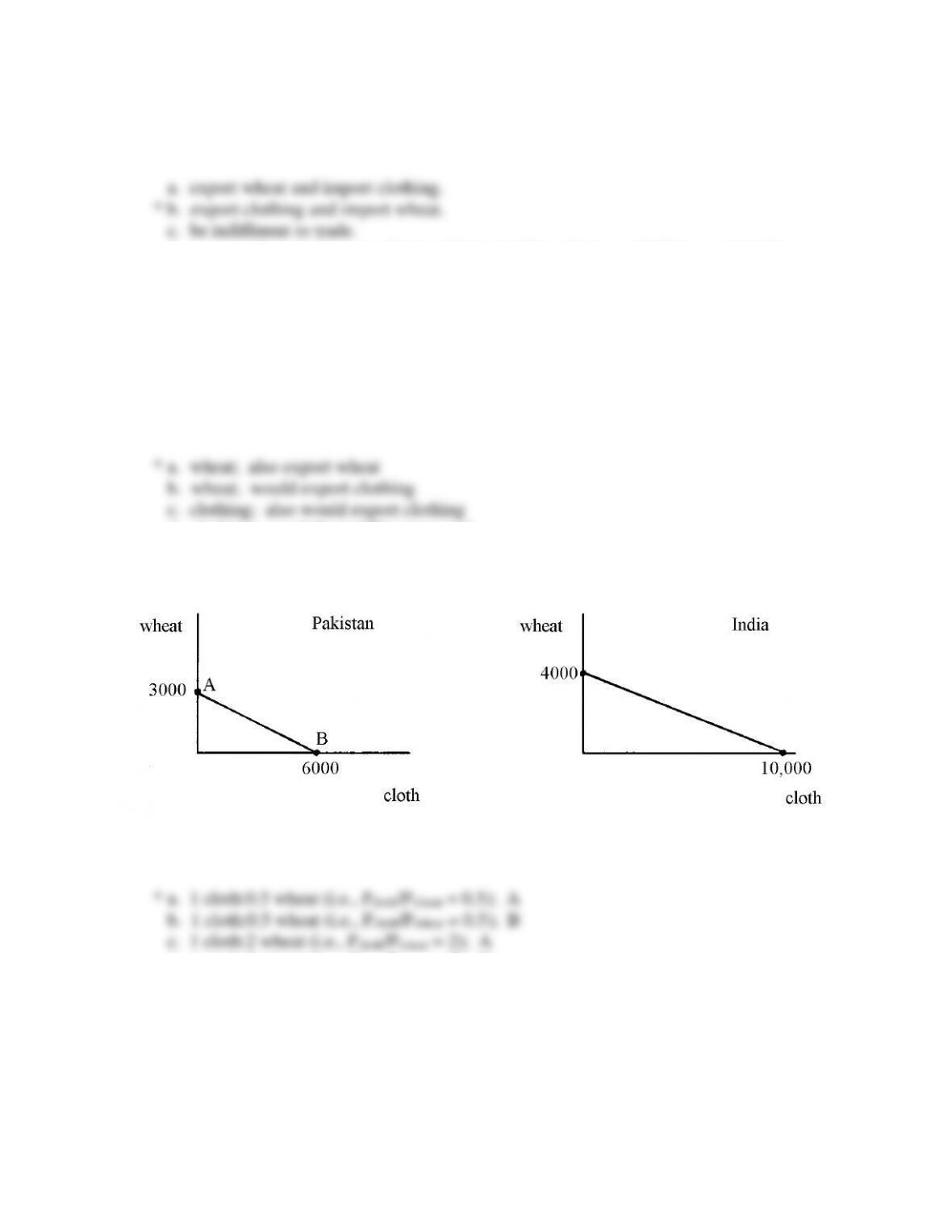
20. Given the following constant-cost production-possibilities frontiers for Pakistan and
India:
Pakistan has an autarky relative price of __________; if trade begins with India, then
Pakistan would produce at point __________, assuming complete specialization.
d. 1 cloth:2 wheat (i.e., Pcloth/Pwheat = 2); B
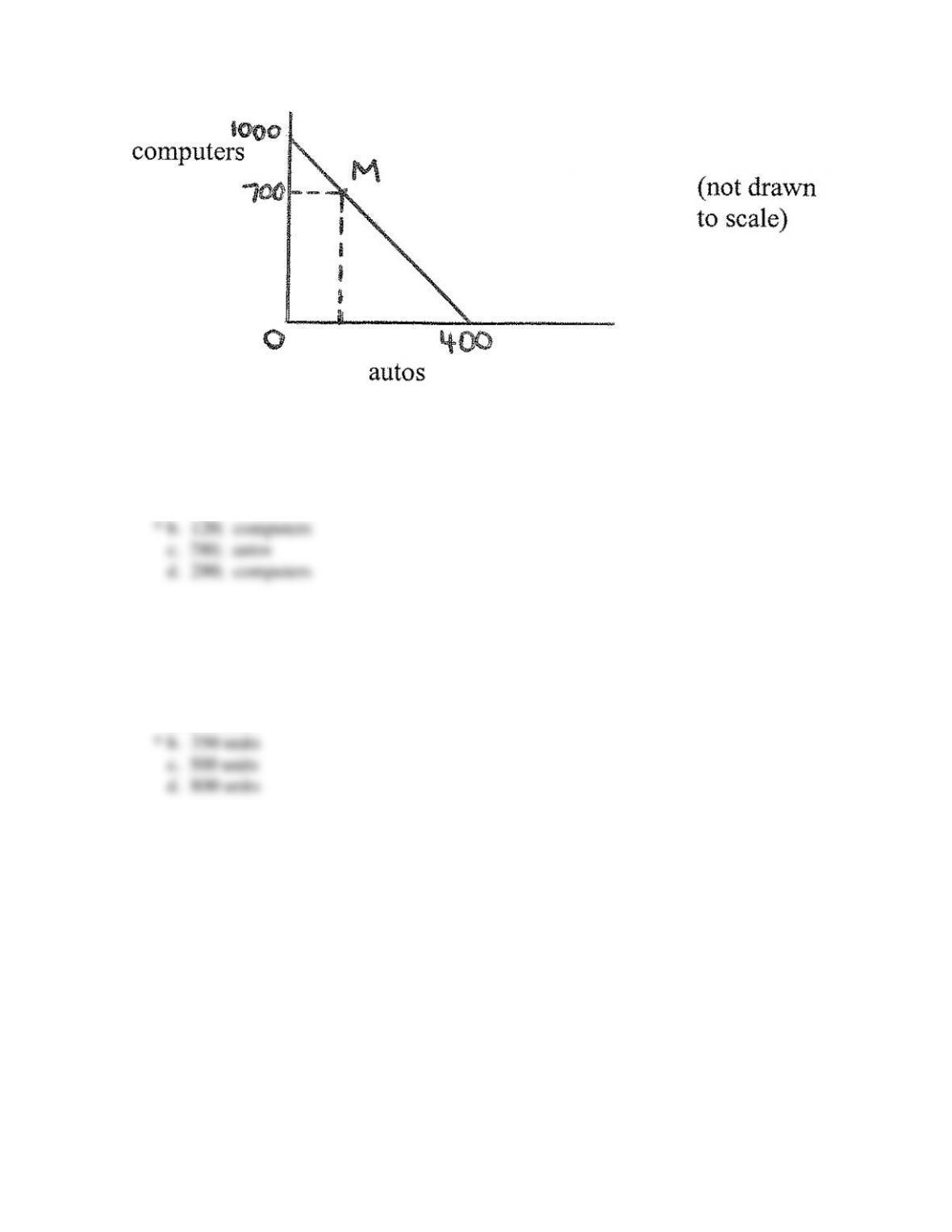
21. Suppose that a country in the Classical model has the following production-possibilities
frontier (PPF):
15
If, in autarky, the country is producing 700 computers and is located at point M on the
PPF, the country would be producing __________ autos. If the country is now opened to
trade at a terms of trade of 1 auto: 2 computers (or 1 computer: 0.5 auto), it would export
__________.
a. 120; autos
22. In Question #21 above, suppose that the country, when it is opened to trade, did not
change its production combination from the production combination at point M. In this
situation, how many units of its import good could the country obtain if it exported all of
the export good that it produced?
a. 240 units
23. If, in a two-commodity, two-country Classical world, Sweden can make a unit of
furniture with 10 days of labor and a unit of steel with 15 days labor, while Germany can
make a unit of furniture with 12 days of labor and a unit of steel with 12 days labor, then
16
a. Sweden has an absolute advantage in steel and Germany has an absolute advantage in
furniture.
24. Given the following Ricardo-type table showing the amount of labor input required to
produce one unit of output of each of the two goods in each of the two countries:
Wheat Clothing
United Kingdom 6 days 5 days
United States 4 days 3 days
d. A post-trade price ratio (terms of trade) of 1 wheat:1.5 clothing is a feasible
equilibrium post-trade price ratio.
25. In Question #24 above,
a. if the United Kingdom were a much larger country than the United States, then, other
things equal, the terms of trade would tend to be located more toward the U.S.
pre-trade price ratio than toward the U.K. pre-trade price ratio.
26. Given the following Ricardo-type table showing the amount of labor input required to
produce one unit of output of each of the two goods in each of the two countries:
Shirts Machines
17
France 3 days 5 days
Germany 2 days 4 days
France has an absolute advantage in __________ and a comparative advantage in
__________.
a. both goods; machines
27. In Question #26 above,
a. a post-trade price ratio (terms of trade) of 1 shirt:0.75 machine is a feasible post-trade
price ratio.
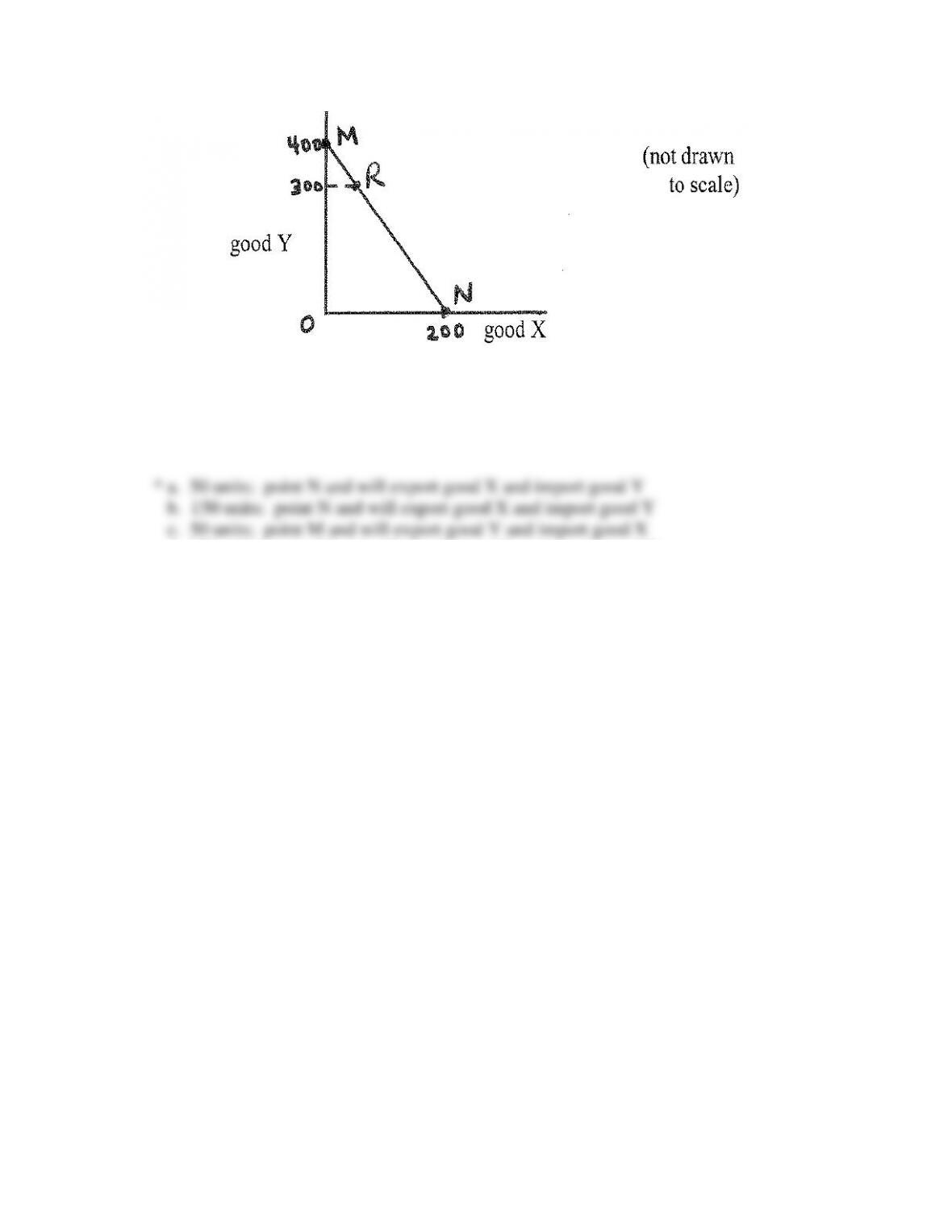
28. Country A has the following constant-opportunity-costs production-possibilities frontier
(PPF):
18
Suppose that this country in autarky is located at point R on its PPF, where it is producing
300 units of good Y and __________ of good X. Suppose that country A is now opened
to trade and can trade at a terms of trade of 1X:3Y. Assuming complete specialization in
production, the country will now produce at __________.
d. 150 units; point M and will export good Y and import good X