
International Economics, 10e (Krugman/Obstfeld/Melitz)
Chapter 3 Labor Productivity and Comparative Advantage: The Ricardian Model
3.1 The Concept of Comparative Advantage
1) Trade between two countries can benefit both countries if
A) each country exports that good in which it has a comparative advantage.
B) each country enjoys superior terms of trade.
C) each country has a more elastic demand for the imported goods.
D) each country has a more elastic supply for the exported goods.
E) each country produces a wide range of goods for export.
2) In order to know whether a country has a comparative advantage in the production of one
particular product we need information on at least ________ unit labor requirements
A) one
B) two
C) three
D) four
E) five
3) A country engaging in trade according to the principles of comparative advantage gains from
trade because it
A) is producing exports indirectly more efficiently than it could alternatively.
B) is producing imports indirectly more efficiently than it could domestically.
C) is producing exports using fewer labor units.
D) is producing imports indirectly using fewer labor units.
E) is producing exports while outsourcing services.

4) Given the information in the table above, if it is ascertained that Foreign uses prison-slave
labor to produce its exports, then home should
A) export cloth.
B) export widgets.
C) export both and import nothing.
D) export and import nothing.
E) export widgets and import cloth.
5) Given the information in the table above, if the Home economy suffered a meltdown, and the
Unit Labor Requirements doubled to 20 for cloth and 40 for widgets then home should
A) export cloth.
B) export widgets.
C) export both and import nothing.
D) export and import nothing.
E) export widgets and import cloth.
6) The earliest statement of the principle of comparative advantage is associated with
A) David Hume.
B) David Ricardo.
C) Adam Smith.
D) Eli Heckscher.
E) Bertil Ohlin.
7) The Ricardian model attributes the gains from trade associated with the principle of
comparative advantage result to
A) differences in technology.
B) differences in preferences.
C) differences in labor productivity.
D) differences in resources.
E) gravity relationships among countries.
8) The Ricardian model demonstrates that
A) trade between two countries will benefit both countries.
B) trade between two countries may benefit both regardless of which good each exports.
C) trade between two countries may benefit both if each exports the product in which it has a
comparative advantage.
D) trade between two countries may benefit one but harm the other.
E) trade between two countries always benefits the country with a larger labor force.
3.2 A One-Factor Economy
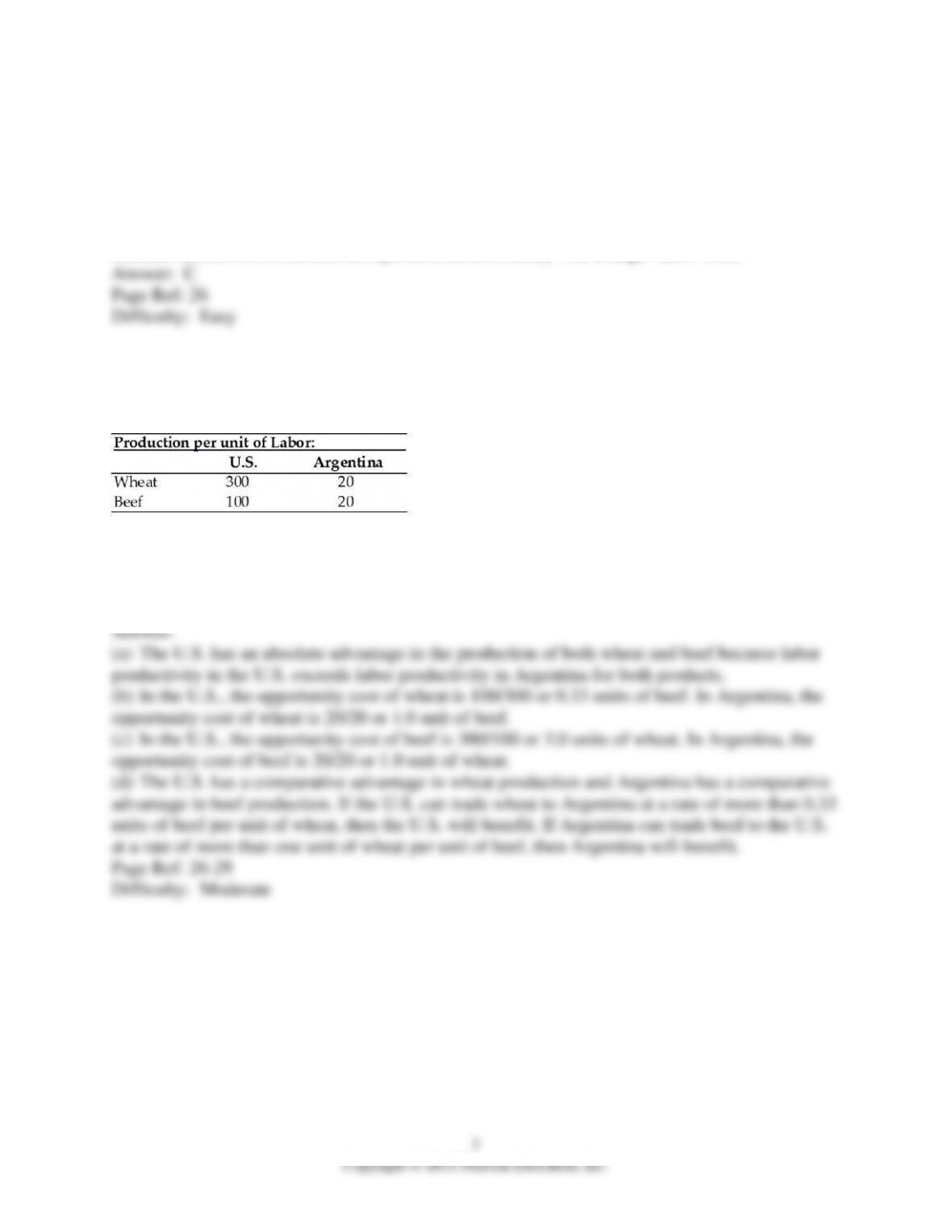
1) Use the information in the table below to answer the following questions.
(a) Does either country have an absolute advantage in the production of wheat or beef? Explain.
(b) What is the opportunity cost of wheat in each country?
(c) What is the opportunity cost of beef in each country?
(d) Analyze comparative advantage and opportunities for trade between the U.S. and Argentina.
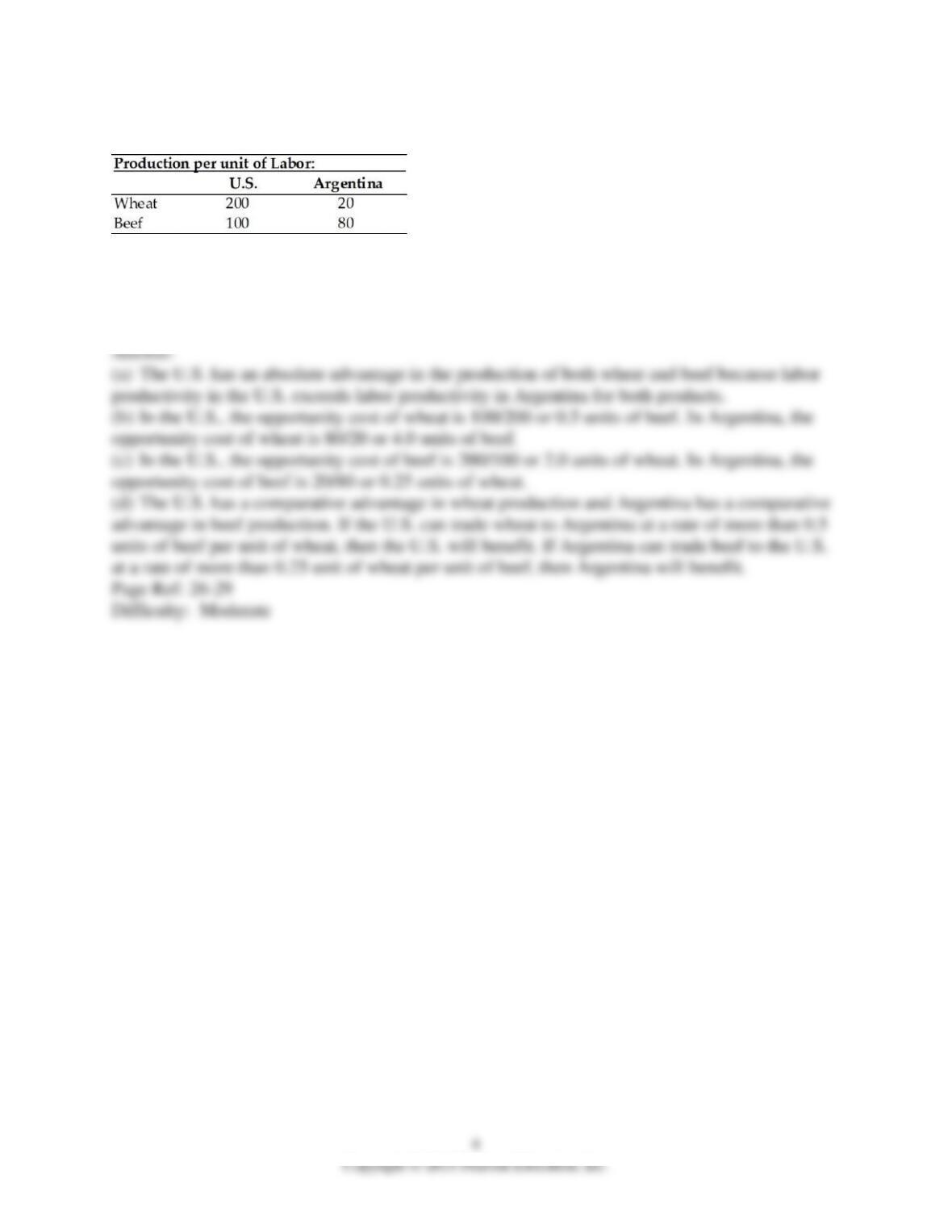
2) Use the information in the table below to answer the following questions.
(a) Does either country have an absolute advantage in the production of wheat or beef? Explain.
(b) What is the opportunity cost of wheat in each country?
(c) What is the opportunity cost of beef in each country?
(d) Analyze comparative advantage and opportunities for trade between the U.S. and Argentina.
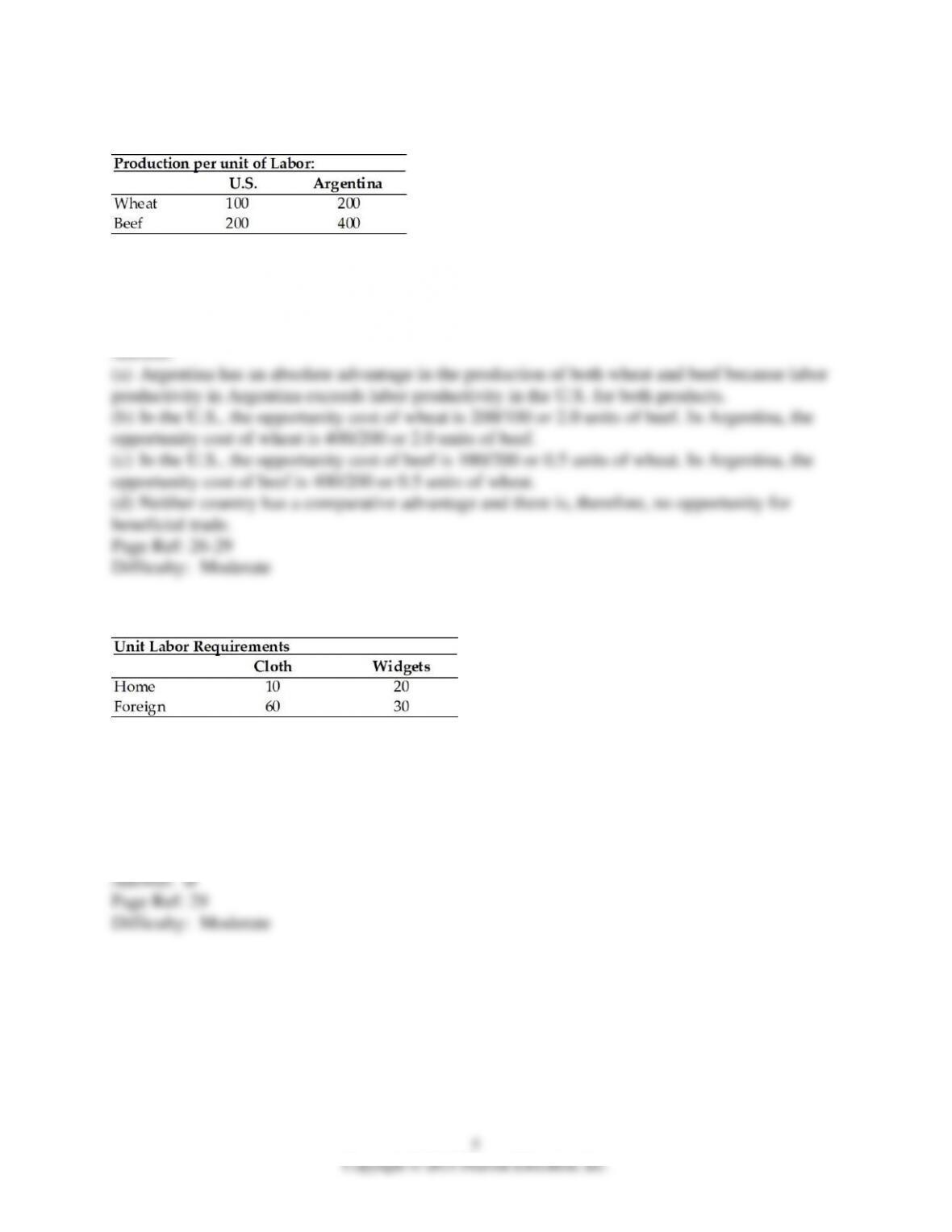
3) Use the information in the table below to answer the following questions.
(a) Does either country have an absolute advantage in the production of wheat or beef? Explain.
(b) What is the opportunity cost of wheat in each country?
(c) What is the opportunity cost of beef in each country?
(d) Analyze comparative advantage and opportunities for trade between the U.S. and Argentina.
3.3 Trade in a One-Factor World
1) Given the information in the table above
A) neither country has a comparative advantage in cloth.
B) Home has a comparative advantage in cloth.
C) Foreign has a comparative advantage in cloth.
D) Home has a comparative advantage in both cloth and widgets.
E) neither country has a comparative advantage in widgets.

2) Given the information in the table above, if wages were to double in Home, then Home should
A) export cloth.
B) export widgets.
C) export both and import nothing.
D) export and import nothing.
E) export widgets and import cloth.
3) Given the information in the table above
A) neither country has a comparative advantage in cloth.
B) Home has a comparative advantage in widgets.
C) Foreign has a comparative advantage in widgets.
D) Home has a comparative advantage in both cloth and widgets.
E) neither country has a comparative advantage in widgets.
4) Given the information in the table above, Home’s opportunity cost of cloth is
A) 0.5.
B) 2.0.
C) 6.0.
D) 1.5.
E) 3.0.
5) Given the information in the table above, Home’s opportunity cost of widgets is
A) 0.5.
B) 2.0.
C) 6.0.
D) 1.5.
E) 3.0.

6) Given the information in the table above, Foreign’s opportunity cost of cloth is
A) 0.5.
B) 2.0.
C) 6.0.
D) 1.5.
E) 3.0.
7) Given the information in the table above, Foreign’s opportunity cost of widgets is
A) 0.5.
B) 2.0.
C) 6.0.
D) 1.5.
E) 3.0.
8) Given the information in the table above, if the world equilibrium price of widgets were 4
cloth, then
A) both countries could benefit from trade with each other.
B) neither country could benefit from trade with each other.
C) each country will want to export the good in which it enjoys comparative advantage.
D) neither country will want to export the good in which it enjoys comparative advantage.
E) both countries will want to specialize in cloth.
9) Given the information in the table above, if the world equilibrium price of widgets were 40
cloths, then
A) both countries could benefit from trade with each other.
B) neither country could benefit from trade with each other.
C) each country will want to export the good in which it enjoys comparative advantage.
D) neither country will want to export the good in which it enjoys comparative advantage.
E) both countries will want to specialize in cloth.

10) In a two product two country world, international trade can lead to increases in
A) consumer welfare only if output of both products is increased.
B) output of both products and consumer welfare in both countries.
C) total production of both products but not consumer welfare in both countries.
D) consumer welfare in both countries but not total production of both products.
E) prices of both goods in both countries.
11) As a result of trade, specialization in the Ricardian model tends to be
A) complete with constant costs and with increasing costs.
B) complete with constant costs and incomplete with increasing costs.
C) incomplete with constant costs and complete with increasing costs.
D) incomplete with constant costs and incomplete with increasing costs.
E) dependent on the specific opportunity costs involved in production.
12) As a result of trade between two countries which are of completely different economic sizes,
specialization in the Ricardian 2X2 model tends to
A) be incomplete in both countries.
B) be complete in both countries.
C) be complete in the small country but incomplete in the large country.
D) be complete in the large country but incomplete in the small country.
E) sustain one countries economy in in direct proportion to the other.
13) A nation engaging in trade according to the Ricardian model will find its consumption
bundle
A) inside its production possibilities frontier.
B) on its production possibilities frontier.
C) outside its production possibilities frontier.
D) inside its trade-partner’s production possibilities frontier.
E) on its trade-partner’s production possibilities frontier.

14) In the Ricardian model, if a country’s trade is restricted, this will cause all EXCEPT which?
A) limited specialization and the division of labor
B) reduced volume of trade and reduced gains from trade
C) nations to produce inside their production possibilities curves
D) a country to produce some of the product of its comparative disadvantage
E) raised costs as more diverse product is produced internally
15) If a very small country trades with a very large country according to the Ricardian model,
then
A) the small country will suffer a decrease in economic welfare.
B) the large country will suffer a decrease in economic welfare.
C) the small country only will enjoy gains from trade.
D) the large country will enjoy gains from trade.
E) both countries will enjoy equal gains from trade.
16) If the world terms of trade for a country are somewhere between the domestic cost ratio of H
and that of F, then
A) country H but not country F will gain from trade.
B) country H and country F will both gain from trade.
C) neither country H nor F will gain from trade.
D) only the country whose government subsidizes its exports will gain.
E) country F but not country H will gain from trade.
17) If the world terms of trade equal those of country F, then
A) country H but not country F will gain from trade.
B) country H and country F will both gain from trade.
C) neither country H nor F will gain from trade.
D) only the country whose government subsidizes its exports will gain.
E) country F but not country H will gain from trade.

18) If the world terms of trade equal those of country H, then
A) country H but not country F will gain from trade.
B) country H and country F will both gain from trade.
C) neither country H nor F will gain from trade.
D) only the country whose government subsidizes its exports will gain.
E) country F but not country H will gain from trade.
19) According to Ricardo, a country will have a comparative advantage in the product in which
its
A) labor productivity is relatively low.
B) labor productivity is relatively high.
C) labor mobility is relatively low.
D) labor mobility is relatively high.
E) labor is outsourced to neighboring countries.
20) Assume that labor is the only factor of production and that wages in the United States equal
$20 per hour while wages in Japan are $10 per hour. Production costs would be lower in the
United States as compared to Japan if
A) U.S. labor productivity equaled 40 units per hour and Japan’s 15 units per hour.
B) U.S. labor productivity equaled 30 units per hour and Japan’s 20 units per hour.
C) U.S. labor productivity equaled 20 units per hour and Japan’s 30 units per hour.
D) U.S. labor productivity equaled 15 units per hour and Japan’s 25 units per hour.
E) U.S. labor productivity equaled 15 units per hour and Japan’s 40 units per hour.
21) If two countries engage in Free Trade following the principles of comparative advantage,
then
A) neither relative prices nor relative marginal costs (marginal rates of transformation-MRTs) in
one country will equal those in the other country.
B) both relative prices and MRTs will become equal in both countries.
C) relative prices but not MRTs will become equal in both countries.
D) MRTs but not relative prices will become equal in both countries.
E) trade will be unrestricted, regardless of relative costs and MRTs.

22) Let us define the real wage as the purchasing power of one hour of labor. In the Ricardian
2X2 model, if two countries under autarky engage in trade then
A) the real wage will not be affected since this is a financial variable.
B) the real wage will increase only if a country attains full specialization.
C) the real wage will increase in one country only if it decreases in the other.
D) the real wage will rise in both countries.
E) the real wage will fall under pressure of international competition.
23) In a two country and two product Ricardian model, a small country is likely to benefit more
than the large country because
A) the large country will wield greater political power, and hence will not yield to market
signals.
B) the small country is less likely to trade at price equal or close to its autarkic (domestic)
relative prices.
C) the small country is more likely to fully specialize.
D) the small country is less likely to fully specialize.
E) the small country can raise wages.
24) In the Ricardian model, comparative advantage is likely to be due to
A) scale economies.
B) home product taste bias.
C) greater capital availability per worker.
D) labor productivity differences.
E) political pressure.