International Economics, 7e (Gerber)
Chapter 3 Comparative Advantage and the Gains from Trade
3.1 Introduction: The Gains from Trade
1) Which of the following is true?
A) Adam Smith proposed the theory of comparative advantage as the basis for trade in The
Wealth of Nations.
B) David Ricardo proposed the theory of absolute advantage as the basis for trade.
C) Absolute advantage is based on comparing the opportunity costs of trading partners.
D) The Ricardian model assumes labor is perfectly mobile.
2) The economic philosophy that favors strict limits on imports and strong support for exports is
called
A) zero sum.
B) mercantilism.
C) comparative advantage.
D) absolute advantage.
3)
U.S.
U.K
Wheat
12
6
Cloth
6
18
The table above shows United States and United Kingdom production of wheat (bushels per
hour) and cloth (yards per hour).
According to Adam Smith, which of the following is true?
A) The United States has an absolute advantage in the production of wheat.
B) The United States has an absolute advantage in the production of cloth.
C) There is no basis for trade between these countries.
D) The United States will gain more from trade than the United Kingdom.
4)
U.S.
U.K
Wheat
12
6
Cloth
6
18
The table above shows United States and United Kingdom production of wheat (bushels per
hour) and cloth (yards per hour).
In order for both countries to gain from trade, one bushel of wheat must trade for
A) between 6 and 18 yards of cloth.
B) between 1/2 and 2 yards of cloth.
C) between 1/3 and 3 yards of cloth.
D) between 1/2 and 1/3 yards of cloth.
5) A country will gain relatively more from trade when
A) trade is regulated.
B) the world price is close to the country’s opportunity cost of the good.
C) the world price is below the country’s opportunity cost of the good.
D) the world price is much greater than the country’s opportunity cost for the good.
6) Mercantilists perceived trade as a zero sum game.
7) Adam Smith created the theory of comparative advantage.
8) What type of policies did Adam Smith attack in his book, An Inquiry into the Nature and
Causes of the Wealth of Nations?
9) What did Adam Smith perceive was primarily responsible for improving standard of living?
10) What is productivity?
11) In the simple trade model, what is assumed about labor?
12) Which economist introduced the simple trade model and the concept of trade based on
comparative advantage?
13) Why did Adam Smith criticize the trade barriers imposed by the mercantilists?
3.2 Comparative Productivity Advantage and the Gains from Trade
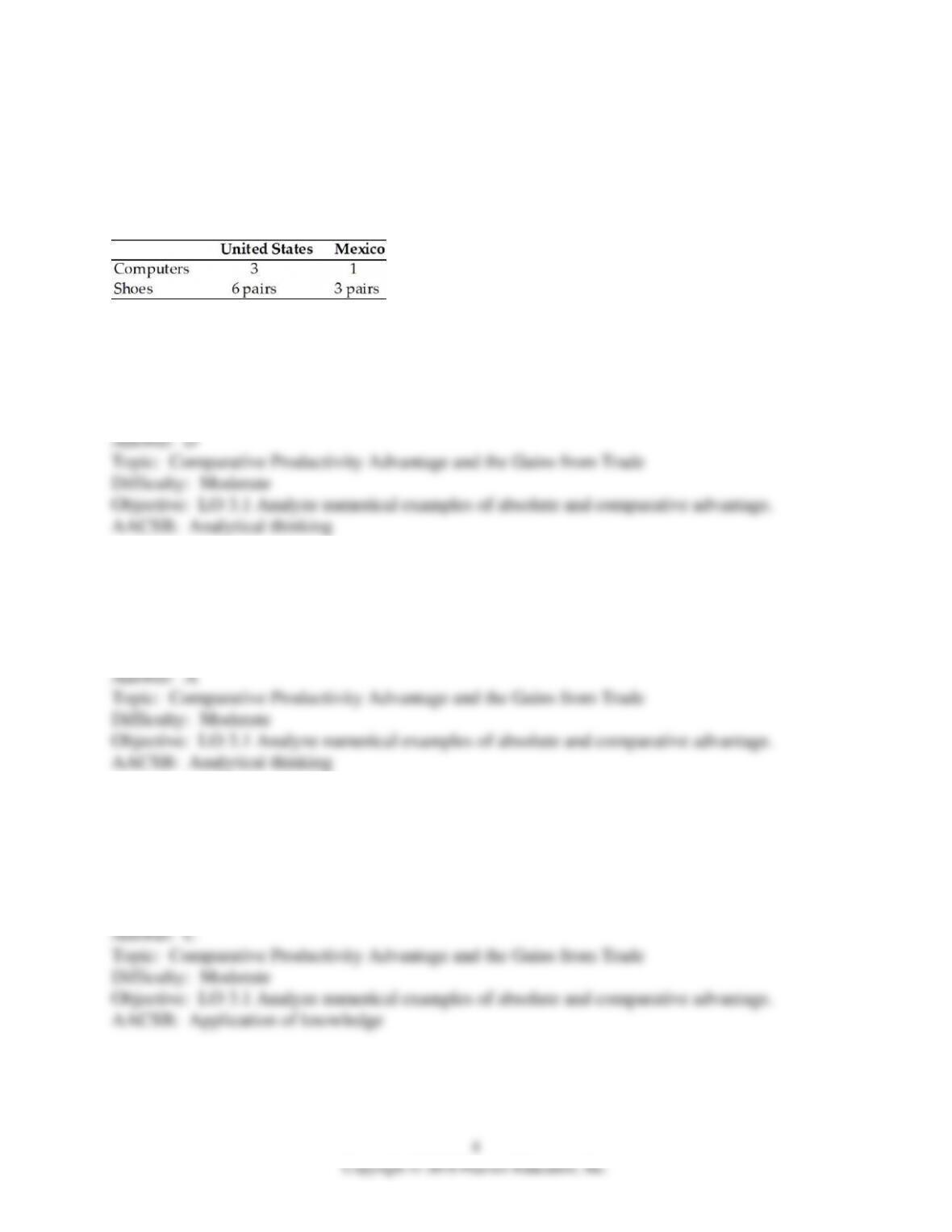
Use the data in the table below to answer the following question(s):
Table 3.1
Output per Hour Worked
1) Based on Table 3.1, the opportunity cost of a pair of shoes in the United States is
A) three computers.
B) two computers.
C) one computer.
D) one-half computer.
2) Based on Table 3.1, the pre-trade relative price of a computer in Mexico is
A) three pairs of shoes.
B) one pair of shoes.
C) one-half pair of shoes.
D) one-third pair of shoes.
3) Based on Table 3.1, trade between the United States and Mexico will occur as long as the
relative price of shoes is between
A) three computers and one computer.
B) three computers and two computers.
C) one-half computer and one-third computer.
D) six computers and three computers.
4) Based on Table 3.1, which country or countries has an absolute advantage and a comparative
advantage in shoes?
A) Mexico has an absolute and comparative advantage in shoes.
B) The United States has an absolute and comparative advantage in shoes.
C) The United States has a comparative advantage, and Mexico has an absolute advantage in
shoes.
D) Mexico has a comparative advantage, and the United States has an absolute advantage in
shoes.
5) Based on Table 3.1, if the world price of computers is four pairs of shoes, then the optimal
strategy for each country would be
A) to specialize in shoes.
B) to specialize in computers.
C) for Mexico to specialize in shoes, and the United States in computers.
D) for the United States to specialize in shoes, and Mexico in computers.
6) Suppose Mexico can produce 5 autos or 10 corn. Suppose the United States can produce 4
autos or 20 corn. If opportunity costs are constant for both countries, then
A) the United States has a comparative advantage in corn production.
B) Mexico has a comparative advantage in corn production.
C) the United States cannot gain from trade with Mexico.
D) the United States has a comparative advantage in auto production.
7) Suppose Mexico can produce 5 autos or 10 corn. Suppose the United States can produce 4
autos or 20 corn. If opportunity costs are constant for both countries, which of the following
would NOT be a potential terms of trade?
A) 1 auto for 3 corn
B) 1 auto for 4 corn
C) 1 corn for 1/3 of an auto
D) 1 corn for 1 auto
8) Suppose Paraguay can produce 12 wheat or 3 corn. Suppose Bolivia can produce 4 wheat or 2
corn. Suppose opportunity costs are constant. Given these production possibilities,
A) Paraguay has a comparative advantage in wheat.
B) Paraguay has a comparative advantage in corn.
C) Paraguay has a comparative advantage in both goods.
D) Paraguay has an absolute advantage in neither good.
9) Suppose that Paraguay can produce 12 wheat or 3 corn and Bolivia can produce 4 wheat or 2
corn. Suppose that opportunity costs are constant. Which of the following is a potentially
agreeable trade arrangement for Paraguay and Bolivia?
A) Paraguay trades one corn to Bolivia for three units of wheat.
B) Bolivia trades one corn to Paraguay for three units of wheat.
C) Bolivia trades one corn to Paraguay for one wheat.
D) Paraguay trades one wheat to Bolivia for two corn.
10) Suppose that Canada can produce 15 timber or 3 film and Mexico can produce 9 timber or 3
film. Suppose that opportunity costs are constant. Which of the following is FALSE?
A) Canada has an absolute advantage in timber production.
B) Mexico has a comparative advantage in film production.
C) The opportunity costs for producing timber are lower in Canada than in Mexico.
D) Canada and Mexico would find trade mutually advantageous at a ratio of one unit of film to
six units of timber.
11) Suppose that Canada can produce 15 units of timber or 3 units of grain. Suppose that Mexico
can produce 6 units of timber or 2 units of grain. Which of the following is CORRECT?
A) Mexico has a comparative advantage in grain production.
B) Mexico has an absolute advantage in timber production.
C) Canada has a comparative advantage in grain production.
D) The countries would find trade mutually beneficial at a trading ratio of 1 grain for 2 timber.
12) Suppose that Sandy can produce 10 economic reports or make 2 sales calls. Suppose Tim can
produce 2 economic reports or make 1 sales call. Which of the following is CORRECT?
A) The opportunity cost for Sandy of producing one economics report is 1/5 of a sales call.
B) The opportunity cost for Sandy of producing one sales call is 10 economics reports.
C) The opportunity cost for Tim of producing one sales call is 1/2 of an economics report.
D) The opportunity cost for Tim of producing one economics report is 2 sales calls.
13) Given that Sandy can produce 10 economics reports or make 2 sales calls and Tim can
produce 2 economics reports or make 1 sales call, we can conclude that
A) Sandy should specialize in economics reports, and Tim should specialize in sales calls.
B) Sandy should produce both economics reports and sales calls since she cannot possibly gain
from trade with Tim.
C) Tim should specialize in producing economics reports, and Sandy should specialize in
producing sales calls.
D) Tim should produce both economics reports and sales calls.
14) Given that Sandy can produce 10 economics reports or 2 sales calls and Tim can produce 2
economics reports or 1 sales call, which of the following is FALSE?
A) Sandy has a comparative advantage in sales calls.
B) Tim has a comparative advantage in sales calls.
C) Sandy has a comparative advantage in economics reports.
D) Sandy has an absolute advantage in both economics reports and sales calls.
15) Given that Sandy can produce 10 economics reports or 2 sales calls and Tim can produce 2
economics reports or 1 sales call, which of the following would NOT be a mutually agreeable
terms of trade for Sandy and Tim?
A) 1 economics report for 1 sales call
B) 1 sales call for 3 economics reports
C) 1 sales call for 4 economics reports
D) 1 economics report for 1/4 of a sales call
16) For a country in autarky, the opportunity cost of the good on the horizontal axis is the same
as
A) the relative price of the good on the vertical axis.
B) the relative price of the good on the horizontal axis.
C) the opportunity cost of the good on the vertical axis.
D) the nominal price of the good on the horizontal axis.
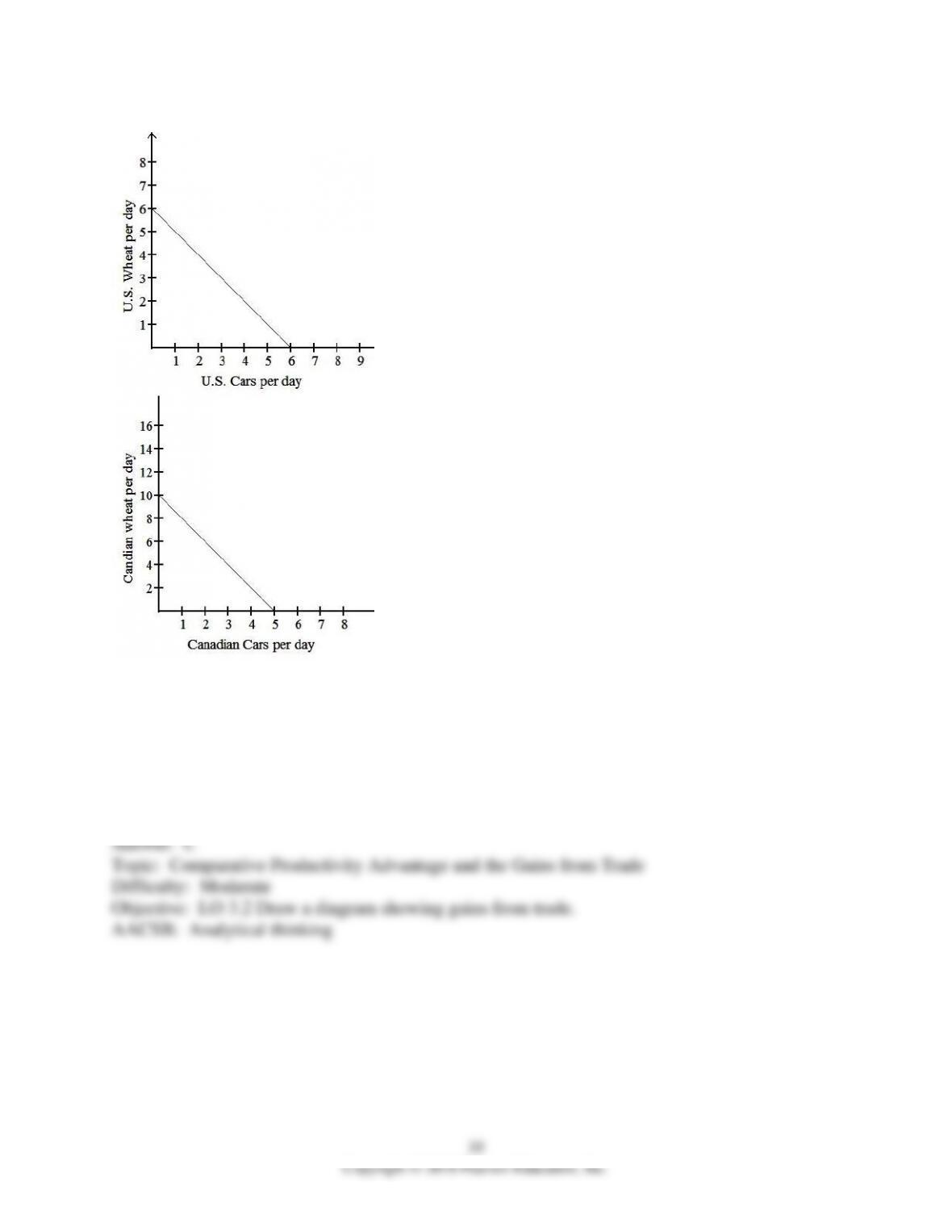
17)
The graphs above show the production possibilities curves for the U.S. and Canada, which both
produce cars and wheat.
Based on the graphs above, which of the following is true?
A) The U.S. has an absolute advantage in both goods.
B) Canada has an absolute advantage in cars.
C) The U.S. has a comparative advantage in cars.
D) The U.S. has a comparative advantage in wheat.
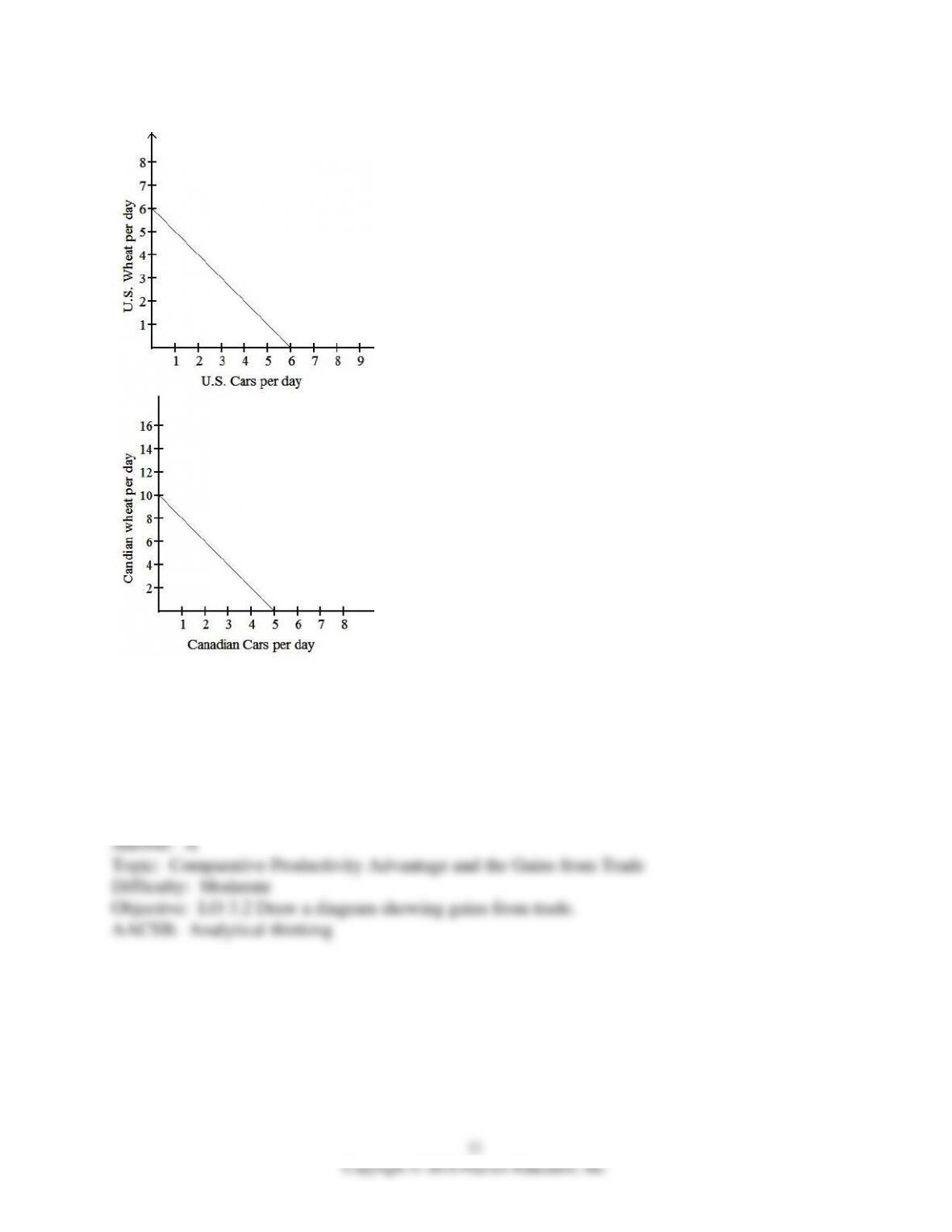
18)
The graphs above show the production possibilities curves for the U.S. and Canada, which both
produce cars and wheat.
Based on the graphs above, which of the following is true?
A) The opportunity cost of a car in the U.S. is 1 unit of wheat.
B) The opportunity cost of a car in the U.S. is 5 units of wheat.
C) The opportunity cost of a car in Canada is 1/2 unit of wheat.
D) The opportunity cost of a car in Canada is 2 units of wheat.