
Name:
Class:
Date:
chapter 3
Copyright Cengage Learning. Powered by Cognero.
Page 1
Indicate whether the statement is true or false.
1. When transportation costs are added to our trade model, the degree of specialization in production between two
countries increases, as do the gains from trade.
a. True
b. False
2. In the absence of transportation costs, free trade results in the equalization of the prices of traded goods, as well as
resource prices, in the trading nations.
a. True
b. False
3. The product-life-cycle theory applies best to trade in primary products in the short run.
a. True
b. False
4. According to the factor-endowment theory, a country will export that good which intensively uses the country’s
relatively scarce resource.
a. True
b. False
5. The magnification effect suggests that the change in the price of a resource is smaller than the change in the price of the
good that uses the resource relatively intensively.
a. True
b. False
6. According to the factor-endowment theory, international specialization and trade cause a nation’s cheap resource to
become cheaper and a nation’s expensive resource to become more expensive.
a. True
b. False
7. Intra-industry trade can be explained by product differentiation, economies of scale, seasons of the year, and
transportation costs.
a. True
b. False
8. The Heckscher-Ohlin theory suggests that land-abundant nations will export land-intensive goods while labor-abundant
nations will export labor-intensive goods.
a. True
b. False
9. The Heckscher-Ohlin theory asserts that relative differences in labor productivity underlie comparative advantage.
a. True
b. False

Name:
Class:
Date:
chapter 3
Copyright Cengage Learning. Powered by Cognero.
Page 2
10. The factor-endowment theory highlights the relative abundance of a nation’s resources as the key factor underlying
comparative advantage.
a. True
b. False
11. The specific-factors theory analyzes the income distribution effects of trade in the short run when resources are
immobile among industries.
a. True
b. False
12. The theory of overlapping demands applies best to trade in manufactured goods.
a. True
b. False
13. The Heckscher-Ohlin theory asserts that trade should occur with different factor endowments. This theory is most
accurate when explaining trade patterns between industrialized countries and developing countries.
a. True
b. False
14. Although the theory of comparative advantage explains trade in manufactured goods, it has no explanatory value for
trade in business services.
a. True
b. False
15. Assume that labor is relatively scarce in the United States. According to the factor-price equalization theory,
American labor may opt for trade barriers once trade opens up.
a. True
b. False
16. According to the product-life-cycle theory, the first stage of a product’s trade cycle is when it is introduced to the
home market.
a. True
b. False
17. Fears about the downward pressure that low-skilled foreign workers place on the wages of U.S. low-skilled workers
have led U.S. labor unions to lobby for import restrictions such as tariffs and quotas.
a. True
b. False
18. Dynamic comparative advantage refers to the creation of comparative advantage through the mobilization of skilled
labor, technology, and capital.
a. True
b. False
19. The Heckscher-Ohlin theory emphasizes the role of consumer demand in the creation of comparative advantage.

Name:
Class:
Date:
chapter 3
Copyright Cengage Learning. Powered by Cognero.
Page 3
a. True
b. False
20. Empirical studies conclude that U.S. environmental policies are a more important determinant of trade performance
than capital, raw materials, labor skills, and wages.
a. True
b. False
21. According to the product life cycle theory, comparative advantage shifts from cheap-labor countries to high-
technology countries after a manufactured good becomes standardized.
a. True
b. False
22. The factor-price equalization theory is a short-run version of the specific-factors theory.
a. True
b. False
23. Although some people may be harmed by international trade, the Heckscher-Ohlin theory asserts that free trade will
promote the standard of living for the nation as a whole.
a. True
b. False
24. Owners of resources specific to export industries tend to lose from international trade, while owners of factors specific
to import-competing industries tend to gain.
a. True
b. False
25. Ricardo’s theory of comparative advantage is a static theory that does not consider changes in international
competitiveness over the long run.
a. True
b. False
26. According to Staffan Linder, the factor-endowment theory is useful in explaining trade patterns in manufactured
goods, but not primary products.
a. True
b. False
27. According to the product-life-cycle theory, the last stage of a product’s trade cycle is when it becomes an import-
competing good.
a. True
b. False
28. Both the Ricardo model of comparative advantage and the Heckscher-Ohlin theory assert that trade patterns are
largely the result of differences in endowments of factors of production.
a. True

Name:
Class:
Date:
chapter 3
Copyright Cengage Learning. Powered by Cognero.
Page 4
b. False
29. According to the factor-priceequalization theory, international trade encourages the elimination of relative resource
prices between nations.
a. True
b. False
30. The theory of overlapping demands asserts that trade in manufactured goods is stronger the less similar the demand
structures of two countries.
a. True
b. False
31. The factor-endowment theory asserts that specialization and trade tends to encourage an equalization in the relative
resource prices of trading partners.
a. True
b. False
32. The product lifecycle theory contends that when a new product is introduced to the home market, it generally requires
low-skilled labor to produce it.
a. True
b. False
33. Most developing countries have pollution-control laws and enforcement policies that are more stringent than those of
the major industrial countries.
a. True
b. False
34. Intra-industry trade would occur if computers manufactured in the United States by IBM were exported to Japan while
the United States imported computers manufactured by Hitachi of Japan.
a. True
b. False
35. The Heckscher-Ohlin theory contends that over a period of years, a country that initially is an exporter of a product
will become an importer of that product.
a. True
b. False
36. Because seasons in the southern hemisphere are opposite those in the northern hemisphere, one would expect intra-
industry trade to occur in agricultural products.
a. True
b. False
37. The Leontief Paradox suggested that, in contrast to the predictions of the factor-endowment theory, U.S. exports were
less capital-intensive than U.S. import-competing goods.
a. True

Name:
Class:
Date:
chapter 3
Copyright Cengage Learning. Powered by Cognero.
Page 5
b. False
38. Generally speaking, transportation costs are more important than production costs as a source of comparative
advantage.
a. True
b. False
39. The Leontief Paradox was the first major challenge to the product-life-cycle theory of trade.
a. True
b. False
40. According to the specific-factors theory, resources that are specific to import-competing industries tend to lose as a
result of trade, while resources specific to export industries tend to gain as a result of trade.
a. True
b. False
41. A change in factor endowments tends to have a similar impact on a production possibilities frontier as a change in
technology.
a. True
b. False
42. Europe’s jumbo-jet manufacturer, Airbus, has justified receiving governmental subsidies with the argument that the
subsidies prevent the United States from becoming a monopoly in the jumbo-jet market.
a. True
b. False
43. Industrial processes that add weight or bulk to a commodity are likely to be located near the resource market to
minimize transportation costs.
a. True
b. False
44. With economies of scale, specialization in a few products allows a manufacturer to benefit from longer production
runs, which lead to decreasing average cost.
a. True
b. False
45. By widening the size of the domestic market, international trade permits companies to take advantage of longer
production runs and increasing efficiencies such as mass production.
a. True
b. False
46. The Heckscher-Ohlin model assumes that tastes and preferences, and also factor endowments, are identical for trading
nations.
a. True
b. False

Name:
Class:
Date:
chapter 3
Copyright Cengage Learning. Powered by Cognero.
Page 6
47. The existence of transportation costs tends to result in increasing gains that a country receives from trade.
a. True
b. False
48. The imposition of pollution-control regulations on domestic steel manufacturers leads to decreases in production costs
and an improvement in the steel manufacturers’ competitiveness.
a. True
b. False
49. Empirical testing by Wassily Leontief gave support to the Heckscher-Ohlin theory of trade.
a. True
b. False
50. The imposition of government regulations (clean environment, workplace safety, product safety) on domestic steel
companies tends to result in lower production costs and improved competitiveness.
a. True
b. False
51. The theory of overlapping demands contends that international trade in manufactured products is strongest among
nations with similar income levels.
a. True
b. False
52. According to Ricardian theory, comparative advantage depends on relative differences in labor productivity.
a. True
b. False
53. Industrial policy includes using governmental subsidies as a tool to provide domestic firms an edge over foreign
competitors in domestic and foreign markets.
a. True
b. False
54. According to the factor-endowment theory, a country will import that good which intensively uses the country’s
relatively abundant resource.
a. True
b. False
55. Decreasing cost conditions lead to complete specialization in the production of the commodity of comparative
advantage.
a. True
b. False

Name:
Class:
Date:
chapter 3
Copyright Cengage Learning. Powered by Cognero.
Page 7
56. In industries where the final product is much less weighty or bulky than the materials from which it is made, firms
tend to locate production near resource supplies.
a. True
b. False
57. According to the theory of overlapping demands, trade in manufactured goods would be greater among two wealthy
countries than among a wealthy country and a poor country.
a. True
b. False
58. When transportation costs are added to our trade model, the low-cost exporting country produces less, consumes more,
and exports less than that which occurs in the absence of transportation costs.
a. True
b. False
59. In his test of the Heckscher-Ohlin model, W. Leontief found that, although the United States was perceived as being
capital abundant relative to the rest of the world, U.S. exports were less capital intensive than import-competing goods.
a. True
b. False
60. According to the theory of intra-industry trade, many manufactured goods undergo a trade cycle in which the home
country initially is an exporter and eventually becomes an importer of a product.
a. True
b. False
61. Industrial policy seeks to direct resources to declining industries in which productivity is low, linkages to the rest of
the economy are weak, and future competitiveness is remote.
a. True
b. False
62. A product will be traded only if the cost of transporting it between nations is less than the pretrade difference between
their relative product prices.
a. True
b. False
63. The increased use of robots, combined with rising labor costs in China, has led some U.S. businesses to return to
manufacturing in the United States.
a. True
b. False
64. The product life cycle theory predicts that patterns of comparative advantage change over time. A country that initially
exports a product to other countries tends to become a net importer of the product.
a. True
b. False

Name:
Class:
Date:
chapter 3
Copyright Cengage Learning. Powered by Cognero.
Page 8
65. Brazil is labor abundant relative to Germany if the ratio of labor to capital in Brazil is higher than that in Germany.
a. True
b. False
66. With decreasing costs, a country has an incentive to partially specialize in the product of its comparative advantage.
a. True
b. False
Indicate the answer choice that best completes the statement or answers the question.
67. Internal economies of scale provide the incentive for countries to
a. specialize in a few products.
b. manufacture a wider range of products.
c. specialize in products that are in demand abroad.
d. manufacture only a few units of products that are in demand.
68. Which trade theory predicts that countries with similar preferences and technologies but dissimilar factor endowments
will experience potential gains from trade?
a. specific-factors theory
b. Stolper-Samuelson theorem
c. Linder’s theory
d. Heckscher-Ohlin theory
69. To justify the subsidies it has received from European governments, The Airbus Company has used all of the
following arguments EXCEPT
a. its subsidies have prevented U.S. aircraft firms from holding a world-wide monopoly.
b. U.S. aircraft firms have benefited from military-sponsored programs of the U.S. government.
c. Airbus’ subsidies were totally repaid as the firm realized profits on its aircraft sales.
d. without subsidies to Airbus, Europe would be dependent on the United States as a supplier of aircrafts.
70. Proponents of ____ maintain that government should enact policies that encourage the development of emerging
“sunrise” industries.
a. product life cycle policy
b. static comparative advantage policy
c. intra-industry trade policy
d. industrial policy
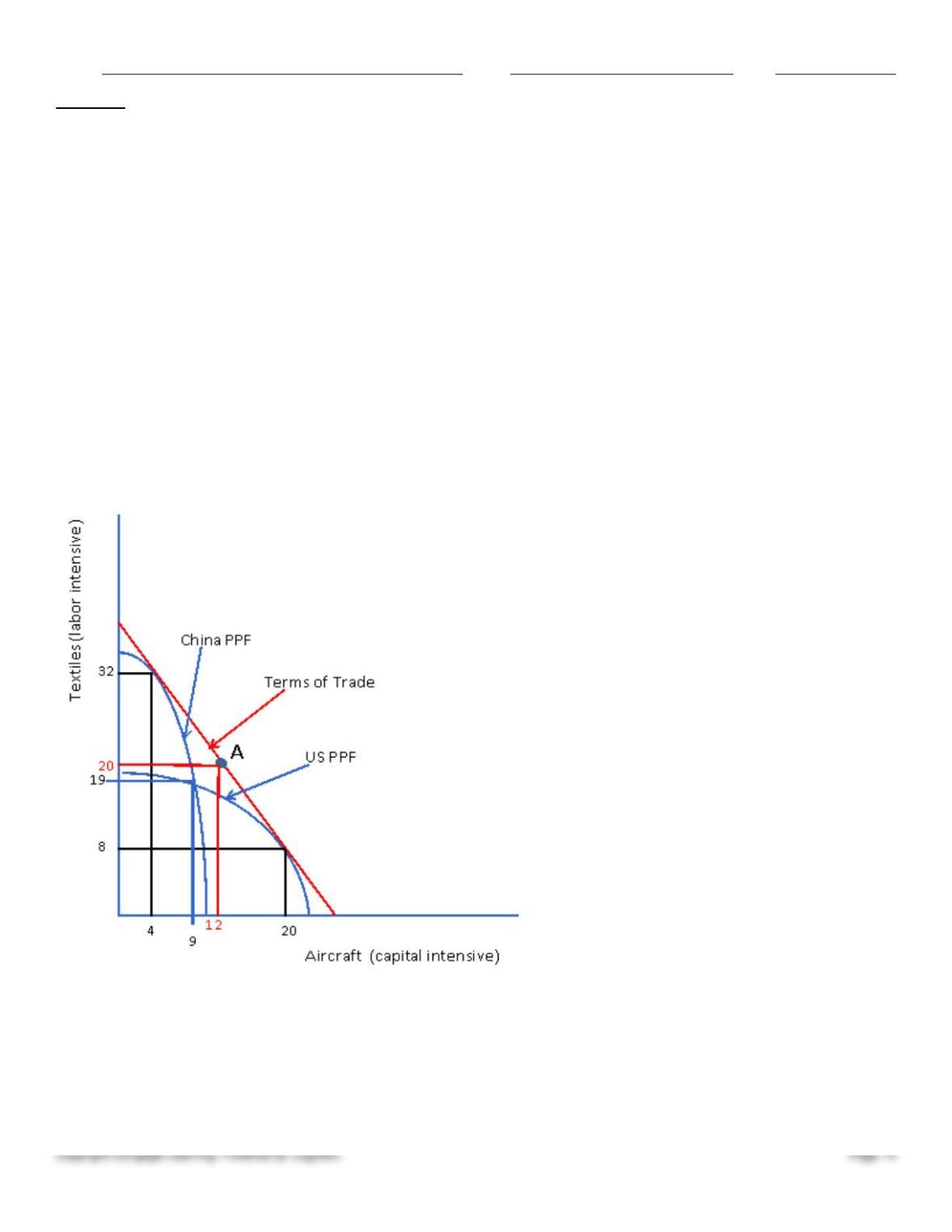
71. Considering Figure 1, what are the terms of trade represented?
a. The terms of trade are 1½ aircraft per textile.
b. The terms of trade are 1½ textiles per aircraft.
c. The terms of trade are 1 textile per aircraft.
d. The terms of trade are 2/3 textile per aircraft.
72. Boeing Inc. has criticized The Airbus Company’s competitiveness on the grounds that Airbus benefits from
a. import tariffs protecting Airbus in the European market.

Name:
Class:
Date:
chapter 3
Copyright Cengage Learning. Powered by Cognero.
Page 9
b. import quotas protecting Airbus in the European market.
c. lenient environmental standards of European governments.
d. subsidies supplied by European governments.
73. According to the product life cycle theory, trade between countries is caused by
a. diseconomies of large scale production.
b. differences in per-capita income levels.
c. the occurrence of monopolies and oligopolies.
d. changing patterns of comparative advantage.
74. The Leontief paradox provided
a. support for the principle of comparative advantage.
b. support for the factor-endowment theory.
c. evidence against the factor-endowment theory.
d. evidence against the principle of comparative advantage.
75. As industry output increases, suppose that new knowledge about production technology spreads among firms in the
area through direct contacts among firms or as workers transfer from firm to firm. Which concept does this example
demonstrate?
a. internal economies of scale
b. external economies of scale
c. the home market effect
d. specialization in production
76. Pollution legislation requiring domestic manufacturers to install pollution abatement equipment tends to promote
a. higher production costs and an increase in output.
b. higher production costs and a decrease in output.
c. lower production costs and an increase in output.
d. lower production costs and a decrease in output.
77. The Leontief paradox questioned the validity of the theory of
a. comparative advantage.
b. factor endowments.
c. overlapping demands.
d. absolute advantage.
78. The Leontief paradox
a. supported the factor-endowment theory.
b. concluded that exports were less capital intensive than import-competing goods.
c. found that national income differences underlie world trade patterns.
d. implied that diseconomies of scale occur at low output levels.
79. Which trade theory suggests that comparative advantage tends to shift from one nation to another as a product
matures?
a. factor-price equalization theory
b. factor-endowment theory

Name:
Class:
Date:
chapter 3
Copyright Cengage Learning. Powered by Cognero.
Page 10
c. product life cycle theory
d. theory of comparative advantage
80. Dynamic comparative advantage involves
a. industrial policy to create comparative advantage.
b. less governmental involvement in the economy.
c. reduced rules and regulations imposed by foreign governments.
d. accepting and working with existing resources.
81. Which of the following is NOT a claim made by industrial-policy critics?
a. Industrial policies result in protectionism and inhibit trade.
b. Industrial policies can promote “pork barrel” politics.
c. Industries do not receive enough governmental assistance.
d. Trading nations will develop policy that encourages “beggar thy neighbor” practices.
82. According to the factor-endowment theory,
a. the abundant factor gains from trade.
b. the scarce factor gains from trade.
c. those disadvantaged by trade outnumber those advantaged by trade.
d. everyone necessarily benefits from trade.
83. Which products would LEAST apply to the product life cycle theory?
a. calculators and computers
b. coal and crude oil
c. home movie cameras
d. office machinery
84. Stringent governmental regulations (e.g., air quality standards) imposed on domestic steel manufacturers tend to
a. increase the competitiveness of domestic steel manufacturers in the international market.
b. reduce the competitiveness of domestic steel manufacturers in the international market.
c. increase the profitability and productivity of domestic steel manufacturers.
d. reduce the market share of foreign firms selling steel in the domestic market.
85. Should international transportation costs decrease, the effect on international trade would include
a. an increase in the total volume of trade.
b. a smaller gain from trade for exporters.
c. a decline in exported goods.
d. a decrease in the level of specialization in production.
86. According to Staffan Linder, trade between two countries tends to be MOST pronounced when the countries
a. have similar tastes and preferences.
b. experience economies of large-scale production over large output levels.
c. have good political relationships.
d. have approximately the same per capita income levels.

Name:
Class:
Date:
chapter 3
Copyright Cengage Learning. Powered by Cognero.
Page 11
87. Labor unions in the United States were generally pro-free trade in the 1950s and 1960s. They became concerned about
free trade when
a. they negotiated wages and benefits above those in a competitive market.
b. they realized that their members faced increased competition from producers in other countries.
c. they stopped receiving subsidies from the federal government.
d. they started losing membership.
88. The theory of overlapping demands argues that consumer demand within nations is strongly determined by
a. tastes and preferences.
b. expectations of future interest rate levels.
c. per-capita income levels.
d. labor productivities.
89. According to the Heckscher-Ohlin Theory, ______ is (are) the major determinant(s) of comparative advantage.
a. research and development
b. innovation
c. resource endowments
d. acquired advantages in labor productivity
90. Which theory considers the income distribution effects of trade in the short run?
a. specific-factors theory
b. product life cycle theory
c. factor-endowment theory
d. Stolper–Samuelson theorem
91. The trade model of the Swedish economists Heckscher and Ohlin maintains that
a. absolute advantage determines the distribution of the gains from trade.
b. comparative advantage determines the distribution of the gains from trade.
c. the division of labor is limited by the size of the world market.
d. a country exports goods for which its resource endowments are most suited.
92. The Linder theory asserts that countries with ______ will trade more manufactured goods with each other.
a. similar demand conditions
b. unlike demand conditions
c. similar supply conditions
d. unlike supply conditions
93. Assume that Country A, in the absence of trade, finds itself relatively abundant in labor and relatively scarce in land.
The factor endowment theory reasons that with free trade, the internal distribution of national income in Country A will
change in favor of
a. labor.
b. land.
c. both labor and land.
d. neither labor nor land.
94. Intra-industry trade can be explained in part by

Name:
Class:
Date:
chapter 3
Copyright Cengage Learning. Powered by Cognero.
Page 12
a. Adam Smith’s principle of absolute advantage.
b. perfect competition in product markets.
c. diseconomies of large scale production.
d. transportation costs between and within nations.
95. Which concept explains why countries specialize in products that have a high domestic demand?
a. demand conditions
b. external economies of scale
c. home market effect
d. overlapping demand
96. Environmental regulation in the United States
a. mostly benefits U.S. steel industries.
b. is especially damaging to the forestry industry.
c. hurts certain industries while making others more competitive.
d. improves quality of life for Americans but harms the economy.
97. Assume that the United States is relatively scarce in labor and relatively abundant in capital. According to the
Heckscher-Ohlin theory, which of the following will occur in the United States in the presence of trade?
a. The price of capital will rise and the price of labor will fall.
b. The price of capital will fall and the price of labor will rise.
c. The price of both capital and labor will fall.
d. The price of both capital and labor will rise.
98. Which trade theory suggests that a newly produced good, once exported, could ultimately end up being imported as
the technology is transferred to foreign nations?
a. factor-endowment theory
b. product life cycle theory
c. theory of overlapping demands
d. specific-factors theory
99. Hong Kong is relatively abundant in labor, while Canada is relatively abundant in capital. In both countries, the
production of shirts is relatively more labor intensive than the production of computers. According to the factor-
endowment theory, Hong Kong will have a(n)
a. absolute advantage in the production of shirts.
b. absolute advantage in the production of computers.
c. comparative advantage in the production of shirts.
d. comparative advantage in the production of computers.
100. The simultaneous import and export of computers by Germany is an example of
a. intra-industry trade.
b. inter-industry trade.
c. perfect competition.
d. imperfect competition.
101. Which of the following is NOT an assumption of the factor-endowment theory?

Name:
Class:
Date:
chapter 3
Copyright Cengage Learning. Powered by Cognero.
Page 13
a. Each country has the same tastes and preferences for all products.
b. Labor and capital move effortlessly among industries within a country.
c. Each country uses the same technology for all products.
d. Comparative advantage is determined by a wide variety of factors.
102. Which of the following suggests that by widening the market’s size, international trade can permit longer production
runs for manufacturers, which leads to increasing efficiency?
a. economies of scale
b. diseconomies of scale
c. comparative cost theory
d. absolute cost theory
103. Intra-industry trade in differentiated products can be explained by
a. the product life cycle theory.
b. the principle of comparative advantage.
c. differences in per capita income.
d. overlapping demand segments in trading nations.
104. According to the factor-endowment theory, which factor is the ultimate determinant of comparative advantage?
a. productivities of labor inputs
b. tastes and preferences among nations
c. changes in technologies over time
d. relative differences in resources
105. Economists David Autor, David Dorn, and Gordon Hanson investigated the effects of trade with China on blue-collar
American jobs. Which statement reflects their findings?
a. Blue-collar jobs are most affected in industries where China has a comparative advantage.
b. Trade with China has resulted in widespread loss of blue-collar jobs across the U.S.
c. Trade with China has not resulted in a loss of American jobs.
d. American labor markets have been responsive and flexible in response to globalization and trade with China.
106. From 2000-2010, which nation lost thousands of jobs to China, whose average wages were half of those of this
country?
a. Japan
b. Canada
c. Germany
d. Mexico
107. Japan’s fading success in the electronics industry can be explained by all of the following EXCEPT
a. the appreciation of the yen’s exchange value.
b. lack of product innovation.
c. failure to use economies of large-scale production.
d. failure to recognize changing patterns of comparative advantage.
108. Which theory suggests that factor (resource) endowments determine a nation’s comparative advantage?
a. the Linder theory
Name:
Class:
Date:
chapter 3
Copyright Cengage Learning. Powered by Cognero.
Page 14
b. the product life cycle theory
c. the MacDougall theory
d. the Heckscher-Ohlin theory
109. Chinese manufacturers face rising wages because of
a. China‘s one-child policy.
b. increased migration to the cities.
c. reductions in Chinese interest rates.
d. restrictions on Chinese labor unions.
110. External economies of scale can occur when
a. an industry’s firms become more dispersed.
b. there is a decrease in specialized workers.
c. firms seek out consultants for technical knowledge.
d. knowledge of production technology spreads through direct contacts.
Figure 1. An Example of China–U.S. Trade Possibilities
111. Considering Figure 1, prior to trade the production of textiles and aircraft for both China and the U.S. are 19 and
9. Which of the following represents the pre-trade situation?
a. China has a comparative advantage in the production of textiles and the U.S. has a comparative advantage in the
production of aircraft.
b. China has a comparative advantage in the production of aircraft and the U.S. has a comparative advantage in the
production of textiles.
c. China has an absolute advantage in the production of both textiles and aircraft.
d. The U.S. has an absolute advantage in the production of both textiles and aircraft.

Name:
Class:
Date:
chapter 3
Copyright Cengage Learning. Powered by Cognero.
Page 15
112. Regarding governmental subsidies applied to commercial jetliners, the World Trade Organization ruled that during
2010-2012
a. only Airbus had received illegal subsidies.
b. only Boeing had received illegal subsidies.
c. both Airbus and Boeing had received illegal subsidies.
d. neither Airbus nor Boeing had received illegal subsidies.
113. In the United States, most low-skilled manufacturing jobs have been lost due to
a. unfair tariffs.
b. international trade.
c. immigrants.
d. robots and other automation technology.
114. Concerning the influence that transportation costs have on the location of industry, which of the following industries
is likely to have the greatest profit gain by locating the production facilities close to resource supplies?
a. autos
b. steel
c. soft drinks
d. valuable electronics goods
115. Considering Figure 1, which of the following would be true?
a. China has more of both labor and capital than the U.S.
b. The U.S. has more of both labor and capital than China.
c. The U.S. is relatively capital abundant and China is relatively labor abundant.
d. The U.S. is relatively labor abundant and China is relatively capital abundant.
116. When transportation costs are included in a trade model
a. an exporting country’s gains from trade decrease.
b. an exporting country’s gains from trade increase.
c. an exporting country’s volume of trade increases.
d. an exporting country’s terms of trade can improve.
117. Relative to Kenya, Japan has relatively higher economies of large-scale production, an abundance of resources,
higher labor costs, and more research and development. The Heckscher-Ohlin theory explains Japan’s comparative
advantage over Kenya as the result of differences in countries’
a. economies of large-scale production.
b. relative abundance of various resources.
c. relative costs of labor.
d. research and development.
118. Most theories dealing with the principle of comparative advantage explain the pattern of international trade by
differences in
a. per-capita income levels.
b. interest rates.

Name:
Class:
Date:
chapter 3
Copyright Cengage Learning. Powered by Cognero.
Page 16
c. demand for consumer products.
d. supply of factors of production.
119. Canada simultaneously exports and imports automobiles. This is an example of
a. intra-industry specialization.
b. inter-industry specialization.
c. intra-industry trade.
d. inter-industry trade.
120. A firm is said to enjoy economies of scale over the range of output for which the long-run average cost is
a. increasing.
b. constant.
c. decreasing.
d. stagnant.
121. Assume that the United States is relatively scarce in unskilled labor and relatively abundant in capital. According to
the Stolper- Samuelson theorem, free trade policies would tend to be opposed by ______ in the United States.
a. unskilled workers
b. owners of capital
c. both unskilled workers and owners of capital
d. neither unskilled workers nor owners of capital
122. The Heckscher-Ohlin theory assumes that ______ is (are) the same for all countries.
a. expenditure on advertising and sales promotion
b. transportation costs
c. technology
d. levels of personal income
123. A product will be internationally traded as long as the pretrade price differential between the trading partners is
a. greater than the cost of transporting it between them.
b. equal to the cost of transporting it between them.
c. less than the cost of transporting it between them.
d. variable, but always decreasing.
124. In the United States, skilled labor is relatively abundant and unskilled labor is relatively scarce. Exporting goods that
require skilled labor will
a. reduce wage inequality between skilled and unskilled workers.
b. increase wage inequality between skilled and unskilled workers.
c. not change the wage inequality between skilled and unskilled workers.
d. reduce the number of skilled workers employed in the United States.
125. Assume the cost of transporting autos from Japan to Canada exceeds the pretrade price difference for autos between
Japan and Canada. Trade in autos is
a. impossible without subsidies of some form.
b. possible but only with sufficiently high taxes.
c. highly profitable but only for the largest firms.

Name:
Class:
Date:
chapter 3
Copyright Cengage Learning. Powered by Cognero.
Page 17
d. moderately profitable but only for the smallest firms.
126. According to the factor-endowment theory, countries with an abundance of unskilled labor, like China, are likely to
a. have higher labor costs.
b. have an economic advantage.
c. export goods like textiles and toys.
d. export goods like aircraft and machinery.
127. The United States argues that Airbus receives government subsidies in Europe, which place them at a disadvantage.
Which of the following statements reflects a common oppositional European trade view?
a. “All of our industries receive tax support from the government, not just Airbus.”
b. “Without subsidies, Airbus will cooperate with Russia to build airplanes.”
c. “Although indirect, Boeing also receives subsidies from the United States government.”
d. “If we do not offer subsidies for European-made planes, production will shift to East Asia.”
128. For the United States, empirical studies indicate that over the past two decades the cost of international transportation
relative to the value of U.S. imports has
a. increased.
b. decreased.
c. not changed.
d. remained stagnant on presidential election years.
129. For textile production, the U.S. capital/labor ratio is 0.5 and China’s capital/labor ratio is 0.02. This means that
a. the United States is the relatively capital scarce country.
b. China is the relatively labor scarce country.
c. China is the relatively capital abundant country.
d. the United States is the relatively capital abundant country.
130. In explaining international trade, the product life-cycle theory focuses on
a. local resources.
b. the role of technological innovation.
c. per-capita income levels of nations.
d. the availability of unskilled labor.
131. If jetliners are a capital-intensive product, and the United States exports jetliners, then the Heckscher-Ohlin theory
predicts that the United States is
a. a labor abundant country.
b. a land abundant country.
c. a capital abundant country.
d. an energy abundant country.
132. Which statement is true about automation of American factories?
a. Automation has led to an increase in the number of factory jobs available.
b. Automation has allowed American industries to produce more with fewer workers.
c. The cost of using robots and automation in factories is steadily rising.
d. Automation of factories has not benefited American workers.

Name:
Class:
Date:
chapter 3
Copyright Cengage Learning. Powered by Cognero.
Page 18
133. Which theory emphasizes the role of technology in determining the trade patterns of manufactured products?
a. factor-endowment theory
b. theory of comparative advantage
c. product life cycle theory
d. theory of overlapping demands
134. Which term best applies to the theory of overlapping demands?
a. manufactured goods
b. human services
c. primary products
d. agricultural goods
135. If tastes and preferences are identical for two trading nations, then comparative advantage is the result of
a. technological conditions of the two nations.
b. income levels of the two nations.
c. demand conditions of the two nations.
d. supply conditions of the two nations.
136. According to the product life cycle theory, comparative advantage
a. always remains in the country where the product is first introduced to the market.
b. increases as government tariffs and quotas are imposed on imports.
c. may shift from the home country to a foreign country as the product matures.
d. is the result of lower wages in the home country than in other countries.
137. When considering the effects of transportation costs, the conclusions of our trade model must be modified. This is
because transportation costs result in
a. lower trade volume, higher import prices, smaller gains from trade.
b. lower trade volume, lower import prices, smaller gains from trade.
c. higher trade volume, higher import prices, smaller gains from trade.
d. higher trade volume, lower import prices, greater gains from trade.
138. Eli Heckscher and Bertil Ohlin are associated with the theory of comparative advantage that stresses differences in
a. income levels among countries.
b. tastes and preferences among countries.
c. resource endowments among countries.
d. labor productivities among countries.
139. External economies of scale exist when an industry’s outputs increase and
a. a firm’s long run average cost curve shifts downward.
b. a firm’s long run average cost curve shifts upward.
c. a firm’s long run average cost curve stays the same.
d. a firm’s long run average cost curve hits zero.

Name:
Class:
Date:
chapter 3
Copyright Cengage Learning. Powered by Cognero.
Page 19
140. What is the focus of the product life cycle theory, and where is it applicable?
141. Explain the impact of factor price equalization on factor prices between nations
142. How does Staffan Linder explain world trade patterns?
143. Explain how immigration and trade may worsen wage inequality, and how college education may mitigate against
that.
144. Explain the Leontief Paradox.
145. Explain how the Airbus-Boeing subsidies are justified by both firms.

Name:
Class:
Date:
chapter 3
Answer Key
1. False
2. True
3. False

Name:
Class:
Date:
Name:
Class:
Date:
Name:
Class:
Date:
Name:
Class:
Date:
Name:
Class:
Date: