21) If two countries engage in Free Trade following the principles of comparative advantage, then
A) neither relative prices nor relative marginal costs (marginal rates of transformation-MRTs) in one
country will equal those in the other country.
B) both relative prices and MRTs will become equal in both countries.
C) relative prices but not MRTs will become equal in both countries.
D) MRTs but not relative prices will become equal in both countries.
E) trade will be unrestricted, regardless of relative costs and MRTs.
22) Let us define the real wage as the purchasing power of one hour of labor. In the Ricardian 2X2
model, if two countries under autarky engage in trade then
A) the real wage will not be affected since this is a financial variable.
B) the real wage will increase only if a country attains full specialization.
C) the real wage will increase in one country only if it decreases in the other.
D) the real wage will rise in both countries.
E) the real wage will fall under pressure of international competition.
23) In a two country and two product Ricardian model, a small country is likely to benefit more than the
large country because
A) the large country will wield greater political power, and hence will not yield to market signals.
B) the small country is less likely to trade at price equal or close to its autarkic (domestic) relative
prices.
C) the small country is more likely to fully specialize.
D) the small country is less likely to fully specialize.
E) the small country can raise wages.
24) In the Ricardian model, comparative advantage is likely to be due to
A) scale economies.
B) home product taste bias.
C) greater capital availability per worker.
D) labor productivity differences.
E) political pressure.
25) An examination of the Ricardian model of comparative advantage yields the clear result that trade is
(potentially) beneficial for each of the two trading partners since it allows for an expanded consumption
choice for each. However, for the world as a whole the expansion of production of one product must
involve a decrease in the availability of the other, so that it is not clear that trade is better for the world
as a whole as compared to an initial situation of non-trade (but efficient production in each country). Are
there in fact gains from trade for the world as a whole? Explain.
26) It is generally claimed that a movement from autarky to free trade consistent with Ricardian
comparative advantage increases the economic welfare of each of the trade partners. However, it may be
demonstrated that under certain circumstances, not everyone in each country is made better off. Illustrate
such a case.
27) It is generally claimed that state trading, or centrally controlled trading will tend to reach a lower
economic welfare than would be reached by allowing market forces to determine trade flow directions
and terms of trade. Illustrate a counter-example to this proposition.
28) The Ricardian proposition that international trade will benefit any country (“gains from trade”) as
long as the world terms of trade do not equal its autarkic relative prices is a straightforward and
powerful concept. Nevertheless, it is impossible to demonstrate empirically. Why?
29) Given the information in the table above. What is the opportunity cost of Cloth in terms of Widgets
in Foreign?
30) Given the information in the table above. If these two countries trade these two goods in the context
of the Ricardian model of comparative advantage, then what is the lower limit of the world equilibrium
price of widgets?
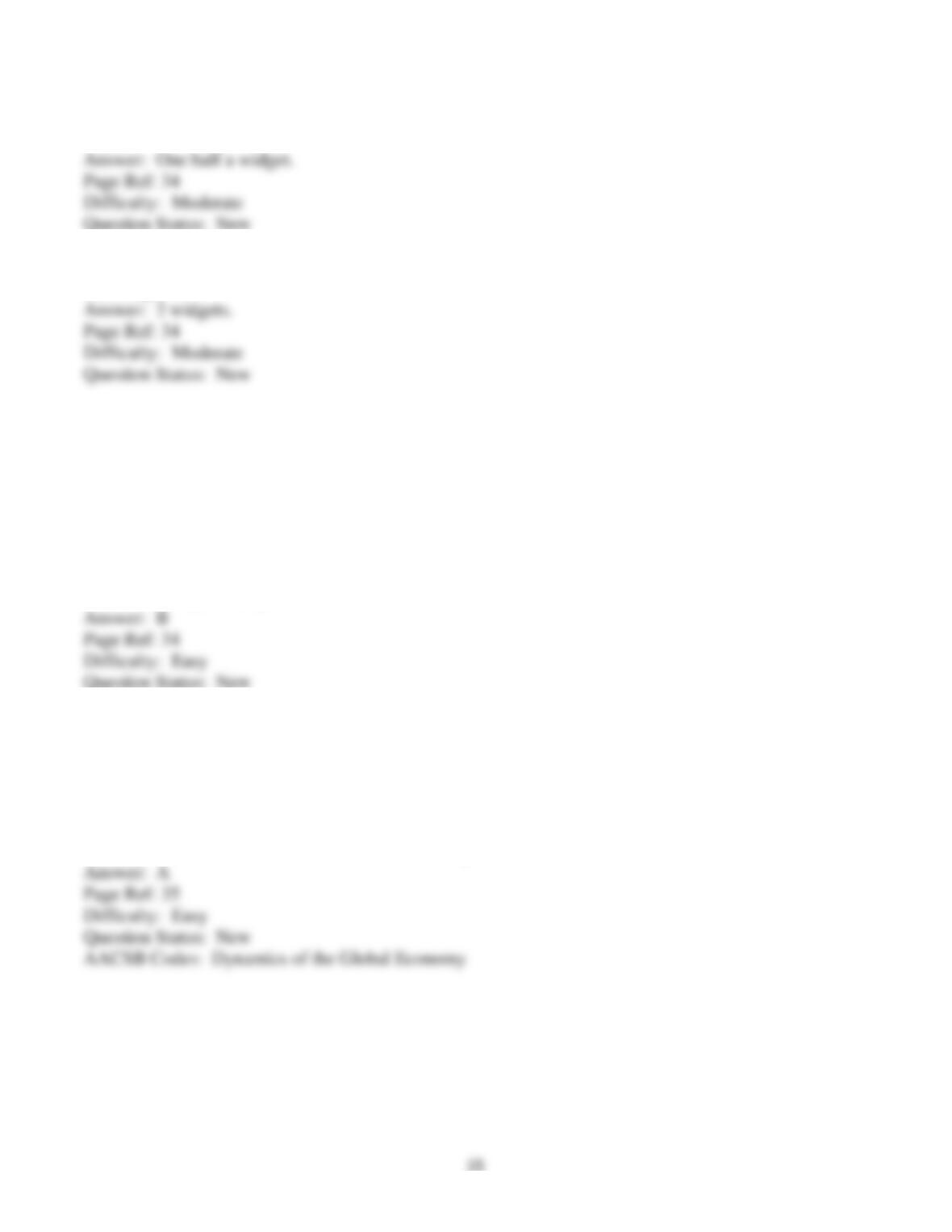
31) Given the information in the table above. If these two countries trade these two goods with each
other in context of the Ricardian model of comparative advantage, what is the lower limit for the price
of cloth?
32) Given the information in the table above. What is the opportunity cost of cloth in terms of Widgets
in Foreign?
3.4 Misconceptions About Comparative Advantage
1) If a production possibilities frontier is bowed out (concave to the origin), then production occurs
under conditions of
A) constant opportunity costs.
B) increasing opportunity costs.
C) decreasing opportunity costs.
D) infinite opportunity costs.
E) uncertain opportunity costs.
2) If the production possibilities frontier of one trade partner (“Country A”) is bowed out (concave to the
origin), then increased specialization in production by that country will
A) increase the economic welfare of both countries.
B) increase the economic welfare of only Country A.
C) decrease the economic welfare of Country A.
D) decrease the economic welfare of Country B.
E) not affect the economic welfare of either country.
3) If two countries have identical production possibility frontiers, then trade between them is likely to be
beneficial if
A) their supply curves are identical.
B) their cost functions are identical.
C) their demand conditions are identical.
D) their incomes are identical.
E) their demand functions differ.
4) If one country’s wage level is very high relative to the other’s (the relative wage exceeding the relative
productivity ratios), then if they both use the same currency
A) neither country has a comparative advantage.
B) only the low wage country has a comparative advantage.
C) only the high wage country has a comparative advantage.
D) consumers will still find trade worth while from their perspective.
E) it is possible that both will enjoy the conventional gains from trade.
5) If one country’s wage level is very high relative to the other’s (the relative wage exceeding the relative
productivity ratios) then it is probable that
A) free trade will not improve either both countries welfare.
B) free trade will result in no trade taking place.
C) free trade will result in each country exporting the good in which it enjoys comparative advantage.
D) free trade will result in each country exporting the good in which it suffers the greatest comparative
disadvantage.
E) free trade will not affect the economic welfare of either country.
6) In a two-country, two-product world, the statement “Germany enjoys a comparative advantage over
France in autos relative to ships” is equivalent to
A) France having a comparative advantage over Germany in ships.
B) France having a comparative disadvantage compared to Germany in autos and ships.
C) Germany having a comparative advantage over France in autos and ships.
D) France having no comparative advantage over Germany.
E) France should produce autos.
7) If the United States’ production possibility frontier was flatter to the widget axis, whereas Germany’s
was flatter to the butter axis, we know that
A) the United States has no comparative advantage
B) Germany has a comparative advantage in butter.
C) the U.S. has a comparative advantage in butter.
D) Germany has comparative advantages in both products.
E) the U.S. has a comparative disadvantage in widgets.
8) Suppose the United States’ production possibility frontier was flatter to the widget axis, whereas
Germany’s was flatter to the butter axis. We now learn that the German mark sharply depreciates against
the U.S. dollar. We now know that
A) the United States has no comparative advantage
B) Germany has a comparative advantage in butter.
C) the United States has a comparative advantage in butter.
D) Germany has a comparative advantage in widgets.
E) Germany has lost its comparative advantage.
9) Suppose the United states production possibility frontier was flatter to the widget axis, whereas
Germany’s was flatter to the butter axis. We now learn that the German wage doubles, but U.S. wages
do not change at all. We now know that
A) the United States has no comparative advantage.
B) Germany has a comparative advantage in butter.
C) the United States has a comparative advantage in butter.
D) Not enough information is given.
E) Germany gains a comparative advantage in widgets.
10) Which of the following statements is true?
A) Free trade is beneficial only if your country is strong enough to stand up to foreign competition.
B) Free trade is beneficial only if your competitor does not pay unreasonably low wages.
C) Free trade is beneficial only if both countries have access to the same technology.
D) Free trade is never beneficial for developing countries.
E) Free trade can be beneficial to economic welfare of all countries involved.
11) Mahatma Ghandi exhorted his followers in India to promote economic welfare by decreasing
imports. This approach
A) makes no sense.
B) makes no economic sense.
C) is consistent with the the Ricardian model of comparative advantage.
D) is not consistent with the Ricardian model of comparative advantage.
E) guarantees benefits for Indian workers.
12) The Country of Rhozundia is blessed with rich copper deposits. The cost of copper produced
(relative to the cost of widgets produced) is therefore very low. From this information we know that
A) Rhozundia has a comparative advantage in copper.
B) Rhozundia should import copper and export widgets.
C) Rhozundia should export both widgets and copper.
D) Rhozundia should invest in more in widget production.
E) Rhozundia may or may not have a comparative advantage in copper.
13) We know that in antiquity, China exported silk because no one in any other country knew how to
produce this product. From this information we know that
A) China had a comparative advantage in silk.
B) China had an absolute advantage, but not a comparative advantage in silk.
C) no comparative advantage could exist because the technology was not diffused.
D) China exported silk for political reasons even though it had no comparative advantage.
E) China was unable to profit by exporting silk because it was unknown in the rest of the world.
14) The pauper labor theory, and the exploitation argument
A) are theoretical weaknesses that limit the applicability of the Ricardian concept of comparative
advantage.
B) are theoretically irrelevant to the Ricardian model, and do not limit its logical relevance.
C) are not relevant because the Ricardian model is based on the labor theory of value.
D) are not relevant because the Ricardian model allows for different technologies in different countries.
E) invalidate the Ricardian model.
15) If labor productivities were exactly proportional to wage levels internationally, this would
A) not negate the logical basis for trade in the Ricardian model.
B) render the Ricardian model theoretically correct but practically useless.
C) negate the logical basis for trade in the Ricardian model.
D) negate the applicability of the Ricardian model if the number of products were greater than the
number of trading partners.
E) demonstrate the validity of the Ricardian model.
16) Many countries in sub-Saharan Africa have very low labor productivities in many sectors, for
example in manufacturing and agriculture. They often despair of even trying to attempt to build their
industries unless it is done in an autarkic context, behind protectionist walls because they do not believe
they can compete with more productive industries abroad. Discuss this issue in the context of the
Ricardian model of comparative advantage.
17) In 1975, wage levels in South Korea were roughly 5% of those in the United States. It is obvious
that if the United States had allowed Korean goods to be freely imported into the United States at that
time, this would have caused devastation to the standard of living in the United States, because no
producer in this country could possibly compete with such low wages. Discuss this assertion in the
context of the Ricardian model of comparative advantage.
18) The evidence cited in the chapter using the examples of the East Asia New Industrializing Countries
suggests that as international productivities converge, so do international wage levels. Why do you
suppose this happened for the East Asian NICs? In light of your answer, what do you think is likely to
happen to the relative wages (relative to those in the United States) of China in the coming decade?
Explain your reasoning.
3.5 Comparative Advantage with Many Goods
1) The two-country, multi-product model differs from the two-country, two-product model in that, in the
former,
A) the relative wage ratio will determine the pattern of trade ( which good is exported by which country.
B) which country will export which product is determined entirely by labor productivity data.
C) full specialization is likely to hold in equilibrium.
D) none of the goods are potentially nontraded.
E) domestic relative prices are not relevant.
2) How does the two-good, two-country version of the Ricardian model differ from the two-country,
many-good model in terms of the determination which goods are produced and exported by each
country?
3.6 Adding Transport Costs and Nontraded Goods
1) Assume that transportation costs are especially high for Widgets in the two-country, two-product
Ricardian model, and Country A enjoys a comparative advantage in Widgets, then
A) country B must also enjoy a comparative advantage in Widgets.
B) country B may end up exporting Widgets.
C) country A may switch to having a comparative advantage in the other good.
D) country A will still export Widgets.
E) Trade may be impossible between the two countries.
2) Which of the following is most likely to be an untraded good in a Ricardian two-country, multi-good
model?
A) steel
B) textiles
C) haircuts
D) petroleum
E) telemarketer services
3.7 Empirical Evidence on the Ricardian Model
1) Which of the following has been confirmed by empirical tests of the Ricardian model?
A) All predictions of the model for a multi-product, multi-country world are highly unrealistic.
B) The existence of nontraded goods results in a high degree of specialization among countries.
C) International trade has no impact on income distribution.
D) The unimportance of economies of scale as a cause of trade.
E) Companies tend to export goods in which they have a relatively high level of productivity.