College Accounting, 12e (Slater)
Chapter 3 Beginning the Accounting Cycle
3.1 Learning Objective 3-1
1) The process that begins with recording business transactions and includes the completion of the
financial statements is the:
A) calendar year.
B) natural business years.
C) fiscal year.
D) accounting cycle.
2) The twelve-month period a business chooses for its accounting period is a(n):
A) calendar year.
B) accounting period.
C) fiscal year.
D) accounting cycle.
3) The time period for which a statement of owner’s equity is prepared is a(n):
A) calendar year.
B) accounting period.
C) fiscal period.
D) accounting cycle.
4) Financial statements that are prepared for a period shorter than a year are called:
A) accounting period statements.
B) fiscal year statements.
C) interim statements.
D) journal statements.
5) The first step of the accounting cycle is:
A) recording journal entries.
B) posting to the ledger.
C) preparing a trial balance.
D) analyzing business transactions.
6) A journal entry affecting three or more accounts is called a:
A) multi-level entry.
B) multi-step entry.
C) compound entry.
D) simple entry.
7) Business transactions are first recorded in the:
A) ledger.
B) journal.
C) trial balance.
D) balance sheet.
8) “PR” in the general journal and general ledger stands for:
A) per reviewer.
B) posting reference.
C) prior receipt.
D) None of the above are correct.
9) Revenue is traditionally recognized in the accounting records when:
A) cash is received.
B) services are rendered.
C) it is incurred.
D) None of the answers are correct.
10) The general journal:
A) is the book of original entry.
B) is the book of final entry.
C) contains account balances.
D) is completed after the general ledger.
11) The general ledger:
A) is the book of original entry.
B) is the book of final entry.
C) lists the transactions in chronological order.
D) is before the general journal.
12) The process of initially recording business transactions in a journal is:
A) sliding.
B) posting.
C) journalizing.
D) transposing.
13) When recording a transaction in a journal, the account listed first is always the:
A) debit.
B) credit.
C) increase.
D) decrease.
14) How are credits distinguished from debits in the journal?
A) A line separation
B) A different color
C) Indenting
D) There is no distinction.
15) How are explanations distinguished in the journal?
A) They are underlined.
B) They are in bold print.
C) They are indented below the credit entries.
D) They are written at the margin, in line with the debit entries.
16) The journal entry debiting Cash and crediting Capital would be a result of a(n):
A) withdrawal.
B) expense.
C) investment.
D) revenue.
17) If you debit Prepaid Insurance, you most likely will:
A) credit Fees Earned.
B) debit Cash.
C) credit Insurance Expense.
D) credit Cash.
18) The entry to record the payment of office salaries would be:
A) Debit Cash; Credit Accounts Receivable
B) Debit Cash; Credit Salaries Expense
C) Debit Salaries Expense; Credit Accounts Payable
D) Debit Salaries Expense; Credit Cash
19) Which of the following entries would record the payment of a utility bill?
A) Utilities Expense, debit; Cash, credit
B) Cash, debit; Utilities Expense, credit
C) Utilities Expense, debit; Accounts Payable, credit
D) Accounts Receivable, debit; Utilities Expense, credit
20) Which of the following entries records the owner taking cash for personal use?
A) Wage Expense, debit; Cash, credit
B) Capital, debit; Cash, credit
C) No entry is necessary since the owner owns the cash and the entire business.
D) Withdrawals, debit; Cash, credit
21) During the month of January, Katelyn invested $11,000 in starting her legal practice. The proper
journal entry would be:
A) Cash, debit $11,000; Katelyn’s Capital, credit $11,000
B) Accounts Payable, debit $11,000; Cash, credit $11,000
C) Cash, debit $11,000; Revenue, credit $11,000
D) Katelyn’s Capital, debit $11,000; Cash, credit $11,000
22) Which of the following entries records the acquisition of office supplies for cash?
A)
Office Supplies
5,000
Cash
5,000
B)
Office Supplies
5,000
Accounts Payable
5,000
C)
Equipment
5,000
Accounts Payable
5,000
D)
Equipment
5,000
Accounts Receivable
5,000
23) During the month of October, Ford advertised on the Internet. Ford received the bill for $600 in
October, but waited until November to pay the advertising expense. The journal entry to record the
payment in November is:
A) Accounts Payable debit; Cash credit
B) Advertising Expense debit; Accounts Payable credit
C) Advertising Expense debit; Cash credit
D) The journal entry is not made in November.
24) On July 1, Hill’s Construction paid six months’ insurance in advance. The journal entry to record this
transaction is:
A) Debit Prepaid Insurance; Credit Cash
B) Debit Insurance Expense; Credit Cash
C) Debit Cash; Credit Prepaid Insurance
D) Debit Cash; Credit Insurance Expense
25) Riley’s Book Review billed customers $450. The journal entry to record this transaction is:
A) Accounts Receivable debit $450; Editing Fees credit $450
B) Editing Fees debit $450; Riley, Capital credit $450
C) Accounts Payable debit $450; Editing Fees credit $450
D) Accounts Payable debit $450; Riley, Capital credit $450
26) Antonio’s catered a reception. The total price was $500. The customer paid half of the fee in cash and
placed the remainder on account. The journal entry to record this transaction is:
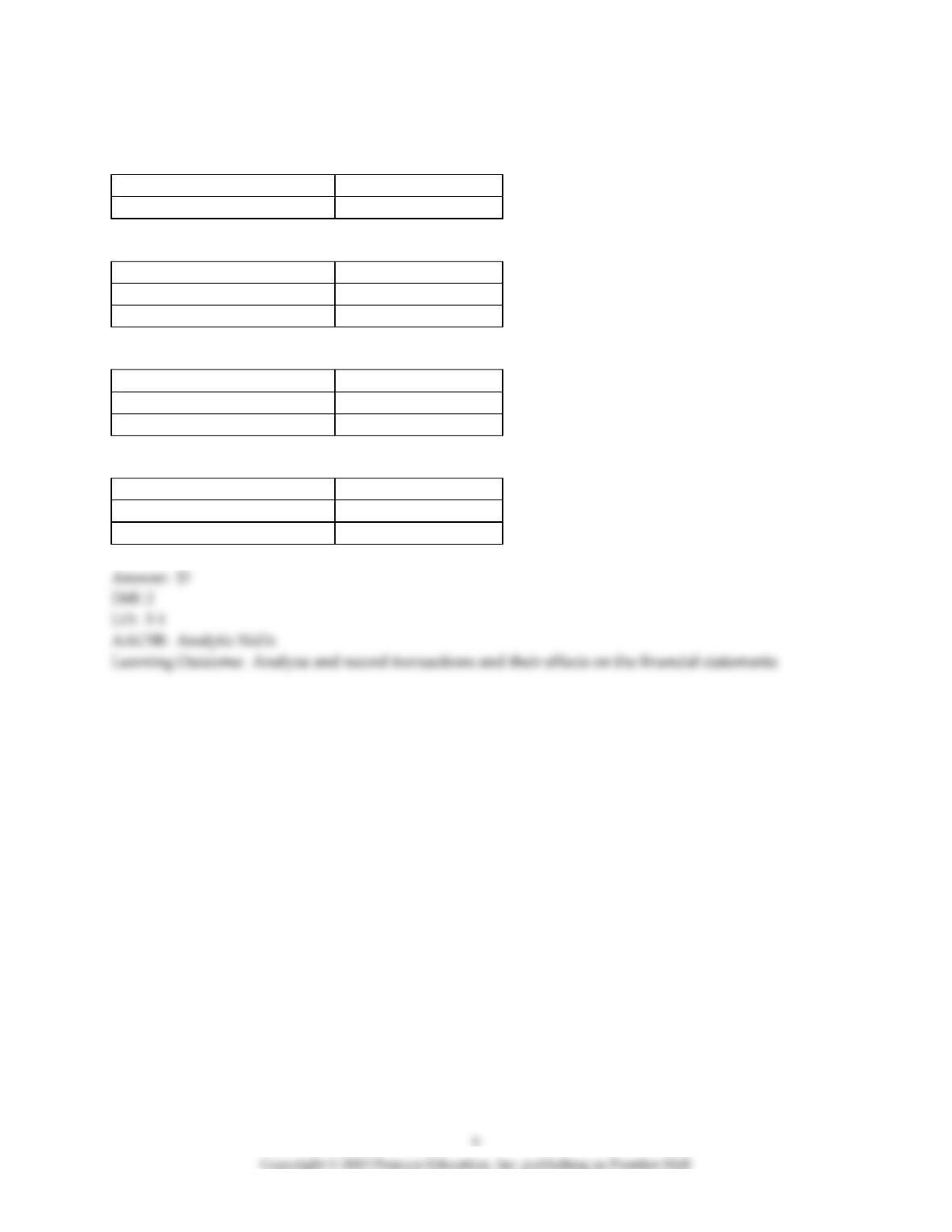
A)
Cash
250
Accounts Receivable
250
Catering Service Fees
500
B)
Cash
500
Accounts Receivable
500
C)
Cash
500
Catering Service Fees
500
D)
Accounts Receivable
500
Cash
250
Catering Service Fees
250
27) Renzi’s Volleyball Gym purchased equipment for $1,200. It made a down payment of $600 with the
remainder on account. The journal entry to record this transaction is:
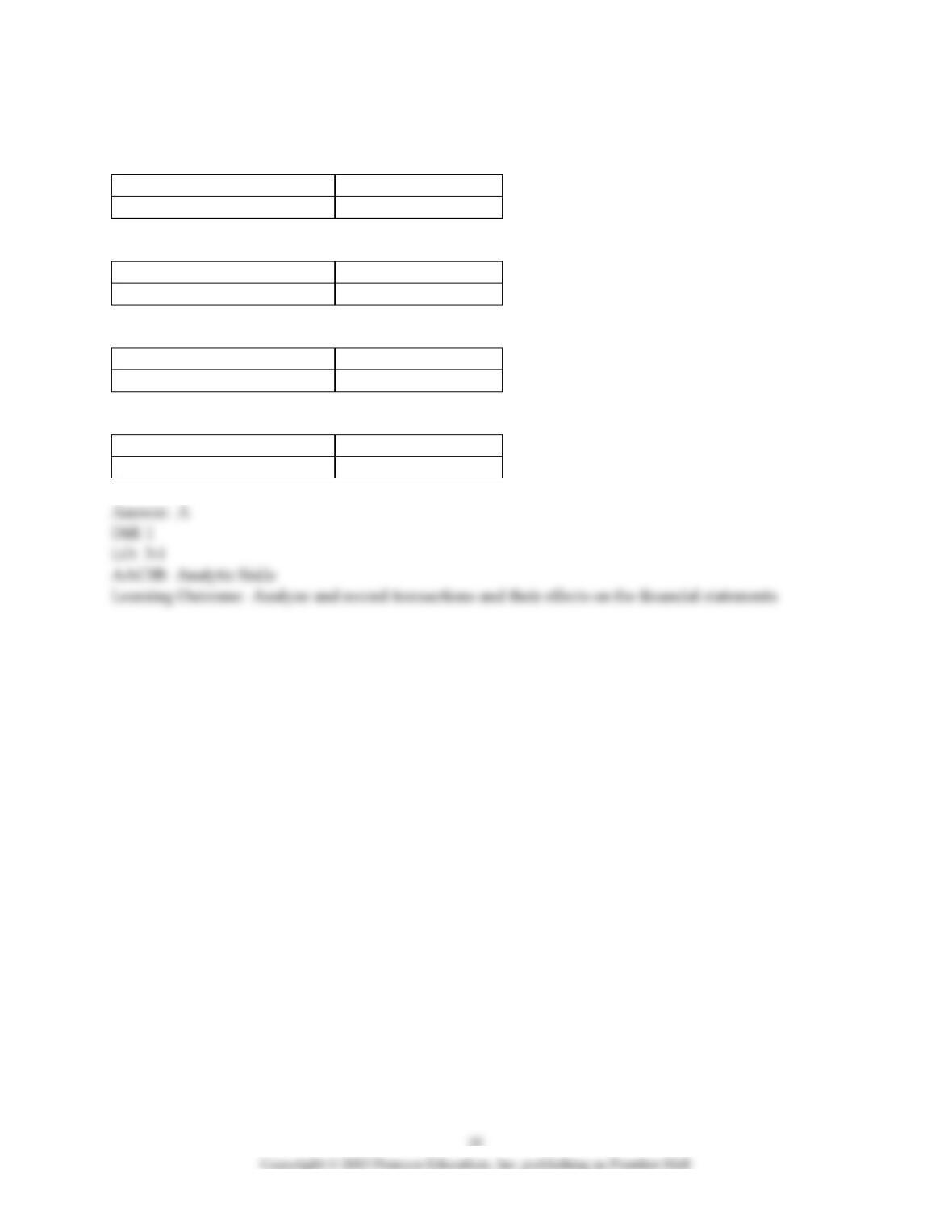
A)
Cash
600
Accounts Receivable
600
B)
Accounts Payable
600
Cash
600
Equipment
1,200
C)
Supplies
1,200
Cash
600
Accounts Payable
600
D)
Equipment
1,200
Accounts Payable
600
Cash
600
28) The entry to record completing a financial lecture and immediately collecting payment from
customers would be:
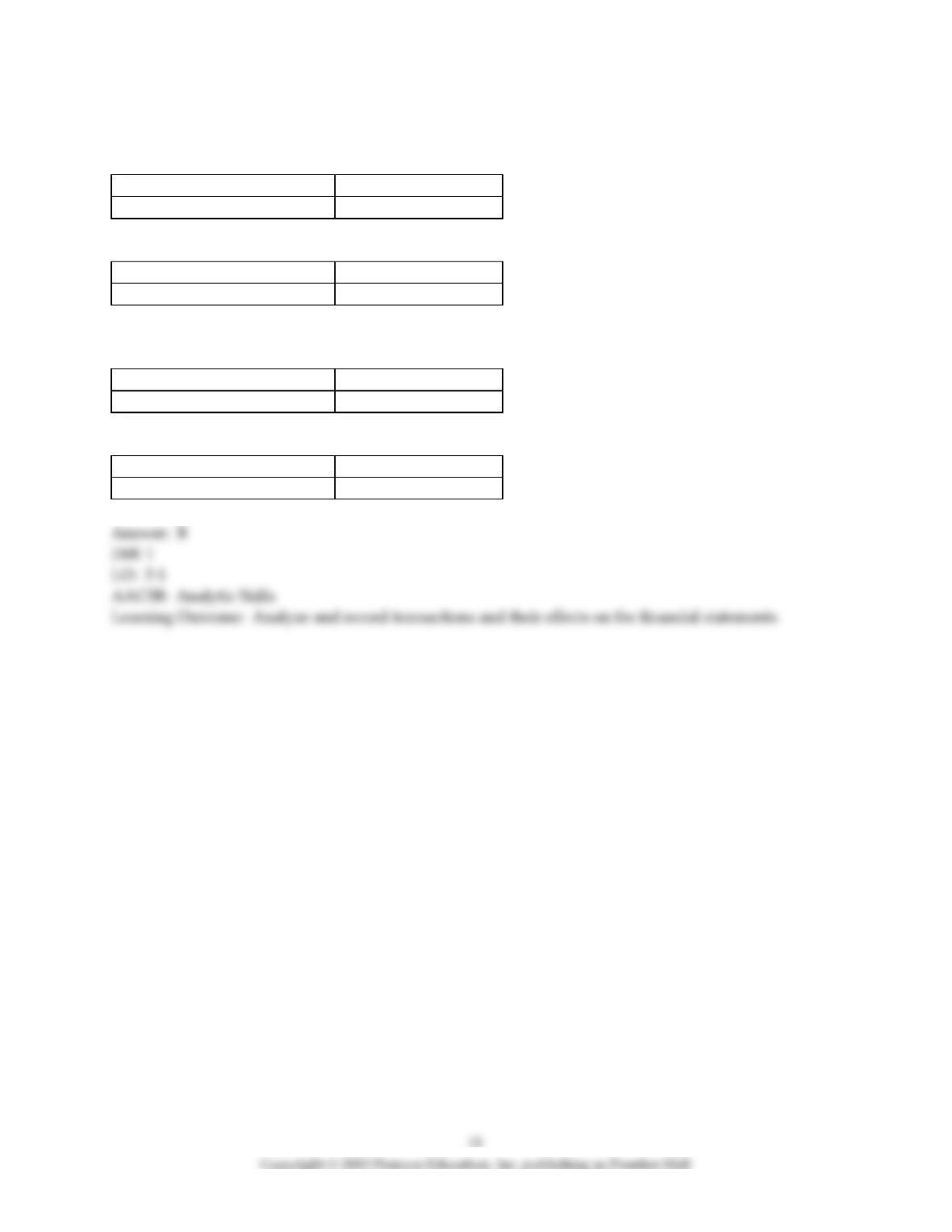
A)
Cash
500
Lecture Fees
500
B)
Cash
500
Accounts Payable
500
C)
Lecture Fees
500
Cash
500
D)
Lecture Fees
500
Accounts Payable
500
29) BNL completed a performance and collected revenue of $8,000 not previously billed or recorded. The
journal entry to record the collection would be:
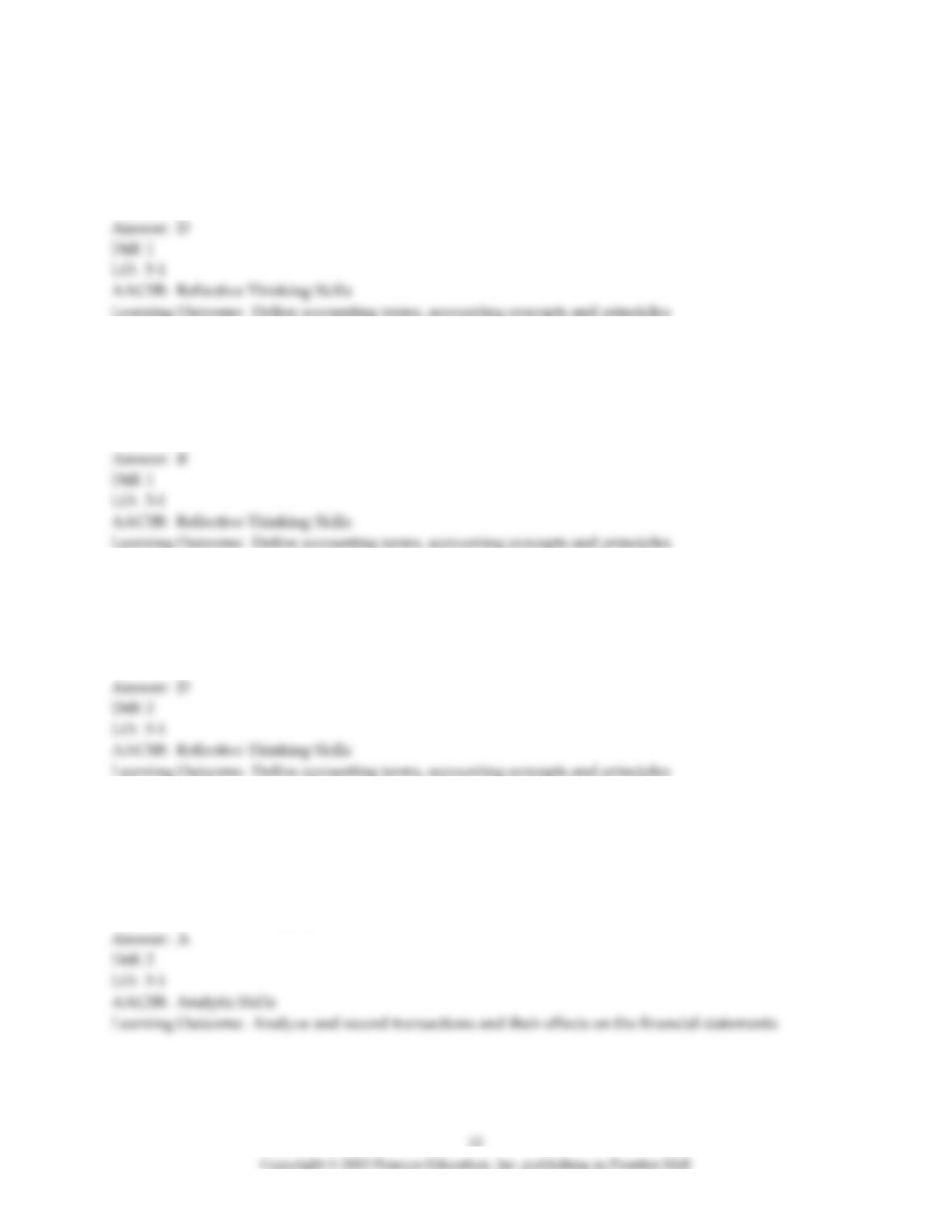
A)
Accounts Receivable
8,000
Performance Fees
8,000
B)
Cash
8,000
Performance Fees
8,000
C)
Accounts Receivable
8,000
Cash
8,000
D)
Performance Fees
8,000
Cash
8,000
30) The general journal does not have a column titled:
A) Date.
B) Account Titles & Descriptions.
C) Dr. and Cr.
D) Balance.
31) A calendar year is:
A) any 12-month period that a business chooses for its accounting year.
B) the 12-month period beginning with January.
C) the period for when a interim financial statement would be completed.
D) All of these answers are correct.
32) Interim statements are prepared to:
A) notify management of the company’s current financial position.
B) notify investors of the company’s current financial position.
C) allow management to make changes to the business before processing year-end financial statements.
D) All of the above are correct.
33) A transaction completed by Norton Company caused a $4,000 increase in both the total assets and the
total liabilities. This transaction could have been:
A) purchase of office equipment for $12,000, paying $8,000 cash, with the rest on account.
B) investment by the owner of an additional $4,000.
C) purchase of office equipment, paying $4,000 cash, and $8,000 on account.
D) None of these answers are correct.
34) Conner Sales’ total assets and total liabilities increased $400. The transaction could have been:
A) purchase of supplies for cash, $400.
B) purchase of supplies for $600 with a down payment of $200 and the remainder on account.
C) paid the rent for the month, $700.
D) None of these answers are correct.
35) Which of the following accounts would be debited in a proper journal entry?
A) Accounts Payable when it is increased
B) Accounts Receivable when it is increased
C) Cash when it is decreased
D) Capital when it is increased
36) The trial balance lists the accounts:
A) alphabetically.
B) in the same order as in the ledger.
C) all debits first and then credits.
D) all credits first and then debits.
37) As Withdrawals increase:
A) owner’s equity decreases.
B) owner’s equity increases.
C) Cash increases.
D) expense increases.
38) If Accounts Payable has been debited, it is most likely that:
A) the company made a payment to a creditor.
B) a customer made a payment.
C) the company made a purchase on account.
D) None of these are possible.
39) If Accounts Payable has been credited, it is most likely that:
A) a collection from a customer was made.
B) a service was provided to a cash customer.
C) the company made a purchase on account.
D) None of these are possible.
40) The journal entry to record an investment by the owner would most commonly include:
A) a debit to Cash and a credit to Fees Earned.
B) a debit to Capital and a credit to Cash.
C) a debit to Fees Earned and a credit to Capital.
D) a debit to Cash and a credit to Capital.
41) The journal entry to record a withdrawal by the owner would most commonly include:
A) a debit to Wage Expense and a credit to Cash.
B) a debit to Capital and a credit to Cash.
C) a debit to Withdrawals and a credit to Cash.
D) a debit to Cash and a credit to Wage Expense.
42) The journal entry to record an exchange of assets would include:
A) a debit to Cash and a credit to Fees Earned.
B) a debit to Supplies and a credit to Accounts Payable.
C) a debit to Cash and a credit to Accounts Receivable.
D) a debit to Fees Earned and a credit to Accounts Receivable.
43) The general journal entry to record the purchase of an asset on account would include:
A) a debit to Accounts Receivable and a credit to Fees Earned.
B) a debit to Equipment and a credit to Accounts Payable.
C) a debit to Accounts Payable and a credit to Equipment.
D) a debit to Supplies and a credit to Cash.
44) The general journal entry to record a payment to a creditor would most commonly include:
A) a debit to Accounts Payable and a credit to Cash.
B) a debit to Capital and a credit to Cash.
C) a debit to Supplies and a credit to Cash.
D) a debit to Cash and a credit to Accounts Payable.
45) The general journal entry to record the earning of revenue would most commonly include:
A) a debit to Accounts Receivable and a credit to Capital.
B) a debit to Cash and a credit to Capital.
C) a debit to Fees Earned and a credit to Cash.
D) a debit to Accounts Receivable and a credit to Fees Earned.
46) Which of the following statements is false regarding a proper journal entry?
A) Debits are always listed first in the entry.
B) Credits are always indented.
C) Skip a line between transactions.
D) Always list the assets first.
47) To find an explanation for a transaction, look in the:
A) ledger.
B) balance sheet.
C) journal.
D) trial balance.
48) If Cash has been debited, it is likely that:
A) the owner made an investment.
B) a charge customer made a payment.
C) the business borrowed cash from the bank.
D) All of these are possible.
49) If Prepaid Rent has been debited, it is likely that:
A) the rent was paid for three months in advance.
B) a bill for the past month’s rent was received.
C) this month’s rent was paid.
D) All of these are possible.
50) If Rent Expense has been debited, it is likely that:
A) the rent was paid for three months in advance.
B) a copy of the lease was received.
C) this month’s rent was paid.
D) All of these are possible.
51) If Capital has been credited, it is likely that:
A) services were provided to a cash customer.
B) services were provided to a charge customer.
C) the owner made an investment.
D) All of these are possible
52) If Fees Earned has been credited, it is most likely that:
A) services were provided.
B) the owner made an investment.
C) a correcting entry for the overstatement of revenue was recorded.
D) All of these are possible.
53) If Accounts Payable has been debited, it is most likely that:
A) a payment was made on account.
B) a purchase was made on account.
C) a charge customer made a payment.
D) None of these are possible.
54) If Accounts Payable has been credited, it is most likely that:
A) a payment was made on account.
B) a purchase was made on account.
C) a correcting entry was made for the overstatement of the purchase of equipment on account.
D) None of these are possible.
55) The time period for which an income statement is prepared is called the accounting period.
56) A fiscal year is always January 1 through December 31.
57) Transactions are listed in chronological order in the journal.
58) Insurance paid in advance is a liability.
59) Interim statements are statements that are usually prepared for a portion of the business’ fiscal year.
60) A journal is called the book of final entry.
61) A business’s fiscal year that ends at the same time as a slow seasonal period begins is the natural
business year.
62) The debit part of the transaction is recorded first in the journal entry.
63) The debit is indented in a journal entry.
64) A compound journal entry affects more than two accounts in the transaction.
65) A company would review the ledger if an account balance was needed.
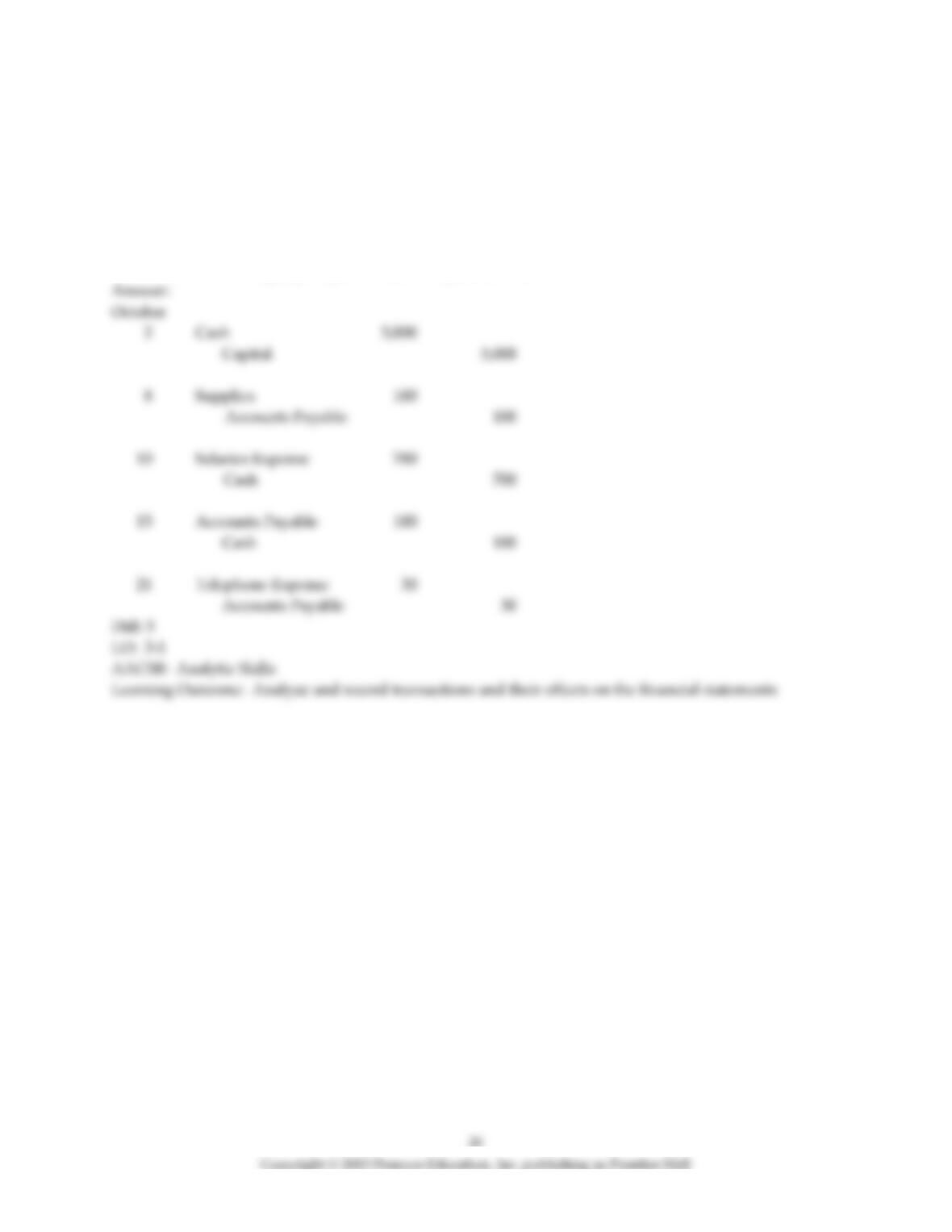
66) Prepare in proper form journal entries for the following transactions. Omit explanations.
October
2 Owner made a cash investment into the company $5,000
8 Bought supplies on account $100.
10 Paid salaries, $700
15 Paid for supplies purchased on October 8
21 Received company telephone bill, to be paid later, $30