CHAPTER 26
ECONOMIC POLICY IN THE OPEN ECONOMY
UNDER FLEXIBLE EXCHANGE RATES
B. Multiple-Choice Questions
8. In a situation of flexible exchange rates and where the BP curve is steeper than the
LM curve,
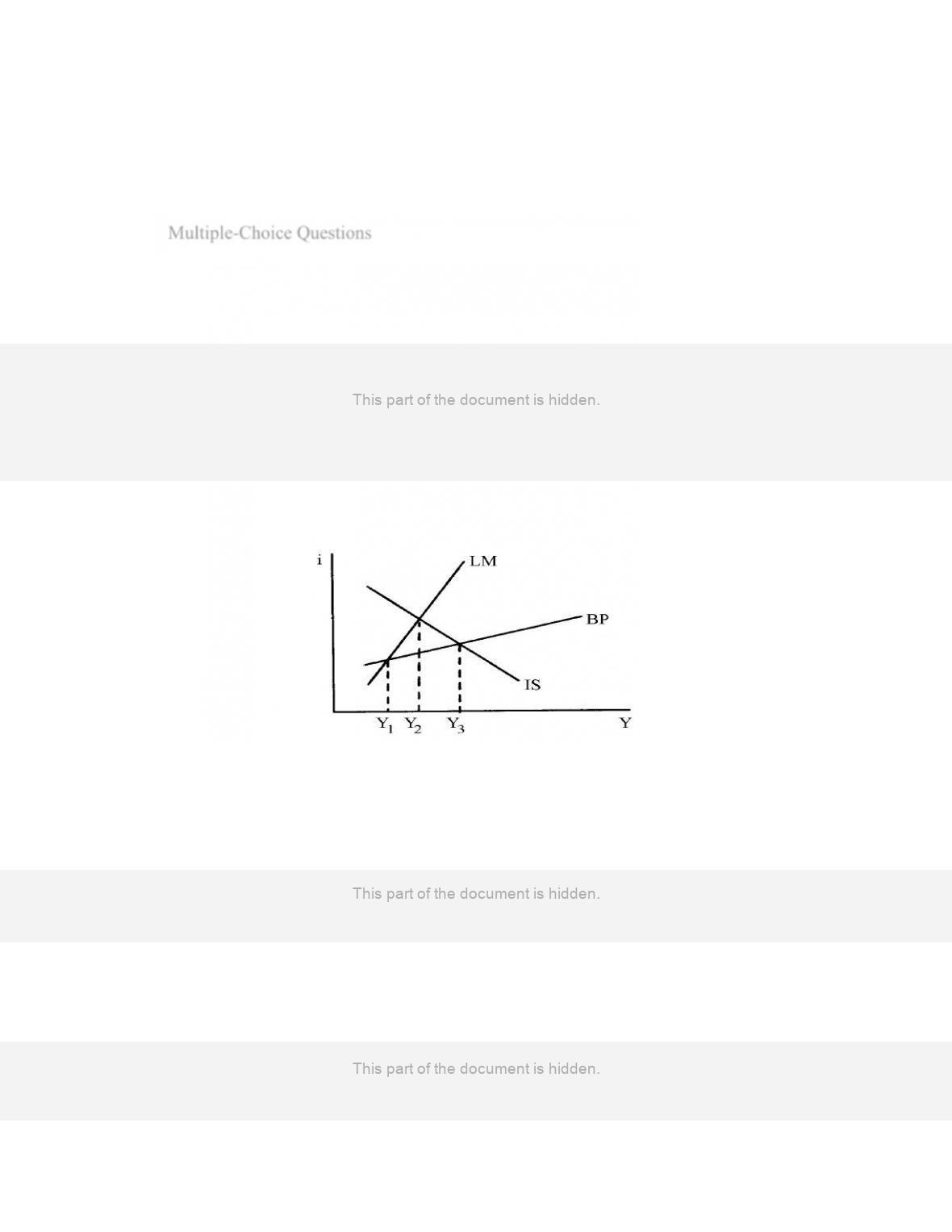
9. Given the following diagram, with flexible exchange rates:
Assume that the economy is in domestic equilibrium. In this situation, there will be
__________ in the country’s balance of payments (official reserve transactions balance),
with the consequence that the country’s currency will __________ in the foreign
exchange markets.
10. In the situation in Question #9 above, during exchange-rate adjustment process that takes
place due to the incipient imbalance in the external sector,
2
d. the LM curve will shift to the left (or vertically upward).
11. In a situation of flexible exchange rates, other things equal, a shift of the IS curve to the
left will lead to __________ of the country’s currency if the BP curve is steeper than
the LM curve and __________ of the country’s currency if the LM curve is steeper than
the BP curve.
12. Under flexible exchange rates,
13. Suppose that country A with a flexible exchange rate undertakes expansionary monetary
policy. Especially if short-term funds are extremely mobile between countries, A’s
currency will tend to __________ because of this policy, and this result suggests that A’s
monetary policy will be __________ effective in influencing national income than if A
had a fixed exchange rate rather than a flexible exchange rate.
14. The IS/LM/BP analysis suggests that, if the BP curve is flatter than the LM curve and the
exchange rate is flexible, expansionary fiscal policy will lead to __________ of the
country’s currency, which will make the fiscal policy __________ effective in
influencing
national income than if the country had a fixed exchange rate.
3
* d. an appreciation; less
15. In a situation of flexible exchange rates, an exogenous increase in foreign interest rates
will cause __________ of the domestic currency and, most likely, a __________ in the
domestic interest rate.
16. Under a flexible-rate system, when the BP curve is flatter than the LM curve, an
autonomous increase in foreign interest rates will have what impacts on the domestic
interest rate and domestic national income?
17. The IS/LM/BP analysis suggests that, under flexible exchange rates,
18. In the IS/LM/BP analysis, as a country’s currency depreciates (and assuming that the
Marshall-Lerner condition holds), the country’s
19. If, other things equal, a country with a flexible exchange rate decreases its money supply,
this will lead to __________ in the value of the country’s currency, which will tend to
__________ the country’s national income.
4
c. an appreciation; increase
* d. an appreciation; decrease
20. If we consider a situation of expansionary monetary policy under flexible exchange rates,
the monetary expansion will lead to __________ of the home currency and thus will be
__________ effective in increasing national income than under fixed exchange rates.
21. If a country’s BP curve is upward-sloping (i.e., it is neither vertical nor horizontal), then
an intersection of the country’s IS and LM curves at a point below the BP curve will be
associated with __________ in the country’s balance of payments. With flexible
exchange rates, the country’s BP curve will consequently shift __________.
22. The effectiveness of monetary policy in influencing national income will, under a system
of fixed exchange rates, be __________ under a system of flexible exchange rates.
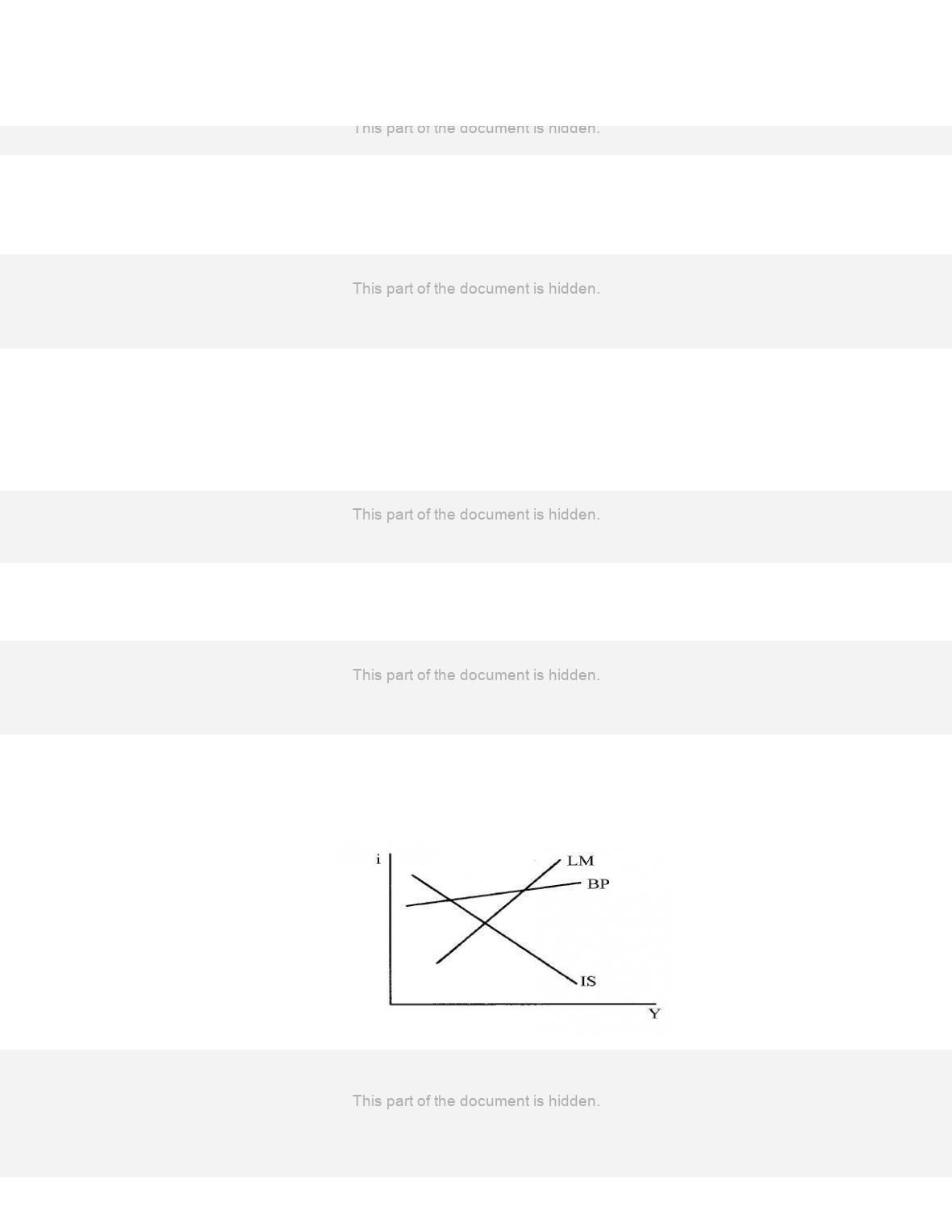
23. In the diagram below, under flexible exchange rates, this country has an incipient
balance-of-payments (official reserve transactions) __________; as a consequence, the
BP curve will shift __________.
5
24. In the view of economists, which one of the following statements is true?
a. Fiscal policy is unambiguously more effective in influencing national income under
flexible exchange rates than under fixed exchange rates.
25. With perfect capital mobility and other things equal, an exogenous increase in demand
for a country’s exports will lead to __________ increase in the country’s national income
under fixed exchange rates than under flexible exchange rates.
26. The IS/LM/BP analysis suggests that, if the BP curve is steeper than the LM curve and
the exchange rate is flexible, contractionary fiscal policy by country A will lead to
__________ in country A’s balance of payments and hence to __________ of A’s
currency relative to other currencies.
27. If, in the IS/LM/BP diagram in a situation where short-term capital is imperfectly mobile
internationally and a flexible exchange rate system exists, an incipient balance-of–
payments (official reserve transactions) surplus will cause the BP curve to shift
__________ and the IS curve to shift __________.