1
CHAPTER 25
ECONOMIC POLICY IN THE OPEN ECONOMY
UNDER FIXED EXCHANGE RATES
B. Multiple-Choice Questions
7. In the ordinary analysis of IS and LM curves (ignoring the BP curve),
8. In the Mundell prescription for monetary and fiscal policy under fixed exchange rates,
expansionary fiscal policy and contractionary monetary policy would be recommended if
a country were faced with
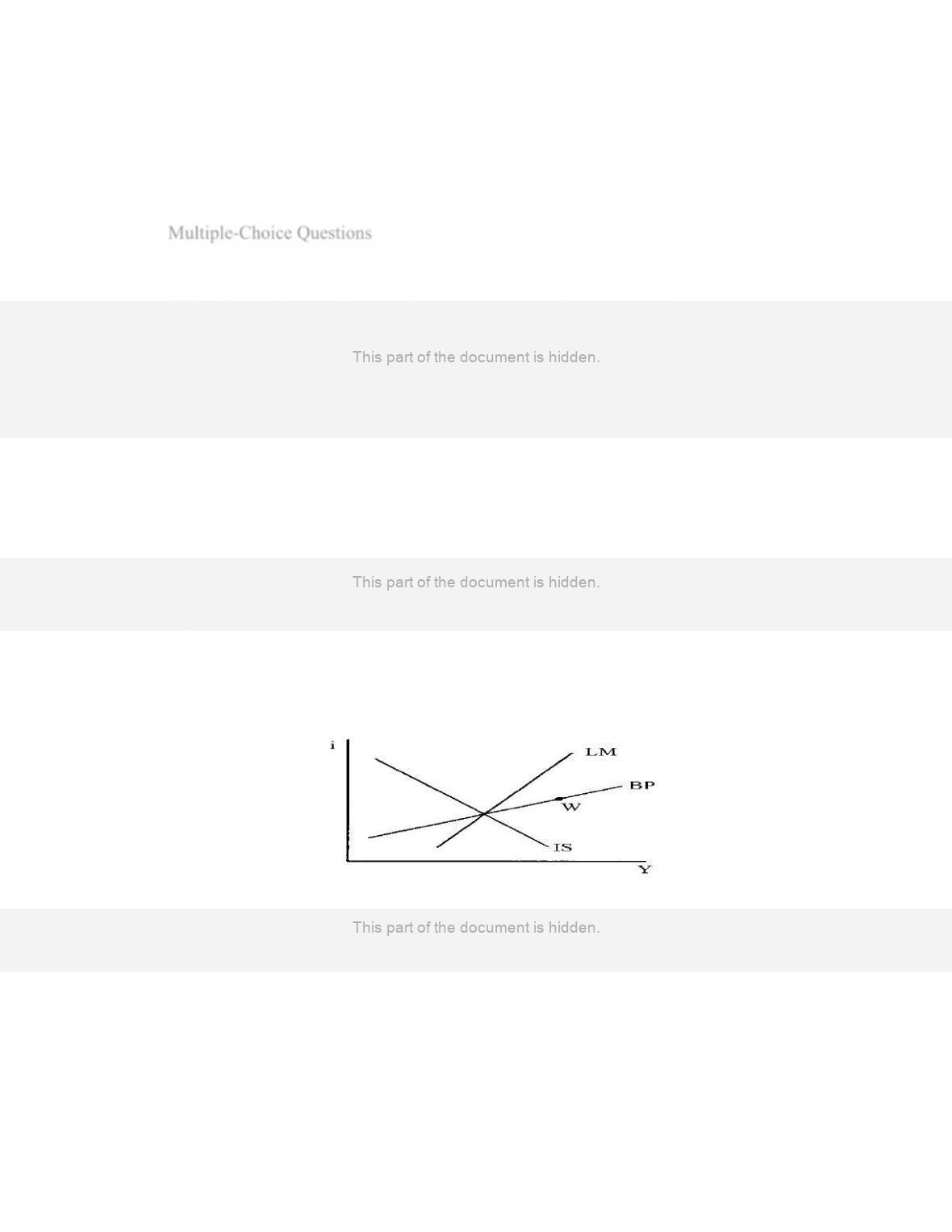
9. In the graph below, if point W represents the income and interest rate targets under a
country’s fixed exchange rate system, then the policy combination needed to reach point
W consists of
d. contractionary monetary policy and expansionary fiscal policy.
2
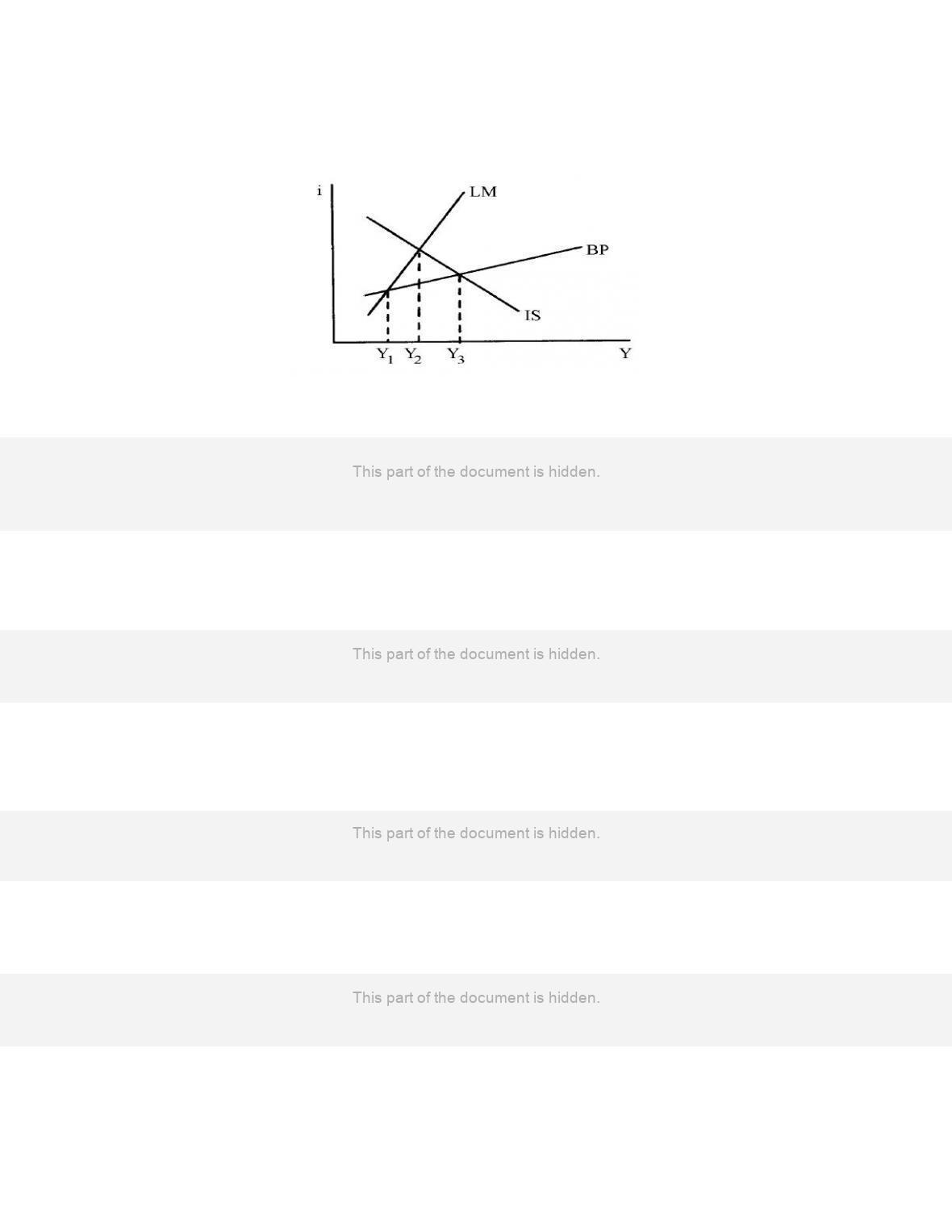
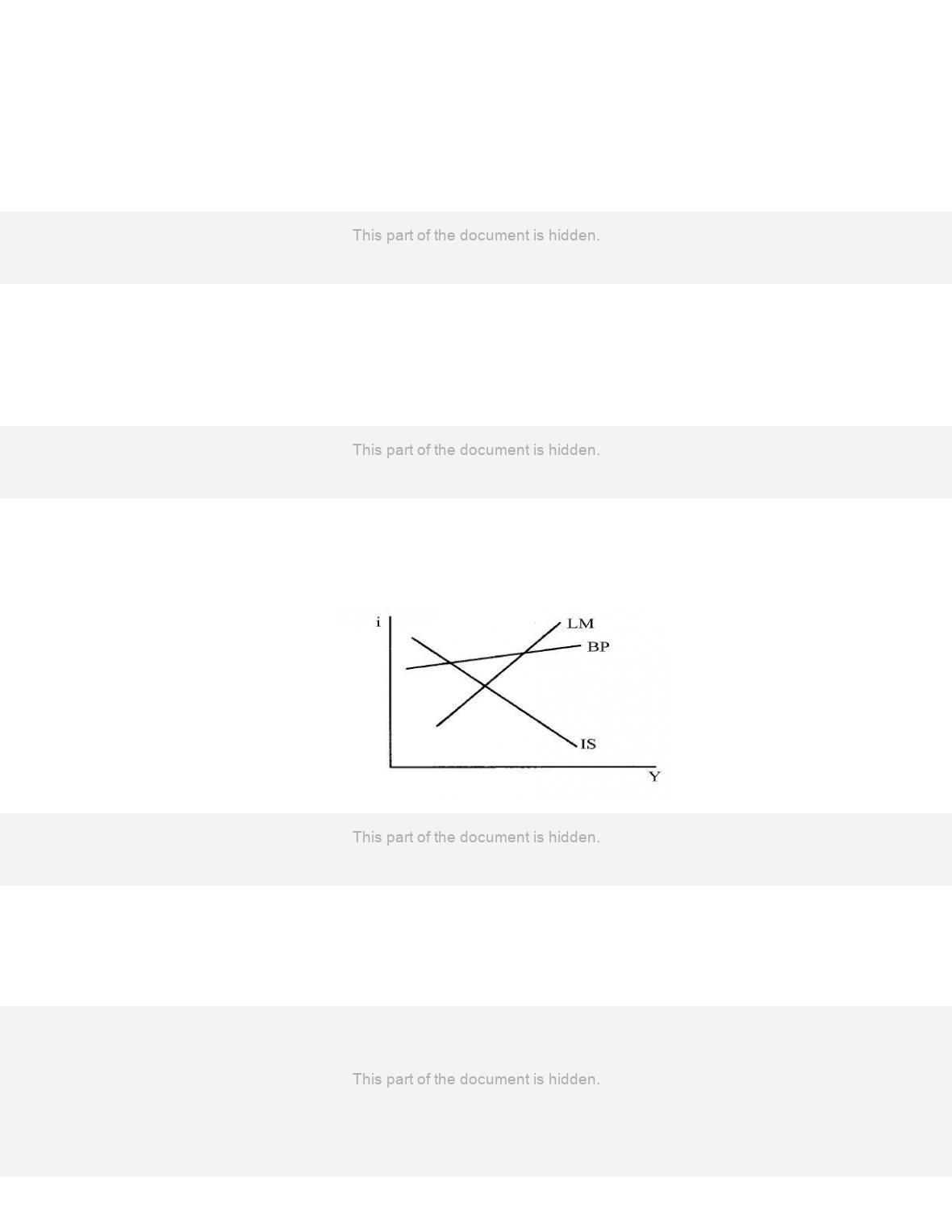
10. In the following diagram, with fixed exchange rates,
the economy is in domestic equilibrium at income level __________ and there is
__________.
11. In the situation pictured in Question #10 above, during the automatic adjustment process
to the disequilibrium in the balance of payments,
12. In a closed economy, an increase in the demand for money shifts the LM curve to the
__________; other things equal, this will lead to __________ in national income.
a. right; an increase
13. Under fixed exchange rates and a constant price level, the automatic adjustment process
produces balance-of-payments equilibrium as
14. In the Mundell analysis in which, in a situation of fixed exchange rates, a country is using
monetary and fiscal policy to attain “external balance” (i.e., balance–of-payments
3
equilibrium) and “internal balance” (i.e., full employment without inflation), the country
__________. In this context, if the country has a balance-of-payments surplus at the
same time that it has inflation, the country should engage in __________.
a. should assign monetary policy to the attainment of internal balance and fiscal policy
to the attainment of external balance; expansionary (“easy”) monetary policy
and contractionary (“tight”) fiscal policy
15. In a system of fixed exchange rates, the automatic balance-of-payments adjustment
process for a country with a balance-of-payments deficit would theoretically involve,
among other things, __________ in the interest rate and __________ in national income.
16. Other things equal, a rise in income in a country will lead to __________ in the demand
for money in the country and consequently to __________ in the country’s LM curve.
17. The use of expansionary or “easy” fiscal policy by a country’s government in a situation
of fixed exchange rates will, other things equal, initially lead to __________ of the
country’s current account balance (or trade balance); if short-term financial capital is
relatively mobile between countries (i.e., the BP curve is flatter than the LM curve), the
policy initially __________ of the country’s capital/financial account balance.
18. Under fixed exchange rates,
4
19. Under a fixed exchange rate, a balance-of-payments surplus for a country will lead to a
__________ in the money supply as the country’s central bank __________ in order to
maintain the fixed exchange rate.
20. Assume an initial equilibrium position for the economy (at the three-way intersection of
the IS, LM, and BP curves), and also assume that the BP curve is vertical. This situation
is one where there is __________ of financial capital internationally, and, from this initial
equilibrium, expansionary fiscal policy would initially lead to a balance-of-payments
__________.
21. Suppose, in the Mundell diagram that plots the internal balance (IB) and external balance
(EB) schedules against the interest rate (i) and government spending minus taxes (G – T),
that the economy is located at a point that is above (or to the left) of the IB schedule and
also above (or to the left) of the EB schedule. In this situation the economy is
experiencing
22. In the IS-LM analysis (and ignoring the BP curve), if the economy is located at a point
that is to the left (or below) the IS curve and also to the left (or above) the LM curve,
there is __________ pressure in the real sector of the economy as well as an excess
__________ money.
23. With imperfect capital mobility, the BP curve slopes upward because, starting from a
given balance-of-payments equilibrium position, a rise in national income will tend to
cause a __________, which must be counteracted by a rise in the interest rate in order to
cause a __________ that will restore BOP equilibrium.
24. In the diagram below, under fixed exchange rates, the automatic adjustment mechanism
will lead to
25. From an initial equilibrium position for the economy (at the three-way intersection of the
IS, LM, and BP curves), and if the LM curve is steeper than the BP curve, expansionary
fiscal policy initially leads to a balance-of-payments (BOP) __________, and
expansionary monetary policy __________.
26. Other things equal, if the if the demand for money becomes more elastic, then the LM
curve will become __________, i.e., a given rise in the interest rate will, in order for
money market equilibrium to be preserved, be associated with a __________ rise in
income.
27. A general rule is that, as international capital mobility for a country increases, the
country’s BP curve __________.
28. Other things equal, a fall in the marginal propensity to save will make the IS curve
__________, and a rise in the responsiveness of short-term international financial capital
to changes in the interest rate will make the BP curve __________.