15) If direct labor for the month is $80,000, and overhead is applied based on 75% of direct labor dollars,
what is the entry to apply overhead?
A) Debit Work-in-Process Inventory $80,000; credit Payroll $80,000
B) Debit Overhead-Applied $60,000; credit Work–in-Process Inventory $60,000
C) Debit Work-in–Process Inventory $60,000; credit Overhead-Applied $60,000
D) Debit Work-in-Process Inventory $80,000; credit Overhead-Applied $80,000
16) If direct labor for the month is $30,000, overhead is applied based on direct labor, annual overhead is
estimated to be $500,000, and annual direct labor is estimated to be $800,000, what is the entry to apply
overhead to production?
A) Debit Work-in-Process Inventory $18,750; credit Payroll $18,750
B) Debit Overhead-Applied $18,750; credit Work–in-Process Inventory $18,750
C) Debit Work-in–Process Inventory $18,750; credit Overhead-Applied $18,750
D) Debit Work-in-Process Inventory $30,000; credit Overhead-Applied $30,000
17) The entry to record rent expense $9,000, supervision expense $19,000, and depreciation expense $7,000
to overhead is:
A) debit Overhead-Applied $35,000; credit Rent Expense $9,000, Supervision $19,000, Depreciation
Expense $7,000.
B) debit Overhead-Control $35,000; credit Rent Expense $9,000, Supervision $19,000, Depreciation
Expense $7,000.
C) debit Overhead-Applied $35,000; credit Overhead-Control $35,000.
D) None of these answers are correct.
18) Madison Manufacturing is using a manufacturing overhead application rate of 110% of direct labor
dollars. If direct labor was 10 hours at $15 per hour, how much overhead should be applied to the job?
A) $135
B) $165
C) $160
D) $150
19) Molly Manufacturing is using a manufacturing overhead application rate of 125% of machine hours.
Machine hours are $9/hour and uses 35 hours. How much overhead should be applied to the job?
A) $315.00
B) $393.75
C) ($393.75)
D) ($315.00)
20) Adams Manufacturing has estimated manufacturing overhead at $72,000 and has estimated direct
labor of 10,000 direct labor hours at $9.00 per hour. The overhead rate per direct labor dollar would be:
A) $0.80
B) $8.00.
C) $1.25.
D) $7.20.
21) Sylvan Manufacturing applies overhead based on direct labor hours. At the beginning of the year, it
estimated that overhead costs would be $75,000 and direct labor hours would be 10,000. The applied
overhead rate per direct labor hour is:
A) $7.50.
B) $15.00.
C) $0.1333.
D) none of the above.
22) If the overhead applied rate based on direct labor hours is $7.00 and the actual labor hours are 5,000,
what is the amount credited to Overhead-Applied?
A) $3500
B) $350
C) $35,000
D) None of the above
23) The estimated manufacturing overhead cost was $20,000 and estimated machine hours were 10,000.
Actual manufacturing overhead cost was $22,000 and actual machine hours were 12,000. The overhead
application rate per hour based on machine hours is:
A) $1.83.
B) $2.00.
C) $4.00.
D) $5.00.
24) Estimated manufacturing overhead costs were $40,000 and the number of estimated machine hours
was 10,000. Actual overhead costs were $40,500 and the actual number of machine hours used was 10,200.
Based on machine hours, the overhead application rate per hour is:
A) $3.97.
B) $3.92.
C) $4.00.
D) $4.05.
25) If direct labor for the month is $40,000, overhead is applied based on direct labor, annual overhead is
$600,000, and annual direct labor is $1,000,000, what is the entry to charge direct labor to production?
A) Debit Work-in-Process Inventory $40,000; credit Payroll $40,000
B) Debit Overhead-Applied $40,000; credit Work–in-Process Inventory $40,000
C) Debit Work-in–Process Inventory $24,000; credit Overhead-Applied $24,000
D) Debit Work-in-Process Inventory $66,000; credit Overhead-Applied $66,000
26) The following data are available for Starbrite Corporation:
Estimated direct labor hours
800
Estimated overhead
$36,000
If overhead is applied based on direct labor hours, the predetermined overhead rate is:
A) $45.
B) $450.
C) $222.
D) $2,220.
27) The following data are available for Skyway:
Estimated machine hours
45,000 hours
Estimated overhead costs
$90,000
If overhead is applied based on machine hours, the predetermined overhead rate is:
A) $2.00.
B) $20.00.
C) $0.50.
D) 200%.
28) The entry to record selling a product that cost $14,000 would be a credit to Finished Goods Inventory
$14,000, and a debit to Cost of Goods Sold $14,000.
29) Work-in-Process Inventory is debited when goods are transferred to finished goods.
30) Raw Material is credited and Work–in-Process is debited when raw material is transferred to
production.
31) Work-in-Process is credited and Payroll is debited when direct labor is charged to production.
32) Finished Goods is debited when products are sold and credited when the products are transferred
from Work-in-Process.
33) Cost of Goods Sold is debited after items have been sold from the finished goods inventory.
34) Overhead may be applied based on direct labor hours or machine hours.
35) The Overhead Applied account is used to apply overhead costs to production.
36) When actual costs are not known until the end of the month, an estimated application rate should be
determined so that the total weekly costs can be applied.
37) One way to determine an overhead application rate is to divide estimated annual overhead by
estimated annual direct labor dollars.
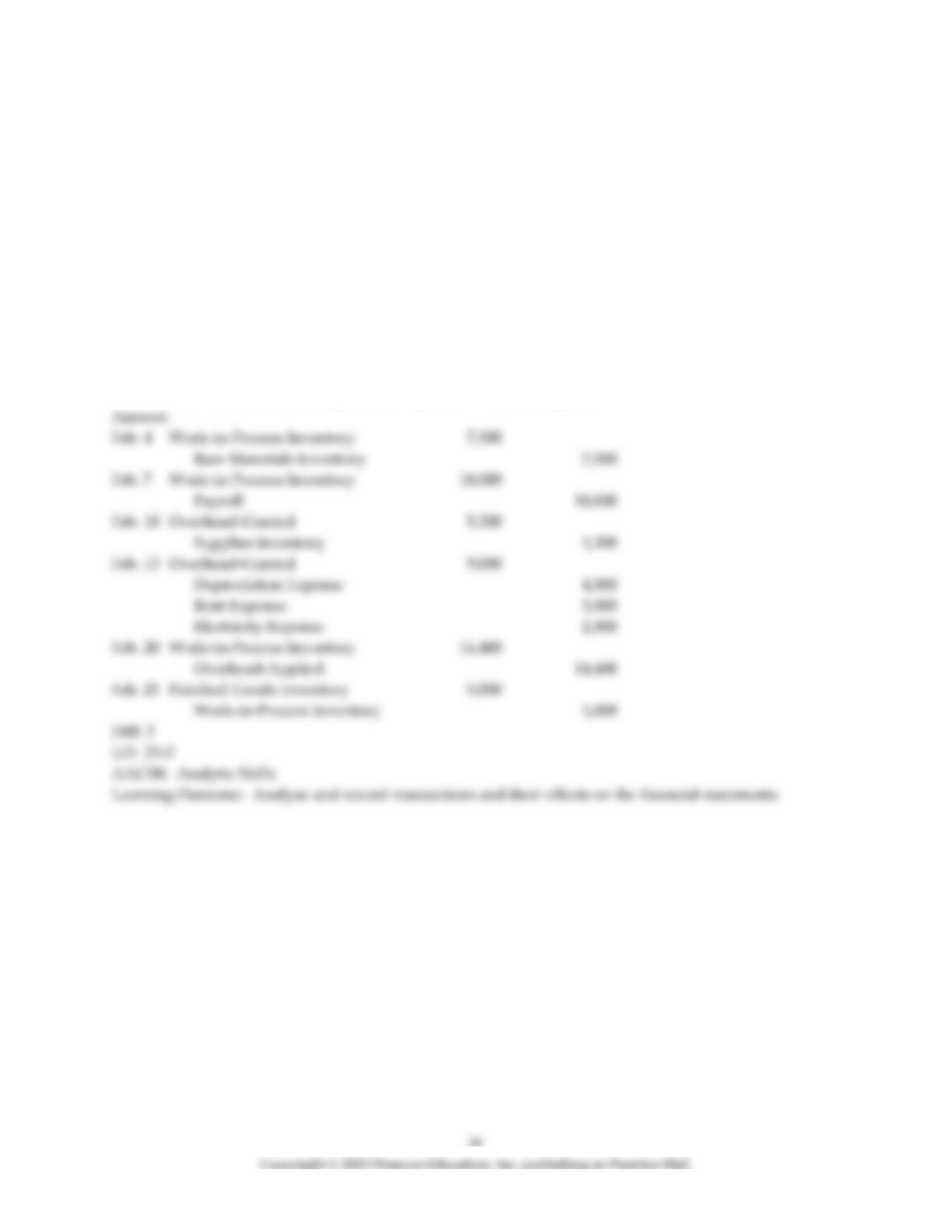
38) Record in general journal form the following transactions for Marble Manufacturing:
Feb. 4 Raw materials of $7,500 were issued from the storeroom.
Feb. 7 Charged $18,000 of direct labor to production.
Feb. 10 Supplies costing $5,300 were issued from the storeroom.
Feb. 15 The following expenses were charged to overhead: depreciation $4,000, rent $3,000, and
electricity $2,000.
Feb. 20 Overhead was applied at 80% of direct labor dollars.
Feb. 21 Transferred completed goods costing $5,000 to finished goods.
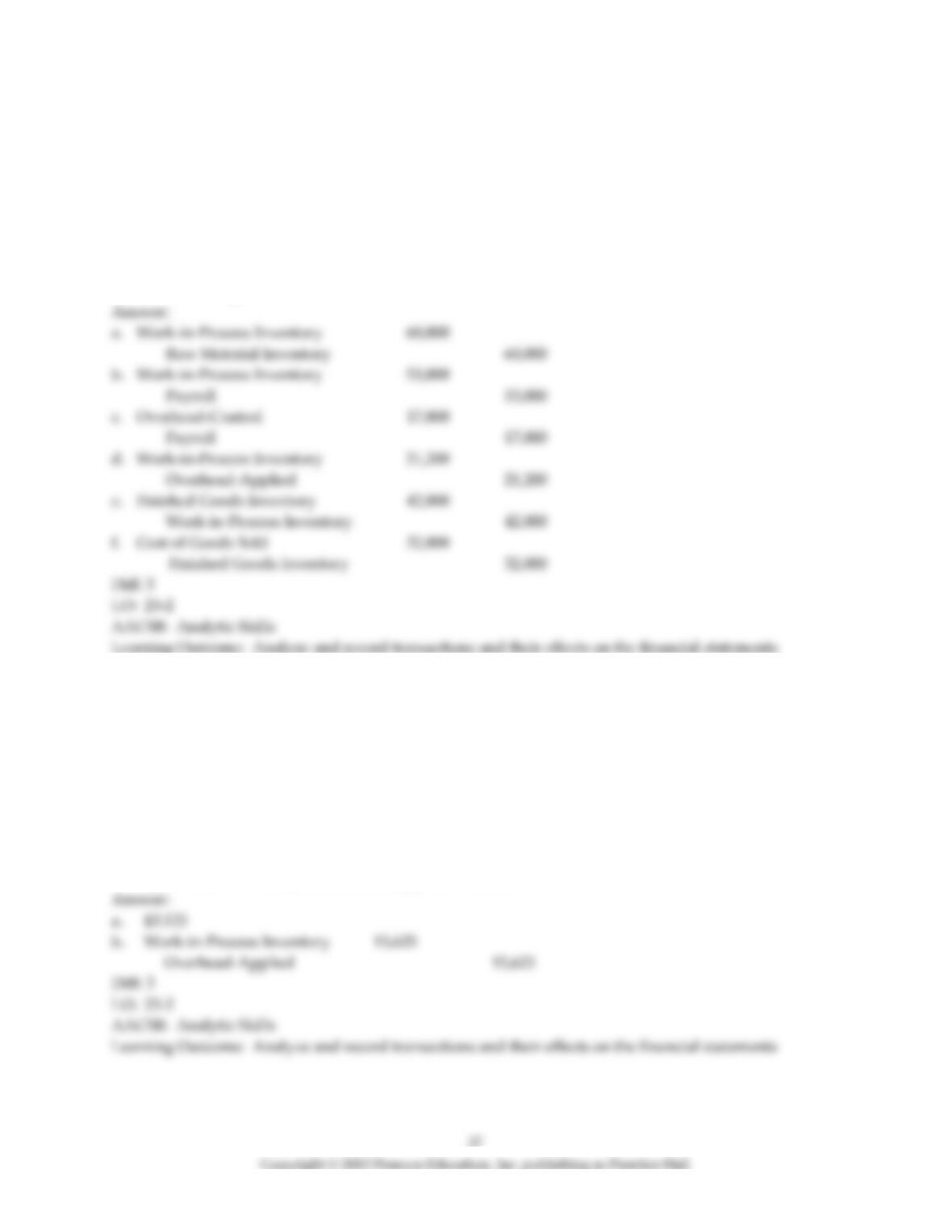
39) From the following transactions, prepare the appropriate general journal entries for the month of
April.
a. Raw materials costing $60,000 were issued from the storeroom.
b. Direct labor of $53,000 was charged to production.
c. Indirect labor costs of $17,000 were incurred.
d. Overhead was applied at the rate of 40% of direct labor dollars.
e. Completed products costing $42,000 were transferred to finished goods.
f. Products costing $32,000 were sold.
40) The following data are available for Convoy Trucks:
Estimated machine hours 40,000 hours
Actual machine hours 5,000 hours
Estimated manufacturing overhead $125,000
Actual manufacturing overhead 13,000
Required:
a. Compute the predetermined overhead rate assuming the rate is based on machine hours.
b. Prepare the journal entry to record the applied overhead.
41) The following data are available for Jackson Company.
Annual estimated manufacturing overhead $ 70,000
Actual manufacturing overhead in May 16,200
Annual estimated direct labor hours 25,000
Actual direct labor hours in May 5,700
Required:
a. Compute the predetermined rate based on direct labor hours.
b. Prepare the journal entry to record the applied overhead for the month of May.
42) Purchased raw materials on account.
Debit ________ & ________ & ________ Credit ________ & ________ & ________
43) Issued raw materials to production.
Debit ________ & ________ & ________ Credit ________ & ________ & ________
44) Charged direct labor to production.
Debit ________ & ________ & ________ Credit ________ & ________ & ________
45) Issued supplies to production.
Debit ________ & ________ & ________ Credit ________ & ________ & ________
46) Charged the following costs to overhead: utilities, salaries, and depreciation.
Debit ________ & ________ & ________ Credit ________ & ________ & ________
47) Applied overhead to production.
Debit ________ & ________ & ________ Credit ________ & ________ & ________
48) Transferred completed products to finished goods.
Debit ________ & ________ & ________ Credit ________ & ________ & ________
49) Sold products on account.
Debit ________ & ________ & ________ Credit ________ & ________ & ________
25.3 Learning Objective 25-3
1) The purchase of direct materials was recorded as the purchase of office supplies. This error will cause:
A) the cost of goods manufactured to be overstated.
B) the cost of goods sold to be overstated.
C) the net income to be overstated.
D) None of these are correct.
2) The direct costs were overstated. This error will cause:
A) the cost of goods manufactured to be understated.
B) the cost of goods sold to be understated.
C) the net income to be overstated.
D) None of these answers is correct.
3) There was no accrual for the direct labor at the end of the year. This error will cause:
A) the cost of goods manufactured to be overstated.
B) the cost of goods sold to be overstated.
C) the net income to be understated.
D) None of these answers is correct.
4) The adjustment for factory depreciation was ignored. This error will cause:
A) the cost of goods manufactured to be overstated.
B) the cost of goods sold to be understated.
C) the net income to be understated.
D) Answers A and C are correct.
5) The work-in-process ending inventory was understated. This error will cause:
A) the cost of goods manufactured to be overstated.
B) the cost of goods sold to be overstated.
C) the net income to be understated.
D) all of the above to happen.
6) The ending inventory for raw materials was understated. This error will cause:
A) the cost of goods manufactured to be overstated.
B) the cost of goods sold to be overstated.
C) the net income to be overstated.
D) Answers A and B are correct.
7) Indirect costs were understated. This error will cause:
A) the cost of goods manufactured to be overstated.
B) the cost of goods sold to be overstated.
C) the net income to be understated.
D) None of these answers is correct.
8) Finished goods ending inventory was overstated. This error will cause:
A) the cost of goods manufactured to be overstated.
B) the cost of goods sold to be overstated.
C) the net income to be overstated.
D) All of these are correct.
9) The work-in-process beginning inventory was overstated. This error will cause:
A) the cost of goods manufactured to be understated.
B) the cost of goods sold to be overstated.
C) the net income to be overstated.
D) Answers B and C are correct.
10) Finished Goods Inventory appears on which of the following statements on the worksheet?
A) Statement of cost of goods manufactured and income statement
B) Statement of cost of goods manufactured and balance sheet
C) Income statement and balance sheet
D) Income statement and cost of goods sold statement
11) Factory Supplies Expense, Depreciation Expense-Factory, and Heat, Light, and Power-Factory appear
on which section of the worksheet?
A) Statement of cost of goods manufactured
B) Balance sheet
C) Income statement
D) Statement of cost of goods sold.
12) A manufacturing company will have a new set of columns on the worksheet for the:
A) statement of finished goods.
B) statement of work-in-process inventories.
C) statement of cost of goods sold.
D) statement of cost of goods manufactured.
13) The major difference on the balance sheet of a manufacturing company is to include:
A) a retained earnings section.
B) three inventory accounts, rather than one.
C) prepaid expenses.
D) accrued payroll.
14) The Raw Materials Inventory, Work–in-Process Inventory, and Finished Goods Inventory accounts
appear on the manufacturing worksheet in the:
A) balance sheet columns.
B) income statement columns.
C) statement of cost of goods manufactured.
D) all of the above.
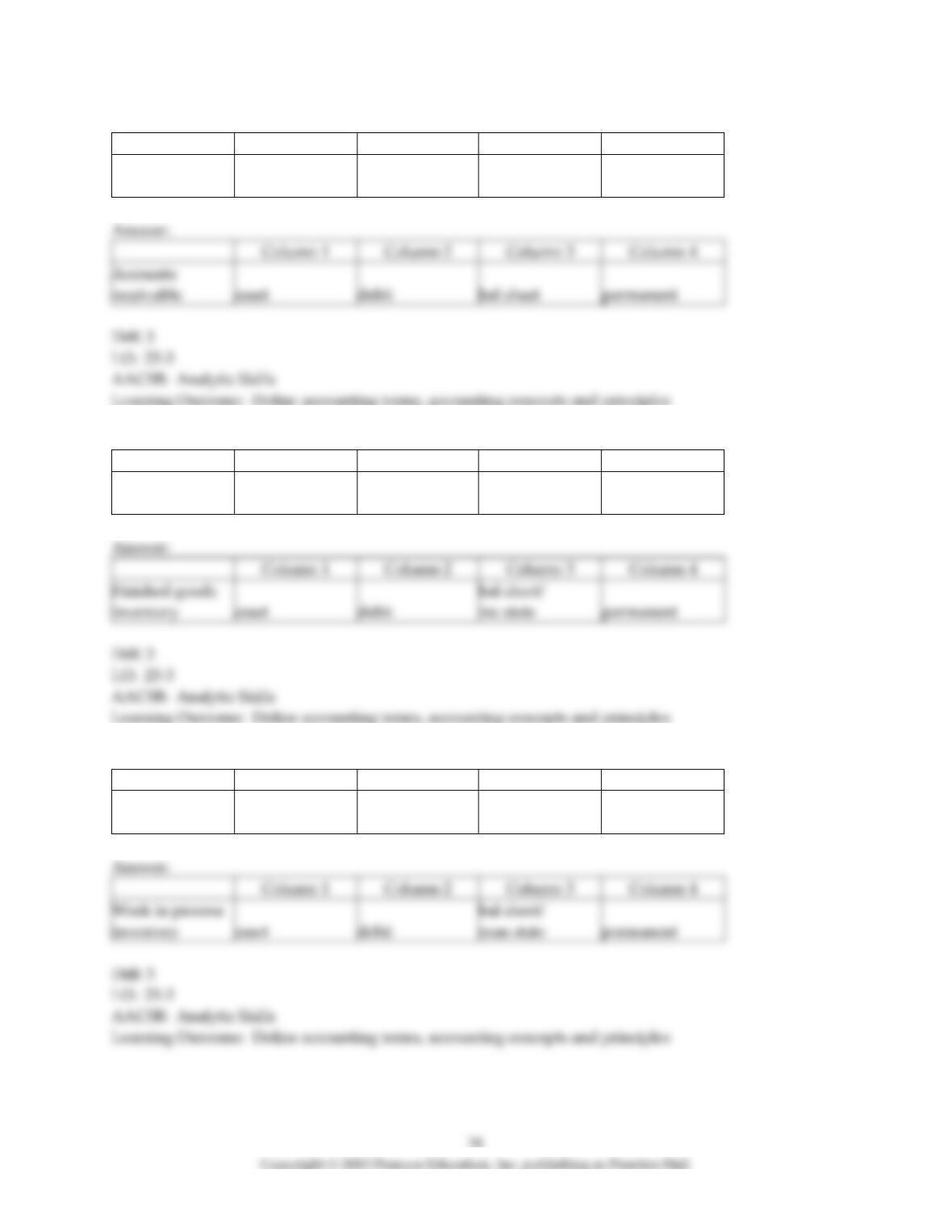
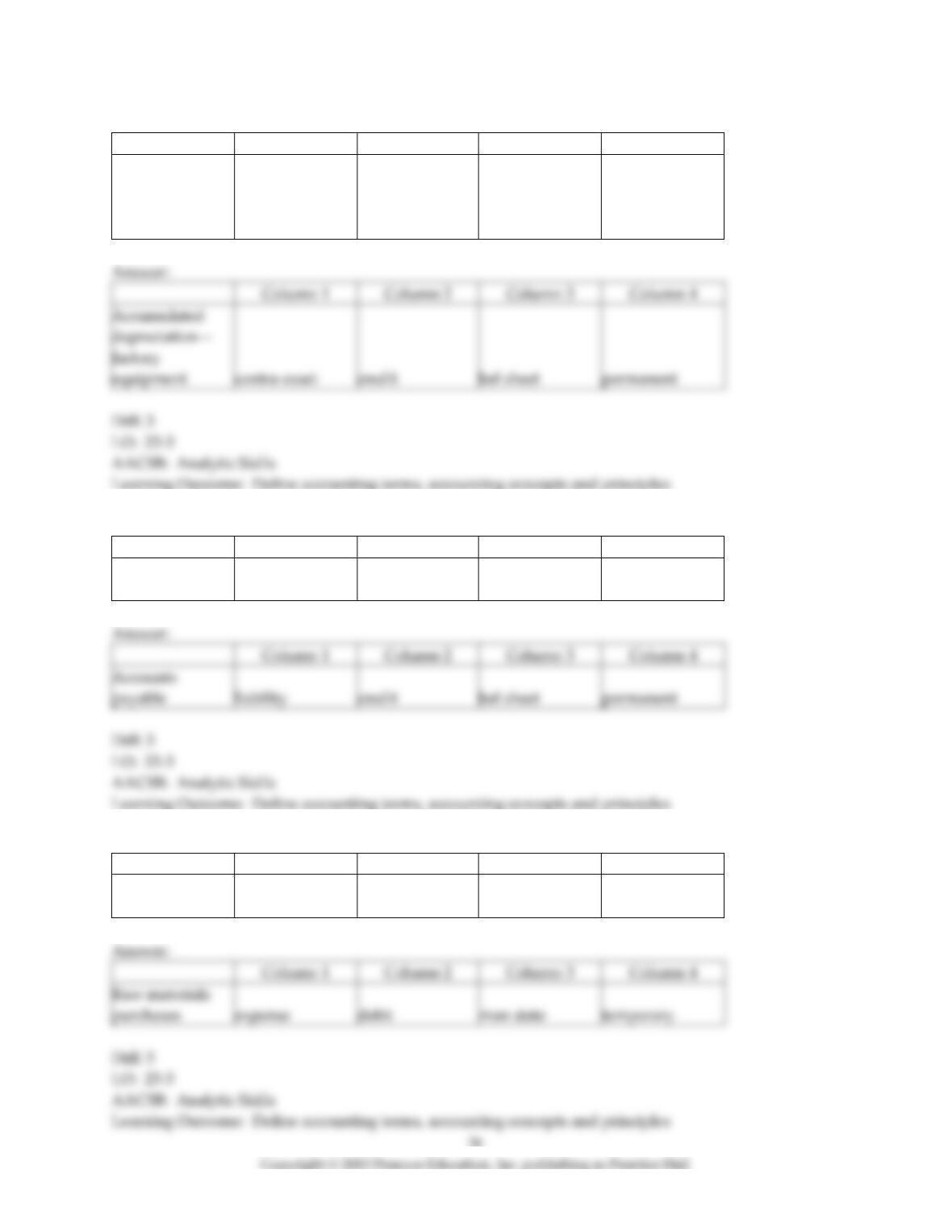
15)
Column 1
Column 2
Column 3
Column 4
Accounts
receivable
Accounts
16)
Column 1
Column 2
Column 3
Column 4
Finished goods
inventory
Finished goods
bal sheet/
17)
Column 1
Column 2
Column 3
Column 4
Work in process
inventory
Column 1
Column 2
Column 3
Column 4
Work in process
asset
debit
bal sheet/
man state
permanent
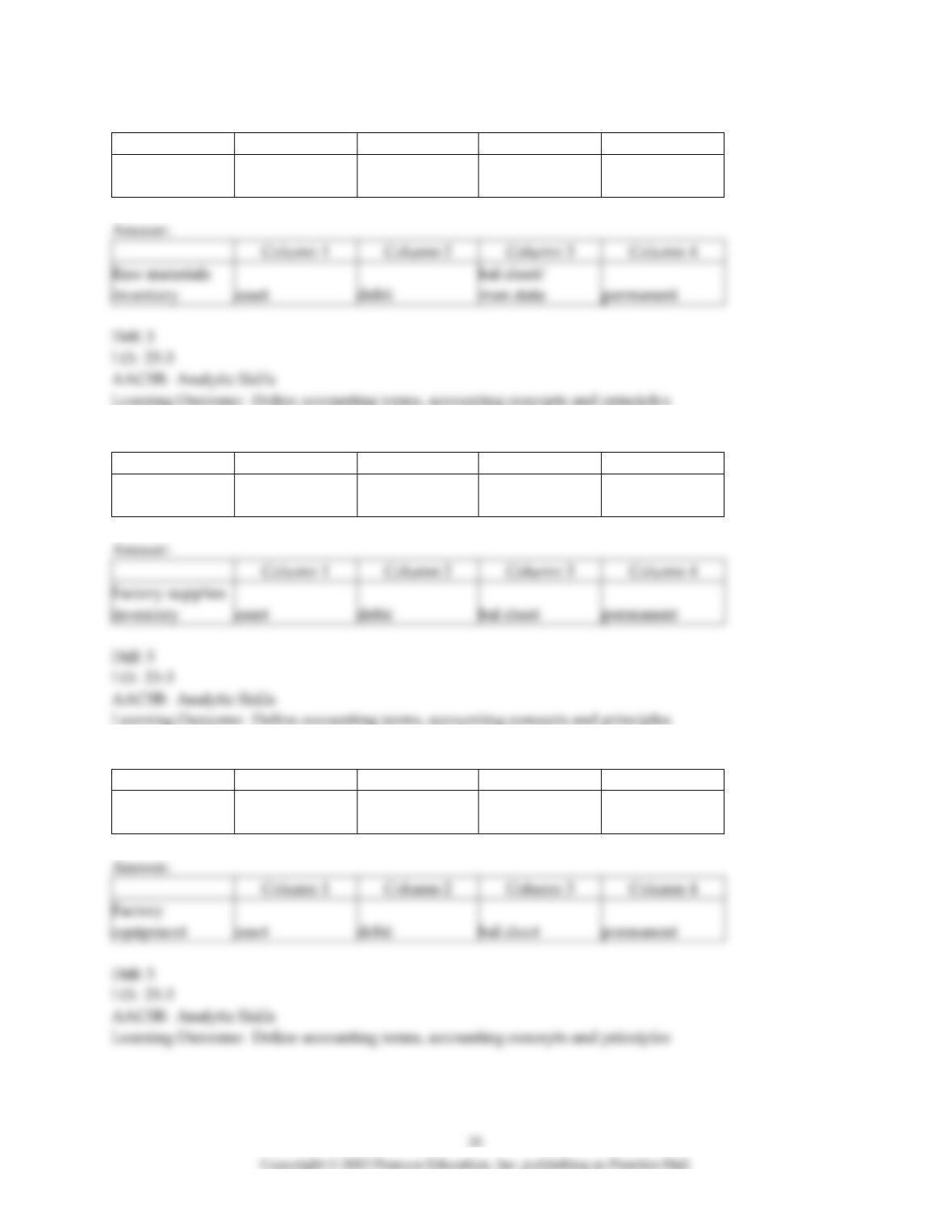
18)
Column 1
Column 2
Column 3
Column 4
Raw materials
inventory
Raw materials
bal sheet/
19)
Column 1
Column 2
Column 3
Column 4
Factory supplies
inventory
Column 1
Column 2
Column 3
Column 4
Factory supplies
inventory
asset
debit
bal sheet
permanent
20)
Column 1
Column 2
Column 3
Column 4
Factory
equipment
Column 1
Column 2
Column 3
Column 4
Factory
equipment
asset
debit
bal sheet
permanent
21)
Column 1
Column 2
Column 3
Column 4
Accumulated
depreciation—
factory
equipment
depreciation—
equipment
contra-asset
credit
bal sheet
permanent
22)
Column 1
Column 2
Column 3
Column 4
Accounts
payable
Accounts
payable
liability
credit
bal sheet
permanent
23)
Column 1
Column 2
Column 3
Column 4
Raw materials
purchases
Raw materials
purchases
expense
debit
man state
temporary
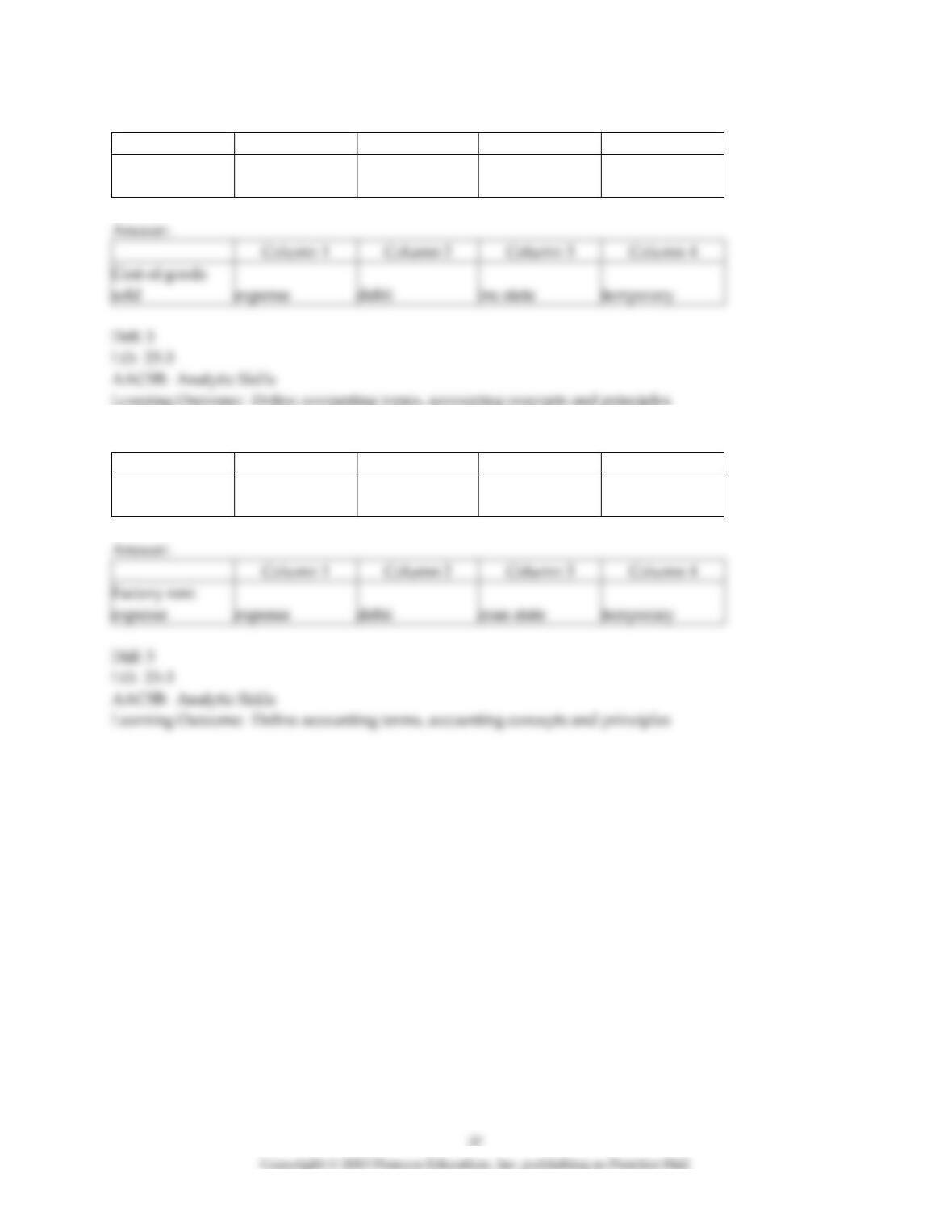
24)
Column 1
Column 2
Column 3
Column 4
Cost of goods
sold
Cost of goods
25)
Column 1
Column 2
Column 3
Column 4
Factory rent
expense
Column 1
Column 2
Column 3
Column 4
Factory rent
expense
expense
debit
man state
temporary