28) If management wishes to measure a business’s ability to pay upcoming debts, they could refer to
measures for:
A) leverage.
B) liquidity.
C) debt management.
D) profitability.
29) Scott Company had a current ratio of 2.76:1 in Year 1 and 2.57:1 in Year 2. This change in current ratio
indicates:
A) the company’s debt paying ability has improved.
B) the company’s debt paying ability has weakened.
C) the company’s customers are paying their accounts sooner.
D) the company is able to sell its inventory faster.
30) Noble Company’s accounts receivable turnover was 18.2 in Year 1 and 24.6 in Year 2. This change in
accounts receivable turnover indicates:
A) the company is not selling its inventory as fast.
B) the company is selling its inventory faster.
C) the company’s customers are paying faster.
D) the company’s customers are paying slower.
31) The ratio that indicates the amount of assets that are financed by creditors is:
A) debt to stockholders’ equity.
B) debt to total retained earnings ratio.
C) rate of return on common stockholders’ equity.
D) None of the above.
32) The debt in relation to the risk taken by stockholders is measured by:
A) debt to stockholders’ equity.
B) gross profit ratio.
C) rate of return to stockholders.
D) None of these answers are correct.
33) The lower the times interest earned ratio, the more likely:
A) a default in payment will occur.
B) a business needs to borrow money.
C) a business will suffer a loss.
D) interest payments can be made.
34) The ratio that indicates how much profit is generated from each sales dollar to cover general and
selling expenses is:
A) gross profit rate.
B) return on sales.
C) rate of return on total assets.
D) rate of return on common stockholders’ equity.
35) The ratio that measures the productivity of total assets used is the:
A) rate of return on total assets.
B) return on sales.
C) Inventory turnover.
D) rate of return on common stockholders’ equity.
36) Which of the following ratios helps evaluate how well a company is earning profit for the common
stockholders?
A) Times interest earned ratio
B) Return on sales ratio
C) Return on total assets
D) Rate of return on common stockholders’ equity
37) Which of the following ratios measures the earnings of a company on each sales dollar?
A) Return on assets
B) Return on sales
C) Return on inventory
D) Return on stockholders’ equity
38) Compute the gross profit rate when net sales are $350,000 and gross profits are $178,500.
A) 51:10
B) 54%
C) 51%
D) 54:10
39) Compute the gross profit rate when sales are $400,000; net sales are $380,000 and gross profits are
$125,000.
A) 31.25%
B) 32.89%
C) 0.3125 to 1
D) 0.3289 to 1
40) Asset management ratios measure:
A) a company’s ability to earn a profit.
B) a company’s ability to meet short-term obligations.
C) how well a company is using debt versus equity.
D) how effectively a company is using its assets.
41) Saxon Corporation‘s beginning inventory was $30,000. The cost of goods sold was $350,000 for the
year, with an ending inventory of $40,000. Inventory turnover for the year is:
A) 20 times.
B) 10 times.
C) 11.67 times.
D) 8.75 times.
42) What is the inventory turnover if the beginning inventory was $60,000, cost of goods sold was
$200,000, and ending inventory was $45,000?
A) 8.8 times
B) 6.7 times
C) 3.8 times
D) None of the above
43) Interest expense was $10,000, income tax expense $20,000, and net income after taxes is $60,000. The
number of times interest was earned is:
A) 9 times.
B) 8 times.
C) 7 times.
D) 6 times.
44) If current assets are $75,000 and current liabilities are $15,000, the current ratio is:
A) 5:1.
B) 0.2:1.
C) 0.5:1.
D) None of the above.
45) If current assets are $60,000 and current liabilities are $50,000, the current ratio is:
A) 0.8:1.
B) 8.3:1.
C) 2.1:1.
D) 1.2:1
46) Accounts receivable on January 1 was $30,000 and, at the end of the year it was $50,000. Net credit
sales were $200,000. Accounts receivable turnover is:
A) 2.5 times.
B) 4 times.
C) 5 times.
D) 6.67 times.
47) If current assets were $90,000, merchandise inventory was $60,000, and current liabilities were
$15,000, the acid test ratio is:
A) 6:1.
B) 4:1.
C) 2:1.
D) 1:2.
48) What is George’s gross profit rate if net sales are $100,000, operating expenses are $25,000, and cost of
goods sold is $40,000?
A) 40.00%
B) 25.0%
C) 35.0%
D) 60.0%
49) What is Jane’s rate of return on total assets if total assets are $100,000, net income is $2,000, interest
expense is $1,600, and income tax is $2,000?
A) 4.6%
B) 5.2%
C) 5.6%
D) 2.3%
50) What is the rate of return on common stockholders’ equity if net income is $22,700, sales are $100,000,
and common stockholders’ equity is $86,000?
A) 22.7%
B) 26.4%
C) 86%
D) None of these answers are correct.
51) The net sales for James, Inc. were $4,000,000; net income was $510,000; and gross profit was
$1,300,000. The return on sales ratio would be:
A) 12.75%.
B) 32.50%.
C) 45.25%.
D) 39.23%.
52) A company has cash of $215,000; short-term investments of $35,000; net receivables of $75,000; and
inventory of $150,000. Current liabilities total $90,000. The current ratio is:
A) 5.28:1.
B) 4.44:1.
C) 3.61:1.
D) 4.89:1.
53) Rick’s Cars had a beginning account receivables balance of $325,000. The ending account receivables
balance was $300,000. Net credit sales for the company were $4,200,000. The accounts receivable turnover
for Rick’s Cars is:
A) 12.92.
B) 14.
C) 13.44.
D) None of the above are correct.
54) The liabilities of a company at the end of the year are $500,000 and the total stockholders’ equity at the
end of the year is $1,500,000. The debt to stockholders’ equity ratio is:
A) 0.50 to 1.
B) 0.33 to 1.
C) 0.67 to 1.
D) 3.00 to 1.
55) Tom’s Toys has a cash balance of $80,000; temporary investments of $20,000; net receivables of
$60,000; and inventory of $450,000. Tom’s current liabilities total $200,000. His quick (acid test) ratio is:
A) 3.05 to 1.
B) 2.25 to 1.
C) 0.80 to 1.
D) 0.54 to 1.
56) Merchandise inventory turnover measures the relationship between
A) cost of goods sold and merchandise inventory.
B) expenses and merchandise inventory.
C) merchandise inventory and current liabilities.
D) assets and current liabilities.
57) Topiary’s Unlimited has a cost of goods sold of $1,600,000. The beginning merchandise inventory was
$195,000 and its ending merchandise inventory is $205,000. Topiary’s merchandise inventory turnover
ratio is:
A) 8.21 times.
B) 7.80 times.
C) 8.00 times.
D) None of the above are correct.
58) Topiary’s Unlimited has a cost of goods sold of $1,900,000. The beginning merchandise inventory was
$125,000 and its ending merchandise inventory is $133,000. Topiary’s merchandise inventory turnover
ratio is:
A) 65.5 times.
B) 33.8 times.
C) 14.7 times.
D) 0.1 times.
59) Isaiah Company has net income before interest and taxes of $720,000; beginning total assets of
$2,100,000; and ending total assets of $2,300,000. Isaiah’s return on total assets is:
A) 32.7%.
B) 11.2%.
C) 3.1%.
D) 31.3%.
60) The income before taxes and interest expense of Barry Builders for the year just ended is $230,000.
Their interest expense is $20,000 and their income taxes are $80,500. The number of times interest would
be earned is:
A) 22.0.
B) 10.5.
C) 11.5.
D) 0.5.
61) Net income before taxes – preferred dividends divided by common stockholders’ equity is the
calculation for:
A) earnings per share.
B) rate of return on stockholders’ equity.
C) rate of return on total assets.
D) return on sales.
62) The net income for the year ended was $300,000. Equity for common stockholders’ at the end of the
year was $1,600,000 and $1,400,000 at the beginning of the year. The return on common stockholders’
equity would be:
A) 87.50%.
B) 21.43%.
C) 20.00%.
D) 18.75%.
63) The reasons for changes in key rations must be analyzed before drawing conclusions.
64) Accounts receivable turnover is calculated by dividing gross sales by the average gross amount of
accounts receivable.
65) The debt–to-equity ratio measures the extent of (or proportion of) borrowed capital to equity, with
which a business operates.
66) To be meaningful, a small business should compare ratios with large companies.
67) A current ratio of 1.5 times would mean that the business has 1.5 times more liabilities than assets.
68) The acid test ratio is the best test to determine the ability to pay short-term debt.
69) The acid test ratio is usually higher than the current ratio.
70) If the average collection period has increased and credit terms remain the same, the company should
put a greater emphasis on collections.
71) A low debt to total assets ratio reduces a creditor’s risk if liquidation occurs.
72) The lower the times interest earned ratio, the more likely it is that interest payments will not be made.
73) If the return on common stockholders’ equity is less than the industry standard, it means the company
is using debt financing successfully.
74) When net income before taxes and interest is $52,000 and total assets equal $205,000, the rate of return
on total assets is 3.9%.
75) If the return on sales is 11% and the total assets turnover is 1.8, the rate of return on total assets would
be 19.8%.
76) A vertical analysis of an income statement automatically provides the return on sales ratio and the
gross profit ratio.
77) From the following information of Carlson’s Restoration Corporation, compute:
a. ________ Asset turnover for Year 2.
b. ________ Inventory turnover for Year 2.
c. ________ Accounts receivable turnover for Year 2.
Year 2 Year 1
Net Sales (on credit) $150,000 $120,000
Cost of Goods Sold 90,000 84,000
Net Income 30,000 24,000
Ending Acct. Receivable 24,000 21,000
Ending Inventory 16,500 13,500
Total Assets 120,000 135,000
78) Selected data for Stick’s Design are given as of December 31, Year 1 and Year 2 (rounded to the
nearest hundredth).
Year 2 Year 1
Net Credit Sales $25,000 $30,000
Cost of Goods Sold 16,000 18,000
Net Income 2,000 2,800
Cash 5,000 900
Accounts Receivable 3,000 2,000
Inventory 2,000 3,600
Current Liabilities 6,000 5,000
Required: Compute the following:
a. ________ Current ratio for Year 2.
b. ________ Acid-test ratio for Year 2.
c. ________ Accounts receivable turnover for Year 2.
d. ________ Average collection period for Year 2.
e. ________ Inventory turnover for Year 2.
79) Explain the following types of ratios:
a. Liquidity
b. Asset management
c. Debt management
d. Profitability
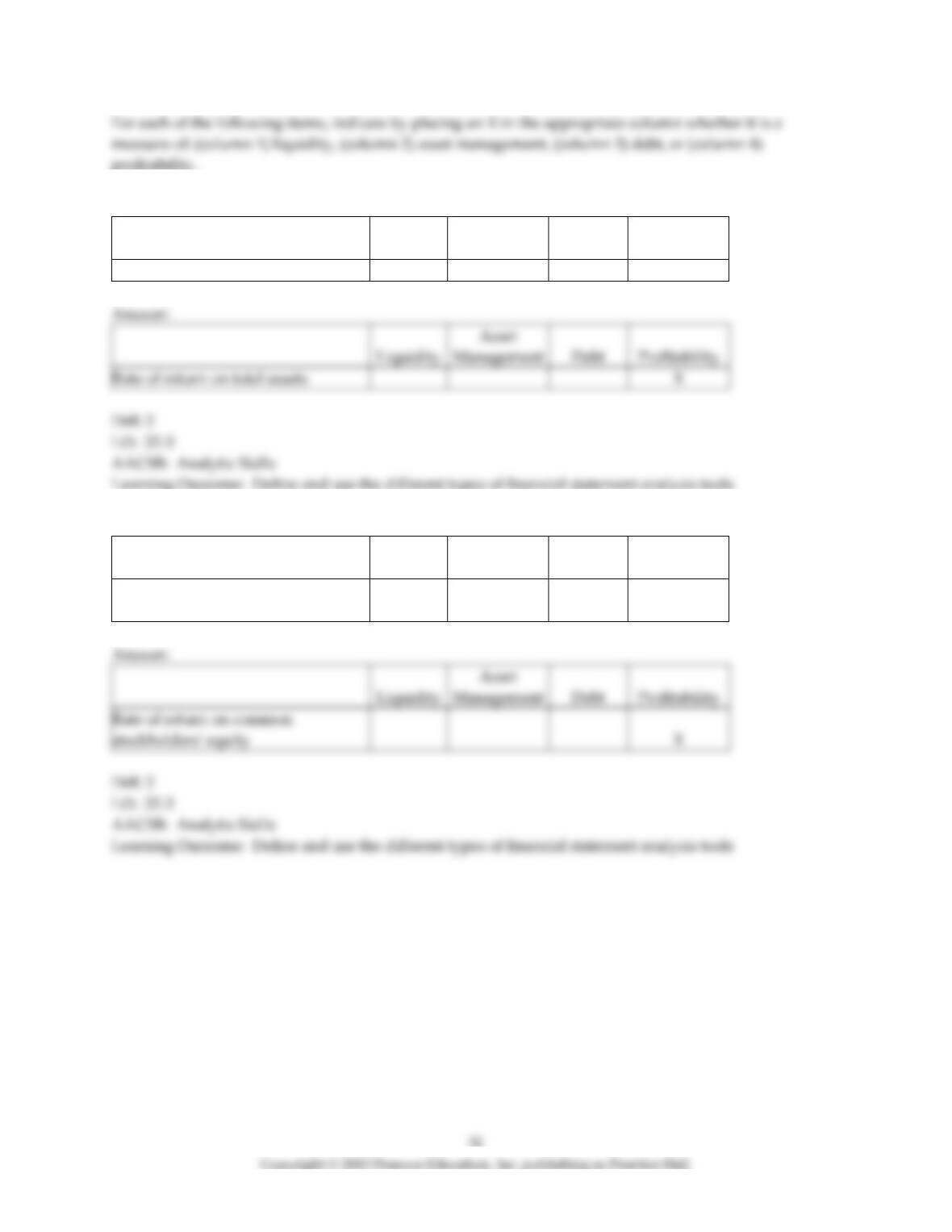
80)
Liquidity
Asset
Management
Debt
Profitability
Rate of return on total assets
Liquidity
Asset
Management
Debt
Profitability
Rate of return on total assets
81)
Liquidity
Asset
Management
Debt
Profitability
Rate of return on common
stockholders’ equity
Liquidity
Asset
Management
Debt
Profitability
Rate of return on common
stockholders’ equity
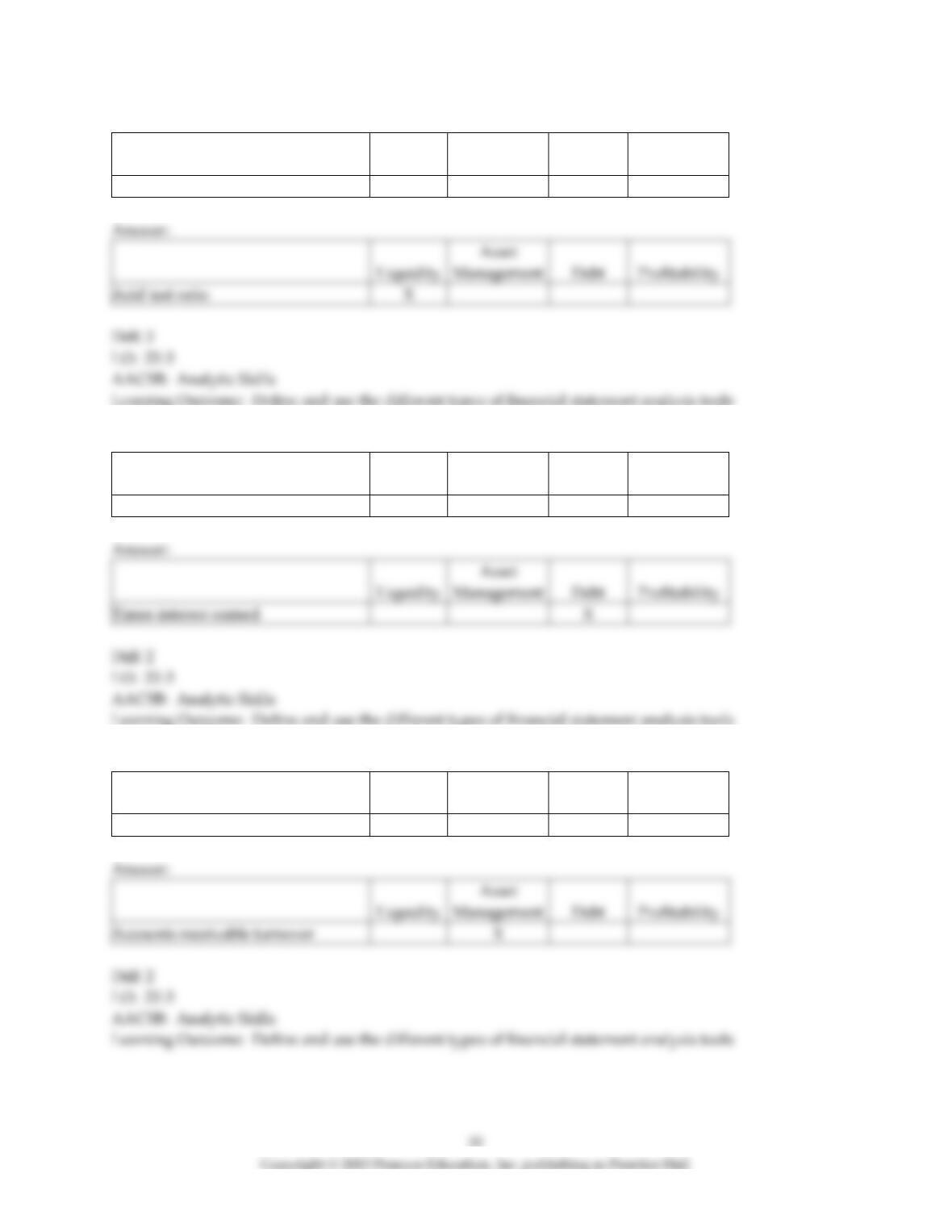
82)
Liquidity
Asset
Management
Debt
Profitability
Acid test ratio
Liquidity
Asset
Management
Debt
Profitability
Acid test ratio
83)
Liquidity
Asset
Management
Debt
Profitability
Times interest earned
Liquidity
Asset
Management
Debt
Profitability
Times interest earned
84)
Liquidity
Asset
Management
Debt
Profitability
Accounts receivable turnover
Liquidity
Management
Debt
Profitability
Accounts receivable turnover
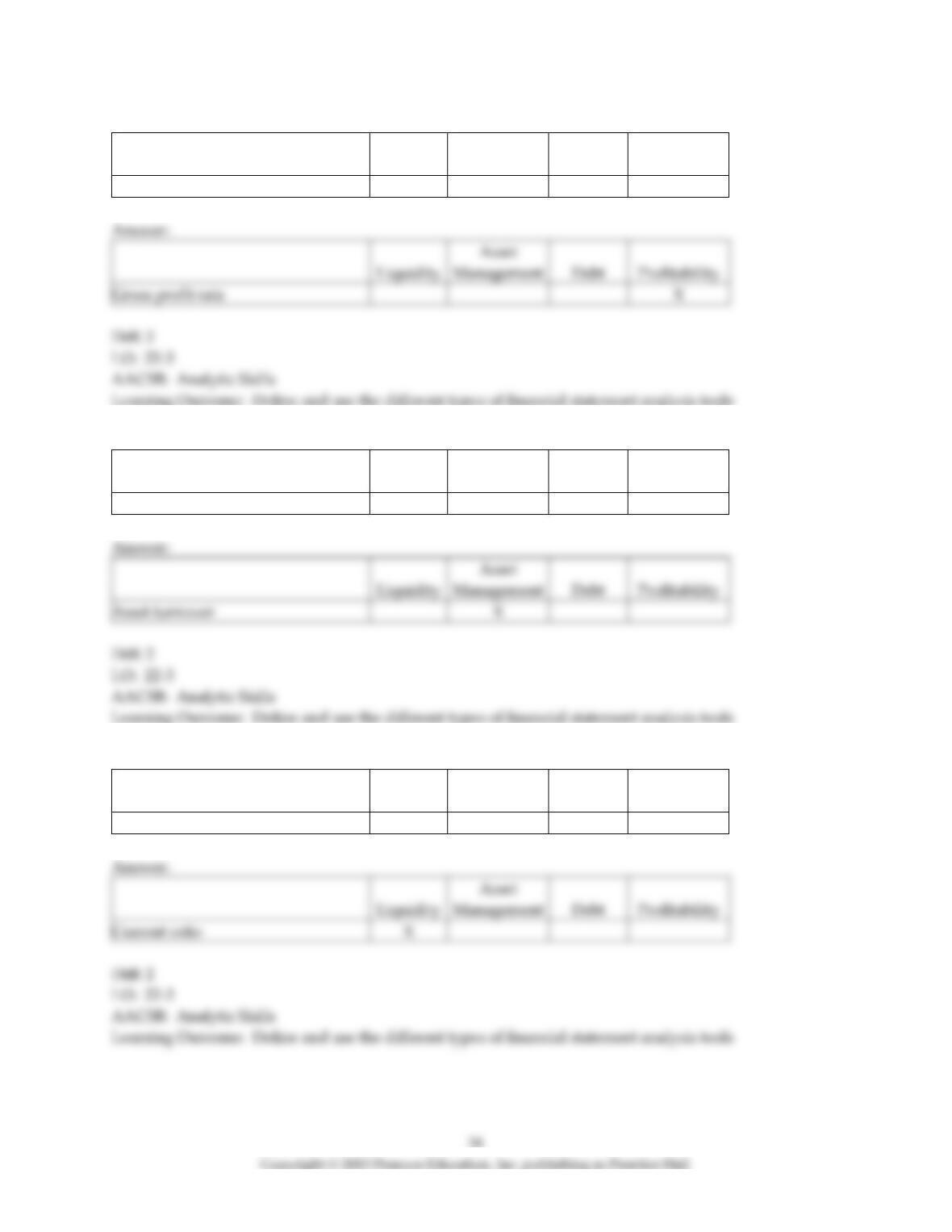
85)
Liquidity
Asset
Management
Debt
Profitability
Gross profit rate
Liquidity
Asset
Management
Debt
Profitability
Gross profit rate
86)
Liquidity
Asset
Management
Debt
Profitability
Asset turnover
Liquidity
Asset
Management
Debt
Asset turnover
87)
Liquidity
Asset
Management
Debt
Profitability
Current ratio
Management
Debt
Profitability
Current ratio
88)
Liquidity
Asset
Management
Debt
Profitability
Debt to total assets
Liquidity
Asset
Management
Debt
Profitability
Debt to total assets
89)
Liquidity
Asset
Management
Debt
Profitability
Average collection period
Liquidity
Asset
Management
Debt
Profitability
Average collection period
90)
Liquidity
Asset
Management
Debt
Profitability
Return on sales
Liquidity
Management
Debt
Profitability
Return on sales