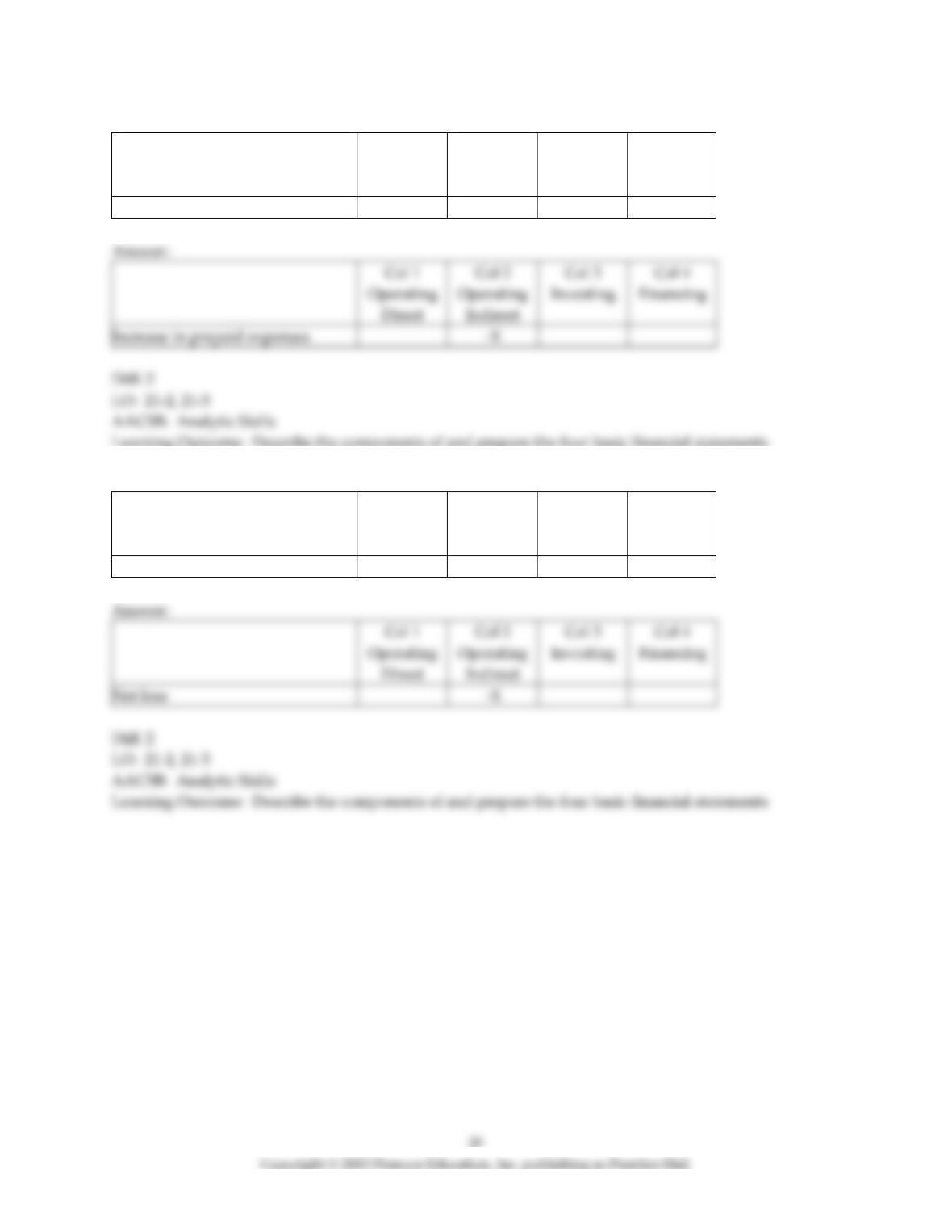
15)
Col 1
Operating
Direct
Col 2
Operating
Indirect
Col 3
Investing
Col 4
Financing
Increase in prepaid expenses
Col 1
Operating
Col 2
Operating
Col 3
Investing
Col 4
Financing
Increase in prepaid expenses
16)
Col 1
Operating
Direct
Col 2
Operating
Indirect
Col 3
Investing
Col 4
Financing
Net loss
Operating
Direct
Operating
Indirect
Investing
Financing
Net loss
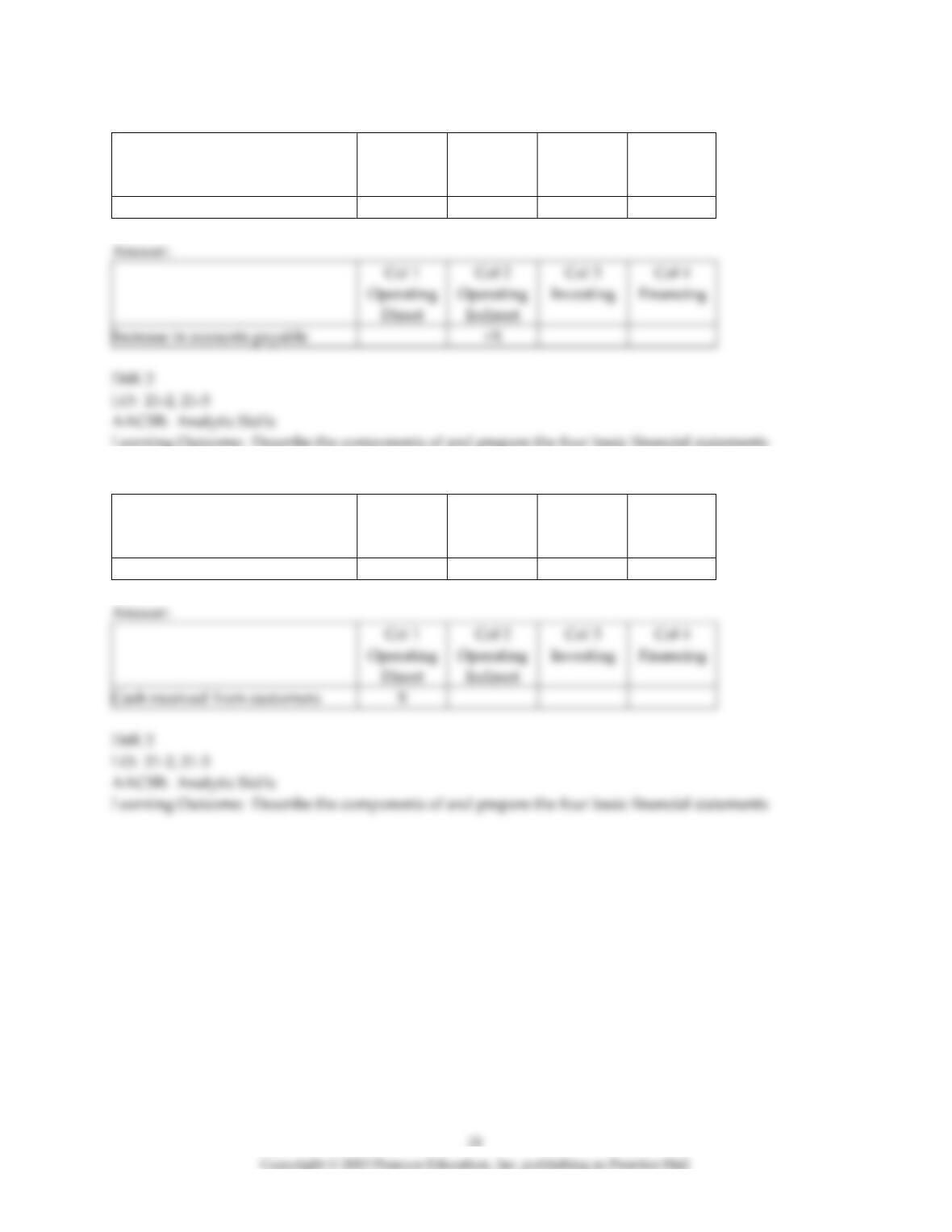
17)
Col 1
Operating
Direct
Col 2
Operating
Indirect
Col 3
Investing
Col 4
Financing
Increase in accounts payable
Col 1
Operating
Direct
Col 2
Operating
Indirect
Col 3
Investing
Col 4
Financing
Increase in accounts payable
18)
Col 1
Operating
Direct
Col 2
Operating
Indirect
Col 3
Investing
Col 4
Financing
Cash received from customers
Operating
Direct
Operating
Indirect
Investing
Financing
Cash received from customers
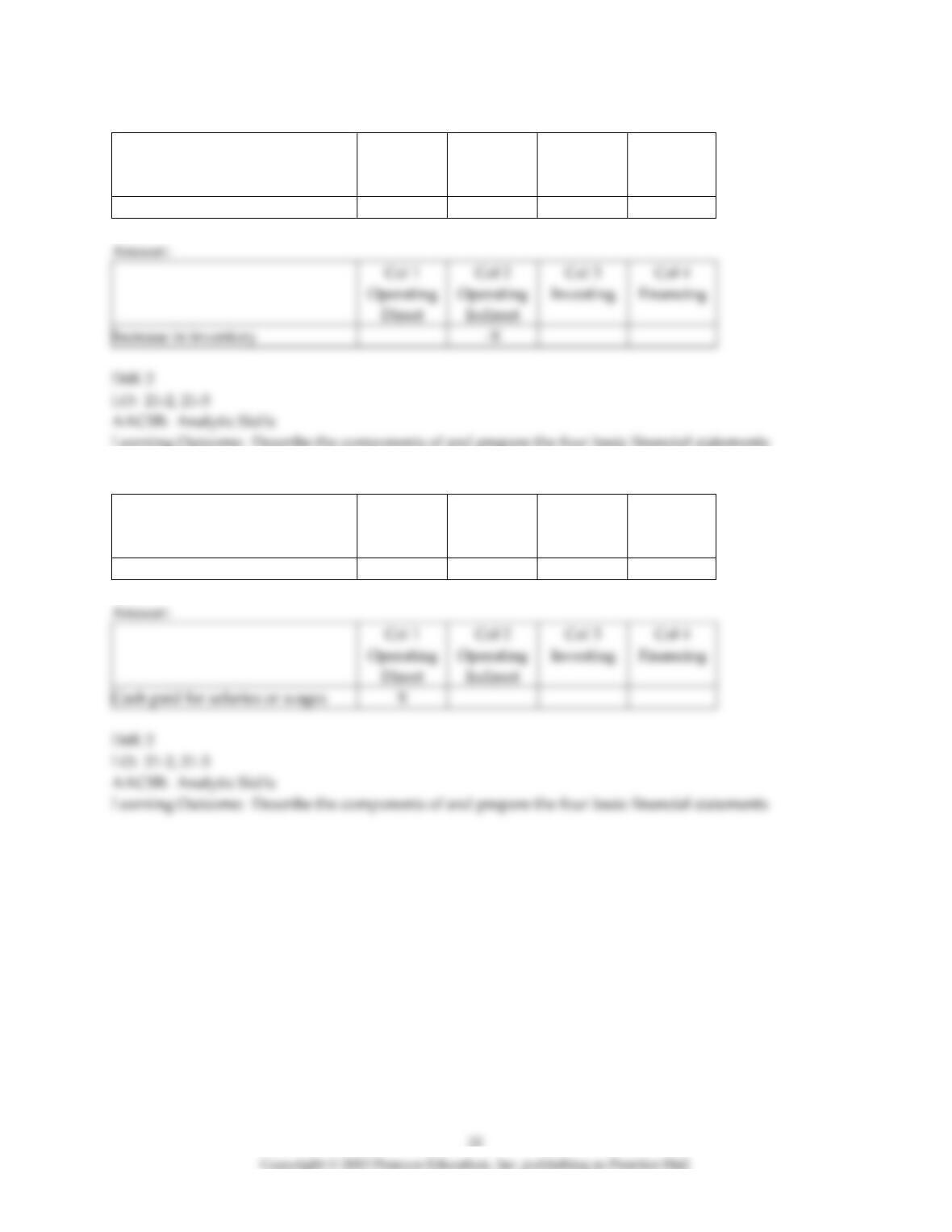
19)
Col 1
Operating
Direct
Col 2
Operating
Indirect
Col 3
Investing
Col 4
Financing
Increase in inventory
Col 1
Operating
Direct
Col 2
Operating
Indirect
Col 3
Investing
Col 4
Financing
Increase in inventory
20)
Col 1
Operating
Direct
Col 2
Operating
Indirect
Col 3
Investing
Col 4
Financing
Cash paid for salaries or wages
Operating
Direct
Operating
Indirect
Investing
Financing
Cash paid for salaries or wages
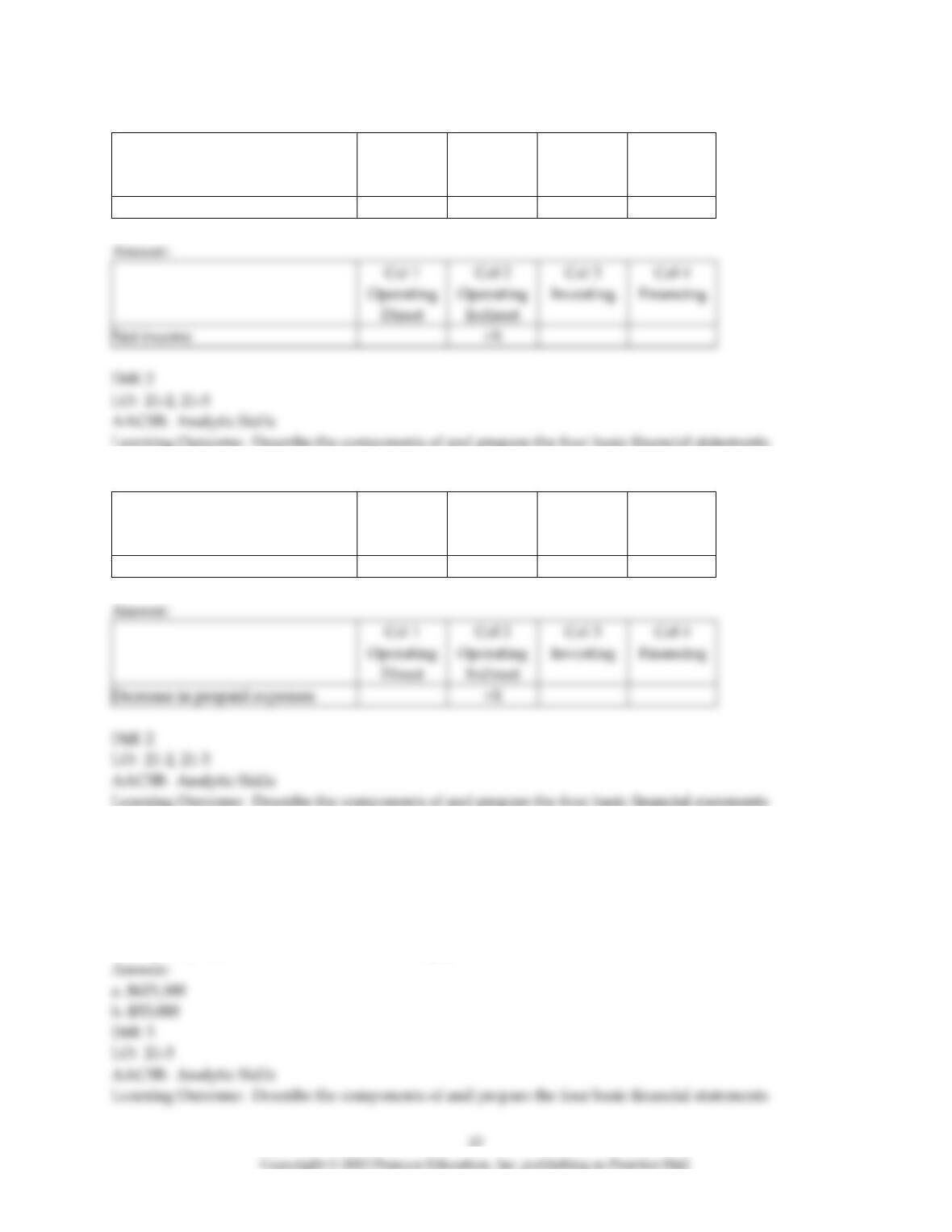
21)
Col 1
Operating
Direct
Col 2
Operating
Indirect
Col 3
Investing
Col 4
Financing
Net income
Col 1
Operating
Col 2
Operating
Col 3
Investing
Col 4
Financing
Net income
22)
Col 1
Operating
Direct
Col 2
Operating
Indirect
Col 3
Investing
Col 4
Financing
Decrease in prepaid expenses
Operating
Direct
Operating
Indirect
Investing
Financing
Decrease in prepaid expenses
23) The cash flows from operating activities are reported by the direct method on the statement of cash
flow. Determine the following:
a. If sales for the current year were $600,000 and accounts receivable decreased $25,500 during the year,
what was the amount of cash received from customers?
b. If sales salaries expense for the current years was $80,000 and sales salaries payable increased $25,000
during the year, what was the amount of cash payments for sales salaries?
24) The cash flows from operating activities are reported by the direct method on the statement of cash
flows. Determine the following:
a. If accrued expenses showed $50,000 on the income statement and payables increased from $15,000 to
$18,500 on the balance sheet, what was the amount of cash paid?
b. If insurance expense showed $10,000 on the income statement and Prepaid Insurance increased from
$10,000 to $12,000 on the balance sheet, what was the amount of cash paid for insurance?
21.4 Learning Objective 21-4
1) Which of the following is not a cash flow from investing activities?
A) Loaning cash to borrowers
B) Payment of cash dividends
C) Sale or purchase of land
D) Cash received from the sales of stock
2) If $12,000 was generated from operations, $6,000 was used for investing activities, and $4,000 was
provided by financing activities, the cash balance would:
A) increase by $14,000.
B) decrease by $20,000.
C) increase by $10,000.
D) increase by $2,000.
3) The accuracy of the statement of cash flows, regardless of method used, can be verified by computing
the change in the balance of:
A) cash.
B) equity.
C) revenue.
D) liabilities.
4) Cash generated from operating activities may be computed by using:
A) the indirect method.
B) the direct method.
C) either the direct or indirect method.
D) the combination method.
5) The board of directors is considering approving a plant expansion which will require a sizable advance
payment to take place early this year. How will this decision affect the period’s cash flows from
investing—direct method?
A) It will increase this period’s cash flows from investing.
B) It will decrease this period’s cash flows from investing.
C) It will not affect this period’s cash flows from investing.
D) This is not listed in the statement of cash flows.
6) The board of directors is considering approving a declaration and payment of dividends for the second
quarter of the year. How will this decision affect the period’s cash flows from operations—indirect
method?
A) It will increase this period’s cash flows from operations.
B) It will decrease this period’s cash flows from operations.
C) It will not affect this period’s cash flows from operations.
D) This does not affect cash flows from operations.
7) The section of the statement of cash flows from investing activities includes:
A) buying debts or stocks of other companies.
B) collecting loans and/or interest.
C) cash purchases of equipment.
D) All of the above.
8) The sale of plant and equipment for cash would result in:
A) an increase in cash from investing activities.
B) a decrease in cash from investing activities.
C) an increase added to net income from operations.
D) a decrease subtracted from net income from operations.
9) Transactions dealing with the exchange of cash between the firm and its owners (stockholders) and
creditors are called:
A) planning activities.
B) financing activities.
C) investing activities.
D) operating activities.
10) Which of the following is a cash outflow from a financing activity?
A) A purchase inventory
B) A purchase of treasury stock
C) A payment to buy property
D) A loan made to a third party
11) A sale of fixed assets for cash is a(n):
A) managing activity.
B) investing activity.
C) financing activity.
D) operating activity.
12) Cash flows from financing activities would include:
A) issuance of long-term notes.
B) cash purchase of stocks and bonds.
C) cash from sale of stock investments.
D) All of these answers are correct.
13) Payments of cash dividends to stockholders would result in:
A) a decrease of cash flow from operating activities.
B) a decrease of cash flow from investing activities.
C) an increase of cash flow from financing activities.
D) a decrease of cash flow from financing activities.
14) Issuance of common stock for cash would result in:
A) an increase of cash flow from operating activities.
B) a decrease of cash flow from investing activities.
C) an increase of cash flow from financing activities.
D) an increase of cash flow from investing activities.
15) Loaning cash to borrowers would result in:
A) an increase of cash flow from investing activities.
B) a decrease of cash flow from investing activities.
C) an increase of cash flow from financing activities.
D) a decrease of cash flow from financing activities.
16) Selling stocks of other companies for cash would result in:
A) an increase of cash flow from investing activities.
B) a decrease of cash flow from investing activities.
C) an increase of cash flow from financing activities.
D) a decrease of cash flow from financing activities.
17) An increase in long-term note payable would mean:
A) an increase of cash flow from investing activities.
B) a decrease of cash flow from investing activities.
C) an increase of cash flow from financing activities.
D) a decrease of cash flow from financing activities.
18) Activities that increase and decrease as a result of selling a company’s stock are:
A) marketing activities.
B) operating activities.
C) investing activities.
D) financing activities.
19) Activities that pay and collect interest on loans are:
A) financing and investing activities.
B) operating and financing activities.
C) operating and investing activities.
D) marketing activities.
20) Of the following items, which is not classified as an investing activity on the statement of cash flows?
A) Sale of a plant asset for cash
B) Purchasing land
C) Collecting loans
D) Selling goods and services
21) Carolina Company sold a machine for $12,000 cash, which had an original cost of $19,000 and
accumulated depreciation of $6,000. The amount of cash provided by this sale is:
A) $12,000.
B) $13,000.
C) $18,000.
D) $19,000.
22) A transaction of issuance of stock in exchange for equipment would be recorded as a(n):
A) operating activity.
B) investing activity.
C) financing activity.
D) noncash investing and financing activity.
23) A statement of cash flows would not disclose the effect of which of the following transactions?
A) Stock dividends declared
B) Bonds payable issued
C) Purchase of treasury stock
D) Capital stock issued to acquire fixed assets
24) A statement of cash flows would not disclose the effect of which of the following transactions?
A) Dividends received on stock investments
B) Receiving cash from customers on product sales
C) Discarding an asset that had been fully depreciated
D) None of these answers are correct.
25) When a corporation pays dividends it:
A) does not affect the cash flow statement.
B) is shown as an investing activity.
C) is shown as a financing activity.
D) is shown as an operating activity.
26) A business issues 10-year bonds payable in exchange for common stock. This transaction would be
reported on the statement of cash flows in:
A) operating activities.
B) financing activities.
C) investing activities.
D) a separate schedule.
27) Common stock in exchange for a warehouse would be reported in the statement of cash flows in:
A) a separate schedule.
B) operating activities.
C) financing activities.
D) investing activities.
28) If a gain of $70,000 is incurred in selling equipment having a book value of $225,000, cash flow will
increase:
A) $295,000.
B) $155,000.
C) $70,000.
D) some other number.
29) Land costing $60,000 was sold for $50,000. What was the effect on the investing activities?
A) Increase $50,000
B) Decrease $10,000
C) Decrease $70,000
D) Increase $10,000
30) Financing activities include transactions with owners and creditors.
31) Dividends received on investments made in the stock of other companies is an example of a financing
activity.
32) One section of a statement of cash flows is purchasing activities.
33) Changes in current assets and current liabilities accounts deal with financing activities.
34) An example of operating activities is the payment of dividends.
35) If $200,000 of a company’s own stock is sold, it is shown in the financing activities section.
36) If equipment is sold for $50,000, it is shown in the financing activities section.
37) If 2,000 shares of stock were sold for $10 per share, cash flow from financing activities would decrease
$20,000.
38) Indicate the effect that each of the following transactions has on the cash balance. Use (I) for increase,
(D) for decrease, and (N) for no change.
a) ________ Increase in inventory
b) ________ Sale of common stock for cash
c) ________ Payment of dividends
d) ________ Depreciation expense for the period
e) ________ Payment of long-term debt
f) ________ Loan of money to another company
g) ________ Increase in Accounts Payable
h) ________ Purchase of equipment on account
39) Indicate the effect that each of the following transactions has on the cash balance. Use (I) for increase,
(D) for decrease, and (N) for no change.
a) ________ Issued common stock for cash
b) ________ Acquired land for cash
c) ________ Purchase equipment on account
d) ________ Paid a cash dividend
e) ________ Purchased supplies on account
f) ________ Received payment on account
g) ________ Borrowed money by issuance of a long-term debt
h) ________ Purchased equipment on account to be paid within one year
40) Identify each of the following transactions as an operating activity (O), an investing activity (I), a
financing activity (F), or a transaction that is not reported on the statement of cash flows (N).
a) ________ Receipt of interest
b) ________ Increase of accounts payable
c) ________ Borrowed money from a bank
d) ________ Purchase of building for cash
e) ________ Declaration of cash dividends
f) ________ Sold plant equipment for cash
g) ________ Increase of accounts receivable
h) ________ Payment on principal of a note
41) Identify where each of the following transactions would be shown on the statement of cash flows
when it is prepared by the indirect method. Identify each transaction as an operating activity (O), an
investing activity (I), a financing activity (F), or transaction that is not reported on the statement of cash
flows (N).
a) ________ Paid for fire insurance in advance
b) ________ Cash used to purchase new computers
c) ________ Cash used to retire bonds outstanding
d) ________ Depreciation expense
e) ________ Cash used to purchase fixed assets
f) ________ Cash proceeds from sale of the company’s own stock
g) ________ Bought back own stock
h) ________ Received cash dividends
42) The following information is given for Tripp Company, which uses the indirect method.
Net income $20,000
Depreciation expense 3,000
Increase in accounts receivable 2,000
Payment of dividends 2,000
Proceeds from sale of equipment 6,000
Increase in accounts payable 4,000
Decrease in inventory 3,000
From the information provided, answer the following questions:
a) The cash flow from operating activities is ________.
b) The cash flow from investing activities is ________.
c) The cash flow from financing activities is ________.
43) The following information is given for Nevada Times:
Net income $20,000
Depreciation expense 4,000
Decrease in accounts receivable 2,000
Increase in supplies on hand 3,000
Sale of common stock 10,000
Purchase of equipment 5,000
Loan money to a customer 4,000
Decrease in accounts payable 1,000
The indirect method is used.
Required:
Answer the following questions with the information provided above.
a) The cash flow from operating activities is ________.
b) The cash flow from investing activities is ________.
c) The cash flow from financing activities is ________.
44) The following information is given for Sunny Corporation:
Net income $45,000
Depreciation expense 8,000
Decrease in accounts receivable 3,000
Increase in supplies on hand 1,000
Sale of common stock 50,000
Purchase of equipment 45,000
Payment of dividends 6,000
Decrease in accounts payable 5,000
The indirect method is used. The beginning Cash balance is $23,000.
Required:
Answer the following questions with the information provided above.
a) The cash flow from operating activities is ________.
b) The cash flow from investing activities is ________.
c) The cash flow from financing activities is ________.
d) The net change in cash is ________.
e) The ending balance of cash is ________.