College Accounting, 12e (Slater)
Chapter 21 Statement of Cash Flows
21.1 Learning Objective 21-1
1) A statement of cash flows:
A) has three main sections: net cash flow from operating, investing, and financing activities.
B) may be computed directly or indirectly.
C) is a statement used to better understand the financing and investing activities.
D) All of the above are correct.
2) The cash flow statement has all of the following sections except:
A) net cash flow from managing activities.
B) net cash flow from operating activities.
C) net cash flow from investing activities.
D) net cash flow from financing activities.
3) A statement of cash flows is helpful in:
A) evaluating.
B) comparing.
C) predicting future cash flows.
D) All of these answers are correct.
4) The statement of cash flows provides information about all of the following except:
A) organizing activities.
B) investing activities.
C) operating activities.
D) financing activities.
5) The difference between the direct and indirect method of computing the cash flow statement occurs in
the:
A) financing activities section.
B) operating activities section.
C) investing activities section.
D) managing activities section.
6) A statement of cash flow’s purpose is to:
A) show the revenue earned.
B) show the profits that were generated.
C) show the expenses that were incurred.
D) show how cash was generated and used during an accounting period.
7) An inflow of cash from investing activities would be:
A) the issuance of stock.
B) the sale of investment in equity securities.
C) interest received on loans.
D) the purchase of fixed assets.
8) The activity that is probably the most important indicator of financial health is the net cash flow from:
A) buying and selling activities.
B) financing activities.
C) operating activities.
D) investing activities.
9) A cash outflow from a financing activity would be:
A) paying cash dividends.
B) buying debt and equity securities.
C) paying interest on notes payable.
D) making payments for additional inventory.
10) Transactions involving the purchase and sale of fixed assets would be considered:
A) buying and selling activities.
B) financing activities.
C) operating activities.
D) investing activities.
11) The purpose of a cash flow statement is to show the inflows and outflows of cash.
12) The income statement shows the results of the operations of the business.
13) If a company issues a comparative balance sheet showing the change in the cash balance, a statement
of cash flows is not needed.
14) According to GAAP, the statement of cash flows is an optional statement.
15) The final cash amount on the statement of cash flows must match the cash balance shown on the
balance sheet.
16) Discuss the purpose of a statement of cash flows, and describe its components.
21.2 Learning Objective 21-2
1) When preparing the statement of cash flows by the indirect method, if current assets have increased
the difference is:
A) added to net income.
B) added to investments.
C) deducted from net income.
D) subtracted from investments.
2) Using the indirect method for cash flows, depreciation expense is added to net income to determine
the:
A) cash flow from investing activities.
B) cash flow from financing activities.
C) cash flow from operating activities.
D) cash flow from fixed asset activities.
3) If, on the comparative balance sheet, Accounts Payable has decreased, the amount of decrease would
be:
A) added to net income on the statement of cash flows.
B) subtracted from net income on the statement of cash flows.
C) ignored because cash is not involved.
D) None of these answers are correct.
4) If Accounts Receivable decreases on a comparative balance sheet, this means:
A) collections were more than sales.
B) credit sales are decreasing.
C) credit sales are increasing more than collections.
D) None of these answers are correct.
5) In the statement of cash flows, which event would cause net income to be increased?
A) A decrease in Inventory
B) An increase in Prepaid Insurance
C) A decrease in Accounts Payable
D) An increase in Accounts Receivable
6) Operating activities deal with which types of accounts?
A) Current liabilities and owner’s equity
B) Current and intangible assets
C) Current assets and current liabilities
D) Current assets and owner’s equity
7) When preparing the statement of cash flows by the indirect method, if current liabilities increase the
difference is:
A) added to net income.
B) added to investments.
C) deducted from net income.
D) subtracted from investments.
8) When preparing the statement of cash flows by the indirect method, if accumulated depreciation
increases the difference is:
A) added to net income.
B) added to investments.
C) deducted from net income.
D) not considered in the statement of cash flows using the indirect method.
9) Which of the following, under the indirect method, is not a proper adjustment to net income to arrive
at cash flow from operations?
A) Adding a decrease in inventory
B) Adding an increase in salaries payable
C) Deducting a increase in prepaid expense
D) All are proper adjustments to net income.
10) Which of the following would be included in the net cash flows from operating activities section of a
cash flow statement using the indirect method?
A) Sales of plant, property and equipment
B) Making loans and paying out interest
C) Payment of interest and expenses
D) Issuing bonds and notes
11) When comparing net cash provided by operating activities using the indirect versus direct method:
A) net cash is higher using the indirect method
B) net cash is lower using indirect method
C) there is no difference between the two methods
D) depreciation expense is used in the direct method.
12) Rick Corporation’s Accounts Receivable decreased by $25,000 during the year. What is the adjustment
to the cash flow statement when it is prepared by the indirect method?
A) Subtract the decrease from the net income in operating activities.
B) Add the decrease to the net income in operating activities.
C) Add the decrease in the investing activities section.
D) Subtract the decrease in the financing activities.
13) Collins Corporation reported net income of $35,000; depreciation expenses of $20,000; an increase in
Accounts Payable of $2,000; and an increase in Accounts Receivable of $3,000. Net cash flow from
operating activities using the indirect method is:
A) $55,000.
B) $54,000.
C) $50,000.
D) $56,000.
14) Smith Corporation reported net income of $54,000, depreciation expenses of $10,000, an increase in
Accounts Payable of $3,000 and an increase in Accounts Receivable of $1,500. Under the indirect method,
net cash flow from operating activities is:
A) $62,500.
B) $59,500.
C) $48,500.
D) $65,500.
15) Trundle Corporation reported net income of $40,000; depreciation expense of $1,000; sales of
additional common shares of $25,000; and a decrease in Accounts Payable of $8,000. Net cash flow from
operating activities using the indirect method is:
A) $41,000.
B) $32,000.
C) $33,000.
D) $58,000.
16) Big Toy Corporation’s records show profit of $30,000; depreciation expense of $10,000; and cash
dividends declared and paid of $5,000. The amount of cash used in operating activities using the indirect
method is:
A) $40,000.
B) $30,000.
C) $20,000.
D) $10,000.
17) Carmen’s Candies’ Net Income was $40,000. Other accounts that changed included: Accounts
Receivable decreased by $30,000; Merchandise Inventory increased by $20,000; Accounts Payable
decreased by $4,000; and Salaries Payable increased by $1,000. The amount of Net Cash Flow from
Operating Activities using the indirect method is:
A) $33,000.
B) $47,000.
C) $53,000.
D) $61,000.
18) Fidelity Furniture’s Net Income was $25,000. Other accounts that changed included: Accounts
Receivable decreased by $18,000; Merchandise Inventory increased by $7,000; Accounts Payable increased
by $4,000; and Salaries Payable decreased by $3,000. The amount of Net Cash Flow from Operating
Activities using the indirect method is:
A) $57,000.
B) $43,000.
C) $37,000.
D) $15,000.
19) Which of the following items would be added to Net Income to compute Net Cash Flow from
Operating Activities under the indirect method?
A) A decrease in Merchandise Inventory
B) A decrease in Accrued Payables
C) A decrease in Accounts Payable
D) An increase in Prepaid Insurance
20) The records of Ashley Boutique showed Net Loss, $30,000; Depreciation Expense, $25,000; and
increase in Supplies on Hand, $5,000. The amount of Net Cash Flow from Operating Activities using the
indirect method is:
A) $15,000.
B) $20,000.
C) ($10,000).
D) ($15,000).
21) The records of Ashley Boutique showed Net Loss, $25,000; Depreciation Expense, $35,000; and
increase in Supplies on Hand, $8,000. The amount of Net Cash Flow from Operating Activities using the
indirect method is:
A) $18,000.
B) $ 2,000.
C) ($18,000).
D) ($2,000).
22) Accounts Receivable amounted to $215,000 at the beginning of the year and $245,000 at the end of the
year. Income reported on the income statement for the year was $300,000. The cash flow from operating
activities on the cash flow statement using the indirect method is:
A) $300,000.
B) $330,000.
C) $270,000.
D) None of these answers are correct.
23) The net income reported on the income statement for the current year was $60,000. Depreciation
recorded on fixed assets was $31,000. What is the cash flow from operations that would appear on a cash
flow statement using the indirect method?
A) $29,000
B) $60,000
C) $31,000
D) $91,000
24) Of the following, which has a positive effect on the computation of cash flow from operations using
the indirect method?
A) Increase in Inventory
B) Decrease in Accounts Payable
C) Increase in Accounts Receivable
D) Decrease in Prepaid Insurance
25) Even though the cost of fuel oil is rising, management is considering using up the business’s reserves
and not ordering any more this period. How will this decision affect the period’s cash flows from
operations—indirect method?
A) It will increase this period’s cash flows from operations.
B) It will decrease this period’s cash flows from operations.
C) It will not affect this period’s cash flows from operations.
D) This does not affect cash flows from operations.
26) Management has authorized the purchase of a large quantity of inventory for early December. The
purchase will have credit terms of 2/10, n/30, they will authorize payment by the discount date. How will
this decision affect the period’s cash flows from operations—indirect method?
A) It will increase this period’s cash flows from operations.
B) It will decrease this period’s cash flows from operations.
C) It will not affect this period’s cash flows from operations.
D) This does not affect cash flows from operations.
27) Of the following, which has a negative effect on the computation of cash flow from operations using
the indirect method?
A) Increase in Accounts Payable
B) Increase in Inventory
C) Increase in Notes Payable
D) Depreciation Expense
28) Which is not a cash outflow from an operating activity?
A) Payment for interest on a loan
B) Payment to the government for taxes
C) Payment to buy merchandise inventory
D) Paying dividends to stockholders
29) Which of the following adjustments would be in error if made to net income when computing cash
from operations using the indirect method?
A) Add an increase in Accounts Payable
B) Add Depreciation Expense
C) Add an increase in Accounts Receivable
D) None of the above
30) There was a utility bill received but not paid. How would this nonpayment affect the statement of
cash flows operations section—indirect method?
A) It is already included in the net income.
B) It would affect the operations section positively.
C) It would affect the operations section negatively.
D) Does not affect the cash flow from operations.
31) The Accounts Payable balance has decreased during the year. How would this event affect the
statement of cash flows operations section—indirect method?
A) It is already included in the net income.
B) It would affect the operations section positively.
C) It would affect the operations section negatively.
D) Does not affect the cash flow from operations.
32) The Accounts Payable balance has increased during the year. How would this event affect the
statement of cash flows operations section—indirect method?
A) It is already included in the net income.
B) It would affect the operations section positively.
C) It would affect the operations section negatively.
D) Does not affect the cash flow from operations.
33) The balance of Supplies has decreased during the year. How would this event affect the statement of
cash flows operations section—indirect method?
A) It is already included in the net income.
B) It would affect the operations section positively.
C) It would affect the operations section negatively.
D) Does not affect the cash flow from operations.
34) The Accounts Receivable balance has decreased during the year. How would this event affect the
statement of cash flows operations section—indirect method?
A) It is already included in the net income.
B) It would affect the operations section positively
C) It would affect the operations section negatively
D) Does not affect the cash flow from operations
35) Depreciation on factory equipment would be reported in the statement of cash flows prepared by the
indirect method in:
A) the operating activities section.
B) the financing activities section.
C) the investing activities section.
D) None of the above.
36) The statement of cash flows can be used for evaluating, comparing, and predicting future cash flows.
37) An example of a noncash expense would be depreciation.
38) Under the indirect method, net income is considered the primary source of cash from operating
activities.
39) For a statement of cash flows to be produced, an accountant needs to compare changes in the related
income statements.
21.3 Learning Objective 21-3
1) The method of reporting cash flows from operating activities under which revenues and expenses on
the income statement are adjusted to reflect the amount of cash received or expended for each item is the:
A) direct method.
B) indirect method.
C) combination method.
D) adjustment method.
2) Many accountants prefer which method of computing cash flow from operating activities?
A) Combination method
B) Direct method
C) Indirect method
D) Adjusting method
3) When using the direct method to determine the net cash flows from operating activities, major
categories would not include:
A) Cash received from customers.
B) Cash paid for salaries.
C) Cash paid for dividends.
D) Cash paid for inventory.
4) Cost of merchandise sold for the year was $850,000. Inventories were $60,000 and $90,000 at the
beginning and end of the year, respectively. There were no changes in accounts payable from the
beginning to the end of the year. Cash payment for merchandise to be reported on the cash flow
statement using the direct method is:
A) $850,000.
B) $910,000.
C) $940,000.
D) $880,000.
5) Operating expenses other than depreciation for the year were $335,000. Prepaid expenses decreased by
$7,000. Cash payments for operating expenses to be reported on the cash flow statement using the direct
method would be:
A) $335,000.
B) $342,000.
C) $328,000.
D) $7,000.
6) Operating expenses other than depreciation for the year were $400,000. Accrued expenses payable
increased by $35,000. Cash payments for operating expenses to be reported on the cash flow statement
using the direct method would be:
A) $400,000.
B) $435,000.
C) $365,000.
D) $35,000.
7) Which would not go into the operating activities section of a statement of cash flows using the direct
method?
A) Depreciation expense
B) Payment for dividends
C) Selling of plant, property and equipment
D) All of the above
8) Under the direct method, each line of the income statement is converted to cash paid or received.
9) Depreciation is shown only when using the direct method of preparing a statement of cash flow.
10) The direct method must be used to report cash flows from operating activities in the statement of cash
flows.
11) To determine cash received from customers for the cash flow statement using the direct method, a
decrease in accounts receivable is added to sales.
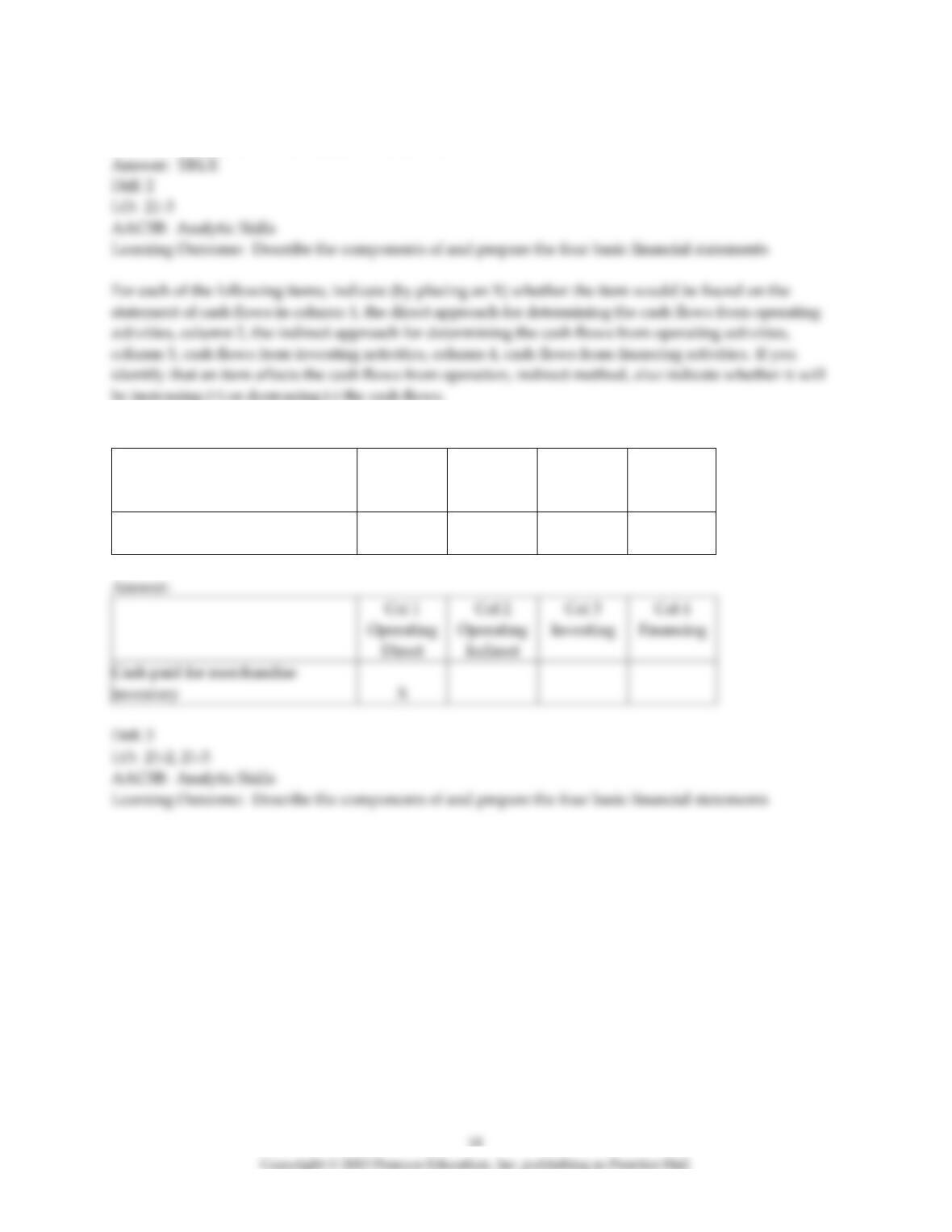
12)
Col 1
Operating
Direct
Col 2
Operating
Indirect
Col 3
Investing
Col 4
Financing
Cash paid for merchandise
inventory
Cash paid for merchandise
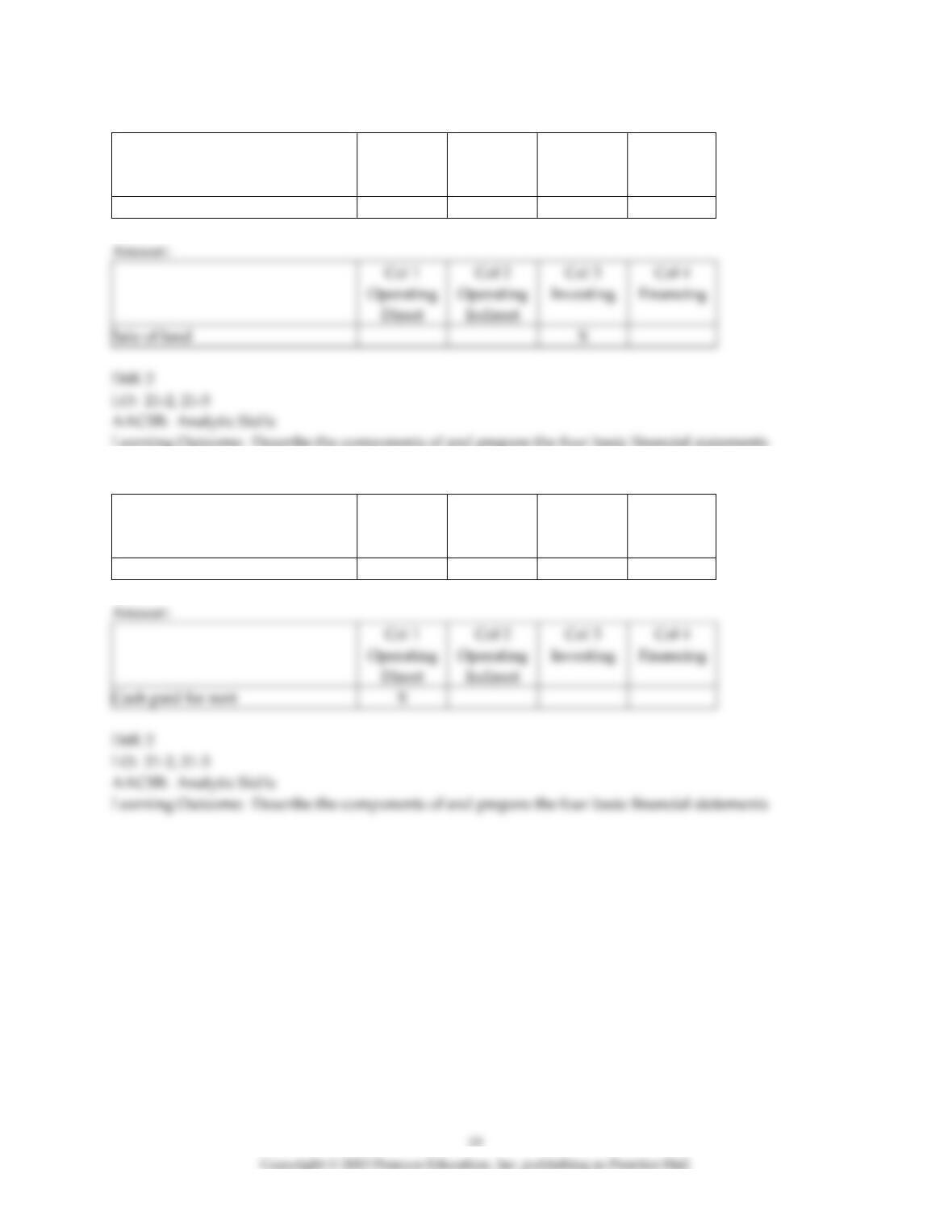
13)
Col 1
Operating
Direct
Col 2
Operating
Indirect
Col 3
Investing
Col 4
Financing
Sale of land
Col 1
Operating
Direct
Col 2
Operating
Indirect
Col 3
Investing
Col 4
Financing
Sale of land
14)
Col 1
Operating
Direct
Col 2
Operating
Indirect
Col 3
Investing
Col 4
Financing
Cash paid for rent
Operating
Direct
Operating
Indirect
Investing
Financing
Cash paid for rent