
International Economics, 9e (Krugman et al.)
Chapter 21 Financial Globalization: Opportunity and Crisis
21.1 The International Capital Market and the Gains from Trade
1) If you are offered a gamble in which you win 500 dollars 3/8 of the time and you lose 500 dollars 5/8
of the time, what is your expected payoff and your behavior given that you are a risk-lover?
A) $500, take the gamble
B) -$125, take the gamble
C) -$125, it is unclear what you would do without further information
D) $500, decline the gamble
E) -$125, decline the gamble
2) The two types of trade, intertemporal and pure asset swap ________ perfect substitutes, because
________.
A) are; they both offer considerable payoff and are equal in the long run
B) are; they both involve the smoothing out of now and future consumption
C) are not; asset swapping is immediate and involves only assets, while intertemporal trade takes two
time periods and involves both assets and goods/services
D) could possibly be; different economic states occur at different points in time
E) are not; asset swapping never relates to intertemporal trade
3) For the following question assume the following facts:
(1) Balance of Payments = 0 prior to the transactions.
(2) Person A (who lives in the United States) purchases an airplane from British Airways for $150,000.
(3) Person A pays with a check from his account at First Union Bank in the United States.
(4) British airways, since it will need dollars in 1 month, deposits the check at the Bank of England.
(5) Bank of England deposits the $150,000 at Commonwealth bank, which is located in the United
States.
Due to the transactions above, what are the effects on the balance of payments?
A) -$150,000 due to import of good (current account debit)
B) +$150,000 due to import of good (current account credit)
C) -$150,000 due to deposit of Bank of England (capital account debit)
D) +$150,000 due to deposit of Bank of England (capital account credit)
E) No effect (150,000 current account debit and 150,000 capital account credit)
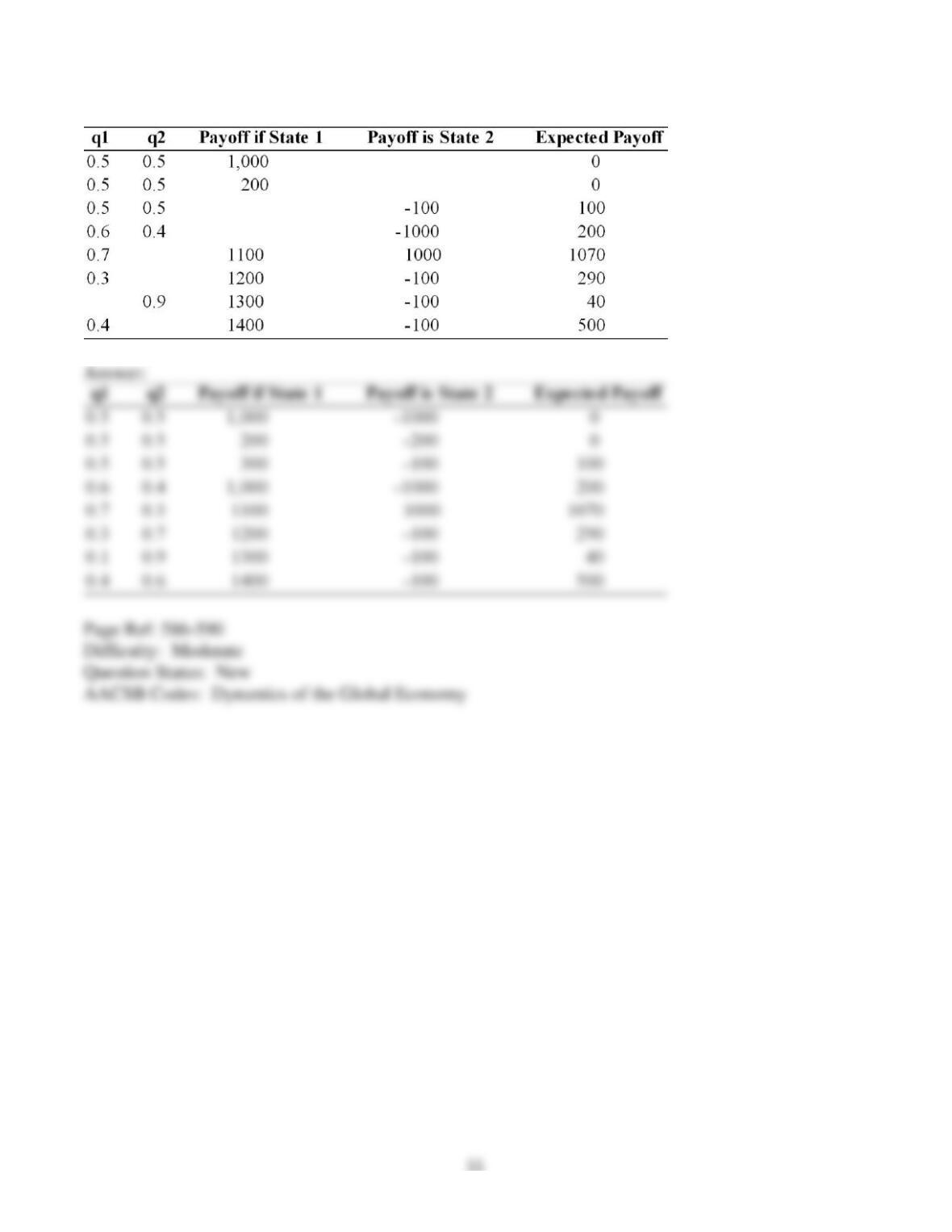
4) For the following questions assume the following facts:
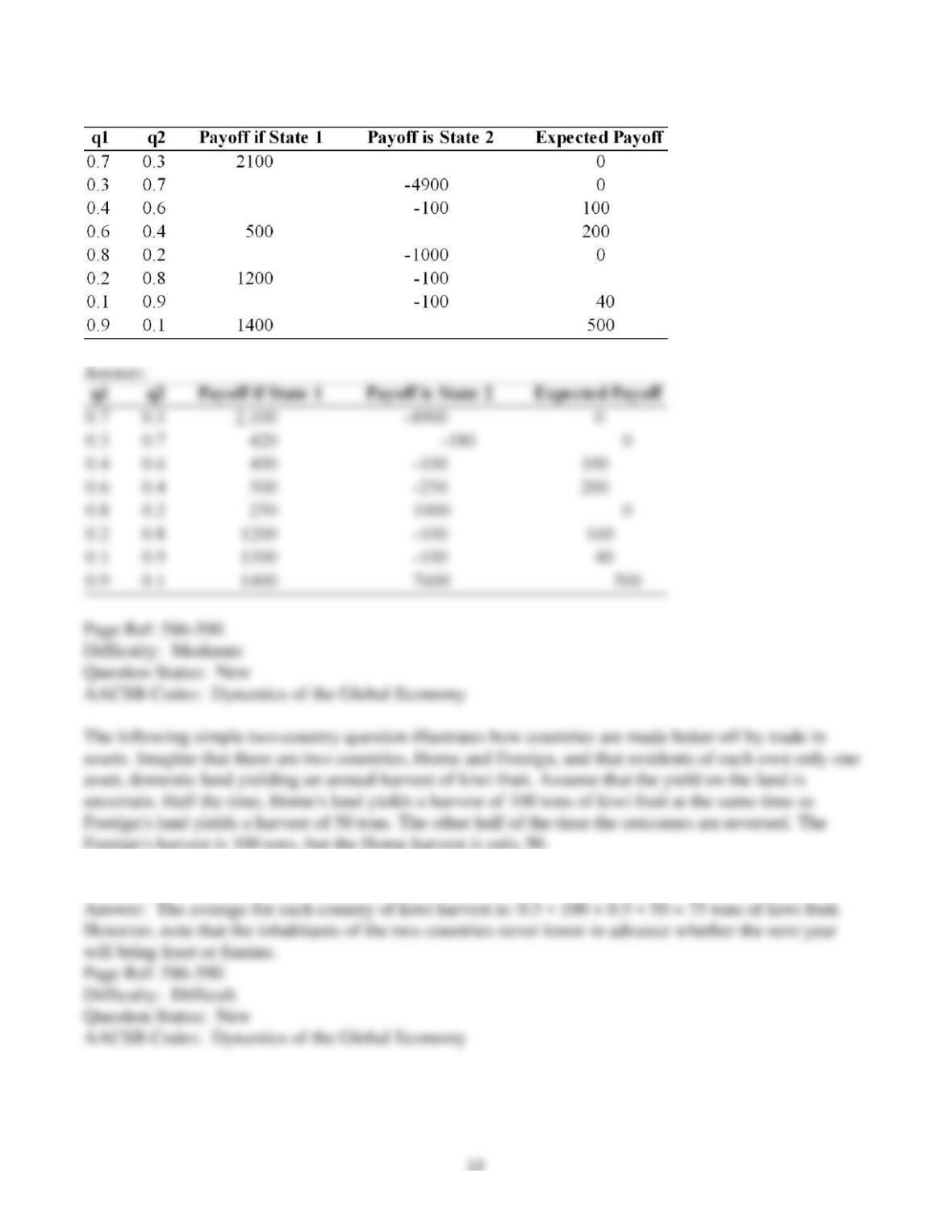
(1) Balance of Payments = 0 prior to the transactions.
(2) Person A (who lives in the United States) purchases an airplane from British Airways for $150,000.
(3) Person A pays with a check from his account at First Union Bank in the United States.
(4) British airways, since it will need dollars in 1 month, deposits the check at the Bank of England.
(5) Bank of England deposits the $150,000 at Commonwealth bank, which is located in the United
States.
Due to the transactions above, what are the effects on the reserve at the Fed?
A) Fact 2 is a decrease of $150,000, fact 5 is a decrease of $150,000, a net effect of -$300,000.
B) Fact 3 is a decrease of $150,000, fact 5 is an increase of $150,000, a net effect of 0.
C) Fact 3 is an increase of $150,000, fact 5 is a decrease of $150,000, a net effect of 0.
D) Both fact 3 and fact 5 result in increases of $150,000, a net effect of +$300,000.
E) Both fact 3 and fact 5 result in decrease of $150,000, a net effect of -$300,000.

5) Suppose one is offered a gamble in which you win $1,000 half the time but lose $1,000 half the time.
Since in this case one is as likely to win as to lose the $1,000, the average payoff on this gamble its
expected value is:
0.5 ∗ $1,000 + 0.5 ∗ (-$1,000) = 0.
Under such circumstances:
A) no one will take the gamble.
B) risk averse individuals will take the gamble.
C) risk lovers individuals will not take the gamble.
D) risk neutral individuals will not take the gamble.
E) risk lovers and risk neutral individuals may take the gamble.
6) For most practical matters, economists assume that:
A) individuals are risk neutral.
B) individuals are risk lovers.
C) individuals are risk averse.
D) most individuals are risk lovers.
E) most individuals are risk neutral.
7) People who are risk averse,
A) value a collection of assets only on the basis of its expected returns.
B) value a collection of assets only on the basis of the risk of that return.
C) value a collection of assets not only on the basis of its expected returns but also on the basis of the
risk of that return.
D) are less likely to invest in life insurance.
E) are less likely to have a diverse portfolio.
8) The idea of risk aversion
A) is at odds with the idea of insurance.
B) help explain the profitability of insurance companies.
C) has nothing to do with insurance companies.
D) help explain the losses suffers by the insurance industry.
E) help explain why insurance companies in the long run are zero profit companies.
9) Risk averse people
A) will never hold bonds denominated in several different currencies because of transaction costs.
B) will always hold bonds denominated in several different currencies because of transaction costs.
C) may hold bonds denominated in several different currencies.
D) may hold bonds denominated in several different currencies only if satisfying the well known interest
party condition.
E) will hold only domestic bonds because of the home bias effect.
10) Imagine that there are two countries, Home and Far Far Away, and that residents of each own only
one asset, domestic land yielding an annual harvest of mangoes. Assume that the yield on the land is
uncertain. Half the time, Home’s land yields a harvest of 5,000 tons of mangoes at the same time as Far
Far Away’s land yields a harvest of 2,500 tons. The other half of the time the outcomes are reversed. The
average for each country mango harvest is:
A) 2500.
B) 2750.
C) 3500.
D) 3750.
E) 3000
11) Equity Instruments include
A) stocks.
B) bonds.
C) banks deposits.
D) receipts.
E) bank statements.
12) What would best describe the international capital markets?
A) the market of exchange of bonds
B) the market of exchange of stocks
C) the market of exchange of real-estate
D) the market in which residents of different countries trade assets
E) the currency market
13) Describe three types of gains from trades?
A) trades of exchange rates for goods or services, trades of goods or services for property, and trades of
gold for textiles
B) trades of goods or services for goods or services, trades of goods or services for assets, and trades of
assets for assets
C) trades of imports for exports, trades of exports for imports, and trades of natural resources for
financial assets
D) trades of services for goods, trades of currency for services, and trades of one type of currency for
another.
E) trades of current goods for future services, trades of currency for gold, and trades of one type of
currency for another
14) Asset trades that deal with debt instruments are best described as
A) share of stock.
B) exchange rate.
C) receipts.
D) factors.
E) bonds or bank deposits.
15) Asset trades that deal with equity instruments are best described as
A) share of stock.
B) exchange rate.
C) bonds.
D) bank deposits.
E) factors.
16) The international capital market is:
A) the international currency exchange.
B) a market in which capital assets are exchanged for services.
C) the market that is subject to intense regulation and must file a report to the Basel committee on a
biannual basis.
D) not really a single market, but a group of closely interconnected markets in which asset exchanges
with some international dimension take place.
E) an organization of fiscal policies that dictate international trade.
17) Intertemporal trade is
A) the exchange of goods but not services for claims to future goods.
B) the exchange of services but not goods for claims to future services.
C) the exchange of good and services for claims to future goods and services.
D) the exchange of domestic goods and services for foreign goods and services.
E) the type of trade that the U.S. government focuses most upon.
7
18) What is the basic motive for asset trade?
A) the belief that large risks will lead to large returns
B) restoration of the balance of payments
C) portfolio unification
D) economic stability
E) increase expected returns and reduced risk
19) Using international asset trade, countries can
A) never really eliminate all risk.
B) eliminate all risk.
C) actually increase their risk in some cases.
D) eliminate all their risk except for emerging markets.
E) never really diversify their holdings.
20) What are the three types of transactions between the residents of different countries?
21) What are the three types of gains from international transactions between the residents of different
countries?
22) How international trade in assets can make both countries better off?
23) Explain Tobin’s idea of “Don’t put all your eggs in one basket.”
24) Why is it useful to make a distinction between debt and equity instruments?
25) Define risk aversion and give an example of a risk-averse person?
26) Why is portfolio diversification so important in international trade?
27) What is the difference between equity instruments and debt instruments?
28) Why is the foreign exchange market so vital?
29) Suppose you are offered a gamble in which you win $1,000 half the time but lose $1,000 half the
time. If you are risk averter will you take the gamble?
30) Suppose you are offered a gamble in which you win $1,000 1/3 half the time but lose $800 2/3 half
the time. If you are risk lover will you take the gamble? What will your expected payoff be?
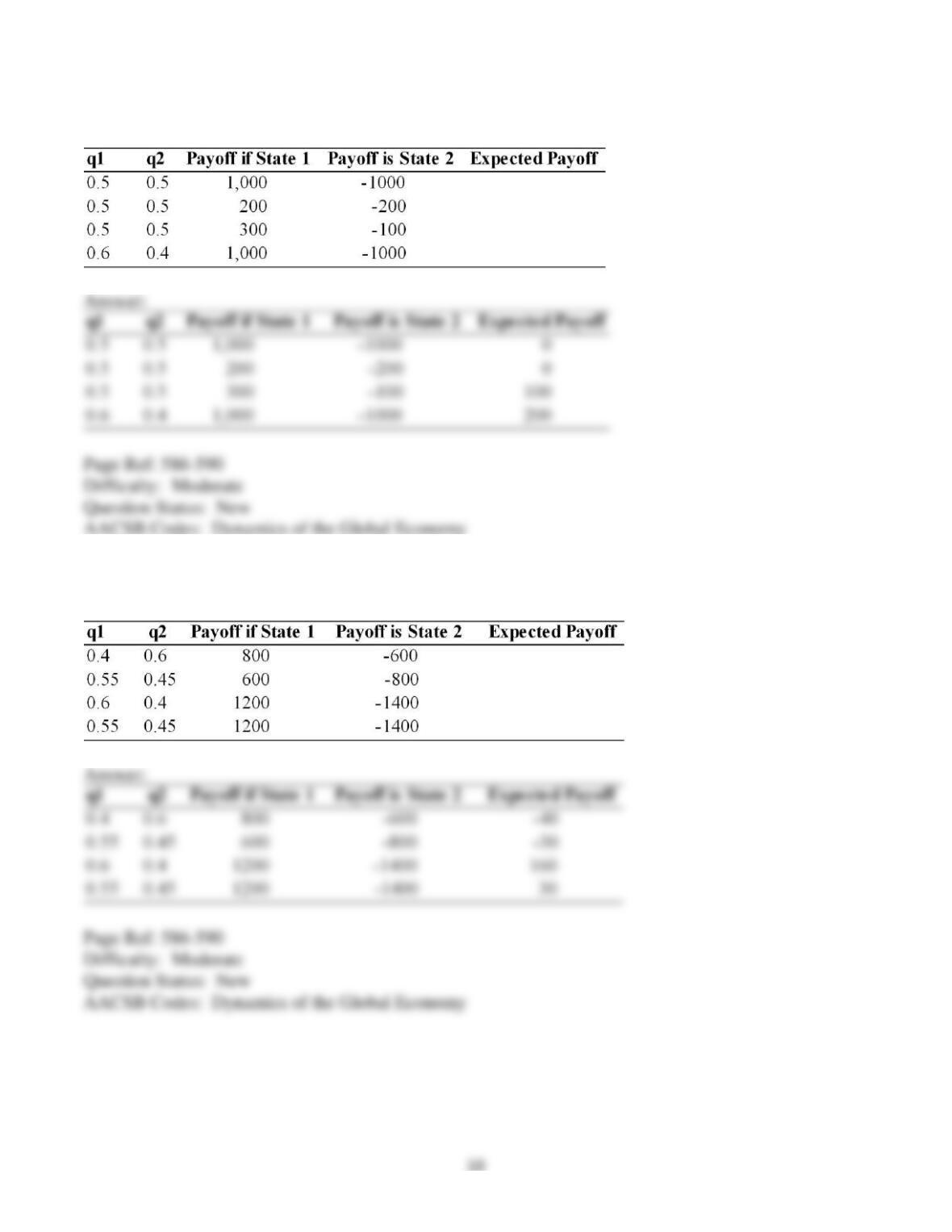
31) Calculate the expected payoff for the following cases, where q1 and q2 are the probabilities of state
1 and 2, respectively.
32) Calculate the expected payoff for the following cases, where q1 and q2 are the probabilities of state
1 and 2, respectively.
33) Complete the following table.
34) Complete the following table.
35) Calculate the average, for each country of kiwi harvest.
36) Suppose the two countries can trade shares in the ownership of their perspective assets. Further,
assume that a Home owner of a 10 percent share in Foreign land. He will receive 10 percent share in
Foreign land, and thus receives 10 percent of the annual Foreign kiwi fruit harvest. Further assume that a
Foreign owner of a 10 percent share in Home land is permitted. In this case, a Foreigner is entitled to 10
percent of the Home harvest. Calculate the expected value of kiwi fruit for each investor. Is the investor
better off?
37) Suppose the two countries can trade shares in the ownership of their perspective assets. Further
assume that a Home owner of a 25 percent share in Foreign land. He will receive 25 percent share in
Foreign land and thus receives 25 percent of the annual Foreign kiwi fruit harvest. Further assume that
also that a Foreign owner of a 25 percent share in Home land is permitted. In this case, a Foreigner is
entitled to 25 percent of the Home harvest. Calculate the expected value of kiwi fruit for each investor.
38) Suppose the two countries can trade shares in the ownership of their perspective assets without any
restrictions. Assume that the consumers in both countries would like to totally smooth their
consumption. Describe the outcomes.
39) Suppose that trade in asset is not allowed but the two countries sign a treaty that guarantee the
sending of 25 tons of kiwi in good time by the high output country in that season. What will the outcome
of such a treaty? Explain why.
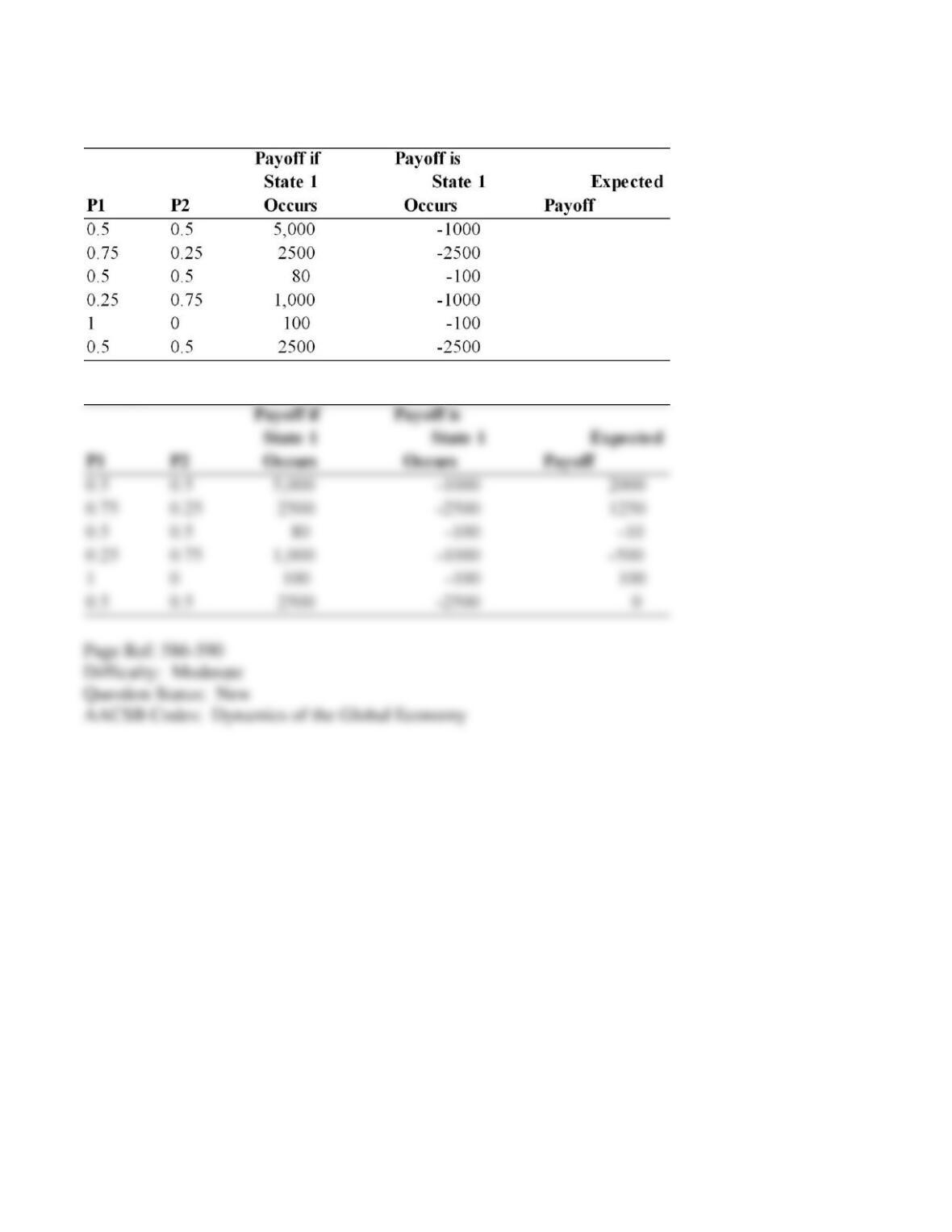
15
40) Calculate the expected payoff for the following cases with the formula: (P1) * (payoff if state 1) +
(P2) * (payoff if state 2), where P1 and P2 are the probabilities of state 1 and 2, respectively.
Answer:
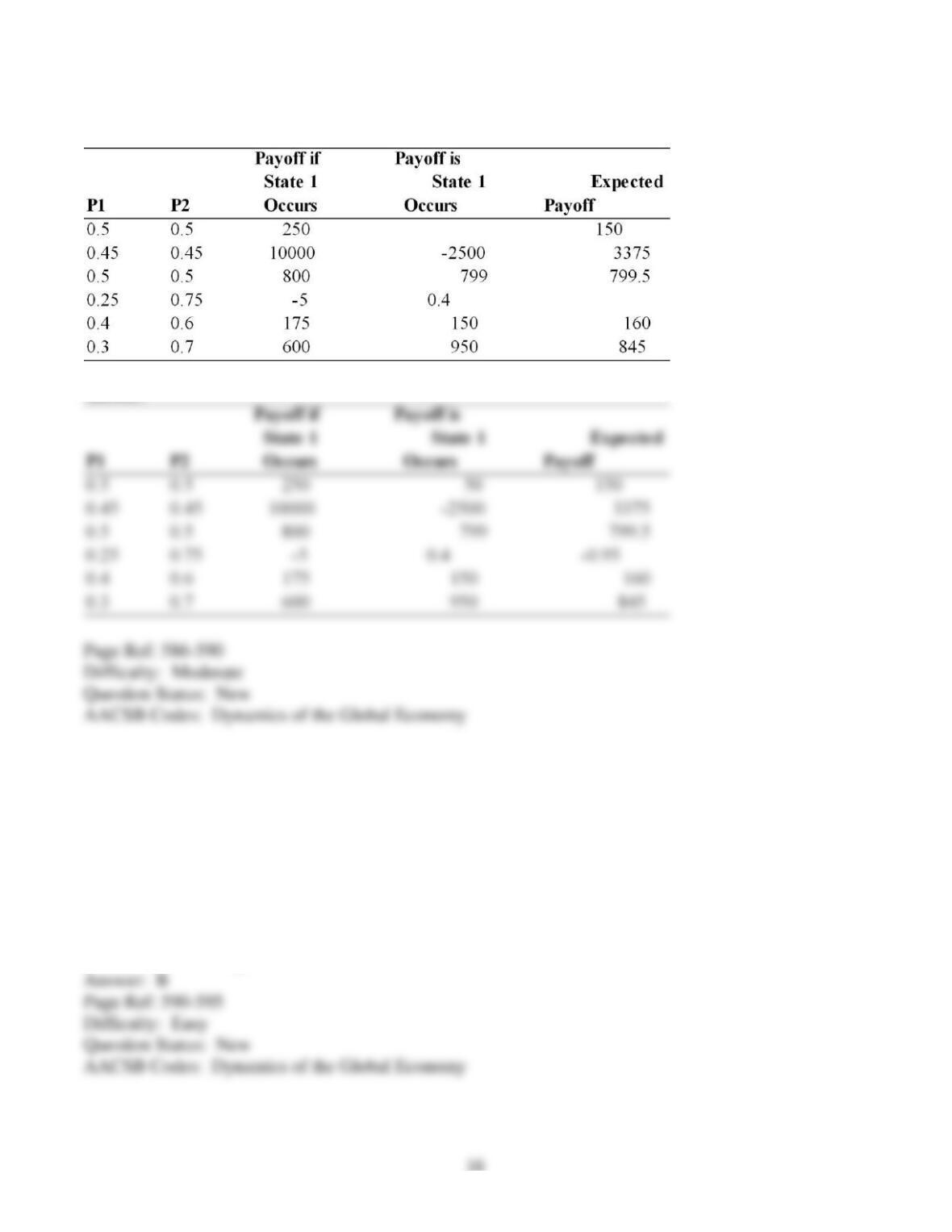
41) Complete the following table with the formula (P1) * (payoff if state 1) + (P2)* (payoff if state 2),
where P1 and P2 are the probabilities of state 1 and 2, respectively.
Answer:
21.2 International Banking and the International Capital Market
1) As a country begins to liberalize its capital account, what would you expect to happen to the
difference between the interest rates for similar assets in this country and another country with open
capital markets?
A) get larger
B) get smaller
C) stay the same
D) it depends on the existing exchange rate
E) exponential divergence

2) Investment banks in the U.S. are
A) regular banks specializing in investment projects.
B) not banks at all but institutions which specialize in underwriting sales of stocks and bonds.
C) special arm of the U.S. government for U.S. banks operating outside the U.S.
D) regular banks specializing in investment projects, but allowed to offer limited domestic transactions.
E) international banks that are heavily invest in the U.S.
3) Credit Suisse, Goldman Sachs, and Lazard Freres are examples of
A) commercial banks.
B) corporations.
C) non-bank financial institutions, such as insurance companies, pension funds, and mutual funds. This
includes investment banks, which specialize in underwriting sales of stocks and bonds by corporations
and in some cases governments.
D) central banks and other government agencies.
E) non-profit organizations.
4) A country can control
A) its flexible exchange rate.
B) monetary policy oriented toward domestic goals.
C) international capital movements.
D) foreign inflationary policies.
E) and avoid risks in international trade.
5) Under a gold standard, countries control
A) its flexible exchange rate.
B) monetary policy oriented toward domestic goals.
C) international capital movements.
D) foreign inflationary policies.
E) and avoid risks in international trade.

18
6) After Bretton Woods period, countries chose to control
A) fixed exchange rate only.
B) monetary policy oriented toward domestic goals only.
C) freedom of international capital movements only.
D) fixed exchange rate and freedom of international capital movements.
E) fixed exchange rate and monetary policy oriented toward domestic goals.
7) Under the unified Euro regime, the European countries control
A) fixed exchange rate only.
B) monetary policy oriented toward domestic goals only.
C) freedom of international capital movements only.
D) monetary policy oriented toward domestic goals and freedom of international capital movements.
E) fixed exchange rate and freedom of international capital movements.
8) Which one of the following possibilities is true?
A) Much of eurocurrency trading occurs in Europe.
B) Much of eurocurrency trading occurs in the United States.
C) Eurocurrencies trading occurs everywhere except the United States.
D) Eurocurrencies trading occurs everywhere except Europe.
E) Eurocurrencies trading occurs everywhere except China.
9) Eurodollars are
A) dollar deposits located in the United States.
B) dollar deposits located in Europe.
C) dollar deposits located outside Europe.
D) dollar deposits located outside the United States.
E) dollar deposits located outside both Europe and the United States.
10) Eurobanks are
A) all European Banks.

19
B) all non American banks.
C) banks that accept deposits denominated in Eurocurrencies excluding Eurodollars.
D) banks that accept deposits denominated in Eurocurrencies including Eurodollars.
E) banks that do not take U.S. dollars.
11) The leading center of Eurocurrency trading is
A) New York City.
B) Chicago.
C) London.
D) Paris.
E) Frankfurt.
12) The Fed’s Regulation Q
A) placed a ceiling on the interest rates U.S. banks could pay on time deposits to foreigners.
B) placed a ceiling on the interest rates U.S. banks could pay on time deposits.
C) placed a ceiling on the amount U.S. residents can deposits in Euro banks.
D) placed a ceiling on the amount foreign residents can deposits in domestic American banks.
E) placed a ceiling on the amount foreign banks can pay on time deposits.
13) Which type of main institution in the international capital market most often is involved in foreign
exchange intervention?
A) central banks
B) non-bank financial institutions
C) insurance companies
D) corporations
E) commercial banks
14) The difference between an agency office located abroad and a subsidiary bank located abroad is:
A) an agency office is just a home bank in another country while a subsidiary bank is controlled by a
foreign bank and subject to the same regulations as local banks.

B) an agency office is just a home bank in another country while a subsidiary bank arranges loans and
transfers funds but does not accept deposits.
C) an agency office arranges loans and transfers funds but does not accept deposits while a subsidiary
bank is controlled by a foreign bank and subject to the same regulations as local banks.
D) an agency office arranges loans and transfers funds but does not accept deposits while a subsidiary
bank is just a home bank in a foreign country.
E) an agency office is controlled by a foreign bank and subject to the same regulations as local banks
while a subsidiary bank arranges loans and transfers funds but does not accept deposits.
15) Besides world trade growth, what can explain the growth of international banking since the 1960s?
A) war in the Middle East
B) government focus on banking regulation.
C) an increase in world travel.
D) the emergence of developing countries like China.
E) desire of depositors to hold currencies outside the jurisdiction of the countries that issue them
16) The Eurodollar market’s early growth was stimulated by the Cold War between the United States
and U.S.S.R. Why?
A) Soviets feared the U.S. might confiscate dollars place in American banks if conditions of Cold War
were to worsen.
B) The United States didn’t feel safe holding as many dollars in American banks.
C) The Cold War did not stimulate the Eurodollar market’s early growth.
D) Developing technologies required larger money transfers than central banks could handle.
E) Soviets developed a new banking system with new allies developed during the tension.