7) On October 1, Indiana Company issued $10,000, 8%, 5-year bonds at 98. What is the adjusting entry on
December 31 using straight-line method?
A)
Bond Interest Expense
800
Bond Interest Payable
800
B)
Bond Interest Expense
200
Bond Interest Payable
200
C)
Bond Interest Expense
190
Discount on Bonds Payable
10
Bond Interest Payable
200
D)
Bond Interest Expense
210
Discount on Bonds Payable
10
Bond Interest Payable
200
8) At year end there was no accrual of interest on a bond payable. This error would cause:
A) the period end assets to be overstated.
B) the period end liabilities to be overstated.
C) the period’s net income to be understated.
D) None of the above.
9) A bond that pays interest on February 28 and October 31 will have to be adjusted for 3 months interest
on December 31.
10) All bonds have accrued interest adjustments on December 31.
11) Island Corporation issued $500,000 of 6%, 10-year bonds at 104 on May 1, 2009. Interest is paid semi–
annually on October 31 and April 30. Journalize the entries for the issuance of the bond on May 1, the first
interest payment on October 31 using straight-line method, and the adjusting entry on December 31.
20.4 Learning Objective 20-4
1) Assume the following account balances immediately after an interest payment date:
Bonds Payable
$100,000
Premium on Bonds Payable
5,000
If the bonds are retired immediately at a total cost of $104,000, the journal entry to record this event is:
A)
Cash
104,000
Loss on Bond Retirement
1,000
Premium on Bonds Payable
5,000
Bonds Payable
100,000
B)
Bonds Payable
100,000
Premium on Bonds Payable
5,000
Cash
104,000
Gain on Bond Retirement
1,000
C)
Bonds Payable
100,000
Loss on Bond Retirement
9,000
Premium on Bonds Payable
5,000
Cash
104,000
D) None of these answers are correct.
2) A bond sinking fund is a:
A) short-term investment.
B) long-term investment.
C) current liability.
D) long-term liability.
3) A bond sinking fund established to redeem bonds at maturity in 10 years should be classified in the
current year on the balance sheet as:
A) current assets.
B) plant and equipment assets.
C) long-term investments.
D) intangible assets.
4) A fund set up so that a bond can be retired at maturity is called a:
A) sinking fund.
B) bond payable fund.
C) stock fund.
D) retirement fund.
5) A $200,000, 8% bond issue was sold at face value and later redeemed at 104. The corporation would
have a:
A) gain of $20,000.
B) loss of $20,000.
C) gain of $8,000.
D) loss of $8,000.
6) Monies set aside to pay off bondholders at maturity are called:
A) discount funds.
B) maturity funds.
C) sinking funds.
D) annuity funds.
7) A bond sinking fund is reported as a liability on the balance sheet.
8) Usually, there is a gain or loss associated with early retirement of bonds.
9) When bonds are retired, the Bonds Payable account is credited for face value even if the bonds were
originally sold at a premium.
10) When bonds are retired at an amount greater than face value, the company records a gain on the
retirement.
11) Interest earned on the sinking fund will be subtracted from the Sinking Fund account.
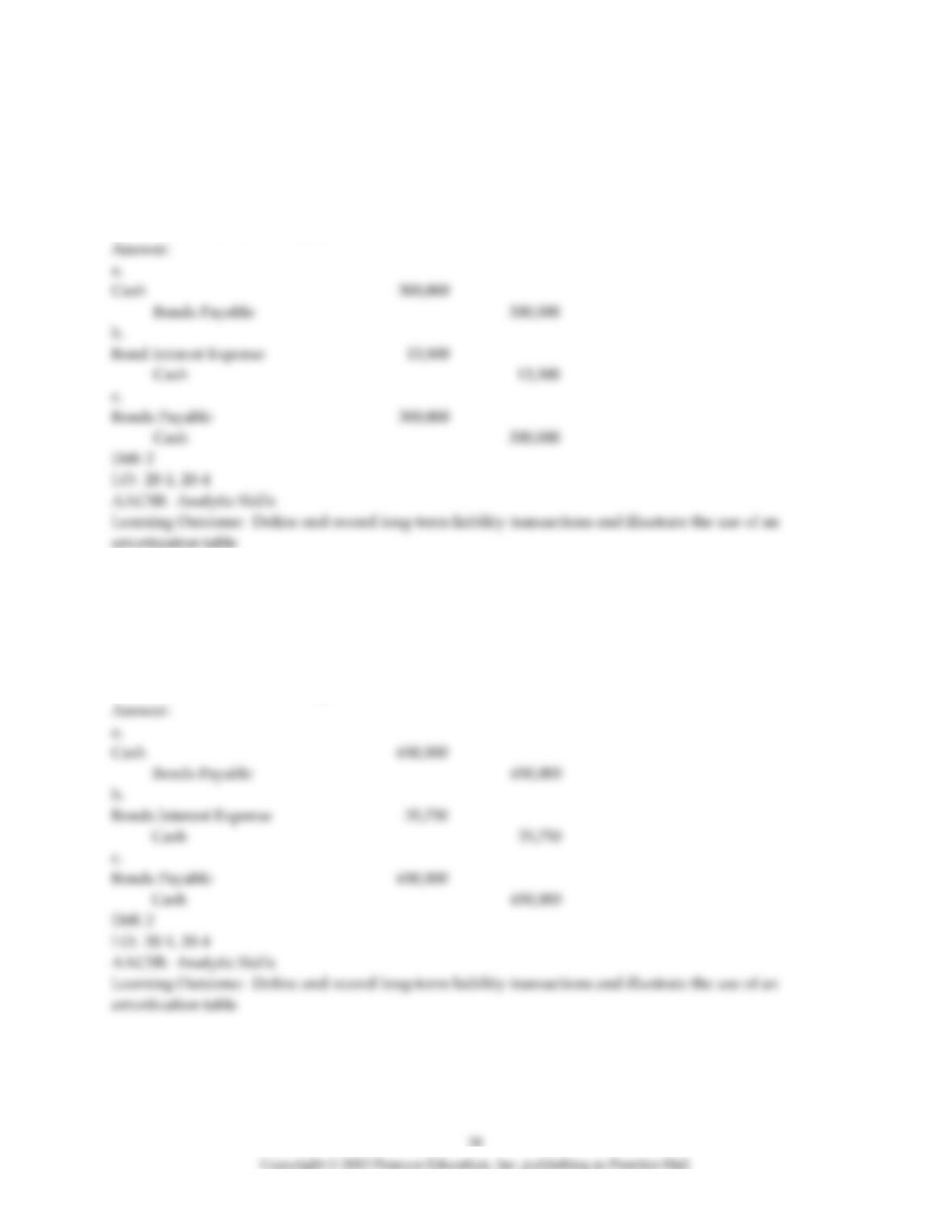
12) On January 1, Auctions Online issued $300,000, 9%, 10-year bonds to lenders at the contract rate.
Interest is to be paid semiannually on July 1 and January 1. Journalize the following entries:
a. Issued the bonds.
b. Paid first semiannual interest payment.
c. Retired the bonds at maturity.
13) Greg Corporation issued on January 1, $650,000 of 11%, 5-year bonds at contract rate. Interest is to be
paid semiannually on July 1 and January 1. Journalize the following entries:
a. Issued the bonds.
b. Paid the first semiannual interest payment.
c. Retired the bonds at maturity.
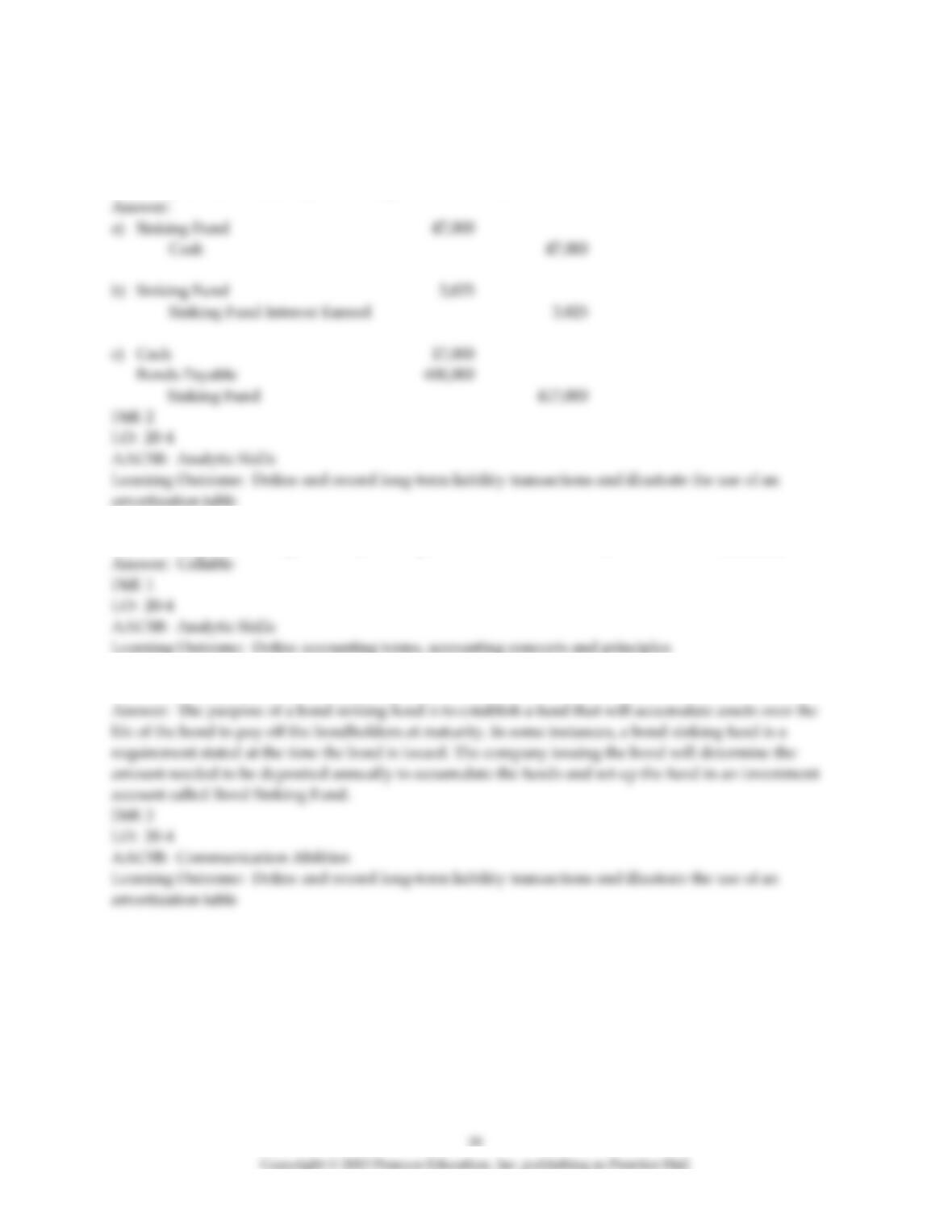
14) Simon Brothers pays $47,000 into a bond sinking fund each year to redeem the future maturity of its
bonds. During the first year, the fund earned $3,825. At the time of bond redemption, the fund has a
balance of $417,000. Of this, $400,000 was used to redeem the bonds. Journalize the a) initial deposit; b)
the first year’s interest; and c) the redemption of the bonds.
15) Bonds that can be bought back by the corporation before the maturity date are called ________ bonds.
16) What is the purpose of a bond sinking fund?
17) Describe bond refunding and explain why it might be advantageous for a company.
18) Paid the bond holders the amount due, face value plus accrued interest, using the sinking fund.
Debit ________ & ________ & ________ Credit ________ & ________ & ________
19) Retired bonds plus interest previously accrued when the retirement value was above the cost of
retirement, cash was paid.
Debit ________ & ________ & ________ Credit ________ & ________ & ________
20) Retired bonds plus interest previously accrued when the retirement value was beneath the cost of
retirement, cash was paid.
Debit ________ & ________ & ________ Credit ________ & ________ & ________
21) Issued bonds at face value in exchange for buildings and land.
Debit ________ & ________ & ________ Credit ________ & ________ & ________
22) Issued bonds at a value above face value in exchange for equipment.
Debit ________ & ________ & ________ Credit ________ & ________ & ________
23) Sold bonds at a discount.
Debit ________ & ________ & ________ Credit ________ & ________ & ________
24) Deposited cash in a bond sinking fund.
Debit ________ & ________ & ________ Credit ________ & ________ & ________
25) Recorded the interest earned on the bond sinking fund.
Debit ________ & ________ & ________ Credit ________ & ________ & ________
26) Accrued interest on bonds which sold at face value.
Debit ________ & ________ & ________ Credit ________ & ________ & ________
27) Accrued interest on bonds which sold beneath face value.
Debit ________ & ________ & ________ Credit ________ & ________ & ________
28) Accrued interest on bonds which sold above face value.
Debit ________ & ________ & ________ Credit ________ & ________ & ________