College Accounting, 12e (Slater)
Chapter 20 Corporations and Bonds Payable
20.1 Learning Objective 20-1
1) A special type of long-term interest-bearing note payable issued by a corporation to raise capital is
called a:
A) short-term note payable.
B) bond payable.
C) stock issue.
D) treasury stock issue.
2) The contract rate for a bond is:
A) the annual interest rate based on selling price.
B) the annual interest rate based on market value.
C) the annual interest rate based on face value.
D) None of these answers are correct.
3) The amount to be paid on the maturity date of a bond is called the:
A) face value of the bond.
B) current market value of the bond.
C) quoted value of the bond.
D) indenture amount of the bond.
4) The information on the bond certificate written by the corporation in a formal agreement is called:
A) a bond contract.
B) a bondholder’s agreement.
C) a bond indenture.
D) a bond quote.
5) Bond certificates state the:
A) market value and contract rate.
B) face value and contract rate.
C) market value and current interest rate.
D) face value and current interest rate.
6) Bailey Corporation has decided to issue bonds pledging specific assets. What type of bonds is it
offering?
A) Secured bonds
B) Debenture bonds
C) Convertible bonds
D) Serial bonds
7) A $1,000 bond quoted at 96.5 would sell for:
A) $1,000.
B) $965.
C) $96.50.
D) None of the above.
8) A $1,000 bond quoted at 104 would sell for:
A) $1,104.
B) $1,000.
C) $104.
D) $1,040.
9) One reason a corporation might issue bonds rather than selling stock is that:
A) bond interest is a tax-deductible expense.
B) interest rates are high.
C) dividends will lower the amount of tax due.
D) bondholders have claims at liquidation.
10) When the maturities of a bond issue are spread over a several dates, the bonds are called:
A) term bonds.
B) bearer bonds.
C) debenture bonds.
D) serial bonds.
11) Bonds payable issued with collateral are called:
A) debenture bonds.
B) serial bonds.
C) callable bonds.
D) secured bonds.
12) Bonds that may be redeemed at a certain price level are known as:
A) callable bonds.
B) debenture bonds.
C) serial bonds.
D) convertible bonds.
13) Dividends paid to stockholders are:
A) taxable to the recipient stockholder.
B) taxable to the corporation.
C) treated the same as bond interest.
D) None of these answers are correct.
14) Which of the following statements is true?
A) Bondholders would be paid before stockholders in a liquidation.
B) Dividends are required to be paid to stockholders.
C) Bondholders are owners while stockholders are creditors.
D) Stockholders receive a fixed interest while bondholders are paid only if earnings are sufficient.
15) The buyer pays the purchase price plus accrued interest since the last interest payment when:
A) the bond matures.
B) the bond is bought on an interest date.
C) the bond is bought between interest dates.
D) the bond is originally issued.
16) When the contract rate of interest on bonds is equal to the market rate of interest, bonds sell at:
A) a premium.
B) their face value.
C) their maturity value.
D) a discount.
17) For a corporation, a premium on bonds results when:
A) the contract rate is greater than the market rate.
B) the contract rate is less than the market rate.
C) the face value is greater than the effective rate.
D) None of these answers are correct.
18) When the market rate of interest on bonds is higher than the contract rate, the bonds will sell at:
A) a premium.
B) their face value.
C) their maturity value.
D) a discount.
19) A bond payable is similar to which of the following?
A) Accounts Payable
B) Accounts Receivable
C) Notes Payable
D) Cash
20) The interest rate specified in the bond indenture is called the:
A) market rate.
B) discount rate.
C) contract rate.
D) effective rate.
21) The primary difference between secured bonds and debenture bonds is:
A) debenture bonds are paid on the same maturity date while secured bonds are paid on multiple dates.
B) secured bonds are backed with specific assets while debenture bonds are not.
C) secured bonds are registered with the issuing company while debenture bonds are not.
D) debenture bonds can be converted to stock while secured bonds cannot.
22) Which of the following best describes the term maturity date?
A) The date on which each interest payments is made
B) The date on which the bond is issued
C) The date on which the bond is called
D) The date on which the principal is repaid
23) When interest payments are made on a bond issued at face value, the journal entry is:
A) debit Bond Interest Expense, credit Cash.
B) debit Bonds Payable, credit Cash.
C) debit Cash, credit Bonds Payable.
D) debit Cash, credit Bond Interest Expense.
24) The entry to record the issuance of a bond between interest payment dates will include a:
A) debit to Cash; credit to Bonds Payable; credit to Bonds Interest Payable.
B) debit to Bonds Payable; credit to Cash.
C) debit to Bond Interest Expense; credit to Bond Interest Payable.
D) debit to Bond Interest Payable; credit to Bond Interest Expense.
25) If bonds are sold between interest payment dates, the amount of cash the issuer receives is:
A) more than the market value of the bonds.
B) less than the market value of the bonds.
C) equal to the market value of the bonds.
D) equal to the face value of the bonds.
26) When a bond issued at face value is retired, the journal entry is:
A) debit Bond Interest Expense, credit Cash.
B) debit Bonds Payable, credit Cash.
C) debit Cash, credit Bonds Payable.
D) debit Cash, credit Bond Interest Expense.
27) The interest rate on which cash payments to bondholders are based is the:
A) market rate.
B) discount rate.
C) contract rate.
D) amortization rate.
28) For a corporation, bond interest:
A) is treated the same as dividends for tax purposes.
B) has no effect on earnings and therefore has no effect on income taxes.
C) reduces income tax by reducing earnings.
D) None of the above.
29) All other factors being equal, issuing bonds rather than issuing stock will:
A) increase earnings per share.
B) decrease earnings per share.
C) have no effect on earnings per share.
D) Cannot be determined from information given.
30) The payment of quarterly interest on 12%, $60,000 bonds would be to:
A) debit Cash $3,600; credit Bond Interest Expense $3,600.
B) debit Bond Interest Expense $7,200; credit Cash $7,200.
C) debit Cash $1,800; credit Bond Interest Expense $1,800.
D) debit Bond Interest Expense $1,800; credit Cash $1,800.
31) Allan Corporation issued 300, 8%, 10-year, $1,000 bonds on July 1. The annual bond interest date is
June 30, and the bonds were issued at face value. The amount of interest expense reported for the current
year is:
A) $0.
B) $24,000.
C) $12,000.
D) None of the above are correct.
32) On October 1, Allan Company issued 8%, 10-year, $300,000 bonds at 100. Interest dates are April 1
and October 1. The amount of cash paid out for interest during the current calendar year is:
A) $0.
B) $24,000.
C) $12,000.
D) $6,000.
33) On April 1, Braintree Corporation issued 10%, 10-year, $300,000 bonds at face value. Interest dates are
April 1 and October 1. The amount of cash paid out for interest during the current calendar year is:
A) $0.
B) $15,000.
C) $30,000.
D) $31,000.
34) At the time a bond was sold at face value the entire amount of interest was recorded as an expense
and a liability. This error would cause:
A) the period end assets to be overstated.
B) the period end liabilities to be understated.
C) the period’s net income to be overstated.
D) None of the above are correct.
35) A bond is issued for less than its face value. Which of the following statements most likely would
explain why?
A) The bond’s contract rate is lower than the market rate at the time of the issue.
B) The bond’s contract rate is the same as the market rate at the time of the issue.
C) The bond’s contract rate is higher than the market rate at the time of the issue.
D) The bond is not secured by specific assets of the corporation.
36) A bond is issued for more than its face value. Which of the following statements most likely would
explain why?
A) The bond’s contract rate is lower than the market rate at the time of the issue.
B) The bond’s contract rate is the same as the market rate at the time of the issue.
C) The bond’s contract rate is higher than the market rate at the time of the issue.
D) The bond is secured by specific assets of the corporation.
37) A bond is issued for an amount equal to its face value. Which of the following statements most likely
would explain why?
A) The bond’s contract rate is lower than the market rate at the time of the issue.
B) The bond’s contract rate is the same as the market rate at the time of the issue.
C) The bond’s contract rate is higher than the market rate at the time of the issue.
D) The bond is secured by specific assets of the corporation.
38) Martin Corporation sells $200,000, 12%, 10-year bonds at face value on January 1. Interest is paid on
January 1 and July 1. The entry to record the issuance of the bonds on January 1 is:
A)
Cash
200,000
Bonds Payable
200,000
B)
Cash
200,000
Interest Payable
24,000
Bonds Payable
176,000
C)
Cash
176,000
Interest Expense
24,000
Bonds Payable
200,000
D)
Cash
188,000
Interest Expense
12,000
Bonds Payable
200,000
39) The sale and issuance of $400,000, 8% bonds with a market rate of 8% would involving debiting Cash
for:
A) $432,000.
B) $400,000.
C) $368,000.
D) $ 32,000.
40) Bonds that are backed solely by the general credit of the corporation issuing the bonds are called:
A) callable bonds.
B) debenture bonds.
C) indenture bonds.
D) convertible bonds.
41) The interest paid to bondholders is determined by:
A) multiplying the bond’s annual rate of interest by the face value.
B) multiplying the market rate of interest by the face value.
C) dividing the bond’s annual rate of interest by the face value.
D) dividing the face value by the bond’s annual rate of interest.
42) Bondholder claims for interest and repayment rank ahead of the claims of stockholders.
43) Bond interest expense is tax deductible only after the bond is paid off at maturity.
44) When the total amount of a bond issue matures at a certain date at which time the bondholder can
convert into shares of stock, the bonds are called convertible bonds.
45) The market rate of interest and the contract rate of interest will always be the same for a bond sold at
face value.
46) Bonds are long-term interest-bearing notes issued to multiple lenders, usually in increments of $1,000.
47) The corporation will repay the principal amount of the bond on the maturity date.
48) If a corporation issues serial bonds, each bond will have the same maturity date.
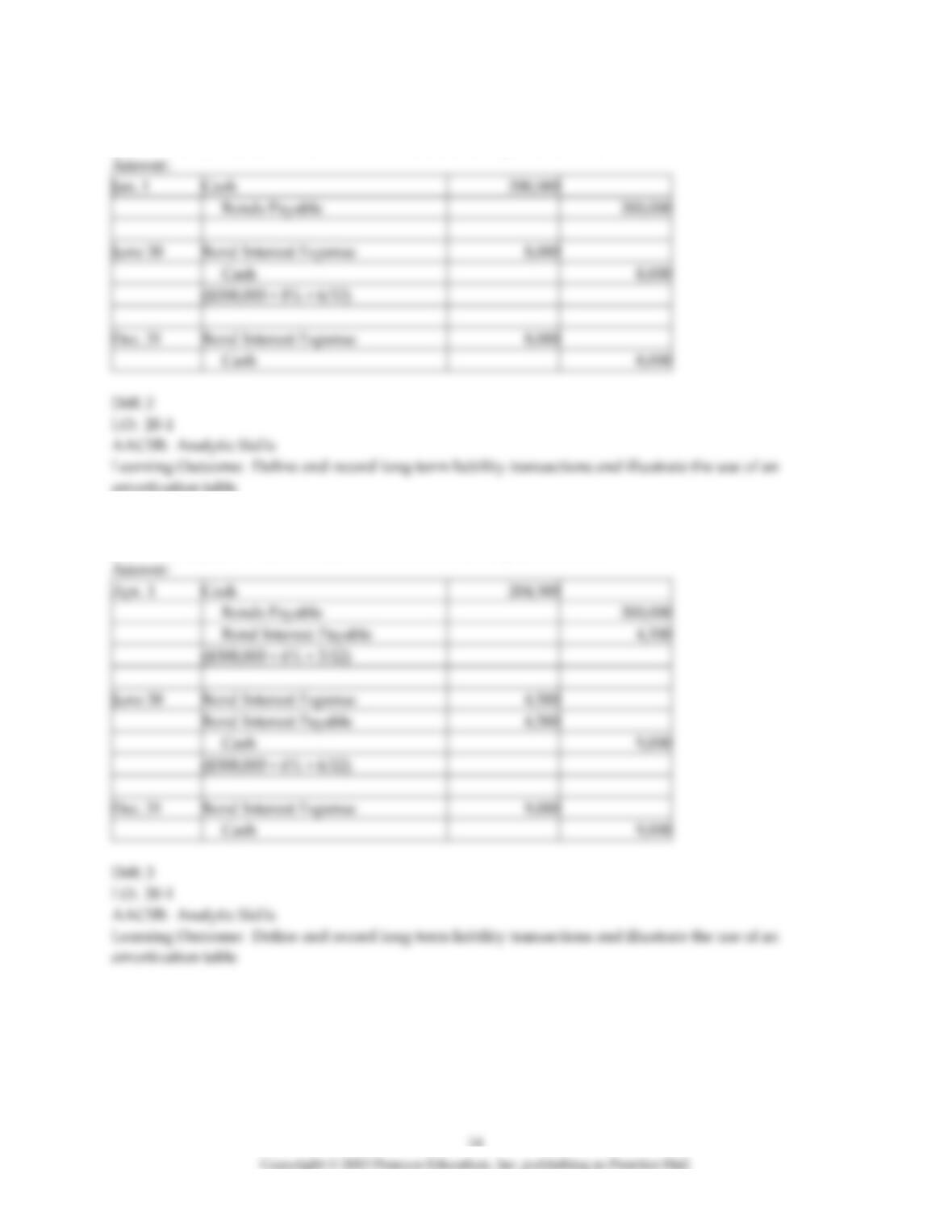
49) On January 1, 20XX, Edward Company issued $200,000, 10-year, 8% bonds with semiannual interest
payments on June 30 and December 31. Record the 20XX journal entries.
50) On April 1, 20XX, Jones Company issued $200,000, 10-year, 6% bonds with semiannual interest
payments on June 30 and December 31. Record the 20XX journal entries.
51) What is the difference between a secured bond and a debenture bond?
52) A bond that has a face value of $250,000 with an annual interest rate of 9% paid semiannually and
sold at par would have an interest payment of ________ semiannually.
53) The formal written agreement for issuing bonds is called a(n) ________.
54) Bonds that can be exchanged for stock in the corporation are called ________ bonds.
55) To determine the interest payment on a bond, multiply the ________ value times the ________ interest
rate.
20.2 Learning Objective 20-2
1) If a bond is issued at a premium, the effective interest rate is most likely ________ the contract interest
rate.
A) higher than
B) lower than
C) the same as
D) Cannot be determined based on information given.
2) The entry to record the semiannual payment and amortization of the discount using the straight-line
method on a 10%, $100,000, 5-year bond issued at 97 would be to:
A) debit Bond Interest Expense $5,000; credit Cash $5,000.
B) debit Bond Interest Expense $5,300; credit Cash $5,000; credit Discount on Bonds Payable $300.
C) debit Bond Interest Expense $10,000; credit Cash $10,000.
D) debit Bond Interest Expense $13,000; credit Cash $10,000; credit Discount on Bonds Payable $3,000.
3) Using the straight-line method, the semiannual interest expense of a 12%, $300,000 bond for 15 years at
102 would be:
A) $20,000.
B) $18,000.
C) $17,800.
D) $35,600.
4) Using the straight-line method, the semiannual bond interest expense of a 12%, $300,000, 15-year bond
issued at 95 is:
A) $36,500.
B) $35,500.
C) $18,500.
D) $17,500.
5) On October 1, German Company issued 12%, 10-year, $400,000 bonds at 105. Interest dates are April 1
and October 1. The amount of straight-line amortization for the current calendar year is:
A) $250.
B) $1000.
C) $2,000.
D) $500.
6) Moab Corporation sells $500,000 of 7%, 20-year bonds for 98 on January 1. Interest is paid on January 1
and July 1. Straight-line amortization is used. What is the amount of the discount at issuance?
A) $10,000
B) $ 5,000
C) $35,000
D) $17,500
7) Applegate Corporation sells $100,000, 8%, 10–year bonds for 95 on January 1. Interest is paid on
January 1 and July 1. Straight-line amortization is used. The amount of interest expense recorded on July
1, six months after issuance is:
A) $4,000.
B) $4,250.
C) $3,750.
D) $8,500.
8) Condi Corporation sells $100,000, 12%, 10-year bonds for 97 on January 1, 2009. Interest is paid on
January 1 and July 1. Straight-line amortization is used. The amount of interest paid on July 1, 2009 is:
A) $6,000.
B) $5,850.
C) $6,150.
D) $12,000.
9) Evans Corporation sells $200,000, 10%, 10-year bonds for 97 on January 1. Compute the semi-annual
interest expense recorded on July 1 using the interest method. The market rate is 12%.
A) $5,820
B) $20,000
C) $10,000
D) $11,640
10) Davis Corporation sells $100,000, 12%, 10-year bonds for 103 on January 1. Compute the semi-annual
interest expense recorded on July 1 using the interest method. The market rate is 8%.
A) $12,000
B) $4,120
C) $8,240
D) $6,000
11) Bond Interest Payable is reported as a:
A) current liability on the balance sheet.
B) current liability on the income statement.
C) contra-liability on the balance sheet.
D) contra-liability on the income statement.
12) The carrying value of bonds is calculated by:
A) subtracting the Premium on Bonds Payable account balance from the Bonds Payable account balance.
B) adding the Premium on Bonds Payable account balance to the Bonds Payable account balance.
C) adding the Discount on Bonds Payable account balance to the Bonds Payable account balance.
D) adding the Bonds Payable account balance to the Bond Interest Payable account balance.
13) When selling bonds at a premium, the premium received effectively:
A) reduces the cost of borrowing.
B) increases the cost of borrowing.
C) does not affect the cost of borrowing.
D) reduces the amount of cash received when bonds are sold.
14) Carrying value is the same thing as:
A) fair market value.
B) discount value.
C) premium value.
D) book value.
15) The real or actual rate of interest to the borrowing corporation is called the:
A) market rate of interest.
B) effective rate of interest.
C) discount rate of interest.
D) premium rate of interest.
16) The carrying value for bonds sold at a discount:
A) equals face value at all times.
B) increases as time passes until it matures at face value.
C) decreases as time passes until it matures at face value.
D) None of these answers are correct.
17) Discount on Bonds Payable is a:
A) contra-asset account.
B) contra-liability account.
C) contra-equity account.
D) None of these answers are correct.