b.
Refrigerators
c.
Televisions and refrigerators
d.
Neither televisions nor refrigerators
75. Consider Figure 2.2. With specialization, Canada produces:
a.
16 televisions
b.
12 televisions and 8 refrigerators
c.
8 televisions and 16 refrigerators
d.
24 refrigerators
76. Consider Figure 2.2. With trade, Canada consumes:
a.
12 televisions and 8 refrigerators
b.
12 televisions and 16 refrigerators
c.
8 televisions and 16 refrigerators
d.
24 refrigerators
77. According to Figure 2.2, exports for Canada total:
a.
16 refrigerators
b.
8 refrigerators
c.
12 refrigerators
d.
16 refrigerators
78. According to Figure 2.2, imports for Canada total:
a.
6 televisions
b.
8 televisions
c.
12 televisions
d.
16 televisions
79. Concerning possible determinants of international trade, which are sources of comparative advantage?
Differences in:
a.
Methods of production
b.
Tastes and preferences
c.
Technological know-how
d.
All of the above
80. Ricardo’s model of comparative advantage assumed all of the following except:
a.
In each nation, labor is the only input
b.
Costs do not vary with the level of production
c.
Perfect competition prevails in all markets
d.
Transportation costs rise as distance increases between countries
81. Ricardo’s model of comparative advantage assumed all of the following except:
a.
Trade is balanced, thus ruling out flows of money between nations
b.
Firms make production decisions in an attempt to maximize profits
c.
Free trade occurs between nations
d.
Labor is immobile within a country, but is incapable of moving between countries
82. The dynamic gains from trade include all of the following except:
a.
Economies of large-scale production resulting in decreasing unit cost
b.
Increased saving and investment resulting in economic growth
c.
Increased competition resulting in lower prices and wider range of output
d.
Increasing comparative advantage leading to specialization
83. All of the following may be exit barriers except
a.
Employee health benefit costs
b.
Treatment, storage and disposal costs
c.
Penalties for terminating contracts with raw material suppliers
d.
Increasing opportunity cost of production
84. Incomplete specialization may be caused by
a.
Increasing opportunity cost
b.
Unrestricted trade
c.
Constant opportunity cost
d.
Decreasing opportunity cost
85. Improvements in productivity may lead to decreasing comparative costs if
a.
The assumption of fixed technologies under constant costs is relaxed
b.
Technologies available to each nation is allowed to differ
c.
Resource endowments are allowed to vary
d.
All of the above
86. Adam Smith
a.
Was a leading advocate of free trade
b.
Developed the concept of absolute advantage
c.
Maintained that labor costs represent the major determinant of production cost
d.
All of the above
87. Modern trade theory contends that the pattern of world trade is governed by
a.
Differences in supply conditions and demand conditions
b.
Supply conditions only
c.
Demand conditions only
d.
None of the above
88. When nations are of similar size, and have similar taste patterns, the gains from trade
a.
Are shared equally between them
b.
Are impossible to determine
c.
Are too small, so that trading is not beneficial
d.
Are determined by the nation that has comparative advantage in the more essential product
89. The commodity terms of trade measures
a.
The rate at which exports exchange for imports
b.
The influence trade has on productivity levels
c.
The effect on income of the trading nation
d.
The improvement in a nation’s welfare
Figure 2.4 Production Possibilities Frontier
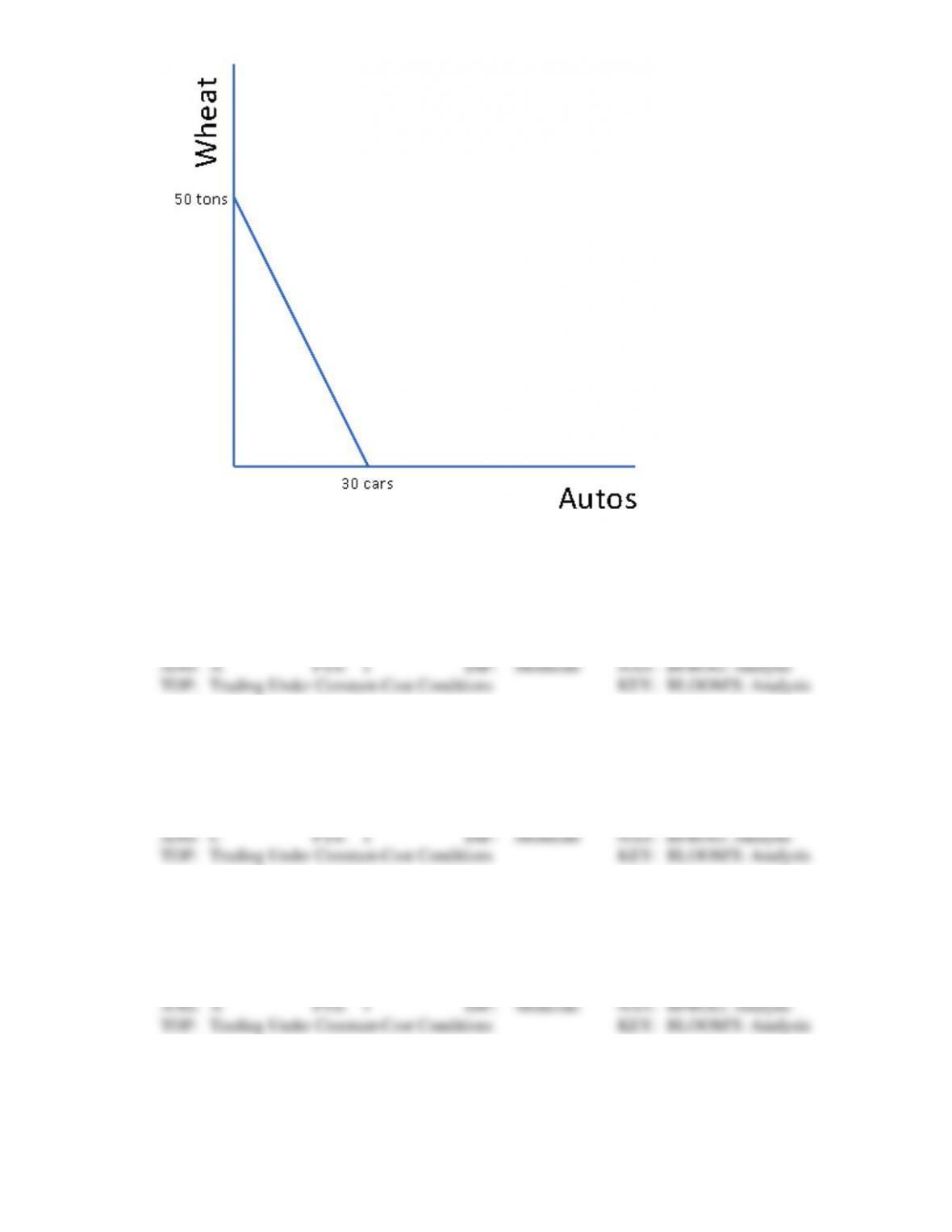
90. In Figure 2.4 the marginal rate of transformation of wheat into autos is
a.
one and two-thirds
b.
two and one-third
c.
three fifths
d.
three sevenths
91. In Figure 2.4 the marginal rate of transformation of autos into wheat is
a.
one and two-thirds
b.
two and one-third
c.
three fifths
d.
three sevenths
92. In Figure 2.4 one car can be produced at a cost of
a.
one and two-thirds tons of wheat
b.
two and one-third tons of wheat
c.
three fifths tons of wheat
d.
three sevenths tons of wheat
93. In Figure 2.4 one ton of wheat can be produced at a cost of
a.
one and two-thirds cars
b.
two and one-third cars
c.
three fifths of a car
d.
three sevenths of a car
TRUE/FALSE
1. According to the mercantilists, a nation’s welfare would improve if it maintained a surplus of exports
over imports.
2. The mercantilists maintained that a free-trade policy best enhances a nation’s welfare.
3. The mercantilists contended that because one nation’s gains from trade come the expense of its trading
partners, not all nations could simultaneously realize gains from trade.
4. According to the price-specie-flow-doctrine, a trade-surplus nation would experience gold outflows, a
decrease in its money supply, and a fall in its price level.
5. The trade theories of Adam Smith and David Ricardo viewed the determination of competitiveness
from the demand side of the market.
6. According to the principle of absolute advantage, international trade is beneficial to the world if one
nation has an absolute cost advantage in the production of one good while the other nation has an
absolute cost advantage in the other good.
7. The principle of absolute advantage asserts that mutually beneficial trade can occur even if one nation
is absolutely more efficient in the production of all goods.
8. The basis for trade is explained by the principle of absolute advantage according to David Ricardo and
the principle of comparative advantage according to Adam Smith.
9. The principle of comparative advantage contends that a nation should specialize in and export the good
in which its absolute advantage is smallest or its absolute disadvantage is greatest.
10. The Ricardian theory of comparative advantage assumes only two nations and two products, labor can
move freely within a nation, and perfect competition exists in all markets.
11. Assume that the United States is more efficient than the United Kingdom in the production of all
goods. Mutually beneficial trade is possible according to the principle of absolute advantage, but is
impossible according to the principle of comparative advantage.
12. It is possible for a nation not to have an absolute advantage in anything; but it is not possible for one
nation to have a comparative advantage in everything and the other nation to have a comparative
advantage in nothing.
13. Ricardo’s theory of comparative advantage was of limited relevance to the real world since it assumed
that labor was only one of several factors of production.
14. Compared to Ricardian trade theory, modern trade theory provides a more general view of
comparative advantage since it is based on all factors of production rather than just labor.
15. Constant opportunity costs suggest that the relative cost of producing one product in terms of the other
will remain the same no matter where a nation chooses to locate on its production-possibilities
schedule.
16. There are two explanations of constant opportunity costs: (1) factors of production are imperfect
substitutes for each other; (2) all units of a given factor have different qualities.
17. With increasing opportunity costs, a nation totally specializes in the production of the commodity of
its comparative advantage; with constant opportunity costs, a nation partially specializes in the
production of the commodity of its comparative advantage.
18. A nation’s trade triangle denotes its exports, imports, and terms of trade.
19. International trade leads to increased welfare if a nation can achieve a post-trade consumption point
lying inside of its production-possibilities schedule.
20. If the U.S. post-trade consumption point lies along its production possibilities schedule, the United
States achieves a higher level of welfare with trade than without trade.
21. If productivity in the German computer industry grows faster than it does in the Japanese computer
industry, the opportunity cost of each computer produced in Japan increases relative to the opportunity
cost of a computer produced in Germany.
22. If Japan loses competitiveness in computers, Japanese computer workers lose jobs to foreign computer
workers and the wages of Japanese computer workers tend to fall relative to the wages of foreign
computer workers.
23. With constant opportunity costs, a nation will achieve the greatest possible gains from trade if it
partially specializes in the production of the commodity of its comparative disadvantage.
24. By reducing the overall volume of trade, import restrictions tend to reduce a nation’s gains from trade.
25. With increasing opportunity costs, comparative advantage depends on a nation’s supply conditions and
demand conditions; with constant opportunity costs, comparative advantage depends only on demand
conditions.
26. According to the principle of comparative advantage, an open trading system results in resources being
channeled from uses of low productivity to those of high productivity.
27. The existence of exit barriers tends to delay the closing of inefficient firms that face international
competitive disadvantages.
28. MacDougall’s empirical study of comparative advantage was based on the notion that a product’s labor
cost is underlaid by labor productivity and the wage rate.
29. The MacDougall study of comparative advantage hypothesized that in those industries in which U.S.
labor productivity was relatively high, U.S. exports to the world should be lower than U.K. exports to
the world, after adjusting for wage differentials.
30. The basic idea of mercantilism was that wealth consisted of the goods and services produced by a
nation.
31. According to Adam Smith, international trade was a “win-win” situation since all nations could enjoy
gains from trade.
32. The price-specie-flow mechanism illustrated why one nation’s gains from trade were accompanied by
another country’s losses.
33. Complete specialization usually occurs under the assumption of increasing opportunity costs.
34. Adam Smith contended that gold, silver, and other precious metals constituted the wealth of a nation.
35. The price-specie-flow mechanism illustrated why nations could not maintain trade surpluses or trade
deficits over the long run.
36. The marginal rate of transformation equals the absolute slope of a country’s production possibilities
schedule.
37. Assume that Germany has higher labor productivity and higher wage levels than France. Germany can
produce a commodity more cheaply than France if its productivity differential more than offsets its
wage differential.
38. Ricardo’s theory of comparative advantage does not take into account demand conditions when
determining relative commodity prices.
39. If Canada has a higher wage level and higher labor productivity than Mexico, Canada will necessarily
produce a good at a higher labor cost than Mexico.
40. If Argentina has a comparative advantage over Brazil in beef relative to coffee, Argentina will
specialize in beef production.
41. Modern trade theory recognizes that the pattern of world trade is governed by both demand conditions
and supply conditions.
42. A nation achieves autarky equilibrium at the point where its community indifference curve is tangent
to its production possibilities schedule.
43. In autarky equilibrium, a nation realizes the lowest possible level of satisfaction given the constraint of
its production possibilities schedule.
44. A nation benefits from international trade if it can achieve a higher indifference curve than it can in
autarky.
45. A nation realizes maximum gains from trade at the point where the international terms-of-trade line is
tangent to its community indifference curve.
46. The Ricardian theory of comparative advantage could fully explain the distribution of the gains from
trade among trading partners.
47. Because the Ricardian theory of comparative advantage was based only on a nation’s demand
conditions, it could not fully explain the distribution of the gains from trade among trading partners.
48. Because the Ricardian theory of comparative advantage was based only on a nation’s supply
conditions, it could only determine the outer limits within which the equilibrium terms of trade would
lie.
49. The domestic cost ratios of nations set the outer limits to the equilibrium terms of trade.
50. Mutually beneficial trade for two countries occurs if the equilibrium terms of trade lies between the
two countries’ domestic cost ratios.
51. Assume that the United States and Canada engage in trade. If the international terms of trade coincides
with the U.S. cost ratio, the United States realizes all of the gains from trade with Canada.
52. Assume that the United States and Canada engage in trade. If the international terms of trade coincides
with the Canadian cost ratio, the United States realizes all of the gains from trade with Canada.
53. If the international terms of trade lies beneath (inside) the Mexican cost ratio, Mexico is worse off with
trade than without trade.
54. Although J. S. Mill recognized that the region of mutually beneficial trade is bounded by the cost
ratios of two countries, it was not until David Ricardo developed the theory of reciprocal demand that
the equilibrium terms of trade could be determined.
55. According to J. S. Mill, if we know the domestic demand expressed by both trading partners for both
products, the equilibrium terms of trade can be defined.
56. The theory of reciprocal demand asserts that as the U.S. demand for Canadian wheat rises, the
equilibrium terms of trade improve for the United States.
57. Assume that Canada has a comparative advantage in wheat and a comparative disadvantage in autos.
As the Canadian demand for wheat increases, Canada’s equilibrium terms of trade improves.
58. The theory of reciprocal demand best applies when two countries are of equal economic size, so that
the demand conditions of each nation have a noticeable impact on market prices.
59. The theory of reciprocal demand best applies when one country has a “large” economy and the other
country has a “small” economy.
60. If two nations of approximately the same size and with similar taste patterns participate in international
trade, the gains from trade tend to be shared about equally between them.
61. The expression “importance of being unimportant” suggests that if one nation is much larger than the
other, the larger nation realizes most of the gains from trade while the smaller nation realizes fewer
gains from trade.
62. An improvement in a nation’s terms of trade occurs if the prices of its exports rise relative to the prices
of its imports over a given time period.
63. If a country’s terms of trade worsen, it must exchange fewer exports for a given amount of imports.
64. If a country’s terms of trade improve, it must exchange more exports for a given amount of imports.
65. The terms of trade represents the rate of exchange between a country’s exports and imports.
66. Assume 1990 to be the base year. If by the end of 2004 a country’s export price index rose from 100 to
130 while its import price index rose from 100 to 115, its terms of trade would equal 113.
67. Assume 1990 to be the base year. If by the end of 2004 a country’s export price index rose from 100 to
140 while its import price index rose from 100 to 160, its terms of trade would equal 120.
68. Assume 1990 to be the base year. If by the end of 2004 a country’s export price index rose from 100 to
125 while its import price index rose from 100 to 125, its terms of trade would equal 100.
69. The commodity terms of trade are found by dividing a country’s import price index by its export price
index.
70. For the commodity terms of trade to improve, a country’s export price index must rise relative to its
import price index over a given time period.
71. For the commodity terms of trade to improve, a country’s import price index must rise relative to its
export price index over a given time period.
SHORT ANSWER
1. Is it possible to add up the preferences of all consumers in an entire nation?
2. Who gains more from trade, when nations are of unequal economic size?
3. Is it possible for comparative advantage to change, thus changing the direction of trade?
4. Do national security concerns lead to incomplete specialization?
ESSAY
1. Will it be impossible to keep low-skilled jobs in the U.S.?
2. Is it possible to estimate the gains from trade?