
Name:
Class:
Date:
chapter 2
Copyright Cengage Learning. Powered by Cognero.
Page 1
Indicate whether the statement is true or false.
1. The MacDougall study of comparative advantage hypothesized that in those industries in which U.S. labor productivity
was relatively high, U.S. exports to the world should be lower than U.K. exports to the world, after adjusting for wage
differentials.
a. True
b. False
2. A nation realizes maximum gains from trade at the point where the international terms-of-trade line is tangent to its
community indifference curve.
a. True
b. False
3. With increasing opportunity costs, a nation totally specializes in the production of the commodity of its comparative
advantage; with constant opportunity costs, a nation partially specializes in the production of the commodity of its
comparative advantage.
a. True
b. False
4. Compared to Ricardian trade theory, modern trade theory provides a more general view of comparative advantage since
it is based on all factors of production rather than just labor.
a. True
b. False
5. If two nations of approximately the same size and with similar taste patterns participate in international trade, the gains
from trade tend to be shared about equally between them.
a. True
b. False
6. The Ricardian theory of comparative advantage assumes only two nations and two products, that labor can move freely
within a nation, and that perfect competition exists in all markets.
a. True
b. False
7. The terms of trade represents the rate of exchange between a country’s exports and imports.
a. True
b. False
8. As international trade proceeds, a country will produce more of its import- competing product.
a. True
b. False
9. There are two explanations of constant opportunity costs: (1) factors of production are imperfect substitutes for each
other; (2) all units of a given factor have different qualities.
a. True

Name:
Class:
Date:
chapter 2
Copyright Cengage Learning. Powered by Cognero.
Page 2
b. False
10. The Ricardian theory of comparative advantage could fully explain the distribution of the gains from trade among
trading partners.
a. True
b. False
11. Modern trade theory recognizes that the pattern of world trade is governed by both demand conditions and supply
conditions.
a. True
b. False
12. Assume 1990 to be the base year. If by the end of 2004 a country’s export price index rose from 100 to 140 while its
import price index rose from 100 to 160, its terms of trade would equal 120.
a. True
b. False
13. The theory of reciprocal demand best applies when one country has a “large” economy and the other country has a
“small” economy.
a. True
b. False
14. Assume that the United States and Canada engage in trade. If the international terms of trade coincides with the U.S.
cost ratio, the United States realizes all of the gains from trade with Canada.
a. True
b. False
15. A nation’s trade triangle denotes its exports, imports, and terms of trade.
a. True
b. False
16. Constant opportunity costs suggest that the relative cost of producing one product in terms of the other will remain the
same no matter where a nation chooses to locate on its production-possibilities frontier.
a. True
b. False
Answer questions 205 and 206 using the information in the following table
Output per labor hour (tons)
Steel Aluminum
Germany 30 80
Brazil 20 40
17. Germany has the absolute advantage in producing both steel and aluminum.
a. True

Name:
Class:
Date:
chapter 2
Copyright Cengage Learning. Powered by Cognero.
Page 3
b. False
18. When testing the Ricardian theory of comparative advantage in 1951, MacDougall found that nations tend to export
goods in which their labor productivity is relatively high.
a. True
b. False
19. Complete specialization usually occurs under the assumption of increasing-opportunity costs.
a. True
b. False
20. If Canada produces computers at a lower relative cost than Germany, Canada is said to have a comparative
disadvantage in computers.
a. True
b. False
21. Adam Smith and David Ricardo reasoned that in a world of two countries, at least one country will be worse off as the
result of trade.
a. True
b. False
22. The marginal rate of transformation equals the absolute slope of a country’s production possibilities frontier.
a. True
b. False
23. Adam Smith contended that gold, silver, and other precious metals constituted the wealth of a nation.
a. True
b. False
24. If a country’s terms of trade improves, it must exchange more exports for a given amount of imports.
a. True
b. False
25. According to J. S. Mill, if we know the domestic demand expressed by both trading partners for both products, the
equilibrium terms of trade can be defined.
a. True
b. False
26. Mercantilism refers to a system of restraints on imports and the promotion of exports, as used by governments in the
1600s and 1700s.
a. True
b. False
27. The basic idea of mercantilism was that wealth consisted of the goods and services produced by a nation.

Name:
Class:
Date:
chapter 2
Copyright Cengage Learning. Powered by Cognero.
Page 4
a. True
b. False
28. The principle of comparative advantage contends that a nation should specialize in and export the good in which its
absolute advantage is smallest or its absolute disadvantage is greatest.
a. True
b. False
Answer questions 205 and 206 using the information in the following table
Output per labor hour (tons)
Steel Aluminum
Germany 30 80
Brazil 20 40
29. Germany has the comparative advantage in producing steel.
a. True
b. False
30. It is possible for a nation not to have an absolute advantage in anything, but it is not possible for one nation to have a
comparative advantage in everything and the other nation to have a comparative advantage in nothing.
a. True
b. False
31. The price-specie-flow mechanism illustrated why nations could not maintain trade surpluses or trade deficits over the
long run.
a. True
b. False
32. If Argentina has a comparative advantage over Brazil in beef relative to coffee, Argentina will specialize in beef
production.
a. True
b. False
33. The basis for trade is explained by the principle of absolute advantage according to David Ricardo and the principle of
comparative advantage according to Adam Smith.
a. True
b. False
34. By reducing the overall volume of trade, import restrictions tend to reduce a nation’s gains from trade.
a. True
b. False
35. According to the mercantilists, a nation’s welfare would improve if it maintained a surplus of exports over imports.
a. True

Name:
Class:
Date:
chapter 2
Copyright Cengage Learning. Powered by Cognero.
Page 5
b. False
36. With increasing opportunity costs, comparative advantage depends on a nation’s supply conditions and demand
conditions; with constant opportunity costs, comparative advantage depends only on demand conditions.
a. True
b. False
37. The trade theories of Adam Smith and David Ricardo viewed the determination of competitiveness from the demand
side of the market.
a. True
b. False
38. Mutually beneficial trade for two countries occurs if the equilibrium terms of trade lies between the two countries’
domestic cost ratios.
a. True
b. False
39. If Mexico was to realize an increase in its factors of production, its production possibilities frontier would shift inward
toward the origin of the diagram.
a. True
b. False
40. An improvement in a nation’s terms of trade occurs if the prices of its exports rise relative to the prices of its imports
over a given time period.
a. True
b. False
41. Assume that the United States is more efficient than the United Kingdom in the production of all goods. Mutually
beneficial trade is possible according to the principle of absolute advantage, but is impossible according to the principle of
comparative advantage.
a. True
b. False
42. According to the principle of absolute advantage, international trade is beneficial to the world if one nation has an
absolute cost advantage in the production of one good while the other nation has an absolute cost advantage in the other
good.
a. True
b. False
43. If a country’s terms of trade worsens, it must exchange fewer exports for a given amount of imports.
a. True
b. False
44. The expression “importance of being unimportant” suggests that if one nation is much larger than the other, the larger
nation realizes most of the gains from trade while the smaller nation realizes fewer gains from trade.

Name:
Class:
Date:
chapter 2
Copyright Cengage Learning. Powered by Cognero.
Page 6
a. True
b. False
45. Ricardo’s theory of comparative advantage does NOT take into account demand conditions when determining relative
commodity prices.
a. True
b. False
46. Because the Ricardian theory of comparative advantage was based only on a nation’s supply conditions, it could only
determine the outer limits within which the equilibrium terms of trade would lie.
a. True
b. False
47. Assume that Germany has higher labor productivity and higher wage levels than France. Germany can produce a
commodity more cheaply than France if its productivity differential more than offsets its wage differential.
a. True
b. False
48. In his empirical test of the principle of comparative advantage, G. MacDougall found that relatively high export ratios
are associated with relatively high labor productivity.
a. True
b. False
49. The mercantilists maintained that a free-trade policy best enhances a nation’s welfare.
a. True
b. False
50. The price-specie-flow mechanism illustrated why one nation’s gains from trade were accompanied by another
country’s losses.
a. True
b. False
51. A nation benefits from international trade if it can achieve a higher indifference curve than it can in autarky.
a. True
b. False
52. The theory of reciprocal demand asserts that as the U.S. demand for Canadian wheat rises, the equilibrium terms of
trade improves for the United States.
a. True
b. False
53. If the U.S. post-trade consumption point lies along its production possibilities frontier, the United States achieves a
higher level of welfare with trade than without trade.
a. True
b. False

Name:
Class:
Date:
chapter 2
Copyright Cengage Learning. Powered by Cognero.
Page 7
54. Although J. S. Mill recognized that the region of mutually beneficial trade is bounded by the cost ratios of two
countries, it was not until David Ricardo developed the theory of reciprocal demand that the equilibrium terms of trade
could be determined.
a. True
b. False
55. The domestic cost ratios of nations set the outer limits to the equilibrium terms of trade.
a. True
b. False
56. The theory of reciprocal demand best applies when two countries are of equal economic size, so that the demand
conditions of each nation have a noticeable impact on market prices.
a. True
b. False
57. Assume that Canada has a comparative advantage in wheat and a comparative disadvantage in autos. As the Canadian
demand for wheat increases, Canada’s equilibrium terms of trade improves.
a. True
b. False
58. In justifying its production outsourcing strategy, Apple Inc. notes that American workers lack the speed and flexibility
the firm needs to produce products such as Ipods and Ipads.
a. True
b. False
59. In autarky equilibrium, a nation realizes the lowest possible level of satisfaction given the constraint of its production
possibilities frontier.
a. True
b. False
60. The existence of exit barriers tends to delay the closing of inefficient firms that face international competitive
disadvantages.
a. True
b. False
61. The commodity terms of trade is found by dividing a country’s import price index by its export price index.
a. True
b. False
62. Assume 1990 to be the base year. If by the end of 2004 a country’s export price index rose from 100 to 125 while its
import price index rose from 100 to 125, its terms of trade would equal 100.
a. True
b. False

Name:
Class:
Date:
chapter 2
Copyright Cengage Learning. Powered by Cognero.
Page 8
63. According to Adam Smith, international trade was a “win-win” situation since all nations could enjoy gains from
trade.
a. True
b. False
64. According to the trade model of David Ricardo, the direction of trade is determined by absolute advantage.
a. True
b. False
65. MacDougall’s empirical study of comparative advantage was based on the notion that a product’s labor cost is
underlaid by labor productivity and the wage rate.
a. True
b. False
66. According to the principle of comparative advantage, an open trading system results in resources being channeled
from uses of low productivity to those of high productivity.
a. True
b. False
67. Critics maintain that outsourcing by American businesses results in jobs moving to low-wage countries, to the
disadvantage of American workers.
a. True
b. False
68. The gains from trade are closely related to the difference between the autarky price and the international terms of trade
(international price).
a. True
b. False
69. International trade leads to increased welfare if a nation can achieve a post-trade consumption point lying inside of its
production-possibilities frontier.
a. True
b. False
70. For the commodity terms of trade to improve, a country’s import price index must rise relative to its export price index
over a given time period.
a. True
b. False
71. If an economy is characterized by increasing opportunity costs, increasing the production of steel by constant amounts
results in a constant rate of decrease in the production of autos.
a. True
b. False

Name:
Class:
Date:
chapter 2
Copyright Cengage Learning. Powered by Cognero.
Page 9
72. Ricardo’s theory of comparative advantage was of limited relevance to the real world since it assumed that labor was
only one of several factors of production.
a. True
b. False
73. The principle of absolute advantage asserts that mutually beneficial trade can occur even if one nation is absolutely
more efficient in the production of all goods.
a. True
b. False
74. With constant opportunity costs, a nation will achieve the greatest possible gains from trade if it partially specializes in
the production of the commodity of its comparative disadvantage.
a. True
b. False
75. Assume that the United States and Canada engage in trade. If the international terms of trade coincides with the
Canadian cost ratio, the United States realizes all of the gains from trade with Canada.
a. True
b. False
76. According to Adam Smith, mutually beneficial trade requires each nation to be the least-cost producer of at least one
good that it can export to its trading partner.
a. True
b. False
77. For the commodity terms of trade to improve, a country’s export price index must rise relative to its import price index
over a given time period.
a. True
b. False
78. The mercantilists contended that because one nation’s gains from trade come from the expense of its trading partners,
not all nations could simultaneously realize gains from trade.
a. True
b. False
79. Analysts widely agree that Boeing’s use of production outsourcing for its 787 has been highly successful in generating
greater efficiencies in jetliner production.
a. True
b. False
80. According to the price-specie-flow-doctrine, a trade-surplus nation would experience gold outflows, a decrease in its
money supply, and a fall in its price level.
a. True
b. False

Name:
Class:
Date:
chapter 2
Copyright Cengage Learning. Powered by Cognero.
Page 10
81. A country with high wages can export to a country with low wages, given sufficiently high labor productivity in the
exporting country.
a. True
b. False
82. If the international terms of trade lies beneath (inside) the Mexican cost ratio, Mexico is worse off with trade than
without trade.
a. True
b. False
83. Assume 1990 to be the base year. If by the end of 2004 a country’s export price index rose from 100 to 130 while its
import price index rose from 100 to 115, its terms of trade would equal 113.
a. True
b. False
84. If productivity in the German computer industry grows faster than it does in the Japanese computer industry, the
opportunity cost of each computer produced in Japan increases relative to the opportunity cost of a computer produced in
Germany.
a. True
b. False
85. If Canada has a higher wage level and higher labor productivity than Mexico, Canada will necessarily produce a good
at a higher labor cost than Mexico.
a. True
b. False
Indicate the answer choice that best completes the statement or answers the question.
86. In the absence of trade, a nation is in equilibrium where a community indifference curve
a. lies above its production possibilities frontier.
b. is tangent to its production possibilities frontier.
c. intersects its production possibilities frontier.
d. lies below its production possibilities frontier.
87. MacDougall’s 1951 writings argued that ______ explains a country’s competitive position?
a. national income levels
b. relative endowments of natural resources
c. domestic tastes and preferences
d. labor productivity
88. Trade between two nations would NOT be possible if they have
a. identical community indifference curves but different production possibilities frontiers.
b. identical production possibilities frontiers but different community indifference curves.
c. different production possibilities frontiers and different community indifference curves.
d. identical production possibilities frontiers and identical community indifference curves.

Name:
Class:
Date:
chapter 2
Copyright Cengage Learning. Powered by Cognero.
Page 11
89. A rise in the price of imports or a fall in the price of exports will
a. improve the terms of trade.
b. worsen the terms of trade.
c. expand the production possibilities frontier.
d. contract the production possibilities frontier.
90. If Japan and France have identical production possibilities frontiers and identical community indifference curves, then
a. Japan will enjoy all the gains from trade.
b. France will enjoy all the gains from trade.
c. Japan and France share equally in the gains from trade.
d. gainful specialization and trade are not possible.
91. Which of the following statements is FALSE?
a. International trade restrictions limit specialization and the division of labor.
b. International trade restrictions reduce the volume of trade and the gains from trade.
c. International trade restrictions cause nations to produce inside their production possibilities frontier.
d. International trade restrictions result in a country producing some of the product of its comparative disadvantage.
92. In defending its strategy of production outsourcing, Apple Inc. notes that
a. U.S. import tariffs and import quotas are too high.
b. the export subsidies of the U.S. government are too low.
c. there are not enough American workers with the skills the company needs.
d. wages are too low in the United States to motivate people to work hard.
Table 2.2. Output possibilities for South Korea and Japan
Output per worker per day
Country Tons of steel VCRs
South Korea 80 40
Japan 20 20
93. Refer to Table 2.2. With international trade, what would be the maximum amount of steel that South Korea would be
willing to export to Japan in exchange for each VCR?
a. 1/2 ton of steel
b. 1 ton of steel
c. 1-1/2 tons of steel
d. 2 tons of steel
94. Suppose that a country’s post-trade consumption point lies outside of its production possibilities frontier. As a result,
the country
a. gains from trade.
b. loses from trade.
c. is not affected by trade.
d. reaches the autarky point.
95. When a nation is in autarky and maximizes its living standard, its consumption and production points are

Name:
Class:
Date:
chapter 2
Copyright Cengage Learning. Powered by Cognero.
Page 12
a. along the production possibilities frontier.
b. above the production possibilities frontier.
c. beneath the production possibilities frontier.
d. beside the production possibilities frontier.
96. Referring to the textbook’s example of Babe Ruth, Ruth switched from being a pitcher to being an outfielder and batter
because of the
a. principle of absolute advantage.
b. principle of comparative advantage.
c. desire to be a mercantilist.
d. concept of economies of scale.
97. The terms of trade is given by the prices
a. paid for all goods imported by the home country.
b. received for all goods exported by the home country.
c. received for exports and paid for imports.
d. of primary products as opposed to manufactured products.
98. Which theory attempted to explain why a favorable balance of trade could only exist in the short run, since it would
automatically be eliminated in the long run?
a. price-specie flow doctrine
b. theory of absolute advantage
c. theory of comparative advantage
d. theory of fluctuating incomes
99. The United States has an absolute disadvantage to Spain on wine production. According to David Ricardo,
specialization can be more efficient only in the following circumstances:
a. Spain intentionally slows its production.
b. The United States grows its own grapes, thereby reducing transport costs.
c. In this case, specialization will not have an impact on either country.
d. Specialization can lead to more efficient allocation of resources with free trade.
100. A nation that gains from trade will find its consumption point being located
a. inside its production possibilities frontier.
b. along its production possibilities frontier.
c. outside its production possibilities frontier.
d. below its production possibilities frontier.
101. Trade increases the amount of goods that are available for each country to
a. gain from trade.
b. lose from trade.
c. consume.
d. sell.
102. Which is an example of movement of factors of production between countries within an industry?
a. an employee quitting work in an automobile firm in the U.S. and joining another
Name:
Class:
Date:
chapter 2
Copyright Cengage Learning. Powered by Cognero.
Page 13
b. an employee moving from a steel firm to an automobile firm in the U.S.
c. an employee moving from one steel firm to another in a different country.
d. an employee moving from a steel firm to an automobile firm in a different country.
Table 2.2. Output possibilities for South Korea and Japan
Output per worker per day
Country Tons of steel VCRs
South Korea 80 40
Japan 20 20
103. Refer to Table 2.2. According to the principle of absolute advantage, Japan should
a. export steel.
b. export VCRs.
c. export steel and VCRs.
d. not trade in anything, as there is no basis for gainful trade.
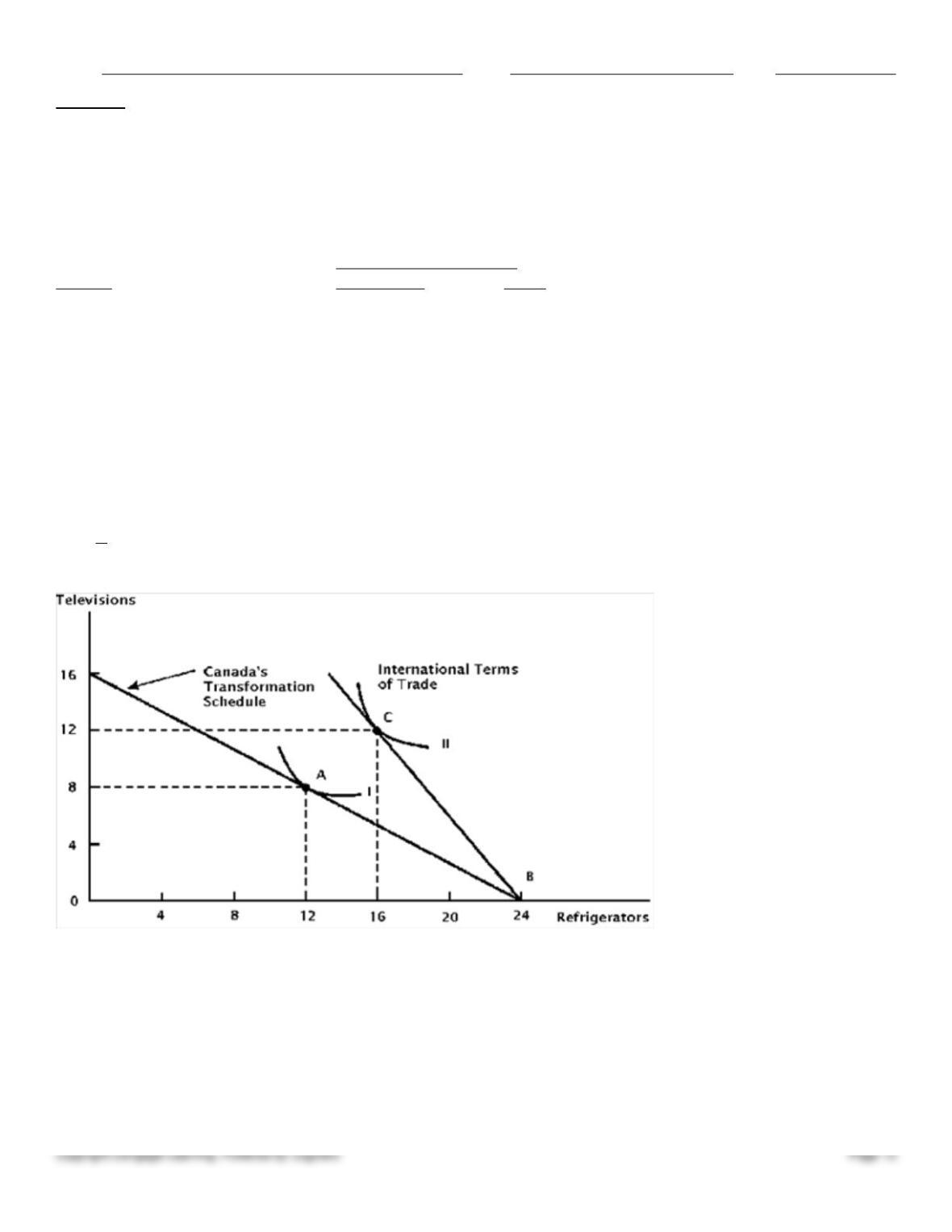
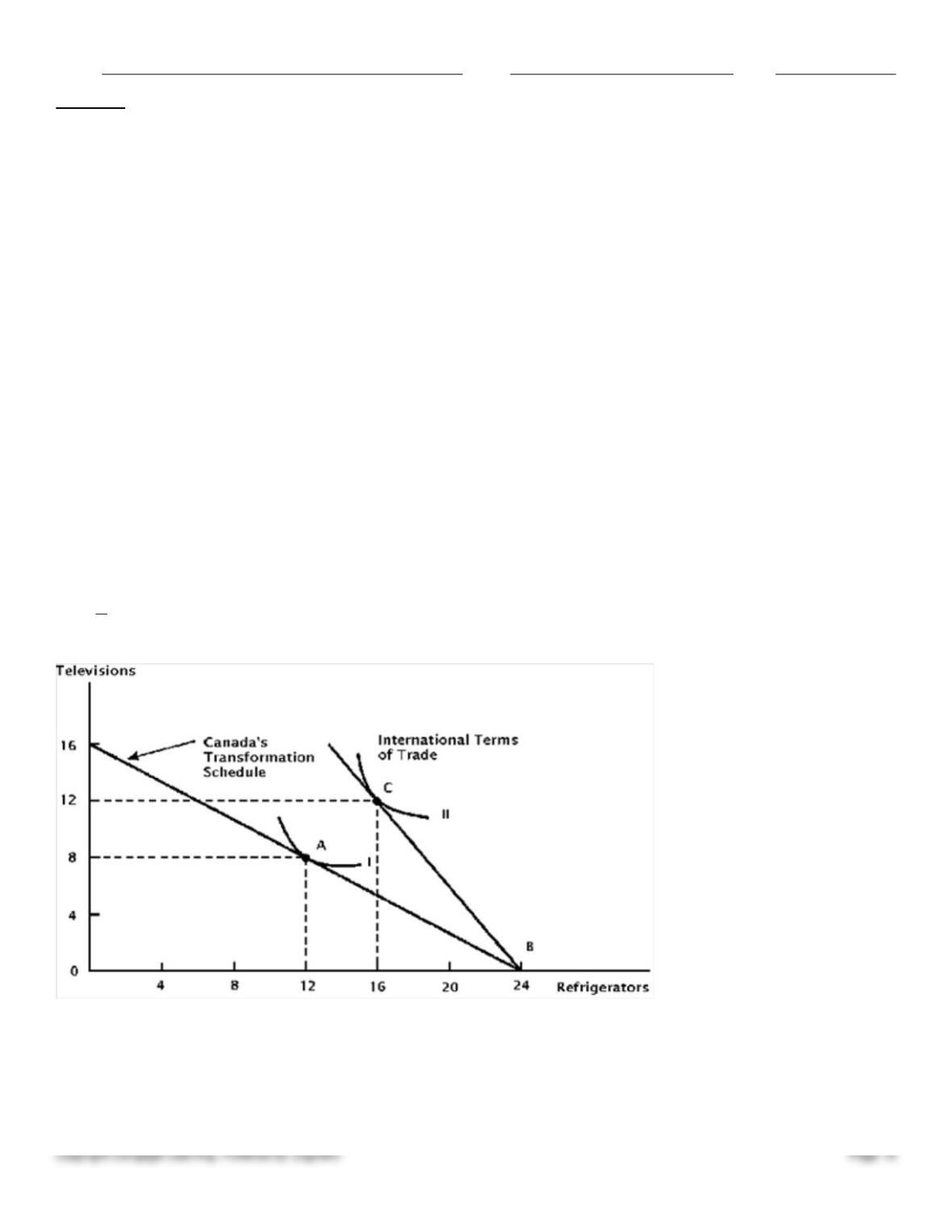
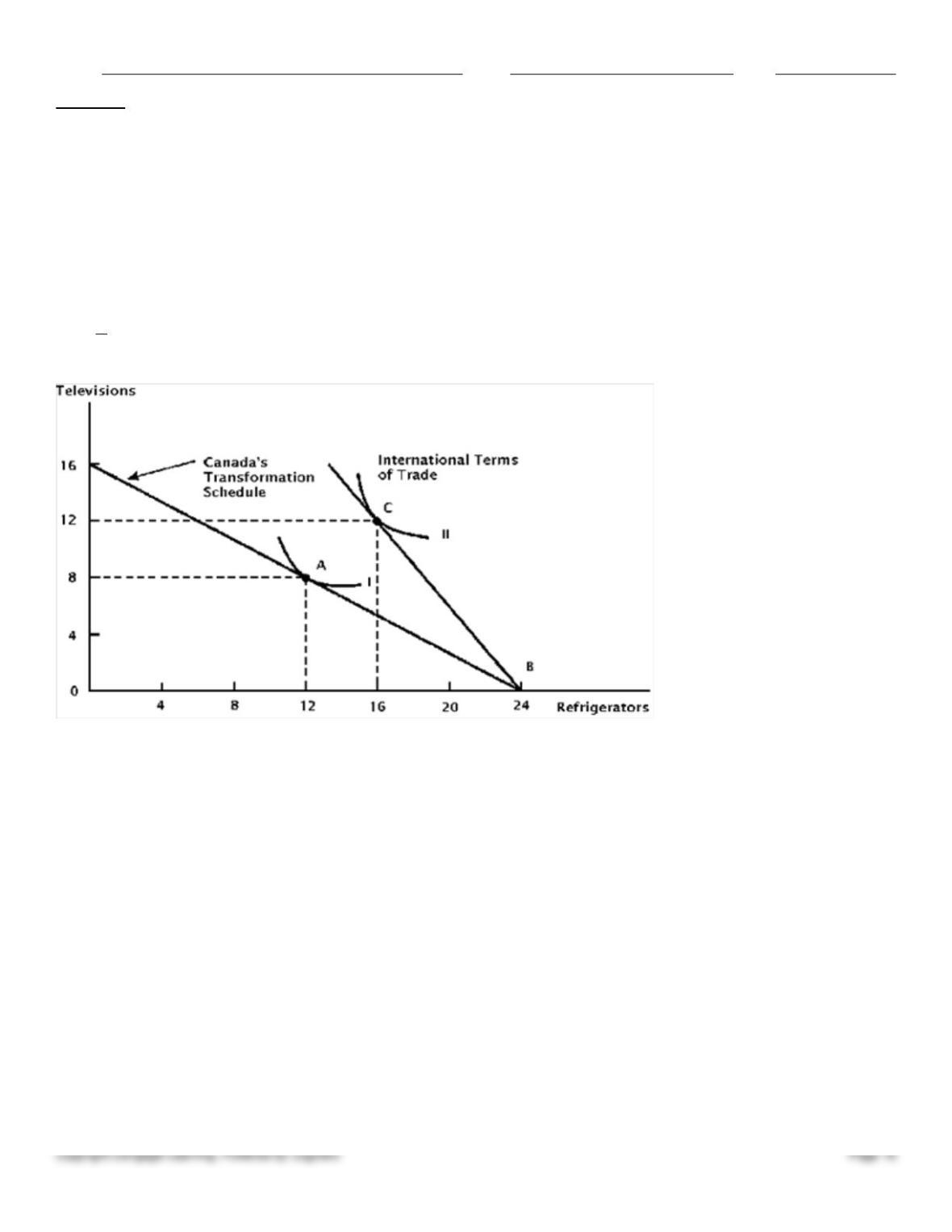
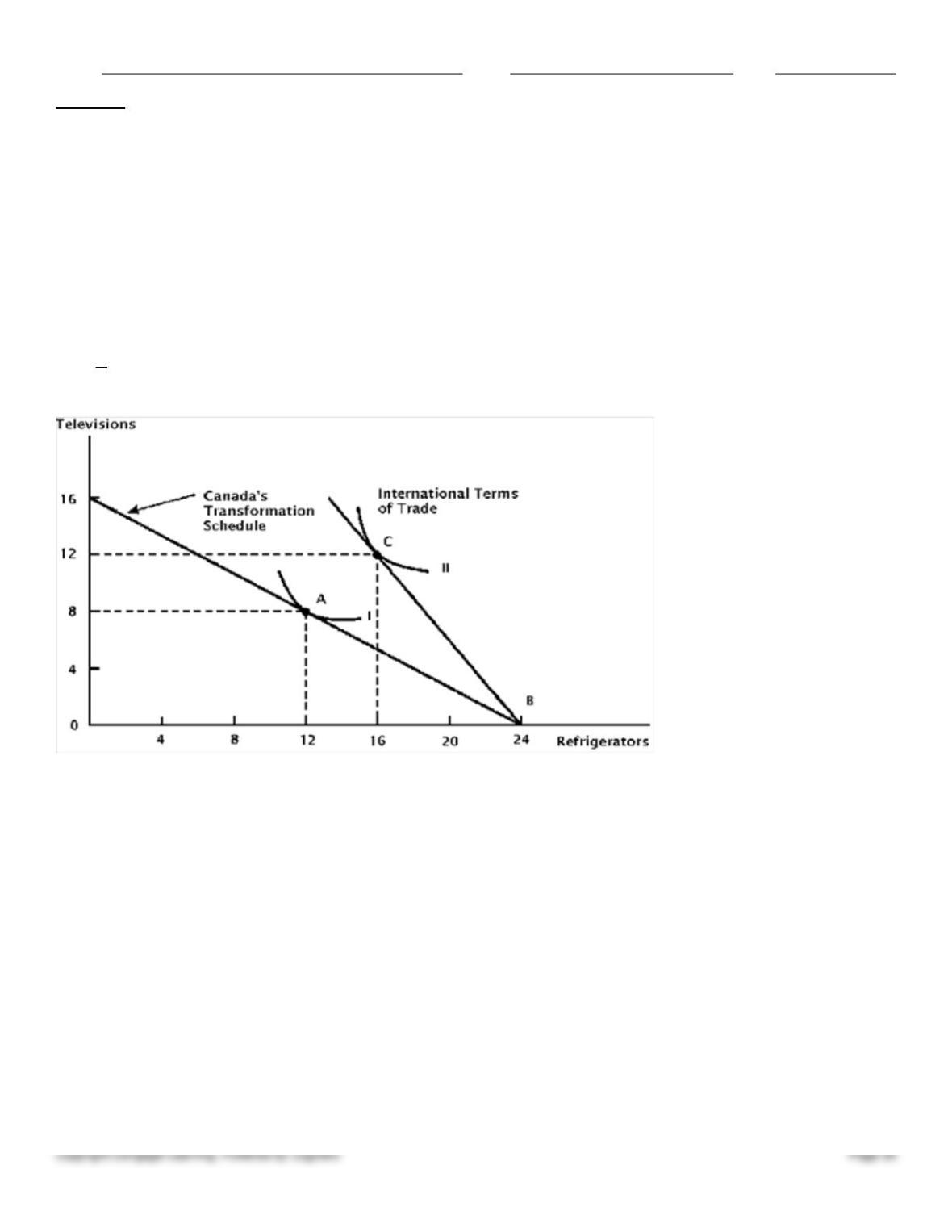
Figure 2.2 illustrates trade data for Canada. The figure assumes that Canada attains international trade equilibrium at
point C.
Figure 2.2. Canadian Trade Possibilities
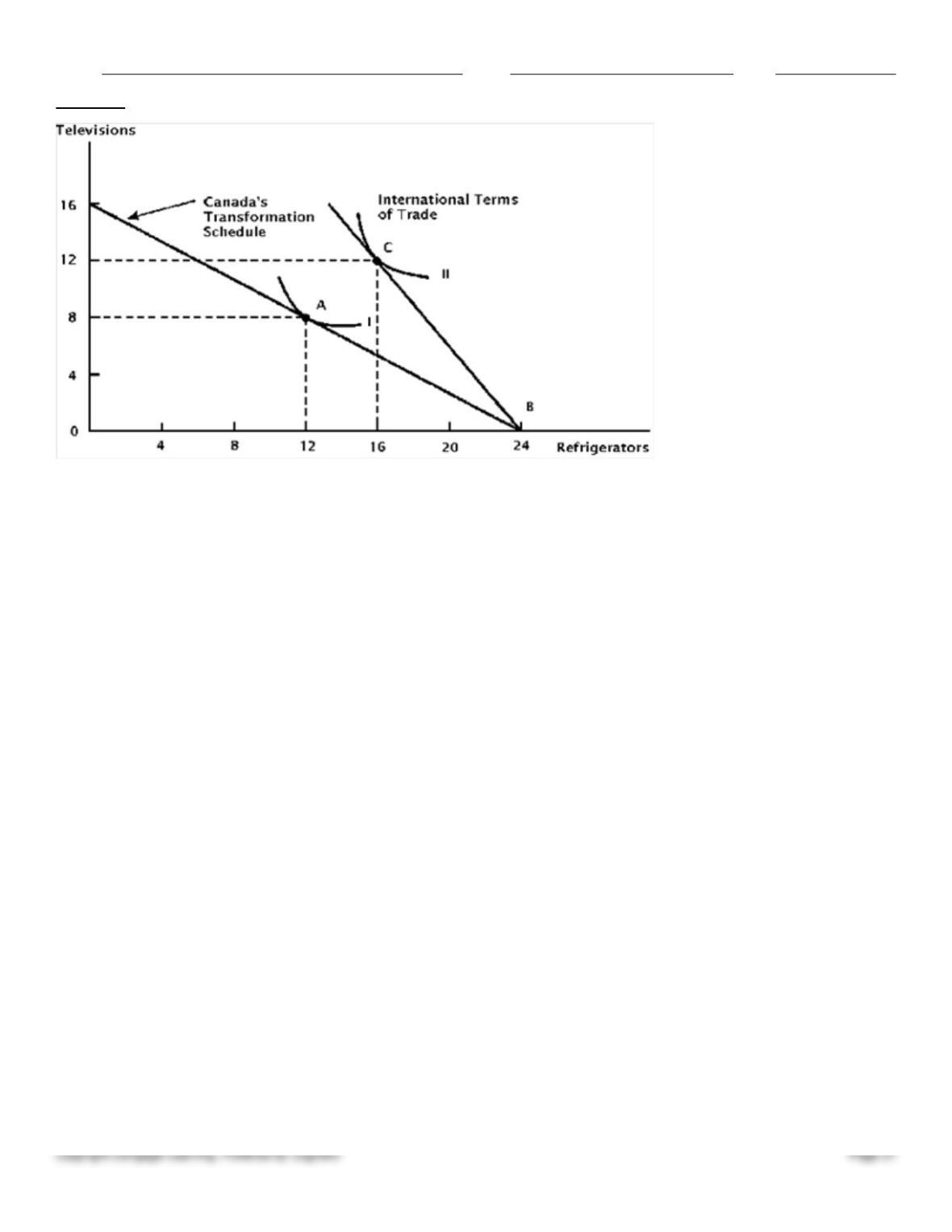
104. Consider Figure 2.2. With specialization, Canada produces
a. 16 televisions.
b. 12 televisions and 8 refrigerators.
c. 8 televisions and 16 refrigerators.
d. 24 refrigerators.
105. Which of the following is NOT an argument to support international trade?
a. Trade can be a powerful antimonopoly tool.
Name:
Class:
Date:
chapter 2
Copyright Cengage Learning. Powered by Cognero.
Page 14
b. Trade is a way to take advantage of economies of large scale production.
c. Trade is a method of transferring knowledge and information.
d. Trade is a method of achieving income equality across sectors of an economy.
106. The best explanation of the gains from trade that David Ricardo could provide was to describe only the outer limits
within which the equilibrium terms of trade would fall. This is because Ricardo’s theory did NOT recognize how market
prices are influenced by
a. demand conditions.
b. supply conditions.
c. business expectations.
d. profit patterns.
107. If Hong Kong and Taiwan had identical labor costs but were subject to increasing costs of production,
a. trade would depend on differences in demand conditions.
b. trade would depend on economies of large-scale production.
c. trade would depend on the use of different currencies.
d. there would be no basis for gainful trade.
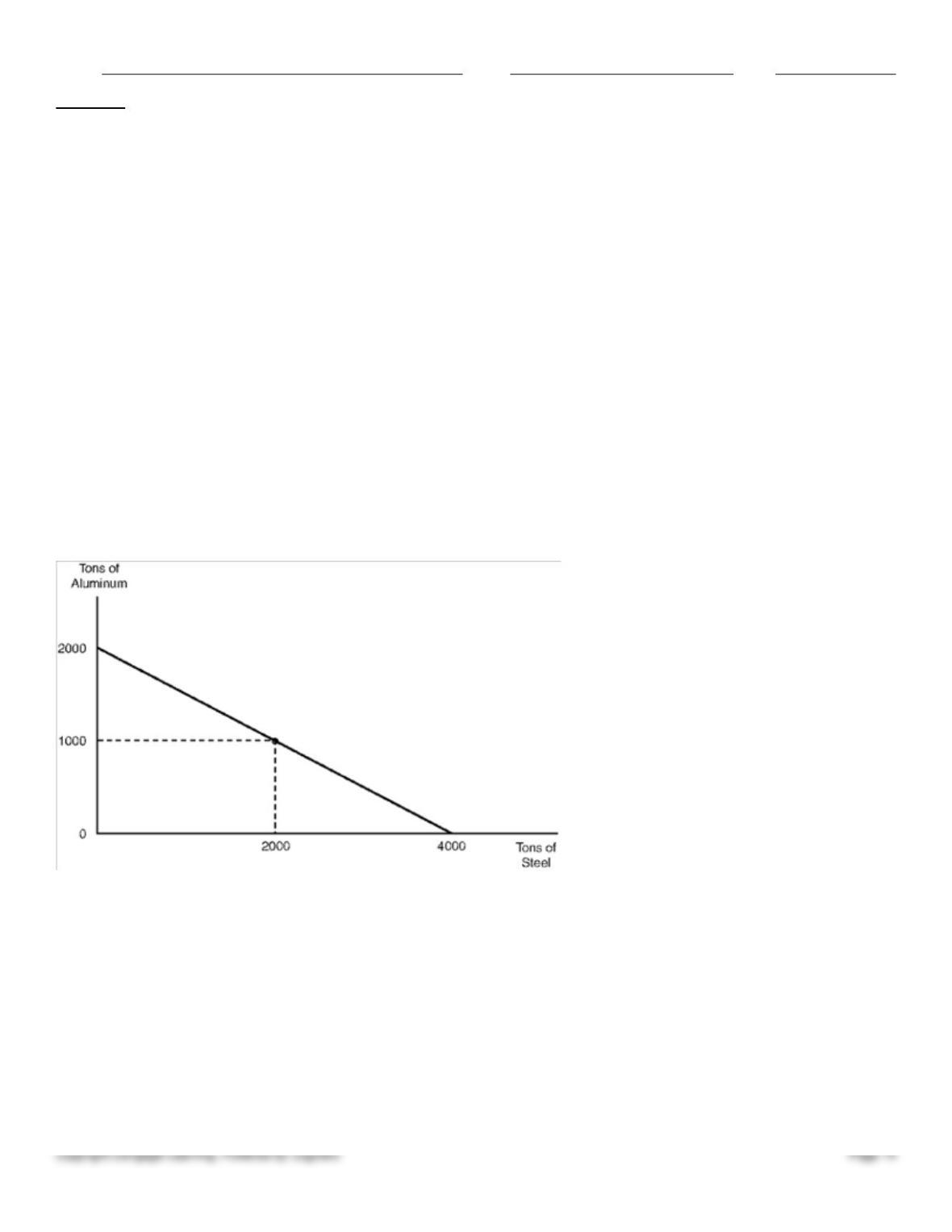
Figure 2.1. Production Possibilities Frontier
108. Refer to Figure 2.1. If the relative cost of steel were to rise, then the production possibilities frontier would
a. become steeper.
b. become flatter.
c. shift inward in a parallel manner.
d. shift outward in a parallel manner.
109. Given free trade, small nations tend to benefit the most from trade since they
a. are more productive than their large trading partners.
b. are less productive than their large trading partners.
c. have demand preferences and income levels lower than their large trading partners.
d. enjoy terms of trade lying near the opportunity costs of their large trading partners.
Name:
Class:
Date:
chapter 2
Copyright Cengage Learning. Powered by Cognero.
Page 15
110. Outsourcing (offshoring)
a. harms the economy’s domestic sectors.
b. applies only to manufacturing industries instead of service industries.
c. is the transfer of work previously done by domestic workers to workers located in foreign countries.
d. refers to the transfer of money capital from domestic banks to foreign banks.
111. Under free trade, Sweden enjoys all of the gains from trade with Holland if Sweden
a. trades at Holland’s rate of transformation.
b. trades at Sweden’s rate of transformation.
c. specializes completely in the production of its export good.
d. specializes partially in the production of its export good.
112. In a two-country, two-product world, the statement “Japan enjoys a comparative advantage over France in steel
relative to bicycles” is equivalent to
a. France having a comparative advantage over Japan in bicycles relative to steel.
b. France having a comparative disadvantage against Japan in bicycles and steel.
c. Japan having a comparative advantage over France in steel and bicycles.
d. Japan having a comparative disadvantage against Japan in bicycles and steel.
Figure 2.2 illustrates trade data for Canada. The figure assumes that Canada attains international trade equilibrium at
point C.
Figure 2.2. Canadian Trade Possibilities
113. Consider Figure 2.2. In the absence of trade, Canada would produce and consume
a. 8 televisions and 16 refrigerators.
b. 12 televisions and 16 refrigerators.
c. 8 televisions and 12 refrigerators.
d. 12 televisions and 8 refrigerators.
Name:
Class:
Date:
chapter 2
Copyright Cengage Learning. Powered by Cognero.
Page 16
114. The so-called ______ shows the amount of one product that a nation must sacrifice in order to obtain one more unit
of the second product.
a. autarkic cost
b. marginal rate of transformation
c. technology cost
d. accounting cost
Figure 2.2 illustrates trade data for Canada. The figure assumes that Canada attains international trade equilibrium at
point C.
Figure 2.2. Canadian Trade Possibilities
115. Consider Figure 2.2. With trade, Canada consumes
a. 12 televisions and 8 refrigerators.
b. 12 televisions and 16 refrigerators.
c. 8 televisions and 16 refrigerators.
d. 24 refrigerators.
116. The commodity terms of trade measures
a. the rate at which exports exchange for imports.
b. the influence trade has on productivity levels.
c. the effect on income of the trading nation.
d. the improvement in a nation’s welfare.
Name:
Class:
Date:
chapter 2
Copyright Cengage Learning. Powered by Cognero.
Page 17
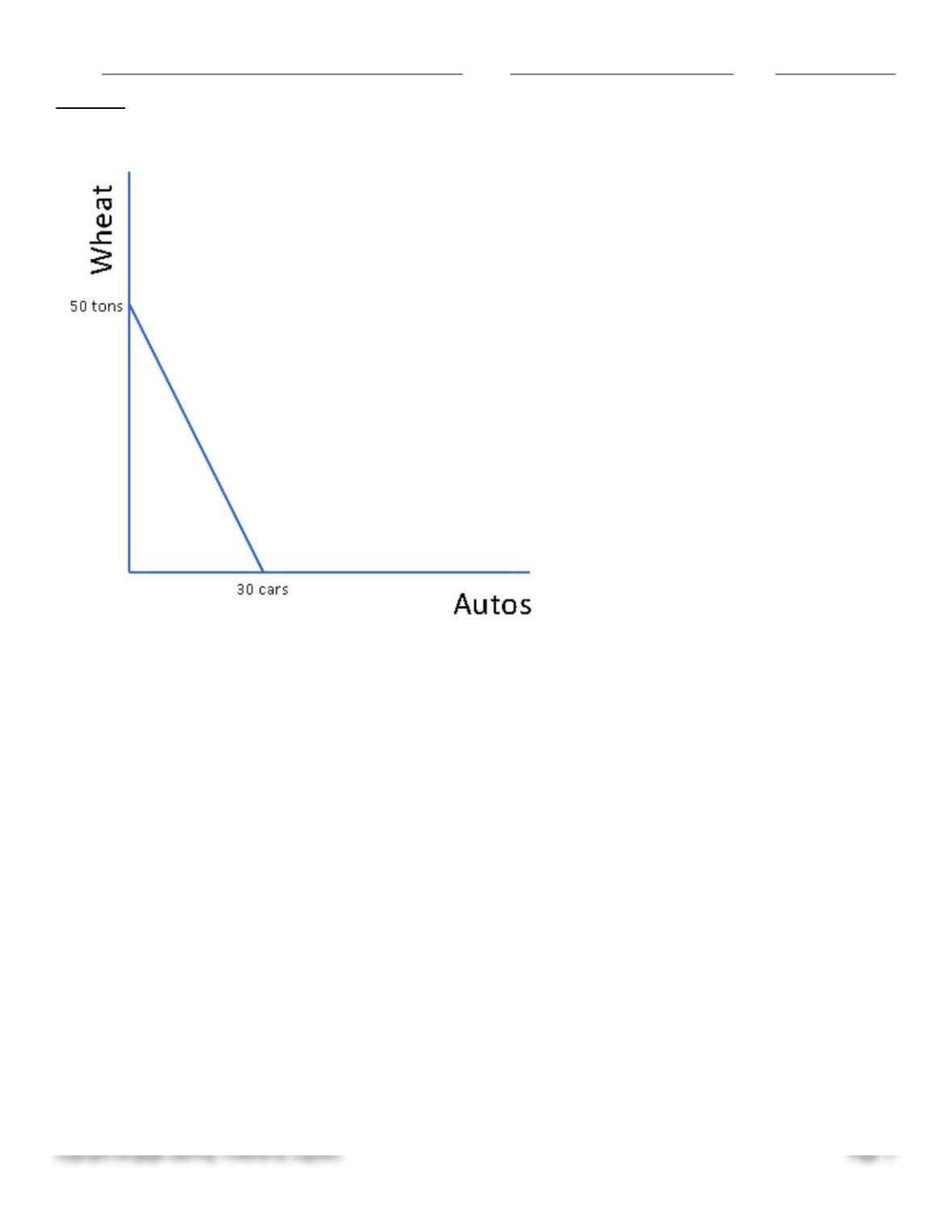
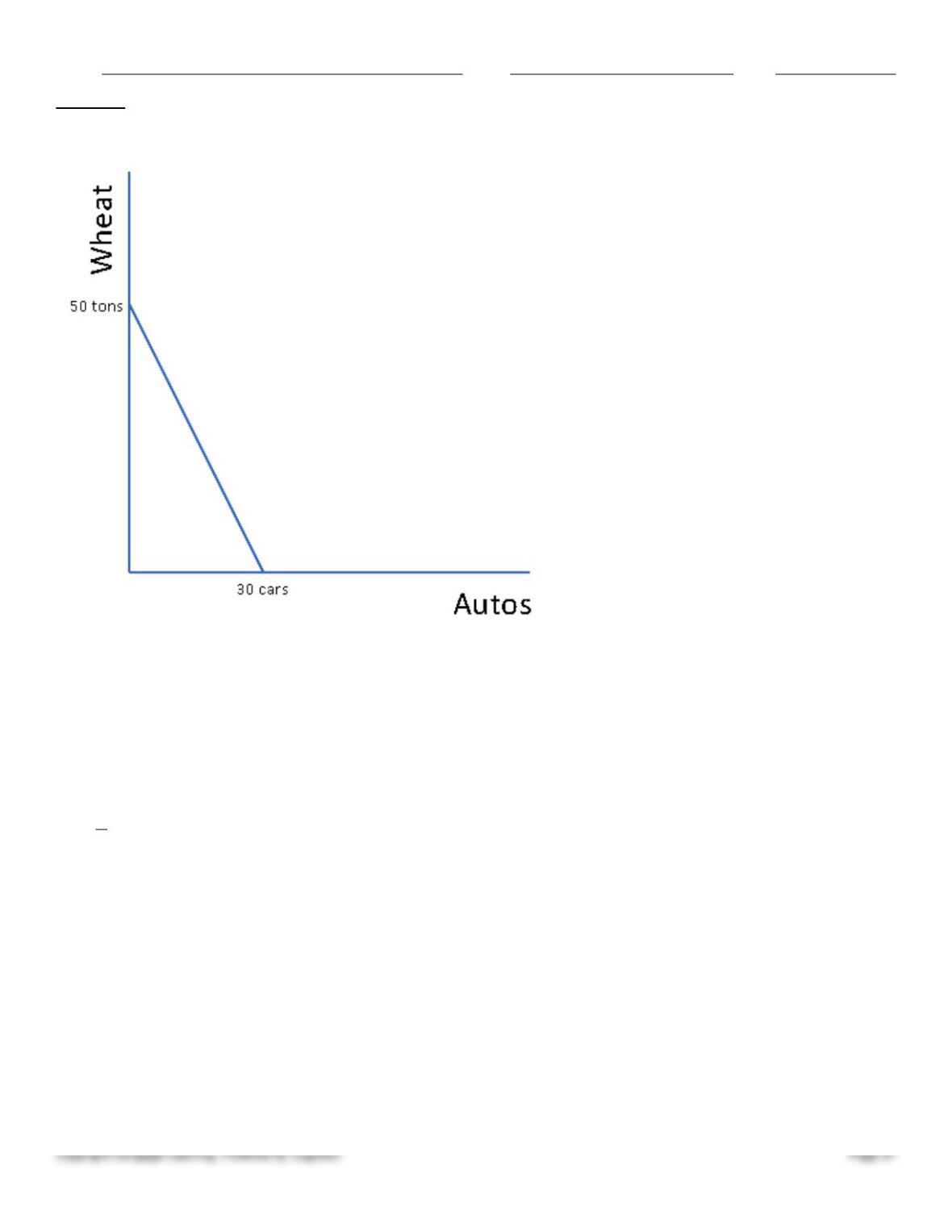
Figure 2.3 Production Possibilities Frontier
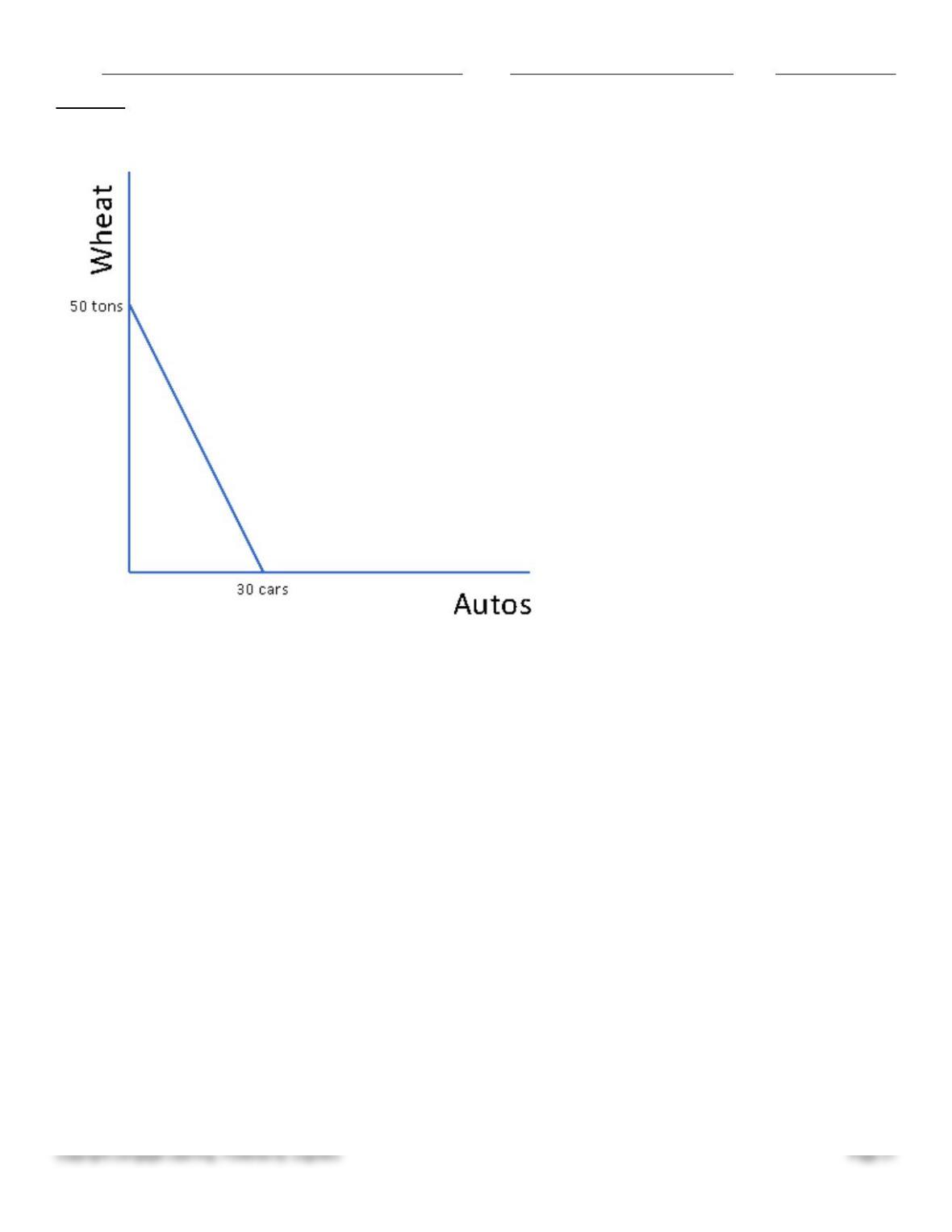
117. In Figure 2.3, the marginal rate of transformation of autos into wheat is
a. one and two-thirds.
b. two and one-third.
c. three fifths.
d. three sevenths.
118. According to the principle of comparative advantage, specialization and trade increase a nation’s total output since
a. resources are directed to their highest productivity.
b. the output of the nation’s trading partner declines.
c. the nation can produce outside of its production possibilities frontier.
d. the problem of unemployment is eliminated.
119. Which is NOT a relatively mobile occupation, as these skills are rarely used in businesses?
a. accountant
b. doctor
c. lecturer
d. farmer
120. A fall in the price of imports or a rise in the price of exports will
a. improve the terms of trade.
b. worsen the terms of trade.
c. expand the production possibilities frontier.

Name:
Class:
Date:
chapter 2
Copyright Cengage Learning. Powered by Cognero.
Page 18
d. contract the production possibilities frontier.
121. Which is an efficiency gain provided by the Internet?
a. eliminates competition
b. increases cost
c. increases market
d. minimizes collaboration
122. All of the following may be exit barriers EXCEPT
a. employee health benefit costs.
b. treatment, storage and disposal costs.
c. penalties for terminating contracts with raw material suppliers.
d. increasing opportunity cost of production.
123. E-books have changed the _________ for books.
a. supply conditions
b. demand conditions
c. terms of trade
d. way people shop
124. All of the following are sources of dynamic gains from trade EXCEPT
a. specialization and the reallocation of existing resources.
b. additional savings and investment that occurs over a period of time.
c. economies of large-scale production.
d. economic stimulus provided by increasing levels of competition.
125. “The equilibrium relative commodity price at which trade takes place is determined by the conditions of demand and
supply for each commodity in both nations. Other things being equal, the nation with the more intense demand for the
other nation’s exported good will gain less from trade than the nation with the less intense demand.” This statement was
first proposed by
a. Alfred Marshall with offer curve analysis.
b. John Stuart Mill with the theory of reciprocal demand.
c. Adam Smith with the theory of absolute advantage.
d. David Ricardo with the theory of comparative advantage.
126. Unlike Adam Smith, David Ricardo’s trading principle emphasizes the
a. demand side of the market.
b. supply side of the market.
c. role of comparative costs.
d. role of absolute costs.
127. Which country is a global leader in developing digital products?
a. China
b. Japan
c. United States
d. Russia

Name:
Class:
Date:
chapter 2
Copyright Cengage Learning. Powered by Cognero.
Page 19
128. Ricardo’s theory of comparative advantage was of limited real-world validity because it was founded on the
a. labor theory of value.
b. capital theory of value.
c. land theory of value.
d. entrepreneur theory of value.
129. Which of the following terms-of-trade concepts is calculated by dividing the change in a country’s export price index
by the change in its import price index between two points in time, multiplied by 100 to express the terms of trade in
percentages?
a. commodity terms of trade
b. marginal rate of transformation
c. marginal rate of substitution
d. autarky price ratio
Table 2.1. Output Possibilities of the U.S. and the U.K.
Output per Worker per labor hour
Country Wine Cloth
United States 5 bottles 20 yards
United Kingdom 15 bottles 10 yards
130. Referring to Table 2.1, the United States has the absolute advantage in the production of
a. cloth.
b. wine.
c. both cloth and wine.
d. neither cloth nor wine.
131. Refer to Table 2.1. Mutually advantageous trade will occur between the United States and the United Kingdom so
long as one 20 yards of cloth trades for
a. 5 bottles of wine.
b. 15 bottles of wine.
c. 20 bottles of wine.
d. 25 bottles of wine.
132. International trade is based on the notion that
a. different currencies are an obstacle to international trade.
b. goods are more mobile internationally than are resources.
c. resources are more mobile internationally than are goods.
d. a country’s exports should always exceed its imports.
133. The trading-triangle concept is used to indicate a nation’s
a. exports, marginal rate of transformation, and terms of trade.
b. imports, terms of trade, and marginal rate of transformation.
c. marginal rate of transformation, imports, and exports.
d. terms of trade, exports, and imports.

Name:
Class:
Date:
chapter 2
Copyright Cengage Learning. Powered by Cognero.
Page 20
134. When a worker quits from a steel company and joins an automobile firm, what factor of mobility does this come
under?
a. movement of factors of production between firms within an industry
b. movement of factors of production across industries
c. movement of factors of production between countries within an industry
d. movement of factors of production between countries across industries
135. The introduction of community indifference curves into our trading example focuses attention on the nation’s
a. income level.
b. resource prices.
c. tastes and preferences.
d. productivity level.
136. The use of indifference curves helps us determine the point
a. along the terms-of-trade line a country will choose.
b. where a country maximizes its resource productivity.
c. at which a country ceases to become competitive.
d. where the marginal rate of transformation approaches zero.
Table 2.1. Output Possibilities of the U.S. and the U.K.
Output per Worker per labor hour
Country Wine Cloth
United States 5 bottles 20 yards
United Kingdom 15 bottles 10 yards
137. Referring to Table 2.1, the United Kingdom has a comparative advantage in the production of
a. cloth.
b. wine.
c. both cloth and wine
d. neither cloth nor wine.
138. The terms of trade is given by
a. (Price of exports/price of imports) − 100.
b. (Price of exports/price of imports) + 100.
c. (Price of exports/price of imports) ÷ 100.
d. (Price of exports/price of imports) × 100.
Table 2.2. Output possibilities for South Korea and Japan
Output per worker per day
Country Tons of steel VCRs
South Korea 80 40
Japan 20 20
139. Refer to Table 2.2. With international trade, what would be the maximum number of VCRs that Japan would be
willing to export to South Korea in exchange for each ton of steel?

Name:
Class:
Date:
chapter 2
Copyright Cengage Learning. Powered by Cognero.
Page 21
a. 1 VCR
b. 2 VCRs
c. 3 VCRs
d. 4 VCRs
140. The earliest theorist to discuss the principle of comparative advantage was
a. Adam Smith.
b. David Ricardo.
c. Eli Heckscher.
d. Bertil Ohlin.
141. Mr. John, aged 58, has not completed his college education. He has been working in an automobile firm for the past
20 years. Now, the firm is shutting down operations in Los Angeles and planning to retain only one firm in Mexico. What
would be the best path forward for Mr. John?
a. migrate to Mexico so that he could continue to work in the same firm
b. identify a new industry where his skill may be of use
c. move to another automobile firm within his country
d. retrain himself in a new field
142. The presence of increasing opportunity costs gives rises to production possibilities frontiers that are
a. downward-sloping straight lines.
b. upward-sloping straight lines.
c. bowed outward from the diagram’s origin.
d. bowed inward toward the diagram’s origin.
143. Suppose that international trade results in an outward shift in a country’s production possibilities frontier. This would
be described as
a. dynamic gains from trade.
b. static gains from trade.
c. protectionist gains from trade.
d. allocative gains from trade.
144. David Ricardo’s simplified trade model assumes all of the following EXCEPT
a. trade is balanced, thus ruling out money flows between nations.
b. firms make production decisions in an attempt to maximize profit.
c. transportation costs are zero.
d. tariffs and quotas are used to protect a nation’s producers from foreign competition.
145. Ricardo’s model of comparative advantage assumed all of the following EXCEPT
a. in each nation, labor is the only input.
b. costs do not vary with the level of production.
c. perfect competition prevails in all markets.
d. transportation costs rise as distance increases between countries.
146. Which is NOT true about Adam Smith?
a. He was a leading advocate of free trade.

Name:
Class:
Date:
chapter 2
Copyright Cengage Learning. Powered by Cognero.
Page 22
b. He developed the concept of absolute advantage.
c. He maintained that labor costs represent the major determinant of production cost.
d. He stated that a favorable trade balance is possible only in the short run, as over time it would automatically be
eliminated.
147. Given a two-country and two-product world, the United States would enjoy all the attainable gains from free trade
with Canada if it
a. trades at the U.S. rate of transformation.
b. trades at the Canadian rate of transformation.
c. specializes completely in the production of both goods.
d. specializes partially in the production of both goods.
148. David Ricardo’s simplified trade model is based on all of these assumptions EXCEPT
a. costs do not vary with the level of production.
b. the level of technology is fixed for all nations.
c. capital is the only factor of production.
d. perfect competition prevails in all markets.
Table 2.2. Output possibilities for South Korea and Japan
Output per worker per day
Country Tons of steel VCRs
South Korea 80 40
Japan 20 20
149. Referring to Table 2.2, the opportunity cost of one VCR in Japan is
a. 1 ton of steel.
b. 2 tons of steel.
c. 3 tons of steel.
d. 4 tons of steel.
150. With trade, a country will maximize its satisfaction when it
a. moves to the highest possible indifference curve.
b. forces the marginal rate of substitution to its lowest possible value.
c. consumes more of both goods than it does in autarky.
d. finds its marginal rate of substitution exceeding its marginal rate of transformation.
151. The British economist G. MacDougall compared the labor productivity ratios and export ratios for the United
Kingdom and the United States in order to test
a. Adam Smith’s principle of absolute advantage.
b. David Hume’s price specie flow mechanism.
c. David Ricardo’s principle of comparative advantage.
d. William Benoit’s theory of mercantilism.
152. Your text describes the last-minute overhaul of the Iphone screens in China. From Apple Inc.’s perspective, Chinese
workers
Name:
Class:
Date:
chapter 2
Copyright Cengage Learning. Powered by Cognero.
Page 23
a. have more expertise in technology.
b. work harder than Americans.
c. have greater national wealth on which to draw.
d. have greater labor flexibility in terms of wages and hours worked.
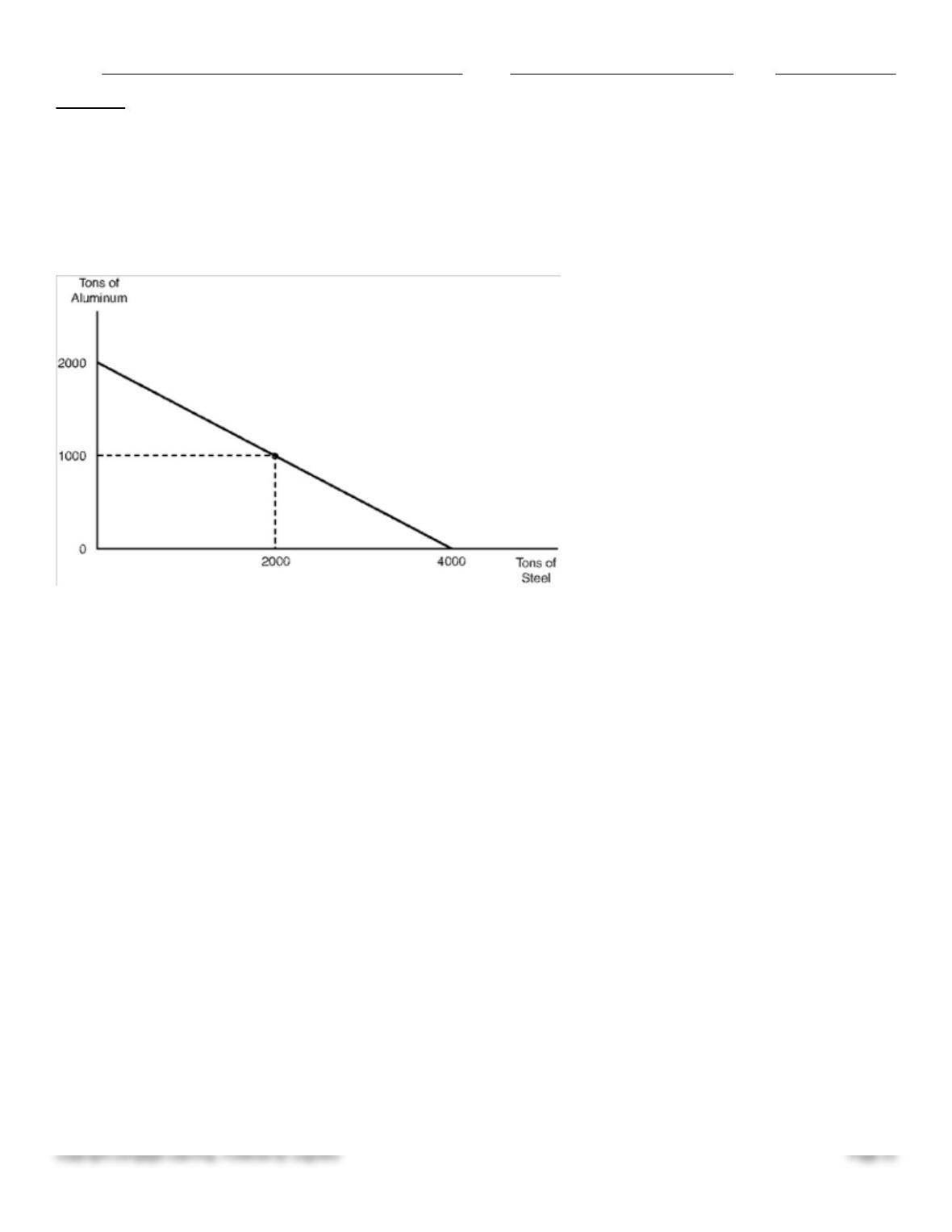
Figure 2.1. Production Possibilities Frontier
153. The gains from international trade increase as
a. a nation consumes inside of its production possibilities schedule.
b. a nation consumes along its production possibilities schedule.
c. the international terms of trade rises above the nation’s autarky price.
d. the international terms of trade approaches the nation’s autarky price.
154. Improvements in productivity may lead to decreasing comparative costs if
a. the assumption of fixed technologies under constant costs is relaxed.
b. technologies available to each nation are maintained the same.
c. resource endowments do not vary.
d. comparative advantage does not change.
155. Today, about ______ percent of a typical Ford vehicle comes from parts, components, and services purchased from
external suppliers, many of which are outside of the United States.
a. 5
b. 15
c. 35
d. 70
156. Both Adam Smith and David Ricardo
a. were advocates of free trade and opponents of protectionism.
b. were advocates of protectionism and opponents of free trade.
c. developed trade theories based on the demand side of an economy.
d. maintained that precious metals represented the wealth of a nation.
Name:
Class:
Date:
chapter 2
Copyright Cengage Learning. Powered by Cognero.
Page 24
157. The Ricardian model of comparative advantage includes all of the following assumptions EXCEPT
a. it is only based on two nations and two products.
b. product quality varies among nations.
c. labor is the only factor of production.
d. labor can move freely within a nation.
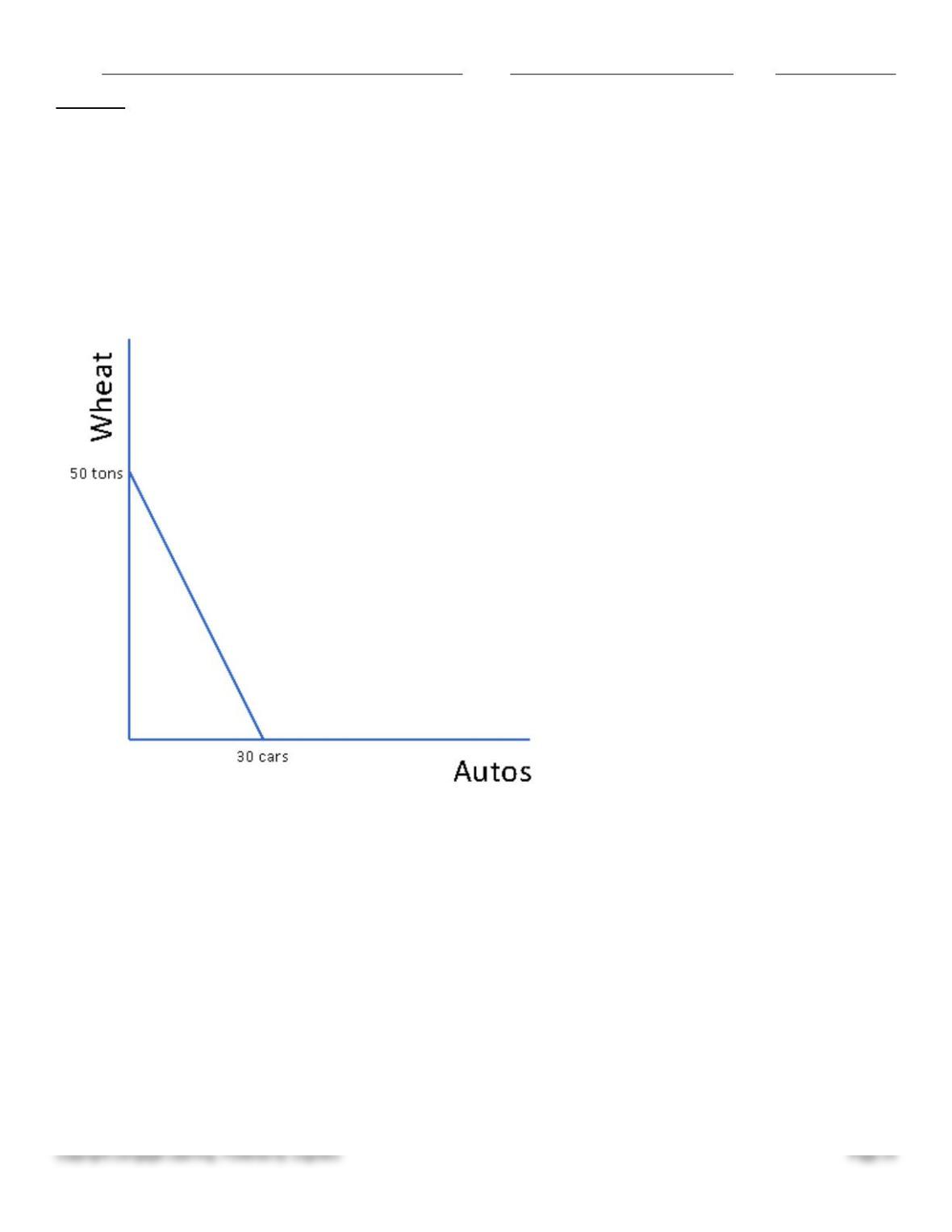
Figure 2.3 Production Possibilities Frontier
158. In Figure 2.3, the marginal rate of transformation of wheat into autos is
a. one and two-thirds.
b. two and one-third.
c. three fifths.
d. three sevenths.
159. Referring to Table 2.3, which country’s terms of trade did NOT change between 1990 and 2004?
a. Spain
b. Sweden
c. France
d. Denmark
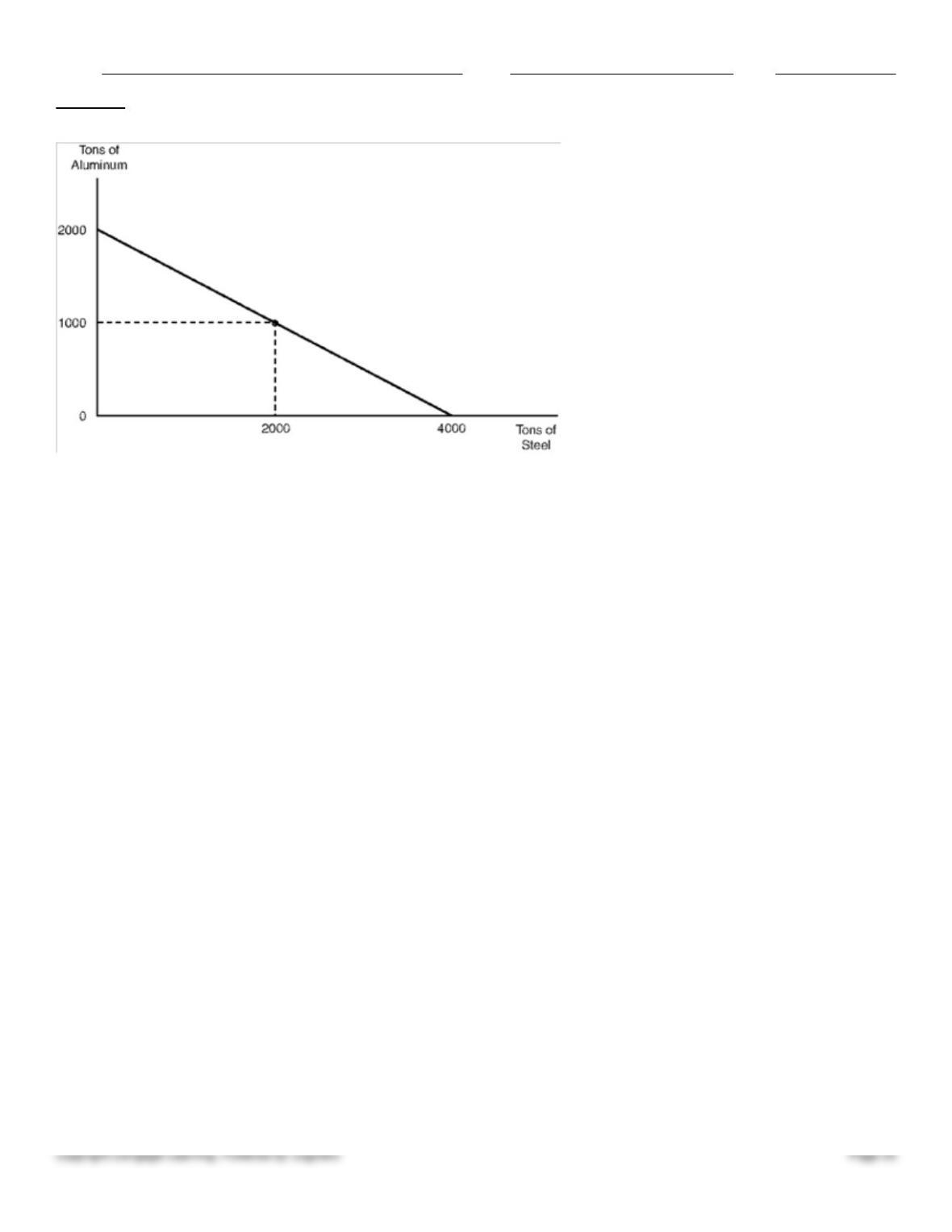
Figure 2.1. Production Possibilities Frontier
Name:
Class:
Date:
chapter 2
Copyright Cengage Learning. Powered by Cognero.
Page 25
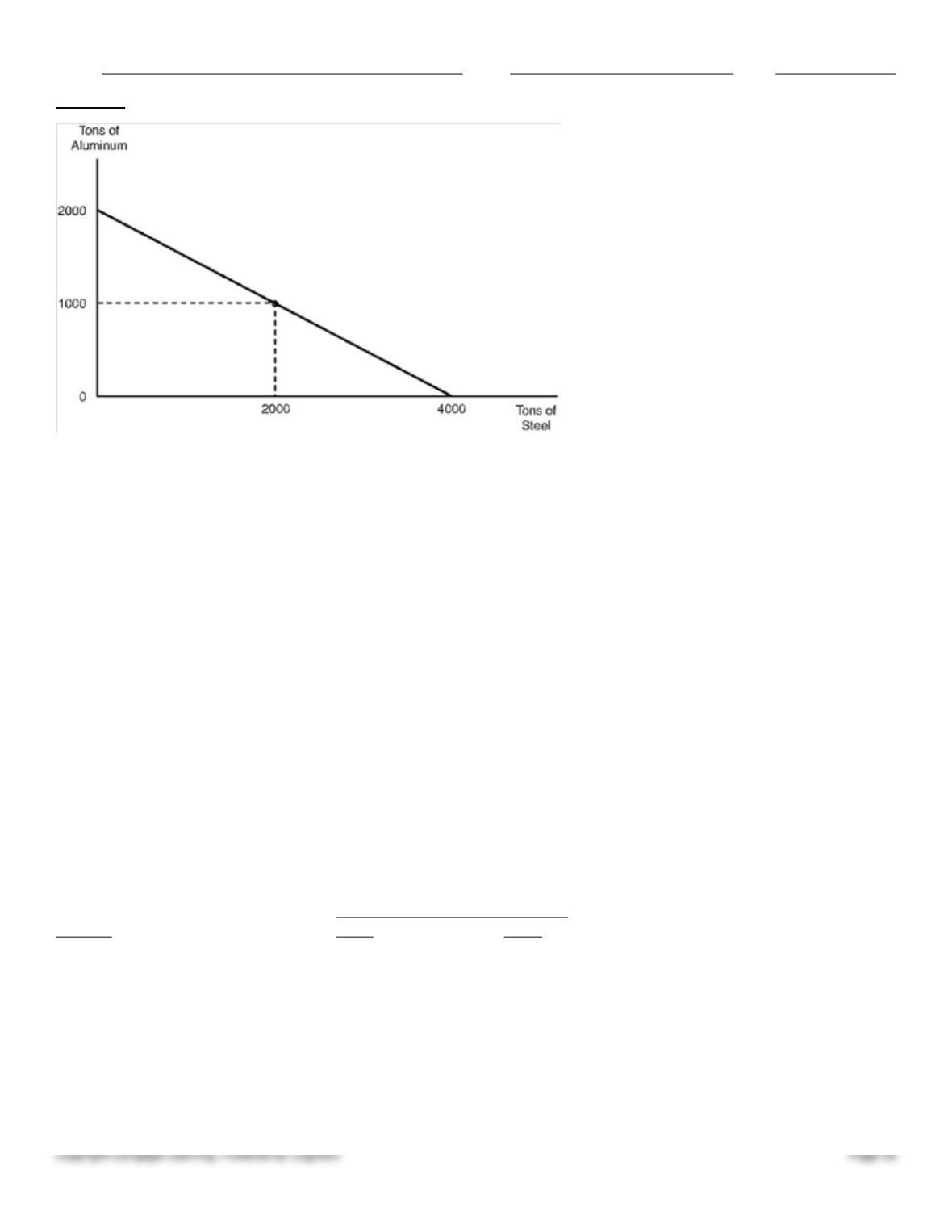
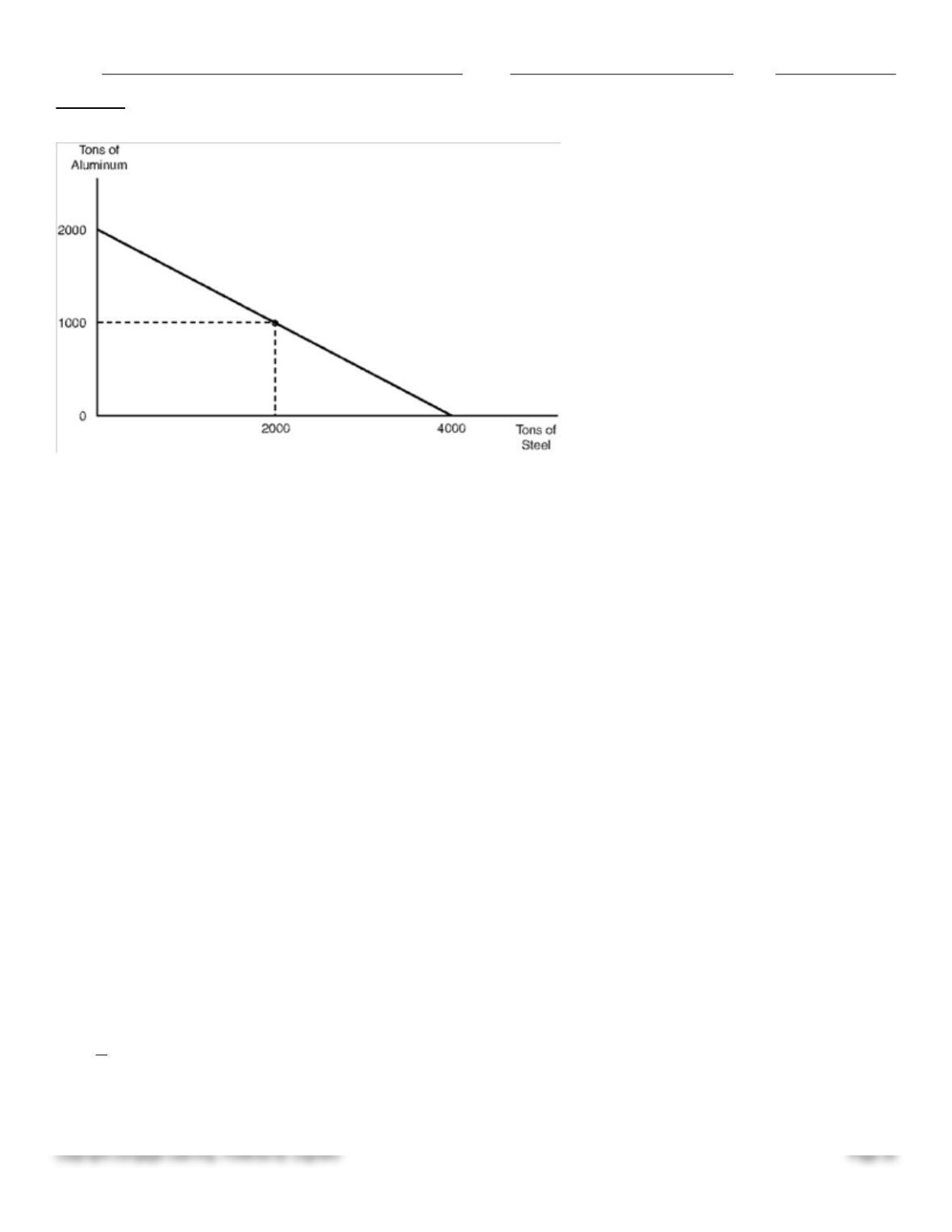
160. Referring to Figure 2.1, the relative cost of steel in terms of aluminum is
a. 4.0 tons.
b. 2.0 tons.
c. 0.5 tons.
d. 0.25 tons.
161. Increasing opportunity costs suggest that
a. resources are not perfectly shiftable between the production of two goods.
b. resources are fully shiftable between the production of two goods.
c. a country’s production possibilities frontier appears as a straight line.
d. a country’s production possibilities frontier is bowed inward (i.e., convex) in appearance.
162. The dynamic gains from trade include all of the following EXCEPT
a. economies of large-scale production resulting in decreasing unit cost.
b. increased saving and investment resulting in economic growth.
c. increased competition resulting in lower prices and wider range of output.
d. increasing comparative advantage leading to specialization.
163. Concerning possible determinants of international trade, which are sources of comparative advantage?
a. differences in role of production
b. differences in tastes and preferences
c. differences in technological know-how
d. differences in terms of trade
164. Advocates of outsourcing by American firms maintain that its advantages consist of
a. enabling American firms to remain profitable by increasing the cost of production.
b. decreasing the demand for American workers in complementary jobs.
c. holding down prices for American consumers.
d. building efficiency by decreasing the number of plants.

Name:
Class:
Date:
chapter 2
Copyright Cengage Learning. Powered by Cognero.
Page 26
165. The example of Rubbermaid in Wooster, Ohio shows us that
a. international trade is always favorable for the U.S. economy.
b. tariffs can reduce firm mobility, thus keeping jobs in the U.S.
c. although international trade generally benefits all, the movement of firms can have a temporary negative impact
on workers in a region.
d. prices always rise to account for price increases in raw materials.
166. Which question is a concern of modern trade theory?
a. What constitutes the basis for trade?
b. What is the basis for direction of trade?
c. What are the gains from trade regarding products exchanged in the world market?
d. What are the potential gains from trade for the world as a whole?
167. Ricardo’s model of comparative advantage assumed all of the following EXCEPT
a. trade is balanced, thus ruling out flows of money between nations.
b. firms make production decisions in an attempt to maximize profits.
c. free trade occurs between nations.
d. labor is immobile within a country, but is incapable of moving between countries.
168. Unlike the mercantilists, Adam Smith maintained that
a. trade benefits one nation only at the expense of another nation.
b. government control of trade leads to maximum economic welfare.
c. all nations can gain from free international trade.
d. the world’s output of goods must remain constant over time.
Table 2.2. Output possibilities for South Korea and Japan
Output per worker per day
Country Tons of steel VCRs
South Korea 80 40
Japan 20 20
169. Referring to Table 2.2, the opportunity cost of one VCR in South Korea is
a. 1/2 ton of steel.
b. 1 ton of steel.
c. 1 1/2 tons of steel.
d. 2 tons of steel.
170. Introducing indifference curves into our trade model permits us to determine
a. where a nation chooses to locate along its production possibilities frontier in autarky.
b. the precise location of a nation’s production possibilities frontier.
c. whether absolute cost or comparative cost conditions exist.
d. the currency price of one product in terms of another product.
Name:
Class:
Date:
chapter 2
Copyright Cengage Learning. Powered by Cognero.
Page 27
Figure 2.3 Production Possibilities Frontier
171. In Figure 2.3, one ton of wheat can be produced at a cost of
a. one and two-thirds cars.
b. two and one-third cars.
c. three fifths of a car.
d. three sevenths of a car.
172. In a two-product, two-country world, international trade can lead to increases in
a. consumer welfare only if output of both products is increased.
b. output of both products and consumer welfare in both countries.
c. total production of both products, but not consumer welfare in both countries.
d. consumer welfare in both countries, but not total production of both products.
173. In Adam Smith’s trade theory, ______ is the only factor of production and is of one quality (homogeneous).
a. land
b. labor
c. capital
d. entrepreneurship
Figure 2.1. Production Possibilities Frontier
Name:
Class:
Date:
chapter 2
Copyright Cengage Learning. Powered by Cognero.
Page 28
174. Refer to Figure 2.1. If the relative cost of aluminum were to rise, then the production possibilities frontier would
a. become steeper.
b. become flatter.
c. shift inward in a parallel manner.
d. shift outward in a parallel manner.
175. Under free trade, Canada would not enjoy any gains from trade with Sweden if Canada
a. trades at the Canadian rate of transformation.
b. trades at Sweden’s rate of transformation.
c. specializes completely in the production of its export good.
d. specializes partially in the production of its export good.
176. John Stuart Mill’s theory of reciprocal demand best applies when trading partners
a. are of equal size and importance in the market.
b. produce under increasing cost conditions.
c. partially specialize in the production of commodities.
d. have similar taste and preference levels.
Table 2.1. Output Possibilities of the U.S. and the U.K.
Output per Worker per labor hour
Country Wine Cloth
United States 5 bottles 20 yards
United Kingdom 15 bottles 10 yards
177. Referring to Table 2.1, the opportunity cost of producing one bottle of wine in the United States is
a. 3 yards of cloth.
b. 4 yards of cloth.
c. 5 yards of cloth.
d. 10 yards of cloth.

Name:
Class:
Date:
chapter 2
Copyright Cengage Learning. Powered by Cognero.
Page 29
178. Because the Ricardian trade theory recognized only how supply conditions influence international prices, it could
determine
a. the equilibrium terms of trade.
b. the outer limits for the terms of trade.
c. where a country chooses to locate along its production possibilities frontier.
d. where a country chooses to locate along its trade triangle.
179. Suppose Japan produces Widget A at the lowest cost. Then, Sweden discovers and uses new technology to produce
Widget A at a slightly lower cost. What could Japan do to increase its comparative advantage in Widget A?
a. Japan could specialize on aspects of Widget A for which it is more productive relative to Sweden.
b. Japan can produce less of Widget A.
c. Japan can use its manufacturing sector to produce a different kind of widget.
d. Japan can continue to produce Widget A with no changes in production.
180. A term-of-trade index that equals 90 indicates that compared to the base year,
a. it requires a greater output of domestic goods to obtain the same amount of foreign goods.
b. it requires a lesser amount of domestic goods to obtain the same amount of foreign goods.
c. the price of exports has fallen from $100 to $90.
d. the price of imports has fallen from $100 to $90.
Table 2.1. Output Possibilities of the U.S. and the U.K.
Output per Worker per labor hour
Country Wine Cloth
United States 5 bottles 20 yards
United Kingdom 15 bottles 10 yards
181. Refer to Table 2.1. If trade opens up between the United States and the United Kingdom, American firms should
specialize in producing
a. cloth.
b. wine.
c. both cloth and wine.
d. neither cloth nor wine.
182. A terms-of-trade index that equals 150 indicates that compared to the base year,
a. it requires a greater output of domestic goods to obtain the same amount of foreign goods.
b. it requires a lesser amount of domestic goods to obtain the same amount of foreign goods.
c. the price of exports has risen from $100 to $150.
d. the price of imports has risen from $100 to $150.
183. For the United States, outsourcing tends to result from
a. a change in the pattern of comparative advantage.
b. the desire of domestic firms to keep domestic labor unions happy.
c. poor educational systems that result in domestic workers becoming less productive.
d. highly restrictive import tariffs and import quotas.
Figure 2.1. Production Possibilities Frontier
Name:
Class:
Date:
chapter 2
Copyright Cengage Learning. Powered by Cognero.
Page 30
184. Referring to Figure 2.1, the relative cost of aluminum in terms of steel is
a. 4.0 tons.
b. 2.0 tons.
c. 0.5 tons.
d. 0.25 tons.
185. International economists use the production possibilities frontier to help explain
a. a favorable trade balance.
b. a trade surplus.
c. levels of consumption.
d. a nation’s gain from trade.
186. If the international terms of trade settles at a level that is between each country’s opportunity cost,
a. there is no basis for gainful trade for either country.
b. both countries gain from trade.
c. only one country gains from trade.
d. one country gains and the other country loses from trade.
187. The United States benefits from outsourcing in all of the following ways EXCEPT
a. reduced costs and increased competitiveness for American producers.
b. new exports for American producers.
c. repatriated earnings into the American economy.
d. less tax revenue for the American government.
Figure 2.2 illustrates trade data for Canada. The figure assumes that Canada attains international trade equilibrium at
point C.
Figure 2.2. Canadian Trade Possibilities
Name:
Class:
Date:
chapter 2
Copyright Cengage Learning. Powered by Cognero.
Page 31
188. According to Figure 2.2, exports for Canada total
a. 16 refrigerators.
b. 8 refrigerators.
c. 12 refrigerators.
d. 16 refrigerators.
189. The trading principle formulated by Adam Smith maintained that
a. international prices are determined from the demand side of the market.
b. differences in resource endowments determine comparative advantage.
c. differences in income levels govern world trade patterns.
d. absolute cost differences determine the immediate basis for trade.
190. Constant-cost conditions reflect that
a. quality differs between products.
b. products are perfect substitutes for each other.
c. product quality is related to who products it.
d. one product is more desirable than the other.
191. Referring to Table 2.3, which countries’ terms of trade worsened between 1990 and 2004?
a. Spain and Mexico
b. Mexico and France
c. France and Denmark
d. Denmark and Sweden
192. According to your text, international trade has little impact on jobs because
a. people prefer to buy domestically.
b. governments control trade through tariffs.
c. trade and unemployment typically move in unison.
d. international trade tends to follow the principle of comparative advantage.

Name:
Class:
Date:
chapter 2
Copyright Cengage Learning. Powered by Cognero.
Page 32
193. The theory of reciprocal demand does NOT well apply when one country
a. produces under constant-cost conditions.
b. produces along its production possibilities frontier.
c. is of minor economic importance in the world marketplace.
d. partially specializes the production of its export good.
Example 2Example 2. Terms of Trade
Export Price Index Import Price Index
Country 1990 2004 1990 2004
Mexico 100 220 100 200
Sweden 100 160 100 150
Spain 100 155 100 155
France 100 170 100 230
Denmark 100 120 100 125
194. Referring to Example 2, which countries’ terms of trade improved between 1990 and 2004?
a. Mexico and Denmark
b. Sweden and Denmark
c. Sweden and Spain
d. Mexico and Sweden
Table 2.2. Output possibilities for South Korea and Japan
Output per worker per day
Country Tons of steel VCRs
South Korea 80 40
Japan 20 20
195. Refer to Table 2.2. According to the principle of comparative advantage
a. South Korea should export steel.
b. South Korea should export steel and VCRs.
c. Japan should export steel.
d. Japan should export steel and VCRs.
Table 2.1. Output Possibilities of the U.S. and the U.K.
Output per Worker per labor hour
Country Wine Cloth
United States 5 bottles 20 yards
United Kingdom 15 bottles 10 yards
196. Referring to Table 2.1, the United Kingdom gains most from trade if
a. 1 bottle of wine trades for 1 yard of cloth.
b. 1 bottle of wins trades for 2 yards of cloth.

Name:
Class:
Date:
chapter 2
Copyright Cengage Learning. Powered by Cognero.
Page 33
c. 2 bottles of wine trades for 1 yard of cloth.
d. 3 bottles of wine trades for 1 yard of cloth.
197. If a production possibilities frontier is bowed out (i.e., concave) in appearance, production occurs under conditions of
a. constant opportunity costs.
b. increasing opportunity costs.
c. decreasing opportunity costs.
d. zero opportunity costs.
198. By enabling the spread of collaboration and ideas, an online-based company promotes
a. increased productivity.
b. product innovation.
c. increasing markets.
d. decreasing costs.
199. Modern trade theory contends that the pattern of world trade is governed by
a. mercantilism.
b. supply conditions only.
c. demand conditions only.
d. the ability to separate the production process into tasks that can be done in different locations.
200. If a production possibilities frontier appears as a downward sloping straight line, which of the following occurs?
a. increasing opportunity cost
b. decreasing opportunity cost
c. constant opportunity cost
d. negative opportunity cost
201. The efficiency gains that _______ provide(s) for economies are not a one-time occurrence but an ongoing process
that fosters long-run economic growth.
a. consumers
b. computers
c. information exchange
d. digital trade
202. If Spain’s weather is better for growing wine grapes than Denmark’s, it can be said that Spain has a(n)
a. absolute advantage in the production of wine.
b. comparative advantage in the production of wine.
c. lower marginal rate of transformation for wine.
d. lower opportunity cost of producing wine.
203. If Canada experiences constant opportunity costs, its supply schedule of steel will be
a. downward-sloping.
b. upward-sloping.
c. horizontal.
d. vertical.

Name:
Class:
Date:
chapter 2
Copyright Cengage Learning. Powered by Cognero.
Page 34
204. Which American companies are participating in international trade as never before?
a. fortune 500 companies
b. smaller companies
c. medium-sized companies
d. smaller and medium-sized companies
205. The equilibrium prices and quantities established after trade are fully determinate if we know
a. the location of all countries’ indifference curves.
b. the shape of each country’s production possibilities frontier.
c. the comparative costs of each trading partner.
d. the strength of world supply and demand for each good.
206. According to Apple, why does the company no longer assemble the majority of its products in the United States?
a. Labor costs are higher in the United States.
b. The United States has more skilled workers.
c. Income taxes are highest in the United States.
d. Foreign workers are more skilled and flexible.
207. Assuming increasing-cost conditions, trade between two countries would NOT be likely if they have
a. identical demand conditions but different supply conditions.
b. identical supply conditions but different demand conditions.
c. different supply conditions and different demand conditions.
d. identical demand conditions and identical supply conditions.
208. Incomplete specialization may be caused by
a. increasing opportunity cost.
b. unrestricted trade.
c. constant opportunity cost.
d. decreasing opportunity cost.
209. Although Apple Inc. employs some 40,000 workers in the United States, it licenses most of the production of its
Ipads and Ipods to Foxconn Technology Group, a company located in
a. Mexico.
b. China.
c. Vietnam.
d. Cambodia.
210. Digital trade involves exchange of all EXCEPT
a. goods.
b. services.
c. information.
d. equipment.
211. Autarky is defined as
a. the relative cost to produce and consume.
b. the absence of trade.
Name:
Class:
Date:
chapter 2
Copyright Cengage Learning. Powered by Cognero.
Page 35
c. the amount of labor required to produce 1 unit of a product.
d. the slope of the production possibilities frontier.
212. According to Ricardo, a country will have a comparative advantage in the product in which its
a. labor productivity is relatively low.
b. labor productivity is relatively high.
c. labor mobility is relatively low.
d. labor mobility is relatively high.
Figure 2.2 illustrates trade data for Canada. The figure assumes that Canada attains international trade equilibrium at
point C.
Figure 2.2. Canadian Trade Possibilities
213. According to Figure 2.2, imports for Canada total
a. 6 televisions.
b. 8 televisions.
c. 12 televisions.
d. 16 televisions.
214. The mercantilists would have objected to
a. export promotion policies initiated by the government.
b. the use of tariffs or quotas to restrict imports.
c. trade policies designed to accumulate gold and other precious metals.
d. international trade based on open markets.
215. When nations are of similar size and have similar taste patterns, the gains from trade
a. are shared equally between them.
b. are impossible to determine.
c. are too small, so that trading is not beneficial.
d. are determined by the nation that has comparative advantage in the more essential product.

Name:
Class:
Date:
chapter 2
Copyright Cengage Learning. Powered by Cognero.
Page 36
216. When a company starts an online trade, which aspect could limit their progress?
a. data privacy issues
b. increasing competition
c. productivity issues
d. decreasing costs
217. Which cannot be part of a digital trade?
a. reading books
b. consultant sending a legal brief to his client
c. ordering product through Ebay
d. streaming movies
218. International trade tends to be complete, rather than partial, when which of the following occurs?
a. constant opportunity cost
b. increasing opportunity cost
c. negative opportunity cost
d. positive opportunity cost
219. Which of the following trade theories asserts that within the outer limits of the terms of trade, the actual terms of
trade is determined by the relative strength of each country’s demand for the other country’s product?
a. theory of reciprocal demand
b. overlapping demand theory
c. theory of income determination
d. theory of negative externalities
220. Assume that a mid-sized company is launching an online store. It has to transform
a. why trade is conducted.
b. how trade is conducted.
c. where trade is conducted.
d. the “what” of international trade.
221. When a nation achieves autarky equilibrium,
a. input price equals final product price.
b. labor productivity equals the wage rate.
c. imports equal exports.
d. production equals consumption.
Name:
Class:
Date:
chapter 2
Copyright Cengage Learning. Powered by Cognero.
Page 37
Figure 2.3 Production Possibilities Frontier
222. In Figure 2.3, one car can be produced at a cost of
a. one and two-thirds tons of wheat.
b. two and one-third tons of wheat.
c. three fifths tons of wheat.
d. three sevenths tons of wheat.
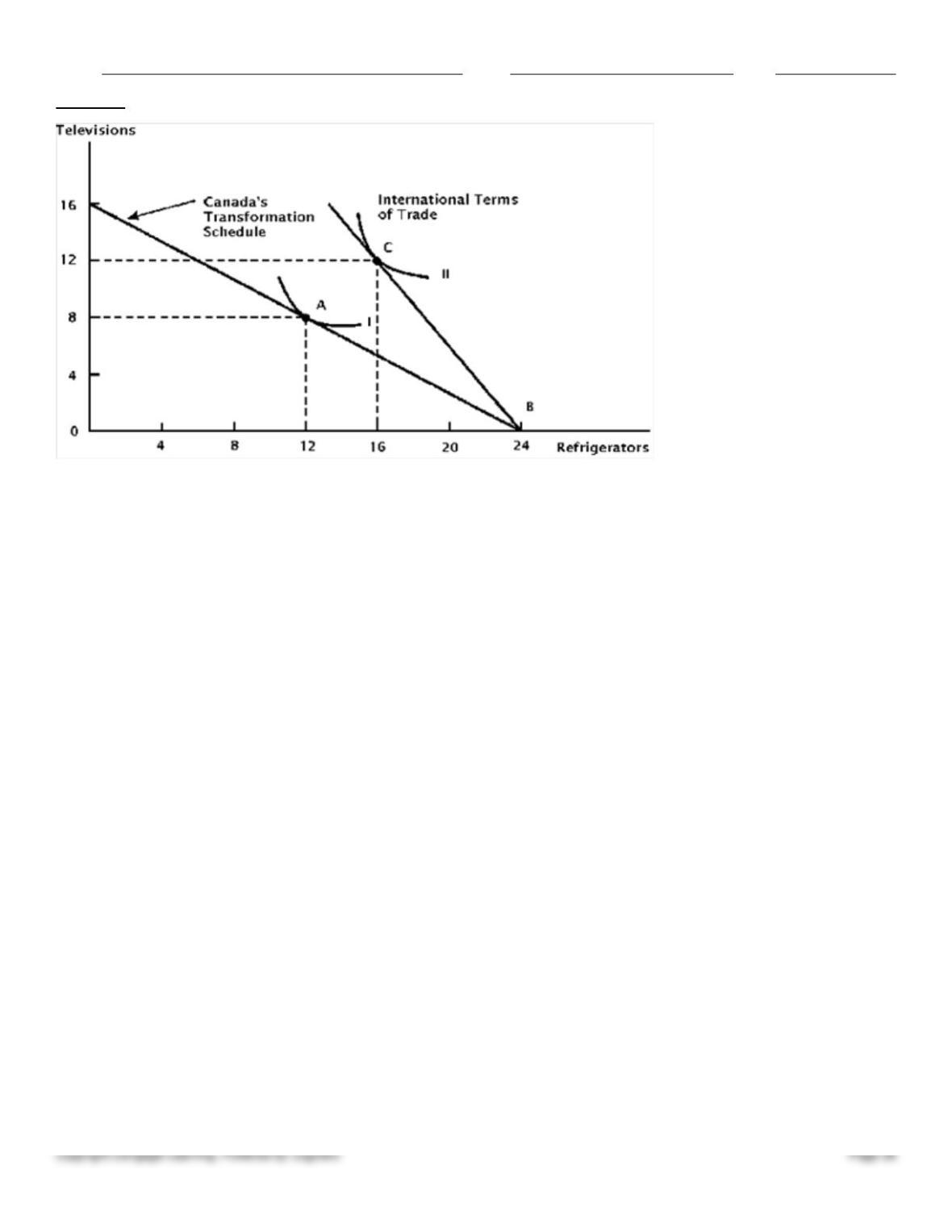
Figure 2.2 illustrates trade data for Canada. The figure assumes that Canada attains international trade equilibrium at
point C.
Figure 2.2. Canadian Trade Possibilities
Name:
Class:
Date:
chapter 2
Copyright Cengage Learning. Powered by Cognero.
Page 38
223. Referring to Figure 2.2, Canada has a comparative advantage in
a. televisions.
b. refrigerators.
c. televisions and refrigerators.
d. neither televisions nor refrigerators.
224. How does Southwest Airlines justify its outsourcing of some of its telephone reservation work to people in India?
225. Who gains more from trade when nations are of unequal economic size?
226. Explain the Law of Comparative Advantage.
227. Is it possible for comparative advantage to change, thus changing the direction of trade?
228. Is it possible to add up the preferences of all consumers in an entire nation?
229. Is it possible to estimate the gains from trade?
230. Discuss the pitfalls of outsourcing, especially as experienced by Boeing.
Name:
Class:
Date:
chapter 2
Answer Key
1. False
2. True
3. False
Name:
Class:
Date:
Name:
Class:
Date:
Name:
Class:
Date:
Name:
Class:
Date:
Name:
Class:
Date:
Name:
Class:
Date:
Name:
Class:
Date:
Name:
Class:
Date:
Name:
Class:
Date: