Copyright Cengage Learning. Powered by Cognero.
Page 21
DATE MODIFIED:
6/22/2016 3:10 PM
48. In the absence of trade, a nation is in equilibrium where a community indifference curve:
a.
Lies above its production possibilities curve
b.
Is tangent to its production possibilities curve
c.
Intersects its production possibilities curve
d.
Lies below its production possibilities curve
ANSWER:
b
POINTS:
1
DIFFICULTY:
Moderate
QUESTION TYPE:
Multiple Choice
HAS VARIABLES:
False
NATIONAL STANDARDS:
United States – BUSPROG: Promotion – BUSPROG: Analytic
United States – BUSPROG: Reflective Thinking
STATE STANDARDS:
United States – PA – DISC: Gains from trade, speciali – DISC: Gains from trade,
specialization and trade
TOPICS:
Trading Under Increasing-Cost Conditions
KEYWORDS:
BLOOM’S: Understand
DATE CREATED:
6/22/2016 3:10 PM
DATE MODIFIED:
6/22/2016 3:10 PM
49. The use of indifference curves helps us determine the point:
a.
Along the terms-of-trade line a country will choose
b.
Where a country maximizes its resource productivity
c.
At which a country ceases to become competitive
d.
Where the marginal rate of transformation approaches zero
ANSWER:
a
POINTS:
1
DIFFICULTY:
Moderate
QUESTION TYPE:
Multiple Choice
HAS VARIABLES:
False
NATIONAL STANDARDS:
United States – BUSPROG: Promotion – BUSPROG: Analytic
United States – BUSPROG: Reflective Thinking
STATE STANDARDS:
United States – PA – DISC: Gains from trade, speciali – DISC: Gains from trade,
specialization and trade
TOPICS:
Trading Under Increasing-Cost Conditions
KEYWORDS:
BLOOM’S: Apply
DATE CREATED:
6/22/2016 3:10 PM
DATE MODIFIED:
6/22/2016 3:10 PM
50. With trade, a country will maximize its satisfaction when it:
a.
Moves to the highest possible indifference curve
b.
Forces the marginal rate of substitution to its lowest possible value
c.
Consumes more of both goods than it does in autarky
d.
Finds its marginal rate of substitution exceeding its marginal rate of transformation
ANSWER:
a

Copyright Cengage Learning. Powered by Cognero.
Page 22
POINTS:
1
DIFFICULTY:
Moderate
QUESTION TYPE:
Multiple Choice
HAS VARIABLES:
False
NATIONAL STANDARDS:
United States – BUSPROG: Promotion – BUSPROG: Analytic
United States – BUSPROG: Reflective Thinking
STATE STANDARDS:
United States – PA – DISC: Gains from trade, speciali – DISC: Gains from trade,
specialization and trade
TOPICS:
Trading Under Increasing-Cost Conditions
KEYWORDS:
BLOOM’S: Apply
DATE CREATED:
6/22/2016 3:10 PM
DATE MODIFIED:
6/22/2016 3:10 PM
51. Trade between two nations would not be possible if they have:
a.
Identical community indifference curves but different production possibilities curves
b.
Identical production possibilities curves but different community indifference curves
c.
Different production possibilities curves and different community indifference curves
d.
Identical production possibilities curves and identical community indifference curves
ANSWER:
d
POINTS:
1
DIFFICULTY:
Moderate
QUESTION TYPE:
Multiple Choice
HAS VARIABLES:
False
NATIONAL STANDARDS:
United States – BUSPROG: Promotion – BUSPROG: Analytic
United States – BUSPROG: Reflective Thinking
STATE STANDARDS:
United States – PA – DISC: Gains from trade, speciali – DISC: Gains from trade,
specialization and trade
TOPICS:
Trading Under Increasing-Cost Conditions
KEYWORDS:
BLOOM’S: Apply
DATE CREATED:
6/22/2016 3:10 PM
DATE MODIFIED:
6/22/2016 3:10 PM
52. Given a two-country and two-product world, the United States would enjoy all the attainable gains from free trade
with Canada if it:
a.
Trades at the U.S. rate of transformation
b.
Trades at the Canadian rate of transformation
c.
Specializes completely in the production of both goods
d.
Specializes partially in the production of both goods
ANSWER:
b
POINTS:
1
DIFFICULTY:
Moderate
QUESTION TYPE:
Multiple Choice
HAS VARIABLES:
False
NATIONAL STANDARDS:
United States – BUSPROG: Promotion – BUSPROG: Analytic
United States – BUSPROG: Reflective Thinking
STATE STANDARDS:
United States – PA – DISC: Gains from trade, speciali – DISC: Gains from trade,

Copyright Cengage Learning. Powered by Cognero.
Page 23
specialization and trade
TOPICS:
Equilibrium Terms of Trade
KEYWORDS:
BLOOM’S: Apply
DATE CREATED:
6/22/2016 3:10 PM
DATE MODIFIED:
6/22/2016 3:10 PM
53. John Stuart Mill’s theory of reciprocal demand best applies when trading partners:
a.
Are of equal size and importance in the market
b.
Produce under increasing cost conditions
c.
Partially specialize in the production of commodities
d.
Have similar taste and preference levels
ANSWER:
a
POINTS:
1
DIFFICULTY:
Easy
QUESTION TYPE:
Multiple Choice
HAS VARIABLES:
False
NATIONAL STANDARDS:
United States – BUSPROG: Promotion – BUSPROG: Analytic
United States – BUSPROG: Reflective Thinking
STATE STANDARDS:
United States – PA – DISC: Gains from trade, speciali – DISC: Gains from trade,
specialization and trade
TOPICS:
Historical Development of Modern Trade Theory
KEYWORDS:
BLOOM’S: Remember
DATE CREATED:
6/22/2016 3:10 PM
DATE MODIFIED:
6/22/2016 3:10 PM
54. The equilibrium prices and quantities established after trade are fully determinate if we know:
a.
The location of all countries’ indifference curves
b.
The shape of each country’s production possibilities curve
c.
The comparative costs of each trading partner
d.
The strength of world supply and demand for each good
ANSWER:
d
POINTS:
1
DIFFICULTY:
Moderate
QUESTION TYPE:
Multiple Choice
HAS VARIABLES:
False
NATIONAL STANDARDS:
United States – BUSPROG: Promotion – BUSPROG: Analytic
United States – BUSPROG: Reflective Thinking
STATE STANDARDS:
United States – PA – DISC: Gains from trade, speciali – DISC: Gains from trade,
specialization and trade
TOPICS:
Trading under Constant-Cost Conditions
KEYWORDS:
BLOOM’S: Understand
DATE CREATED:
6/22/2016 3:10 PM
DATE MODIFIED:
6/22/2016 3:10 PM
55. “The equilibrium relative commodity price at which trade takes place is determined by the conditions of demand and
supply for each commodity in both nations. Other things being equal, the nation with the more intense demand for the
other nation’s exported good will gain less from trade than the nation with the less intense demand.” This statement was

Copyright Cengage Learning. Powered by Cognero.
Page 24
first proposed by:
a.
Alfred Marshall with offer curve analysis
b.
John Stuart Mill with the theory of reciprocal demand
c.
Adam Smith with the theory of absolute advantage
d.
David Ricardo with the theory of comparative advantage
ANSWER:
b
POINTS:
1
DIFFICULTY:
Moderate
QUESTION TYPE:
Multiple Choice
HAS VARIABLES:
False
NATIONAL STANDARDS:
United States – BUSPROG: Promotion – BUSPROG: Analytic
United States – BUSPROG: Reflective Thinking
STATE STANDARDS:
United States – PA – DISC: Gains from trade, speciali – DISC: Gains from trade,
specialization and trade
TOPICS:
Historical Development of Modern Trade Theory
KEYWORDS:
BLOOM’S: Remember
DATE CREATED:
6/22/2016 3:10 PM
DATE MODIFIED:
6/22/2016 3:10 PM
56. Which of the following terms-of-trade concepts is calculated by dividing the change in a country’s export price index
by the change in its import price index between two points in time, multiplied by 100 to express the terms of trade in
percentages?
a.
Commodity terms of trade
b.
Marginal rate of transformation
c.
Marginal rate of substitution
d.
Autarky price ratio
ANSWER:
a
POINTS:
1
DIFFICULTY:
Moderate
QUESTION TYPE:
Multiple Choice
HAS VARIABLES:
False
NATIONAL STANDARDS:
United States – BUSPROG: Promotion – BUSPROG: Analytic
United States – BUSPROG: Reflective Thinking
STATE STANDARDS:
United States – PA – DISC: Gains from trade, speciali – DISC: Gains from trade,
specialization and trade
TOPICS:
Equilibrium Terms of Trade
KEYWORDS:
BLOOM’S: Understand
DATE CREATED:
6/22/2016 3:10 PM
DATE MODIFIED:
6/22/2016 3:10 PM
57. The best explanation of the gains from trade that David Ricardo could provide was to describe only the outer limits
within which the equilibrium terms of trade would fall. This is because Ricardo’s theory did not recognize how market
prices are influenced by:
a.
Demand conditions
b.
Supply conditions
c.
Business expectations
d.
Profit patterns
Copyright Cengage Learning. Powered by Cognero.
Page 25
ANSWER:
a
POINTS:
1
DIFFICULTY:
Easy
QUESTION TYPE:
Multiple Choice
HAS VARIABLES:
False
NATIONAL STANDARDS:
United States – BUSPROG: Promotion – BUSPROG: Analytic
United States – BUSPROG: Reflective Thinking
STATE STANDARDS:
United States – PA – DISC: Gains from trade, speciali – DISC: Gains from trade,
specialization and trade
TOPICS:
Historical Development of Modern Trade Theory
KEYWORDS:
BLOOM’S: Remember
DATE CREATED:
6/22/2016 3:10 PM
DATE MODIFIED:
6/22/2016 3:10 PM
58. Under free trade, Sweden enjoys all of the gains from trade with Holland if Sweden:
a.
Trades at Holland’s rate of transformation
b.
Trades at Sweden’s rate of transformation
c.
Specializes completely in the production of its export good
d.
Specializes partially in the production of its export good
ANSWER:
a
POINTS:
1
DIFFICULTY:
Moderate
QUESTION TYPE:
Multiple Choice
HAS VARIABLES:
False
NATIONAL STANDARDS:
United States – BUSPROG: Promotion – BUSPROG: Analytic
United States – BUSPROG: Reflective Thinking
STATE STANDARDS:
United States – PA – DISC: Gains from trade, speciali – DISC: Gains from trade,
specialization and trade
TOPICS:
Equilibrium Terms of Trade
KEYWORDS:
BLOOM’S: Apply
DATE CREATED:
6/22/2016 3:10 PM
DATE MODIFIED:
6/22/2016 3:10 PM
59. Because the Ricardian trade theory recognized only how supply conditions influence international prices, it could
determine:
a.
The equilibrium terms of trade
b.
The outer limits for the terms of trade
c.
Where a country chooses to locate along its production possibilities curve
d.
Where a country chooses to locate along its trade triangle
ANSWER:
b
POINTS:
1
DIFFICULTY:
Easy
QUESTION TYPE:
Multiple Choice
HAS VARIABLES:
False
NATIONAL STANDARDS:
United States – BUSPROG: Promotion – BUSPROG: Analytic
United States – BUSPROG: Reflective Thinking

Copyright Cengage Learning. Powered by Cognero.
Page 26
STATE STANDARDS:
United States – PA – DISC: Gains from trade, speciali – DISC: Gains from trade,
specialization and trade
TOPICS:
Equilibrium Terms of Trade
KEYWORDS:
BLOOM’S: Understand
DATE CREATED:
6/22/2016 3:10 PM
DATE MODIFIED:
6/22/2016 3:10 PM
60. The terms of trade is given by the prices:
a.
Paid for all goods imported by the home country
b.
Received for all goods exported by the home country
c.
Received for exports and paid for imports
d.
Of primary products as opposed to manufactured products
ANSWER:
c
POINTS:
1
DIFFICULTY:
Moderate
QUESTION TYPE:
Multiple Choice
HAS VARIABLES:
False
NATIONAL STANDARDS:
United States – BUSPROG: Promotion – BUSPROG: Analytic
United States – BUSPROG: Reflective Thinking
STATE STANDARDS:
United States – PA – DISC: Gains from trade, speciali – DISC: Gains from trade,
specialization and trade
TOPICS:
Equilibrium Terms of Trade
KEYWORDS:
BLOOM’S: Understand
DATE CREATED:
6/22/2016 3:10 PM
DATE MODIFIED:
6/22/2016 3:10 PM
Table 2.3. Terms of Trade
Export Price Index Import Price Index
Country
1990
2004
1990
2004
Mexico
100
220
100
200
Sweden
100
160
100
150
Spain
100
155
100
155
France
100
170
100
230
Denmark
100
120
100
125
61. Referring to Table 2.3, which countries’ terms of trade improved between 1990 and 2004?
a.
Mexico and Denmark
b.
Sweden and Denmark
c.
Sweden and Spain
d.
Mexico and Sweden
ANSWER:
d
POINTS:
1
DIFFICULTY:
Moderate
QUESTION TYPE:
Multiple Choice
HAS VARIABLES:
False
PREFACE NAME:
Table 2.3
NATIONAL STANDARDS:
United States – BUSPROG: Promotion – BUSPROG: Analytic

Copyright Cengage Learning. Powered by Cognero.
Page 27
STATE STANDARDS:
United States – PA – DISC: Gains from trade, speciali – DISC: Gains from trade,
specialization and trade
TOPICS:
Equilibrium Terms of Trade
KEYWORDS:
BLOOM’S: Apply
DATE CREATED:
6/22/2016 3:10 PM
DATE MODIFIED:
6/22/2016 3:10 PM
62. Referring to Table 2.3, which countries’ terms of trade worsened between 1990 and 2004?
a.
Spain and Mexico
b.
Mexico and France
c.
France and Denmark
d.
Denmark and Sweden
ANSWER:
c
POINTS:
1
DIFFICULTY:
Moderate
QUESTION TYPE:
Multiple Choice
HAS VARIABLES:
False
PREFACE NAME:
Table 2.3
NATIONAL STANDARDS:
United States – BUSPROG: Promotion – BUSPROG: Analytic
STATE STANDARDS:
United States – PA – DISC: Gains from trade, speciali – DISC: Gains from trade,
specialization and trade
TOPICS:
Equilibrium Terms of Trade
KEYWORDS:
BLOOM’S: Apply
DATE CREATED:
6/22/2016 3:10 PM
DATE MODIFIED:
6/22/2016 3:10 PM
63. Referring to Table 2.3, which country’s terms of trade did not change between 1990 and 2004?
a.
Spain
b.
Sweden
c.
France
d.
Denmark
ANSWER:
a
POINTS:
1
DIFFICULTY:
Moderate
QUESTION TYPE:
Multiple Choice
HAS VARIABLES:
False
PREFACE NAME:
Table 2.3
NATIONAL STANDARDS:
United States – BUSPROG: Promotion – BUSPROG: Analytic
STATE STANDARDS:
United States – PA – DISC: Gains from trade, speciali – DISC: Gains from trade,
specialization and trade
TOPICS:
Equilibrium Terms of Trade
KEYWORDS:
BLOOM’S: Apply
DATE CREATED:
6/22/2016 3:10 PM
DATE MODIFIED:
6/22/2016 3:10 PM
64. Given free trade, small nations tend to benefit the most from trade since they:
Copyright Cengage Learning. Powered by Cognero.
Page 28
a.
Are more productive than their large trading partners
b.
Are less productive than their large trading partners
c.
Have demand preferences and income levels lower than their large trading partners
d.
Enjoy terms of trade lying near the opportunity costs of their large trading partners
ANSWER:
d
POINTS:
1
DIFFICULTY:
Moderate
QUESTION TYPE:
Multiple Choice
HAS VARIABLES:
False
NATIONAL STANDARDS:
United States – BUSPROG: Promotion – BUSPROG: Analytic
United States – BUSPROG: Reflective Thinking
STATE STANDARDS:
United States – PA – DISC: Gains from trade, speciali – DISC: Gains from trade,
specialization and trade
TOPICS:
Equilibrium Terms of Trade
KEYWORDS:
BLOOM’S: Understand
DATE CREATED:
6/22/2016 3:10 PM
DATE MODIFIED:
6/22/2016 3:10 PM
65. A terms-of-trade index that equals 150 indicates that compared to the base year:
a.
It requires a greater output of domestic goods to obtain the same amount of foreign goods
b.
It requires a lesser amount of domestic goods to obtain the same amount of foreign goods
c.
The price of exports has risen from $100 to $150
d.
The price of imports has risen from $100 to $150
ANSWER:
b
POINTS:
1
DIFFICULTY:
Moderate
QUESTION TYPE:
Multiple Choice
HAS VARIABLES:
False
NATIONAL STANDARDS:
United States – BUSPROG: Promotion – BUSPROG: Analytic
United States – BUSPROG: Reflective Thinking
STATE STANDARDS:
United States – PA – DISC: Gains from trade, speciali – DISC: Gains from trade,
specialization and trade
TOPICS:
Equilibrium Terms of Trade
KEYWORDS:
BLOOM’S: Understand
DATE CREATED:
6/22/2016 3:10 PM
DATE MODIFIED:
6/22/2016 3:10 PM
66. A term-of-trade index that equals 90 indicates that compared to the base year:
a.
It requires a greater output of domestic goods to obtain the same amount of foreign goods
b.
It requires a lesser amount of domestic goods to obtain the same amount of foreign goods
c.
The price of exports has fallen from $100 to $90
d.
The price of imports has fallen from $100 to $90
ANSWER:
a
POINTS:
1
DIFFICULTY:
Moderate
QUESTION TYPE:
Multiple Choice

Copyright Cengage Learning. Powered by Cognero.
Page 29
HAS VARIABLES:
False
NATIONAL STANDARDS:
United States – BUSPROG: Promotion – BUSPROG: Analytic
United States – BUSPROG: Reflective Thinking
STATE STANDARDS:
United States – PA – DISC: Gains from trade, speciali – DISC: Gains from trade,
specialization and trade
TOPICS:
Equilibrium Terms of Trade
KEYWORDS:
BLOOM’S: Understand
DATE CREATED:
6/22/2016 3:10 PM
DATE MODIFIED:
6/22/2016 3:10 PM
67. The theory of reciprocal demand does not well apply when one country:
a.
Produces under constant cost conditions
b.
Produces along its production possibilities curve
c.
Is of minor economic importance in the world marketplace
d.
Partially specializes the production of its export good
ANSWER:
c
POINTS:
1
DIFFICULTY:
Moderate
QUESTION TYPE:
Multiple Choice
HAS VARIABLES:
False
NATIONAL STANDARDS:
United States – BUSPROG: Promotion – BUSPROG: Analytic
United States – BUSPROG: Reflective Thinking
STATE STANDARDS:
United States – PA – DISC: Gains from trade, speciali – DISC: Gains from trade,
specialization and trade
TOPICS:
Equilibrium Terms of Trade
KEYWORDS:
BLOOM’S: Understand
DATE CREATED:
6/22/2016 3:10 PM
DATE MODIFIED:
6/22/2016 3:10 PM
68. The terms of trade is given by:
a.
(Price of exports/price of imports) − 100
b.
(Price of exports/price of imports) + 100
c.
(Price of exports/price of imports) ÷ 100
d.
(Price of exports/price of imports) × 100
ANSWER:
d
POINTS:
1
DIFFICULTY:
Easy
QUESTION TYPE:
Multiple Choice
HAS VARIABLES:
False
NATIONAL STANDARDS:
United States – BUSPROG: Promotion – BUSPROG: Analytic
United States – BUSPROG: Reflective Thinking
STATE STANDARDS:
United States – PA – DISC: Gains from trade, speciali – DISC: Gains from trade,
specialization and trade
TOPICS:
Equilibrium Terms of Trade
KEYWORDS:
BLOOM’S: Remember
DATE CREATED:
6/22/2016 3:10 PM
Copyright Cengage Learning. Powered by Cognero.
Page 30
DATE MODIFIED:
6/22/2016 3:10 PM
69. If Japan and France have identical production possibilities curves and identical community indifference curves:
a.
Japan will enjoy all the gains from trade
b.
France will enjoy all the gains from trade
c.
Japan and France share equally in the gains from trade
d.
Gainful specialization and trade are not possible
ANSWER:
d
POINTS:
1
DIFFICULTY:
Moderate
QUESTION TYPE:
Multiple Choice
HAS VARIABLES:
False
NATIONAL STANDARDS:
United States – BUSPROG: Promotion – BUSPROG: Analytic
United States – BUSPROG: Reflective Thinking
STATE STANDARDS:
United States – PA – DISC: Gains from trade, speciali – DISC: Gains from trade,
specialization and trade
TOPICS:
Trading Under Increasing-Cost Conditions
KEYWORDS:
BLOOM’S: Understand
DATE CREATED:
6/22/2016 3:10 PM
DATE MODIFIED:
6/22/2016 3:10 PM
70. A rise in the price of imports or a fall in the price of exports will:
a.
Improve the terms of trade
b.
Worsen the terms of trade
c.
Expand the production possibilities curve
d.
Contract the production possibilities curve
ANSWER:
b
POINTS:
1
DIFFICULTY:
Easy
QUESTION TYPE:
Multiple Choice
HAS VARIABLES:
False
NATIONAL STANDARDS:
United States – BUSPROG: Promotion – BUSPROG: Analytic
United States – BUSPROG: Reflective Thinking
STATE STANDARDS:
United States – PA – DISC: Gains from trade, speciali – DISC: Gains from trade,
specialization and trade
TOPICS:
Equilibrium Terms of Trade
KEYWORDS:
BLOOM’S: Understand
DATE CREATED:
6/22/2016 3:10 PM
DATE MODIFIED:
6/22/2016 3:10 PM
71. A fall in the price of imports or a rise in the price of exports will:
a.
Improve the terms of trade
b.
Worsen the terms of trade
c.
Expand the production possibilities curve
d.
Contract the production possibilities curve
ANSWER:
a

POINTS:
1
DIFFICULTY:
Easy
QUESTION TYPE:
Multiple Choice
HAS VARIABLES:
False
NATIONAL STANDARDS:
United States – BUSPROG: Promotion – BUSPROG: Analytic
United States – BUSPROG: Reflective Thinking
STATE STANDARDS:
United States – PA – DISC: Gains from trade, speciali – DISC: Gains from trade,
specialization and trade
TOPICS:
Equilibrium Terms of Trade
KEYWORDS:
BLOOM’S: Understand
DATE CREATED:
6/22/2016 3:10 PM
DATE MODIFIED:
6/22/2016 3:10 PM
72. Under free trade, Canada would not enjoy any gains from trade with Sweden if Canada:
a.
Trades at the Canadian rate of transformation
b.
Trades at Sweden’s rate of transformation
c.
Specializes completely in the production of its export good
d.
Specializes partially in the production of its export good
ANSWER:
a
POINTS:
1
DIFFICULTY:
Easy
QUESTION TYPE:
Multiple Choice
HAS VARIABLES:
False
NATIONAL STANDARDS:
United States – BUSPROG: Promotion – BUSPROG: Analytic
United States – BUSPROG: Reflective Thinking
STATE STANDARDS:
United States – PA – DISC: Gains from trade, speciali – DISC: Gains from trade,
specialization and trade
TOPICS:
Equilibrium Terms of Trade
KEYWORDS:
BLOOM’S: Understand
DATE CREATED:
6/22/2016 3:10 PM
DATE MODIFIED:
6/22/2016 3:10 PM
Copyright Cengage Learning. Powered by Cognero.
Page 32
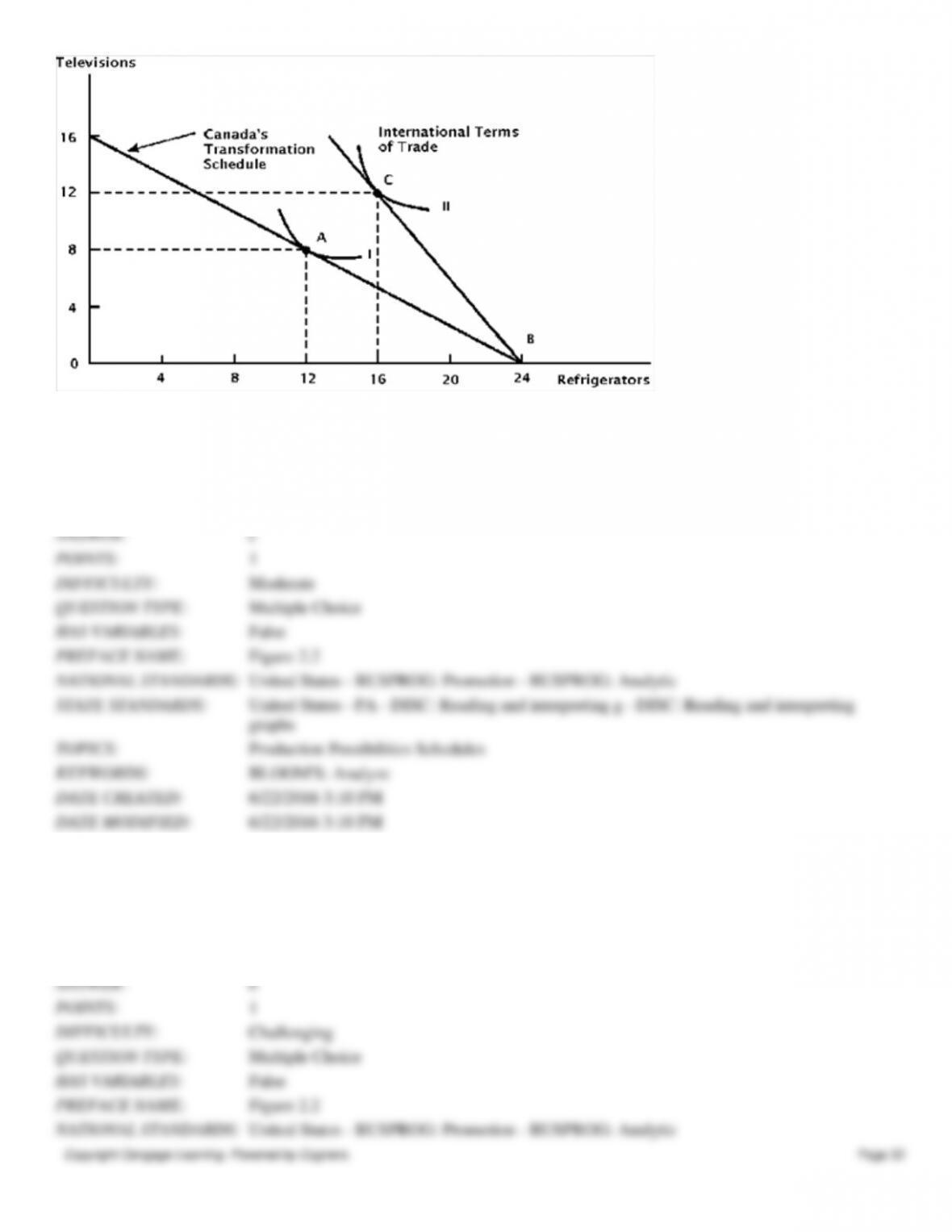
73. Consider Figure 2.2. In the absence of trade, Canada would produce and consume:
a.
8 televisions and 16 refrigerators
b.
12 televisions and 16 refrigerators
c.
8 televisions and 12 refrigerators
d.
12 televisions and 8 refrigerators
ANSWER:
c
POINTS:
1
DIFFICULTY:
Moderate
QUESTION TYPE:
Multiple Choice
HAS VARIABLES:
False
PREFACE NAME:
Figure 2.2
NATIONAL STANDARDS:
United States – BUSPROG: Promotion – BUSPROG: Analytic
STATE STANDARDS:
United States – PA – DISC: Reading and interpreting g – DISC: Reading and interpreting
graphs
TOPICS:
Production Possibilities Schedules
KEYWORDS:
BLOOM’S: Analyze
DATE CREATED:
6/22/2016 3:10 PM
DATE MODIFIED:
6/22/2016 3:10 PM
74. Referring to Figure 2.2, Canada has a comparative advantage in:
a.
Televisions
b.
Refrigerators
c.
Televisions and refrigerators
d.
Neither televisions nor refrigerators
ANSWER:
b
POINTS:
1
DIFFICULTY:
Challenging
QUESTION TYPE:
Multiple Choice
HAS VARIABLES:
False
PREFACE NAME:
Figure 2.2
NATIONAL STANDARDS:
United States – BUSPROG: Promotion – BUSPROG: Analytic

Copyright Cengage Learning. Powered by Cognero.
Page 33
STATE STANDARDS:
United States – PA – DISC: Reading and interpreting g – DISC: Reading and interpreting
graphs
TOPICS:
Production Possibilities Schedules
KEYWORDS:
BLOOM’S: Analyze
DATE CREATED:
6/22/2016 3:10 PM
DATE MODIFIED:
6/22/2016 3:10 PM
75. Consider Figure 2.2. With specialization, Canada produces:
a.
16 televisions
b.
12 televisions and 8 refrigerators
c.
8 televisions and 16 refrigerators
d.
24 refrigerators
ANSWER:
d
POINTS:
1
DIFFICULTY:
Challenging
QUESTION TYPE:
Multiple Choice
HAS VARIABLES:
False
PREFACE NAME:
Figure 2.2
NATIONAL STANDARDS:
United States – BUSPROG: Promotion – BUSPROG: Analytic
STATE STANDARDS:
United States – PA – DISC: Reading and interpreting g – DISC: Reading and interpreting
graphs
TOPICS:
Production Possibilities Schedules
KEYWORDS:
BLOOM’S: Analyze
DATE CREATED:
6/22/2016 3:10 PM
DATE MODIFIED:
6/22/2016 3:10 PM
76. Consider Figure 2.2. With trade, Canada consumes:
a.
12 televisions and 8 refrigerators
b.
12 televisions and 16 refrigerators
c.
8 televisions and 16 refrigerators
d.
24 refrigerators
ANSWER:
b
POINTS:
1
DIFFICULTY:
Challenging
QUESTION TYPE:
Multiple Choice
HAS VARIABLES:
False
PREFACE NAME:
Figure 2.2
NATIONAL STANDARDS:
United States – BUSPROG: Promotion – BUSPROG: Analytic
United States – BUSPROG: Reflective Thinking
STATE STANDARDS:
United States – PA – DISC: Reading and interpreting g – DISC: Reading and interpreting
graphs
TOPICS:
Production Possibilities Schedules
KEYWORDS:
BLOOM’S: Analyze
DATE CREATED:
6/22/2016 3:10 PM
DATE MODIFIED:
6/22/2016 3:10 PM

Copyright Cengage Learning. Powered by Cognero.
Page 34
77. According to Figure 2.2, exports for Canada total:
a.
16 refrigerators
b.
8 refrigerators
c.
12 refrigerators
d.
16 refrigerators
ANSWER:
b
POINTS:
1
DIFFICULTY:
Challenging
QUESTION TYPE:
Multiple Choice
HAS VARIABLES:
False
PREFACE NAME:
Figure 2.2
NATIONAL STANDARDS:
United States – BUSPROG: Promotion – BUSPROG: Analytic
United States – BUSPROG: Reflective Thinking
STATE STANDARDS:
United States – PA – DISC: Reading and interpreting g – DISC: Reading and interpreting
graphs
TOPICS:
Production Possibilities Schedules
KEYWORDS:
BLOOM’S: Analyze
DATE CREATED:
6/22/2016 3:10 PM
DATE MODIFIED:
6/22/2016 3:10 PM
78. According to Figure 2.2, imports for Canada total:
a.
6 televisions
b.
8 televisions
c.
12 televisions
d.
16 televisions
ANSWER:
c
POINTS:
1
DIFFICULTY:
Challenging
QUESTION TYPE:
Multiple Choice
HAS VARIABLES:
False
PREFACE NAME:
Figure 2.2
NATIONAL STANDARDS:
United States – BUSPROG: Promotion – BUSPROG: Analytic
United States – BUSPROG: Reflective Thinking
STATE STANDARDS:
United States – PA – DISC: Reading and interpreting g – DISC: Reading and interpreting
graphs
TOPICS:
Production Possibilities Schedules
KEYWORDS:
BLOOM’S: Analyze
DATE CREATED:
6/22/2016 3:10 PM
DATE MODIFIED:
6/22/2016 3:10 PM
79. Concerning possible determinants of international trade, which are sources of comparative advantage? Differences in:
a.
Methods of production
b.
Tastes and preferences
c.
Technological know-how
d.
All of the above
ANSWER:
d
Copyright Cengage Learning. Powered by Cognero.
Page 35
POINTS:
1
DIFFICULTY:
Moderate
QUESTION TYPE:
Multiple Choice
HAS VARIABLES:
False
NATIONAL STANDARDS:
United States – BUSPROG: Promotion – BUSPROG: Analytic
United States – BUSPROG: Reflective Thinking
STATE STANDARDS:
United States – PA – DISC: Gains from trade, speciali – DISC: Gains from trade,
specialization and trade
TOPICS:
Historical Development of Modern Trade Theory
KEYWORDS:
BLOOM’S: Understand
DATE CREATED:
6/22/2016 3:10 PM
DATE MODIFIED:
6/22/2016 3:10 PM
80. Ricardo’s model of comparative advantage assumed all of the following except:
a.
In each nation, labor is the only input
b.
Costs do not vary with the level of production
c.
Perfect competition prevails in all markets
d.
Transportation costs rise as distance increases between countries
ANSWER:
d
POINTS:
1
DIFFICULTY:
Moderate
QUESTION TYPE:
Multiple Choice
HAS VARIABLES:
False
NATIONAL STANDARDS:
United States – BUSPROG: Promotion – BUSPROG: Analytic
United States – BUSPROG: Reflective Thinking
STATE STANDARDS:
United States – PA – DISC: Gains from trade, speciali – DISC: Gains from trade,
specialization and trade
TOPICS:
Historical Development of Modern Trade Theory
KEYWORDS:
BLOOM’S: Understand
DATE CREATED:
6/22/2016 3:10 PM
DATE MODIFIED:
6/22/2016 3:10 PM
81. Ricardo’s model of comparative advantage assumed all of the following except:
a.
Trade is balanced, thus ruling out flows of money between nations
b.
Firms make production decisions in an attempt to maximize profits
c.
Free trade occurs between nations
d.
Labor is immobile within a country, but is incapable of moving between countries
ANSWER:
d
POINTS:
1
DIFFICULTY:
Moderate
QUESTION TYPE:
Multiple Choice
HAS VARIABLES:
False
NATIONAL STANDARDS:
United States – BUSPROG: Promotion – BUSPROG: Analytic
STATE STANDARDS:
United States – PA – DISC: Gains from trade, speciali – DISC: Gains from trade,
specialization and trade
TOPICS:
Historical Development of Modern Trade Theory

Copyright Cengage Learning. Powered by Cognero.
Page 36
KEYWORDS:
BLOOM’S: Understand
DATE CREATED:
6/22/2016 3:10 PM
DATE MODIFIED:
6/22/2016 3:10 PM
82. The dynamic gains from trade include all of the following except:
a.
Economies of large-scale production resulting in decreasing unit cost
b.
Increased saving and investment resulting in economic growth
c.
Increased competition resulting in lower prices and wider range of output
d.
Increasing comparative advantage leading to specialization
ANSWER:
d
POINTS:
1
DIFFICULTY:
Moderate
QUESTION TYPE:
Multiple Choice
HAS VARIABLES:
False
NATIONAL STANDARDS:
United States – BUSPROG: Promotion – BUSPROG: Analytic
United States – BUSPROG: Reflective Thinking
STATE STANDARDS:
United States – PA – DISC: Gains from trade, speciali – DISC: Gains from trade,
specialization and trade
TOPICS:
Dynamic Gains from Trade
KEYWORDS:
BLOOM’S: Understand
DATE CREATED:
6/22/2016 3:10 PM
DATE MODIFIED:
6/22/2016 3:10 PM
83. All of the following may be exit barriers except
a.
Employee health benefit costs
b.
Treatment, storage and disposal costs
c.
Penalties for terminating contracts with raw material suppliers
d.
Increasing opportunity cost of production
ANSWER:
d
POINTS:
1
DIFFICULTY:
Moderate
QUESTION TYPE:
Multiple Choice
HAS VARIABLES:
False
NATIONAL STANDARDS:
United States – BUSPROG: Promotion – BUSPROG: Analytic
STATE STANDARDS:
United States – PA – DISC: Gains from trade, speciali – DISC: Gains from trade,
specialization and trade
TOPICS:
Exit Barriers
KEYWORDS:
BLOOM’S: Understand
DATE CREATED:
6/22/2016 3:10 PM
DATE MODIFIED:
6/22/2016 3:10 PM
84. Incomplete specialization may be caused by
a.
Increasing opportunity cost
b.
Unrestricted trade
c.
Constant opportunity cost
d.
Decreasing opportunity cost
Copyright Cengage Learning. Powered by Cognero.
Page 37
ANSWER:
a
POINTS:
1
DIFFICULTY:
Moderate
QUESTION TYPE:
Multiple Choice
HAS VARIABLES:
False
NATIONAL STANDARDS:
United States – BUSPROG: Promotion – BUSPROG: Analytic
STATE STANDARDS:
United States – PA – DISC: Gains from trade, speciali – DISC: Gains from trade,
specialization and trade
TOPICS:
Trading Under Increasing-Cost Conditions
KEYWORDS:
BLOOM’S: Understand
DATE CREATED:
6/22/2016 3:10 PM
DATE MODIFIED:
6/22/2016 3:10 PM
85. Improvements in productivity may lead to decreasing comparative costs if
a.
The assumption of fixed technologies under constant costs is relaxed
b.
Technologies available to each nation is allowed to differ
c.
Resource endowments are allowed to vary
d.
All of the above
ANSWER:
d
POINTS:
1
DIFFICULTY:
Moderate
QUESTION TYPE:
Multiple Choice
HAS VARIABLES:
False
NATIONAL STANDARDS:
United States – BUSPROG: Promotion – BUSPROG: Analytic
STATE STANDARDS:
United States – PA – DISC: Gains from trade, speciali – DISC: Gains from trade,
specialization and trade
TOPICS:
Productions Gains From Specialization
KEYWORDS:
BLOOM’S: Understand
DATE CREATED:
6/22/2016 3:10 PM
DATE MODIFIED:
6/22/2016 3:10 PM
86. Adam Smith
a.
Was a leading advocate of free trade
b.
Developed the concept of absolute advantage
c.
Maintained that labor costs represent the major determinant of production cost
d.
All of the above
ANSWER:
d
POINTS:
1
DIFFICULTY:
Easy
QUESTION TYPE:
Multiple Choice
HAS VARIABLES:
False
NATIONAL STANDARDS:
United States – BUSPROG: Promotion – BUSPROG: Analytic
United States – BUSPROG: Reflective Thinking
STATE STANDARDS:
United States – PA – DISC: Gains from trade, speciali – DISC: Gains from trade,
specialization and trade
TOPICS:
Historical Development of Modern Trade Theory
Copyright Cengage Learning. Powered by Cognero.
Page 38
KEYWORDS:
BLOOM’S: Remember
DATE CREATED:
6/22/2016 3:10 PM
DATE MODIFIED:
6/22/2016 3:10 PM
87. Modern trade theory contends that the pattern of world trade is governed by
a.
Differences in supply conditions and demand conditions
b.
Supply conditions only
c.
Demand conditions only
d.
None of the above
ANSWER:
a
POINTS:
1
DIFFICULTY:
Moderate
QUESTION TYPE:
Multiple Choice
HAS VARIABLES:
False
NATIONAL STANDARDS:
United States – BUSPROG: Promotion – BUSPROG: Analytic
United States – BUSPROG: Reflective Thinking
STATE STANDARDS:
United States – PA – DISC: Gains from trade, speciali – DISC: Gains from trade,
specialization and trade
TOPICS:
Trading Under Constant-Cost Conditions
KEYWORDS:
BLOOM’S: Understand
DATE CREATED:
6/22/2016 3:10 PM
DATE MODIFIED:
6/22/2016 3:10 PM
88. When nations are of similar size, and have similar taste patterns, the gains from trade
a.
Are shared equally between them
b.
Are impossible to determine
c.
Are too small, so that trading is not beneficial
d.
Are determined by the nation that has comparative advantage in the more essential product
ANSWER:
a
POINTS:
1
DIFFICULTY:
Moderate
QUESTION TYPE:
Multiple Choice
HAS VARIABLES:
False
NATIONAL STANDARDS:
United States – BUSPROG: Promotion – BUSPROG: Analytic
United States – BUSPROG: Reflective Thinking
STATE STANDARDS:
United States – PA – DISC: Gains from trade, speciali – DISC: Gains from trade,
specialization and trade
TOPICS:
Equilibrium Terms of Trade
KEYWORDS:
BLOOM’S: Apply
DATE CREATED:
6/22/2016 3:10 PM
DATE MODIFIED:
6/22/2016 3:10 PM
89. The commodity terms of trade measures
a.
The rate at which exports exchange for imports
b.
The influence trade has on productivity levels
c.
The effect on income of the trading nation
Copyright Cengage Learning. Powered by Cognero.
Page 39
d.
The improvement in a nation’s welfare
ANSWER:
a
POINTS:
1
DIFFICULTY:
Moderate
QUESTION TYPE:
Multiple Choice
HAS VARIABLES:
False
NATIONAL STANDARDS:
United States – BUSPROG: Promotion – BUSPROG: Analytic
United States – BUSPROG: Reflective Thinking
STATE STANDARDS:
United States – PA – DISC: Gains from trade, speciali – DISC: Gains from trade,
specialization and trade
TOPICS:
Equilibrium Terms of Trade
KEYWORDS:
BLOOM’S: Understand
DATE CREATED:
6/22/2016 3:10 PM
DATE MODIFIED:
6/22/2016 3:10 PM
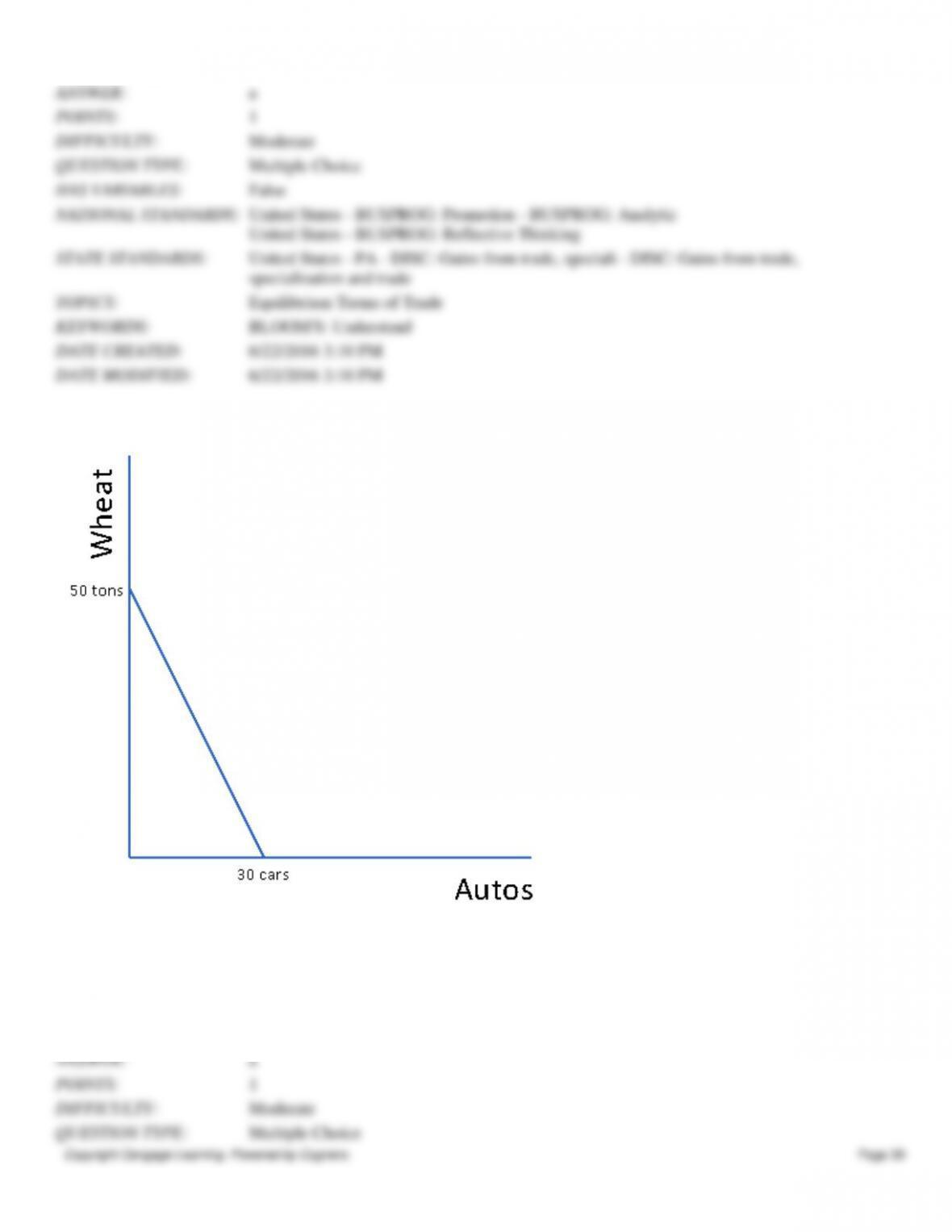
Figure 2.4 Production Possibilities Frontier
90. In Figure 2.4 the marginal rate of transformation of wheat into autos is
a.
one and two-thirds
b.
two and one-third
c.
three fifths
d.
three sevenths
ANSWER:
a
POINTS:
1
DIFFICULTY:
Moderate
QUESTION TYPE:
Multiple Choice
Copyright Cengage Learning. Powered by Cognero.
Page 40
HAS VARIABLES:
False
PREFACE NAME:
Figure 2.4
NATIONAL STANDARDS:
United States – BUSPROG: Promotion – BUSPROG: Analytic
STATE STANDARDS:
United States – PA – DISC: Reading and interpreting g – DISC: Reading and interpreting
graphs
TOPICS:
Trading Under Constant-Cost Conditions
KEYWORDS:
BLOOM’S: Analyze
DATE CREATED:
6/22/2016 3:10 PM
DATE MODIFIED:
6/22/2016 3:10 PM
91. In Figure 2.4 the marginal rate of transformation of autos into wheat is
a.
one and two-thirds
b.
two and one-third
c.
three fifths
d.
three sevenths
ANSWER:
c
POINTS:
1
DIFFICULTY:
Moderate
QUESTION TYPE:
Multiple Choice
HAS VARIABLES:
False
PREFACE NAME:
Figure 2.4
NATIONAL STANDARDS:
United States – BUSPROG: Promotion – BUSPROG: Analytic
STATE STANDARDS:
United States – PA – DISC: Reading and interpreting g – DISC: Reading and interpreting
graphs
TOPICS:
Trading Under Constant-Cost Conditions
KEYWORDS:
BLOOM’S: Analyze
DATE CREATED:
6/22/2016 3:10 PM
DATE MODIFIED:
6/22/2016 3:10 PM
92. In Figure 2.4 one car can be produced at a cost of
a.
one and two-thirds tons of wheat
b.
two and one-third tons of wheat
c.
three fifths tons of wheat
d.
three sevenths tons of wheat
ANSWER:
a
POINTS:
1
DIFFICULTY:
Moderate
QUESTION TYPE:
Multiple Choice
HAS VARIABLES:
False
PREFACE NAME:
Figure 2.4
NATIONAL STANDARDS:
United States – BUSPROG: Promotion – BUSPROG: Analytic
STATE STANDARDS:
United States – PA – DISC: Reading and interpreting g – DISC: Reading and interpreting
graphs
TOPICS:
Trading Under Constant-Cost Conditions
KEYWORDS:
BLOOM’S: Analyze
DATE CREATED:
6/22/2016 3:10 PM