72) When the owner invests personal equipment in the business, cash is increased.
73) Accounts Receivable indicates amounts owed to us by our clients or customers.
74) Accounts Payable indicates monies owed to us by our clients or customers.
75) Expenses are recorded when paid.
76) Accounts Payable is an asset account that is increased on the credit side.
77) The Accounts Receivable account is increased by a debit.
78) Identify the normal balance for each of the following accounts by placing a Dr. (debit) or a Cr. (credit)
in the space provided.
________ 1. Computer
________ 2. M. Bryant, Withdrawals
________ 3. M. Bryant, Capital
________ 4. Legal Fees
________ 5. Cash
________ 6. Accounts Receivable
________ 7. Accounts Payable
________ 8. Rent Expense
________ 9. Office Equipment
________ 10. Supplies
79) Identify whether a debit or credit would be correct for each of the following account changes. Use a
Dr. (debit) or Cr. (credit) in the space provided.
________ 1. Increase Delivery Van
________ 2. Decrease Accounts Receivable
________ 3. Decrease Accounts Payable
________ 4. Increase Salaries Expense
________ 5. Increase Service Fees
________ 6. Decrease Cash
________ 7. Increase S. McCrae, Capital
________ 8. Increase S. McCrae, Withdrawals
________ 9. Increase Rent Expense
________ 10. Decrease Equipment
80) Below is a chart of accounts. Following is a series of transactions. Indicate for each transaction the
accounts that should be debited and credited by inserting the proper account number in the space
provided.
111 Cash 312 R. Andrews, Withdrawals
112 Accounts Receivable 411 Service Fees
121 Office Equipment 511 Salaries Expense
211 Accounts Payable 512 Rent Expense
311 R. Andrews, Capital 513 Advertising Expense
Debit Credit Transaction
________ ________ 1. Purchased office equipment on account.
________ ________ 2. Paid salaries for the week.
________ ________ 3. Invested additional cash in the business.
________ ________ 4. Received cash for services performed.
________ ________ 5. Billed a client on account for services performed.
________ ________ 6. Paid accounts payable.
________ ________ 7. Collected accounts receivable.
________ ________ 8. Withdrew cash for personal use.
________ ________ 9. Paid advertising expense.
________ ________ 10. Paid rent expense for the month.
81) A chart of accounts is below. Following is a series of transactions. Indicate for each transaction the
accounts that should be debited and credited by inserting the proper account number in the space
provided.
111 Cash 312 C. Webster, Withdrawals
112 Accounts Receivable 411 Delivery Fees Earned
121 Delivery Equipment 511 Salaries Expense
211 Accounts Payable 512 Rent Expense
311 C. Webster, Capital 513 Advertising Expense
514 Gas Expense
Debit Credit Transaction
________ ________ 1. Invested cash in the business.
________ ________ 2. Received cash for delivery services performed.
________ ________ 3. Billed a customer for services performed.
________ ________ 4. Paid accounts payable.
________ ________ 5. Collected accounts receivable.
________ ________ 6. Withdrew cash for personal use.
________ ________ 7. Paid advertising expense.
________ ________ 8. Paid rent expense for the month.
________ ________ 9. Purchased delivery equipment on account.
________ ________ 10. Paid salaries for the week.
25
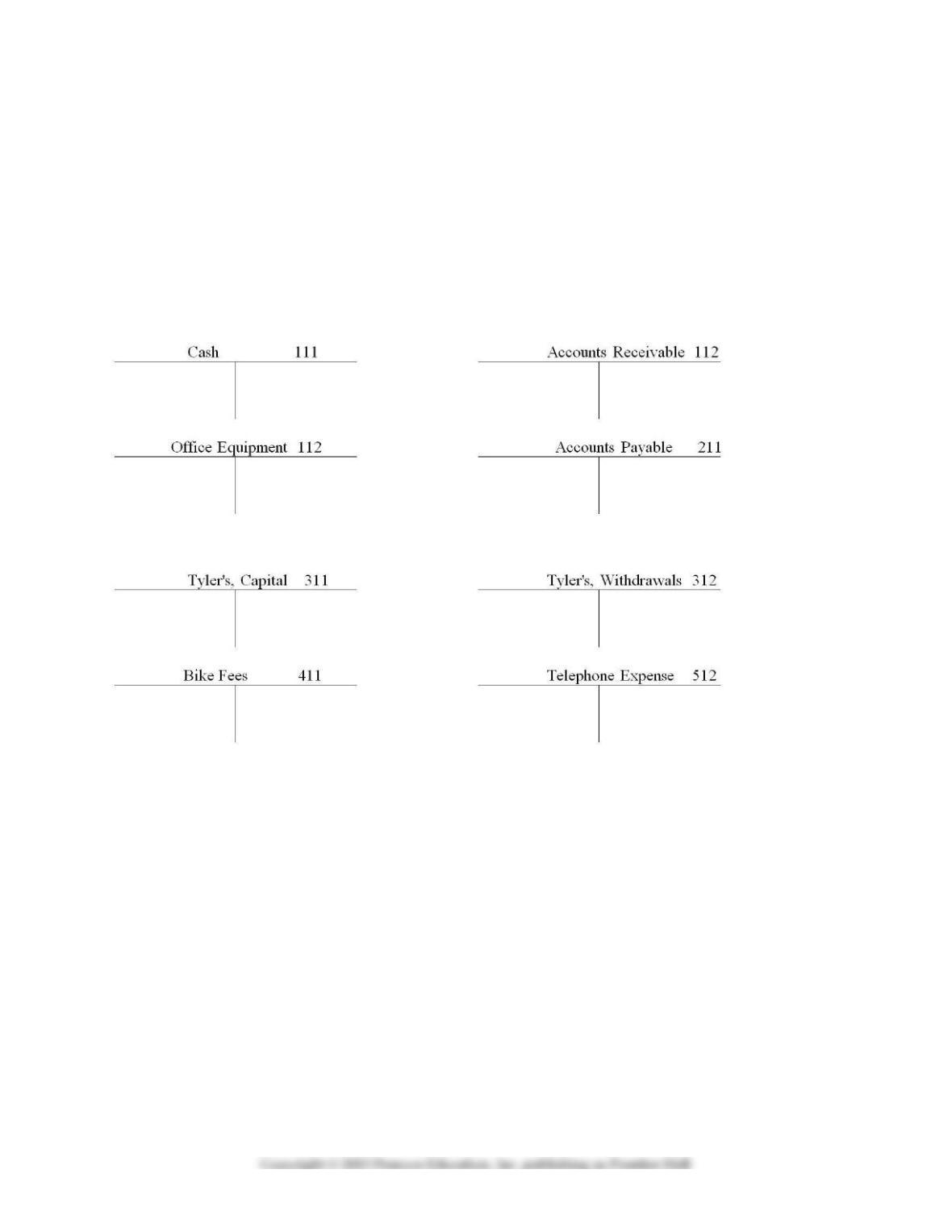
82) The following transactions occurred during June for Campus Cycle Shop. Record the transactions
below in the T accounts. Place the letter of the transaction next to the entry. Foot and calculate the ending
balances of the T accounts where appropriate.
a. Tyler invested $6,500 in the bike service from his personal savings account.
b. Bought office equipment for cash, $900.
c. Performed bike service for a customer on account, $1,000.
d. Company cell phone bill received, but not paid, $80.
e. Collected $500 from customer in transaction c.
f. Tyler withdrew $300 for personal use.
83)
Column 1
Column 2
Column 3
Postage Expense
Column 1
Column 2
Column 3
Postage Expense
expense
debit
income statement
84)
Column 1
Column 2
Column 3
Truck
Column 1
Column 2
Column 3
Truck
asset
debit
balance sheet
85)
Column 1
Column 2
Column 3
Equipment
Column 1
Column 2
Column 3
Equipment
asset
debit
balance sheet
86)
Column 1
Column 2
Column 3
Cleaning Expense
Column 1
Column 2
Column 3
Cleaning Expense
expense
debit
income statement
87)
Column 1
Column 2
Column 3
Cleaning Fees Earned
Column 1
Column 2
Column 3
Cleaning Fees Earned
revenue
credit
income statement
88)
Column 1
Column 2
Column 3
Wages Expense
Column 1
Column 2
Column 3
Wages Expense
expense
debit
income statement
89)
Column 1
Column 2
Column 3
Installation Fees Earned
Column 1
Column 2
Column 3
Installation Fees Earned
revenue
credit
income statement
90)
Column 1
Column 2
Column 3
Lawn Care Fees Earned
Column 1
Column 2
Column 3
Lawn Care Fees Earned
revenue
credit
income statement
91)
Column 1
Column 2
Column 3
Supplies
Column 1
Column 2
Column 3
2.3 Learning Objective 2-3
1) Which of the following is not a financial statement?
A) Balance sheet
B) Income statement
C) Statement of owner’s equity
D) Trial balance
2) A list of all the accounts from the ledger with their ending balances is called a:
A) normal balance.
B) trial balance.
C) chart of accounts.
D) footing.
3) Which of the following is prepared first?
A) Balance sheet
B) Income statement
C) Statement of owner’s equity
D) Trial balance
4) Given the following list of accounts with normal balances, what are the trial balance totals of the debits
and credits?
Cash
$1,100
Accounts Receivable
800
Capital
1,900
Withdrawals
500
Service Fees
1,000
Rent Expense
500
A) $2,900 debit, $2,900 credit
B) $3,900 debit, $3,900 credit
C) $2,000 debit, $2,000 credit
D) $1,200 debit, $1,200 credit
5) Given the following list of accounts with normal balances, what are the trial balance totals of the debits
and credits?
Cash
$1000
Equipment
500
Accounts Payable
350
Capital
900
Service Fees
1000
Salaries Expense
750
A) $3,250 debit, $3,250 credit
B) $1,125 debit, $1,125 credit
C) $4,500 debit, $4,500 credit
D) $2,250 debit, $2,250 credit
6) The trial balance is a financial statement.
7) Number the following types of accounts (1-6) as they would appear on the Trial Balance.
________ Assets
________ Capital
________ Revenue
________ Liabilities
________ Withdrawals
________ Expenses
8) The following is a list of accounts and their balances for Myra‘s Company for the month ended May 31,
20xx. Prepare a trial balance in good form.
Cash $1,210 Myra, Withdrawals $ 980
Accounts Payable 500 Accounts Receivable 1,200
Office Equipment 2,260 Service Fees 1,835
Myra, Capital 3,965 Rent Expense 650
9) The following is a list of accounts and their balances for Benson Company for the month ended June
30, 20xx. Prepare a trial balance in good form.
Cash $1,370 Benson, Withdrawals $ 500
Accounts Payable 770 Accounts Receivable 1,600
Office Equipment 900 Service Fees 2,730
Benson, Capital 1,500 Salaries Expense 630
2.4 Learning Objective 2-4
1) Which type of account would not be reported on the income statement?
A) Revenue
B) Expenses
C) Liabilities
D) None of these answers are correct.
2) Accounts Payable would appear on which financial statement?
A) Balance sheet
B) Income statement
C) Owner’s equity statement
D) None of these answers are correct.
3) The left column of a financial statement is often used to:
A) show debits.
B) show credits.
C) show totals.
D) subtotal numbers.
4) The Beginning Capital account would appear on which financial statement?
A) Statement of owner’s equity
B) Balance sheet
C) Income statement
D) None of these answers are correct.
5) The income statement contains:
A) liabilities.
B) revenues.
C) assets.
D) Both B and C are correct.
6) On which financial statement would you find the ending Capital balance?
A) Income statement
B) Balance Sheet
C) Statement of owner’s equity
D) Both B and C are correct.
7) Which of the following is prepared last?
A) Balance Sheet
B) Income Statement
C) Statement of Owner’s Equity
D) Trial Balance
8) Net income or net loss for a period is calculated by the following formula:
A) total revenues – total withdrawals.
B) total revenues – total expenses – total withdrawals.
C) total revenues – total expenses.
D) total revenues – total expenses + capital.
9) Which type of account would not be reported on the balance sheet?
A) Expense
B) Cash
C) Accounts Payable
D) Accounts Receivable
10) What is X-cel Company’s net income or net loss if it had Revenue of $1,800, Salary Expense of $500,
Utility Expense of $250, and Withdrawals of $5,000 during October?
A) $50 net income
B) $1,050 net loss
C) $1,050 net income
D) $50 net loss
11) The financial statements contain debit and credit columns.
12) Withdrawals and expenses are reported on the income statement.
13) Accounts Payable appears on the income statement.
14) Wages Expense appears on the balance sheet.
15) Determine the ending owner’s equity of a business having a beginning owner’s equity of $9,500,
additional investments of $450 withdrawals of $1,000, and net income of $1,400.
$ ________
16) Determine the beginning owner’s equity of a business having an ending owner’s equity of $3,500,
additional investments of $600 withdrawals of $500, and net loss of $750.
$ ________
17) Determine the beginning owner’s equity of a business having beginning assets of $10,000, ending
liabilities of $5,000. During the year the liabilities decreased by $1,000.
$ ________