College Accounting, 12e (Slater)
Chapter 2 Debits and Credits: Analyzing and Recording Business Transactions
2.1 Learning Objective 2-1
1) A chart of accounts:
A) is set up in alphabetical order.
B) includes account balances.
C) is a listing of all the accounts used by a company.
D) All of the above are correct.
2) Accounts Payable had a normal starting balance of $800. There were debit postings of $600 and credit
postings of $300 during the month. The ending balance is:
A) $500 credit.
B) $1,000 debit.
C) $500 debit.
D) $1,000 credit.
3) The beginning balance in the Computers account was $2,000. The company purchased an additional
$1000 worth of computers. The balance in the account is:
A) debit of $2,000.
B) credit of $3,000.
C) debit of $3,000.
D) credit of $2,000.
4) Accounts receivable increases on the debit side of the account.
5) Revenues are recorded when earned.
6) Selected accounts from the ledger of Thomas Company appear below. For each account, indicate the
following:
a. In the first column at right, indicate the type of each account using the following abbreviations:
Asset – A Revenue – R None of the above – N Liability – L Expense – E
b. In the second column, indicate the normal balance of the account by inserting a Dr. or Cr.
Account
Type of
Account
Normal Balance
1. Office Supplies
______
______
2. Accounts Receivable
______
______
3. Fees Earned
______
______
4. Thomas, Withdrawals
______
______
5. Accounts Payable
______
______
6. Salaries Expense
______
______
7. Thomas, Capital
______
______
8. Accounts Receivable
______
______
9. Equipment
______
______
10. Telephone Expense
______
______
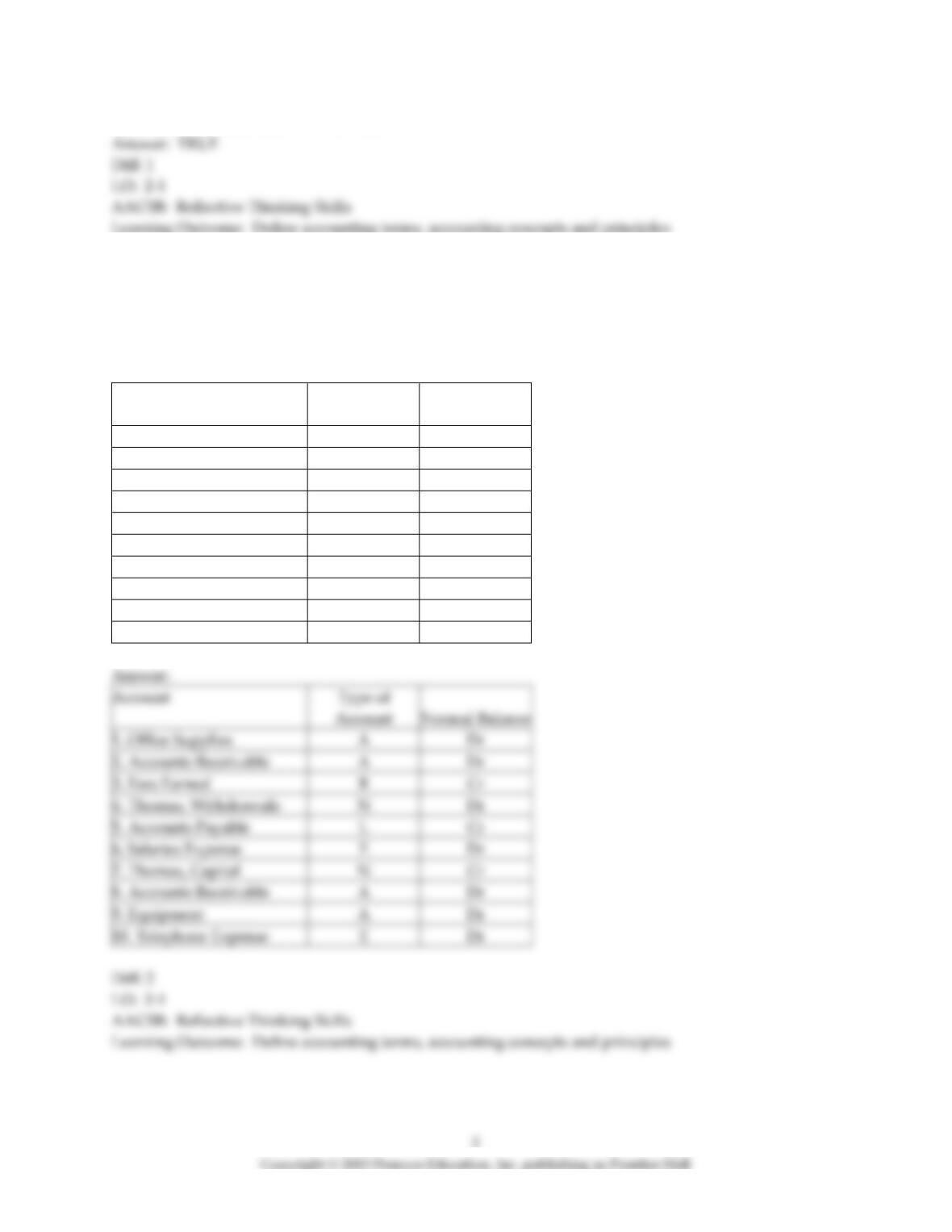
Account
Type of
Account
Normal Balance
1. Office Supplies
2. Accounts Receivable
3. Fees Earned
4. Thomas, Withdrawals
5. Accounts Payable
6. Salaries Expense
7. Thomas, Capital
8. Accounts Receivable
9. Equipment
10. Telephone Expense
7) Explain the difference between expenses and withdrawals.
8) Why is Revenue increased on the Credit side? (Explain as it pertains to the expanded accounting
equation and its relationship to Owner’s Equity.)
1) An accounting device used to record increases and decreases in individual assets, liabilities, capital,
revenue, expenses, and withdrawals is a(n):
A) chart of accounts.
B) account.
C) trial balance.
D) footing.
2) A compound entry is:
A) a transaction involving more than one debit and/or credit.
B) used to prepare the trial balance.
C) the same as the chart of accounts.
D) found on the income statement.
3) A formal account that has columns for date, explanation, post reference, debit, and credit is called the:
A) T account.
B) standard account form.
C) ledger.
D) chart of accounts.
4) A ledger:
A) is a group of accounts and their balances.
B) can replace the financial statements.
C) is the same as a chart of accounts.
D) None of these answers are correct.
5) The left side of any account is the:
A) debit side.
B) credit side.
C) ending balance.
D) footings.
6) The right side of any account is the:
A) debit side.
B) credit side.
C) ending balance.
D) footings.
7) The side that increases the account balance, by the rules of debit and credit, is said to be the:
A) debit side.
B) credit side.
C) normal balance.
D) None of these answers are correct.
8) The Accounts Payable account is:
A) a revenue, and it has a normal debit balance.
B) an expense, and it has a normal credit balance.
C) a liability, and it has a normal debit balance.
D) a liability, and it has a normal credit balance.
9) An account that would be increased by a credit is:
A) Cash.
B) Accounts Receivable.
C) Utilities Expense.
D) Accounts Payable.
10) An account is said to have a debit balance if:
A) the footing of the debits exceeds the footing of the credits.
B) there are more entries on the debit side than on the credit side.
C) its normal balance is debit without regard to the amounts or number of entries on the debit side.
D) the last entry of the accounting period was posted on the debit side.
11) A debit may signify a(n):
A) increase in asset accounts.
B) increase in liability accounts.
C) increase in the capital account.
D) decrease in expense accounts.
12) A credit may signify a(n):
A) increase in assets.
B) decrease in liabilities.
C) increase in capital.
D) increase in withdrawals.
13) Which of the following types of accounts has a normal credit balance?
A) Withdrawals
B) Assets
C) Expenses
D) Revenues
14) Which of the following types of accounts has a normal debit balance?
A) Withdrawals
B) Assets
C) Expenses
D) All of these answers are correct.
15) When recording transactions in two or more accounts and the totals of the debits and credits are
equal, it is called:
A) debiting.
B) crediting.
C) posting.
D) double-entry bookkeeping.
16) Which of the following groups of accounts have a normal debit balance?
A) Revenue, liabilities, and capital
B) Assets, capital, and withdrawals
C) Liabilities, expenses, and assets
D) Assets, expenses, and withdrawals
17) The ledger is:
A) a group of accounts that records data from business transactions.
B) a tool used to make sure that all accounts have normal balances.
C) a chronological record of the day’s transactions.
D) a tool used to ensure that debits equal credits.
18) Which of the following accounts would be increased by a debit?
A) Cash
B) Accounts Payable
C) Capital
D) Fees Earned
19) What is the proper entry to show the owner making an investment in the company?
A) A credit to Cash and a debit to Capital
B) A debit to Cash and a credit to Capital
C) A debit to Cash and a credit to Revenue
D) A credit to Cash and a debit to Revenue
20) Which of the following entries would be used to record the billing of fees earned?
A) Debit Accounts Receivable and credit Rental Fees
B) Credit Cash and credit Rental Fees
C) Debit Cash and credit Rental Fees
D) Debit Cash and debit Rental Fees
21) Which of the statements of the rules of debit and credit is true?
A) Decrease Accounts Receivable with a credit and the normal balance is a credit.
B) Increase Accounts Payable with a credit and the normal balance is a credit.
C) Increase Capital with a debit and the normal balance is a debit.
D) Decrease Cash with a debit and the normal balance is a debit.
22) Which of the following entries records the investment of cash by John, owner of a sole proprietorship?
A) Debit John, Capital; credit Cash
B) Debit Cash; credit John, Withdrawals
C) Debit John, Withdrawals; credit Cash
D) Debit Cash; credit John, Capital
23) Dennis, owner of Dennis’ Golf Center, withdrew $900 in cash from the business. Record the
transaction by:
A) debiting Dennis, Withdrawals, $900; crediting Cash, $900.
B) debiting Accounts Receivable, $900; crediting Cash, $900.
C) debiting Expense, $900; crediting Cash, $900.
D) debiting Dennis, Withdrawals, $900; crediting Dennis, Capital, $900.
24) The entry to record Tom’s payment of a home telephone bill is:
A) debit Telephone Expense; credit Accounts Payable.
B) debit Tom’s Withdrawals; credit Cash.
C) debit Telephone Expense; credit Cash.
D) debit Tom’s Withdrawals; credit Accounts Payable.
25) Extreme Home bought painting equipment on account for $2,100. The entry would include:
A) debit to Supplies Expense, $2,100; credit to Cash, $2,100.
B) debit to Equipment, $2,100; credit to Cash, $2,100.
C) debit to Equipment, $2,100; credit to Accounts Payable, $2,100.
D) debit to Supplies Expense, $2,100; credit to Accounts Payable, $2,100.
26) The owner of BobCats R Us paid his personal MasterCard bill using a company check. The correct
entry to record the transaction is:
A) credit Cash; debit Capital.
B) credit Cash; debit Supplies Expense.
C) credit Cash; debit Withdrawals.
D) credit Cash; debit Accounts Receivable.
27) Carrie flew to San Francisco on a business trip. The purchase price of the ticket was $422 and it was
bought on account. The entry to record the transaction is:
A) debit Accounts Payable, $422; credit Travel Expense, $422.
B) debit Capital, $422; credit Accounts Payable, $422.
C) debit Travel Expense, $422; credit Accounts Payable, $422.
D) debit Travel Expense, $422; credit Cash, $422.
28) The Accounts Receivable account has total debit postings of $1,900 and credit postings of $1100. The
balance of the account is:
A) $800 debit.
B) $800 credit.
C) $2,600 credit.
D) $2,600 debit.
29) The Accounts Payable account has total debit postings of $900 and credit postings of $1,500. The
balance is:
A) $2,200 debit.
B) $600 credit.
C) $2,200 credit.
D) $600 debit.
30) Office Supplies had a normal starting balance of $75. There were debit postings of $80 and credit
postings of $60 during the month. The ending balance is:
A) $55 debit.
B) $55 credit.
C) $95 debit.
D) $95 credit.
31) Accounts Receivable has a normal balance of $1,100. After collecting $800, the balance in the account
is:
A) debit $300.
B) debit $1,900.
C) credit $300.
D) credit $1,900.
32) The beginning balance in Cash was $3,500. Additional cash of $2,000 was received. Checks were
written totaling $2,500. The cash balance is:
A) $2,000.
B) $6,000.
C) $4,500.
D) $3,000.
33) A credit to an asset account was posted to the Capital account. This error would cause:
A) assets to be overstated.
B) liabilities to be overstated.
C) Capital to be understated.
D) Both A and C are correct.
34) A credit to a liability account was posted to an expense account. This error would cause:
A) assets to be overstated.
B) liabilities to be overstated.
C) expenses to be overstated.
D) None of the above are correct.
35) A debit to an expense account was posted to a revenue account. This error would cause:
A) assets to be overstated.
B) liabilities to be overstated.
C) revenue to be understated.
D) None of the above are correct.
36) A credit to an asset account was posted to a revenue account. This error would cause:
A) assets to be overstated.
B) revenue to be overstated.
C) expenses to be overstated.
D) Both A and C are correct.
37) A debit to a liability account was posted to the Capital account. This error would cause:
A) assets to be overstated.
B) liabilities to be overstated.
C) Capital to be overstated.
D) None of the above are correct.
38) A debit to an asset account was posted to an expense account. This error would cause:
A) liabilities to be overstated.
B) expenses to be overstated.
C) assets to be understated.
D) Both B and C are correct.
39) A debit to a liability account was posted to a revenue account. This error would cause:
A) revenues to be understated.
B) liabilities to be understated.
C) capital to be overstated.
D) None of the above are correct.
40) A debit to an asset account was posted to a liability account. This error would cause:
A) assets to be understated.
B) liabilities to be overstated.
C) capital to be overstated.
D) None of the above are correct.
41) The chart of accounts:
A) is a numbered list of all of the business’ accounts.
B) allows accounts to be located quickly.
C) can be expanded as the business grows.
D) All of the above are correct.
42) A credit to an asset account was posted to a liability account. This error would cause:
A) assets to be understated.
B) liabilities to be overstated.
C) capital to be understated.
D) None of the above are correct.
43) The business incurred an expense and paid it immediately. To record this:
A) an expense is debited and a liability is credited.
B) an expense is debited and an asset is credited.
C) an expense is debited and Capital is credited.
D) None of these are correct.
44) The business provided services to a cash customer. To record this:
A) an asset is debited and a liability is credited.
B) an asset is debited and a revenue is credited.
C) an expense is debited and Capital is credited.
D) None of these are correct.
45) The owner invested personal equipment in the business. To record this transaction:
A) debit Equipment and credit Accounts Payable.
B) debit Accounts Payable and credit Equipment.
C) debit Equipment and credit Capital.
D) credit Equipment and debit Capital.
46) Which of the following errors would cause the trial balance to be out of balance?
A) An entry is posted twice.
B) An entry is not posted at all.
C) A debit is entered as $200 and the credit is entered at $2,000.
D) None of these answers are correct.
47) The business bought supplies on account. To record this:
A) an expense is debited and a liability is credited.
B) an asset is debited and an asset is credited.
C) an asset is debited and a liability is credited.
D) None of these are correct.
48) A liability would be credited and an expense debited if:
A) the business paid a creditor.
B) the business incurred an expense and did not pay the expense immediately.
C) the business bought supplies on account.
D) the business bought supplies for cash.
49) One asset would be debited and another credited if:
A) the business provided services to a cash customer.
B) the business paid a creditor.
C) the business bought supplies paying cash.
D) the business provided services to a credit customer.
50) An asset would be debited and a liability credited if:
A) the business bought supplies for cash.
B) the business incurred an expense and paid it.
C) the business incurred an expense and did not pay for the expense immediately.
D) the business bought equipment on account.
51) What would be the effect on accounts if the business provided services to a customer on account?
A) An asset would be debited and an expense credited.
B) Capital would be debited and revenue credited.
C) An asset would be debited and revenue credited.
D) An asset would be debited and Capital credited.
52) What would be the effect on accounts if the business provided services to a customer collecting cash?
A) An asset would be debited and an expense credited.
B) Capital would be debited and revenue credited.
C) An asset would be debited and revenue credited.
D) An asset would be debited and Capital credited.
53) What would be the effect on accounts if the owner withdrew cash?
A) An asset would be debited and an expense credited.
B) Withdrawals would be debited and an asset credited.
C) An asset would be debited and a revenue credited.
D) An asset would be debited and Capital credited.
54) What would be the effect on accounts if the business purchased office supplies for cash?
A) An asset would be debited and an expense credited.
B) Capital would be debited and revenue credited.
C) An asset would be debited and revenue credited.
D) An asset would be debited and an asset credited.
55) What would be the effect on accounts if the business received the telephone bill but did not pay it
immediately.
A) An expense would be debited and a liability credited.
B) Capital would be debited and revenue credited.
C) An expense would be debited and an asset credited.
D) An asset would be debited and Capital credited.
56) An account that would be increased by a debit is:
A) Cash.
B) Fees Earned.
C) Capital.
D) Accounts Payable.
57) Which of the following groups of accounts have a normal credit balance?
A) Revenue, liabilities, and capital
B) Assets, capital, and withdrawals
C) Liabilities, expenses, and assets
D) Assets, expenses, and withdrawals
58) Cash is debited when the business makes a payment for supplies.
59) Debits must always equal credits.
60) The debit side of all accounts decreases the balance and the credit side increases all accounts.
61) The debit side is always the right side of the account.
62) A transaction that involves more than one credit or more than one debit is called a compound entry.
63) The side of an account that increases the balance is always the same as the normal balance side.
64) Double-entry accounting requires transactions to affect two or more accounts, and the total of the
debits and credits must equal.
65) The credit side is always the right side of the account.
66) A T account is used for demonstration purposes.
67) Only one account is affected in every transaction.
68) Withdrawals increase on the debit side of the account.
69) After deciding which accounts are affected, the next step in analyzing a transaction is to determine to
which categories the accounts belong.
70) Equipment is an example of a liability.
71) A compound entry is when more than one transaction occurs.