18) Which one of the following statements is true?
A) By devaluing its currency, that is, by lowering the domestic currency price of foreign currency, a
country can insulate itself completely from an inflationary increase in foreign prices.
B) By revaluing its currency, that is, by increasing the domestic currency price of foreign currency, a
country can insulate itself completely from an inflationary increase in foreign prices.
C) By revaluing its currency, that is, by lowering the domestic currency price of foreign currency, a
country cannot insulate itself completely from an inflationary increase in foreign prices.
D) By revaluing its currency, that is, by lowering the domestic currency price of foreign currency, a
country can insulate itself completely from an inflationary increase in foreign prices.
E) By revaluing its currency, that is, by lowering the domestic currency price of foreign currency, a
country cannot insulate itself completely from a harmful decrease in foreign prices.
19) When all changes in the world are due to
A) fiscal policy, purchasing power parity holds true in the long run.
B) monetary policy, purchasing power parity does not hold true in the long run.
C) monetary policy, purchasing power parity holds true in the long run.
D) monetary policy, purchasing power parity holds true even in the short run.
E) fiscal and monetary policy, purchasing power parity holds true in the long run.
20) Federal Reserve Chairman Volcker’s policy to fight inflation
A) led to the 1981-1983 recession, but was ultimately successful.
B) led to the 1981-1983 recession, but did not end high inflation due to beggar-thy-neighbor effects.
C) was perfectly complemented by Reagan’s decrease in fiscal spending.
D) led to the 1981-1983 recession and foretold the economic downturn in the mid-1990s.
E) led to an immediate depreciation of the dollar.
21) Under purchasing power parity (PPP), if U.S. monetary growth leads to a long run doubling of the
U.S. price level, while Germany’s price level remains constant, PPP predicts that the
A) long-run DM price of the dollar will be doubled.
B) long-run DM price of the dollar will be halved.
C) long-run DM price of the dollar will remain the same.
D) short-run DM price of the dollar will be halved.
E) short-run DM price of the dollar will be doubled.
22) Under flexible exchange rate regime, a money-induced
A) decrease in U.S. prices causes an immediate appreciation of the foreign currencies against the dollar.
B) increase in U.S. prices causes an immediate appreciation of the foreign currencies against the dollar.
C) increase in U.S. prices causes an eventual appreciation of the foreign currencies against the dollar.
D) increase in U.S. prices causes an eventual depreciation of the foreign currencies against the dollar.
E) decrease in U.S. prices causes no change in foreign exchange rate.
23) Under Bretton Woods,
A) any foreign country cannot devalue its currency against the dollar in conditions of “fundamental
disequilibrium.”
B) any foreign country could devalue its currency against the dollar in conditions of “fundamental
disequilibrium,” but the system’s rules did not give the United States the option of devaluing against
foreign currencies.
C) any foreign country could devalue its currency against the dollar in conditions of “fundamental
disequilibrium,” and the system’s rules did give the United States the same option of devaluing against
foreign currencies.
D) the U.S. could devalue its currency against the foreign currencies in conditions of “fundamental
disequilibrium.”
E) any foreign country can revalue its currency against the dollar in conditions of “fundamental
disequilibrium.”
24) The DD schedule shows
A) interest rate and output pairs for which aggregate demand equals aggregate output.
B) exchange rate and output pairs for which aggregate demand equals aggregate output.
C) exchange rate and output pairs for which aggregate supply equals aggregate output.
D) interest rate and output pairs for which aggregate supply equals aggregate output.
E) exchange rate and output pairs for which aggregate demand is greater than aggregate output.
25) The AA schedule shows
A) Interest rate and output pairs at which the foreign exchange market and the domestic money market
are in equilibrium.
B) Exchange rate and output pairs at which the foreign exchange market and the domestic money market
are in equilibrium.
C) Interest rate and output pairs at which only the foreign exchange market is in equilibrium.
D) Exchange rate and output pairs at which only the foreign exchange market is in equilibrium.
E) Exchange rate and output pairs at which only the domestic money market are in equilibrium.
26) Under flexible exchange rate, the response of an economy to a temporary fall in foreign demand for
its exports is
A) the currency appreciates, and output falls.
B) the currency depreciates, and output falls.
C) the currency depreciates, and output increases.
D) the currency depreciates, and output remains constant.
E) the currency appreciates, and output increases.
27) Under fixed exchange rate, the response of an economy to a temporary fall in foreign demand for its
exports is
A) the currency appreciates, and output falls.
B) the currency depreciates, and output falls.
C) the currency remains the same, and output decreases.
D) the currency depreciates, and output remains constant.
E) the currency appreciates, and output remains the same.
28) Comparing fixed to flexible exchange rate, the response of an economy to a temporary fall in foreign
demand for its exports is
A) output actually falls less under fixed rate than under floating rate.
B) output actually falls more under fixed rate than under floating rate.
C) output actually remains the same under fixed rate than under floating rate.
D) the currency value grows in a fixed rate system and falls in a flexible system.
E) output grows in a fixed rate system and falls in a flexible system.
29) The effects of a decrease in export demand
A) is a powerful argument in favor of fixed rates.
B) is a powerful argument in favor of flexible rates.
C) shows the difficulties in determining which exchange rate is better.
D) is a powerful argument in favor of fixed rates only in the short run.
E) is a powerful argument in favor of fixed rates only in the long run.
30) Under the fixed rate regime foreign countries could hold their dollar exchange rates constant by
A) using tight monetary policy.
B) using expansionary fiscal policy.
C) negotiating with the central bank of the United States.
D) setting their domestic interest rate equal to the U.S. interest rate.
E) holding their exchange rates constantly pegged to the euro and yen.
44
31) Under the flexible exchange rate, lowering the price of a foreign currency will
A) allow the expansion of monetary policy without causing inflation.
B) decrease the foreign country’s output.
C) prevent a foreign price increase from causing deflation at home.
D) cause a home price increase to be exported to the foreign markets.
E) cause a “beggar-thy-neighbor” effect.
32) Supporters of a floating exchange rate cited all of the following as advantages over the Bretton
Woods system except
A) each country would be able to choose its own long run inflation rate.
B) parity changes and speculative attacks would no longer be possible.
C) countries would be forced to work cooperatively in deciding monetary policy.
D) exchange rates would be set symmetrically in foreign markets rather than by government decision.
E) governments would not need to export inflation to decrease domestic unemployment.
33) The mechanism behind the inflation insulation provided by a floating exchange rate is:
A) Purchasing Power Parity.
B) a fixed AA curve.
C) market speculation.
D) tight monetary policy.
E) symmetry.
34) If the demand for Home exports decreased abroad, the Home fall in output would be greatest:
A) if the decrease was temporary and the exchange rate was fixed.
B) if the decrease was temporary and the exchange rate was floating.
C) if the decrease was permanent and the exchange rate was fixed.
D) if the decrease was permanent and the exchange rate was floating.
E) if the decrease was permanent and the exchange rate was high.
35) Present the case for floating exchange rates.
36) “No central bank can be indifferent to its currency’s value in the foreign exchange market.” Discuss.
37) Refer to the above figure. Use the DD-AA model to examine and compare the response of an
economy under fixed and floating exchange rate to a temporary fall in foreign demand for its exports.
38) Refer to the above figure. Use the DD-AA model to examine and compare the response of an
economy under fixed and floating exchange rate to a permanent fall in foreign demand for its exports.
39) Use the DD-AA model to compare the domestic economic response under flexible and fixed
exchange rate regimes to a temporary rise in export demand from foreign countries.
40) The reason that the claim that floating exchange rates result in greater economic autonomy for
individual countries may not be entirely accurate is that:
A) empirical research finds no supporting data.
B) policy makers are influenced by the effect of domestic policies on the exchange rate.
C) there is no generally satisfactory method for measuring economic autonomy.
D) it is based on the assumption of a gold standard.
E) countries that run large trade deficits must increase exports to balance trade.
41) Under a flexible exchange rate regime, an increase in real money demand
A) moves the AA curve to the right.
B) moves the AA curve to the left.
C) leaves the AA curve unchanged.
D) moves the DD curve to the right.
E) moves the DD curve to the left.
42) The effects of an increase in real money demand on an economy
A) is an argument against flexible exchange rates.
B) is an argument in favor of flexible exchange rates.
C) shows the difficulties in determining which exchange rate regime is better.
D) is an argument in favor of flexible exchange rates only in the short run.
E) is an argument against flexible exchange rates only in the short run.
43) If most of the shocks that buffet the economy come from the output market shocks, then
A) fixed exchange rates are better than flexible exchange rates.
B) flexible exchange rates are better than fixed exchange rates.
C) which system is chosen is not important.
D) fixed exchange rates are better than flexible exchange rates only in the short run.
E) flexible exchange rates are better than fixed exchange rates only in the short-run.
44) One should expect the forward exchange market to flourish
A) under a fixed exchange rate regime.
B) under a flexible exchange rate regime.
C) under neither fixed nor flexible exchange rate regimes.
D) under both fixed and flexible exchange rate regimes.
E) only under a gold standard.
45) In the case of a domestic monetary shock, floating exchange rates:
A) make the home economy less vulnerable.
B) make the home economy more vulnerable.
C) make the foreign economy more vulnerable.
D) would not affect the foreign economy.
E) would not affect the home economy.
46) “Under floating rates, the economy is more vulnerable to shocks coming from the domestic money
market.” Discuss.
19.10 Macroeconomic Interdependence under a Floating Rate
1) Due to macroeconomics interdependence between large countries, the effect of a permanent monetary
policy expansion by Home is as follows: Home output
A) rises, Home’s currency depreciates, and Foreign output may rise or fall.
B) falls, Home’s currency depreciates, and Foreign output may rise or fall.
C) rises, Home’s currency appreciates, and Foreign output may rise or fall.
D) rises, Home’s currency depreciates, and Foreign output rises.
E) falls, Home’s currency appreciates, and Foreign output may rise or fall.
2) Due to macroeconomics interdependence between large countries, the effect of a permanent fiscal
expansion by Home is as follows: Home output
A) falls, Home’s currency appreciates, Foreign output rises.
B) rises, Home’s currency appreciates, Foreign output rises.
C) rises, Home’s currency depreciates, Foreign output rises.
D) rises, Home’s currency appreciates, Foreign output decreases.
E) falls, Homes currency depreciates, Foreign output rises.
3) Which of the following does not occur if Home starts a policy of permanent fiscal expansion:
A) Home’s exchange rate increases.
B) Foreign’s interest rate rises.
C) Home output rises.
D) Foreign output rises.
E) Current Account Balance increases.
4) The Plaza Accord of 1985 announces that the
A) G-5 countries will intervene in the foreign exchange market to bring about a dollar appreciation.
B) G-7 countries will intervene in the foreign exchange market to bring about a dollar depreciation.
C) G-5 countries will intervene in the foreign exchange market to bring about a dollar depreciation.
D) G-7 countries will intervene in the foreign exchange market to bring about a DM depreciation.
E) G-5 countries will not intervene in the foreign exchange market unless the dollar needs to appreciate.
5) Imagine a world with two large countries, Home and Foreign. Evaluate how Home’s macroeconomic
policies affect Foreign. Compare the small and the large country cases; consider both permanent
monetary and fiscal policies.
6) “Even under flexible exchange rate regime, governments could not be indifferent to the behavior of
exchange rates and inevitably surrendered some of their policy autonomy in other areas to prevent
exchange rate movements they viewed as harmful to their economies.” Discuss.
7) Which system of interest rates is theoretically worst for policy coordination among the industrial
countries of the world? How has this played out since the 1980s?
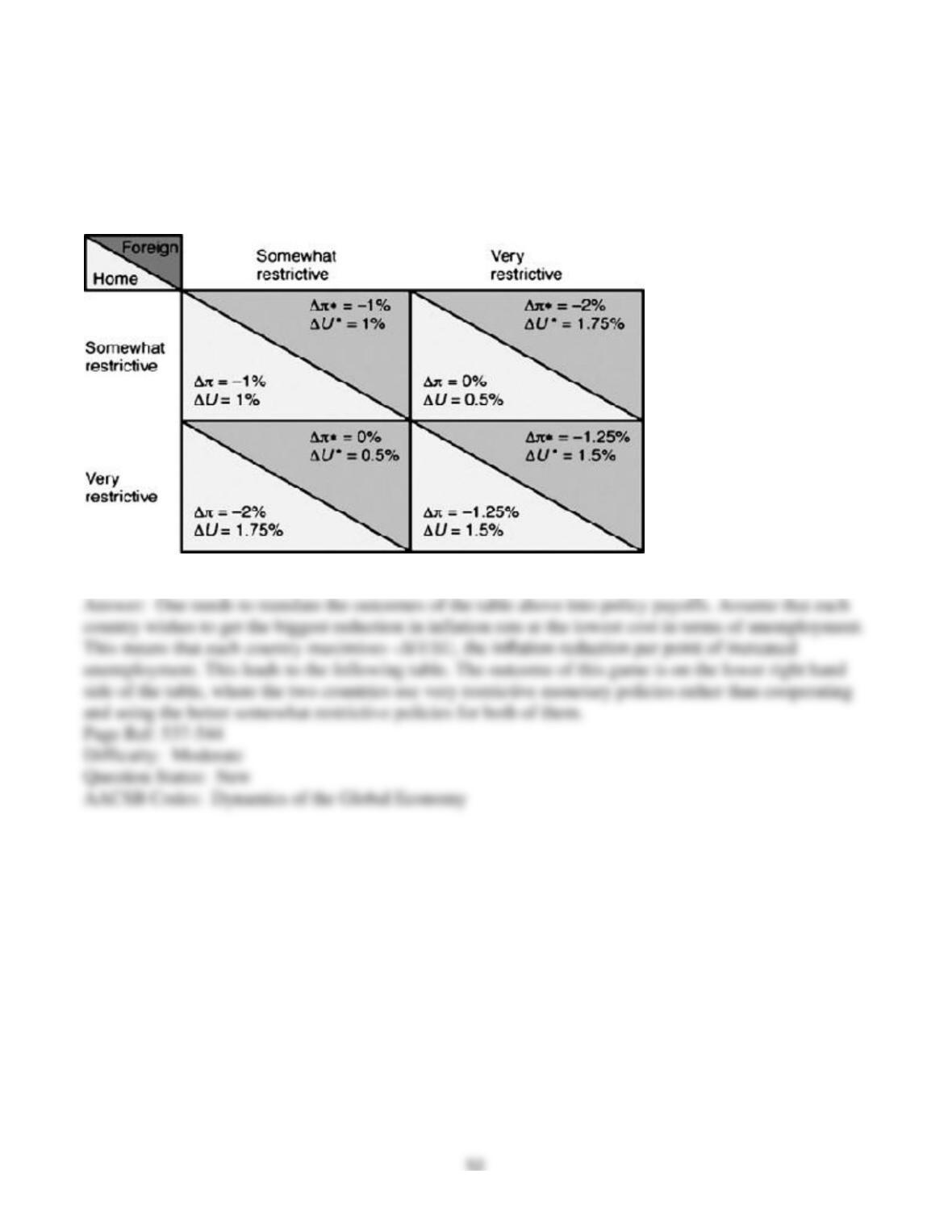
8) Use the following table to illustrate the importance of macroeconomic policy coordination. Show that
the two governments would have been happier if the two of them had adopted looser monetary policies,
but given the policies that the other government did adopt, it is not in the interest of any individual
government to change its course. Assume that each country wishes to get the biggest reduction in
inflation rate at the lowest cost in terms of unemployment. This means that each country maximizes-
ΔΠ/ΔU, the inflation reduction per point of increased unemployment.
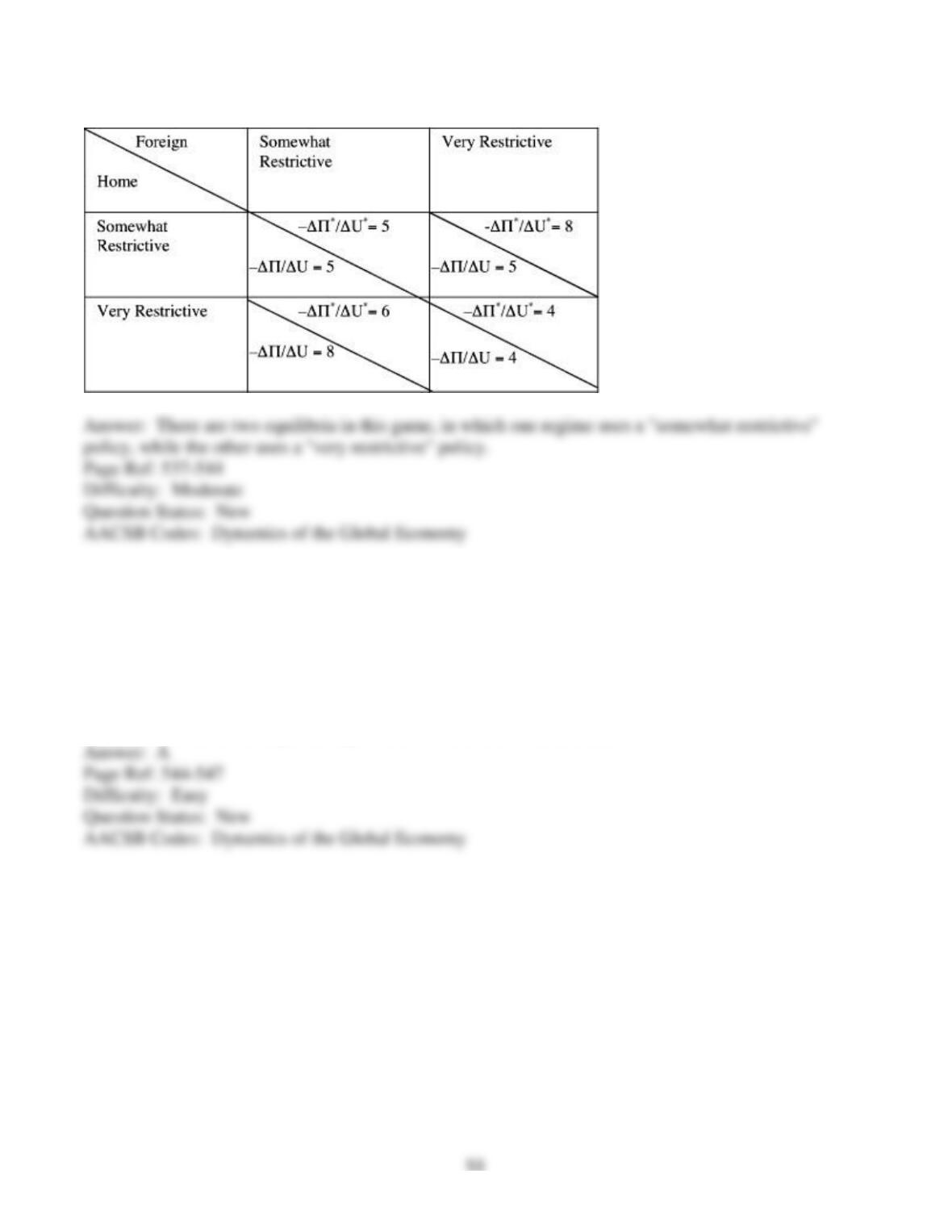
9) What are the outcomes of the following games, assuming the max-min criteria is used?
19.11 What Has Been Learned Since 1973?
1) Since 1973 “dirty floats” have been required because:
A) PPP has not held.
B) high inflation countries have stronger currencies than countries with low inflation.
C) countries are not cooperating as much as original theorists predicted.
D) in the short run, monetary and fiscal policy only affects the autonomous home economy.
E) countries with a floating exchange rate have laissez-faire economies.
2) What has been learned since 1973 with regards to the experience with floating exchange rate regime?
Answer:
19.12 Are Fixed Exchange Rates Even an Option for Most Countries?
1) Maintaining a fixed exchange rate over the long run is today:
A) virtually impossible.
B) more vulnerable to speculative attacks than in the past.
C) preferable.
D) possible only in special cases such as maintaining strict capital controls.
E) aided by technology which allows instant movement of money between financial markets in different
countries.
2) The focus of policy in the 1990s was:
A) increasing trade.
B) increasing employment.
C) maintaining stable exchange rates.
D) holding down inflation and increasing domestic output.
E) levying beggar-thy-neighbor tariffs.
3) “Fixed exchange rates are not even an option for most countries.” Discuss.
4) “No central bank can be indifferent to its currency’s value in the foreign exchange market.” Discuss.
56
19.13 Appendix to Chapter 19: International Policy Coordination Failures
1) Coordination of economic policies among nations is a prisoner’s ________ because all countries will
be better off if they ________.
A) dilemma; cooperate
B) conundrum; cooperate
C) sentence; compete
D) screed; compete
E) quandary; collude
2) Coordination of economic policies among nations is a prisoner’s ________ because if all countries go
it alone, they will choose to ________.
A) dilemma; compete
B) conundrum; cooperate
C) sentence; compete
D) dilemma; cooperate
E) quandary; collude
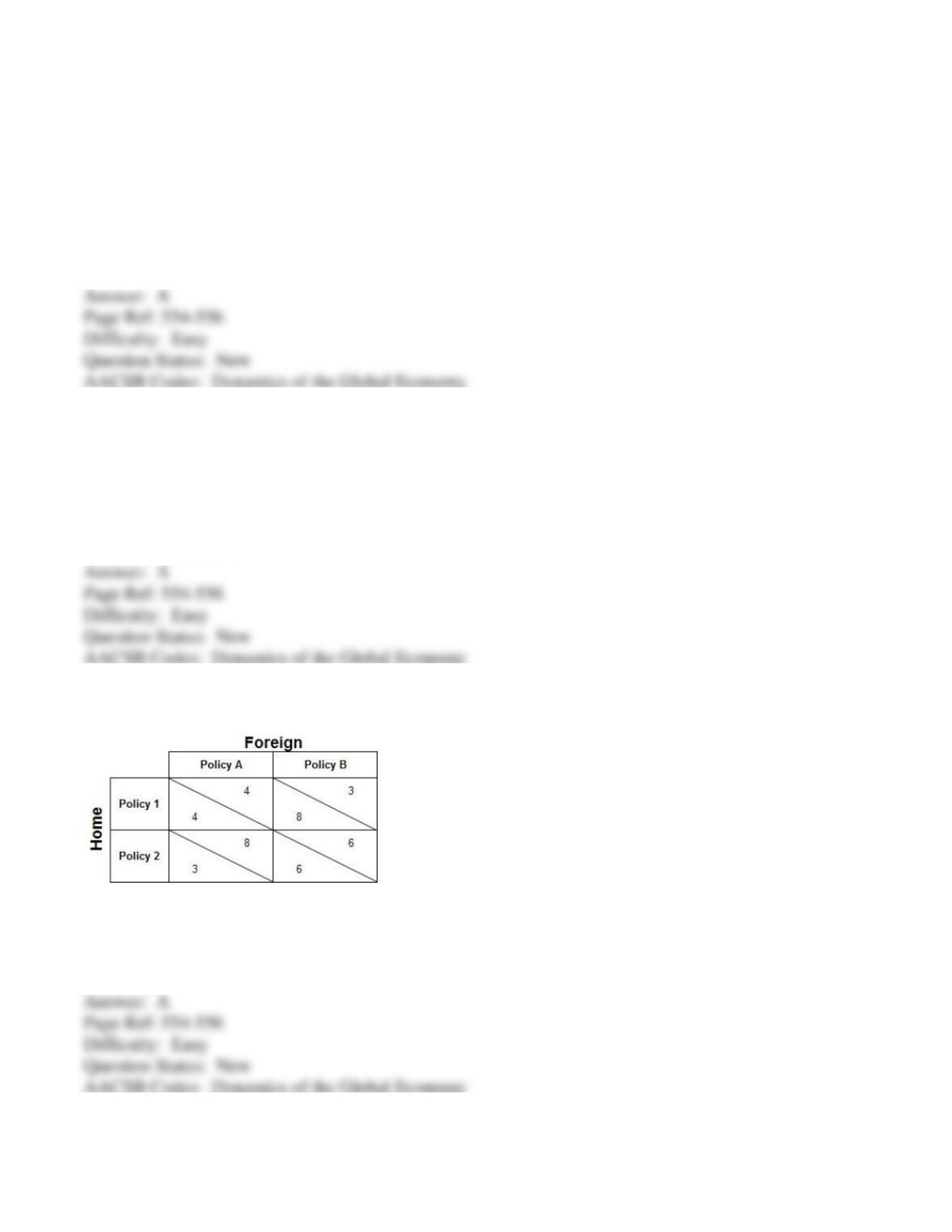
3) Refer to the payoff matrix below, which ________ a prisoner’s dilemma. If both countries go it alone,
Home will choose Policy ________ and Foreign will choose Policy ________.
A) is; 1; A
B) is; 2; B
C) is; 1; B
D) is not; 2; B
E) is not; 1; A
4) Refer to the payoff matrix below, which ________ a prisoner’s dilemma. If both countries cooperate,
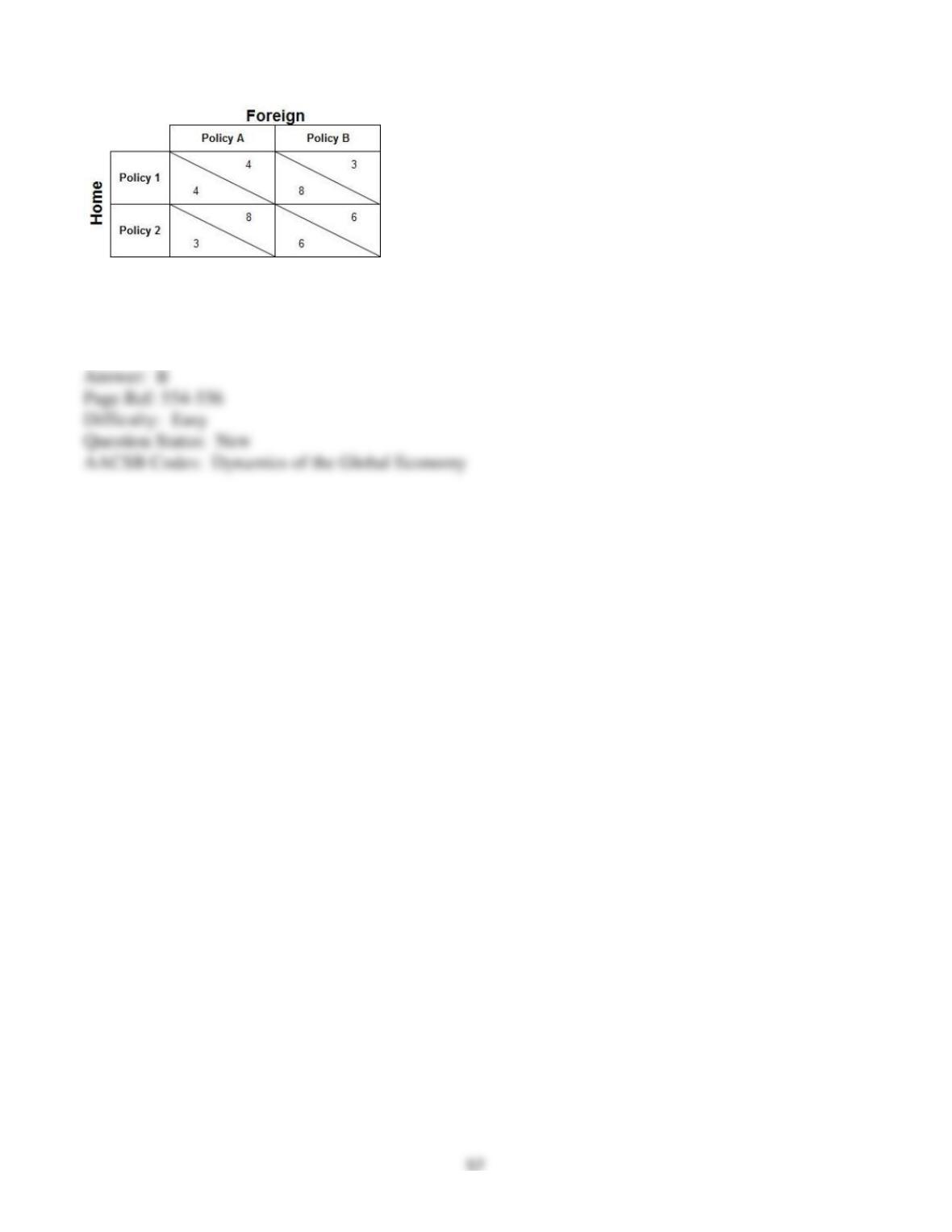
Home will choose Policy ________ and Foreign will choose Policy ________.
A) is; 1; A
B) is; 2; B
C) is; 1; B
D) is not; 2; B
E) is not; 1; A