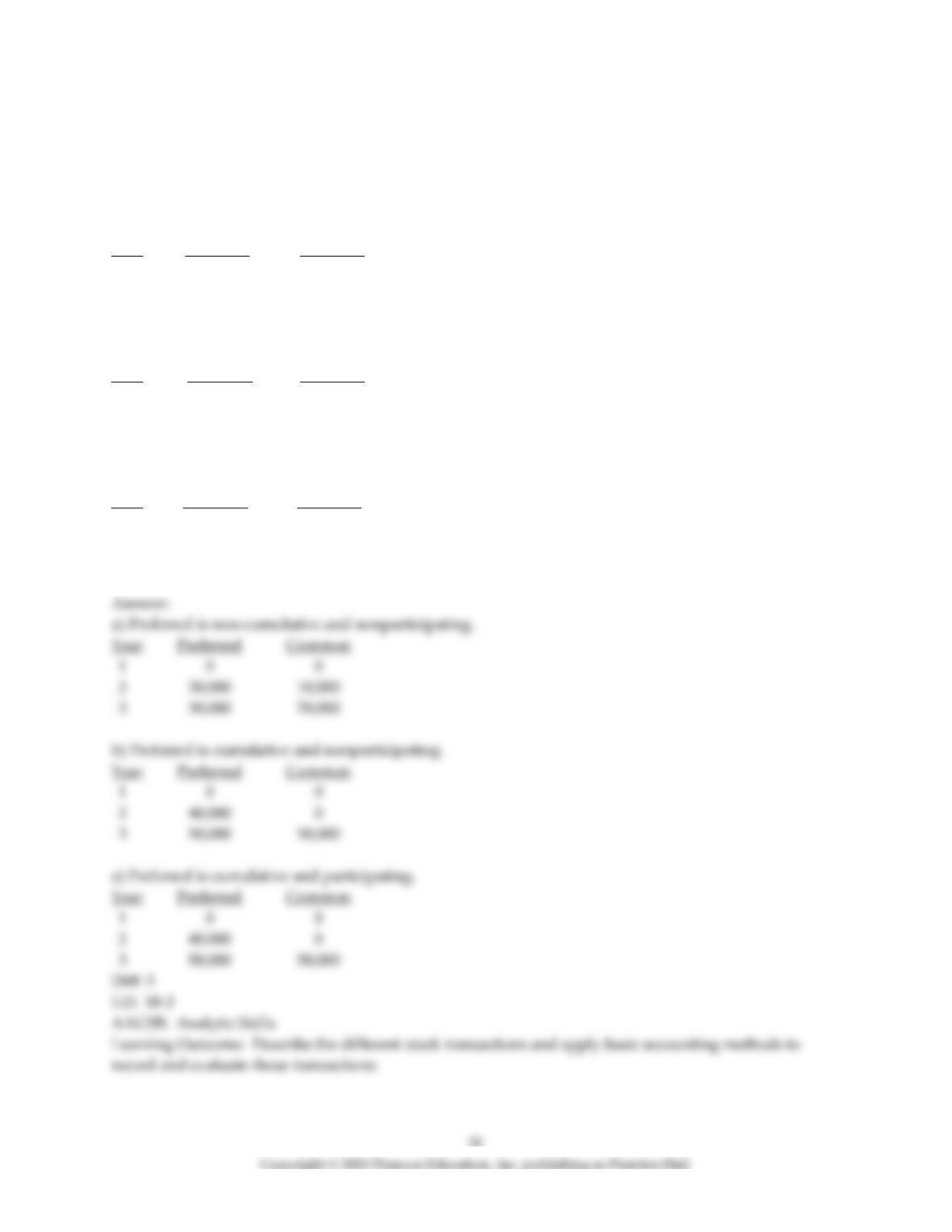
12) Jane Kathryn has 30,000 shares outstanding of $10 par value, 10% preferred stock and 100,000 shares
outstanding $5 par value common stock. In the first 3 years of operations, the company paid dividends in
Year 1, $0; Year 2, $40,000; Year 3, $100,000. Calculate the dividend paid to preferred and common
stockholders under the following independent situations:
a) Preferred is non-cumulative and nonparticipating.
Year Preferred Common
1 ________ ________
2 ________ ________
3 ________ ________
b) Preferred is cumulative and nonparticipating.
Year Preferred Common
1 ________ ________
2 ________ ________
3 ________ ________
c) Preferred is cumulative and participating.
Year Preferred Common
1 ________ ________
2 ________ ________
3 ________ ________
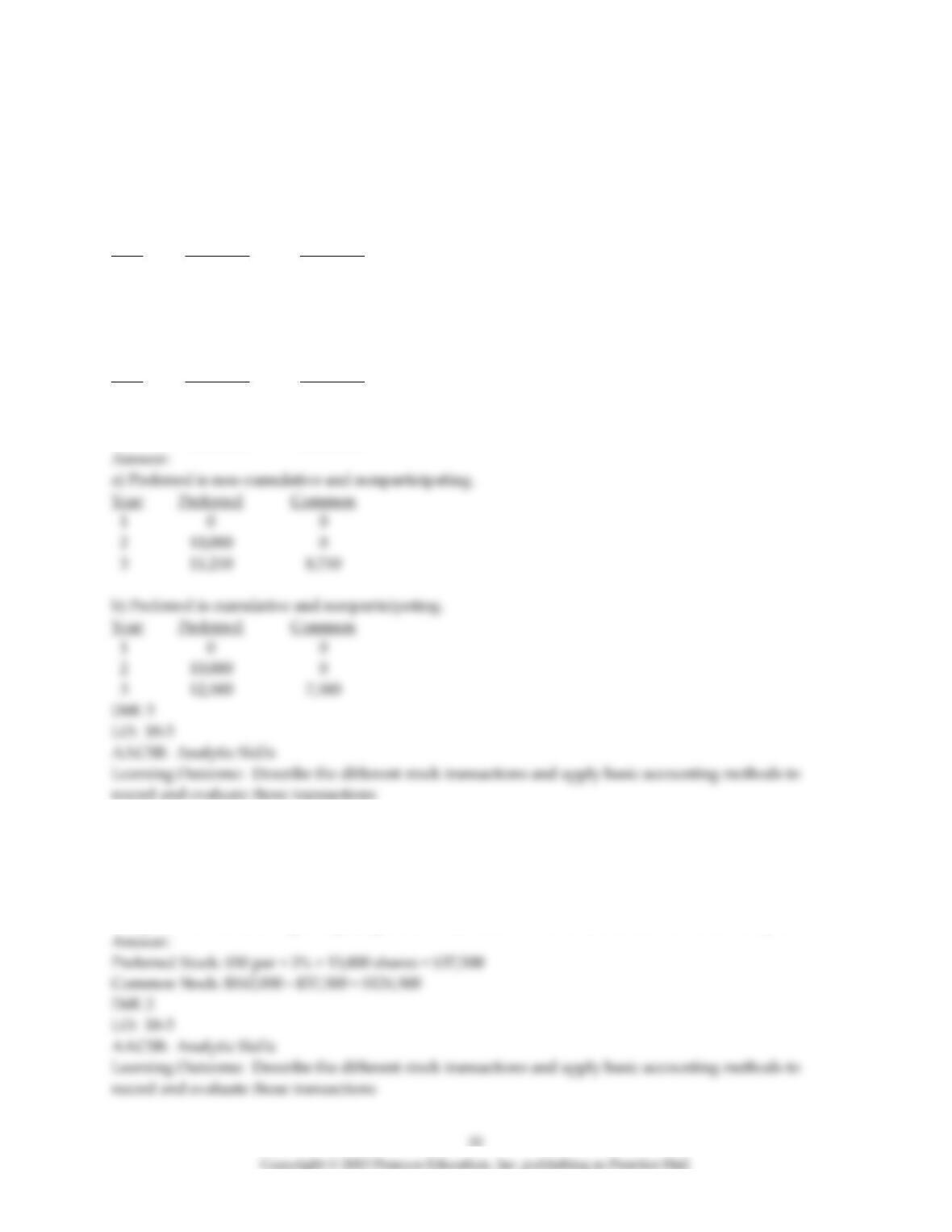
13) Jane Kathryn has 15,000 shares outstanding of $15 par value, 5% preferred stock and 100,000 shares
outstanding $10 par value common stock. In the first 3 years of operations, the company paid dividends
in Year 1, $0; Year 2, $10,000; Year 3, $20,000. Calculate the dividend paid to preferred and common
stockholders under the following independent situations:
a) Preferred is non-cumulative and nonparticipating.
Year Preferred Common
1 ________ ________
2 ________ ________
3 ________ ________
b) Preferred is cumulative and nonparticipating.
Year Preferred Common
1 ________ ________
2 ________ ________
3 ________ ________
14) Alpha-Omega Industries has 30,000 shares of $12 par common stock and 15,000 shares of $50 par, 5%
preferred stock outstanding. Total dividends available are $162,000. Compute the dividends to be
distributed to preferred and common stockholders under the following condition.
The preferred stock is nonparticipating and non-cumulative with no dividends distributed last year.
15) Alpha-Omega Industries has 30,000 shares of $12 par common stock and 15,000 shares of $50 par, 5%
preferred stock outstanding. Total dividends available are $162,000. Compute the dividends to be
distributed to preferred and common stockholders under the following condition.
The preferred stock is nonparticipating and cumulative with no dividends distributed last year.
16) Alpha-Omega Industries has 30,000 shares of $12 par common stock and 15,000 shares of $50 par, 5%
preferred stock outstanding. Total dividends available are $162,000. Compute the dividends to be
distributed to preferred and common stockholders under the following condition.
The preferred stock is participating and non-cumulative with no dividends distributed last year.
17) Alpha-Omega Industries has 30,000 shares of $12 par common stock and 15,000 shares of $50 par, 5%
preferred stock outstanding. Total dividends available are $162,000. Compute the dividends to be
distributed to preferred and common stockholders under the following condition.
The preferred stock is participating and cumulative with no dividends distributed last year.
18) Prepare the journal entries for Mayhem Manufacturing:
June 10 Incurred organization costs totaling $4,200
June 14 Issued 9,000 shares of $10 par value common stock for $110,000
June 22 Issued 3,500 shares of 7%, $30 par value preferred stock for $115,000.
19) Prepare the journal entries for Mayhem Manufacturing:
July 21 Issued 6,000 shares of $10 par common stock for $65,000.
July 29 Issued 3,000 shares of 7%, $30 par preferred stock for equipment with a fair market value of
$93,000.
1) The journal entry for the receipt of a cash payment on common stock subscriptions would include:
A) debiting Subscriptions Receivable-Common Stock ; crediting Common Stock.
B) debiting Common Stock; crediting Subscriptions Receivable-Common Stock.
C) debiting Cash; crediting Subscriptions Receivable-Common Stock.
D) debiting Cash; crediting Common Stock Subscribed.
2) The Bean Counter Corporation received subscriptions for 100 shares of its $10 par value common stock
at $13 per share. The entry to record receipt of the subscriptions would include a:
A) debit to Cash $1,300 and a credit to Common Stock $1,300.
B) debit to Cash $1,300; a credit to Common Stock $1,000; and a credit to Paid-in Capital in Excess of Par
$300.
C) debit to Common Stock Subscribed $1,300 and a credit to Subscriptions Receivable–Common Stock
$1,300.
D) debit to Subscriptions Receivable-Common Stock $1,300; a credit to Common Stock Subscribed $1,000;
and a credit to Paid-in Capital in Excess of Par for $300.
3) Diamonds Forever Corporation received subscriptions for 80 shares of its $100 par value common
stock for $120 per share. The entry to record the receipt of the subscriptions would include a:
A) debit to Common Stock Subscribed for $9,600.
B) debit to Subscriptions Receivable-Common Stock for $8,000.
C) credit to Paid-in Capital in Excess of Par for $1,600.
D) credit to Common Stock to be Outstanding $8,000.
4) Tory Company received the first installment of $3,200 on a common stock subscription. The entry to
record the collection would include a:
A) debit to Subscriptions Receivable-Common Stock for $3,200.
B) credit to Common Stock Subscribed for $2,500.
C) credit to Common Stock for $2,500.
D) credit to Subscriptions Receivable-Common Stock for $3,200.
5) Nature’s Honey Corporation received the final installment of $1,000 on a stock subscription for 20
shares of $100 par value common stock. After recording the cash receipt, the entry to issue the stock
would include a:
A) debit to Paid-in Capital in Excess of Par for $2,000.
B) credit to Paid-in Capital in excess of Par for $2,000.
C) credit to Common Stock for $2,000.
D) credit to Organization Cost for $2,000.
6) Monarch Company reported Subscriptions Receivable–Common Stock of $1,500 and Common Stock
Subscribed of $3,200 on its balance sheet. All the following are true except:
A) the amount previously collected on the stock subscriptions is $1,700.
B) the original stock subscribed totaled $3,200.
C) Monarch previously issued $1,700 of the subscribed stock.
D) the remaining amount to be collected from subscribers before the shares will be issued is $1,500.
7) What is the entry to record subscriptions received for 1,700 shares of $100 par value common stock at
$130 per share?
A) Debit Common Stock Subscribed $221,000; credit Cash $221,000
B) Debit Subscriptions Receivable-Common Stock $221,000; credit Common Stock Subscribed $221,000
C) Debit Subscriptions Receivable-Common Stock $221,000; credit Common Stock $221,000
D) None of these answers are correct.
8) Common Stock Subscribed is:
A) shown as an equity account below Issued Common Stock.
B) contra-asset account.
C) a receivables account.
D) shown on the income statement as a revenue.
9) In the stockholders’ equity section of a balance sheet:
A) common stock goes first.
B) retained earnings goes first.
C) preferred stock goes first.
D) all paid-in capital goes first.
10) When a stock subscription is received, Common Stock subscribed is credited for the total par value.
11) Journalize the transactions for the stock subscription plan for Nick Company. On February 1, Nick
received subscriptions for 80 shares of $10 par value common stock at $12 per share. The buyer will pay
two equal installments on March 1 and June 1. Assume all payments are made as scheduled and the
company issues the stock after the June 1 collection.
12) Journalize the transactions for the stock subscription plan for Rico Company. On February 1, Rico
received subscriptions for 50 shares of $9 par value common stock at $16 per share. The buyer will pay
two equal installments on March 1 and June 1. Assume all payments are made as scheduled and the
company issues the stock after the June 1 collection.
13) Identify the account types used in recording transactions related to a stock subscription plan:
Subscriptions Receivable-Common Stock; Common Stock Subscribed, Paid-In Capital in Excess of Par,
Common Stock, Cash. Also list the financial statement where the accounts are found.
14) Describe a stock subscription plan.