17.6 Short-Run Equilibrium for an Open Economy: Putting the DD and AA Schedules Together
1) Imagine that the economy is at a point that is above both AA and DD, where both the output
and asset markets are out of equilibrium. Which first action is TRUE?
A) The economy will stay at this level in the short run.
B) The exchange rate will first drop to a point on the AA schedule.
C) The exchange rate will first move to a point on the DD schedule.
D) The AA-DD equilibrium will shift to the position of the economy.
E) The exchange rate will first move left to a position on the AA schedule.
2) Which of the following have to be in equilibrium for the economy to be in equilibrium?
A) the money market only
B) the goods market only
C) the output and asset markets
D) the savings and investment markets
E) the goods and output markets
3) Assume the asset market is always in equilibrium. Therefore a fall in Y would result in
A) higher inflation abroad.
B) a decreased demand for domestic products.
C) a contraction of the money supply.
D) a depreciation of the home currency.
E) an appreciation of the home currency.
4) Why does an exchange rate-output combination lying above both DD and AA jump first to
AA in equilibrium?
A) Asset prices can adjust immediately.
B) Production plans can adjust immediately.
C) to preserve full employment
D) Prices are nominal and demand is real.
E) Aggregate demand adjusts faster than output.
5) Explain how an increase in government spending would affect the DD-AA schedule in the
short run.
6) Imagine that the economy is at a point on the DD-AA schedule that is above both AA and DD
and where both the output and asset markets are out of equilibrium. Explain what will happen
next?
7) A naïve implication of the DD-AA framework is that either fiscal or monetary policy can lead
to full employment. Discuss why this view is naïve.
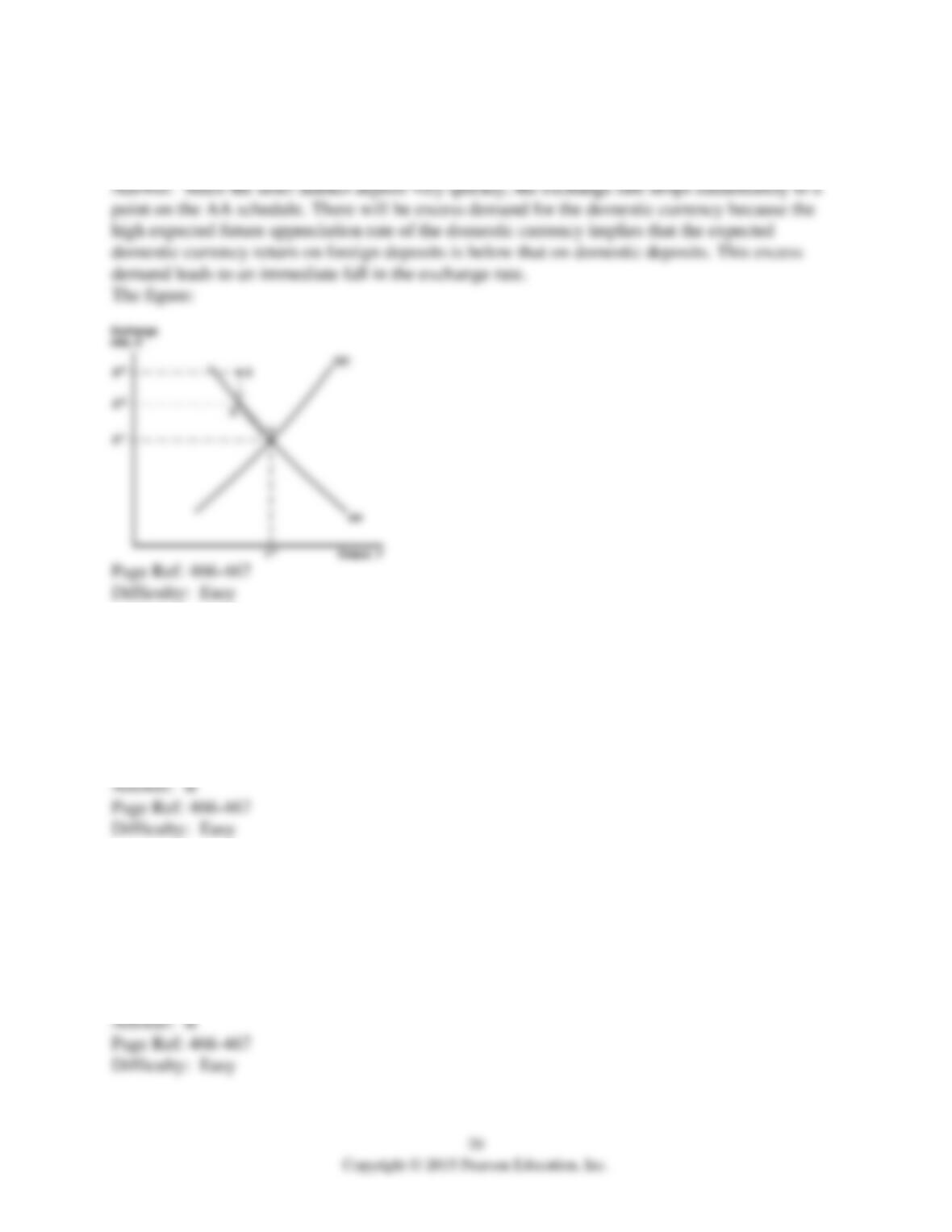
8) Use a figure to study the following question: Imagine that the economy is at a point on the
DD-AA schedule that is above both AA and DD, where both the output and asset markets are out
of equilibrium. Explain what will happen next.
9) Imagine that the economy is at a point on that is below both AA and DD, where both the
output and asset markets are out of equilibrium. Which first action is TRUE?
A) The economy will stay at this level in the short run.
B) The exchange rate will first rise to a point on the AA schedule.
C) The exchange rate will first rise to a point on the DD schedule.
D) The AA-DD equilibrium will shift to the position of the economy.
E) The output level will first increase to a position on the DD schedule.
10) Assume the output market adjusts more rapidly than the asset market. A point of
disequilibrium that is below both AA and DD will therefore initially result in
A) an increase in output.
B) a decrease in output.
C) a contraction of the money supply.
D) a depreciation of the home currency.
E) an appreciation of the home currency.
17.7 Temporary Changes in Monetary and Fiscal Policy
1) In the short run, with prices fixed, how would an increase in government spending affect the
DD-AA equilibrium?
A) It will increase output and appreciate the currency.
B) It will increase output and depreciate the currency.
C) It will decrease output and appreciate the currency.
D) It will decrease output and depreciate the currency.
E) It will increase output and have no effect on the currency.
2) In the short-run, an increase in government purchases will cause
A) a shift of the DD curve to the left and an increase in output.
B) a shift of the DD curve to the right and a decrease in output.
C) a shift of the DD curve to the left and a decrease in output.
D) a shift of the DD curve to the right and an increase in output.
E) a shift of the DD curve the left and an appreciation of the currency.
3) What are two ways the government can use to maintain full employment in an open economy?
Also give an example for each.
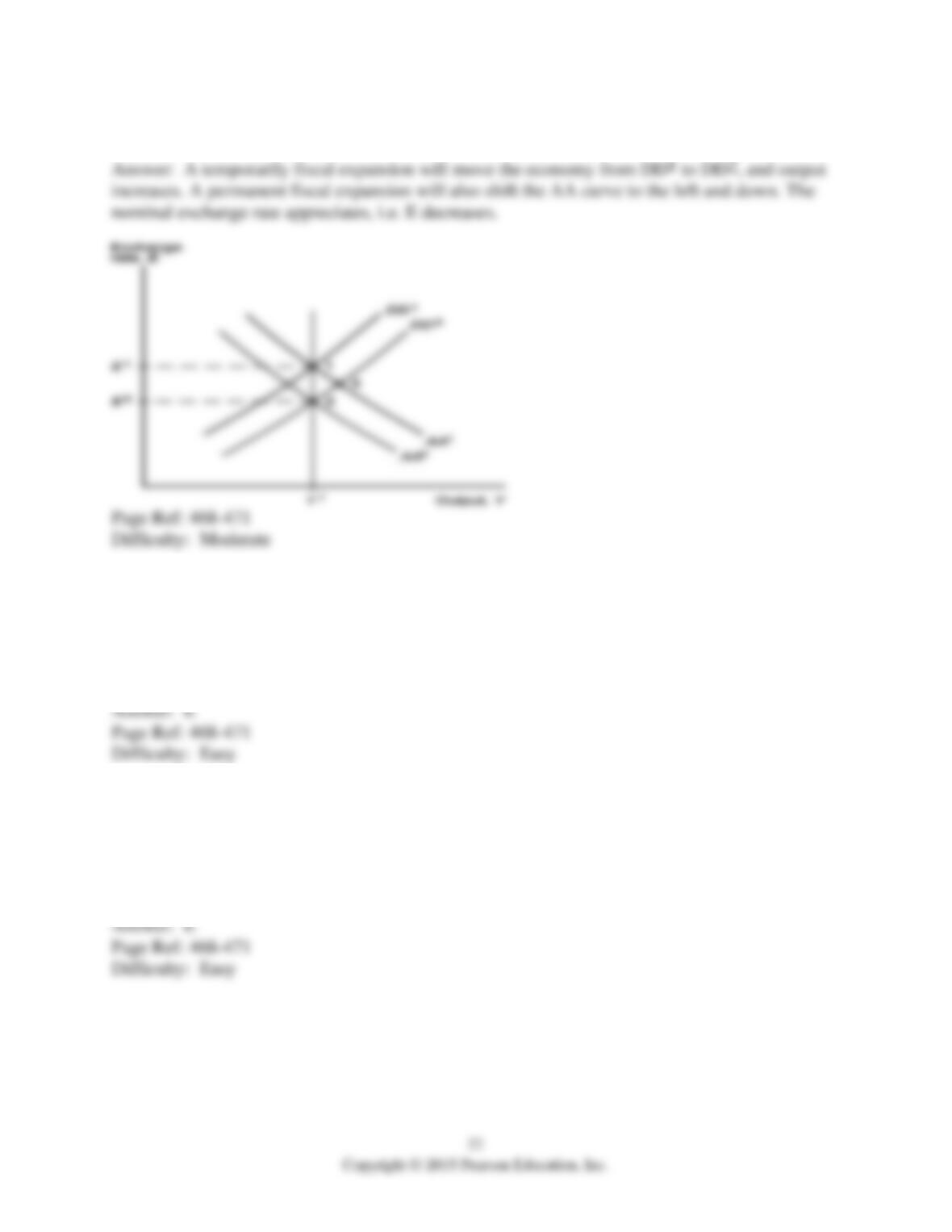
4) Using a figure show that under full employment, a temporary fiscal expansion would increase
output (over-employment) but cannot increase output in the long run.
5) In the short-run, a temporary increase in money supply
A) shifts the DD curve to the right, increases output and appreciates the currency.
B) shifts the AA curve to the left, increases output and depreciates the currency.
C) shifts the AA curve to the left, decreases output and depreciates the currency.
D) shifts the AA curve to the left, increases output and appreciates the currency.
E) shifts the AA curve to the right, increases output and depreciates the currency.
6) In the short-run, a tax increase
A) shifts the DD curve to the right, increases output and appreciates the currency.
B) shifts the AA curve to the left, increases output and depreciates the currency.
C) shifts the AA curve to the left, decreases output and depreciates the currency.
D) shifts the AA curve to the left, increases output and appreciates the currency.
E) shifts the DD curve to the left, decreases output and depreciates the currency.
17.8 Inflation Bias and Other Problems of Policy Formulation
1) What is inflation bias? What measures have governments taken to avoid it?
2) Explain and give some examples of governmental policy problems.
17.9 Permanent Shifts in Monetary and Fiscal Policy
1) If the economy starts in long-run equilibrium, a permanent fiscal expansion will cause
A) an increase in exchange rate, E.
B) a decrease in exchange rate, E.
C) an increase in output, Y.
D) a decrease in output, Y.
E) shifting of the AA curve up and to the right.
2) In long-run equilibrium after a permanent money-supply increase there follows:
A) an increase in exchange rate, E.
B) a decrease in exchange rate, E.
C) an increase in output, Y.
D) a decrease in output, Y.
E) an unchanged exchange rate, E.
3) Which one of the following statements is the MOST accurate?
A) Over time, the inflationary pressure that follows a temporary money supply expansion pushes
the price level to its long-run value and returns the economy to full employment.
B) Over time, the inflationary pressure that follows a permanent money supply expansion pushes
the price level to its long-run value and returns the economy to full employment.
C) Over time, the inflationary pressure that follows a temporary money supply expansion pushes
the price level to its long-run value, but leaves the economy in a state of artificially low
employment.
D) Over time, the inflationary pressure that follows a permanent money supply expansion pushes
the price level to its long-run value, but leaves the economy in a state of artificially low
employment.
E) Over time, the inflationary pressure that follows a permanent money supply expansion pushes
the price level beyond its long-run value and lower the level of employment.
4) Using the DD-AA framework, which one of the following statements is the MOST accurate?
A) Only monetary policy can bring the economy to full employment.
B) Only fiscal policy can bring the economy to full employment.
C) Only both monetary and fiscal policies can bring the economy to full employment.
D) Both policies are capable of bringing the economy to full employment and low inflation.
E) Monetary policy by itself or fiscal policy by itself can bring the economy to full employment.
5) Which one of the following statements is the MOST accurate?
A) A permanent increase in the money supply cannot have any short-run effects.
B) A permanent increase in taxes cannot have any short-run effects.
C) A permanent decrease in the money supply cannot have short-run effects.
D) A permanent decrease in taxes cannot have short-run effects.
E) A permanent increase in money demand can be offset with a permanent increase in the money
supply of equal magnitude.
6) A permanent increase in the domestic money supply
A) must ultimately lead to a proportional decrease in E, and, therefore, the expected future
exchange rate must rise proportionally.
B) must ultimately lead to a proportional decrease in E, and, therefore, the expected future
exchange rate must decrease proportionally.
C) must ultimately lead to a proportional rise in E, and, therefore, the expected future exchange
rate must rise proportionally.
D) must ultimately lead to a proportional rise in E, and, therefore, the expected future exchange
rate must rise more than proportionally.
E) must ultimately lead to a proportional rise in E, and, therefore, the expected future exchange
rate must rise less than proportionally.
7) In the short run, a permanent increase in the domestic money supply causes
A) a greater upward shift in the DD curve than that caused by an equal, but transitory, increase.
B) a greater downward shift in the AA curve than that caused by an equal, but transitory,
increase.
C) an smaller upward shift in the AA curve than that caused by an equal, but transitory, increase.
D) a smaller downward shift in the AA curve than that caused by an equal, but transitory,
increase.
E) a greater upward shift in the AA curve than that caused by an equal, but transitory, increase.
8) In the short run, a permanent increase in the domestic money supply
A) has stronger effects on the exchange rate and output than an equal temporary increase.
B) has stronger effects only on the exchange rate but not on output than an equal temporary
increase.
C) has weaker effects on the exchange rate and output than an equal temporary increase.
D) has stronger effects on output, but lower effect the exchange rate than an equal temporary
increase.
E) has weaker effects only on the exchange rate than an equal temporary increase.
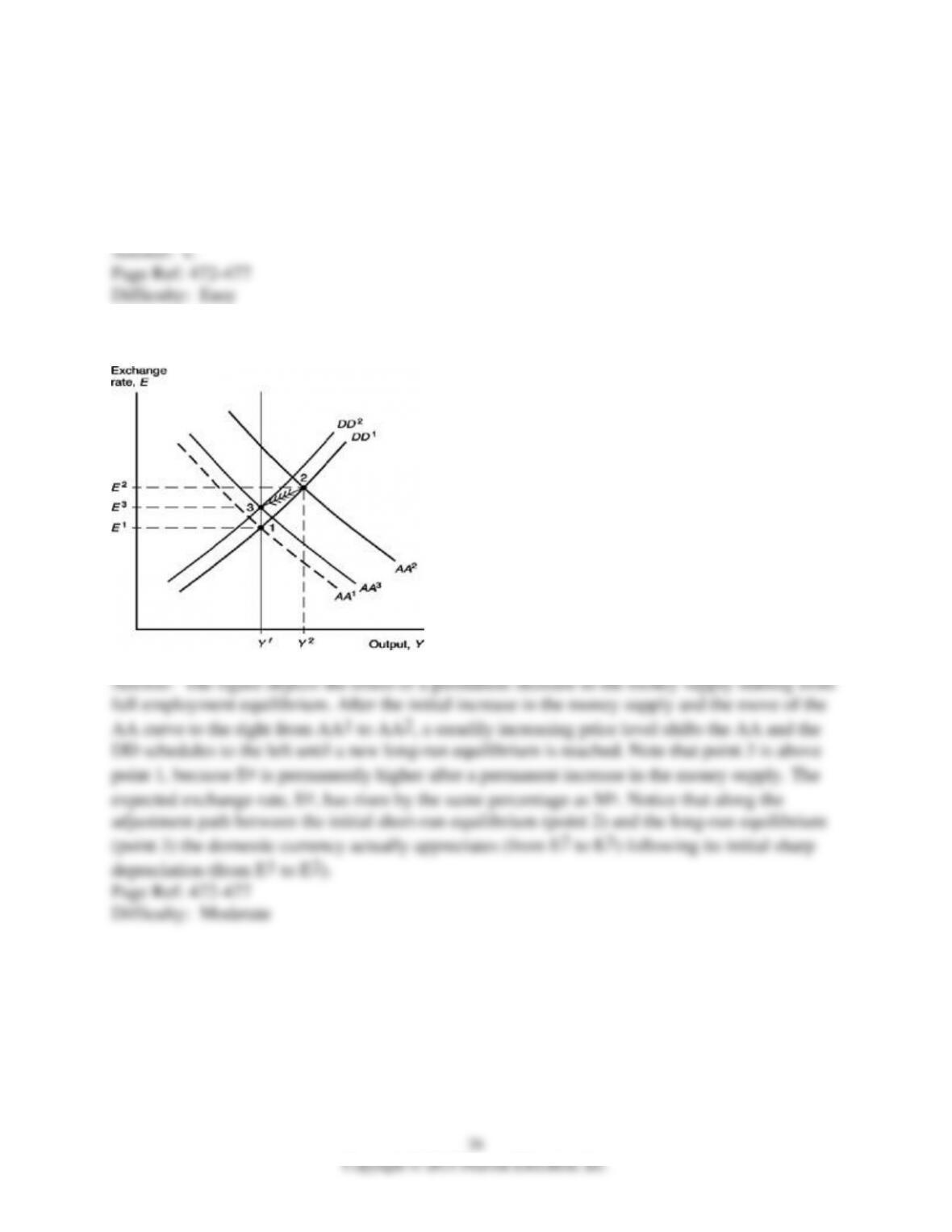
9) A permanent fiscal expansion
A) shifts the DD and the AA schedules to the right, increasing output.
B) shifts the DD and the AA schedules to the right, decreasing output.
C) shifts the DD to the right and the AA schedule to the left, leaving output the same.
D) shifts the DD to the left and the AA schedule to the left, decreasing output.
E) shifts the DD and the AA schedules to the left, leaving output the same.
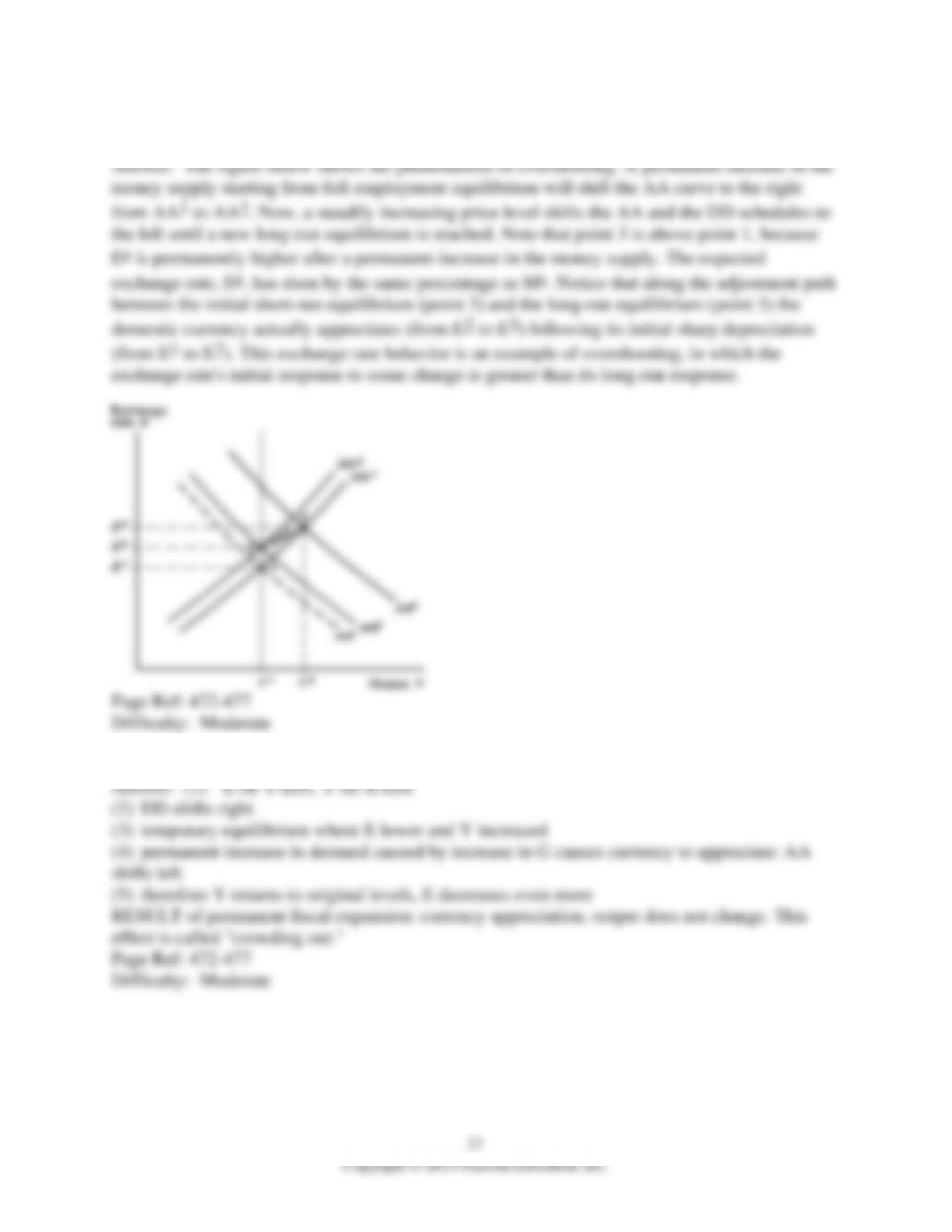
10) Explain the following figure:
11) Using the DD-AA framework, show the phenomenon of overshooting. Use a figure to
explain when it is taking place.
12) Demonstrate how a permanent fiscal expansion will not increase output in the long run.
13) Show the effects of a permanent increase in the money supply.
14) Using the DD model, explain what happens to out put when Government demands increase.
Use a figure to explain when it is taking place.
17.10 Macroeconomic Policies and the Current Account
1) Which of the following is TRUE of the current account balance?
A) Monetary expansion has no effect on the current account balance.
B) Monetary expansion decreases the current account balance.
C) Fiscal expansion increases the current account balance.
D) Fiscal expansion has no effect on the current account balance.
E) Monetary expansion increases the current account balance.
2) In the short run
A) monetary expansion causes the CA to increase & fiscal expansion causes the CA to decrease.
B) monetary expansion causes the CA to decrease & fiscal expansion causes the CA to decrease.
C) monetary expansion causes the CA to increase & fiscal expansion causes the CA to increase.
D) monetary expansion causes the CA to decrease & fiscal expansion causes the CA to increase.
E) monetary expansion causes the CA to increase & the effects of fiscal expansion are
ambiguous.
3) Which statement best describes the current account balance in the short run?
A) Monetary expansion lowers the current account balance.
B) Monetary expansion keeps the current account balance the same.
C) Fiscal expansion increases the current account balance.
D) Fiscal expansion keeps the current account balance the same.
E) Monetary expansion increases the current account balance.
17.11 Gradual Trade Flow Adjustment and Current Account Dynamics
1) According to historical data, what is the effect of a sharp change in the current account on the
exchange rate (both in the short and long run)?
A) At first, home currency will depreciate as CA balance falls, but over time, currency will begin
to depreciate.
B) At first, home currency will appreciate as CA balance falls, but over time, currency will begin
to depreciate.
C) At first, home currency will appreciate as CA balance rises, but over time, currency will begin
to depreciate.
D) At first, home currency will depreciate as CA balance falls, but over time, currency will begin
to appreciate.
E) At first, home currency will appreciate as CA balance falls, but over time, currency will begin
to appreciate.
2) Which two time periods did the U.S. begin to experience a sharp increase in Current Account
deficits?
A) 1981, mid-1990s
B) 1971, mid-1990s
C) 1961, mid-1990s
D) 1971, mid-1980s
E) 1985, mid-1990s
3) The J-curve illustrates which of the following?
A) the effects of depreciation on the home country’s economy
B) the immediate increase in current account caused by a currency depreciation
C) the gradual adjustment of home prices to a currency depreciation
D) the short-term effects of depreciation on the current account
E) the Keynesian view of international trade dynamics
4) The percent by which import prices rise when the home currency depreciates by 1% is the
degree of
A) pass-forward from exchange rates to import prices.
B) pass-through from exchange rates to import prices.
C) pass-on from exchange rates to import prices.
D) roll-forward from exchange rates to import prices.
E) pass-beyond from exchange rates to import prices.
5) In practice, many U.S. import prices tend to rise by only around
A) 1/4 of a typical dollar depreciation over the following year.
B) 1/3 of a typical dollar depreciation over the following year.
C) 1/2 of a typical dollar depreciation over the following year.
D) 2/3 of a typical dollar depreciation over the following year.
E) 2/5 of a typical dollar depreciation over the following year.
6) Describe what is a J Curve?
17.12 The Liquidity Trap
1) If a country’s nominal interest rate is zero, then
A) the country’s economy is in a liquidity trap.
B) exchange rates with other countries are likely to decline.
C) exchange rates with other countries are likely to increase.
D) monetary policy is likely to be very effective in stimulating the economy.
E) the country’s economy has achieved monetary equilibrium.
2) When an economy is in a liquidity trap
A) monetary policy cannot be used to influence the exchange rate.
B) monetary policy can be used to drive interest rates down, but not to drive them up.
C) there is an excess demand for bonds.
D) people and institutions avoid holding cash balances.
E) it can escape only by introducing a hard, or illiquid, currency.
3) Which of the following is an example of an “unconventional monetary policy” by a central
bank?
A) The purchase of specific categories of assets with new money.
B) The sale of long-term government bonds for foreign exchange.
C) the purchase of long-term government bonds using foreign exchange.
D) raising reserve requirements by commercial banks.
E) selling gold reserves.
32
4) If an economy is in a liquidity trap, then the nominal interest rate is ________ and the only
effective policy that can be used to stimulate the economy is ________.
A) zero or negative; expansionary fiscal policy
B) zero or negative; expansionary monetary policy
C) high and rising; contractionary monetary policy
D) high and rising; expansionary monetary policy
E) high and rising; expansionary fiscal policy
17.13 Appendix 1 to Chapter 17: Intertemporal Trade and Consumption Demand
1) An intertemporal budget constraint
A) requires the present value of consumption to be equal to the present value of production.
B) requires total spending in each period to be equal to total consumption in each period.
C) does not take into account the ability to borrow or loan goods domestically.
D) categorizes income into permanent and temporary income.
E) limits consumption to the amount produced in each time period.
2) If consumers experience an increase in lifetime income, current spending will ________,
current saving will ________, and future spending will ________.
A) increase; increase; increase
B) increase; decrease; decrease
C) increase; decrease; increase
D) increase; increase; decrease
E) decrease; increase; increase
3) If consumers experience an decrease in lifetime income, current spending will ________,
current saving will ________, and future spending will ________.
A) decrease; decrease; decrease
B) increase; decrease; decrease
C) increase; decrease; increase
D) increase; increase; decrease
E) decrease; increase; increase
17.14 Appendix 2 to Chapter 17: The Marshall-Lerner Condition and Empirical
Estimates of Trade Elasticities
1) One implication of an empirical investigation of the Marshall-Lerner condition is that, in the
________, a real ________ in a nation’s currency is likely to ________ the country’s current
account balance.
A) long-run; depreciation; improve
B) short-run; depreciation; improve
C) long-run; appreciation; improve
D) short-run; appreciation; improve
E) short-run but not the long-run; appreciation; improve
2) The Marshall-Lerner condition holds that a country’s current account balance will ________
in response to a real ________ in a nation’s currency if ________.
A) improve; depreciation; sum of the price elasticities of export and import demand exceeds 1
B) worsen; depreciation; sum of the price elasticities of export and import demand exceeds 1
C) improve; appreciation; sum of the price elasticities of export and import demand exceeds 1
D) improve; appreciation; sum of the price elasticities of export and import demand exceeds 0
E) worsen; depreciation; sum of the price elasticities of export and import demand exceeds 0
3) A real depreciation of a nation’s currency gives rise to the ________ effect and the ________
effect on the current account.
A) volume; value
B) depletion; expansion
C) surplus; deficit
D) output; trade
E) price; profit
4) The Marshall-Lerner Condition states that, all else equal
A) nominal appreciation improves the current account if export and import volumes are
sufficiently elastic with respect to the real exchange rate.
B) real depreciation improves the current account if export and import volumes are sufficiently
inelastic with respect to the real exchange rate.
C) real appreciation improves the current account if export and import volumes are sufficiently
elastic with respect to the real exchange rate.
D) real depreciation improves the current account if export and import volumes are sufficiently
elastic with respect to the real exchange rate.
E) the sum of import and export elasticities must be equal to one in order for depreciation to
occur.