International Economics, 9e (Krugman et al.)
Chapter 17 Output and the Exchange Rate in the Short Run
17.1 Determinants of Aggregate Demand in an Open Economy
1) How does an increase in the real exchange rate affect exports and imports?
A) Exports increase; imports decrease.
B) Exports decrease; imports increase.
C) Exports increase; imports change ambiguously.
D) Exports change ambiguously; imports decrease.
E) Exports increase; imports are constant.
2) Which one of the following statements is the most accurate?
A) For asset markets to remain in equilibrium, a rise in domestic output must be accompanied by a
depreciation of domestic currency, all else equal.
B) For asset markets to remain in equilibrium, a fall in domestic output must be accompanied by a
depreciation of foreign currency, all else equal.
C) For asset markets to remain in equilibrium, a rise in domestic output must be accompanied by an
appreciation of domestic currency, all else equal.
D) For asset markets to remain in equilibrium, a fall in domestic output must be accompanied by an
appreciation of domestic currency, all else equal.
E) For asset markets to remain in equilibrium, a fall in domestic output must be accompanied by an
appreciation of foreign currency, all else equal.
3) Which one of the following statements is most accurate?
A) In general, consumption demand rises by less than disposable income.
B) In general, consumption demand rises by more than disposable income.
C) In general, consumption demand rises by more than income.
D) In general, consumption demand rises by the same amount as disposable income rises.
E) In general, consumption demand rises are unrelated to disposable income rises.
2
4) The current account balance is
A) the supply of a country’s exports less the country’s own demand for imports.
B) the demand for a country’s exports plus the country’s own demand for imports.
C) the country’s own demand for imports less the demand for a country’s exports.
D) the demand for a country’s exports less the country’s own demand for imports.
E) the country’s federal reserves minus the national debt.
5) The domestic currency price of a representative foreign expenditure basket is
A) P, the domestic price level.
B) E, the nominal exchange rate.
C) P times E, the domestic price level times the domestic price level.
D) P , the foreign price level.
E) P times E, the foreign price level times the nominal exchange rate.
6) Current account is given by the equation:
A) CA=IM-EX (measured in terms of domestic output).
B) CA=IM-EX (measured in terms of foreign output).
C) CA=EX-IM (measured in terms of domestic output).
D) CA=EX-IM (measured in terms of foreign output).
E) CA=EX+IM (measured in terms of domestic output).
7) The domestic currency price of a representative domestic expenditure basket is
A) P, the domestic price level.
B) E, the nominal exchange rate.
C) P times E, the domestic price level times the domestic price level.
D) P , the foreign price level.
E) P times E, the foreign price level times the nominal exchange rate.
8) The real exchange rate, q, is defined as
A) the price of the foreign basket in terms of the domestic one.
B) the price of the domestic basket in terms of the foreign one.
C) the price of the foreign basket.
D) the price of the domestic basket.
E) the nominal exchange rate in terms of the domestic basket.
9) A country’s domestic currency’s real exchange rate, q, is defined as
A) E.
B) E times P.
C) E times P .
D) (E times P )/P.
E) P/(E times P ).
10) If the representative basket of European goods and services costs 40 euros, the representative U.S.
basket costs $50, and the dollar/euro exchange rate is $0.90 per euro, then the price of the European
basket in terms of U.S. basket is
A) [(0.9 $/euro) (40 euro per a European basket)]/[(50 $/U.S. basket)].
B) [(0.9 $/euro) (50 $/U.S. basket)]/[(40 euro per a European basket)].
C) [(40 euro per a European basket)]/[(50 $/U.S. basket) (0.9 $/euro)].
D) [(50 $/U.S. basket)].
E) [(0.9 $/euro) (40 euro per a European basket) (50 $ U.S. basket)].
11) When EP /P rises,
A) IM will rise.
B) IM will fall.
C) IM may rise or fall.
D) IM is not affected.
E) IM and P* will both rise.
12) When the real exchange rate rises,
A) Imports measured in terms of domestic output will rise.
B) Imports measured in terms of domestic output will fall.
C) Imports measured in terms of domestic output will never be affected.
D) Imports measured in terms of domestic output may rise or fall.
E) Imports measured in terms of foreign output will rise.
13) Which one of the following statements is the most accurate?
A) An increase in disposable income improves the current account.
B) An increase in disposable income does not affect the current account.
C) An increase in disposable income worsens the current account.
D) An increase in income worsens the current account.
E) An increase in income improves the current account.
14) Which one of the following statements is the most accurate?
A) An increase in the real exchange rate and an increase in disposable income improve the current
account.
B) A decrease in the real exchange rate and a decrease in disposable income improve the current
account.
C) A decrease in the real exchange rate and a increase in disposable income improve the current
account.
D) An increase in the real exchange rate and a decrease in disposable income improve the current
account.
E) An increase in the real exchange rate and a decrease in disposable income lowers the current account.
15) Disposable income is defined as
A) Y-C.
B) Y-T.
C) C-T.
D) I-C.
E) Y-I.
16) The real exchange rate is:
A) how much of a foreign currency you can buy with the domestic currency.
B) foreign CPI divided by the domestic CPI.
C) the price of foreign goods in terms of domestic goods.
D) the price of foreign goods in dollars.
E) the domestic currency divided by the price level.
17) An increase in the real exchange rate
A) makes imports more expensive.
B) makes imports less expensive.
C) does not affect import values.
D) always makes the number of imports rise.
E) makes domestic consumers spend more on only foreign imports.
18) Which of the following compete to determine whether the current account improves or worsens
following a rise in the real exchange rate?
A) appreciation and depreciation
B) crowding Out effect and producers effect
C) volume effect and value effect
D) volume effect and inflation
E) producers effect and value effect
19) The current account increases when
A) real exchange rate decreases.
B) real exchange rate increases.
C) disposable income increases.
D) exports fall.
E) domestic prices fall.
20) Which of the following would not cause the real exchange rate to rise?
A) a rise in the exchange rate, E
B) depreciation of the home currency
C) a right shift of the aggregate demand curve
D) a rise in foreign prices, P
E) a fall in domestic prices, P
21) What is the best way to describe aggregate demand?
A) quantity required to satisfy equilibrium
B) exports decrease; imports increase
C) amount of a country’s goods and services demanded by household and firms throughout the world
D) individual’s demand
E) domestic demand of foreign imports.
22) What have we assumed when we conclude that a real depreciation of the currency improves the
current account?
A) The volume effect outweighs the value effect.
B) The value effect outweighs the volume effect.
C) All else equal and the volume effect outweighs the value effect.
D) All else equal and the value effect outweighs the volume effect.
E) All else equal and the volume effect equals the value effect.
23) A country’s domestic currency’s real exchange rate, q, is best described by
A) the price of similar goods in the same market.
B) the price of the domestic basket in terms of the foreign one.
C) the price of a domestic basket.
D) the price of the foreign basket in terms of the domestic basket.
E) the price of different goods baskets in the same market.
24) Explain how does an increase in the real exchange rate affect exports and imports?
25) Please discuss the volume effect and the value effect in regards to how the current account will
move given a change in the real exchange rate.
26) What is the real exchange rate? What is its relationship to the current account?
27) Monetary expansion causes the current account balance to increase in the short run. Discuss. Is the
same the case for fiscal expansion?
28) Find the real exchange rate for the following case: Assume that the representative basket of
European goods and services costs 40 euros and the representative U.S. basket costs $50, and the
dollar/euro exchange rate is $0.90 per euro, then the price of the European basket in terms of U.S. basket
is ________.
29) Find the real exchange rate for the following case: Assume that the representative basket of
European goods costs 150 euros and the representative U.S. basket costs $90, and the dollar/euro
exchange rate is $0.80 per euro, then the price of the European basket in terms of U.S. basket is:
30) Find the real exchange rate for the following case: Assume that the representative basket of
European goods costs 150 euros and the representative U.S. basket costs $200, and the dollar/euro
exchange rate is $1.20 per euro, then the price of the European basket in terms of U.S. basket is:
31) Find the real exchange rate for the following case: Assume that the representative basket of
European goods costs 100 euros and the representative U.S. basket costs $125, and the dollar/euro
exchange rate is $0.75 per euro, then the price of the European basket in terms of U.S. basket is:
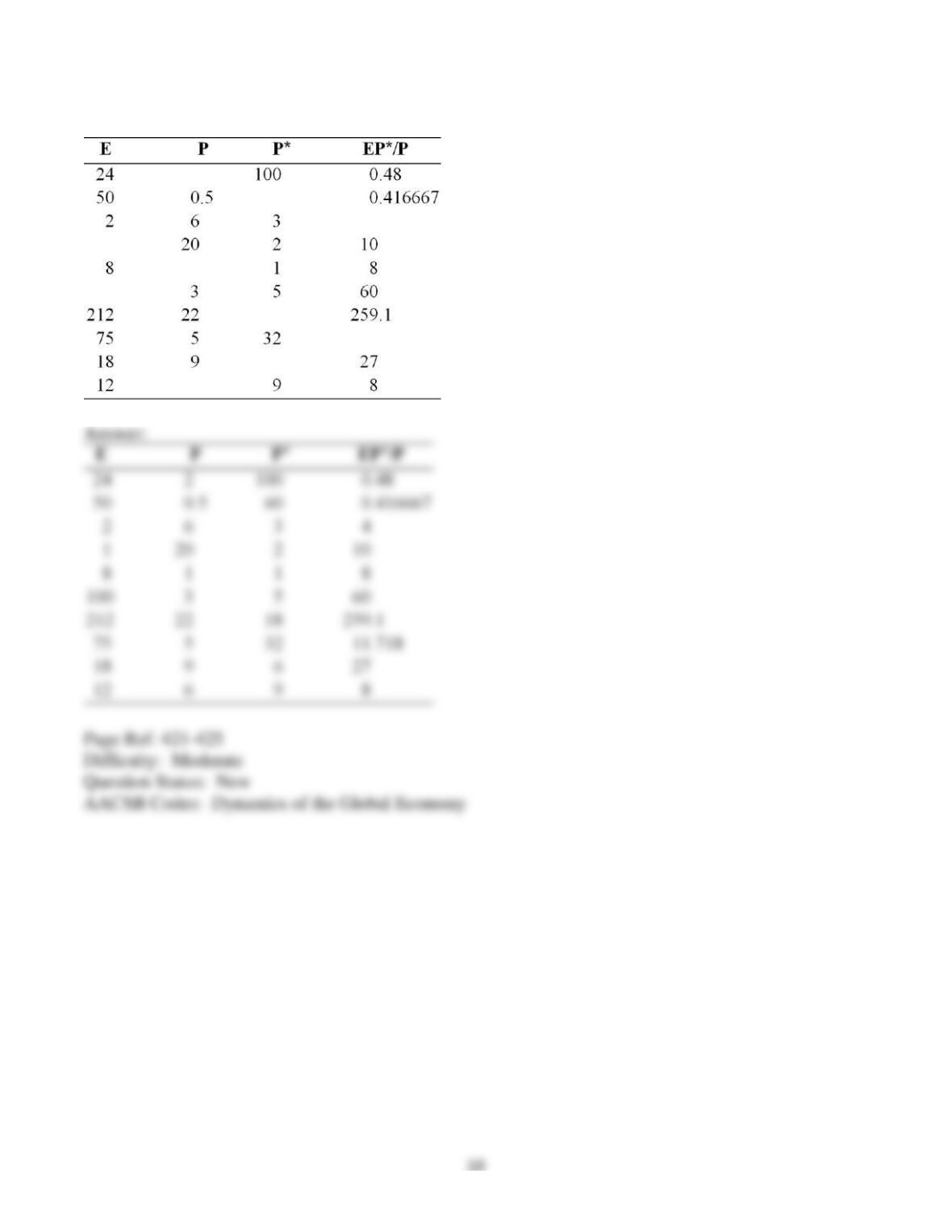
32) Fill in the following table.
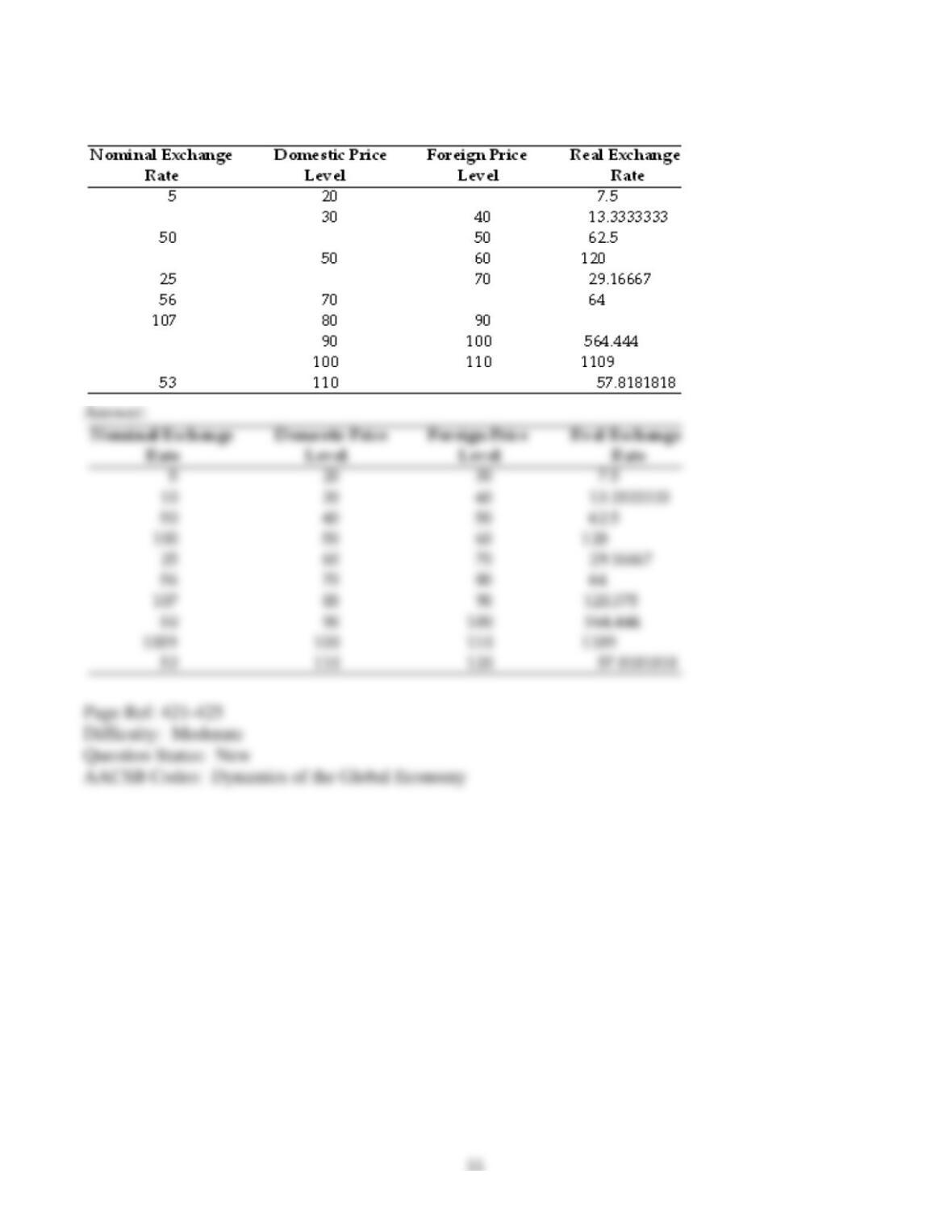
33) Fill in the following table.
17.2 The Equation of Aggregate Demand
1) How does a rise in real income affect aggregate demand?
A) Y ↑ implies Yd ↑ implies Im ↑ implies CA ↓ implies AD ↓, but Y ↑ implies Yd ↑ implies C ↑ implies
AD ↑ by more
B) Y ↑ implies Yd ↑ implies Im ↓ implies CA ↓ implies AD ↓, but Y ↑ implies Yd ↑ implies C ↑ implies
AD ↑ by more
C) Y ↑ implies Yd ↑ implies Im ↑ implies CA ↑ implies AD ↑, and Y ↑ implies Yd ↑ implies C ↑ implies
AD ↑
D) Y ↑ implies Yd ↑ implies Im ↑ implies CA ↓ implies AD ↓, but Y ↑ implies Yd ↑ implies C ↑ implies
AD ↑ by less
E) Y ↑ implies Yd ↑ implies Im ↓ implies CA ↓ implies AD ↓, but Y ↑ implies Yd ↑ implies C ↑ implies
AD ↑ by less
2) Which one of the following statements is the most accurate?
A) A rise in domestic real income raises aggregate demand for home output.
B) A rise in domestic real income decreases aggregate demand for home output because of the increase
demand for import.
C) A rise in domestic real income keeps aggregate demand for home output at the same level.
D) It is difficult to tell whether a rise in domestic real income affects positively or negatively aggregate
demand for home output.
E) A rise in domestic real income decreases aggregate demand for home output because the CA is
raised.
3) The aggregate demand for home input can be written as a function of:
I. Real exchange rate.
II. Government spending.
III. Disposable income.
A) I only
B) III only
C) I and III
D) II and III
E) I, II, and III
13
4) What is an accurate implication resulting from an increase in income?
A) an increase in exchange rate
B) a decrease in exchange rate
C) a decrease in consumption
D) a decrease in output
E) an increase in consumption
5) Explain how does a rise in real income affect aggregate demand?
6) Explain the difference between the following two expressions:
Y = C(Yd) + I + G + CA(EP /P, Yd) and
Y = C + I +G + CA
17.3 How Output Is Determined in the Short Run
1) Which one of the following statements is most accurate?
A) Factors of production can only be over-employed in the short run.
B) Factors of production can only be under-employed in the short run.
C) Factors of production can be over- or under-employed in the long run.
D) Factors of production can be over- or under-employed in the short run.
E) Factors of production are fully employed in the short run.
2) In the short-run, any rise in the real exchange rate, EP /P, will cause
A) an upward shift in the aggregate demand function and a reduction in output
B) an upward shift in the aggregate demand function and an expansion of output
C) a downward shift in the aggregate demand function and an expansion of output
D) an downward shift in the aggregate demand function and a reduction in output
E) an upward shift in the aggregate demand function but leaves output intact
3) In the short-run, any fall in EP /P, regardless of its causes, will cause
A) an upward shift in the aggregate demand function and an expansion of output
B) an upward shift in the aggregate demand function and a reduction in output
C) a downward shift in the aggregate demand function and an expansion of output
D) an downward shift in the aggregate demand function and a reduction in output
E) an upward shift in the aggregate demand function but leaves output intact
4) The unique output level in the short-run is found at the intersection of the following curves:
A) aggregate demand and aggregate supply
B) aggregate demand and 45 degree line
C) aggregate supply and 45 degree line
D) aggregate demand and short-run aggregate supply
E) aggregate supply and long-run demand
5) Why is the economy at full employment in the long run?
A) Only wages have the ability to adjust.
B) Only price can adjust.
C) Prices don’t adjust.
D) Wages and the price level eventually adjust to develop full employment.
E) Wages don’t adjust.
6) In the short-run, we assume that the money prices of goods and services are
A) temporarily fixed.
B) permanently fixed.
C) allowed to fluctuate.
D) equal to long-run prices.
E) fully employed.
7) What would be the best description of what we assume about money prices in the short run?
A) Money prices of goods and services vary.
B) Money prices of goods and services not related to each other.
C) Money prices of goods are fixed.
D) Money prices of services are fixed.
E) Money prices of goods and services are only temporarily fixed.
17.4 Output Market Equilibrium in the Short Run: The DD Schedule
1) In the short-run, a temporary increase in money supply
A) shifts the DD curve to the right, increases output and appreciates the currency.
B) shifts the AA curve to the left, increases output and depreciates the currency.
C) shifts the AA curve to the left, decreases output and depreciates the currency.
D) shifts the AA curve to the left, increases output and appreciates the currency.
E) shifts the AA curve to the right, increases output and depreciates the currency.
2) The DD schedule shows all combinations of which 2 variables so that the output market is in
equilibrium?
A) imports and exports
B) exports and the exchange rate
C) foreign prices and the exchange rate
D) output and the exchange rate
E) output and exports
3) Which of the following does not affect the position of the DD curve?
A) monetary policy
B) government spending
C) taxes
D) export Demand
E) price levels
4) Temporary tax cuts would cause
A) the AA-curve to shift left.
B) the AA-curve to shift right.
C) the DD-curve to shift left.
D) the DD-curve to shift right.
E) a shift in the AA-curve, although the direction is ambiguous.
5) How would you define a DD schedule?
A) the combinations of output and the exchange rate that must hold when the home money market and
the foreign exchange market are in equilibrium
B) the combinations of output and the exchange rate that must hold when the output market is in short-
run equilibrium
C) factors of production in the long run
D) the aggregate demand in relation to the foreign market value
E) the currency depreciation in relation to the exchange rate
6) Which of the following is the most accurate?
A) Any disturbance that lowers aggregate demand for domestic output shifts the DD schedule to the
right.
B) Any disturbance that lowers aggregate demand for foreign output shifts the DD schedule to the left.
C) Any disturbance that raises aggregate demand for domestic output shifts the DD schedule to the right.
D) Any disturbance that raises aggregate demand for domestic output shifts the DD schedule to the left.
E) Any disturbance that lowers aggregate demand for domestic output shifts the DD schedule
downward.
7) Discuss the main factors affecting the position of the DD schedule.
8) Give 4 examples of situations that would cause the DD-curve to shift to the left.
9) Explain what are the factors that shift the DD Schedule.
1) How is the AA schedule derived?
A) The AA schedule has a positive slope because an increase in output leads to a depreciation of the
currency.
B) The AA schedule has a negative slope because an increase in output leads to a decrease in the
domestic interest rate.
C) The AA schedule has a negative slope because an increase in output leads to an increase in the
domestic interest rate and a domestic currency appreciation.
D) The AA schedule has a positive slope because an increase in the money supply leads to an increase in
the domestic interest rate.
E) The AA schedule has a positive slope because a decrease in output leads to a depreciation of the
currency.
2) Which one of the following statements is most accurate?
A) In the long run, foreign output depends only on the available domestic supplies of factors of
production.
B) In the short run, domestic output depends only on the available domestic supplies of factors of
production.
C) In the long run, domestic output depends only on the available domestic supplies of factors of
production.
D) In the long run and in the short run, domestic output depends only on the available domestic supplies
of factors of production.
E) In the long run, domestic output depends only on the real exchange rate.
3) In the short-run, a temporary increase in the money supply
A) shifts the AA curve to the right, increases output and depreciates the currency.
B) shifts the AA curve to the left, increases output and depreciates the currency.
C) shifts the AA curve to the left, decreases output and depreciates the currency.
D) shifts the AA curve to the left, increases output and appreciates the currency.
E) shifts the AA curve to the right, increases output and appreciates the currency.
4) Which of the following equations does not state a condition required for equilibrium output:?
A) Y=C(Yd)+I+G+CA(EP*/P,Yd)
B) Y=C(Y-T)+I+G+CA(EP*/P,Y-T)
C) Y=D(EP*/P,Y-T,I,G)
D) R = R* + (EP/E)
E) Y=D(EP*/P,Yd,I,G)