College Accounting, 12e (Slater)
Chapter 16 Accounting for Property, Plant, Equipment, and Intangible Assets
16.1 Learning Objective 16-1
1) Which of the following assets would not be classified as property, plant, and equipment?
A) Delivery truck
B) Copyright
C) Land
D) Furniture
2) The amount to include in the entry to record the cost of a property, plant, and equipment asset would
include:
A) acquisition cost.
B) freight.
C) installation.
D) All of these answers are correct.
3) The entry to record the purchase of a machine on account that costs $20,000, set–up fees, $1,000, and
freight, $500, would be:
A) debit Machinery $20,000; credit Accounts Payable $20,000.
B) debit Machinery $21,500; credit Accounts Payable $21,500.
C) debit Machinery $20,000, debit Expenses $1,500; and credit Accounts Payable $21,500.
D) debit Machinery $20,500; credit Accounts Payable $20,500.
4) Which of the following is an example of a land improvement?
A) Shrubbery
B) Fences
C) Driveway
D) All of these answers are correct.
5) Mount Company purchased a machine at an invoice cost of $21,000 subject to terms of 3/10, n/30. The
discount was taken. Additional costs were installation, $1200; insurance on the machine after it was in
operation, $370. The total cost to be added to the machinery account is:
A) $21,940.
B) $21,000.
C) $21,570.
D) $20,740.
6) Chocolate Supreme purchased new baking equipment for $15,000 subject to terms 4/10, n/45. The
discount was taken. Additional costs included sales tax $900 and installation $300. The total cost to be
added to the machinery account is:
A) $15,900.
B) $15,300.
C) $15,000.
D) $15,600.
7) A company purchased new machinery and incurred freight, assembly, and installation costs in
addition to the invoice cost of the machinery. These additional costs should be debited to:
A) Cash.
B) Machinery.
C) Installation Expense.
D) Machinery Expense.
8) Which of the following is a non-depreciable asset?
A) Desk chairs
B) Land
C) Computer
D) Building
9) The cost of a plant asset was increased for the payment of this year’s insurance premium. This error
would cause:
A) the period’s net income to be overstated.
B) the period’s net income to be understated.
C) the period’s end assets to be understated.
D) None of these are correct.
10) The cost of a plant asset did not include installation costs that were expensed. This error would cause:
A) the period’s net income to be overstated.
B) the period’s net income to be understated.
C) the period end assets to be understated.
D) both B and C.
11) Assets that are not expected to provide benefits for a number of accounting periods are called:
A) current assets.
B) fixed assets.
C) long-term assets.
D) property, plant, and equipment.
12) Tangible assets include:
A) patents.
B) cash.
C) trademarks.
D) copyrights.
13) Costs and assessments that should be charged to the land account include:
A) streets.
B) parks.
C) flood prevention.
D) All should be included.
14) A company purchased new computer equipment from a local vendor. An employee offered to pick
up the equipment and received a speeding ticket on his way back to the office. The cost of the speeding
ticket should be charged to the cost of the equipment.
15) Assembly costs, and any other costs necessary to get a machine ready for operation, except for freight
costs, would be added to the cost of the machine.
16) If there are repairs needed in the process of installation, this should be charged to the cost of the
machine.
17) Land Improvements is an asset account that records improvements to land that have an unlimited
life.
18) A purchase of land and buildings would require the use of only one asset account, Land and
Buildings.
19) Land is depreciated based on the MACRS schedule.
20) R.J. Berkshire incurred the following expenditures to buy new equipment:
Invoice, subject to 3% discount $25,000
Installation cost 1,800
Insurance for equipment after installation 500
Sales tax 1,500
Discount taken
The amount the Equipment account will be debited for is ________.
21) Rockwell Industries purchased a plant asset to be used in its business. The expenditures included:
Cost of machine $ 8,000
Special concrete base to support machine 500
Freight charges 1,000
Repair cost of damage incurred during installation 300
The Machine account will be debited for ________.
16.2 Learning Objective 16-2
1) The cost of equipment is expensed:
A) at the time it is paid.
B) over the periods that benefit the company.
C) in the period it is purchased.
D) in the period it is sold.
2) In the last year of useful life, the salvage value was ignored using double–declining-balance
depreciation. This error would cause:
A) the period’s depreciation expense to be overstated.
B) the period’s depreciation expense to be understated.
C) the period end assets to be overstated.
D) None of these are correct.
3) When calculating declining balance depreciation, the straight-line rate was used instead of double the
straight-line rate. In the first year of ownership, this error would cause:
A) the period’s depreciation expense to be overstated.
B) the period’s depreciation expense to be understated.
C) the period end assets to be understated.
D) None of these are correct.
4) Salvage value was ignored when originally calculating the units–of–production depreciation. This error
would cause:
A) the period’s net income to be overstated.
B) the period’s net income to be understated.
C) the period end assets to be overstated.
D) None of these are correct.
5) The depreciation method which charges more expense in earlier years than in later years is the:
A) straight-line method.
B) double declining-balance method.
C) units-of-production method.
D) All of the above.
6) The depreciation method(s) in which an even amount of depreciation expense is taken each year is
(are) called:
A) straight-line method.
B) double declining-balance method.
C) units-of-production method.
D) All of the above.
7) The depreciation method that does not base the expense on the passage of time but on the level of use
is:
A) units-of-production.
B) straight-line.
C) modified accelerated cost recovery.
D) double-declining-balance.
8) Which depreciation method does not deduct residual value when computing depreciation expense?
A) Units-of–production
B) Straight-line
C) Double-declining-balance
D) Both A and B are correct.
9) Which depreciation method uses twice the straight-line rate?
A) Units-of–production
B) Modified accelerated cost recovery
C) Straight-line
D) Double-declining-balance
10) Assuming a useful life of five years, which of the following methods would most likely result in the
least depreciation in the first year?
A) Straight-line
B) MACRS
C) Double-declining-balance
D) None of these answers are correct.
11) Which depreciation method uses the current book value in determining depreciation?
A) Straight-line
B) MACRS
C) Units-of-production
D) Double-declining balance
12) The cost of an asset less its accumulated depreciation is called:
A) residual value.
B) salvage value.
C) market value.
D) book value.
13) Josh Kindel purchased equipment for $60,000 on January 1. Its residual value is $4,000 with a useful
life of 8 years. The amount of depreciation expense in the first year under the double–declining-balance
method is:
A) $14,000.
B) $ 7,500.
C) $ 7,000.
D) $15,000.
14) Lacy purchased equipment for $77,000 on January 1. Its residual value is $5,000 with a useful life of 9
years. The amount of depreciation expense in the first year under the straight-line method is:
A) $8,556.
B) $8,000.
C) $16,940.
D) $15,840.
15) Jason Moore purchased computer equipment for $2,800 on January 1, 2012. It has a residual value of
$400 with a useful life of 4 years. After the appropriate adjusting entries have been made, the balance in
Accumulated Depreciation account for this asset on January 1, 2014, under the straight-line method,
should be:
A) $1,200.
B) $600.
C) $700.
D) $1,400.
16) J. Long purchased computer equipment for $5,000 on January 1, 200x. It has a residual value of $500
with a useful life of 5 years. After the appropriate adjusting entries are made, the book value of the asset
on December 31, 200x, under the double-declining-balance method, is:
A) $4,000.
B) $3,200.
C) $3,000.
D) $4,100.
17) Straight-line depreciation is used in the first year when double-declining-balance should be used. This
error would cause:
A) the period’s net income to be overstated.
B) the period’s net income to be understated.
C) the period end assets to be understated.
D) None of these are correct.
18) What would the depreciation expense be in year 3 for a computer system using the straight-line
method when cost is $5,000, residual value is $1,000, and the expected life is 4 years?
A) $2,000
B) $1,500
C) $1,250
D) $1,000
19) What would be the depreciation expense using double-declining-balance to compute the expense for
year 2 of a machine costing $15,000, when residual value is $5,000, and useful life is 5 years?
A) $3,600
B) $6,000
C) $5,000
D) $3,000
20) What would be the depreciation expense in year 1, using units–of-production, for a molding machine
that cost $18,000, had a useful life of 3 years, no residual value, and an estimated total machine hours of
36,000? Production in year 1 was 10,000 hours.
A) $2,667
B) $4,000
C) $6,000
D) $5,000
21) What would be the depreciation expense in year 1, using units–of-production, for a molding machine
that cost $18,000, had a useful life of 3 years, and an estimated total machine hours of 36,000? The salvage
value is $3,000 and production in year 1 was 10,000 hours.
A) $5,000
B) $4,167
C) $6,000
D) $2,167
22) Talarico’s Subs purchased a new van for $25,000, its estimated useful life at 100,000 miles, residual
value of $5,000. The van was driven 15,000 miles in year 1. What is the depreciation expense in year 1?
A) $6,667
B) $3,000
C) $3,750
D) $4,000
23) Double-declining-balance method is used in the first year when straight-line should be used. This
error would cause:
A) the period’s net income to be overstated.
B) the period’s net income to be understated.
C) the period end assets to be overstated.
D) None of these are correct.
24) What would the accumulated depreciation at the end of year 3 for a computer system using the
straight-line method when cost is $5,000, residual value is $1,000, and the expected life is 4 years?
A) $1,000
B) $1,250
C) $3,000
D) $3,750
25) A plant asset is fully depreciated when the book value is:
A) greater than the salvage value.
B) greater than the market value.
C) equal to the salvage value.
D) equal to the market value.
26) What would the book value be at the end of year 3 for a computer system using the straight-line
method when cost is $5,000, residual value is $1,000, and the expected life is 4 years?
A) $2,000
B) $1,500
C) $1,250
D) $1,000
27) The amortization method and double-declining-balance method are both accelerated depreciation
methods.
28) The units-of-production method does not take into account the passage of time.
29) To calculate the double-declining-balance rate, you would divide 2 by the number of years of useful
life.
30) Net income is affected by the depreciation method used.
31) Tender Years purchased a new van on January 1, 200x, for $40,000. The life of the van is 4 years or
100,000 miles, with an estimated residual value of $5,000. During the first year, the van was driven 20,000
miles. Compute the depreciation expense for the first year applying each of the methods below.
a) ________ Straight-line
b) ________ Units-of-production
c) ________ Double-declining-balance
32) Yamara Company purchased a $75,000 machine at the beginning of the year. The machine is expected
to have a useful life of 5 years or 40,000 operating hours and a residual value of $15,000. The machine was
used for 6,000 hours in the first year and 4,400 hours in the second year. Compute the amount of
depreciation expense for the first and second years under each of the methods below.
Year 1 Year 2 Method
a) $ ________ $ ________ Straight-line
b) $ ________ $ ________ Units-of-production
c) $ ________ $ ________ Double-declining-balance
33) Assume an asset costing $72,000 is expected to produce 400,000 units and have a salvage value of
$6,000. During year 1, 75,000 units were produced; during year 2, 68,000 units were produced; and during
year 3, 70,000 units were produced. Using units–of-production, compute the depreciation expense for
each of the three years.
34) A car is purchased for $25,000 on January 1. It has a 4-year life and a salvage value of $1,000. Compute
the annual depreciation expense using the double-declining-balance method for all 4 years.
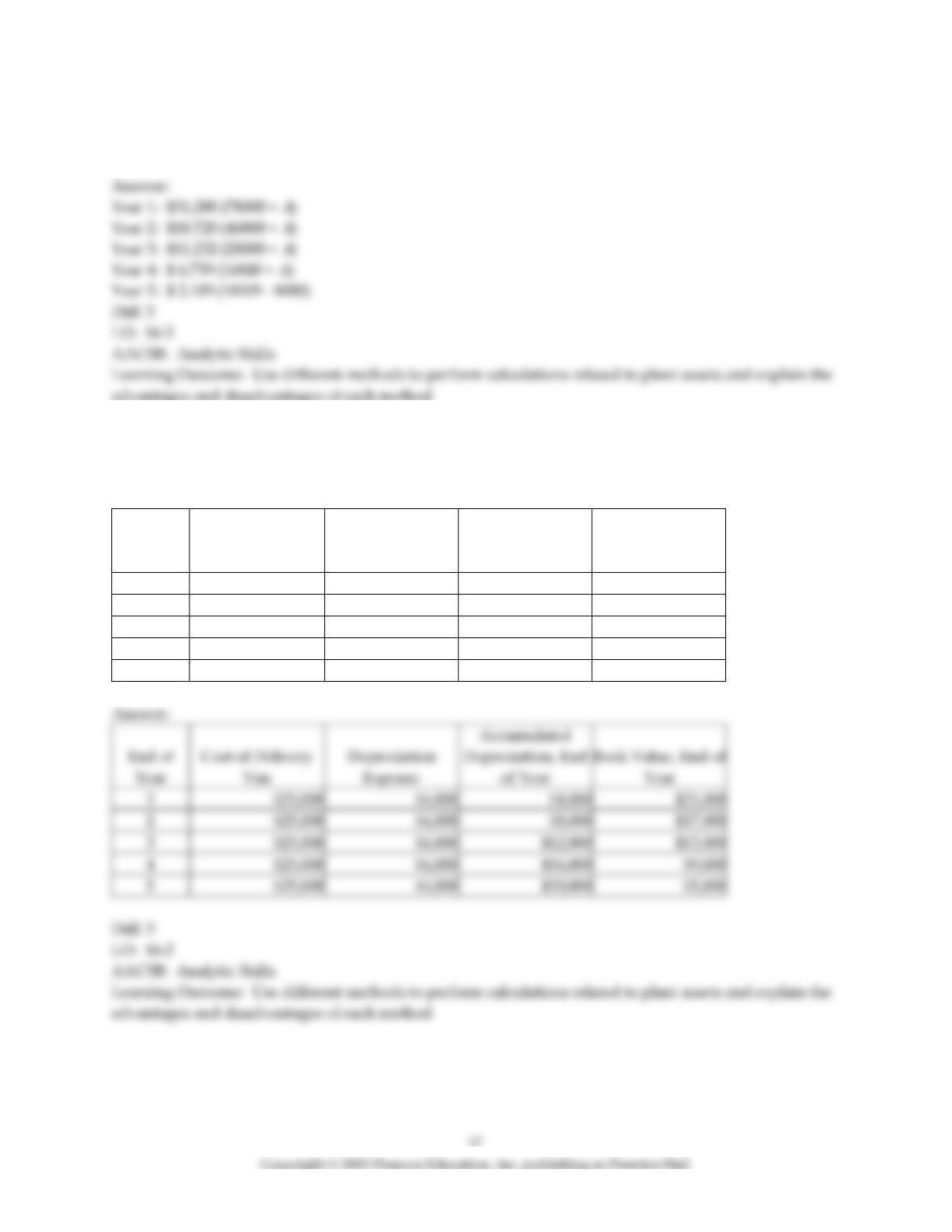
35) A piece of equipment is purchased for $78,000 on January 1. It has a 5-year life and a salvage value of
$8,000. Compute the annual depreciation expense using the double-declining-balance method for all 5
years.
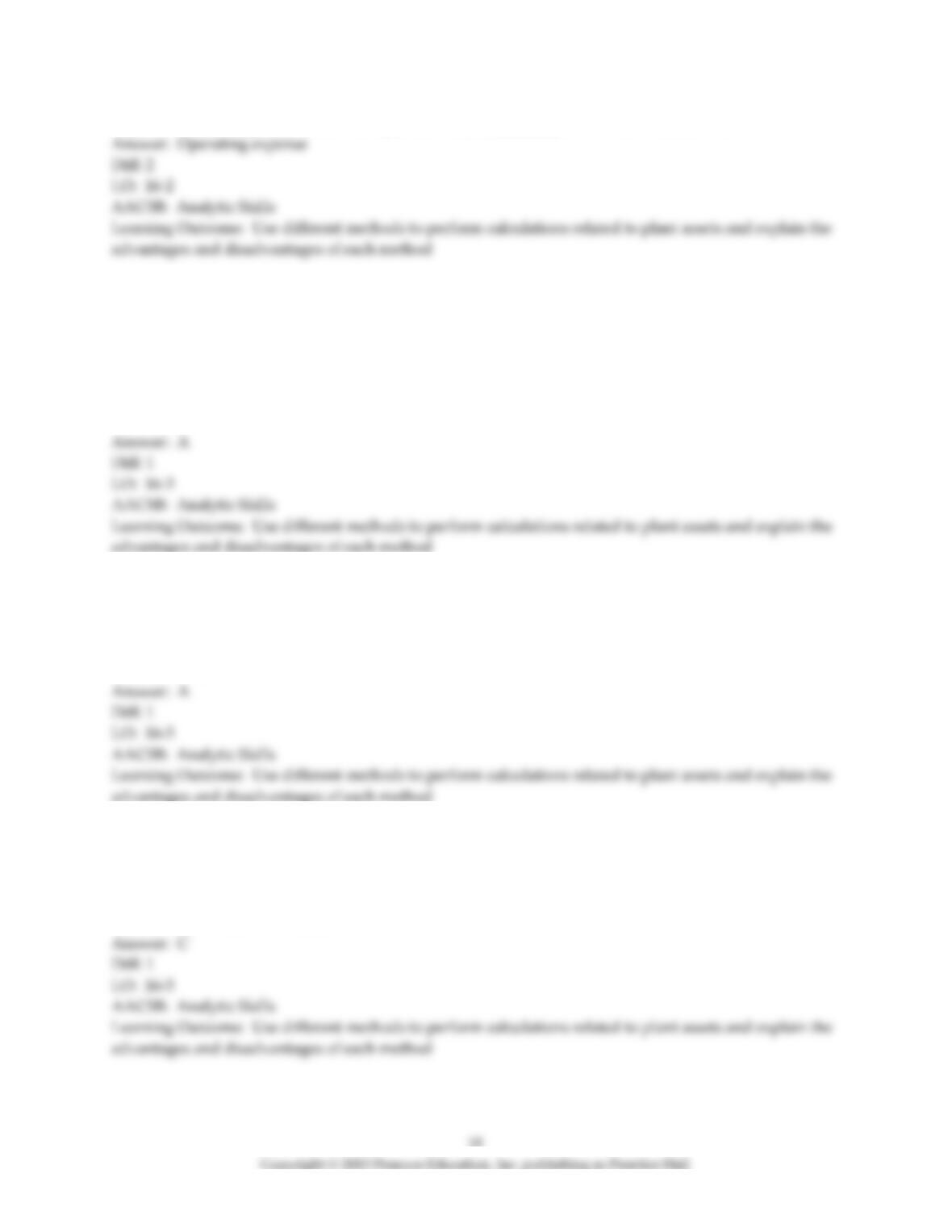
36) A company purchased a new delivery van on January 1, 2012 for $25,000. The company expects to use
the van for 5 years and then sell it for $5,000. Complete the following depreciation table assuming
straight-line depreciation:
End of
Year
Cost of Delivery
Van
Depreciation
Expense
Accumulated
Depreciation, End
of Year
Book Value, End of
Year
1
2
3
4
5
End of
Cost of Delivery
Depreciation
Depreciation, End
Book Value, End of
1
2
3
4
5
37) Accumulated depletion should be reported as a(an) ________ on the income statement.
16.3 Learning Objective 16-3
1) Using MACRS rates for a 3, 5, 7, and 10-year property, what is the percentage for the depreciable rate?
A) 200 percent
B) 150 percent
C) 125 percent
D) 100 percent
2) According to the MACRS tax rate table, the following classes use straight-line depreciation:
A) residential rental property.
B) automobiles.
C) railroad tracks.
D) race horses.
3) Under MACRS, the salvage value is:
A) added to the straight-line depreciation.
B) subtracted from the cost of the asset.
C) ignored.
D) added to the cost of the asset.
4) A tractor costing $80,000 is depreciated using MACRS. The tractor qualifies as a 3-year property, and
has a scrap value of $20,000. The depreciation rates are:
Year 1:
33.33%
Year 2:
44.45%
Year 3:
14.81%
Year 4:
7.41%
What is the depreciation expense for year 2?
A) $44,450
B) $35,560
C) $26,670
D) $20,000
5) A depreciation method that allocates depreciation of a plant asset based on the Tax Act of 1989 is the:
A) straight-line method.
B) units-of-production method.
C) modified accelerated cost recovery method.
D) double-declining-balance method.
6) For tax purposes, residential real property is depreciated using the straight-line method under
MACRS.
7) Under MACRS, furniture is depreciated over five years.
8) Two depreciation methods that ignore the salvage value are ________ and ________.
9) For tax purposes, ________ establishes the guidelines and the percentages for depreciation.
16.4 Learning Objective 16-4
1) Capital expenditures would include:
A) additions.
B) betterments.
C) extraordinary repairs.
D) All of these answers are correct.
2) Revenue expenditures include:
A) additions to existing plant assets.
B) periodic normal maintenance costs.
C) initial costs of acquiring plant assets.
D) All of these answers are correct.