International Economics, 9e (Krugman et al.)
Chapter 16 Price Levels and the Exchange Rate in the Long Run
16.1 The Law of One Price
1) Which of the following statements is the most accurate? The law of one price states:
A) in competitive markets free of transportation costs and official barrier to trade, identical goods sold in
different countries must sell for the same price when their prices are expressed in terms of the same
currency.
B) in competitive markets free of transportation costs and official barrier to trade, identical goods sold in
the same country must sell for the same price when their prices are expressed in terms of the same
currency.
C) in competitive markets free of transportation costs and official barrier to trade, identical goods sold in
different countries must sell for the same price.
D) identical goods sold in different countries must sell for the same price when their prices are
expressed in terms of the same currency.
E) in competitive markets free of official barrier to trade, identical goods are sold at the same price
regardless of transportation costs.
2) Under Purchasing Power Parity,
A) E$/E = PUS/PE.
B) E$/E = PE/PES.
C) E$/E = PUS + PE.
D) E$/E = PUS – PE.
E) E$/P = PUS/PE.
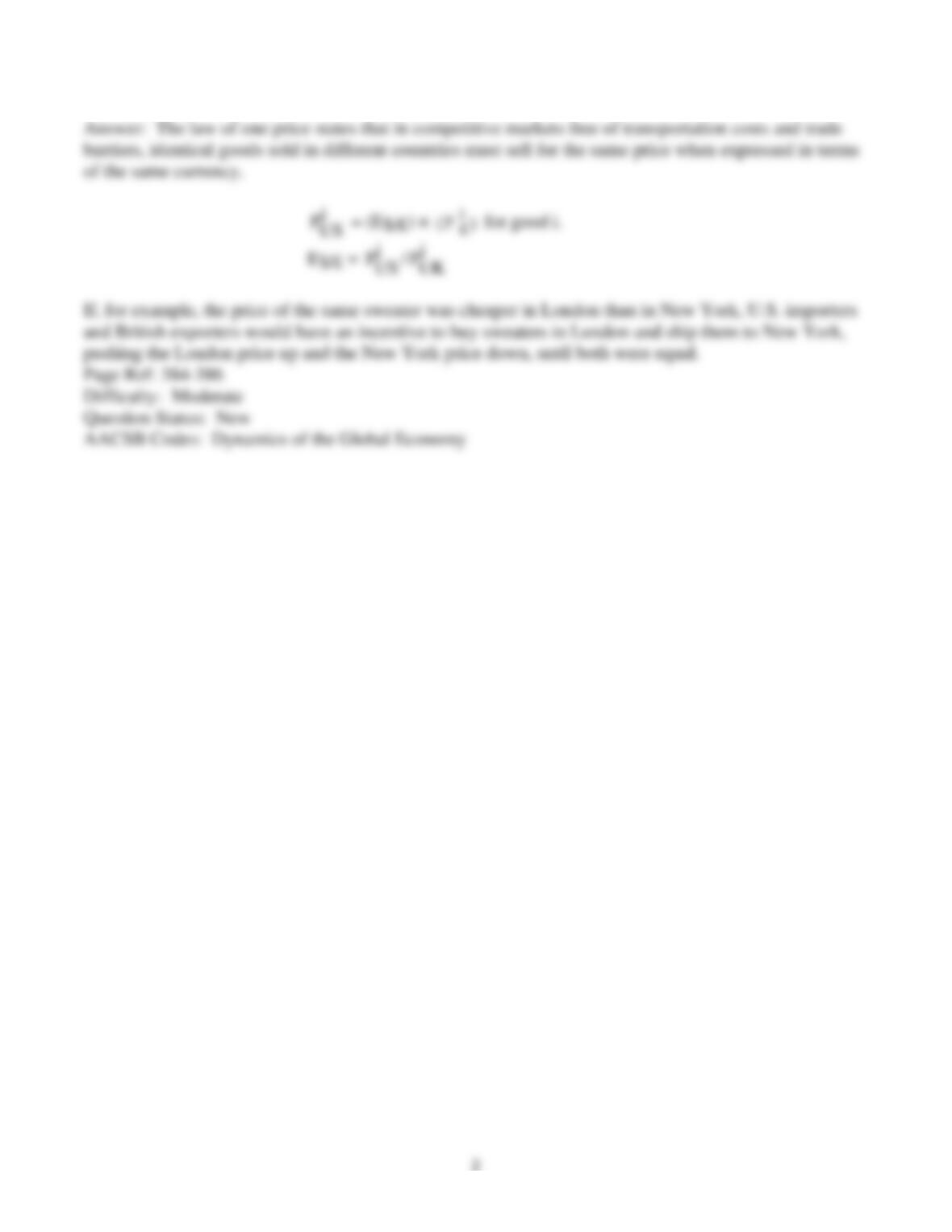
3) Explain the Law of One Price. Give an example.
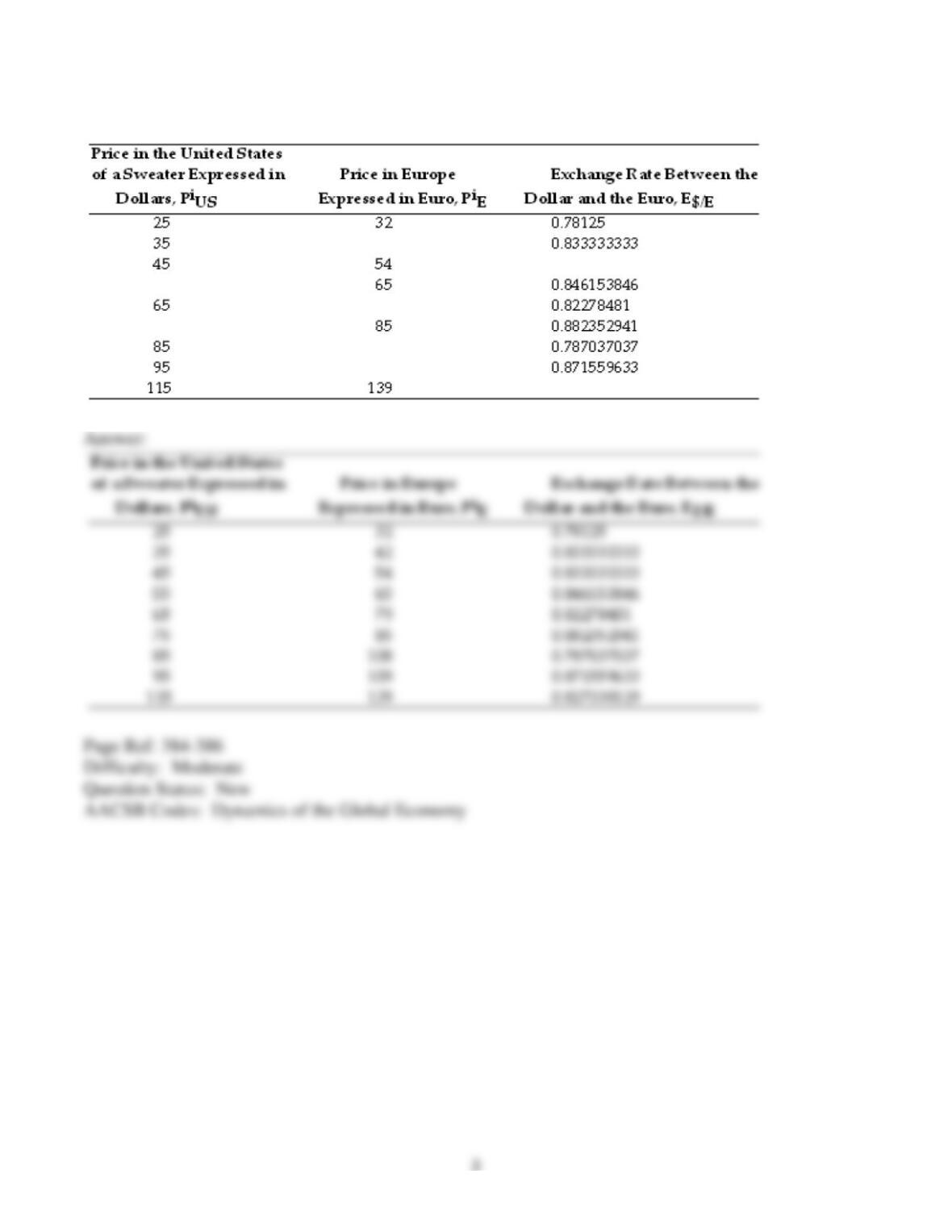
4) Fill in the following table, assuming the law of one price prevails.
16.2 Purchasing Power Parity
1) Under Purchasing Power Parity,
A) E$/E = PiUS/PiE.
B) E$/E = PiE/PiUS.
C) E$/E = PUS/PE.
D) E$/E = PE/PES.
E) E$/E = PiE + PiUS/PiE.
2) Which of the following statements is the most accurate?
A) The law of one price applies only to the general price level.
B) The law of one price applies to the general price level while PPP applies to individual commodities.
C) The law of one price applies to individual commodities while PPP applies to both the general price
level and to individual commodities.
D) PPP applies only to individual commodities.
E) The law of one price applies to individual commodities while PPP applies to the general price level.
3) Which of the following statements is the most accurate?
A) If PPP holds true, then the law of one price holds true for every commodity as long as the reference
baskets used to reckon different countries’ price levels are the same.
B) If the law of one price holds true for every commodity, PPP must hold automatically.
C) If the law of one price holds true for every commodity, PPP must automatically hold as long as the
reference baskets used to reckon different countries’ price levels are the same.
D) If the law of one price does not hold true for every commodity, PPP cannot be true as long as the
reference baskets used to reckon different countries’ price levels are the same.
E) If PPP holds true, then the law of one price must hold true automatically.
4) Which of the following statements is the most accurate?
A) Absolute PPP does not imply relative PPP.
B) Relative PPP implies absolute PPP.
C) There is no causality relation between the two.
D) Absolute PPP implies relative PPP.
E) Absolute PPP is inversely related to relative PPP.
5) Which of the following statements is the most accurate?
A) Relative PPP may be valid even when absolute PPP is not, provided the factors causing deviations
from absolute PPP are more or less stable over different commodities space.
B) Absolute PPP may be valid even when relative PPP is not, provided the factors causing deviations
from relative PPP are more or less stable over time.
C) Relative PPP may be valid even when absolute PPP is not, provided the factors causing deviations
from absolute PPP are more or less stable over time.
D) Relative PPP is not valid when absolute PPP is not.
E) Relative PPP is only valid when absolute PPP is valid, providing the factors causing deviations from
relative PPP are more or less stable over time.
6) Explain Purchasing Power Parity.
7) Discuss the relationship between PPP and the Law of One Price.
8) Discuss the differences between Absolute PPP and Relative PPP.
9) Explain why Relative PPP is useful when comparing countries that base their price levels on different
product baskets.
10) Suppose Russia’s inflation rate is 200% over one year but the inflation rate in Switzerland is only
2%. According to relative PPP, what should happen over the year to the Swiss franc’s exchange rate
against the Russian ruble?
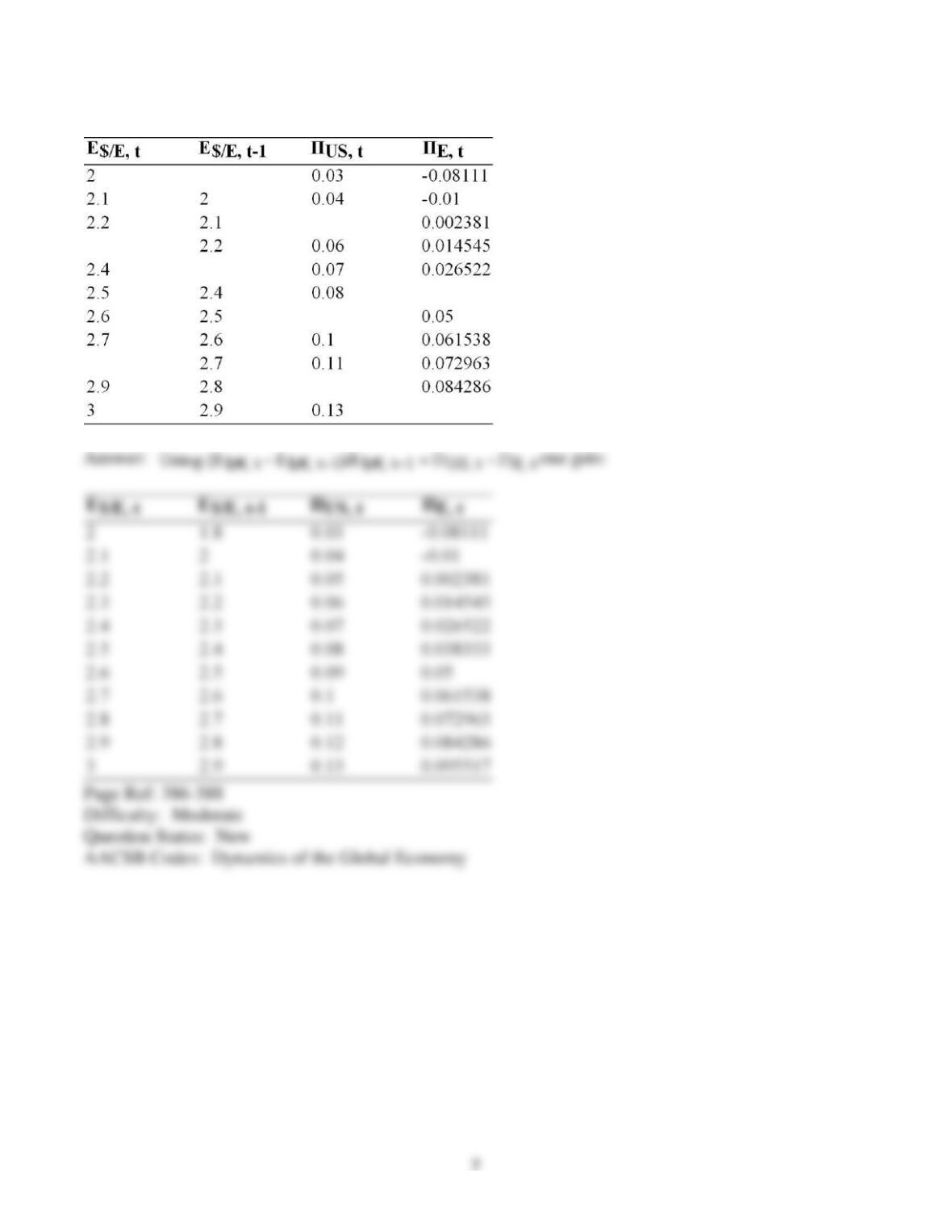
11) Assuming relative PPP, fill in the table below:
16.3 A Long–Run Exchange Rate Model Based on PPP
1) In order for the condition E$/HK$ = PUS/PHK to hold, what assumptions does the principle of
purchasing power parity make?
A) Only that there are no transportation costs and restrictions on trade.
B) Only that the markets are perfectly competitive, i.e., P = MC.
C) The factors of production are identical between countries.
D) No arbitrage exists.
E) HK and US are perfectly competitive and there are no transportation costs or restrictions on trade.
2) Which of the following statements is the most accurate?
A) In the long run, national price levels play a minor role in determining both interest rates and the
relative prices at which countries’ products are traded.
B) In the long run, national price levels play a key role only in determining interest rates.
C) In the long run, national price levels play a key role only in determining the relative prices at which
countries’ products are traded.
D) In the long run, national price levels play a key role in determining both interest rates and the relative
prices at which countries’ products are traded.
E) In the long run, national price levels play no role in determining interest rates and the relative prices
at which countries’ products are traded.
3) Which of the following statements is the most accurate? In general,
A) the monetary approach to the exchange rate is a long run theory.
B) the monetary approach to the exchange rate is a short run theory.
C) the monetary approach to the exchange rate is both a short and long run theory.
D) the monetary approach to the exchange rate neither long run nor short run theory.
E) the monetary approach to the exchange rate is considered less practical than the law of one price.
4) The monetary approach makes the general prediction that
A) the exchange rate, which is the relative price of American and European money, is fully determined
in the long run by the relative supplies of those monies.
B) the exchange rate, which is the relative price of American and European money, is fully determined
in the short run by the relative supplies of those monies and the relative demands for them.
C) the exchange rate, which is the relative price of American and European money, is fully determined
in the short run and long run by the relative supplies of those monies and the relative demands for them.
D) the exchange rate, which is the relative price of American and European money, is fully determined
in the long run by the relative supplies of those monies and the relative demands for them.
E) the money supply in the U.S. will adjust to European monetary equilibrium.
5) Under the monetary approach to the exchange rate theory, money supply growth at a constant rate
A) eventually results in ongoing price level deflation at the same rate, but changes in this long-run
deflation rate do not affect the full-employment output level or the long-run relative prices of goods and
services.
B) eventually results in ongoing price level inflation at the same rate, but changes in this long-run
inflation rate do affect the full-employment output level and the long-run relative prices of goods and
services.
C) eventually results in ongoing price level inflation at the same rate, but changes in this long-run
inflation rate do not affect the full-employment output level or the long-run relative prices of goods and
services.
D) eventually results in ongoing price level inflation at the same rate, but changes in this long-run
inflation rate do not affect the full-employment output level, only the long-run relative prices of goods
and services.
E) eventually results in ongoing price level deflation at the same rate, but changes in this long-run
deflation rate do not affect the full-employment output level, only the long-run relative prices of goods
and services.
6) Which of the following statements is the most accurate? In general, under the monetary approach to
the exchange rate,
A) the interest rate is not independent of the money supply growth rate in the short run.
B) the interest rate is independent of the money supply growth rate in the long run.
C) the interest rate is not independent of the money supply growth rate in the long run, but independent
in the short run.
D) the interest rate is not independent of the money supply growth rate in the long run.
E) the interest rate is a factor of the money supply growth rate only in the short term.
7) Which of the following statements is the most accurate? In general, under the monetary approach to
the exchange rate,
A) while the short-run interest rate does not depend on the absolute level of the money supply,
continuing growth in the money supply eventually will affect the interest rate.
B) while the long-run interest rate does depend on the absolute level of the money supply, continuing
growth in the money supply do not affect the interest rate.
C) while the long-run interest rate does not depend on the absolute level of the money supply, continuing
growth in the money supply eventually will affect the interest rate.
D) the long-run interest rate does not depend on the absolute level of the money supply, and thus
continuing growth in the money supply will not affect the interest rate.
E) while the short-run interest rate does not depend on the absolute level of the money supply,
continuing decline in the money supply eventually will not affect the interest rate.
8) Who among the following list of people is an early 20th century economist from Yale University who
wrote the book The Theory of Interest?
A) Gustav Cassel
B) Irving Fisher
C) David Ricardo
D) Paul Krugman
E) Israel Kirzner
9) If people expect relative PPP to hold,
A) the difference between the interest rates offered by dollar and euro deposits will equal the difference
between the inflation rates expected, in the United States and Europe, respectively, over the relevant
horizon.
B) the difference between the interest rates offered by dollar and euro deposits will equal the difference
between the inflation rates expected in Europe and the United States, respectively.
C) the difference between the interest rates offered by dollar and euro deposits will equal the difference
between the inflation rates expected, over the relevant horizon, in the United States and Europe,
respectively, in the short run.
D) the difference between the interest rates offered by dollar and euro deposits will be above the
difference between the inflation rates expected, over the relevant horizon, in the United States and
Europe, respectively.
E) the difference between the interest rates offered by dollar and euro deposits will be below the
difference between the inflation rates expected, over the relevant horizon, in the United States and
Europe, respectively.
10) Under PPP (and by the Fisher Effect), all else equal,
A) a rise in a country’s expected inflation rate will eventually cause a more-than proportional rise in the
interest rate that deposits of its currency offer in order to accommodate for the higher inflation.
B) a fall in a country’s expected inflation rate will eventually cause an equal rise in the interest rate that
deposits of its currency offer.
C) a rise in a country’s expected inflation rate will eventually cause an equal rise in the interest rate that
deposits of its currency offer.
D) a rise in a country’s expected inflation rate will eventually cause a less than proportional rise in the
interest rate that deposits of its currency offer to accommodate the rise in expected inflation.
E) a fall in a country’s expected inflation rate will eventually cause an inversely proportional rise in the
interest rate that deposits of its currency offer to accommodate the rise in expected inflation.
11) In the short run,
A) the interest rate can rise when the domestic money supply falls.
B) the interest rate can decrease when the domestic money supply falls.
C) the interest rate stays constant when the domestic money supply falls.
D) the interest rate rises in the same proportion as the domestic money supply falls.
E) the interest rate never rises when the domestic money supply falls.
12) Under a flexible-price monetary approach to the exchange rate,
A) when the domestic money supply falls, the price level would eventually fall, increasing the interest
rate.
B) when the domestic money supply falls, the price level would fall right away, causing a reduction in
the interest rate.
C) when the domestic money supply falls, the price level would fall right away, causing an increase in
the interest rate.
D) when the domestic money supply falls, the price level would eventually fall, keeping the interest rate
constant.
E) when the domestic money supply falls, the price level would fall right away, keeping the interest rate
constant.
13) Under sticky prices,
A) a fall in the money supply raises the interest rate to preserve money market equilibrium.
B) a fall in the money supply reduces the interest rate to preserve money market equilibrium.
C) a fall in the money supply keeps the interest rate intact to preserve money market equilibrium.
D) a fall in the money supply does not affect the interest rate in the short run, only in the long run.
E) a fall in the money supply raises the interest rate to preserve money market equilibrium in the long
run.
14) Under sticky prices,
A) an interest rate rise is associated with lower expected deflation and a long-run currency appreciation,
so the currency appreciates immediately.
B) an interest rate rise is associated with higher expected inflation and a long-run currency appreciation,
so the currency appreciates immediately.
C) an interest rate rise is associated with lower expected inflation and a long-run currency depreciation,
so the currency appreciates immediately.
D) an interest rate rise is associated with lower expected inflation and a long-run currency depreciation,
so the currency depreciates immediately.
E) an interest rate rise is associated with lower expected inflation and a long-run currency appreciation,
so the currency appreciates immediately.
15) Under the monetary approach to the exchange rate,
A) an interest rate decrease is associated with higher expected inflation and a currency that will be
weaker on all future dates.
B) an interest rate increase is associated with higher expected deflation and a currency that will be
weaker on all future dates.
C) an interest rate increase is associated with higher expected inflation and a currency that will be
strengthened on all future dates.
D) an interest rate increase is associated with higher expected deflation and a currency that will be
strengthened on all future dates.
E) an interest rate increase is associated with higher expected inflation and a currency that will be
weaker on all future dates.
16) Under the monetary approach to the exchange rate,
A) a reduction in the money supply will cause immediate currency depreciation.
B) a rise in the money supply will cause currency depreciation.
C) a rise in the money supply will cause immediate currency appreciation.
D) a rise in the money supply will cause depreciation.
E) a rise in the money supply will cause immediate currency depreciation.
17) Explain why exchange rate model based on PPP is a long run theory.
18) Present and explain the Fundamental Equation of the Monetary Approach.
19) What are the predictions for the long run equilibrium of the Monetary Approach?
20) Discuss the effects of ongoing inflation based on the PPP theory.
21) Describe and explain the relationship between expected inflation rates in two countries and their
interest rate differential according to the PPP theory.
16
22) What is the Fisher Effect? Provide an example.
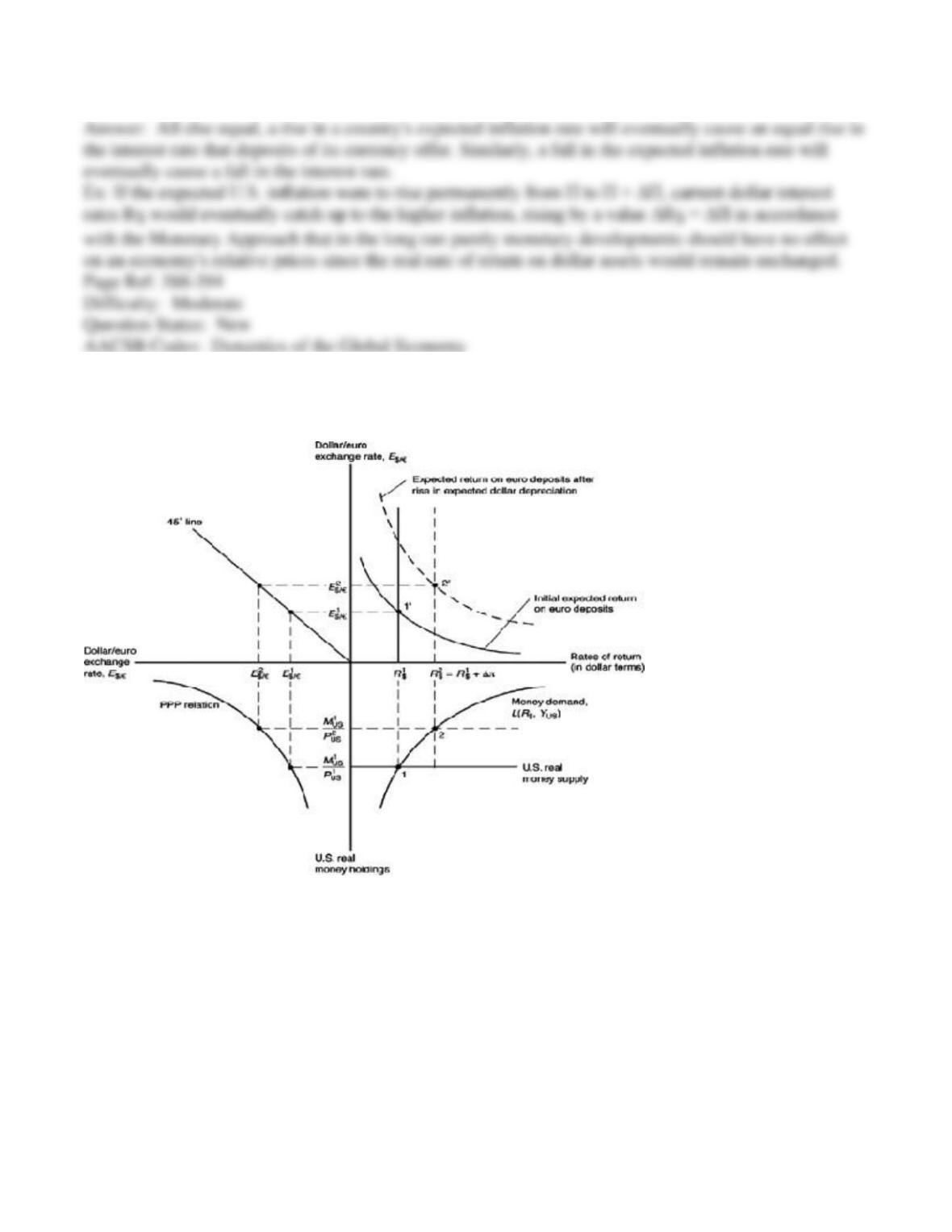
23) To answer the following question, please refer to the figure below. Concentrating only at the lower
right quadrant, discuss the effects of a change in U.S. expected inflation.