International Economics, 10e (Krugman/Obstfeld/Melitz)
Chapter 15 (4) Money, Interest Rates, and Exchange Rates
15.1 Money Defined: A Brief Review
1) The exchange rate between currencies depends on
A) the interest rate that can be earned on deposits of those currencies.
B) the interest rate that can be earned on deposits of those currencies and the expected future
exchange rate.
C) the expected future exchange rate.
D) national output.
E) the interest rate that can be earned on deposits of those countries and the national output.
2) Money serves as all of the following EXCEPT
A) a medium of exchange.
B) a unit of account.
C) a store of value.
D) a symbol that is made of or can be redeemed for a fixed amount of precious metal.
E) a highly liquid asset.
3) Money includes
A) currency.
B) checking deposits held by households and firms.
C) deposits in the foreign exchange markets.
D) currency and checking deposits held by households and firms.
E) futures and deposits in the foreign exchange market.
4) In the United States at the end of 2012, the total money supply, M1, amounted to
approximately
A) 16 percent of that year’s GNP.
B) 20 percent of that year’s GNP.
C) 30 percent of that year’s GNP.
D) 40 percent of that year’s GNP.
E) 50 percent of that year’s GNP.
5) What are the main functions of money?
15.2 The Demand for Money by Individuals
1) Individuals base their demand for an asset on
A) the expected return the asset offers compared with the returns offered by other assets.
B) the riskiness of the asset’s expected return.
C) the asset’s liquidity.
D) the expected return, how risky that expected return is, and the asset’s liquidity.
E) the aesthetic qualities of the asset.
2) A family’s summer house on Cape Cod pays a return in the form of
A) interest rate.
B) capital gains.
C) the pleasure of vacations at the beach.
D) stock options.
E) capital gains and pleasure.
3) In a world with money and bonds only
A) it is not risky to hold money.
B) it is risky to hold money.
C) risk is an important factor in the demand for money.
D) there is no relationship between risk and holding money.
E) assets become meaningless.
4) Which one of the following statements is the MOST accurate?
A) A rise in the average value of transactions carried out by a household or a firm causes its
demand for money to fall.
B) A reduction in the average value of transactions carried out by a household or a firm causes
its demand for money to rise.
C) A rise in the average value of transactions carried out by a household or a firm causes its
demand for money to rise.
D) A rise in the average value of transactions carried out by a household or a firm causes its
demand for real money to rise.
E) a decrease in the average value of transactions carried out by a household or a firm causes its
demand for real money to rise.
5) An individual’s need for liquidity would increase if
A) the average value of transactions carried out by the individual fell.
B) the average value of transactions carried out by the individual rose.
C) the individual got a raise.
D) the individual received a new ATM card.
E) the individual wanted to avoid risks.
6) What are the factors that determine the amount of money an individual desires to hold?
15.3 Aggregate Money Demand
1) The aggregate money demand depends on
A) the interest rate.
B) the price level.
C) real national income.
D) the interest rate, price level, and real national income.
E) the price level and the liquidity of the asset.
2) If there is initially an
A) excess demand for money, the interest rate will fall, and the supply of money it will rise.
B) excess supply of money, the interest rate will fall, and if there is initially an excess demand, it
will rise.
C) excess supply of money, the interest rate will rise, and if there is initially an excess demand, it
will fall.
D) excess supply of money, the interest rate will fall, and if there is also an excess demand, it
will fall rapidly.
E) excess supply of money, the interest rate will rise, and if there is also an excess demand, it
will rise rapidly.
3) Which one of the following statements is the MOST accurate?
A) A decrease in the money supply lowers the interest rate while an increase in the money
supply raises the interest rate, given the price level and output.
B) An increase in the money supply lowers the interest rate while a fall in the money supply
raises the interest rate, given the price level.
C) An increase in the money supply lowers the interest rate while a fall in the money supply
raises the interest rate, given the output level.
D) An increase in the money supply lowers the interest rate while a fall in the money supply
raises the interest rate, given the price level and output.
E) An increase in the money supply does not usually affect the interest rate.
4) An increase in
A) nominal output raises the interest rate while a fall in real output lowers the interest rate, given
the price level and the money supply.
B) real output decreases the interest rate while a fall in real output increases the interest rate,
given the price level.
C) real output raises the interest rate while a fall in real output lowers the interest rate, given the
money supply.
D) nominal output raises the interest rate while a fall in real output lowers the interest rate, given
the price level.
E) real output raises the interest rate while a fall in real output lowers the interest rate, given the
price level and the money supply.
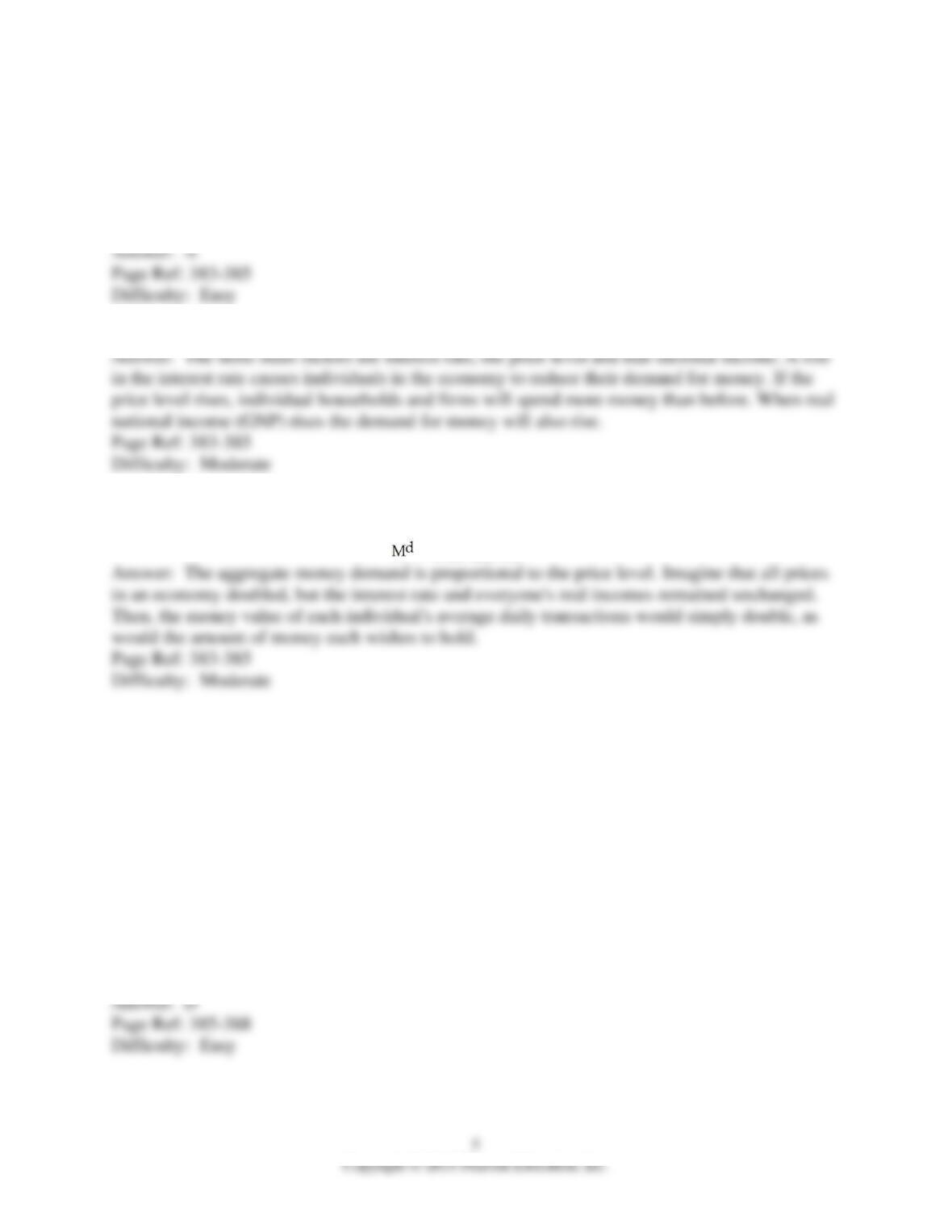
5) The aggregate demand for money can be expressed by
A) Md = P × L(R,Y).
B) Md = L × P(R,Y).
C) Md = P × Y(R, L).
D) Md = R × L(P,Y).
E) Md = R × L(R, P).
6) What are the main factors that determine aggregate money demand?
7) Explain why one can write the demand for money as the price level times a function of the
interest rate and real income as follows:
= PxL (R, Y)
15.4 The Equilibrium Interest Rate: The Interaction of Money Supply and Demand
1) The aggregate real money demand schedule L(R,Y)
A) slopes upward because a fall in the interest rate raises the desired real money holdings of each
household and firm in the economy.
B) slopes downward because a fall in the interest rate reduces the desired real money holdings of
each household and firm in the economy.
C) has a zero slope because a fall in the interest rate keeps constant the desired real money
holdings of each household and firm in the economy.
D) slopes downward because a fall in the interest rate raises the desired real money holdings of
each household and firm in the economy.
E) slopes downward because a rise in the interest rate makes consumers less focused on the
liquidity of their assets.
2) For a given level of
A) nominal GNP, changes in interest rates cause movements along the L(R,Y) schedule.
B) real GNP, changes in interest rates cause a decrease of the L(R,Y) schedule.
C) real GNP, changes in interest rates cause an increase of the L(R,Y) schedule.
D) nominal GNP, changes in interest rates cause an increase in the L(R,Y) schedule.
E) real GNP, changes in interest rates cause movements along the L(R,Y) schedule.
3) The money supply schedule is
A) horizontal because is set by the central bank while P is taken as given.
B) horizontal because is set by the central bank.
C) vertical because is set by the households and firms while P is taken as given.
D) vertical because and P are set by the central bank.
E) vertical because is set by the central bank while P is taken as given.
4) If individuals are holding more money than they desire
A) they will attempt to reduce their liquidity by using money to purchase goods.
B) they will attempt to reduce their liquidity by using money to purchase interest-bearing assets.
C) they will attempt to reduce their liquidity by converting real money holdings into nominal
money holdings.
D) they will keep their holdings constant.
5) If there is an excess supply of money
A) the interest rate falls.
B) the interest rate rises.
C) the real money supply shifts left to make an equilibrium.
D) the real money supply shifts right to make an equilibrium.
E) the interest rate stays constant, but consumer confidence falters.
6) A reduction in a country’s money supply causes
A) its currency to depreciate in the foreign exchange market.
B) its currency to appreciate in the foreign exchange market.
C) does not affect its currency in the foreign market.
D) does affect its currency in the foreign market in an ambiguous manor.
E) affects other countries currency in the foreign market.
7) What will be the effects of an increase in the money supply on the interest rate?
8) What will be the effects of an increase in real output on the interest rate?
15.5 The Money Supply and the Exchange Rate in the Short Run
1) An increase in a country’s money supply causes
A) its currency to appreciate in the foreign exchange market while a reduction in the money
supply causes its currency to depreciate.
B) its currency to depreciate in the foreign exchange market while a reduction in the money
supply causes its currency to appreciate.
C) no effect on the values of it currency in international markets.
D) its currency to depreciate in the foreign exchange market while a reduction in the money
supply causes its currency to further depreciate.
E) its currency to depreciate in the domestic market and appreciate in the foreign market.
2) Which one of the following statements is the MOST accurate?
A) Given PUS, when the money supply rises, the dollar interest rate declines and the dollar
depreciates against the euro.
B) Given YUS, when the money supply rises, the dollar interest rate declines and the dollar
depreciates against the euro.
C) Given PUS and YUS, when the money supply decreases, the dollar interest rate declines and
the dollar depreciates against the euro.
D) Given PUS and YUS, when the money supply rises, the dollar interest rate declines and the
dollar appreciates against the euro.
E) Given PUS and YUS, when the money supply rises, the dollar interest rate declines and the
dollar depreciates against the euro.
3) Given PUS and YUS
A) An increase in the European money supply causes the euro to appreciate against the dollar,
but it does not disturb the U.S. money market equilibrium.
B) An increase in the European money supply causes the euro to appreciate against the dollar,
and it creates excess demand for dollars in the U.S. money market.
C) An increase in the European money supply causes the euro to depreciate against the dollar,
and it creates excess demand for dollars in the U.S. money market.
D) An increase in the European money supply causes the euro to depreciate against the dollar,
but it does not disturb the U.S. money market equilibrium.
E) An increase in the European money supply causes the euro to depreciate against the dollar,
and disturbing the U.S. money market equilibrium.
4) Analyze the effects of an increase in the European money supply on the dollar/euro exchange
rate.
5) Explain how the money markets of two countries are linked through the foreign exchange
market.
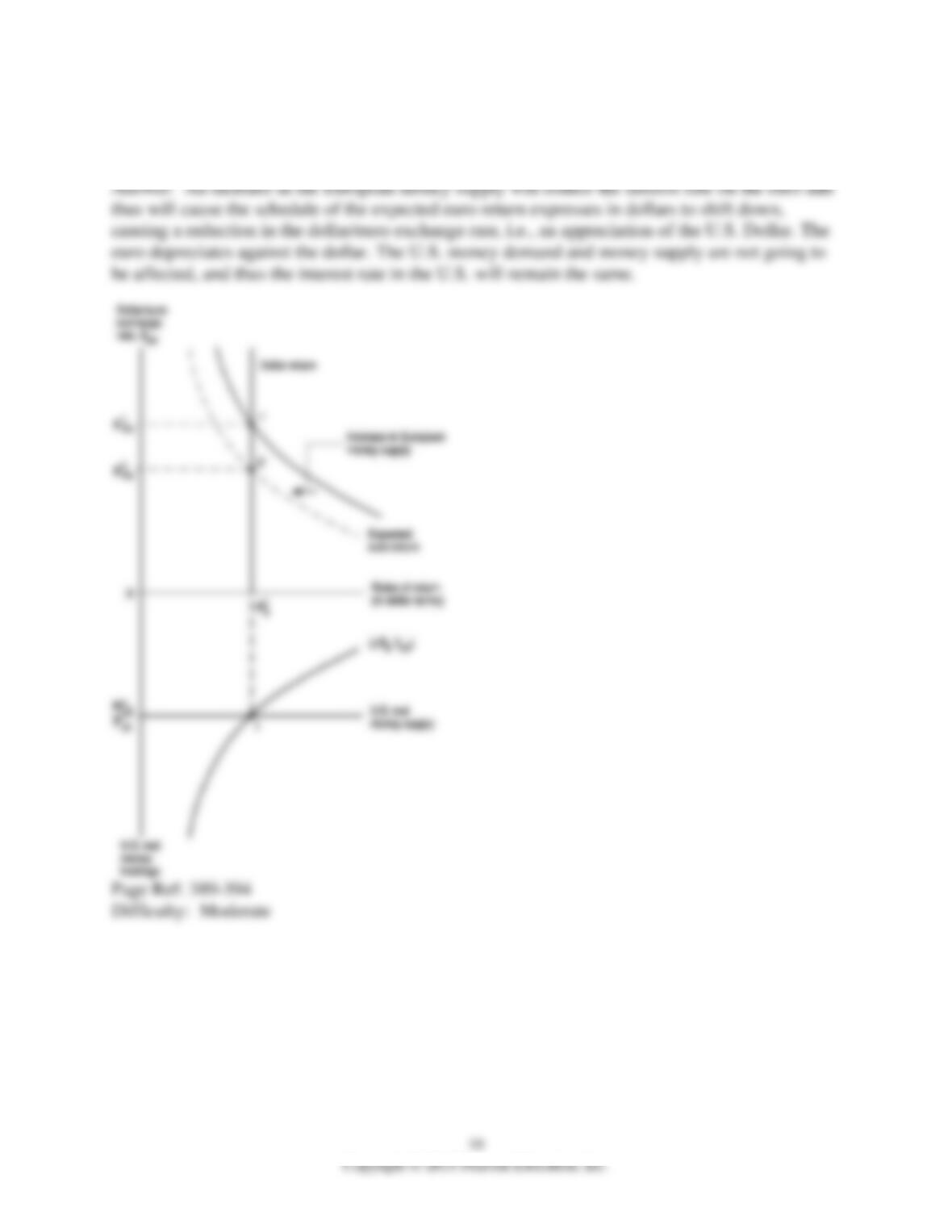
6) What would be the effect of an increase in the European Money Supply in the Dollar Euro
Exchange Rate?
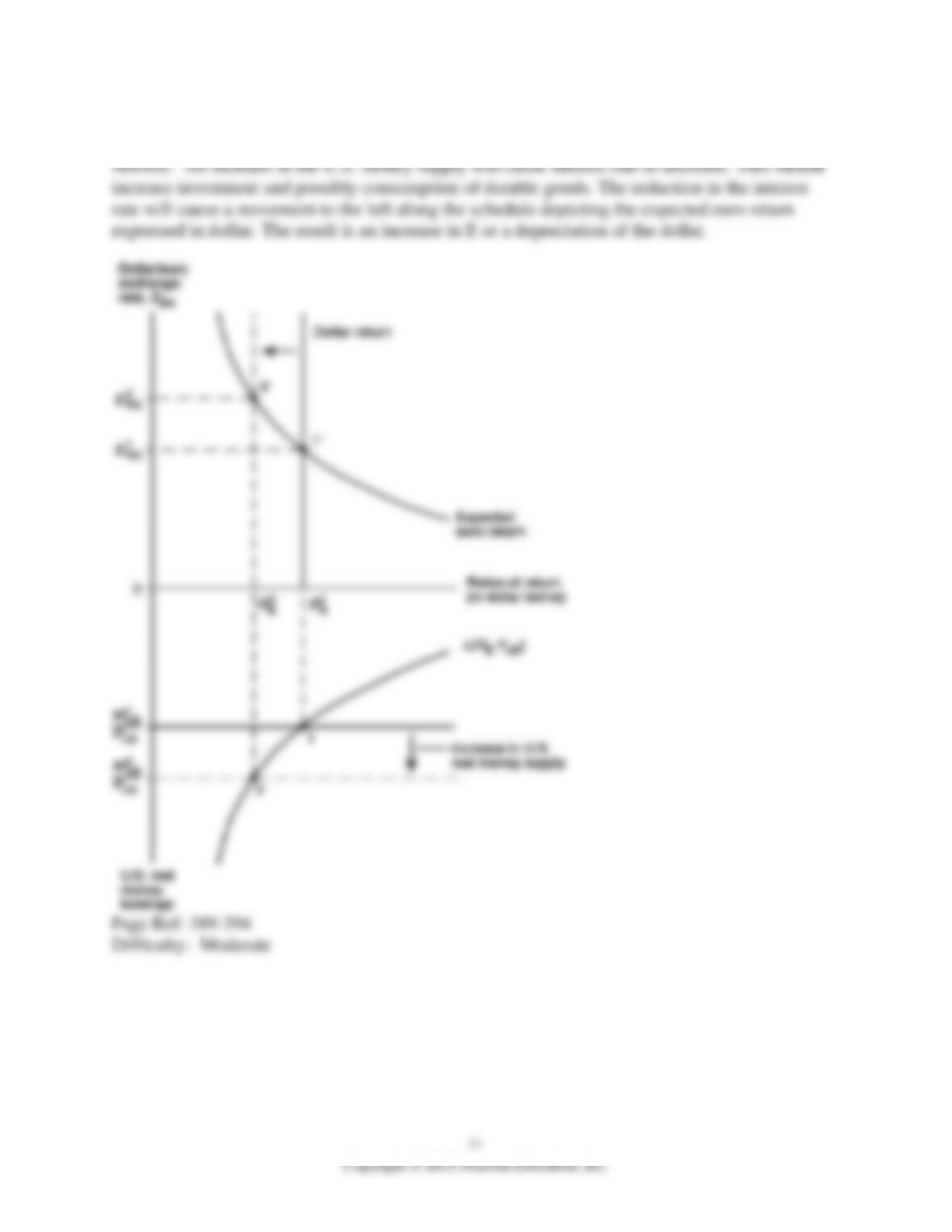
7) Using a figure describing both the U.S. money market and the foreign exchange market,
analyze the effects of a temporary increase in the European money supply on the dollar/euro
exchange rate.
8) Using a figure describing both the U.S. money market and the foreign exchange market,
analyze the effects of an increase in the U.S. money supply on the dollar/euro exchange rate.
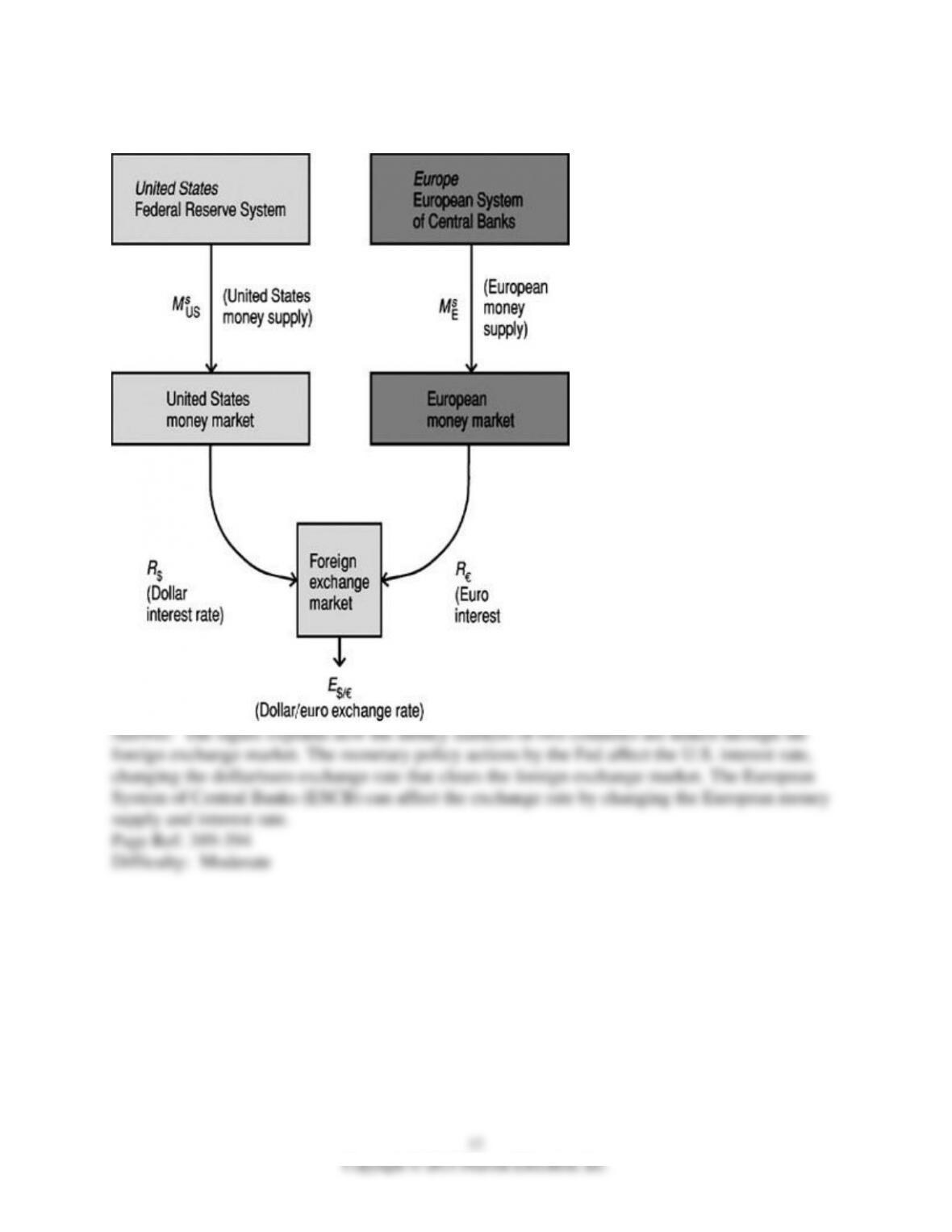
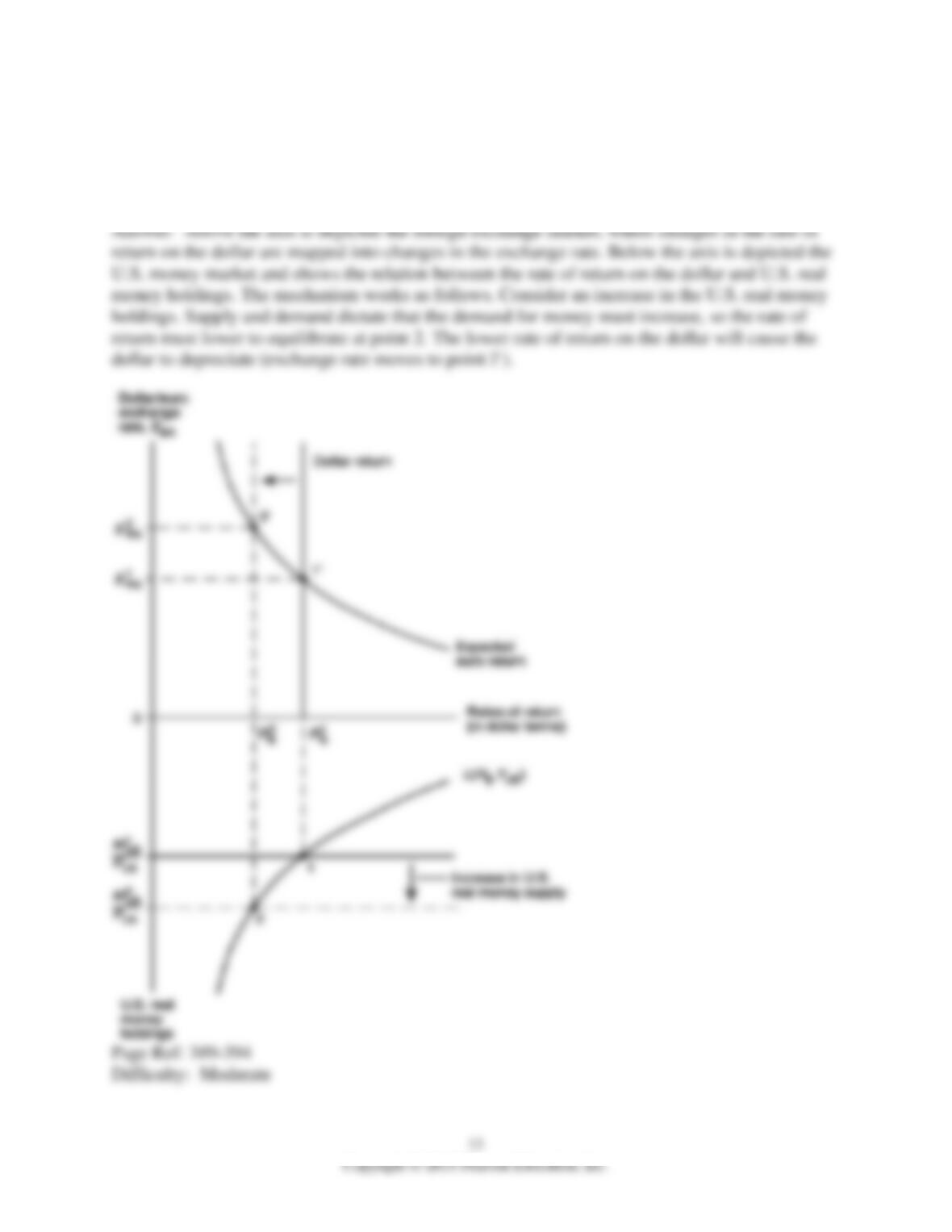
9) Explain the following figure.
10) Combine a graph showing the interest parity condition and one showing money demand and
supply to demonstrate simultaneous equilibrium in the money market and the foreign exchange
market.
How would an increase in the U.S. money supply affect the Dollar/Euro exchange rate and the
U.S. interest rate? Illustrate your answer graphically and explain.