CHAPTER 15
ARGUMENTS FOR INTERVENTIONIST TRADE POLICIES
B. Multiple-Choice Questions
12. In a two-country world, the terms-of-trade impact of a tariff will definitely improve the
welfare of the tariff-imposing country (assuming no retaliation) if the tariff-imposing
country
13. In the case of the economist’s definition of “dumping,” an exporting firm is selling its
product at a __________ price in the importing country than in the exporter’s home
country, and this suggests that demand for the exporter’s product is __________ in the
exporting country than in the importing country.
14. The following diagram shows the demand and marginal revenue curves facing a foreign
monopoly supplier of a good to the home country, as well as the firm’s horizontal
marginal cost curve when there is no tariff by the home country (MC) and the marginal
cost curve when a specific tariff is imposed by the home country (MC + T). (Assume
that average cost (AC) equals marginal cost.) In this situation, the price to home country
consumers after the tariff has been imposed is __________.
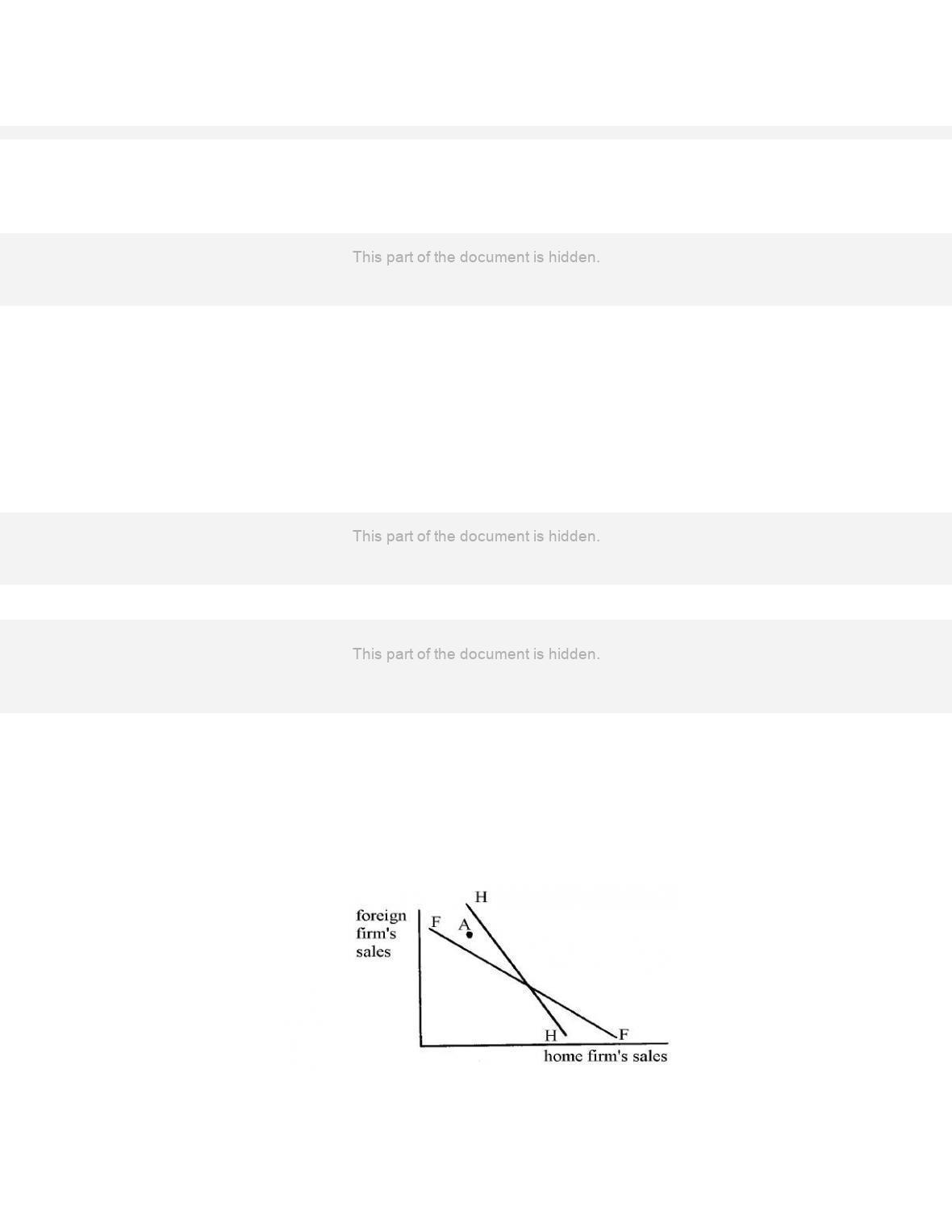
15. In the situation in the diagram in Question #14 above, the loss of consumer surplus for
home consumers because of the imposition of the tariff is __________.
16. In the situation in the diagram in Question #14 above, the amount of former foreign
monopoly profit that has been transferred as revenue to the home country’s government
because of the imposition of the tariff is __________.
17. A tariff placed upon a product in order to offset a foreign export subsidy is called
18. The following diagram shows a “reaction function” graph for two firms selling in an
export market, where HH is the home firm’s reaction function and FF is the foreign
firm’s reaction function. Reaction function HH reflects the fact that, if the foreign firm
increases its quantity sold in this market, then the home firm will __________ its sales
level in the market; reaction function FF reflects the fact that, if the home firm increases
its quantity sold in this market, the foreign firm will __________ its sales level in the
market.
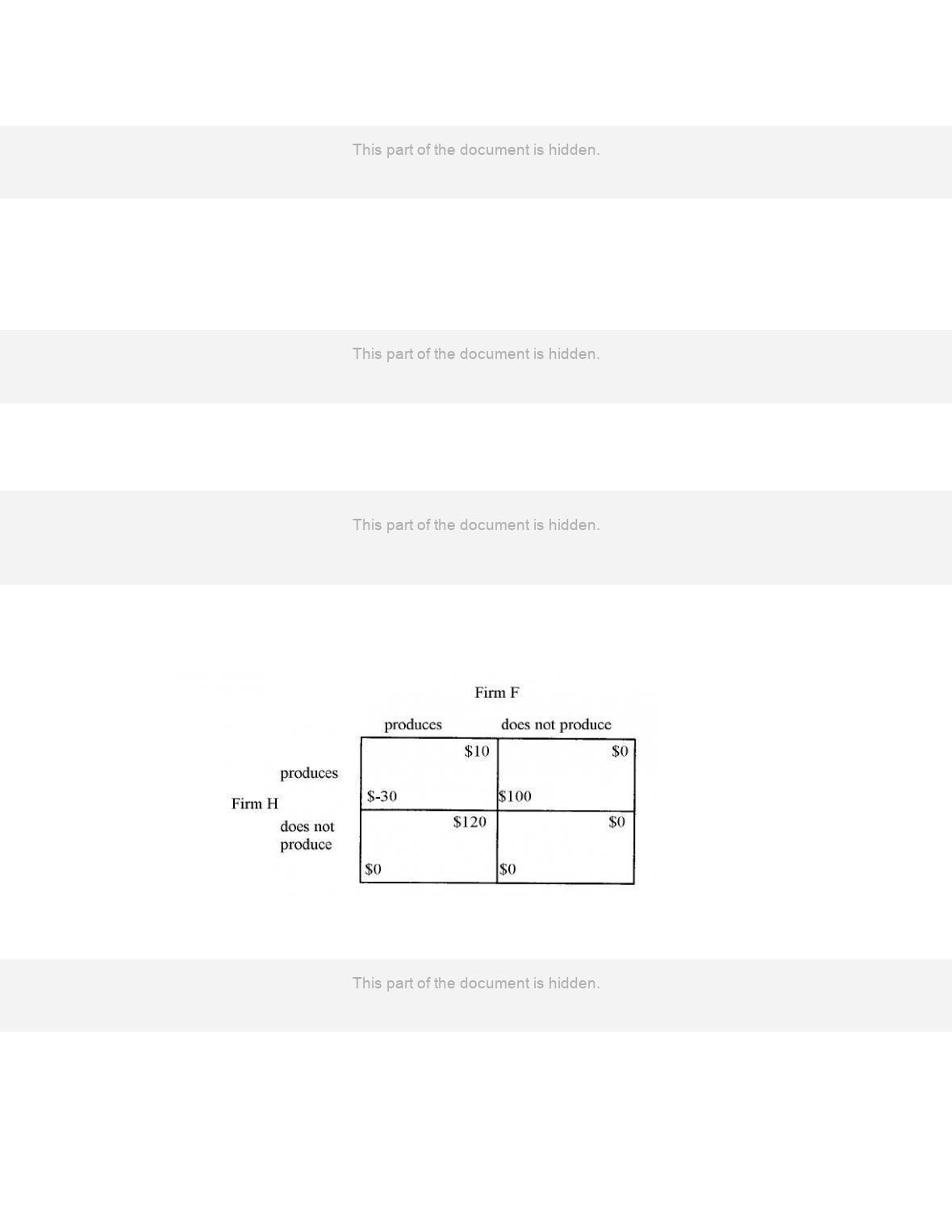
19. In the “reaction function” diagram of Question #18 above, if the firms are at point A and
if both firms are seeking to maximize profit, the foreign firm wants to __________ its
sales in this market, and the home firm __________its sales in this market.
a. decrease; also wants to decrease
20. In the “reaction function” diagram of Question #18 above, if economies of scale exist for
both firms, then protection instituted in the home market to keep out the foreign firm’s
product will, other things equal, cause HH to shift to the __________.
21. Given the following “payoff matrix” for two interdependent firms in duopoly, where the
figure in the lower left of each box shows Firm H’s profit and the figure in the upper right
of each box shows Firm F’s profit:
In this situation Firm F will __________.
d. never produce if its cost of production exceeds $10
22. In the “payoff matrix” in Question #21 above, Firm H __________ a “dominant strategy”
and Firm F __________ a “dominant strategy.”
23. Starting from the “payoff matrix” situation in Question #21 above, suppose that a subsidy
of $40 is now given to Firm H. Other things equal, with this subsidy, Firm H will
__________.
24. If the United States government imposes a “countervailing duty,” this duty is being
imposed to offset
d. a foreign import quota on U.S. exports of a good.
25. In the game-theoretic analysis of tariff reaction functions of two governments, suppose
that the equilibrium position has been attained (i.e., the countries are located at the
intersection of their respective tariff reaction functions). If, from this equilibrium
position, one country reduces its tariff rate while the other country does not change its
tariff rate, the result, other things equal, is that the country that has reduced its tariff will
experience __________.
26. The argument that a tariff can provide temporary protection to an industry so that the
industry can expand, realize economies of scale, and eventually become an export
industry is known as the
27. In world of two “large” countries, if one country imposes a tariff, the welfare of the
tariff-imposing country will definitely improve (assuming no retaliation) if, the tariff-
imposing country
28. In the following diagram, offer curve 0A0 of country A is the free-trade offer curve, and
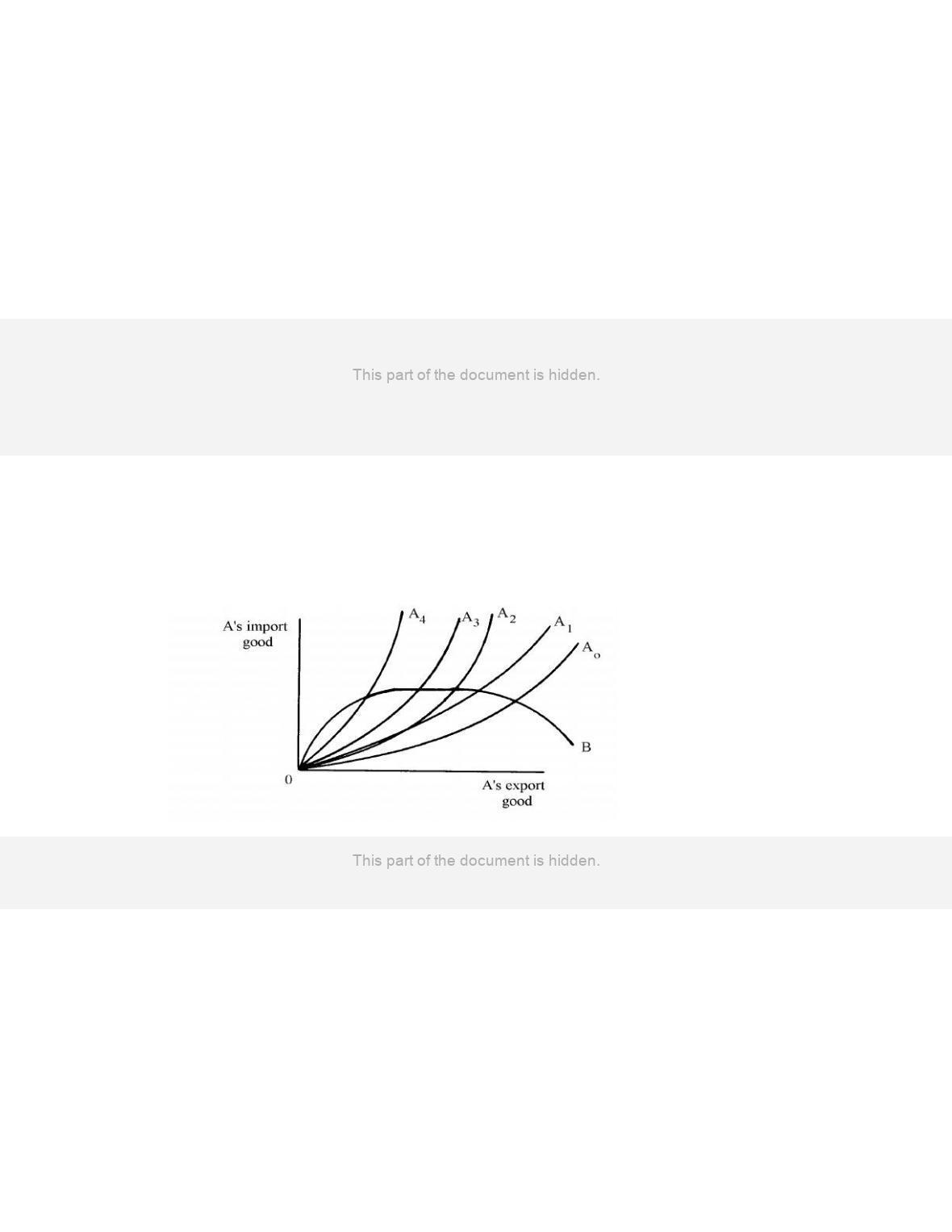
the other four offer curves represent A’s offer curves under four different tariff rates. Of
these four other curves, only one of them can possibly be an offer curve which is
associated with A’s “optimum tariff.” Which one?
29. The diagram below shows the demand curve (D) facing a foreign monopoly
supplier of a good to home country I, the associated marginal revenue curve
(MR), and the foreign monopolist’s marginal cost curve (MC), which equals the
average cost curve (AC). If country I places a tariff of the amount T on the
import of the foreign firm’s product, the MC curve shifts vertically upward by the
amount of the tariff to (MC + T), which is also (AC + T). Given this situation,
which one of the following statements is TRUE?
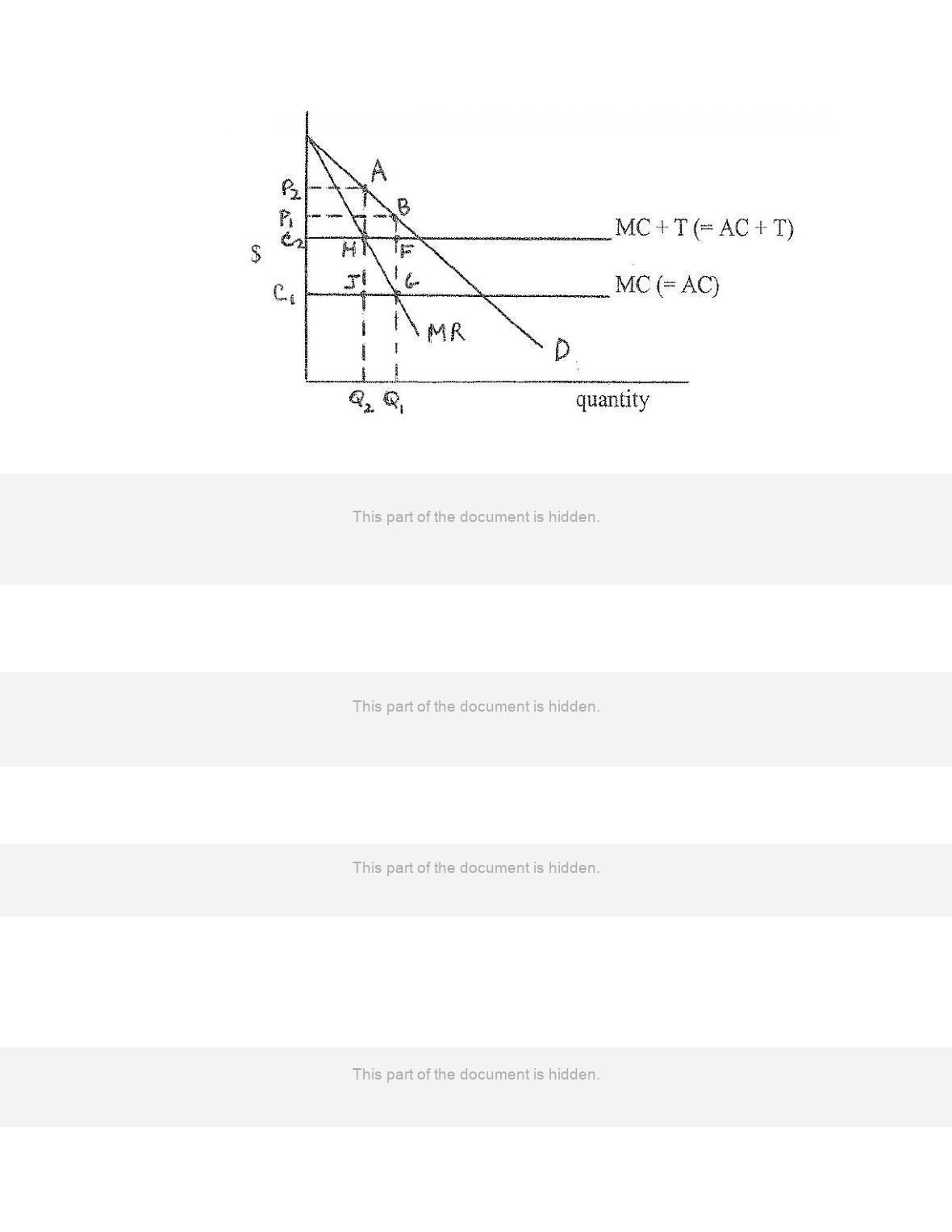
a. The price of the product when there is no tariff is P2.
30. If tariffs are used in an attempt to improve country A’s balance of trade, and if exchange
rates are flexible, the imposition of the tariffs will cause __________ in the value of A’s
currency relative to other currencies and, as a consequence, A’s exports will __________.
31. The “optimum tariff rate” for a country is that rate which, assuming no retaliation,
32. The macroeconomic interpretation of a trade deficit for a country utilizes which one of
the following expressions (where Y = national income, C = consumption, I = investment,
G = government spending on goods and services, X = exports, and M = imports)?
a. Y + (C + I + G) = (X – M)
33. The existence of which type of dumping most likely constitutes the weakest argument for
the imposition of an antidumping duty?
34. The macroeconomic view of a trade deficit implies that, other things equal, the
imposition of a tariff will reduce the country’s trade deficit
35. The general policy rule that states that the appropriate policies for alleviating a problem
are those policies aimed directly at the source of the problem is called
36. The Krugman economies-of-scale “strategic trade policy” model stresses that protection
given to a home firm will, other things equal, __________ the marginal cost of producing
each level of home output and will __________ the marginal cost of producing each level
of foreign output.
37. If, in a tariff game between two governments, both countries are on their tariff reaction
functions, then each country __________ maximizing its welfare given the tariff of the
other country. In this situation, there __________ incentive for each country to reduce its
tariff unilaterally.
a. is; is an