College Accounting, 12e (Slater)
Chapter 15 Accounting for Merchandise Inventory
15.1 Learning Objective 15-1
1) In a perpetual inventory system:
A) Merchandise Inventory is debited every time inventory is purchased.
B) Cost of Goods Sold is debited every time inventory is sold.
C) a physical inventory is taken at least annually.
D) all of the above take place.
2) Under the perpetual system, the purchase of merchandise is recorded by a:
A) debit to Merchandise Inventory; credit to Accounts Payable or Cash.
B) debit to Cost of Goods Sold; credit to Accounts Payable.
C) debit to Purchases; credit to Accounts Payable.
D) debit to Accounts Payable; credit to Purchases.
3) The journal entry to record a sale of inventory under the perpetual system includes:
A) a debit to Cost of Goods Sold and a credit to Merchandise Inventory.
B) a debit to Cost of Goods Sold and a debit to Merchandise Inventory.
C) a debit to Accounts Receivable or Cash and a credit to Sales.
D) both A and C.
4) The journal entry to record a purchase of inventory on credit under the perpetual system includes:
A) a debit to Merchandise Inventory.
B) a debit to Purchases.
C) a credit to Accounts Payable.
D) both A and C.
5) The journal entry to record the return of a purchase of inventory under the periodic system includes a:
A) debit to Merchandise Inventory.
B) credit to Purchases Returns and Allowances.
C) credit to Merchandise Inventory.
D) credit to Purchases.
6) Which of the following would not be used to pay for purchases under the periodic system?
A) Debit to Accounts Payable
B) Credit to Purchase Discounts
C) Credit to Accounts Payable
D) Credit to Cash
7) Which of the following accounts is used with a periodic inventory system?
A) Purchases
B) Purchases Discounts
C) Purchases Returns and Allowances
D) All of these answers are correct.
8) Under the perpetual inventory system, which of the following accounts would not be used?
A) Sales
B) Purchases
C) Cost of Goods Sold
D) Merchandise Inventory
9) Inventory becomes part of Cost of Goods Sold when a company:
A) receives the inventory.
B) purchases the inventory.
C) sells the inventory.
D) makes payment on the inventory.
10) Under the periodic inventory system, in addition to making the entry to record a sale, a company
would:
A) debit Merchandise Inventory and credit Cost of Goods Sold.
B) debit Cost of Goods Sold and credit Merchandise Inventory.
C) debit Cost of Goods Sold and credit Purchases.
D) make no additional entry.
11) Under the perpetual inventory system, in addition to making the entry to record a return of goods
from a customer, a company would:
A) debit Merchandise Inventory and credit Cost of Goods Sold.
B) debit Cost of Goods Sold and credit Merchandise Inventory.
C) debit Sales and credit Cost of Goods Sold.
D) debit Purchases and credit Cost of Goods Sold.
12) A credit customer purchased $450 worth of items. Two days later, the customer returned $300 worth
of those items. The entry to record this under the perpetual inventory method would include:
A) a debit to Sales Returns and Allowances $300; credit Accounts Receivable $300.
B) a debit to Merchandise Inventory for our cost.
C) a credit to Cost of Goods Sold for our cost.
D) All of the above.
13) The perpetual inventory system is a system which:
A) updates inventory continuously.
B) uses either FIFO, LIFO, weighted-average, or specific invoice method.
C) never needs a physical inventory taken.
D) both A and B.
14) The company returned $200 of damaged merchandise. The entry to record this under the periodic
inventory method is:
A) debit Merchandise Inventory $200; credit Accounts Payable $200.
B) debit Cost of Goods Sold $200; credit Accounts Payable $200.
C) debit Accounts Payable $200; credit Purchases Returns and Allowances $200.
D) debit Accounts Payable $200; credit Merchandise Inventory $200.
15) A customer returned merchandise that had been paid for within a discount period for credit. The
entry was recorded with a debit to Sales Returns and Allowances and a credit to Accounts Receivable for
the net amount. This error would cause:
A) the period end assets to be understated.
B) the period end liabilities to be understated.
C) the period’s net income to be understated.
D) None of these are correct.
16) The freight paid on goods purchased F.O.B. shipping point was debited to the Freight Expense
account. This error would cause:
A) the period end assets to be understated.
B) the period end liabilities to be understated.
C) the period’s net income to be overstated.
D) None of these are correct.
17) The return of merchandise was recorded as a debit to Accounts Payable and a credit to Purchases.
This error would cause:
A) the period end assets to be understated.
B) the period end liabilities to be understated.
C) the period’s net income to be understated.
D) None of these are correct.
18) The freight paid on goods purchased F.O.B. shipping point was debited to the Purchases account.
This error would cause:
A) the period end expenses to be understated.
B) the period end expenses to be overstated.
C) the period’s net income to be understated.
D) None of these are correct.
19) Office Supplies bought on account were returned for credit and recorded with a debit to Accounts
Payable and a credit to Merchandise Inventory. This error would cause:
A) the period end Cost of Goods Sold to be understated.
B) the period end Cost of Goods Sold to be overstated.
C) the period’s net income to be understated.
D) None of these are correct.
20) The journal entry to record a customer’s return of an item for a cash refund would:
A) be the same under both the periodic and perpetual system.
B) only include one entry under the perpetual system.
C) include two entries under the perpetual system.
D) include none of the above.
21) In a perpetual inventory system, the Merchandise Inventory account is updated:
A) at the end of the accounting period.
B) once each month.
C) when merchandise is purchased.
D) The account never needs updating.
22) Only periodic systems must take a physical inventory at year-end.
23) When a perpetual inventory system is used, a physical inventory should be taken at least annually.
24) In a periodic inventory system, Purchases, Freight, and Purchases Returns and Allowances accounts
are not used.
25) In a perpetual inventory system, Cost of Goods Sold is an account in the general ledger.
26) When merchandise is sold, the perpetual inventory system requires a debit to Cost of Goods Sold and
a credit to Merchandise Inventory.
27) Merchandise Inventory is an expense account.
28) Inventory purchases are entered in the Merchandise Inventory account at the expected sales price
amount.
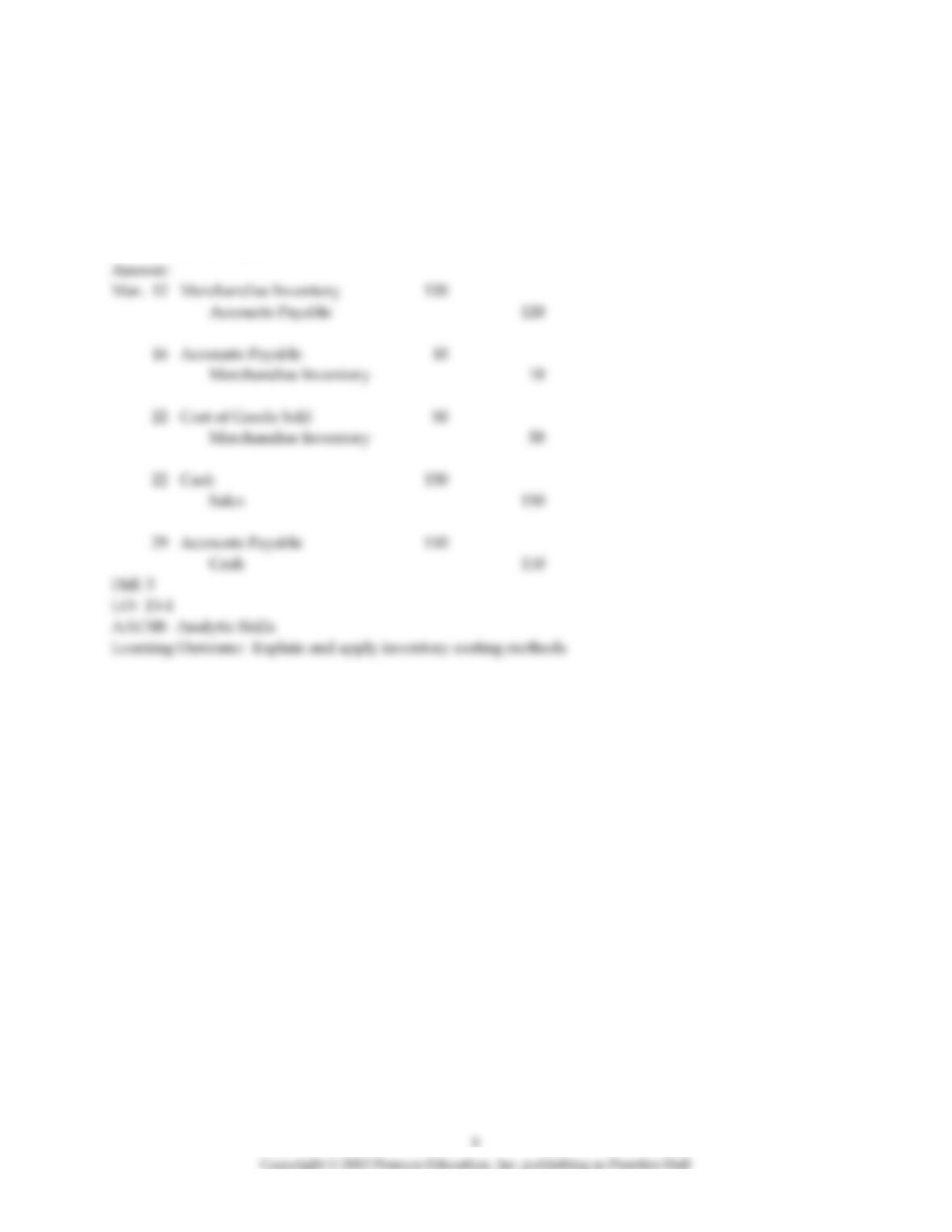
29) Prepare journal entries for the following transactions for Jane’s Violin Shop applying the perpetual
inventory system. Omit explanations.
Mar. 12 Purchased on account 2 boxes of bows for $120.
16 Returned 1 bow for $10 credit.
22 Sold 3 bows for $150, cost $50.
29 Paid the balance due on account.
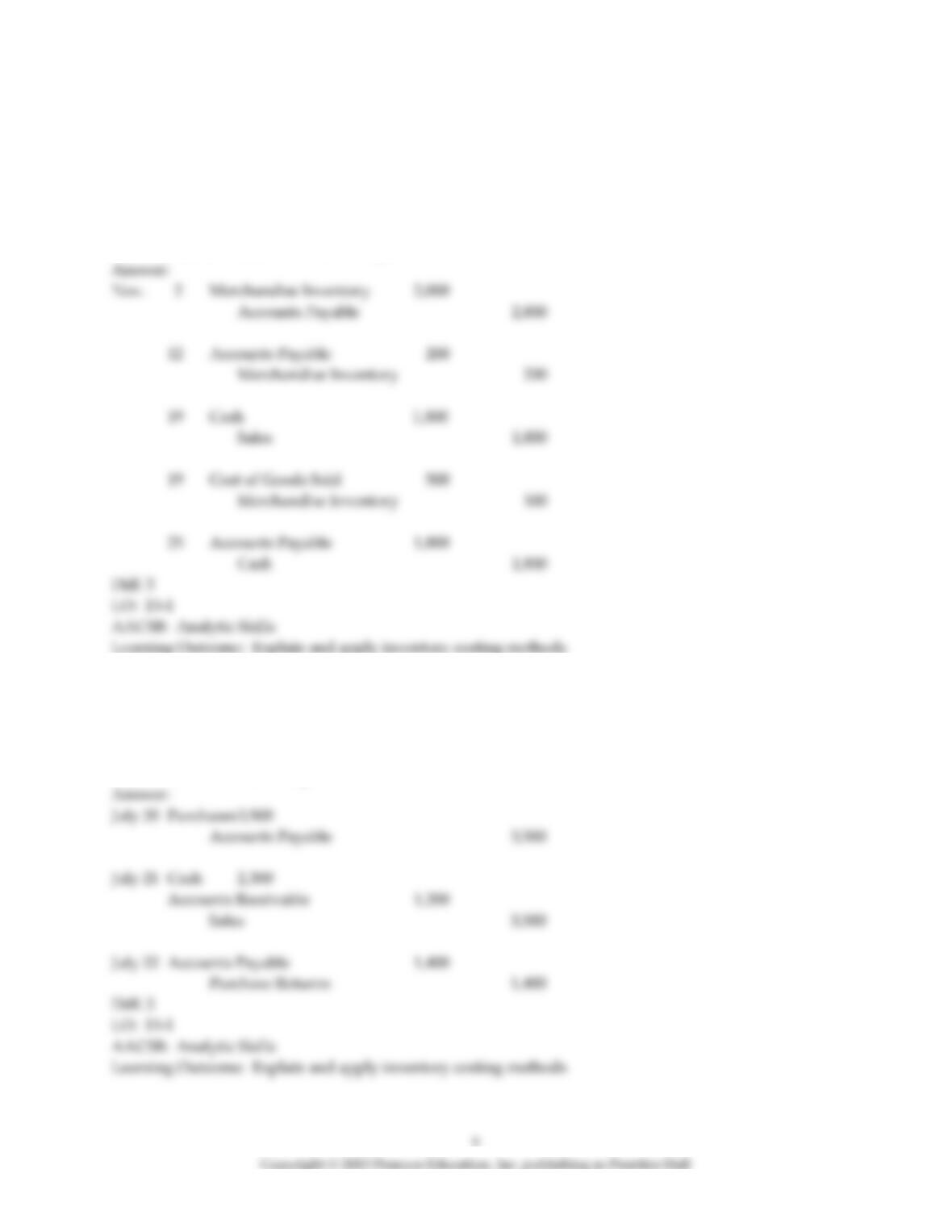
30) Prepare journal entries for the following transactions for HO Train Shop applying the perpetual
inventory system. Omit explanations.
Mar. 2 Purchased on account 200 model engines for $2,000.
12 Returned 20 engines for full credit.
19 Sold 50 of the engines to R. Holmes for $1,000 cash.
25 Paid the balance due on the engines.
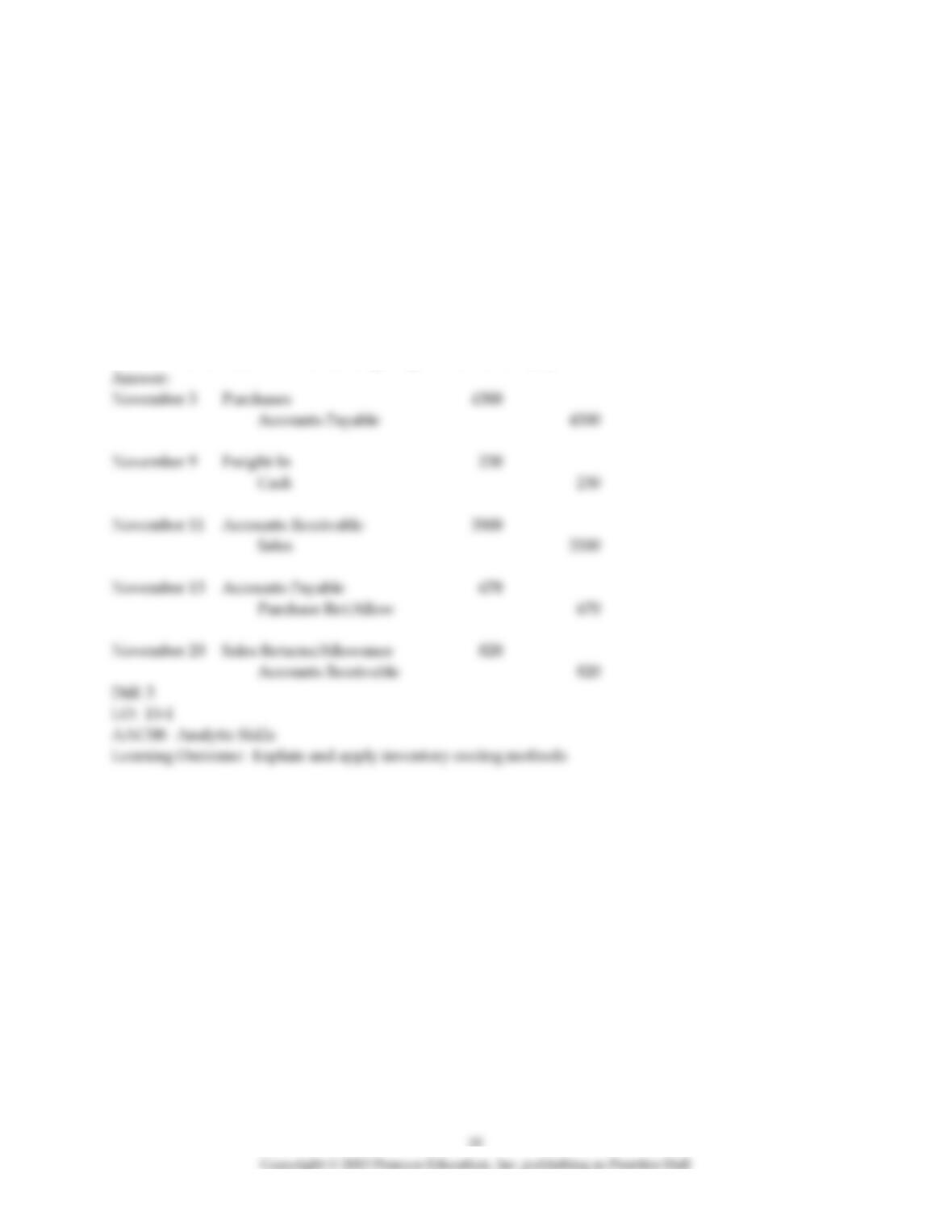
31) Journalize the following assuming periodic inventory.
July 20 Made purchases of inventory for $3,500 on account.
July 21 Made sales of $2,300 cash and $1,200 credit.
July 22 Returned $1,400 of purchases for defects.
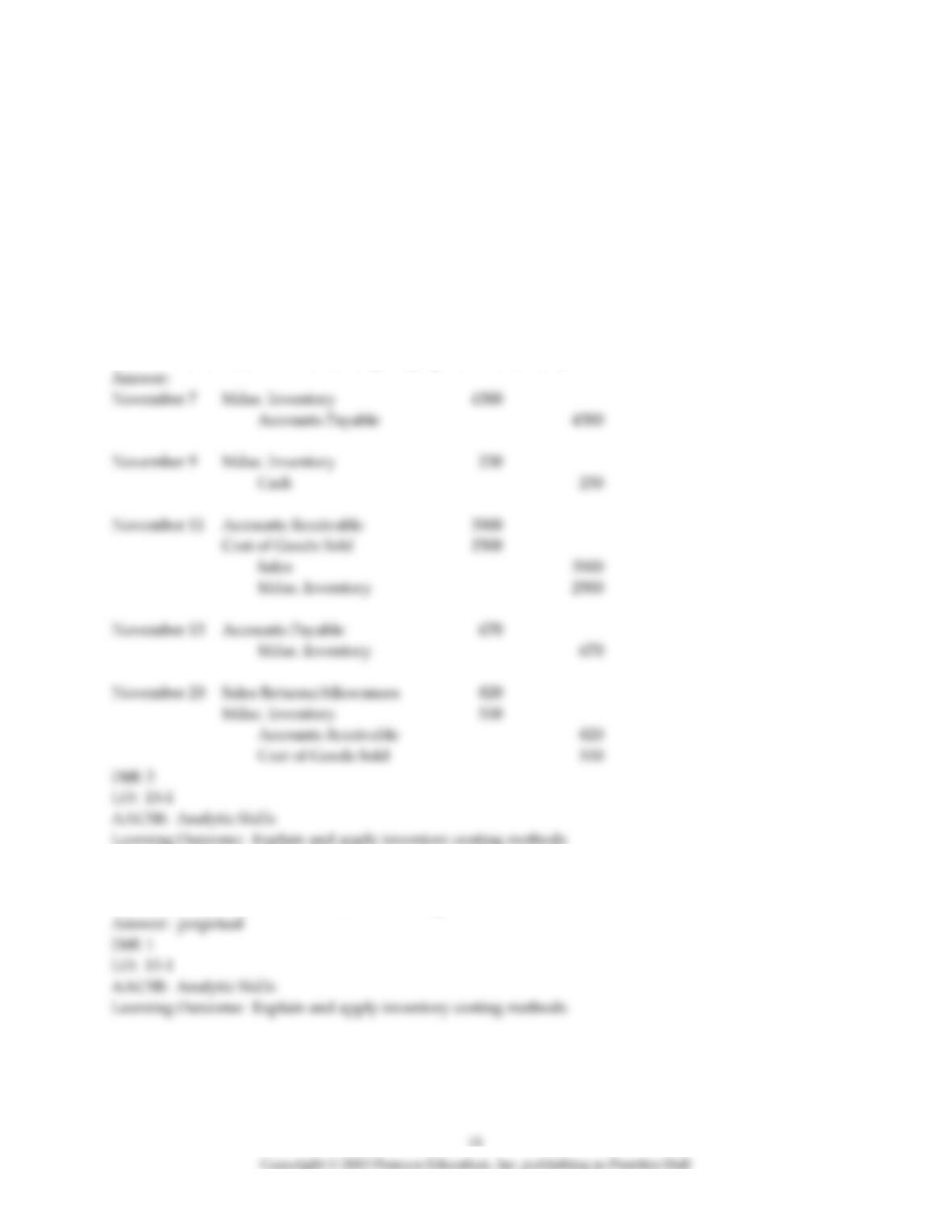
32) Joe owns an auto parts store called Joe’s Auto Care. The following transactions took place during
November of the current year.
November 7 Purchased merchandise on account from Wheeler Auto for $4,300.
November 9 Paid freight charges of $230 on merchandise purchased on the 7th.
November 11 Sold merchandise on account to Lancaster Auto Sales for $3,500. The cost of the
merchandise was $2,500.
November 13 Received a credit memo from Wheeler for merchandise returned, $670.
November 20 Issued a credit memo to Lancaster Auto Sales for merchandise returned, $820. The cost of
the merchandise is $550.
Journalize the above transactions using the periodic inventory system.
33) Joe owns an auto parts store called Joe’s Auto Care. The following transactions took place during
November of the current year.
November 7 Purchased merchandise on account from Wheeler Auto for $4,300.
November 9 Paid freight charges of $230 on merchandise purchases on the 7th.
November 11 Sold merchandise on account to Lancaster Auto Sales for $3,500. The cost of the
merchandise was $2,500.
November 13 Received a credit memo from Wheeler for merchandise returned, $670.
November 20 Issued a credit memo to Lancaster Auto Sales for merchandise returned, $820. The cost of
the merchandise is $550.
Journalize the above transactions using the perpetual inventory system.
34) Under the ________ inventory system, cost of goods sold and the amount of merchandise inventory
on hand are updated when merchandise is bought and sold.
35) The ________ system of accounting for inventory provides information on a transaction-by–
transaction basis.
36) Under the ________ inventory system, no entries are made to the merchandise inventory or cost of
goods sold account during the year.
37) Title passes immediately to the buyer under FOB ________.
38) Purchased merchandise with credit terms of 2/10, n/30. – Perpetual
Debit ________ & ________ Credit ________ & ________
39) Purchased merchandise with credit terms of 2/10, n/30. – Periodic
Debit ________ & ________ Credit ________ & ________
40) Paid for merchandise within the discount period. – Perpetual
Debit ________ & ________ Credit ________ & ________
41) Sold merchandise for cash. – Periodic
Debit ________ & ________ Credit ________ & ________
42) Returned merchandise inventory for credit – Periodic
Debit ________ & ________ Credit ________ & ________
43) Paid for merchandise after the discount period expired. – Perpetual
Debit ________ & ________ Credit ________ & ________
44) Paid for merchandise after the discount period expired. – Periodic
Debit ________ & ________ Credit ________ & ________
45) Sold merchandise on account. – Perpetual
Debit ________ & ________ Credit ________ & ________
46) Sold merchandise on account – Periodic
Debit ________ & ________ Credit ________ & ________
47) Customer returned goods – Periodic
Debit ________ & ________ Credit ________ & ________
48) Under the perpetual inventory method, purchase returns are credited to ________.
15.2 Learning Objective 15-2
1) Tracking individual inventory items is tracked in the:
A) accounts receivable ledger.
B) inventory ledger.
C) accounts payable ledger.
D) purchases journal.
2) An entry to record the payment to a vendor was correctly recorded and posted to the general ledger
but was not posted to the subsidiary ledger. This error would cause:
A) the period end assets to be understated.
B) the period end liabilities to be understated
C) the Accounts Payable will be larger than the subsidiary ledger.
D) the Accounts Payable will be less than the subsidiary ledger.
3) An inventory ledger may be used to track inventory.
4) A subsidiary payables ledger is used to track details of quantities and costs.
15.3 Learning Objective 15-3
1) The weighted-average method:
A) calculates an average unit cost by dividing the total cost of goods sold by the total units sold.
B) calculates an average unit cost by dividing the total cost of goods available for sale by the total units of
goods available for sale.
C) calculates an average unit cost by adding the total cost of goods available for sale to the total units of
goods available for sale.
D) None of these answers are correct.
2) One advantage of the LIFO method is that:
A) an equal cost is assigned to each unit, so net income does not fluctuate as much as with other methods.
B) flow of goods and flow of costs are the same.
C) it matches current selling prices and current costs.
D) ending inventory is valued at very old costs.
3) This method assumes that the most recently acquired goods are sold first.
A) LIFO
B) FIFO
C) Specific invoice method
D) Weighted-average method
4) The inventory method where the cost flows tend to follow the physical flow is:
A) LIFO.
B) FIFO.
C) weighted-average.
D) specific invoice.
5) The inventory method that matches old costs with current selling prices is:
A) LIFO.
B) FIFO.
C) weighted-average.
D) specific invoice.
6) The advantage of the weighted-average method is:
A) an equal cost is assigned to each unit so net income does not fluctuate as much as with other methods.
B) flow of goods and flow of costs are the same.
C) it matches current selling prices and current costs.
D) old costs are matched against current income.
7) The inventory method where the ending inventory consists of current costs is:
A) LIFO.
B) FIFO.
C) weighted-average.
D) specific invoice.
8) The inventory method that assumes the oldest goods are sold first is:
A) LIFO.
B) FIFO.
C) weighted-average.
D) specific invoice.
9) The inventory method that assumes the cost of the ending inventory consists of new inventory is:
A) LIFO.
B) FIFO.
C) weighted-average.
D) specific invoice.
10) This inventory method produces the lowest income tax during a period of inflation.
A) LIFO
B) FIFO
C) Weighted-average
D) All would have the same tax effect.
11) The principle of consistency states that:
A) changes in accounting methods should occur from one fiscal period to the next.
B) a company cannot change from one inventory valuation method to another.
C) a company should switch from LIFO to FIFO every other period.
D) by using the same method, the financial statements are more meaningful.
12) The full disclosure principle says that if a change is made:
A) the company should disclose the change.
B) the effects of the change on profit and inventory valuation should be disclosed.
C) the company should show justification for the change in a footnote on the financial reports.
D) All of these answers are correct.
13) If goods are shipped FOB destination point by the seller, when does title pass?
A) When the goods arrive at the buyer’s location
B) When they leave the seller’s location
C) When they are signed for
D) None of the above
14) Which of the following items should be included in inventory?
A) Supplies on hand
B) Goods that have been consigned to another company
C) Goods in transit shipped to another company FOB destination
D) All of the above
15) Barry’s Books uses a periodic inventory system. Barry’s Books sold 45 copies of Helpful Hints during
September. Other data for September include:
Sep. 1
Balance
12 books @ $20
8
Purchased
10 books @ $21
17
Purchased
30 books @ $22
25
Purchased
15 books @ $24
Ending inventory under the FIFO method is:
A) $450.
B) $514.
C) $528.
D) $440.