CHAPTER 14
THE IMPACT OF TRADE POLICIES
B. Multiple-Choice Questions
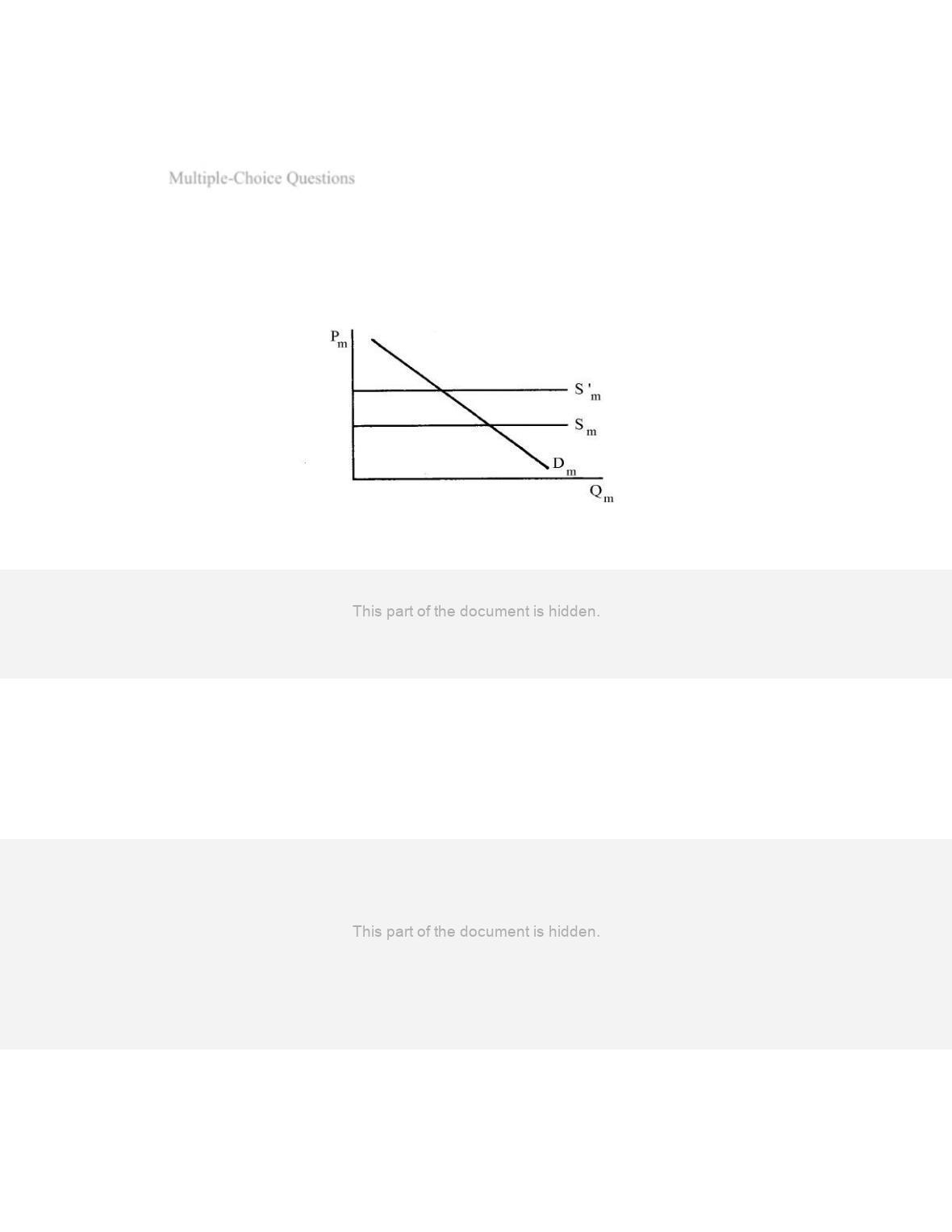
14. In the following import graph, if horizontal supply line Sm shifts to horizontal line S’m because of
the imposition of a tariff,
15. The presence of an export subsidy (assuming that foreign demand is not perfectly-
inelastic)
16. The imposition of an export tax by a home country will lead to __________ in home
country consumer surplus and will __________ in home country producer surplus.
17. In the large-country case, an export tax
18. The diagram below shows the situation of a small country with free-trade in an imported product
(at a price of $10) and the situation with a tariff on the product (at a price of $11). In this graph,
the net welfare loss (or total deadweight loss) to the country from the imposition of the tariff is
__________.
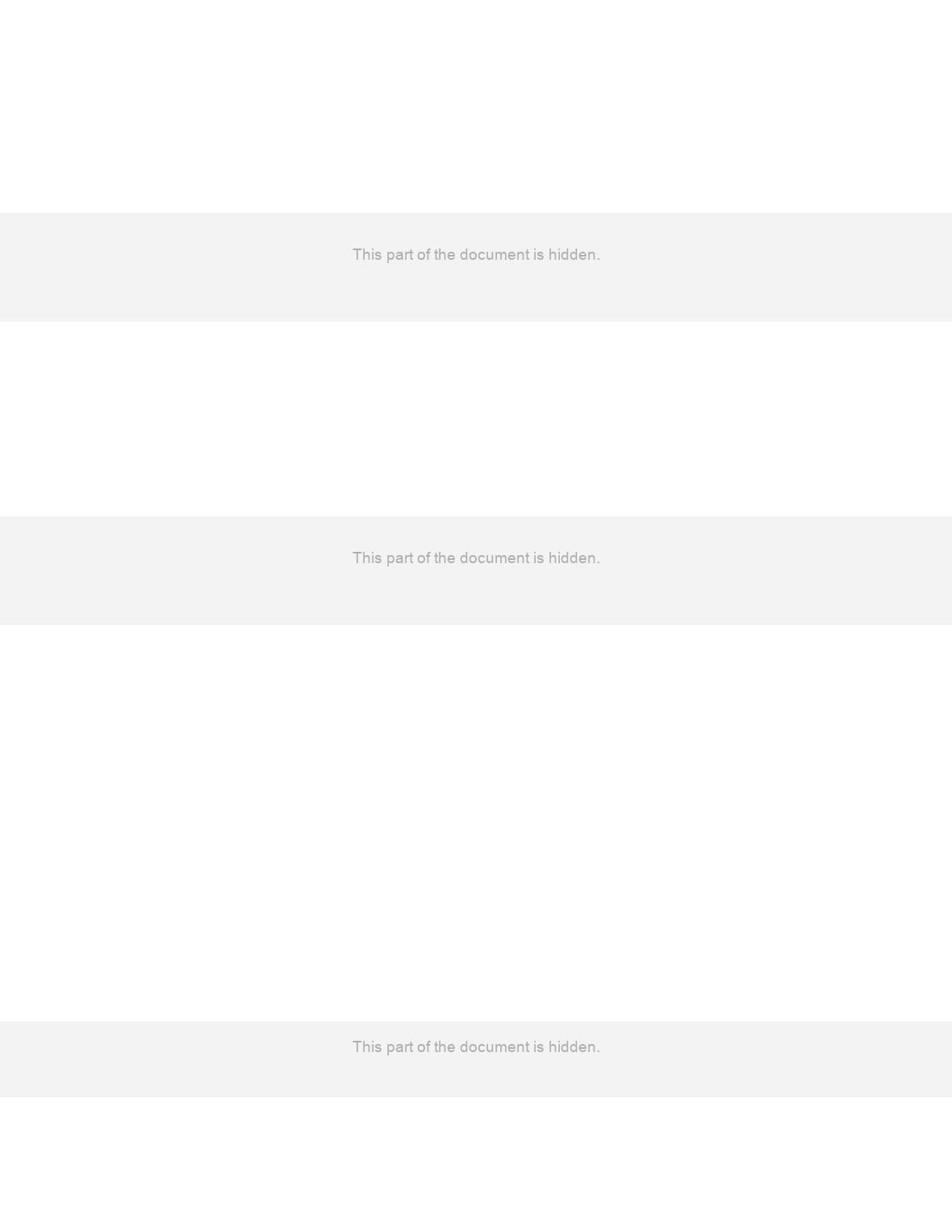
19. In the diagram in Question #18 above, what is the amount of tariff revenue collected by the
government when the tariff is in place?
20. In the diagram in Question #18 above, suppose that a subsidy to import-competing
producers is given instead of a tariff being imposed. The subsidy is set to generate the
same amount of domestic production of the good as occurred under the tariff. What
would be the net welfare loss to the country in this situation?
21. Given the following information for (small) country A concerning a good X:
free trade price in A $20 per unit
tariff rate 20 percent
price in A, with tariff $24 per unit
consumption in A, free trade 1,000 units
consumption in A, with tariff 900 units
production in A, free trade 600 units
production in A, with tariff 800 units
22. Other things equal, a country’s consumers’ “demand for imports” schedule for a good
tends to be __________ than the country’s consumers’ overall demand schedule for the
good. In addition, other things equal, a country’s producers’ “supply of exports” schedule
of a good tends to be __________ than the country’s producers’ overall supply schedule
of the good.
d. less elastic; less elastic
23. In the large country case, the imposition of an import quota
a. will always produce a net loss for the imposing country.
24. In the general equilibrium graph with a production-possibilities frontier (PPF) and
consumer indifference curves,
a. a tariff has the same welfare impact as a subsidy to the import-competing industry
(provided domestic production is the same with each alternative instrument).
(Questions 25 and 26 draw on Appendix B material.)
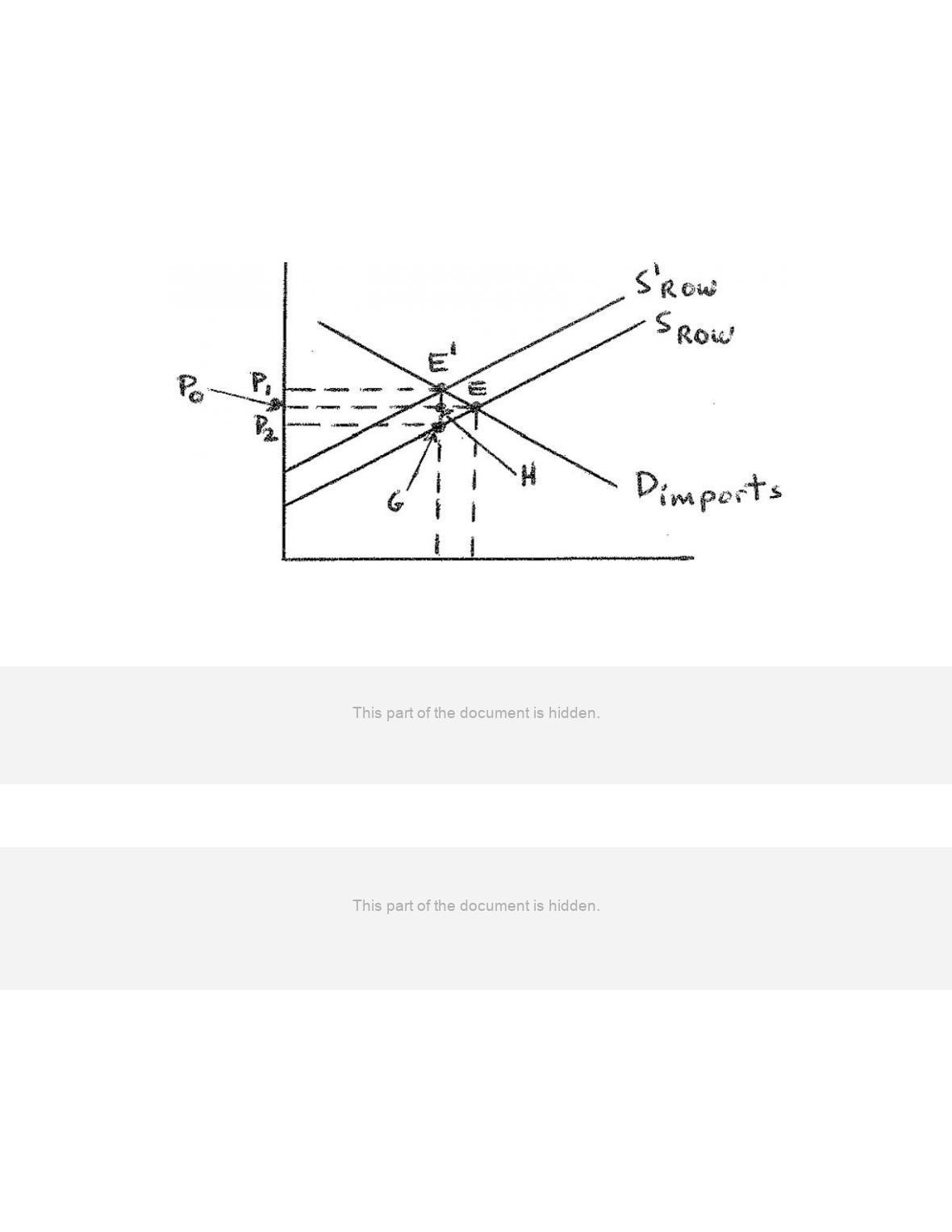
25. Given the following diagram showing country A’s demand for imports schedule for good
X (Dimports), the supply of exports schedule to A from the rest of the world of good X
(SROW), and the supply of exports schedule to A from the rest of the world of good X
when country A has imposed a specific tariff on imports of good X (S’ROW):
price
quantity
a. The total tariff revenue collected by country A is indicated by the rectangle
P0P1E’H.
26. In Question #25 above, country A
a. can never improve its welfare by the imposition of this tariff.
27. You are given the following information pertaining to large country B with respect to
good W (which is produced at home and also imported), both under free trade and with a
$10.00 import tariff in place:
domestic price of W under free trade $40
world price of W (i.e., price of W from rest-of–the-
world) under free trade $40
domestic price of W after imposition of tariff $44
world price of W (i.e., price of W from rest-of–the-
world after imposition of tariff $34
domestic production of W under free trade 80 units
domestic production of W after imposition of tariff 94 units
domestic consumption of W under free trade 120 units
domestic consumption of W after imposition of tariff 112 units
Given this information, and assuming that demand and supply curves are straight lines,
what is the loss of consumer surplus in country B that occurs because of the imposition of
the tariff?
28. Given the information on prices, production, and consumption in Question #27 above,
and assuming that demand and supply curves are straight lines, what is the gain in
producer surplus in country B that occurs because of the imposition of the tariff?
29. Given the information on prices, production, and consumption in Question #27 above,
and assuming that demand and supply curves are straight lines, the impact of the
imposition of the tariff is that tariff revenue of the government increases by __________.
Further, the “net welfare effect” of the imposition of the tariff is a __________.
a. $72; loss of $44
30. Other things equal, a larger share of a tariff is more likely to be “paid” by the foreign
exporting country B rather than the domestic importing country A if
d. the demand curve of A’s consumers is very inelastic.
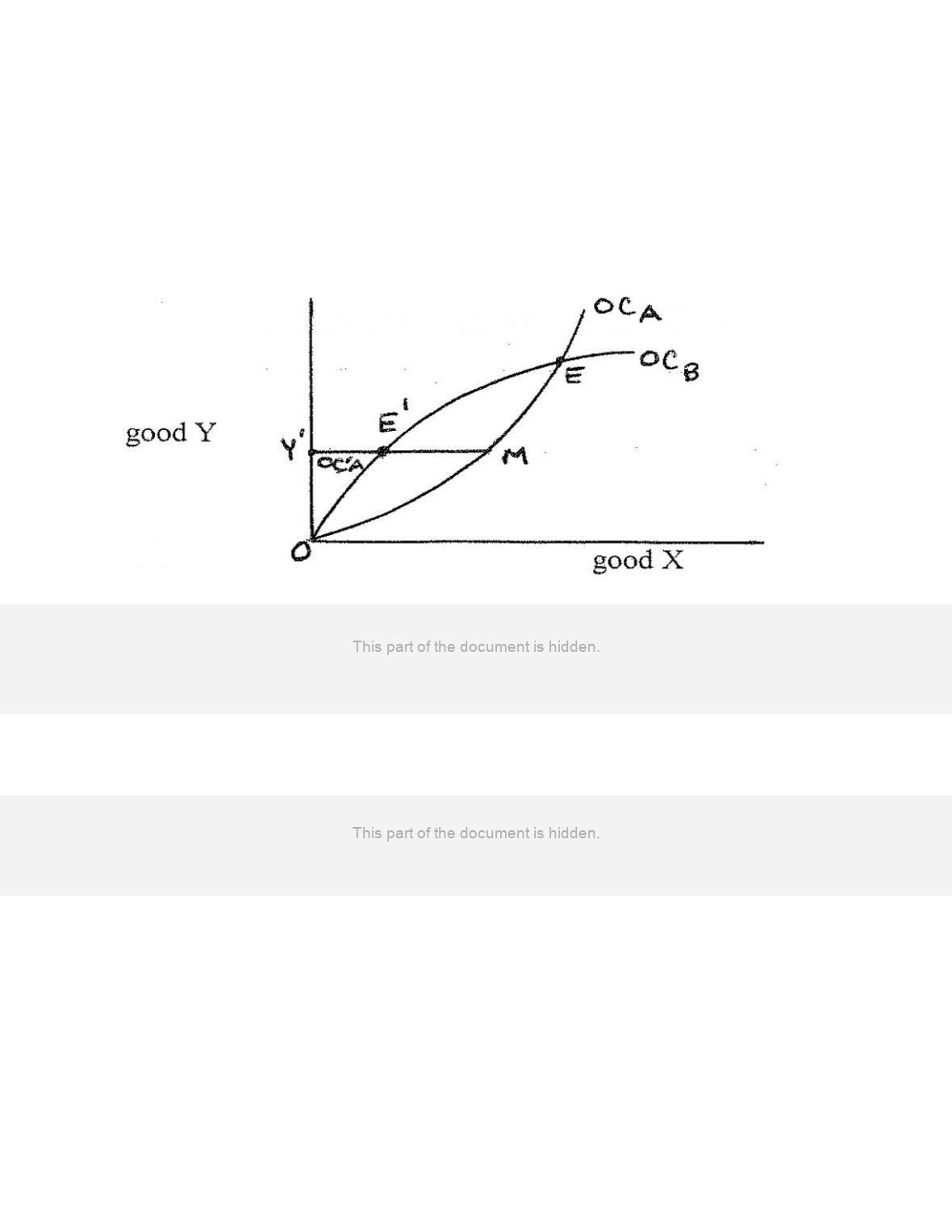
31. In the following offer curve diagram, OCA is the free-trade offer curve of country A, OCB is the
free-trade offer curve of country B, and OC’A (which starts at the origin O, goes to point M and
then comes back horizontally to point Y’) is the offer curve of country A when it has a restrictive
trade policy instrument in place (while country B continues with free trade). In this situation, the
restrictive instrument that country A has employed is __________, and the resulting equilibrium
position E’ is __________ equilibrium position.
a. a “voluntary” export restraint (VER) on its exports to country B; an unstable
32. In the case of nonhomogeneous goods, the imposition of an import tariff
d. results in deadweight losses in both the domestic market and the import market.
33. If a (large) country B puts an export tax on a good, and assuming that world demand for
the export from B is not perfectly inelastic, then, because of the tax, the price of the good
in country B will __________ and the price of the good on the world market
__________.
a. increase; also will increase
34. Given the following information pertaining to large country A with respect to good X
under free trade and with a tariff in place:
domestic price of X under free trade $100
world price of X under free trade $100
domestic price of X with tariff in place $103
world price of X with tariff in place $ 98
domestic production of X under free trade 40 units
domestic production of X with tariff in place 50 units
consumption of X under free trade 100 units
consumption of X with tariff in place 80 units
What is the loss of consumer surplus in country A that occurs because of the imposition of the
tariff?
35. The imposition of an export tax on good X by country A, other things equal,
a. will improve the terms of trade of country A if A is a “small” country.
36. If a small country produces 100 units of product X and consumes 140 units at a price of $2
under free trade, but the imposition of a tariff leads to a situation where domestic price is $2.20,
domestic production is 120 units, and domestic consumption is 125 units, then the gain in producer
surplus in this country because of the tariff is __________.
37. Given the following information pertaining to large country A with respect to good X
under free trade and with a tariff in place:
domestic price of X under free trade $100
world price of X under free trade $100
domestic price of X with tariff in place $103
world price of X with tariff in place $ 98
domestic production of X under free trade 40 units
domestic production of X with tariff in place 50 units
consumption of X under free trade 100 units
consumption of X with tariff in place 80 units
What is the impact of the tariff upon country A’s welfare?