9) Steadman’s Computer endorses a customer’s note dated June 17 to the bank on August The interest
rate on the note is 10%, and the bank discount rate is 12%. The note matures on September 6. The
discount period is:
A) 21 days.
B) 60 days.
C) 81 days.
D) 0 days.
10) Marble Company discounts a customer‘s 12%, $5,000, 60-day note dated August 1, on August 16. The
discount period is 45 days, and the bank discount rate is 15%. The maturity value of the note is $5,100.
The bank discount is:
A) $95.62.
B) $31.88.
C) $769.78.
D) $43.25.
11) Mountain Site discounts a customer‘s 12%, $6,000, 90-day note dated July 1, on August The discount
period is 45 days, and the bank discount rate is 18%. The maturity value of the note is $6,180. The bank
discount is $139. The proceeds of the note are:
A) $6,041.
B) $6,319.
C) $5,861.
D) $6,139.
12) Ross, immediately after receiving a note from a customer, discounted it at the bank and received the
proceeds. Ross’s entry on his books would be to:
A) debit Cash and credit Notes Payable.
B) debit Cash, credit Interest Income, credit Notes Receivable.
C) debit Cash, debit Interest Expense, and credit Notes Receivable.
D) debit Notes Receivable, credit Cash, and Interest Income.
13) When Major endorsed customer Minor’s note to Story County Bank, Major agreed to pay the note at
maturity if Minor failed to pay. Major’s liability is a(n):
A) contra-liability.
B) absolute liability.
C) contingent liability.
D) regular liability.
14) The entry to record the cash received on a note discounted at less than face value is to:
A) debit Cash, credit Interest Income, and credit Notes Receivable.
B) debit Cash, debit Interest Expense, and credit Notes Receivable.
C) debit Cash and credit Interest Expense.
D) debit Notes Receivable and credit Cash.
15) Bill’s Bikes discounts a 90-day, 8%, $4,000 note at a bank at 12%. The discount period is 50 days. It
records the proceeds as:
A) debit Cash $4,012; credit Notes Receivable $4,000; credit Interest Income $12.
B) debit Cash $4,160; credit Notes Receivable $4,080; credit Interest Income $80.
C) debit Cash $4,068, credit Notes Receivable $4,000; credit Interest Income $68.
D) debit Cash $4,012; credit Notes Receivable $4,000, credit Interest Expense $12.
16) When a company goes to a bank and exchanges a note for cash, the process is called discounting a
note.
17) The discount period begins with the date of issue and ends with the date of the discount.
18) The discount period begins when the note is discounted and ends with the maturity date.
19) The journal entry to record the payment of a discounted note at maturity is a debit to Notes Payable
and Interest Expense, and a credit to Cash.
20) The proceeds can never be less than the face value.
21) The proceeds of a discounted note are the face value less the bank discount.
22) On June 1, Mike’s Motorcycle Shop accepted a 120-day, 8%, $10,000 note from a customer from the
sale of a motorcycle. On July 1, after 30 days, Mike discounted the note at First Bank at 10%. Record the
journal entries for Mike’s Motorcycles.
23) Chase Hunford negotiated a $40,000 bank loan for 240 days at a bank rate of 10%. The bank deducted
the interest in advance.
Required (show your calculations):
a) Calculate the amount of interest charged by the bank.
b) Calculate the amount of cash Chase received from the bank.
c) Calculate the effective interest rate charged by the bank.
d) Prepare Chase’s journal entry for the transaction.
14.4 Learning Objective 14-4
1) The adjusting entry for accrued interest on a notes receivable includes:
A) a debit to Interest Expense; a credit to Interest Revenue.
B) a debit to Accrued Interest Receivable; a credit to Interest Revenue.
C) a debit to Interest Revenue; a credit to Accrued Interest Payable.
D) a debit to Accrued Interest Receivable; a credit to Interest Payable.
2) There was no accrual for interest on a promissory note receivable; this error would cause:
A) the period end assets to be overstated.
B) the period end liabilities to be understated.
C) the period’s net income to be overstated.
D) the period’s net income to be understated.
3) When calculating the interest on a note receivable 365 days instead of 360 days was used. This error
would cause:
A) the period end assets to be overstated.
B) the period end liabilities to be understated.
C) the period’s net income to be overstated.
D) the period’s net income to be understated.
4) When paying off a note payable, last year’s accrual was ignored and the total interest was recorded as
an expense. This error would cause:
A) the period end assets to be understated.
B) the period end liabilities to be understated.
C) the period’s net income to be understated.
D) the period’s net income to be overstated.
5) The accounting department forgot to adjust for interest on the note payable. This error would cause:
A) the period end assets to be understated.
B) the period end liabilities to be understated.
C) the period’s net income to be understated.
D) None of these answers are correct.
6) Smyth Company borrows $5,000 by giving the bank its own 8%, 90-day note. The bank discounts the
interest. The effective interest rate is
A) 7.84%.
B) 8.00%.
C) 8.16%.
D) 8.84%.
7) A promissory note from the sales of merchandise would have which effect on the categories?
A) Total assets would be increased.
B) Total liabilities would be increased.
C) Owner’s equity would be decreased.
D) None of these answers are correct.
8) Interest income is on a merchandise company’s income statement under the heading:
A) Sales Revenue.
B) Other Income or Interest Income.
C) Unearned Revenue.
D) Notes Receivable.
9) Interest expense is on a merchandise company’s income statement under the heading:
A) Daily Expenses.
B) Operating Expenses.
C) Borrowing Expenses.
D) Other Expenses or Interest Expense.
10) An adjustment that must be made for the interest on a note payable that is incurred during the period
but not paid or recorded because payment is not due is called:
A) Notes Payable.
B) Accrued Interest Income.
C) Accrued Interest Expense.
D) Discount Payable Liability.
11) Accrued interest resulting from a trade note receivable would have which effect on the categories?
A) Total liabilities would be increased.
B) Total assets would be increased.
C) Owner’s equity would be decreased.
D) None of these answers are correct.
12) Accrued interest on a note payable would have which effect on the categories?
A) Total liabilities would be increased.
B) Total assets would be increased.
C) Owner’s equity would be increased.
D) None of these answers are correct.
13) Purchased merchandise (periodic) issuing a note would have which effect on the categories?
A) Total assets would be increased.
B) Total liabilities would be increased.
C) Owner’s equity would be decreased.
D) Both B and C would be correct.
14) Sold merchandise on account would have which effect on the following categories?
A) Total Accounts Receivable would increase.
B) Total revenues would be increased.
C) Total liabilities would not be affected.
D) A and B would definitely occur.
15) Purchased merchandise (perpetual), by issuing a note, would have which effect on the categories?
A) Total assets would be decreased.
B) Total liabilities would be increased.
C) Owner’s equity would be decreased.
D) None of these answers are correct.
16) Paying the principal plus interest would have which effect on the categories?
A) Total liabilities would be increased.
B) Total assets would be decreased.
C) Owner’s equity would be decreased.
D) B and C could be correct.
17) An adjustment that must be made for the accrued interest on a note receivable is to:
A) debit Interest Expense and credit Interest Payable.
B) debit Interest Receivable and credit Interest Income.
C) debit Interest Receivable and credit Notes Receivable.
D) None of these answers are correct.
18) An adjustment that must be made for the accrued interest on a note payable is to:
A) debit Interest Expense and credit Interest Income.
B) credit Interest Expense and debit Interest Income.
C) debit Interest Expense and credit Interest Payable.
D) debit Interest Expense and credit Cash.
19) On December 16, an 11%, 60-day, $2,000 note was issued by Carmen. What entry does Carmen make
on December 31 to recognize the interest?
A) Debit Interest Expense; credit Interest Payable $9.17
B) Debit Interest Payable; credit Interest Expense for $9.17
C) Debit Interest Receivable; credit Interest Income for $9.17
D) None of these answers are correct.
20) Johnson accepts a $5,000, 7%, 100-day promissory note from Adam on November 1. What is the
adjusting entry made by Johnson on December 31 to recognize the interest (using a 360-day year)?
A) Debit Interest Expense; credit Interest Payable for $58.33
B) Debit Interest Expense; credit Interest Payable for $97.22
C) Debit Interest Receivable; credit Interest Income for $58.33
D) Debit Interest Receivable; credit Interest Income for $97.22
21) The journal entry for accrued interest on a note payable includes:
A) debiting Interest Expense.
B) debiting Accrued Interest Payable.
C) crediting Interest Expense.
D) debiting Accrued Interest Receivable.
22) Betty’s Boutique discounts its own 120–day, 6%, $25,000 note payable at a bank. It records the
proceeds as:
A) debit Cash $24,500; debit Discounts on Notes Payable $500; credit Notes Payable $25,000.
B) debit Cash $25,000; credit Notes Payable $25,000.
C) debit Cash $23,500; debit Discount on Notes Payable $1,500; credit Notes Payable $25,000.
D) debit Cash $24,500; credit Notes Payable $24,500.
23) For notes payable issued in one period and due in the next period, accrued interest payable must be
recorded at the end of the period.
24) When a commercial bank discounts a note on the date of issue, the interest is deducted in advance.
25) Discount on Notes Payable is a contra-liability account that records interest deducted in advance.
26) The effective interest rate on a discounted note payable is greater than the rate on the note.
27) Explain what happens to assets and to liabilities when a borrower issues a note payable for the
purchase of equipment?
28) Why is the effective rate of interest always higher than the interest rate of the loan on a discounted
note?
29) How would you compute the accrued interest expense on December 31 for a $5,000 note payable for
73 days at 8% interest dated November 22?
30) Prepare general journal entries for the Knapp Computers Company for the following transactions:
Aug. 1 Received a $9,000, 60-day, 6% note from Barber’s Accounting Service in settlement of its
account.
31 Recorded the adjustment for interest.
Sep. 30 Barber paid the note and interest at maturity.
31) Prepare general journal entries for Huckabee Corporation for the following transactions:
200x
Dec. 1 Discounted its own $32,000, 60-day, 9% note at Colo Bank.
31 Accrued the interest expense on the discounted note.
200x
Jan. 15 Paid the discounted note.
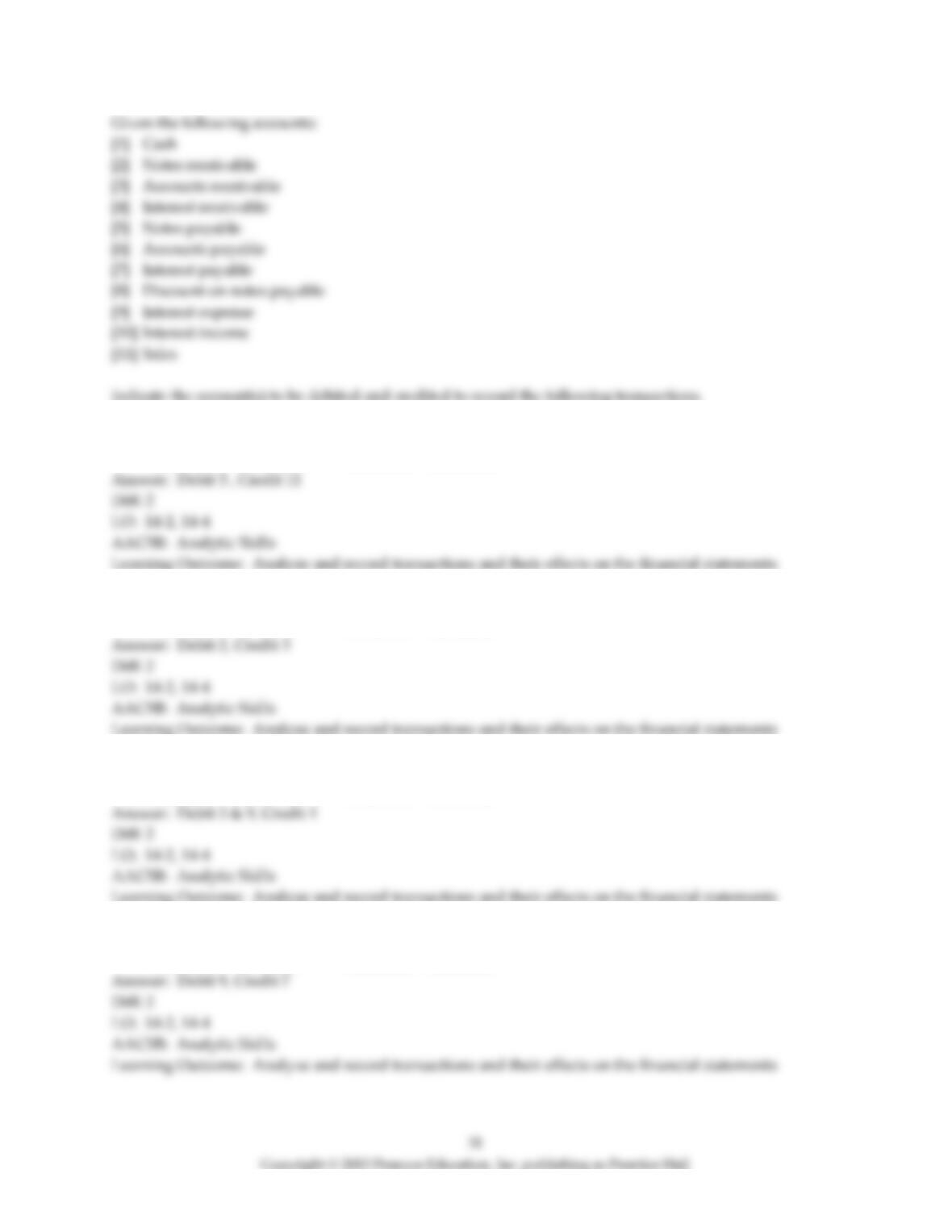
32) Sold merchandise on account.
Debit ________ & ________ Credit ________ & ________
33) A promissory note received in granting a time extension to a charge customer.
Debit ________ & ________ Credit ________ & ________
34) Paying the principal plus accrued interest.
Debit ________ & ________ Credit ________ & ________
35) Accrued interest on a note payable.
Debit ________ & ________ Credit ________ & ________
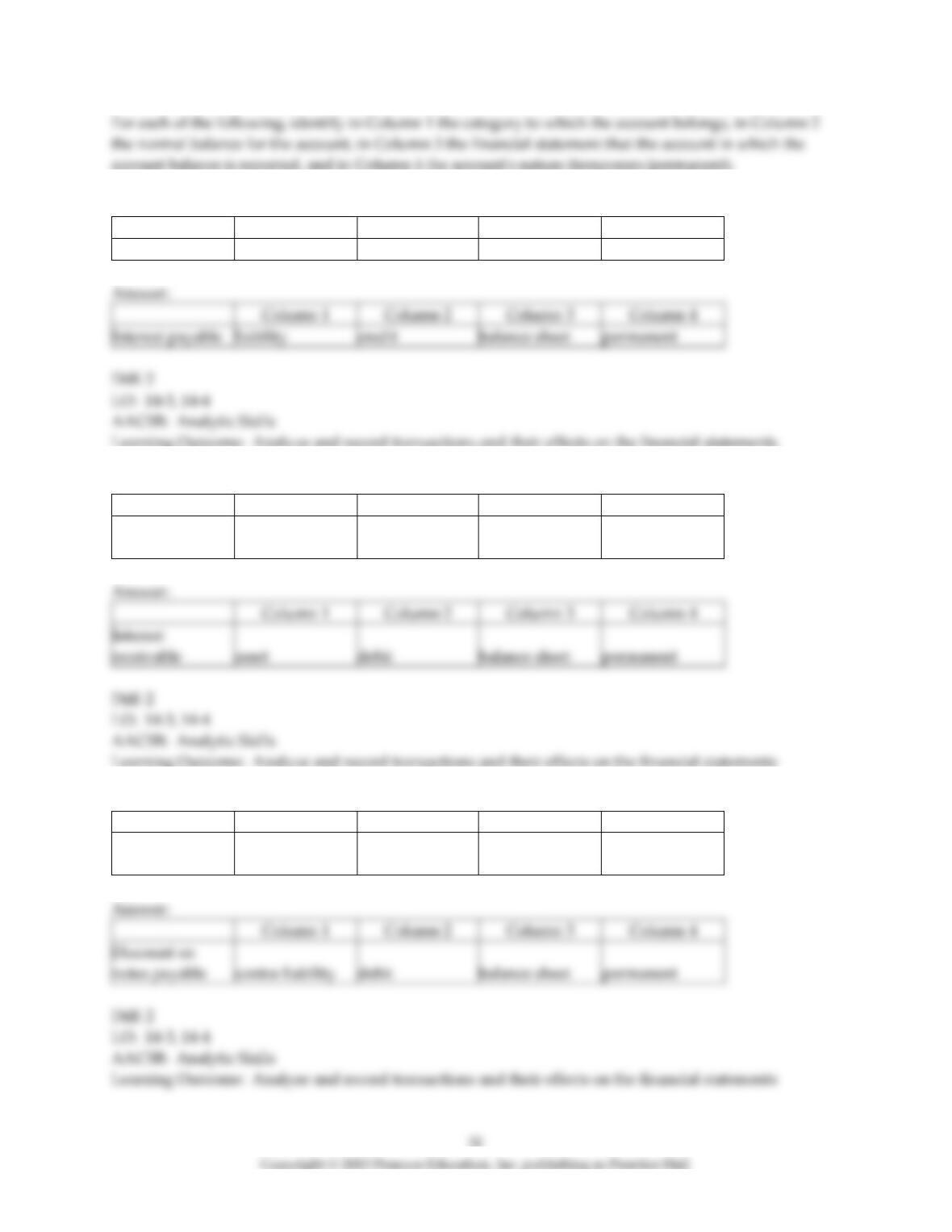
36)
Column 1
Column 2
Column 3
Column 4
Interest payable
Column 1
Column 2
Column 3
Column 4
Interest payable
liability
credit
balance sheet
permanent
37)
Column 1
Column 2
Column 3
Column 4
Interest
receivable
Column 1
Column 2
Column 3
Column 4
receivable
asset
debit
balance sheet
permanent
38)
Column 1
Column 2
Column 3
Column 4
Discount on
notes payable
Column 1
Column 2
Column 3
Column 4
Discount on
notes payable
contra-liability
debit
balance sheet
permanent
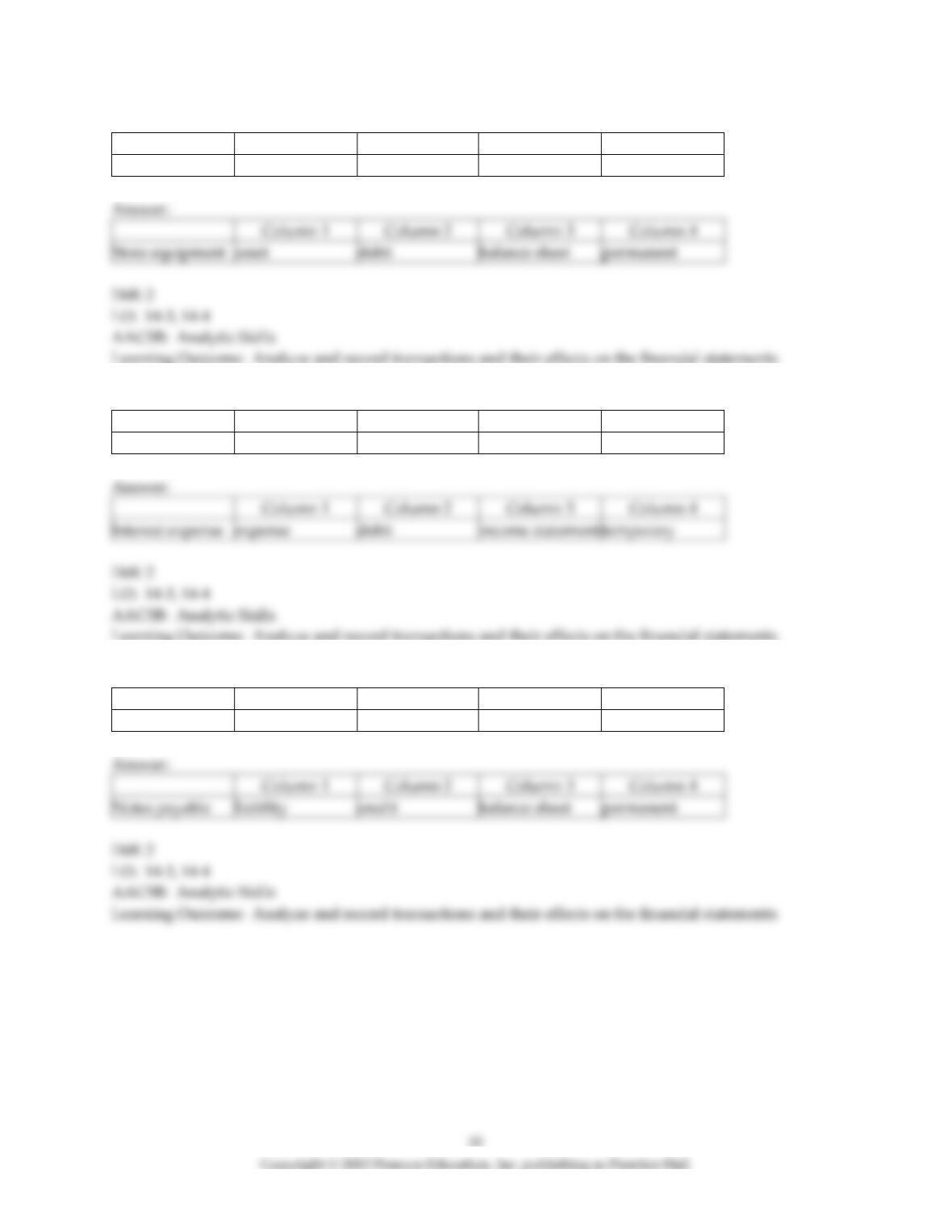
39)
Column 1
Column 2
Column 3
Column 4
Store equipment
Column 1
Column 2
Column 3
Column 4
Store equipment
asset
debit
balance sheet
permanent
40)
Column 1
Column 2
Column 3
Column 4
Interest expense
Column 1
Column 2
Column 3
Column 4
Interest expense
expense
debit
income statement
temporary
41)
Column 1
Column 2
Column 3
Column 4
Notes payable
Column 1
Column 2
Column 3
Column 4
Notes payable
liability
credit
balance sheet
permanent
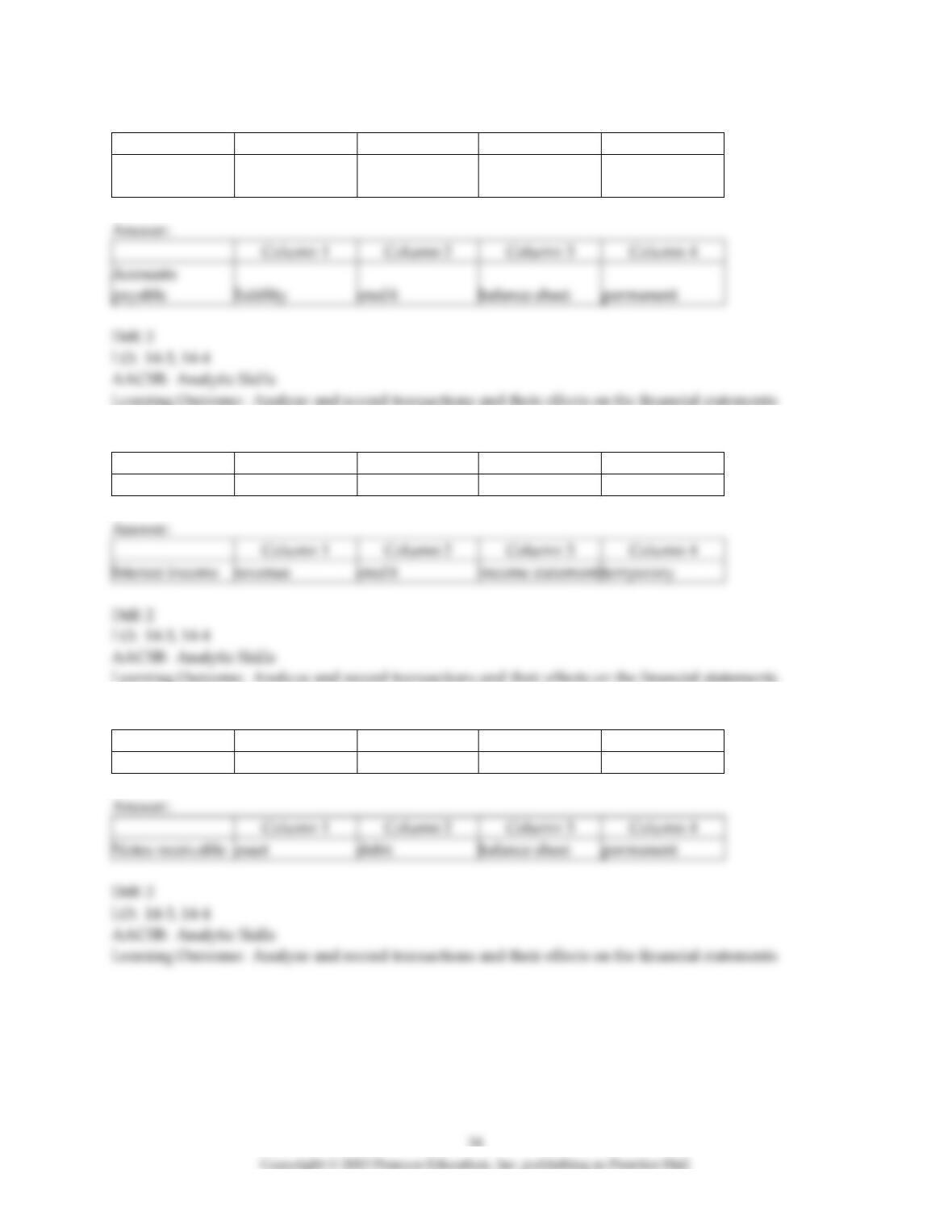
42)
Column 1
Column 2
Column 3
Column 4
Accounts
payable
Accounts
payable
liability
credit
balance sheet
permanent
43)
Column 1
Column 2
Column 3
Column 4
Interest income
Interest income
revenue
credit
income statement
temporary
44)
Column 1
Column 2
Column 3
Column 4
Notes receivable
Column 1
Column 2
Column 3
Column 4
Notes receivable
asset
debit
balance sheet
permanent
45)
Column 1
Column 2
Column 3
Column 4
Accounts
receivable
Accounts
asset
debit
balance sheet
permanent
46)
Column 1
Column 2
Column 3
Column 4
Sales
Column 1
Column 2
Column 3
Column 4
Sales
revenue
credit
income statement
temporary