Version 1 17
A) a localization strategy.
B) an international strategy.
C) a global strategy.
D) a transnational strategy.
59) The need for coordination between subunits is greatest in firms pursuing
A) a localization strategy.
B) an international strategy.
C) a global strategy.
D) a transnational strategy.
60) _____ refers to giving a person in each subunit responsibility for coordinating with
another subunit on a regular basis.
A) Global learning
B) Liaison roles
C) Knowledge network
D) Matrix structures
61) _____ is valuable because it can be used as a nonbureaucratic conduit for information
flows within a multinational enterprise.
A) A liaison network
B) A matrix structure
C) An organizational structure
D) A knowledge network
Version 1 18
62) Which control system is most widely used by small firms?
A) personal
B) output
C) bureaucratic
D) cultural
63) _____ control is achieved by comparing actual performance against targets and
intervening selectively to take corrective action.
A) Personal
B) Output
C) Bureaucratic
D) Cultural
64) There is low interdependence, performance ambiguity, and costs of control in firms
pursuing
A) a localization strategy.
B) an international strategy.
C) a transnational strategy.
D) a global strategy.
65) Which of the following is true of a strong corporate culture?
Version 1 19
A) Almost all managers share a relatively consistent set of values and norms that have a
clear impact on the way work is performed.
B) A strong culture leads to high performance.
C) Outsiders see firms with a strong culture as being autocratic and inflexible.
D) A strong culture is always a good culture.
66) _____ refers to the location of decision-making responsibilities within a structure.
A) Vertical differentiation
B) Integrating mechanisms
C) Horizontal integration
D) Horizontal differentiation
67) What type of control system achieves control through a system of rules and procedures
that directs the actions of subunits?
A) personal controls
B) bureaucratic controls
C) cultural controls
D) output controls
68) Which of the following is a potential drawback of the worldwide area structure?
A) This structure discourages division of the organization into autonomous entities.
B) This structure makes it difficult to decentralize decisions regarding operations
authority.
C) This structure makes it difficult to realize location and experience curve economies.
D) This structure reduces local responsiveness.
Version 1 20
69) The establishment of integrating mechanisms that coordinate subunits is a dimension of
A) horizontal differentiation.
B) organizational culture.
C) vertical differentiation.
D) organizational structure.
70) In Firm A, each division is a self-contained, largely autonomous entity with full
responsibility for its own value creation activities. What type of structure does Firm A employ?
A) worldwide product division structure
B) global matrix structure
C) worldwide area structure
D) knowledge network structure
71) In the _____, the philosophy is that responsibility for operating decisions pertaining to a
particular product should be shared by the product division and the various areas of the firm.
A) worldwide product division structure
B) classic global matrix structure
C) worldwide area structure
D) knowledge network structure
72) When the need to integrate subunits is very high and complex, firms may
Version 1 21
A) use direct contact between subunit managers.
B) give a person in each subunit responsibility for coordinating with another subunit on
a regular basis.
C) institute a matrix structure, in which all roles are viewed as integrating roles.
D) use temporary or permanent teams composed of individuals from the subunits that
need to achieve coordination.
73) _____ is achieved by comparing actual performance against targets and intervening
selectively to take corrective action.
A) Personal control
B) Cultural control
C) Bureaucratic control
D) Output control
74) _____ exists when the causes of a subunit’s poor performance are not clear.
A) Performance ambiguity
B) Vertical differentiation
C) Output controls
D) Horizontal differentiation
75) Which of the following is a disadvantage of a worldwide area structure?
Version 1 22
A) Firms that use this structure tend to have a high degree of diversification.
B) Decision making is centralized and subsidiaries cannot customize to local marketing
needs.
C) The structure encourages fragmentation of the organization into highly autonomous
entities.
D) It does not facilitate local responsiveness.
76) All of the following are strategies that multinational firms pursue except a ________
strategy.
A) localization
B) domestic
C) transnational
D) global
77) Firms pursuing _____ attempt to create value by transferring core competencies from
home to foreign subsidiaries.
A) a localization strategy
B) an international strategy
C) a transnational strategy
D) a global strategy
78) A firm that operates with matrix-type structures in which both product divisions and
geographic areas have significant influence would use which of the following strategies?
Version 1 23
A) international strategy
B) transnational strategy
C) global strategy
D) localization strategy
79) Firms pursuing a transnational strategy
A) have a low need for coordination.
B) require very few integrating mechanisms.
C) need to cultivate a strong culture.
D) operate with a worldwide product division structure.
80) Firms pursuing _____ strategy have a low need for coordination between subunits.
A) a global standardization
B) a localization
C) A transnational
D) an international
81) Firms pursuing _____ strategyare more centralized than enterprises pursuing a
localization or international strategy.
A) a localization
B) an international
C) a global standardization
D) a transnational
Version 1 24
82) Which of the following is a required step for implementing organizational change?
A) Physically move the organization to a new state.
B) Keep the organizational structure.
C) Refreeze the organizational structure.
D) Slowly, through incremental changes, rearrange the organizational structure.
83) Because of inertia forces, _____ is often no change.
A) big bang change
B) cultural change
C) shock therapy change
D) incremental change
84) To unfreeze the established culture of an organization, the company
A) must take bold steps such as shaking up the management structure in order to
implement change.
B) is best served by taking incremental steps.
C) should employ the existing structural organization to integrate changes.
D) implement a rewards or incentive program.
85) Organizational structure refers to the totality of a firm’s organization.
⊚ true
⊚ false
86) A manager receives a bonus because the national operating subsidiary that she is in
charge of exceeds its performance target. This is an example of an incentive.
Version 1 25
⊚ true
⊚ false
87) A decentralized organization allows managers to respond to environmental changes more
quickly than in a centralized organization.
⊚ true
⊚ false
88) The choice between centralization and decentralization is absolute.
⊚ true
⊚ false
89) Beyond the initial functional division of the organization, further horizontal
differentiation may be required if the firm significantly diversifies its product offering, which
takes the firm into different business areas.
⊚ true
⊚ false
90) In a worldwide area structure, each area tends to be a self-contained, largely autonomous
entity with its own set of value creation activities.
⊚ true
⊚ false
91) In a worldwide product divisional structure, each division is a self-contained, largely
autonomous entity with full responsibility for its own value creation activities.
⊚ true
⊚ false
Version 1 26
92) The worldwide product division structure may create a lack of local responsiveness.
⊚ true
⊚ false
93) It is difficult to ascertain accountability in the global matrix structure.
⊚ true
⊚ false
94) The need for coordination between units is greatest in firms pursuing a localization
strategy.
⊚ true
⊚ false
95) Direct contact between subunit managers is the simplest integrating mechanism.
⊚ true
⊚ false
96) A knowledge network is a network for transmitting information within an organization
that is based on formal organizational structure.
⊚ true
⊚ false
Version 1 27
97) The basic principle behind incentive systems is to ensure that the incentive scheme for an
individual employee is linked to an output target that he or she has some control over and can
influence.
⊚ true
⊚ false
98) Performance ambiguity lowers the cost of control.
⊚ true
⊚ false
99) New processes that might lead to a competitive advantage can be developed anywhere
within the organization’s global network of operations.
⊚ true
⊚ false
100) Norms are abstract ideas about what a group believes to be good, right, and desirable.
⊚ true
⊚ false
101) An organizational culture can be strong but bad.
⊚ true
⊚ false
102) Firm ABC is pursuing a localization strategy that is focused on local responsiveness.
Therefore, the need for integration and coordination between self-contained country subsidiaries
is low.
Version 1 28
⊚ true
⊚ false
103) Firms pursuing a localization strategy tend to operate with an array of formal and
informal integrating mechanisms.
⊚ true
⊚ false
104) A firm’s organizational architecture must be consistent with its strategy.
⊚ true
⊚ false
105) It is important to realize that organizational change will occur regardless of the
commitment of senior managers to it.
⊚ true
⊚ false
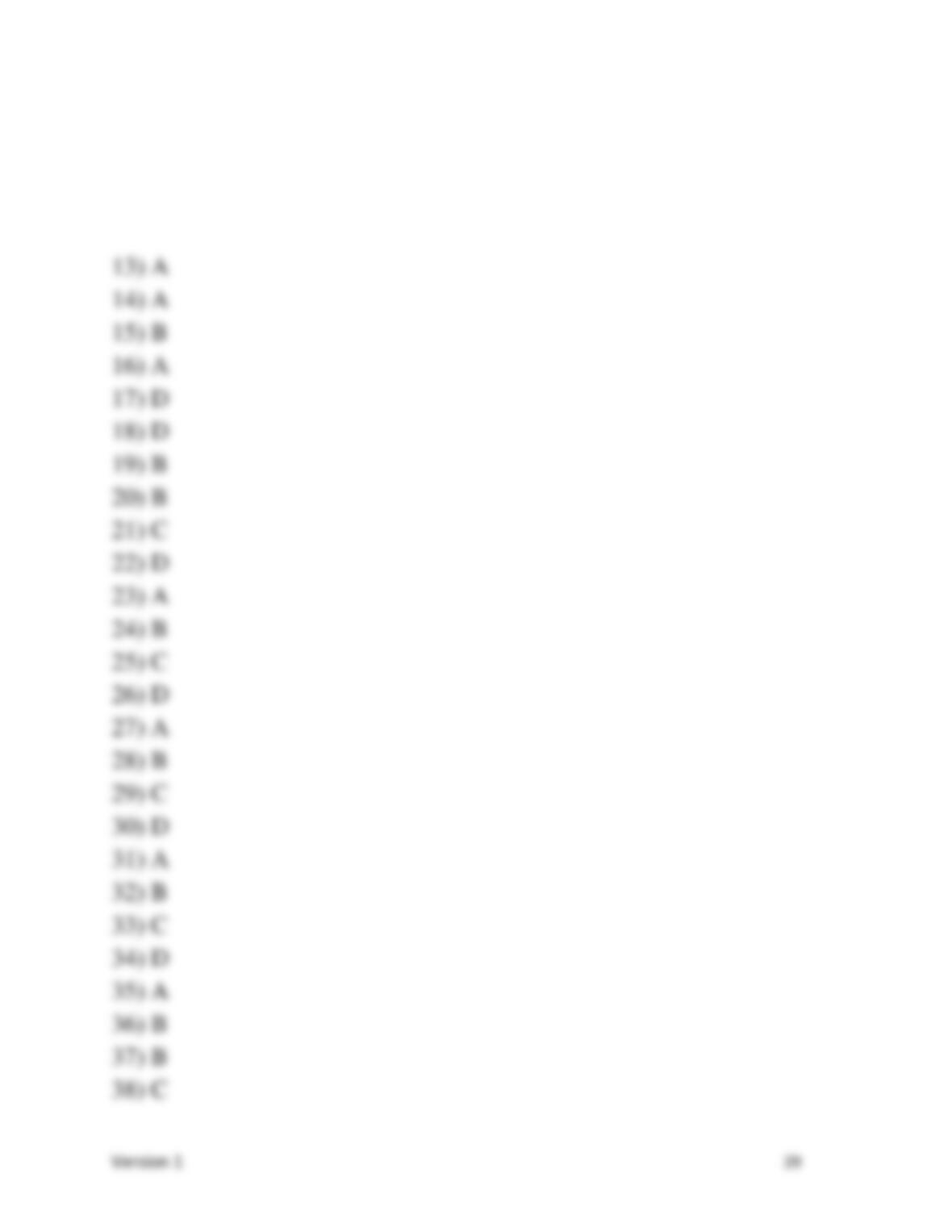
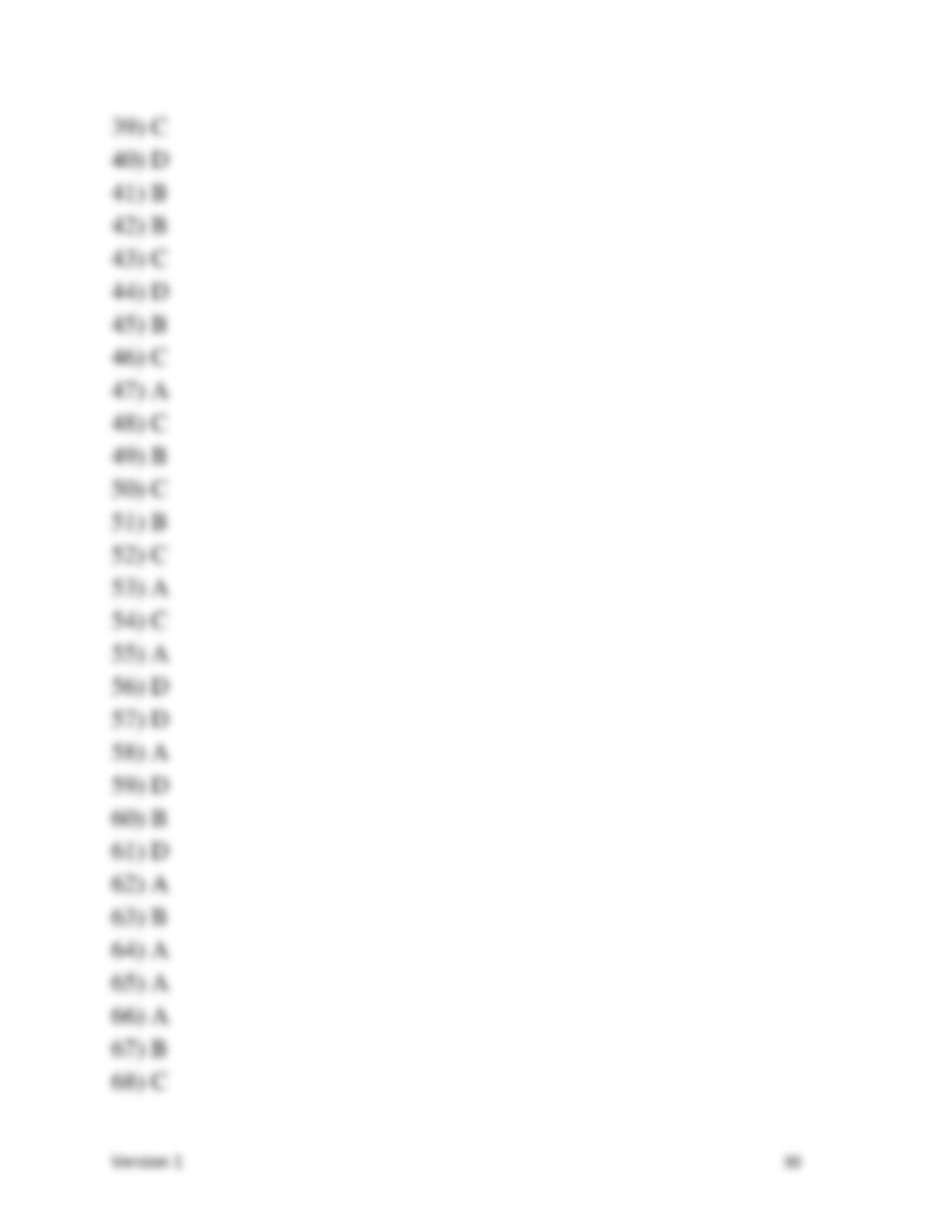
Answer Key
Test name: chapter 14


Version 1 32