College Accounting, 12e (Slater)
Chapter 14 Notes Receivable and Notes Payable
14.1 Learning Objective 14-1
1) A written promise to pay a certain sum of money to another person or company is a:
A) Promissory Accounts Payable.
B) Promissory Note Payable.
C) Promissory Accounts Receivable.
D) Promissory Note Receivable.
2) James borrowed $550 from Tracy. James promised in writing that he would repay the money to Tracy
on May 13, 200x. At the time of the loan, Tracy records the transaction as a(n):
A) Accounts Receivable.
B) Accounts Payable.
C) Promissory Note Receivable.
D) Promissory Note Payable.
3) An advantage of a promissory note receivable over an account receivable is that it:
A) establishes formal proof against the borrower.
B) has a specified interest rate and maturity date.
C) collects interest revenue from the borrower.
D) All of these answers are correct.
4) A promissory note:
A) is a written promise to pay.
B) is an oral promise to pay.
C) is due in 30 days.
D) entitles the maker to a discount.
5) The person or company that borrows money and signs a promissory note payable is the:
A) drawee.
B) drawer.
C) payee.
D) maker.
6) Jane borrowed $1,000 from West Bank and signed a promissory note. Jane is:
A) the payee.
B) the drawee.
C) the creditor.
D) the maker.
7) Morris Law Firm is borrowing $10,000 at 6% interest for one year. The $10,000 is the:
A) proceeds.
B) principal.
C) amount of interest.
D) net amount.
8) David borrows $2,000 from Matthew and gives him a promissory note. Matthew is the:
A) payee.
B) payor.
C) maker.
D) drawer.
9) Harvey loaned $50 to Chase and received a promissory note. Chase is the:
A) maker.
B) drawee.
C) payee.
D) debtor.
10) The interest rate stated on a note for 90 days is:
A) stated on a daily basis.
B) stated on a monthly.
C) stated on an annual basis.
D) indeterminable.
11) A promissory note comes due on the:
A) discount date.
B) maturity date.
C) interest note.
D) issue date.
12) The basic formula for calculating the interest on a note is:
A) Interest = Principal × Rate × Time.
B) Interest = (Principal × Rate) – Time.
C) Interest = (Principal × Time) + Rate.
D) Interest = Principal × Rate/ Time.
13) In the basic formula for calculating interest, rate refers to:
A) percent per day.
B) percent per year.
C) percent per quarter.
D) percent per month.
14) In the basic formula for calculating interest on a promissory note, principal refers to:
A) the original amount—the discount.
B) the amount of interest to be paid.
C) the original amount loaned or borrowed.
D) the maturity value.
15) Interest calculated for one year on a $5,000, 8% promissory note is:
A) $4.
B) $40.
C) $400.
D) some other amount.
16) Interest on a $3,000, 10% promissory note for four months is:
A) $300.
B) $30.
C) $100.
D) $75.
17) Using a 360-day year, interest calculated for 180 days on a $7,000, 9% promissory note is:
A) $630.
B) $310.
C) $315.
D) some other amount.
18) Given a 360-day year, the interest expense on a $7,300, 8%, 77–day promissory note payable is:
A) $584.00.
B) $459.09.
C) $124.91.
D) some other amount.
19) The maturity date for a 60-day note dated February 10, 2012, a leap year is:
A) February 10.
B) April 10.
C) April 11.
D) April 9.
20) The maturity date for a 66-day note dated June 29 is:
A) September 1.
B) September 2.
C) September 3.
D) August 31.
21) The maturity date for a four-month note dated January 31 is:
A) May 1.
B) April 30.
C) May 31.
D) April 29.
22) The maturity value of a $3,000, 12%, 6-month note is:
A) $360.
B) $3,600.
C) $3,000.
D) $3,180.
23) In calculating interest on a note, it is necessary to take which of the following into consideration?
A) The bank
B) The principal
C) The payee
D) The maker
24) A $10,000, 7% note is dated May 18 and is due in 60 days. The due date would be:
A) July 15.
B) July 16.
C) July 17.
D) July 18.
25) A $10,000, 7% note is dated May 18 and is due in 90 days. Using a 360-day year, the maturity value
would be:
A) $10,000.
B) $10,700.
C) $10,175.
D) $10,525.
26) Colo Bank accepts a promissory note for $3,000 from a customer on November 1, to be repaid in seven
months plus 8% interest. The maturity value of the note is:
A) $3,240.
B) $3,140.
C) $3,075.
D) $3,000.
27) The formula for calculating interest on a note is: principal x rate x time.
28) Both Accounts Payable and Notes Payable are both informal promises to pay.
29) The maturity date of a 60-day note dated April 5 is June 3.
30) Maturity value is Principal + Discount.
31) The maker is the party to whom the note is payable.
32) A 3-month note dated September 30 is due December 31.
33) In computing interest, it is required to consider a 365–day year.
34) The terms payee and maker are interchangeable.
35) A 90-day note dated July 9 would be due on October 9.
36) The maturity value for a $6500, 88-day note at 9% interest is $153.
37) Calculate the simple interest and maturity value for the following:
a) $15,000, 10%, 2 1/2 years
b) $ 3,800, 7%, 7 months
c) $ 8,400, 14%, 90 days
38) Find the maturity dates for the following:
a) A 123-day note date March 22.
b) A 5-month note dated January 31.
c) A 75-day note dated February 21, 2012, a leap year.
39) On March 15, Ben Jones negotiated a $25,000 bank loan for 270 days at an interest rate of 8%.
Required (show your calculations):
a) Determine the due date of the note.
b) Calculate the amount of interest charged by the bank.
c) Calculate the maturity value of the note.
40) Scott Moore is considering accepting a $10,000, 60-day, 12% promissory note from Cory Gregor to
extend additional time to settle a past-due account. Discuss some of the reasons why Moore would accept
a promissory note from Cory Gregor.
41) Describe (a) the function of a promissory note and (b) explain its various parts and features.
14.2 Learning Objective 14-2
1) For the maker, being given additional time to settle an account with issuance of a note results in a shift
of:
A) assets from Notes Receivable to Accounts Receivable.
B) assets from Accounts Receivable to Notes Receivable.
C) liabilities from Notes Payable to Accounts Payable.
D) liabilities from Accounts Payable to Notes Payable.
2) When an interest-bearing note comes due and is uncollectible, the journal entry includes:
A) debiting Notes Receivable; crediting Accounts Receivable.
B) debiting Notes Receivable; crediting Accounts Receivable and Interest Revenue.
C) debiting Accounts Receivable and crediting Interest Revenue.
D) debiting Accounts Receivable and crediting Notes Receivable and Interest Revenue.
3) Martin Company needs additional time to pay its accounts payable to Boster Company. Martin makes
a written promise to pay Boster the amount on a certain date. Boster records this transaction as follows:
A) debit Notes Receivable; credit Accounts Receivable.
B) debit Cash; credit Accounts Receivable.
C) debit Accounts Receivable; credit Notes Receivable.
D) debit Notes Receivable; credit Cash.
4) Brooke Company grants James Decorating additional time to pay its past due account. James makes a
written promise to pay Brooke the amount on a certain date. James records this transaction as follows:
A) debit Notes Receivable; credit Accounts Receivable.
B) debit Cash; credit Accounts Receivable.
C) debit Accounts Receivable; credit Notes Receivable.
D) debit Accounts Payable; credit Notes Payable.
5) Jeff Company issues a promissory note to David Company to get extended time on an account payable.
David records this transaction as follows:
A) debit Accounts Receivable; credit Notes Receivable.
B) debit Notes Receivable; credit Accounts Receivable.
C) debit Notes Payable; credit Accounts Payable.
D) debit Accounts Payable; credit Notes Payable.
6) Cory issued a note to his creditor in exchange for an account. Cory records the transaction as follows:
A) debit Notes Payable; credit Accounts Payable.
B) debit Notes Receivable; credit Accounts Receivable.
C) debit Accounts Payable; credit Notes Payable.
D) debit Accounts Receivable; credit Notes Payable.
7) If a company does not pay its note payable on the agreed upon date, the note:
A) is renewed automatically for the same period of time.
B) is discounted at a higher rate of interest.
C) is dishonored by the vendor.
D) is automatically placed in collection with an outside agency.
8) On November 10, Twister Rides issued a 14%, 90-day, $15,000 promissory note. Twister should record
the payment of the note on the maturity day as:
A) debit Notes Payable $15,525; credit Cash $15,525.
B) debit Notes Payable $15,000; debit Interest Payable $525; credit Cash $15,525.
C) debit Notes Payable $15,000; debit Interest Expense $525; credit Cash $15,525.
D) debit Notes Payable $15,000; credit Cash $15,000.
9) Straight Company sold merchandise to Cross Company and received a promissory note from Cross.
Straight should record the transaction as:
A) debit Notes Receivable and credit Sales for the principal amount of the note.
B) debit Notes Receivable and credit Sales for the maturity value of the note.
C) debit Accounts Receivable and credit Sales for the maturity amount of the note.
D) debit Accounts Receivable and credit Sales for the principal amount of the note.
10) Tricia’s Decor purchased merchandise from House Beautiful and issued a promissory note. Tricia
should record the transaction as:
A) debit Purchases and credit Notes Payable for the principal amount of the note.
B) debit Purchases and credit Notes Payable for the maturity value of the note.
C) debit Purchases and credit Accounts Payable for the face amount of the note.
D) debit Purchases and credit Accounts Payable for the maturity value of the note.
11) Warner Enterprises was unable to collect a $1,000 note receivable plus $60 interest on the maturity
date, but hoped to collect the amount in the future. Warner should record this as:
A) debit Bad Debts Expense $1,000; credit Notes Receivable $1,000.
B) debit Allowance for Doubtful Accounts $1,060; credit Notes Receivable $1,060.
C) debit Accounts Receivable $1,060; credit Interest Income $60; credit Notes Receivable $1,000.
D) debit Accounts Receivable $1,000; debit Interest Income $60; credit Cash $1,060.
12) If your customer does not pay the note at maturity, the journal entry on your books would be:
A) debit Notes Payable and credit Accounts Payable.
B) debit Accounts Payable, credit Interest Income and credit Notes Payable.
C) debit Accounts Receivable, credit Interest Income and credit Notes Receivable.
D) debit Notes Receivable, credit Interest Income, and credit Accounts Receivable.
13) A promissory note received for granting a time extension to a charge customer would have which
effect on the categories?
A) Total assets would be increased.
B) Total liabilities would be increased.
C) Owner’s equity would be decreased.
D) None of these answers are correct.
14) The proper entry to make when a note is paid on the maturity date depends on whether the note is an
interest-bearing or non-interest-bearing note.
15) To obtain an extension of time for the payment of an account, a customer may issue a note for any
portion of the amount due.
16) Receiving payment from a customer on an interest bearing note would entail a credit to Interest
Income.
17) When an account receivable is exchanged for a note receivable, a shift in assets occurs.
18) A note that is not paid on the maturity date is considered dishonored.
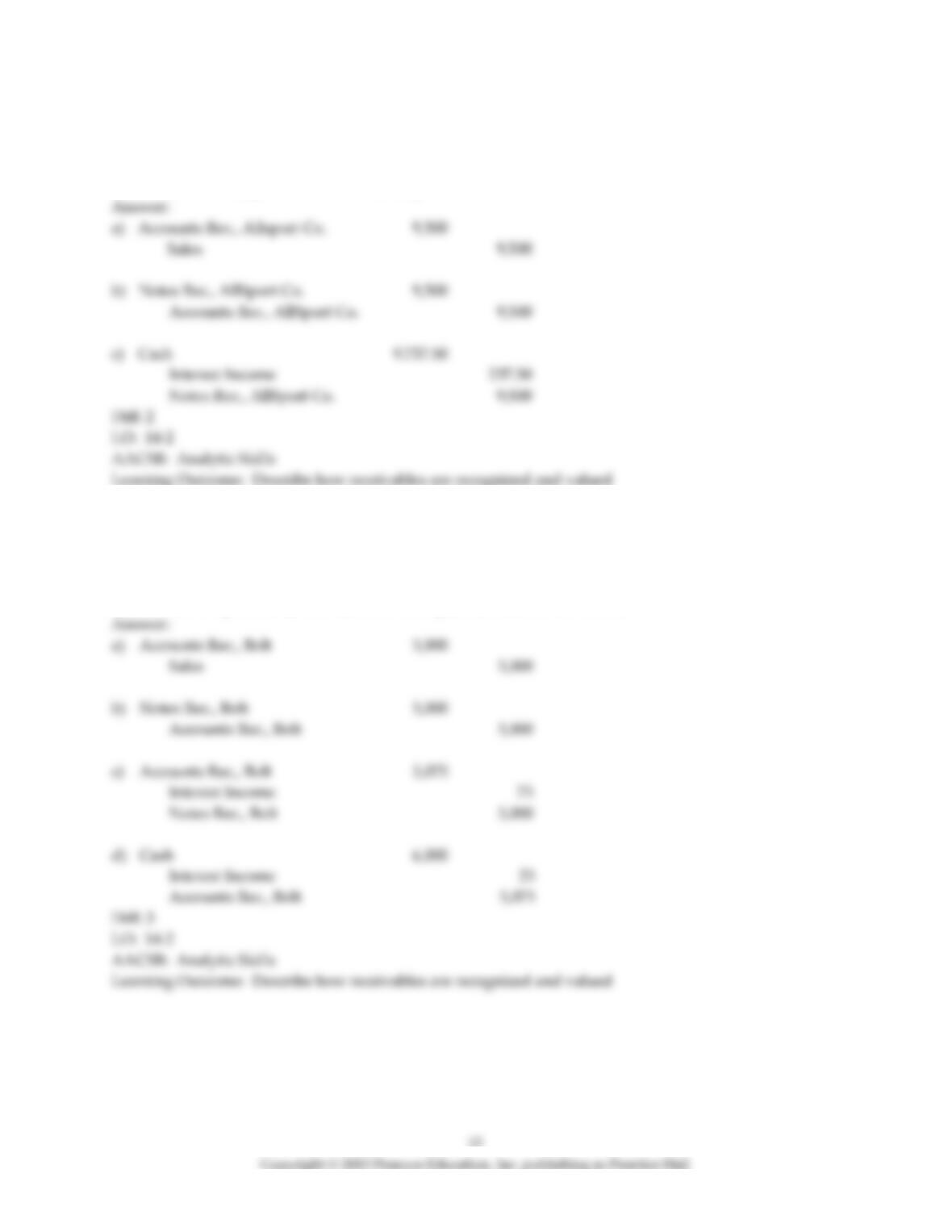
19) Prepare the journal entries for Fit City Company for the following transactions:
a) Fit sold $9,500 of merchandise to AllSport Company on account.
b) Fit City received a 90-day, $9,500, 10% note for a time extension of past-due account of AllSport.
c) Collected the AllSport note on the maturity date.
20) Prepare the journal entries for the following transactions for Dobson Industries Company.
a) Dobson sold $5,000 of merchandise to Bolt Imports Company on account.
b) Dobson accepted a 60-day, 9% note from Bolt in settlement of its account.
c) Bolt defaulted on its note on the maturity date.
d) Collected the previously defaulted Bolt note plus $25 additional interest.
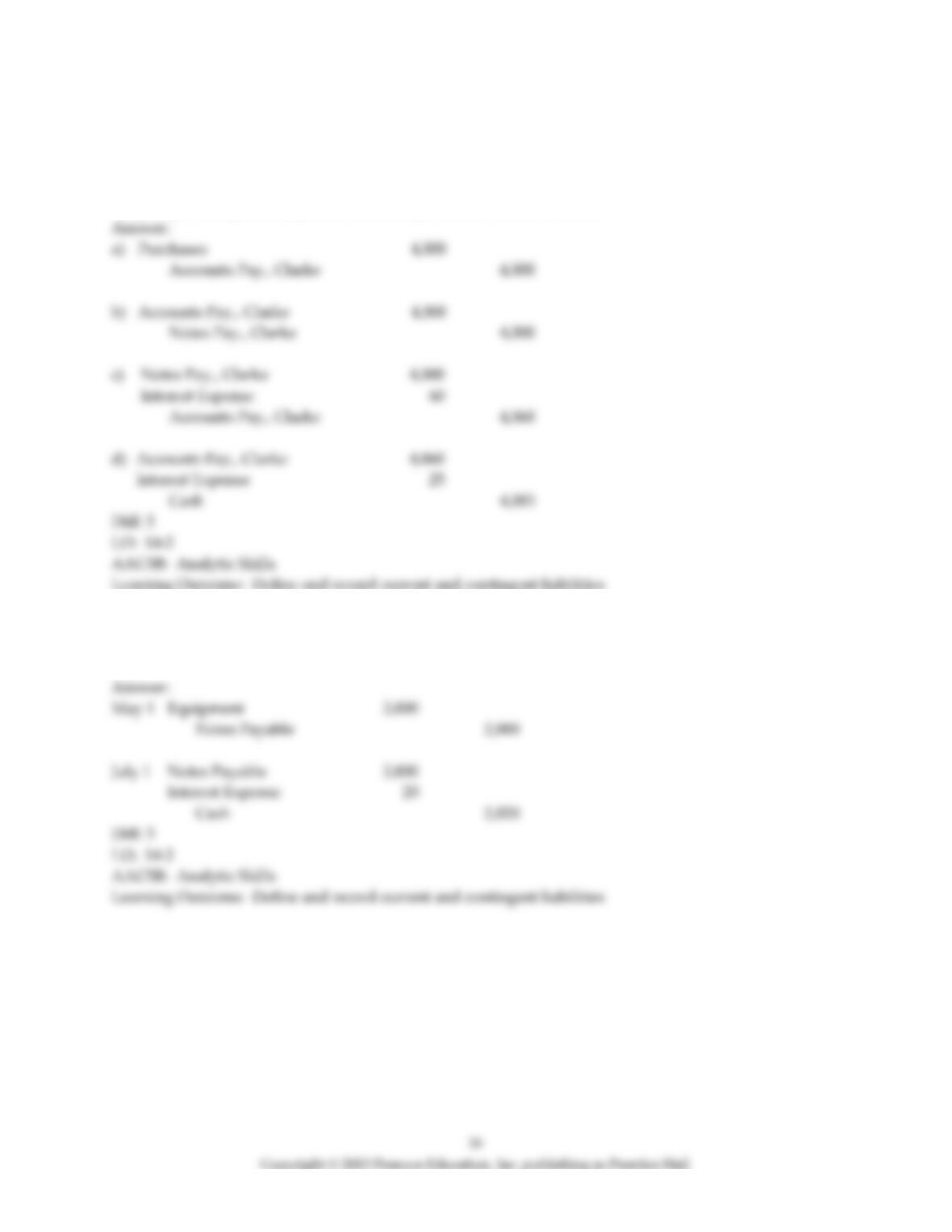
21) Prepare journal entries for the following transactions for Sysco Imports Company.
a) Purchased $4,000 of merchandise (periodic) from Clarke Industries Company on account.
b) Gave Clarke Industries Company a 60-day, 9% note settlement of the account payable.
c) Sysco defaulted on its note on the maturity date.
d) Sysco paid the previously defaulted note plus $25 additional interest.
22) Prepare journal entries for the following transactions for Grant Company:
May 1 Purchased equipment from Knox, Inc. for $2,000 giving a 2-month 6% note
July 1 Paid amount due on note
14.3 Learning Objective 14-3
1) When a business endorses a note and transfers it to a financial institution, the process is called:
A) dishonoring a note receivable.
B) collecting a note receivable.
C) cosigning a note receivable.
D) discounting a note receivable.
2) When a note receivable is discounted, the business that endorses the note becomes potentially liable to
the bank. This type of liability is called a:
A) dependent liability.
B) contingent liability.
C) potential liability.
D) conditional liability.
3) A $6,500, 12% note dated April 23 for 88 days was discounted on June 2 at 14%. The number of days in
the discount period is:
A) 88 days.
B) 48 days.
C) 40 days.
D) some other number.
4) A $6,500, 12% note dated April 23 for 88 days was discounted on June 2 at 14%. The amount of the
discount (using a 360-day year) is:
A) $780.00.
B) $190.67.
C) $124.89.
D) $115.56.
5) The proceeds from discounting a note receivable are the:
A) principal + discount.
B) maturity value – discount.
C) principal – discount.
D) maturity value minus principal.
6) The discount period on a discounted note is:
A) the same as the original period of the note.
B) the time between the original date and the discount date.
C) the time between the discount date and the maturity date.
D) the original note period minus 10 days.
7) The amount the bank charges when it discounts a note is calculated as:
A) bank discount = note principal × bank discount rate × (discount period /360 days).
B) bank discount = maturity value × bank discount rate × (original note period /360 days).
C) bank discount = maturity value × bank discount rate + original interest rate (discount period /360
days).
D) bank discount = maturity value × bank discount rate × (discount period /360 days).
8) On February 15, Weber Services discounts a customer‘s 9%, 90-day, $10,000 note dated January 10. The
discount rate charged by the bank is 12%. The discount period is:
A) 54 days.
B) 36 days.
C) 90 days.
D) 0 days.