Copyright Cengage Learning. Powered by Cognero.
Page 34
b.
False
ANSWER:
False
POINTS:
1
DIFFICULTY:
Challenging
QUESTION TYPE:
True / False
HAS VARIABLES:
False
PREFACE NAME:
Figure 13.3
NATIONAL STANDARDS:
United States – BUSPROG: Promotion – BUSPROG: Analytic
STATE STANDARDS:
United States – PA – DISC: Reading and interpreting g – DISC: Reading and interpreting
graphs
TOPICS:
Financial Flows and Interest-Rate Differentials
KEYWORDS:
BLOOM’S: Analyze
DATE CREATED:
6/22/2016 3:25 PM
DATE MODIFIED:
6/22/2016 3:25 PM
80. Refer to Figure 13.3. Falling investment profitability in the United States, relative to investment profitability abroad,
would shift the U.S. capital and financial account schedule downward from CA0 to CA1, resulting in net financial
outflows from the United States.
a.
True
b.
False
ANSWER:
True
POINTS:
1
DIFFICULTY:
Challenging
QUESTION TYPE:
True / False
HAS VARIABLES:
False
PREFACE NAME:
Figure 13.3
NATIONAL STANDARDS:
United States – BUSPROG: Promotion – BUSPROG: Analytic
STATE STANDARDS:
United States – PA – DISC: Reading and interpreting g – DISC: Reading and interpreting
graphs
TOPICS:
Financial Flows and Interest-Rate Differentials
KEYWORDS:
BLOOM’S: Analyze
DATE CREATED:
6/22/2016 3:25 PM
DATE MODIFIED:
6/22/2016 3:25 PM
81. Refer to Figure 13.3. As the U.S. government decreases taxes on income earned by U.S. residents from foreign
investments, the U.S. capital and financial account schedule shifts downward from CA0 to CA1 and the United States
realizes net financial outflows.
a.
True
b.
False
ANSWER:
True
POINTS:
1
DIFFICULTY:
Challenging
QUESTION TYPE:
True / False
HAS VARIABLES:
False
PREFACE NAME:
Figure 13.3
NATIONAL STANDARDS:
United States – BUSPROG: Promotion – BUSPROG: Analytic
Copyright Cengage Learning. Powered by Cognero.
Page 35
STATE STANDARDS:
United States – PA – DISC: Reading and interpreting g – DISC: Reading and interpreting
graphs
TOPICS:
Financial Flows and Interest-Rate Differentials
KEYWORDS:
BLOOM’S: Analyze
DATE CREATED:
6/22/2016 3:25 PM
DATE MODIFIED:
6/22/2016 3:25 PM
82. Refer to Figure 13.3. If the political and economic stability of foreign countries worsens relative to that of the United
States, the U.S. capital and financial account schedule would shift downward from CA0 to CA1, resulting in net financial
outflows from the United States.
a.
True
b.
False
ANSWER:
False
POINTS:
1
DIFFICULTY:
Challenging
QUESTION TYPE:
True / False
HAS VARIABLES:
False
PREFACE NAME:
Figure 13.3
NATIONAL STANDARDS:
United States – BUSPROG: Promotion – BUSPROG: Analytic
STATE STANDARDS:
United States – PA – DISC: Reading and interpreting g – DISC: Reading and interpreting
graphs
TOPICS:
Financial Flows and Interest-Rate Differentials
KEYWORDS:
BLOOM’S: Analyze
DATE CREATED:
6/22/2016 3:25 PM
DATE MODIFIED:
6/22/2016 3:25 PM
83. According to the Keynesian income-adjustment mechanism, income differentials among nations guarantee current-
account equilibrium in a world of fixed exchange rates.
a.
True
b.
False
ANSWER:
False
POINTS:
1
DIFFICULTY:
Moderate
QUESTION TYPE:
True / False
HAS VARIABLES:
False
NATIONAL STANDARDS:
United States – BUSPROG: Promotion – BUSPROG: Analytic
STATE STANDARDS:
United States – PA – DISC: International trade and fi – DISC: International trade and finance
TOPICS:
Income Adjustments
KEYWORDS:
BLOOM’S: Understand
DATE CREATED:
6/22/2016 3:25 PM
DATE MODIFIED:
6/22/2016 3:25 PM
84. Keynesian theory asserts that, under a system of fixed exchange rates, the influence of income changes in surplus and
deficit countries will automatically promote current-account equilibrium.
a.
True
b.
False
Copyright Cengage Learning. Powered by Cognero.
Page 36
ANSWER:
True
POINTS:
1
DIFFICULTY:
Moderate
QUESTION TYPE:
True / False
HAS VARIABLES:
False
NATIONAL STANDARDS:
United States – BUSPROG: Analytic Reflective Thi – BUSPROG: Reflective Thinking
United States – BUSPROG: Promotion – BUSPROG: Analytic
STATE STANDARDS:
United States – PA – DISC: International trade and fi – DISC: International trade and finance
TOPICS:
Income Adjustments
KEYWORDS:
BLOOM’S: Understand
DATE CREATED:
6/22/2016 3:25 PM
DATE MODIFIED:
6/22/2016 3:25 PM
85. The Keynesian income-adjustment mechanism contends that a trade-surplus nation tends to realize falling income and
falling imports, thus accentuating the trade surplus.
a.
True
b.
False
ANSWER:
False
POINTS:
1
DIFFICULTY:
Moderate
QUESTION TYPE:
True / False
HAS VARIABLES:
False
NATIONAL STANDARDS:
United States – BUSPROG: Analytic Reflective Thi – BUSPROG: Reflective Thinking
United States – BUSPROG: Promotion – BUSPROG: Analytic
STATE STANDARDS:
United States – PA – DISC: International trade and fi – DISC: International trade and finance
TOPICS:
Income Adjustments
KEYWORDS:
BLOOM’S: Understand
DATE CREATED:
6/22/2016 3:25 PM
DATE MODIFIED:
6/22/2016 3:25 PM
86. The foreign-trade multiplier equals the sum of the marginal propensity to import and the marginal propensity to save.
a.
True
b.
False
ANSWER:
False
POINTS:
1
DIFFICULTY:
Challenging
QUESTION TYPE:
True / False
HAS VARIABLES:
False
NATIONAL STANDARDS:
United States – BUSPROG: Analytic Reflective Thi – BUSPROG: Reflective Thinking
United States – BUSPROG: Promotion – BUSPROG: Analytic
STATE STANDARDS:
United States – PA – DISC: International trade and fi – DISC: International trade and finance
TOPICS:
Explore Further
KEYWORDS:
BLOOM’S: Understand
DATE CREATED:
6/22/2016 3:25 PM
DATE MODIFIED:
6/22/2016 3:25 PM
Copyright Cengage Learning. Powered by Cognero.
Page 37
87. If the marginal propensity to save equals 0.2 and the marginal propensity to import equals 0.3, the foreign-trade
multiplier equal 2.0.
a.
True
b.
False
ANSWER:
True
POINTS:
1
DIFFICULTY:
Moderate
QUESTION TYPE:
True / False
HAS VARIABLES:
False
NATIONAL STANDARDS:
United States – BUSPROG: Analytic Reflective Thi – BUSPROG: Reflective Thinking
United States – BUSPROG: Promotion – BUSPROG: Analytic
STATE STANDARDS:
United States – PA – DISC: International trade and fi – DISC: International trade and finance
TOPICS:
Explore Further
KEYWORDS:
BLOOM’S: Understand
DATE CREATED:
6/22/2016 3:25 PM
DATE MODIFIED:
6/22/2016 3:25 PM
88. For an open economy subject to international trade, equilibrium income occurs where saving plus investment equals
imports plus exports.
a.
True
b.
False
ANSWER:
False
POINTS:
1
DIFFICULTY:
Moderate
QUESTION TYPE:
True / False
HAS VARIABLES:
False
NATIONAL STANDARDS:
United States – BUSPROG: Analytic Reflective Thi – BUSPROG: Reflective Thinking
United States – BUSPROG: Promotion – BUSPROG: Analytic
STATE STANDARDS:
United States – PA – DISC: International trade and fi – DISC: International trade and finance
TOPICS:
Explore Further
KEYWORDS:
BLOOM’S: Understand
DATE CREATED:
6/22/2016 3:25 PM
DATE MODIFIED:
6/22/2016 3:25 PM
89. If the marginal propensity to save equals 0.1 and the marginal propensity to import equals 0.3, an autonomous increase
in exports of $1,000 would expand domestic income by $2,500 which leads to an increase in imports of $750.
a.
True
b.
False
ANSWER:
True
POINTS:
1
DIFFICULTY:
Moderate
QUESTION TYPE:
True / False
HAS VARIABLES:
False
NATIONAL STANDARDS:
United States – BUSPROG: Analytic Reflective Thi – BUSPROG: Reflective Thinking
United States – BUSPROG: Promotion – BUSPROG: Analytic
STATE STANDARDS:
United States – PA – DISC: International trade and fi – DISC: International trade and finance
Copyright Cengage Learning. Powered by Cognero.
Page 38
TOPICS:
Explore Further
KEYWORDS:
BLOOM’S: Understand
DATE CREATED:
6/22/2016 3:25 PM
DATE MODIFIED:
6/22/2016 3:25 PM
90. If the marginal propensity to save equals 0.2 and the marginal propensity to import equals 0.3, an autonomous
decrease in investment spending of $1 million leads to a $2 million decrease in domestic income and a $600,000 decrease
in imports.
a.
True
b.
False
ANSWER:
True
POINTS:
1
DIFFICULTY:
Moderate
QUESTION TYPE:
True / False
HAS VARIABLES:
False
NATIONAL STANDARDS:
United States – BUSPROG: Analytic Reflective Thi – BUSPROG: Reflective Thinking
United States – BUSPROG: Promotion – BUSPROG: Analytic
STATE STANDARDS:
United States – PA – DISC: International trade and fi – DISC: International trade and finance
TOPICS:
Explore Further
KEYWORDS:
BLOOM’S: Understand
DATE CREATED:
6/22/2016 3:25 PM
DATE MODIFIED:
6/22/2016 3:25 PM
91. For the income adjustment mechanism to reverse a trade deficit, economic policymakers must be willing to permit
domestic income to increase which leads to rising imports.
a.
True
b.
False
ANSWER:
False
POINTS:
1
DIFFICULTY:
Moderate
QUESTION TYPE:
True / False
HAS VARIABLES:
False
NATIONAL STANDARDS:
United States – BUSPROG: Analytic Reflective Thi – BUSPROG: Reflective Thinking
United States – BUSPROG: Promotion – BUSPROG: Analytic
STATE STANDARDS:
United States – PA – DISC: International trade and fi – DISC: International trade and finance
TOPICS:
Income Adjustments
KEYWORDS:
BLOOM’S: Understand
DATE CREATED:
6/22/2016 3:25 PM
DATE MODIFIED:
6/22/2016 3:25 PM
92. Reliance on an automatic adjustment process tends to be unacceptable in trade-deficit nations since it requires them to
accept price deflation and/or falling income as a cost of reducing imports.
a.
True
b.
False
ANSWER:
True
POINTS:
1
DIFFICULTY:
Moderate
Copyright Cengage Learning. Powered by Cognero.
Page 39
QUESTION TYPE:
True / False
HAS VARIABLES:
False
NATIONAL STANDARDS:
United States – BUSPROG: Analytic Reflective Thi – BUSPROG: Reflective Thinking
United States – BUSPROG: Promotion – BUSPROG: Analytic
STATE STANDARDS:
United States – PA – DISC: International trade and fi – DISC: International trade and finance
TOPICS:
Disadvantages of Automatic Adjustment Mechanisms
KEYWORDS:
BLOOM’S: Understand
DATE CREATED:
6/22/2016 3:25 PM
DATE MODIFIED:
6/22/2016 3:25 PM
93. An “automatic” adjustment mechanism would require a trade-surplus nation to accept price deflation and/or falling
income as the cost of increasing imports.
a.
True
b.
False
ANSWER:
False
POINTS:
1
DIFFICULTY:
Moderate
QUESTION TYPE:
True / False
HAS VARIABLES:
False
NATIONAL STANDARDS:
United States – BUSPROG: Analytic Reflective Thi – BUSPROG: Reflective Thinking
United States – BUSPROG: Promotion – BUSPROG: Analytic
STATE STANDARDS:
United States – PA – DISC: International trade and fi – DISC: International trade and finance
TOPICS:
Disadvantages of Automatic Adjustment Mechanisms
KEYWORDS:
BLOOM’S: Understand
DATE CREATED:
6/22/2016 3:25 PM
DATE MODIFIED:
6/22/2016 3:25 PM
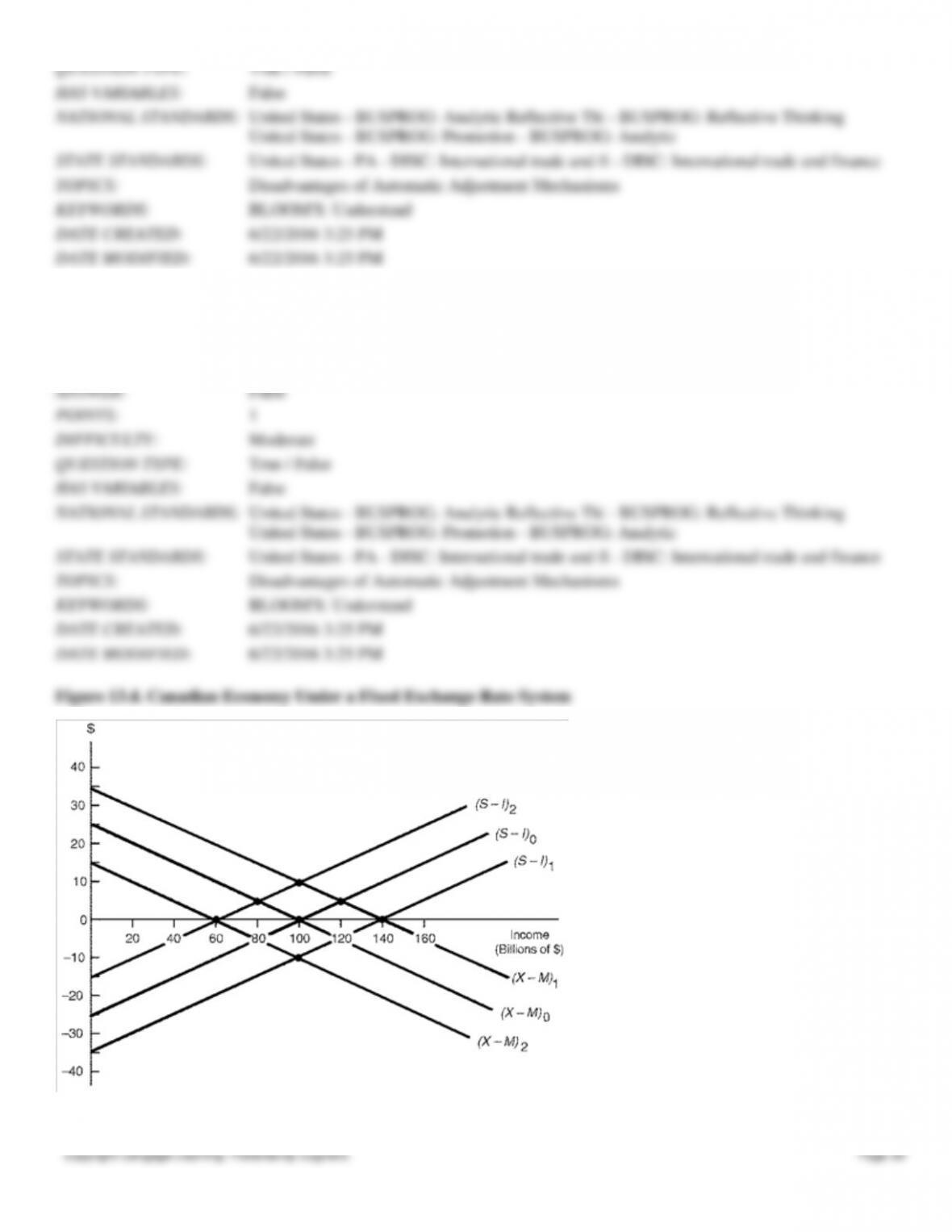
94. Referring to Figure 13.4, Canada’s marginal propensity to save equals 0.25 and marginal propensity to import equal
0.5.
Copyright Cengage Learning. Powered by Cognero.
Page 40
a.
True
b.
False
ANSWER:
False
POINTS:
1
DIFFICULTY:
Challenging
QUESTION TYPE:
True / False
HAS VARIABLES:
False
PREFACE NAME:
Figure 13.4
NATIONAL STANDARDS:
United States – BUSPROG: Promotion – BUSPROG: Analytic
STATE STANDARDS:
United States – PA – DISC: Reading and interpreting g – DISC: Reading and interpreting
graphs
TOPICS:
Explore Further
KEYWORDS:
BLOOM’S: Analyze
DATE CREATED:
6/22/2016 3:25 PM
DATE MODIFIED:
6/22/2016 3:25 PM
95. Referring to Figure 13.4, Canada’s foreign-trade multiplier equals 2.0.
a.
True
b.
False
ANSWER:
True
POINTS:
1
DIFFICULTY:
Challenging
QUESTION TYPE:
True / False
HAS VARIABLES:
False
PREFACE NAME:
Figure 13.4
NATIONAL STANDARDS:
United States – BUSPROG: Promotion – BUSPROG: Analytic
STATE STANDARDS:
United States – PA – DISC: Reading and interpreting g – DISC: Reading and interpreting
graphs
TOPICS:
Explore Further
KEYWORDS:
BLOOM’S: Analyze
DATE CREATED:
6/22/2016 3:25 PM
DATE MODIFIED:
6/22/2016 3:25 PM
96. Refer to Figure 13.4. Starting at equilibrium income $100 billion, where (S – I)0 intersects (X – M)0, an autonomous
decrease in Canadian imports of $10 billion leads to a $20 billion decrease in income and a trade deficit of $5 billion.
a.
True
b.
False
ANSWER:
False
POINTS:
1
DIFFICULTY:
Challenging
QUESTION TYPE:
True / False
HAS VARIABLES:
False
PREFACE NAME:
Figure 13.4
NATIONAL STANDARDS:
United States – BUSPROG: Promotion – BUSPROG: Analytic
STATE STANDARDS:
United States – PA – DISC: Reading and interpreting g – DISC: Reading and interpreting
graphs
Copyright Cengage Learning. Powered by Cognero.
Page 41
TOPICS:
Explore Further
KEYWORDS:
BLOOM’S: Analyze
DATE CREATED:
6/22/2016 3:25 PM
DATE MODIFIED:
6/22/2016 3:25 PM
97. Refer to Figure 13.4. Starting at equilibrium income $100 billion, where (S – I)0 intersects (X – M)0, an autonomous
increase in Canadian investment of $10 billion leads to a $20 billion increase in income and no change in the country’s
trade account.
a.
True
b.
False
ANSWER:
False
POINTS:
1
DIFFICULTY:
Challenging
QUESTION TYPE:
True / False
HAS VARIABLES:
False
PREFACE NAME:
Figure 13.4
NATIONAL STANDARDS:
United States – BUSPROG: Promotion – BUSPROG: Analytic
STATE STANDARDS:
United States – PA – DISC: Reading and interpreting g – DISC: Reading and interpreting
graphs
TOPICS:
Explore Further
KEYWORDS:
BLOOM’S: Analyze
DATE CREATED:
6/22/2016 3:25 PM
DATE MODIFIED:
6/22/2016 3:25 PM
98. Refer to Figure 13.4. Starting at equilibrium income $100 billion, where (S – I)0 intersects (X – M)0, an autonomous
decrease in saving of $10 billion leads to a $20 billion increase in income and a trade deficit of $5 billion.
a.
True
b.
False
ANSWER:
True
POINTS:
1
DIFFICULTY:
Challenging
QUESTION TYPE:
True / False
HAS VARIABLES:
False
PREFACE NAME:
Figure 13.4
NATIONAL STANDARDS:
United States – BUSPROG: Promotion – BUSPROG: Analytic
STATE STANDARDS:
United States – PA – DISC: Reading and interpreting g – DISC: Reading and interpreting
graphs
TOPICS:
Explore Further
KEYWORDS:
BLOOM’S: Analyze
DATE CREATED:
6/22/2016 3:25 PM
DATE MODIFIED:
6/22/2016 3:25 PM
99. Refer to Figure 13.4. Starting at equilibrium income $100 billion, where (S – I)0 intersects (X – M)0, an autonomous
decrease in Canadian exports of $10 billion leads to a $20 decrease in income and a trade deficit of $5 billion.
a.
True
b.
False
Copyright Cengage Learning. Powered by Cognero.
Page 42
ANSWER:
True
POINTS:
1
DIFFICULTY:
Challenging
QUESTION TYPE:
True / False
HAS VARIABLES:
False
PREFACE NAME:
Figure 13.4
NATIONAL STANDARDS:
United States – BUSPROG: Promotion – BUSPROG: Analytic
STATE STANDARDS:
United States – PA – DISC: Reading and interpreting g – DISC: Reading and interpreting
graphs
TOPICS:
Explore Further
KEYWORDS:
BLOOM’S: Analyze
DATE CREATED:
6/22/2016 3:25 PM
DATE MODIFIED:
6/22/2016 3:25 PM
100. According to the monetary approach, balance-of-payments disequilibriums are the result of imbalances in a country’s
money supply and money demand.
a.
True
b.
False
ANSWER:
True
POINTS:
1
DIFFICULTY:
Moderate
QUESTION TYPE:
True / False
HAS VARIABLES:
False
NATIONAL STANDARDS:
United States – BUSPROG: Analytic Reflective Thi – BUSPROG: Reflective Thinking
United States – BUSPROG: Promotion – BUSPROG: Analytic
STATE STANDARDS:
United States – PA – DISC: International trade and fi – DISC: International trade and finance
TOPICS:
Monetary Adjustments
KEYWORDS:
BLOOM’S: Understand
DATE CREATED:
6/22/2016 3:25 PM
DATE MODIFIED:
6/22/2016 3:25 PM
101. The monetary approach contends that, under a fixed exchange rate system, an excess supply of money leads to a
trade surplus.
a.
True
b.
False
ANSWER:
False
POINTS:
1
DIFFICULTY:
Moderate
QUESTION TYPE:
True / False
HAS VARIABLES:
False
NATIONAL STANDARDS:
United States – BUSPROG: Analytic Reflective Thi – BUSPROG: Reflective Thinking
United States – BUSPROG: Promotion – BUSPROG: Analytic
STATE STANDARDS:
United States – PA – DISC: International trade and fi – DISC: International trade and finance
TOPICS:
Monetary Adjustments
KEYWORDS:
BLOOM’S: Understand
DATE CREATED:
6/22/2016 3:25 PM
Copyright Cengage Learning. Powered by Cognero.
Page 43
DATE MODIFIED:
6/22/2016 3:25 PM
102. The monetary approach contends that, under a fixed exchange rate system, an excess demand for money leads to a
trade deficit.
a.
True
b.
False
ANSWER:
False
POINTS:
1
DIFFICULTY:
Moderate
QUESTION TYPE:
True / False
HAS VARIABLES:
False
NATIONAL STANDARDS:
United States – BUSPROG: Analytic Reflective Thi – BUSPROG: Reflective Thinking
United States – BUSPROG: Promotion – BUSPROG: Analytic
STATE STANDARDS:
United States – PA – DISC: International trade and fi – DISC: International trade and finance
TOPICS:
Monetary Adjustments
KEYWORDS:
BLOOM’S: Understand
DATE CREATED:
6/22/2016 3:25 PM
DATE MODIFIED:
6/22/2016 3:25 PM
103. The monetary approach contends that, under a fixed exchange rate system, policies that increase the supply of money
relative to the demand for money lead to a trade surplus.
a.
True
b.
False
ANSWER:
False
POINTS:
1
DIFFICULTY:
Moderate
QUESTION TYPE:
True / False
HAS VARIABLES:
False
NATIONAL STANDARDS:
United States – BUSPROG: Analytic Reflective Thi – BUSPROG: Reflective Thinking
United States – BUSPROG: Promotion – BUSPROG: Analytic
STATE STANDARDS:
United States – PA – DISC: International trade and fi – DISC: International trade and finance
TOPICS:
Monetary Adjustments
KEYWORDS:
BLOOM’S: Understand
DATE CREATED:
6/22/2016 3:25 PM
DATE MODIFIED:
6/22/2016 3:25 PM
104. Compared to classical economists, how did Keynesian economics change the discussion of trade adjustment?
ANSWER:
Keynesian economics put a greater emphasis on the income effects of trade in explaining
trade adjustment. The classical economists emphasized price and interest rate adjustments.
POINTS:
1
DIFFICULTY:
Moderate
QUESTION TYPE:
Subjective Short Answer
HAS VARIABLES:
False
NATIONAL STANDARDS:
United States – BUSPROG: Analytic Reflective Thi – BUSPROG: Reflective Thinking
United States – BUSPROG: Promotion – BUSPROG: Analytic
STATE STANDARDS:
United States – PA – DISC: International trade and fi – DISC: International trade and finance
TOPICS:
Income Adjustments
KEYWORDS:
BLOOM’S: Understand
DATE CREATED:
6/22/2016 3:25 PM
DATE MODIFIED:
6/22/2016 3:25 PM
105. What is the foreign repercussion effect?
ANSWER:
It refers to a situation in which a change in one nation’s macroeconomic variables relative to
another nation will induce a chain reaction in both nations’ economies. The consequence is
that a rise in income of a nation with a balance-of-payments surplus and the fall in income of
the nation with a balance-of-payments deficit are dampened.
POINTS:
1
DIFFICULTY:
Moderate
QUESTION TYPE:
Subjective Short Answer
HAS VARIABLES:
False
NATIONAL STANDARDS:
United States – BUSPROG: Analytic Reflective Thi – BUSPROG: Reflective Thinking
United States – BUSPROG: Promotion – BUSPROG: Analytic
STATE STANDARDS:
United States – PA – DISC: International trade and fi – DISC: International trade and finance
TOPICS:
Income Adjustments
KEYWORDS:
BLOOM’S: Understand
DATE CREATED:
6/22/2016 3:25 PM
DATE MODIFIED:
6/22/2016 3:25 PM
106. Explain David Hume’s theory of automatic adjustment for balance of payments disequilibria.
ANSWER:
David Hume’s theory provided an explanation of the automatic adjustment process that
occurred under the gold standard. Starting from a condition of payments balance, any surplus
or deficit would automatically be eliminated by changes in domestic price levels. Nations
with a payments surplus would experience inflation; this would lead to a loss of
competitiveness, a decrease in net exports, and a fall in the surplus. The opposite applies to
nations with a payments deficit.
POINTS:
1
DIFFICULTY:
Moderate
QUESTION TYPE:
Essay
HAS VARIABLES:
False
NATIONAL STANDARDS:
United States – BUSPROG: Analytic Reflective Thi – BUSPROG: Reflective Thinking
United States – BUSPROG: Promotion – BUSPROG: Analytic
STATE STANDARDS:
United States – PA – DISC: International trade and fi – DISC: International trade and finance
TOPICS:
Price Adjustments
KEYWORDS:
BLOOM’S: Understand
DATE CREATED:
6/22/2016 3:25 PM
DATE MODIFIED:
6/22/2016 3:25 PM
107. Is the monetary approach to the balance-of-payments part of the traditional adjustment theories?
ANSWER:
The monetary approach to the balance of payments is presented as an alternative, rather than a
supplement to traditional adjustment theories. It maintains that, over the long run, payments
disequilibria are rooted in the relationship between the demand for and the supply of money.
Adjustment in the balance of payments is viewed as an automatic process.
POINTS:
1
DIFFICULTY:
Moderate

Copyright Cengage Learning. Powered by Cognero.
Page 45
HAS VARIABLES:
False
NATIONAL STANDARDS:
United States – BUSPROG: Analytic Reflective Thi – BUSPROG: Reflective Thinking
United States – BUSPROG: Promotion – BUSPROG: Analytic
STATE STANDARDS:
United States – PA – DISC: International trade and fi – DISC: International trade and finance
TOPICS:
Monetary Adjustments
KEYWORDS:
BLOOM’S: Understand
DATE CREATED:
6/22/2016 3:25 PM
DATE MODIFIED:
6/22/2016 3:25 PM