13.3 Learning Objective 13-3
1) If the allowance method of accounting for uncollectible receivables is used, what general ledger
account is credited to write off a customer’s account as uncollectible?
A) Bad Debts Expense
B) Accounts Receivable
C) Accounts Payable
D) Bad Debts Recovered
2) If the allowance method of accounting for uncollectible receivables is used, what general ledger
account is debited to write off a customer’s account as uncollectible?
A) Allowance for Doubtful Accounts
B) Bad Debt Expense
C) Accounts Payable
D) Bad Debts Recovered
3) Colleen’s account was written off for $800. She received an inheritance from her uncle and wants to
clear her account. The entry to record this is to:
A) debit Cash and credit Accounts Receivable/Maggie.
B) debit Allowances for Doubtful Accounts, credit Accounts Receivable/Maggie, debit Cash, and credit
Accounts Receivable/Maggie.
C) debit Accounts Receivable/Maggie, credit Allowance for Doubtful Accounts, debit Cash, and credit
Accounts Receivable/Maggie.
D) debit Accounts Receivable/Maggie, credit Allowance for Doubtful Accounts, debit Accounts
Receivable/Maggie, and credit Cash.
4) As the past due time increases for an account, the likelihood of collecting that account:
A) usually goes up.
B) usually goes down.
C) time does not affect collectibility.
D) None of the above
5) After aging the receivables, Tim’s Toys estimates that $900 will not be collected and the allowance
account has a debit balance of $325. The adjusting entry would be for:
A) $575.
B) $900.
C) $1,225.
D) $325.
6) A detailed analysis of Accounts Receivable to determine how long each account has been outstanding
is called:
A) analyzing the Accounts Receivable.
B) aging the uncollectible accounts.
C) aging the Accounts Receivable.
D) taking a percentage of sales on account.
7) A notice was received from Mary, who is a customer, that she was bankrupt. The entry to write-off her
balance of $1,250 would be:
A)
Allowance for Doubtful Accounts
1,250
Accounts Receivable/Mary
1,250
B)
Accounts Receivable/Mary
1,250
Bad Debt Expense
1,250
C)
Bad Debt Expense
1,250
Allowance for Doubtful Accounts
1,250
D) None of the above
8) After aging the Accounts Receivable, it is estimated that $2,450 will not be collected and the allowance
account has an existing debit balance of $300. If Accounts Receivable is $107,000, the net receivables
would be:
A) $107,000.
B) $106,900.
C) $104,550.
D) $104,250.
9) Empire has a credit balance of $750 in its Allowance for Doubtful Accounts. The balance it the
Accounts Receivable account is $80,500, with $2,415 estimated to be uncollectible after aging the accounts.
Under the balance sheet approach, the debit to Bad Debt Expense will be:
A) $2,415.
B) $3,165.
C) $1,665.
D) $750.
10) The aging of Accounts Receivable is an income statement approach.
13.4 Learning Objective 13-4
1) No entry was recorded to reinstate a bad debt when making a collection. The allowance method is
being used. This error would cause:
A) total assets to be overstated.
B) total liabilities to be understated.
C) net income to be understated.
D) None of these are correct.
2) The journal entry to write off an account judged to be uncollectible under the allowance would include
a debit to:
A) Sales.
B) Accounts Receivable.
C) Allowance for Doubtful Accounts.
D) Bad Debts Expense.
3) Town and Country Saddle learns the account receivable for a customer is uncollectible. The journal
entry under the allowance method to write-off an account is to:
A) debit Allowance for Doubtful Accounts; credit Accounts Receivable.
B) debit Sales; credit Allowance for Doubtful Accounts.
C) debit Bad Debts Expense; credit Accounts Receivable.
D) debit Allowance for Doubtful Accounts; credit Bad Debts Expense.
4) What would be the basis for the following journal entry if it appears on Travis Company records?
Travis uses the allowance method.
Allowance for Doubtful Accounts
150
Accounts Receivable—Tim Morgan
150
A) The firm is estimating its uncollectible accounts.
B) The firm is writing off a specific account.
C) The firm is making a collection of a previously written-off account.
D) It is a reversing entry.
5) Myra’s balance of Accounts Receivable is $4,000. The balance of the Allowance account is $600 credit.
Myra writes off a $150 uncollectible account. The effect on net realizable value of the receivables is that it:
A) reduces net realizable value.
B) increases net realizable value.
C) is unchanged.
D) is undeterminable.
6) The net realizable value of a company‘s Accounts Receivables is:
A) increased at the time of a specific write-off.
B) decreased at the time of a specific write-off.
C) unchanged at the time of a specific write-off.
D) the guaranteed amount the company will collect from its customers.
7) A company writes off a specific account as uncollectible, but later the customer pays. The journal entry
to record the reinstatement under the allowance method includes a(n):
A) increase to Cash.
B) decrease to Sales.
C) decrease to Allowance for Doubtful Accounts.
D) decrease to Bad Debts Expense.
8) Aging Accounts Receivable measures:
A) days a bill has been due but not paid.
B) months a bill has been due but not paid.
C) sales for the year.
D) All of these answers are correct.
9) Miami Company uses Allowance for Doubtful Accounts. When Miami writes off an uncollectible
account, there is:
A) a decrease in Accounts Receivable.
B) a decrease in expense.
C) an increase in net income.
D) None of these answers is correct.
10) After having written off a customer under the direct write-off method, the account will be reopened
when the customer:
A) sends the full amount to pay off the account.
B) sends any amount to pay on their account.
C) pays the collection bureau.
D) none of the above
11) When an account receivable is written off as uncollectible, it decreases Bad Debts Expense.
12) If a recovery of a written-off account is made in the same year using the allowance method, the Bad
Debts Recovered account would be used.
13) Carolina Sports uses the allowance method of accounting for uncollectible accounts. Record journal
entries for the transactions listed below:
March 1 Received $800 from Joe in payment of his $1,500 account.
March 8 Wrote off the balance of Joe’s account.
March 9 Received $600 from Tayler to pay off his account in full.
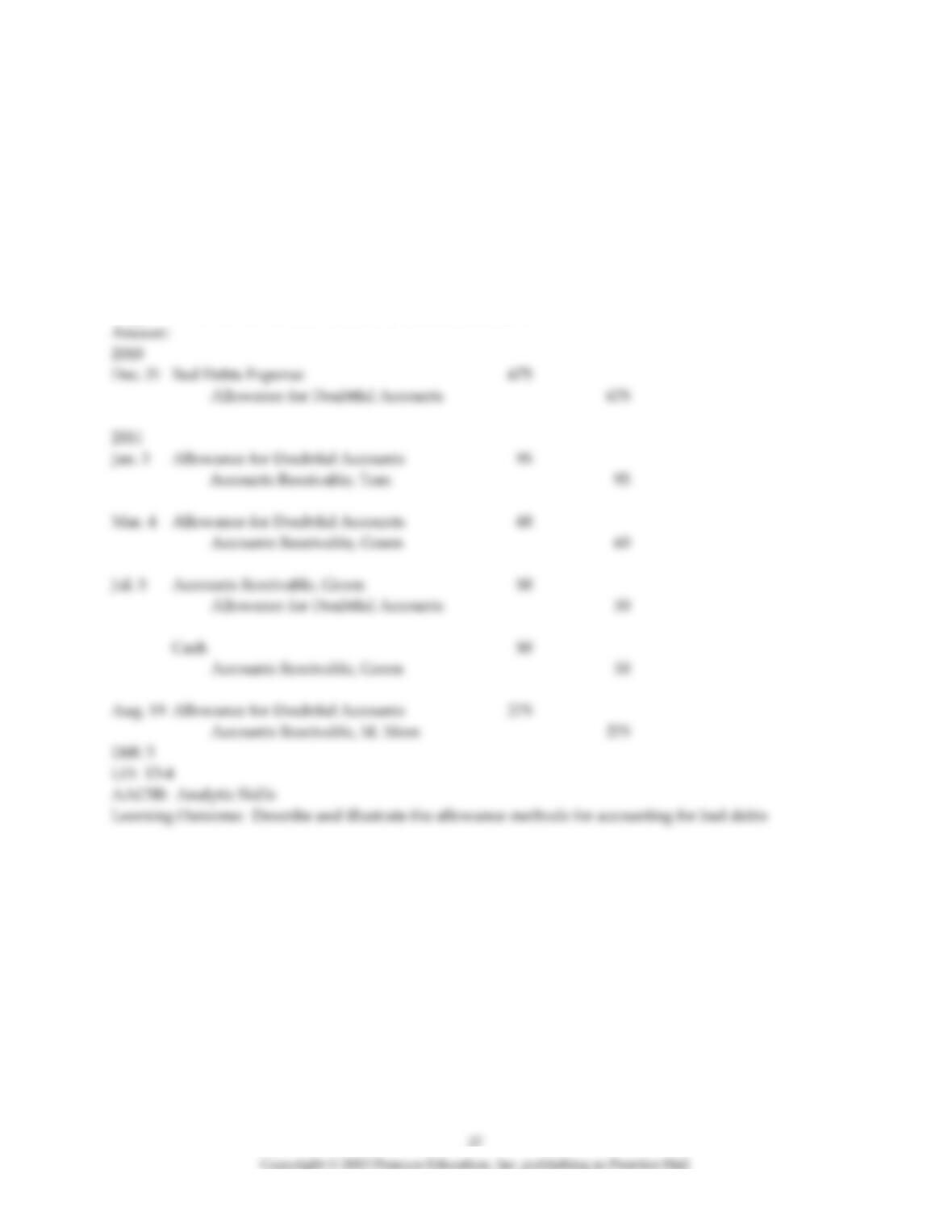
14) Prepare general journal entries to record the following transactions for the Sullivan Company. (The
company uses the income statement approach for recording bad debts expense.)
2010
Dec. 31 Recorded Bad Debts Expense, $ 675
2011
Jan. 3 Wrote off Tom’s account as uncollectible, $95
Mar. 4 Wrote off Green’s account as uncollectible, $ 60
Jul. 5 Recovered $50 from Green
Aug. 19 Wrote off M. Moss’ account as uncollectible, $275
15) Prepare general journal entries to record the following transactions for the Harris Company. (The
company uses the balance sheet approach for recording bad debts expense.)
2010
Dec. 31 Recorded Bad Debts Expense, $800
2011
Jan. 3 Wrote off Jal’s account as uncollectible, $60
Mar. 4 Wrote off Hall’s account as uncollectible, $75
Jul. 5 Recovered $45 from Hall
Aug. 19 Wrote off M. Wilson’s account as uncollectible, $100
Nov. 7 Recovered $25 from Jal
16) Describe and contrast the procedures for estimating uncollectible accounts under the (a) income
statement approach, (b) the balance sheet approach, and (c) the direct write–off approach.
13.5 Learning Objective 13-5
1) The two methods of accounting for uncollectible receivables are the direct write-off method and the:
A) equity method.
B) allowance method.
C) interest method.
D) cost method.
2) The two methods of accounting for uncollectible receivables are the allowance method and the:
A) cost method.
B) interest method.
C) direct write-off method.
D) equity method.
3) In the direct write-off method, writing off an account causes:
A) an increase in expense.
B) an increase in Accounts Receivable.
C) a decrease in the Allowance account.
D) an increase in Liabilities.
4) San Francisco Tours collected $90 on an account that had been directly written off the previous year.
The journal entry to record the transaction would include:
A) a debit to Allowance for Doubtful Accounts.
B) a debit to Bad Debts Recovered.
C) a credit to Bad Debts Recovered.
D) a credit to Bad Debts Expense.
5) A company is not able to reasonably estimate its bad debts expense. The method it may use is:
A) net realizable value method.
B) direct write-off method.
C) aging method.
D) income statement method.
6) If the direct write-off method of accounting for uncollectible receivables is used, what general ledger
account is credited to write off a customer’s account as uncollectible?
A) Bad Debts Recovered
B) Bad Debts Expense
C) Accounts Receivable
D) Interest Expense
7) What would be the basis for the following entry on a firm’s records?
Bad Debt Expense
150
Accounts Receivable
150
A) The firm is using the direct write-off method.
B) The firm is writing off an uncollectible account.
C) The firm is not using the allowance method for writing off accounts.
D) All of these answers are correct.
8) Stacy’s Service Bureau is able to collect an amount previously written off last year under the direct
method. The journal entry will:
A) decrease Bad Debts Expense.
B) increase Bad Debts Recovered.
C) decrease Accounts Receivable.
D) decrease Cash.
9) If the direct write-off method is used, the debit account to write off an uncollectible is:
A) Accounts Receivable.
B) Bad Debt Expense.
C) Allowance for Doubtful Accounts.
D) Sales.
10) When all of the cash for an account previously written off under the direct write-off method is
unexpectedly collected, the correct entry would be:
A) debit Bad Debt Expense and credit Accounts Receivable.
B) debit Accounts Receivable and credit Bad Debt Expense.
C) debit Cash and credit Accounts Receivable.
D) dependent on the period in which the cash was collected.
11) To directly write off an account would require a debit to:
A) Allowance for Doubtful Accounts.
B) Accounts Receivable.
C) Bad Debts Expense.
D) Cash.
12) To record receipt of money after an account has been written off using the direct method, you would
need to:
A) record the receipt of cash.
B) reopen the customer‘s account receivable.
C) credit Bad Debts Recovered.
D) All of the above.
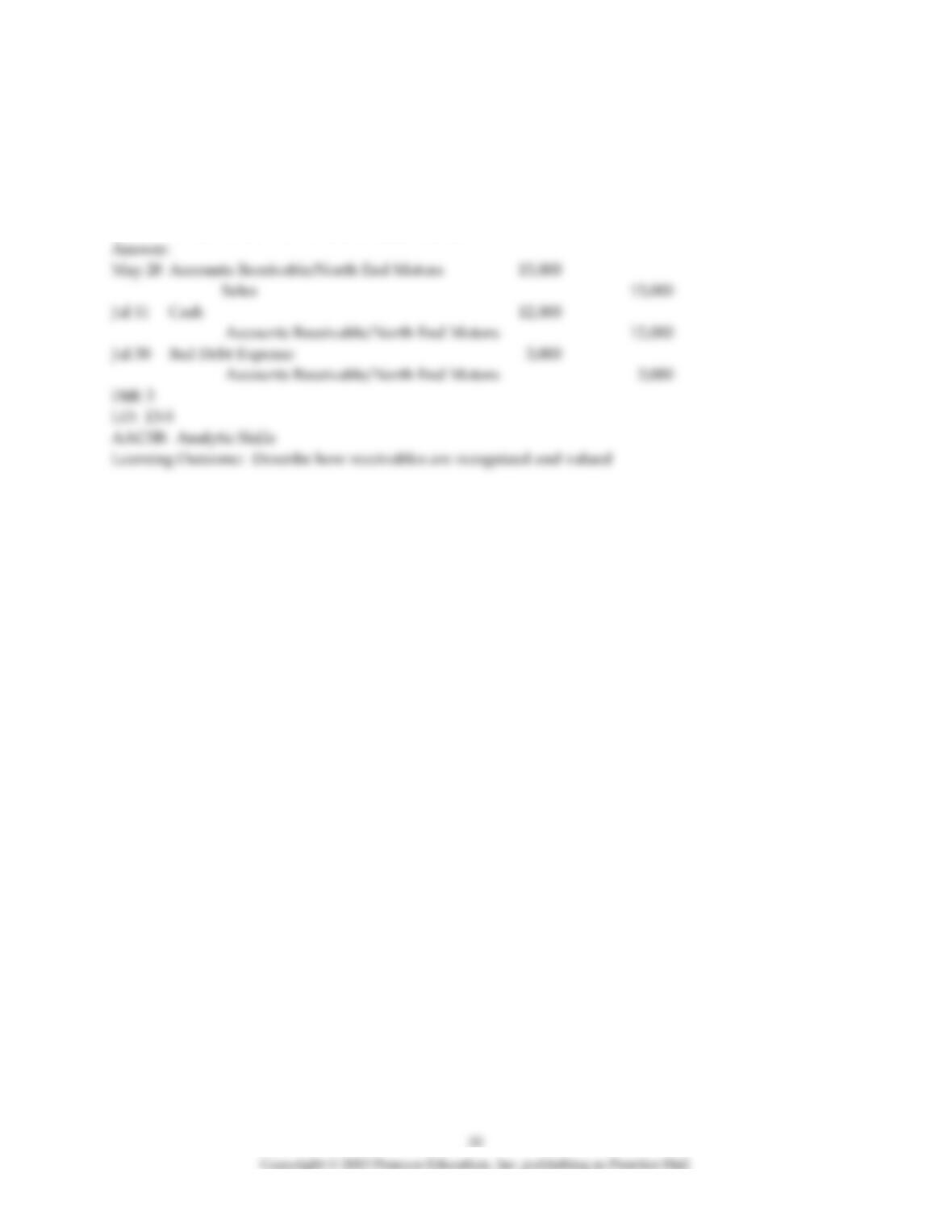
13) CJM Sales uses the direct write-off method in accounting for uncollectible accounts.
Record the following transactions in general journal form.
May 28 Sold merchandise on account to North End Motors for $15,000.
Jul 11 Received $12,000 from North End Motors on their account.
Jul 30 Wrote off the balance due as uncollectible.
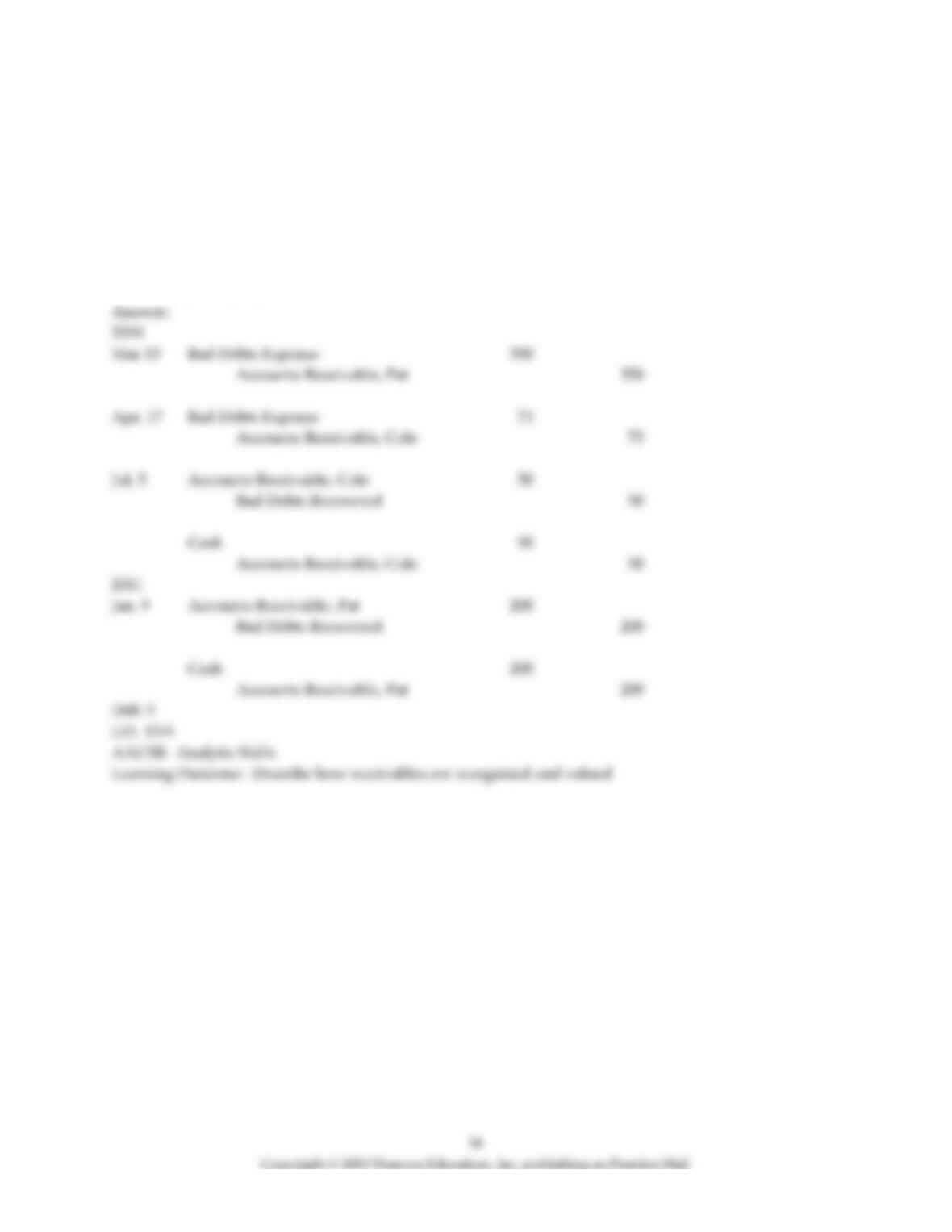
14) Mid-Iowa Internet Service uses the direct write-off method for recording bad debts. Journalize the
following transactions for Mid-Iowa:
2010
Mar. 13 Wrote off Pat’s account for $350
Apr. 17 Wrote off Cole’s account for $75
Jul. 5 Recovered $50 from Cole
2011
Jan. 9 Recovered $200 from Pat
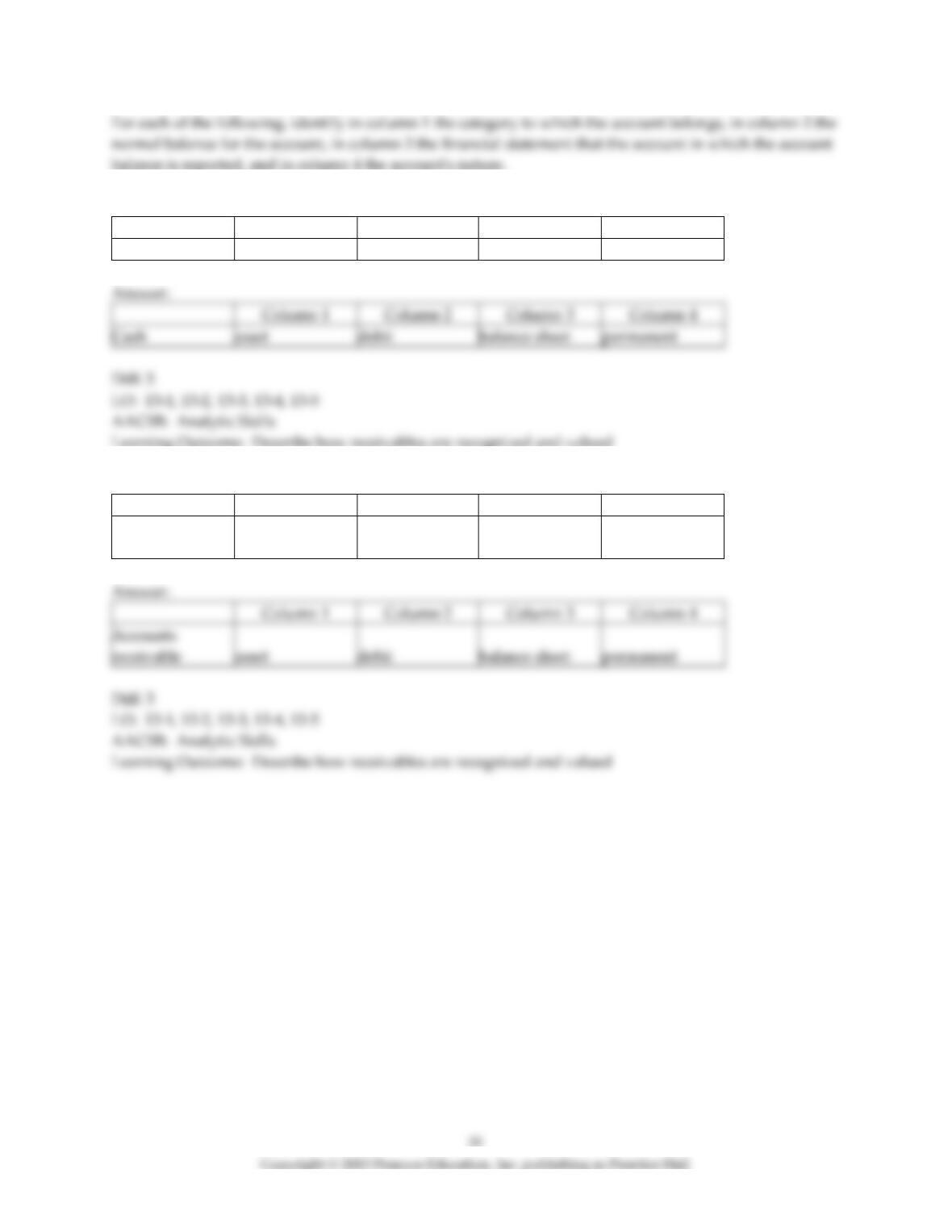
15)
Column 1
Column 2
Column 3
Column 4
Cash
Column 1
Column 2
Column 3
Column 4
Cash
asset
debit
balance sheet
permanent
16)
Column 1
Column 2
Column 3
Column 4
Accounts
receivable
Column 1
Column 2
Column 3
Column 4
receivable
asset
debit
balance sheet
permanent
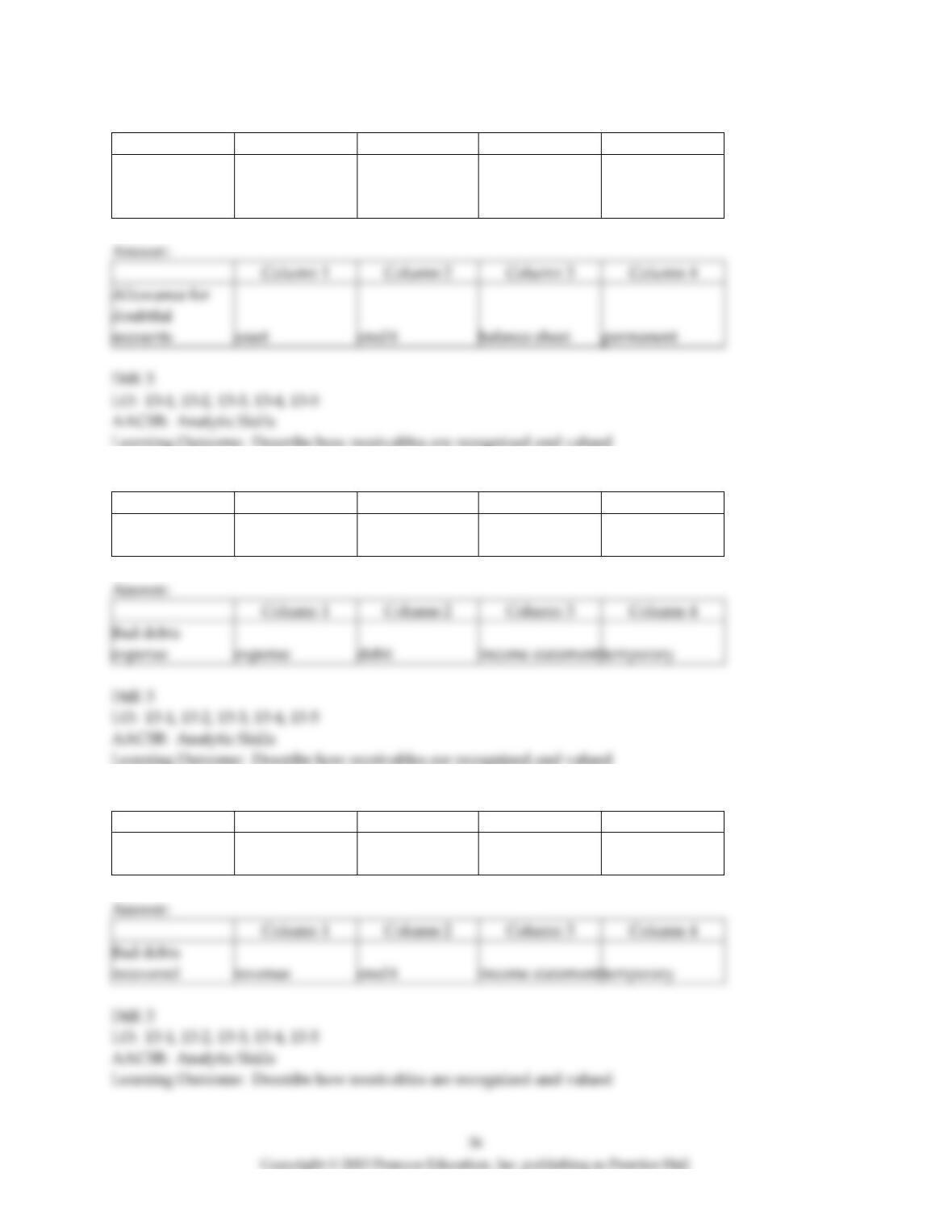
17)
Column 1
Column 2
Column 3
Column 4
Allowance for
doubtful
accounts
Column 1
Column 2
Column 3
Column 4
doubtful
accounts
asset
balance sheet
permanent
18)
Column 1
Column 2
Column 3
Column 4
Bad debts
expense
Column 1
Column 2
Column 3
Column 4
expense
expense
debit
income statement
temporary
19)
Column 1
Column 2
Column 3
Column 4
Bad debts
recovered
Column 1
Column 2
Column 3
Column 4
Bad debts
recovered
revenue
credit
income statement
temporary
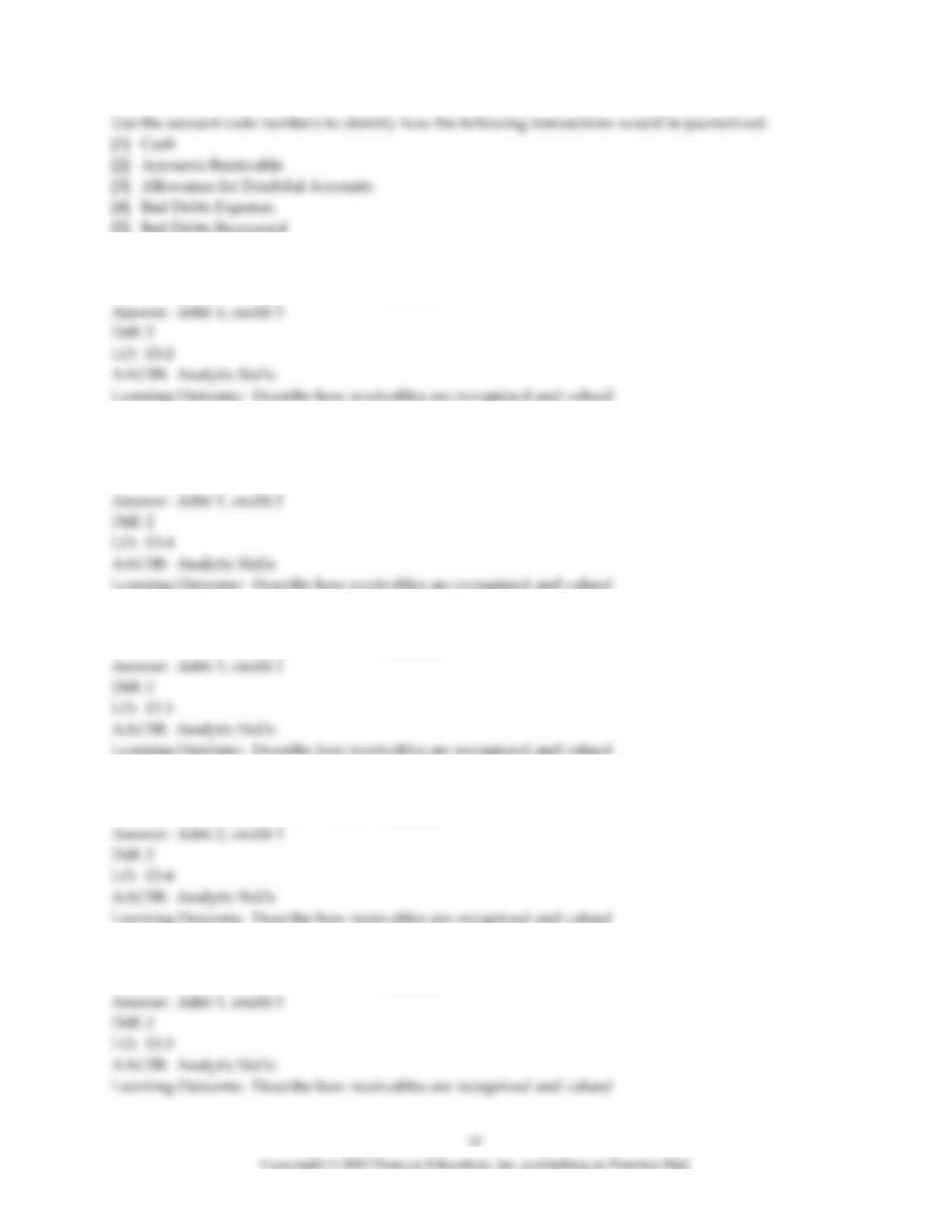
20) Increase the allowance for the estimated bad debts using the percentage of receivables.
Debit account ________ Credit account ________
21) Collected a partial payment from a bad debt under the allowance method. The account had been
reinstated.
Debit account ________ Credit account ________
22) Wrote off an account using the allowance method.
Debit account ________ Credit account ________
23) Reinstated an account previously written off under the allowance method.
Debit account ________ Credit account ________
24) Collected from a customer previously written off under the direct write off method.
Debit account ________ Credit account ________