College Accounting, 12e (Slater)
Chapter 13 Accounting for Bad Debts
13.1 Learning Objective 13-1
1) Which of the following situations would more likely not result in bad debts?
A) The company extends credit easily.
B) The company has a strict credit policy.
C) The company has a cash only policy.
D) None of these answers are correct.
2) What type of account is an Allowance for Doubtful Accounts?
A) Asset
B) Contra-asset
C) Revenue
D) Contra-revenue
3) Which financial statement reports Allowance for Doubtful Accounts?
A) Balance sheet
B) Income statement
C) Statement of owner’s equity
D) None of these answers is correct.
4) What type of account is a Bad Debts Expense?
A) Asset
B) Contra-asset
C) Expense
D) Liability
5) The Allowance for Doubtful Accounts is listed on the balance sheet under the caption:
A) owner’s equity.
B) current liabilities.
C) current assets.
D) fixed assets.
6) Under the allowance method, Bad Debt Expense is recorded:
A) as an estimate.
B) when an individual account is written off.
C) several times during the year as needed.
D) None of these answers is correct.
7) Which account is classified as a contra-asset?
A) Bad Debts Expense
B) Accounts Receivable
C) Sales Returns and Allowances
D) Allowance for Doubtful Accounts
8) The amount of Accounts Receivable a company estimates it will collect is the:
A) Gross Accounts Receivable.
B) Bad Debts Allowance.
C) Net Realizable Value.
D) Accounts Receivable Allowance.
9) Net Realizable Value can be defined as:
A) the Gross Accounts Receivable.
B) the Current Bad Debts Expense.
C) the amount of Accounts Receivable you do not expect to collect.
D) the Gross Accounts Receivable minus the Allowance for Doubtful Accounts.
10) Fit City estimates it will collect $2,300 of the $2,425 owed by customers. The estimated collectible
amount is called:
A) the Bad Debts Allowance.
B) the Net Realizable Value.
C) the Allowance for Doubtful Accounts.
D) the Gross Accounts Receivable.
11) 1 Fit City estimates it will collect $2,300 of the $2,425 owed by customers. The difference of $125
represents the:
A) Gross Accounts Receivable.
B) Allowance for Doubtful Accounts.
C) Net Realizable Value.
D) Value of the Current Unpaid Receivables.
12) After the accounts are adjusted and closed at the end of the year, Accounts Receivable has a normal
balance of $540,000 and Allowance for Doubtful Accounts has a normal balance of $25,000. What is the
net realizable value of the Accounts Receivable?
A) $540,000
B) $565,000
C) $515,000
D) The amount cannot be determined from the given information.
13) Before the accounts are adjusted and closed at the end of the year, Accounts Receivable has a normal
balance of $200,000 and Allowance for Doubtful Accounts has a debit balance $20,000. What is the net
realizable value of the accounts receivable?
A) $180,000
B) $20,000
C) $220,000
D) $200,000
14) The entry to adjust for bad debts was ignored. This error would cause:
A) total assets to be overstated.
B) total liabilities to be understated.
C) net income to be understated.
D) None of these are correct.
15) The Allowance for Doubtful Accounts is adjusted:
A) at the end of each accounting period.
B) each time a customer’s debt is satisfied.
C) within one year of granting credit to a customer.
D) each time a customer is granted credit.
16) A major cost of selling goods on account could be:
A) accounts payable.
B) cash shortages.
C) easy credit.
D) uncollectible accounts.
17) Estimating Bad Debts Expense is an example of:
A) recording accrued expense.
B) the matching principle.
C) the balance sheet approach.
D) recording accrued sales.
18) Bad Debts Expense is:
A) included in Cost of Goods Sold.
B) considered an expense matched with revenues.
C) listed on the balance sheet.
D) not an operating expense.
19) When a customer‘s account is written off:
A) net realizable value of the Accounts Receivable increases.
B) net realizable value of the Accounts Receivable decreases.
C) net realizable value of the Accounts Receivable remains the same.
D) none of the above
20) A company uses the allowance method and expects not to collect $15,000 of sales. The journal entry to
record the estimated bad debt is:
A)
Allowance for Doubtful Accounts
$15,000
Bad Debt Expense
$15,000
B)
Allowance for Doubtful Accounts
$15,000
Accounts Receivable
$15,000
C)
Accounts Receivable
$15,000
Allowance for Doubtful Accounts
$15,000
D)
Bad Debt Expense
$15,000
Allowance for Doubtful Accounts
$15,000
21) A company uses the allowance method and has determined a customer’s bill for $2,000 must be
written off. The journal entry to record the write off is:
A)
Allowance for Doubtful Accounts
$2,000
Bad Debt Expense
$2,000
B)
Allowance for Doubtful Accounts
$2,000
Accounts Receivable
$2,000
C)
Accounts Receivable
$2,000
Allowance for Doubtful Accounts
$2,000
D)
Bad Debt Expense
$2,000
Allowance for Doubtful Accounts
$2,000
22) The Allowance for Doubtful Accounts is shown on the balance sheet as a contra–asset.
23) The normal balance of the Allowance for Doubtful Accounts account is a debit.
24) The normal balance of the Bad Debts Expense account is a debit.
25) The Allowance for Doubtful accounts is shown on the income statement.
26) The adjusting entry for uncollectibles is based on an estimate.
27) The Allowance account is a contra-liability account.
28) The Allowance for Doubtful Accounts may have a debit balance before adjustment.
29) A debit balance in Allowance for Doubtful Accounts indicates the estimate for Bad Debts was too
high.
30) Prepare a partial balance sheet for the Meredith Company at December 31, 200x, from the following
information:
Accounts Receivable $7,500
Allowance for Doubtful Accounts 300
Bad Debt Expense 2,000
Cash 12,000
Merchandise Inventory 3,500
1) Gross Accounts Receivable is $10,000. Allowance for Doubtful Accounts has a credit balance of $200.
Net sales for the year are $150,000. In the past, 2% of sales had proved uncollectible. What would be the
adjusted balance of the Allowance account under the income statement approach?
A) $3,200
B) $2,800
C) $1,400
D) $3,000
2) Gross Accounts Receivable is $12,000. Allowance for Doubtful Accounts has a credit balance of $600.
Net sales for the year are $100,000. In the past, 2% of sales had proved uncollectible, and an aging of the
receivables indicates $1,900 as uncollectible. What would be the adjusted balance of the Allowance
account under the balance sheet approach?
A) $2,000
B) $1,400
C) $2,500
D) $1,900
3) Using the aging method, estimated uncollectible accounts are $3,000. If the balance in the Allowance
for Doubtful Accounts is a $600 credit before adjustment, what is the Bad Debts Expense adjustment for
the period?
A) $3,000
B) $600
C) $2,400
D) $3,600
4) At December 31, 200x, Brooke’s Horse Stable unadjusted Allowance for Doubtful Accounts showed a
debit balance of $432. An aging of the Accounts Receivable indicates probable uncollectible accounts of
$1,000. The year-end adjusting entry for Bad Debts Expense:
A) includes a debit to the Allowance account for $568.
B) includes a credit to the Allowance account for $42.
C) includes a debit to the Allowance account for $822.
D) includes a credit to the Allowance account for $1,432.
5) Which method uses an aging of Accounts Receivable to calculate the Bad Debts Expense?
A) Income statement approach
B) Balance sheet approach
C) Aging the Accounts Receivable
D) Direct write-off
6) Harry’s Hardware estimates that approximately $1.75 out of every $100 of credit sales proves to be
uncollectible. Barber calculates Bad Debts Expense using the:
A) income statement approach.
B) direct write-off method.
C) balance sheet approach.
D) aging the Accounts Receivable approach.
7) The current balance of Allowance for Doubtful Accounts is considered when calculating the current
period’s Bad Debts Expense under the following approach:
A) direct write-off approach.
B) income statement approach.
C) balance sheet approach.
D) All of these answers are correct.
8) Joe’s Auto Repair estimates that approximately 3% of net credit sales are uncollectible. Joe’s calculates
Bad Debts Expense using the:
A) direct write-off method.
B) income statement method.
C) gross method.
D) balance sheet method.
9) Gross Accounts Receivable is $10,000. Allowance for Doubtful Accounts has a credit balance of $200.
Net sales for the year are $150,000. In the past, 2% of sales had proved uncollectible, and an aging of the
receivables indicates $1,200 is doubtful. Under the income statement approach, Bad Debts Expense for the
year is:
A) $1,000.
B) $3,000.
C) $2,800.
D) $1,200.
10) Gross Accounts Receivable is $10,000. Allowance for Doubtful Accounts has a credit balance of $200.
Net sales for the year are $150,000. In the past, 2% of sales had proved uncollectible, and an aging of the
receivables indicates $1,200 is doubtful. Under the balance sheet approach, Bad Debts Expense for the
year is:
A) $1,000.
B) $3,000.
C) $2,800.
D) $1,200.
11) The adjustment for bad debts using the percentage of receivables ignored the debit balance in the
Allowance account. This error would cause:
A) total assets to be overstated.
B) total liabilities to be understated.
C) net income to be understated.
D) None of these are correct.
12) The adjustment for bad debts using the percentage of receivables ignored the credit balance in the
Allowance account. This error would cause:
A) total assets to be overstated.
B) total liabilities to be understated.
C) net income to be understated.
D) None of these are correct.
13) Indy Sport and Hobby’s Allowance for Doubtful Accounts had an unadjusted credit balance of $400.
The manager estimates that $900 of the Accounts Receivable is uncollectible. Using the balance sheet
approach, the year-end adjusting entry for Bad Debts Expense:
A) includes a credit to the Bad Debt Expense account for $500.
B) includes a debit to the Bad Debts Expense account for $900.
C) includes a credit to the Bad Debts Expense account for $1,300.
D) includes a debit to the Bad Debts Expense account for $500.
14) The balance in the Allowance for Doubtful Accounts is considered under which of the following
approaches?
A) Balance sheet approach
B) Income statement approach
C) Direct write-off approach
D) All three approaches
15) Using the aging method, estimated uncollectible accounts are $5,000. If the balance of Allowance for
Doubtful Accounts is $1,500 credit before adjustment, what is a Bad Debt Expense for the period?
A) $3,500
B) $6,500
C) $5,000
D) $1,500
16) When a year-end adjustment is made for estimated bad debts:
A) net income is increased.
B) liabilities increase.
C) net assets increase.
D) net assets decrease.
17) Sylvia’s, Inc., decreases Allowance for Doubtful Accounts $700 at year-end. As a result:
A) net assets decrease.
B) net income is unchanged.
C) net assets increase.
D) net realizable value assets decreases.
18) The journal entry to record the estimate of uncollectible accounts includes:
A) debit Sales; credit Bad Debts Expense.
B) debit Bad Debts Expense; credit Accounts Receivable.
C) debit Allowance for Doubtful Accounts; credit Bad Debts Expense.
D) debit Bad Debts Expense; credit Allowance for Doubtful Accounts.
19) Last year, Congo Corporation had net credit sales of $690,000 and it had uncollectible accounts of
$31,050. Based on last year, what would the percent of estimated uncollectible accounts be this year?
A) 7.10%
B) 3.55%
C) 4.50%
D) 45.00%
20) Sigma reports net credit sales of $400,000. There is a credit balance of $1,000 in the Allowance for
Doubtful Accounts. Uncollectible accounts are estimated to be 2.5% of net credit sales. Under the income
statement approach, the adjusting entry would require a debit to Bad Debt Expense for:
A) $10,000.
B) $9,000.
C) $ 9,975.
D) some other number.
21) The balance sheet approach estimates a percentage of Accounts Receivable that is uncollectible.
22) The income statement approach estimates a percentage of sales that is uncollectible.
23) Using the balance sheet approach, the balance in Allowance for Doubtful Accounts is taken into
consideration when finding the adjustment.
24) Using the income statement approach, the balance in Allowance for Doubtful Accounts is ignored.
25) Under the accrual method of accounting, the allowance method is generally required for financial
reporting purposes.
26) When it is possible to make a reasonable estimate of uncollectible accounts, the allowance method is
preferred for financial reporting purposes.
27) Bad Debts Expense is recorded in the year the sale was earned when using the income statement
allowance approach.
28) On December 31, 2010, Paint Pros had a balance in Accounts Receivable of $15,000. Net credit sales for
the year were $450,000. The Allowance for Doubtful Accounts has a credit balance of $900. Journalize the
recording of the bad debt expense under the income statement approach if 2% of net credit sales is
deemed uncollectible.
29) On December 31, 2010, Paint Pros had a balance in Accounts Receivable of $15,000. Net credit sales for
the year were $450,000. The Allowance for Doubtful Accounts has a debit balance of $800. Journalize the
recording of the bad debt expense under the income statement approach if 0.8% of net credit sales is
deemed uncollectible.
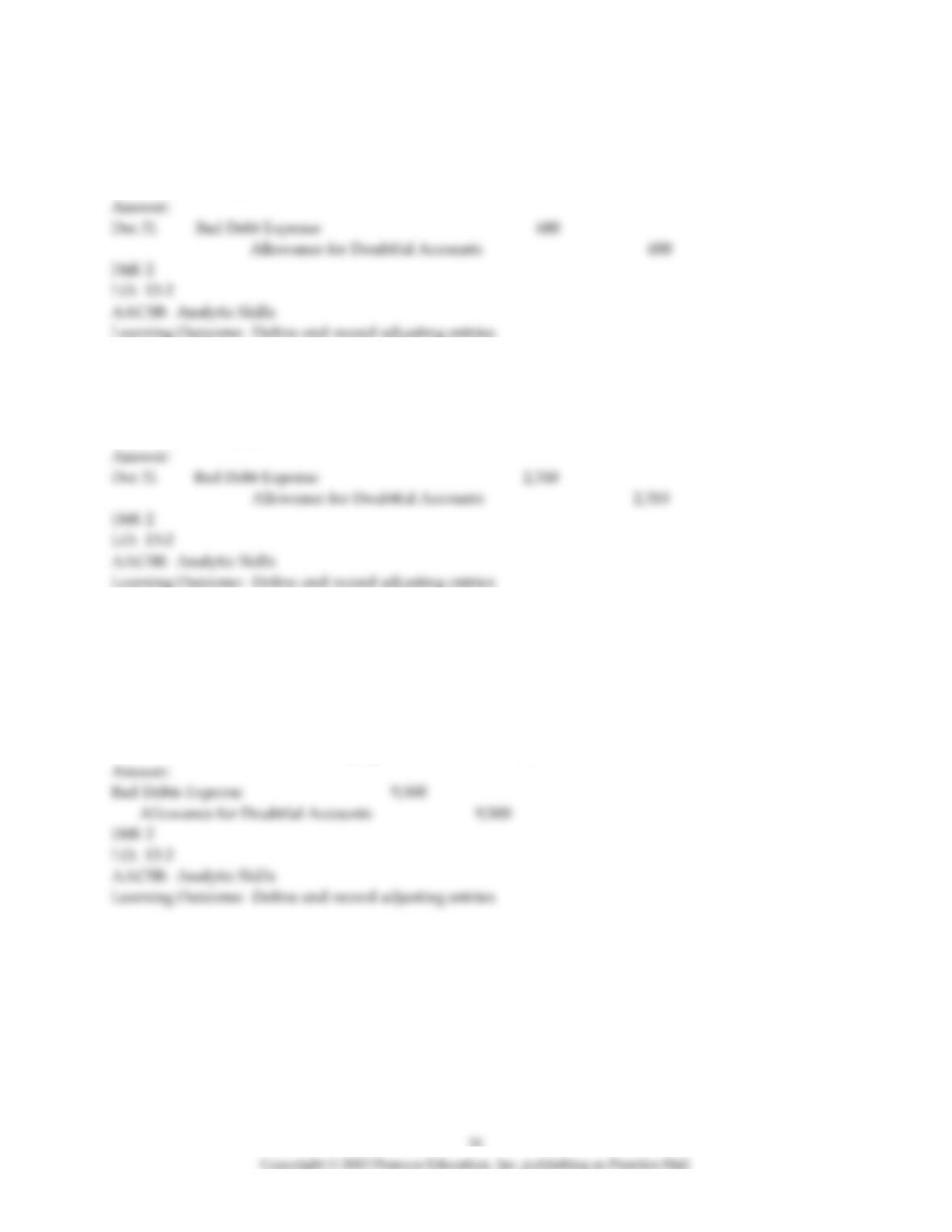
30) On December 31, 2010, Paint Pros had a balance in Accounts Receivable of $15,000. Net credit sales for
the year were $450,000. The Allowance for Doubtful Accounts has a credit balance of $900. Journalize the
recording of the bad debt expense under the balance sheet approach if $1,580 is the estimated amount of
uncollectible accounts.
31) On December 31, 2010, Paint Pros had a balance in Accounts Receivable of $15,000. Net credit sales for
the year were $450,000. The Allowance for Doubtful Accounts has a debit balance of $800. Journalize the
recording of the bad debt expense under the balance sheet approach if $1,510 is the estimated amount of
uncollectible accounts.
32) Prepare the adjusting journal entry of Bad Debts Expense from the following information using the
income statement approach.
Net Sales for the year $475,000
Balance in the allowance account 900 credit
Estimated percentage of sales uncollectible 2%
Estimated uncollectible accounts-aging $2,500
33) Prepare the adjusting journal entry for Bad Debts Expense from the following information using the
balance sheet approach.
Net Sales for the year $250,000
Balance in the allowance account 250 credit
Estimated percentage of sales uncollectible 1%
Estimated uncollectible accounts-aging 3,000
34) The Allowance for Doubtful Accounts has a credit balance of $4,000. Net sales for the year were
$800,000. Two percent is the estimated uncollectible based on net sales. Calculate the amount of the
adjustment using the income statement approach.
Amount of the adjustment ________
35) The general ledger controlling account for Accounts Receivable shows a debit balance of $120,000. The
Allowance for Doubtful Accounts has a credit balance of $5,000. An aging report of accounts receivable
accounts resulted in an estimate of $23,000 of uncollectible accounts receivable. Calculate the amount of
the adjustment using the balance sheet approach.
Amount of the adjustment ________
36) Evaluate the differences of the effect on the financial statements between the income statement
approach and the balance sheet approach for estimating bad debts expense on the financial statement
presentation.
37) Determine the amount of the adjustment for bad debts given:
Bad debts are estimated to be 8% of sales
Accounts receivable balance $ 370,000
Allowance for bad debts balance (debit) $900
Net Sales $200,000
$ ________
38) Determine the amount of the adjustment for bad debts given:
Bad debts are estimated to be 4% of sales
Accounts receivable balance $ 600,000
Allowance for bad debts balance (credit) $200
Net Sales $215,000
$ ________
39) Determine the amount of the adjustment for bad debts given:
Bad debts are estimated to be 6% of receivables
Accounts receivable balance $ 85,000
Allowance for bad debts, balance (debit) $ 240
Net Sales $ 750,000
$ ________
40) Determine the estimated realizable (collectable) value:
Bad debts are estimated to be 3% of net sales.
Accounts receivable balance $ 95,000
Allowance for bad debts balance (credit) $ 675
Net Sales $800,000
$ ________
41) Determine the estimated realizable (collectable) value:
Bad debts are estimated to be 1% of receivables
Accounts receivable balance $ 880,920
Allowance for bad debts balance (debit) $ 1,809
Sales net value $ 6,500,000
$ ________