International Economics, 9e (Krugman et al.)
Chapter 13 National Income Accounting and the Balance of Payments
13.1 The National Income Accounts
1) A country’s gross national product (GNP) is
A) the value of all final goods and services produced by its factors of production and sold on the market
in a given time period.
B) the value of all intermediate goods and services produced by its factors of production and sold on the
market in a given time period.
C) the value of all final goods produced by its factors of production and sold on the market in a given
time period.
D) the value of all final goods and services produced by its factors of production and sold on the market.
E) the value of all final goods and services produced by its factors of production, excluding land, and
sold on the market in a given time period.
2) For most macroeconomists,
A) national income accounts and national output accounts are equal to each other.
B) national income accounts exceed national output accounts.
C) national output accounts exceed national income accounts.
D) it is impossible to tell whether national income accounts equal to national output accounts.
E) national income accounts is much more important than national output accounts.
3) For most macroeconomists,
A) gross national income and gross national product are the same.
B) gross national income exceeds gross national product.
C) gross national product exceeds gross national product.
D) it is hard to tell whether gross national income equal gross national product.
E) gross national product is much more important than gross national income.
4) The highest component of GNP is,
A) the current account.
B) investment.
C) government purchases.
D) consumption.
E) trade.
5) An example of how GNP accounts for services provided by foreign-owned capital (and GDP does
not) is
A) earnings of a Spanish factory with British owners counts only in Spain’s GDP.
B) earnings of a Spanish factory with British owners counts only in Britain’s GNP.
C) earnings of a Spanish factory counts in Spain’s GNP but are part of Britain’s GDP.
D) earnings of a Spanish factory counts in Spain’s GDP but are part of Britain’s GNP.
E) earnings of a Spanish factory counts in Spain’s GNP but not in Britain’s GDP or GNP.
6) The sale of
A) a used textbook does enter GNP.
B) a used textbook does not enter GNP, but the sale of a used house does.
C) both a used textbook and a used house do not enter GNP.
D) a used house does not enter GNP, but the sale of a used book does.
E) the GNP does not include sale of used items priced below $1000.
7) Which one of the following statements is the most accurate?
A) The sale of a used textbook does generate income for factors of production.
B) The sale of a used textbook does not generate income for any factor of production.
C) The sale of a used textbook sometimes does and sometimes does not generate income for factors of
production.
D) It is hard to tell whether a sale of a used textbook does or does not generate income for factors of
production.
E) the sale of a used textbook is a part of the GNP.
8) Which one of the following statements is the most accurate?
A) GNP plus depreciation is called net national product (NNP).
B) GNP less depreciation is called net national product (NNP).
C) GNP less depreciation is called net factor product (NFP).
D) GDP plus depreciation is called net national product (NNP).
E) GDP less depreciation is called net national product (NNP).
9) National income equals GNP
A) less depreciation, less net unilateral transfers, less indirect business taxes.
B) less depreciation, plus net unilateral transfers, plus indirect business taxes.
C) less depreciation, less net unilateral transfers, plus indirect business taxes.
D) plus depreciation, plus net unilateral transfers, less indirect business taxes.
E) less depreciation, plus net unilateral transfers, less indirect business taxes.
10) The United States began to report its gross domestic product (GDP) only since
A) 1900.
B) 1921.
C) 1931.
D) 1941.
E) 1991.
11) GDP is supposed to measure
A) the volume of production within a country’s borders.
B) the volume of services generated within a country’s borders.
C) the volume of production of a country’s output.
D) GNP plus depreciation.
E) net unilateral transfers from foreigners.
12) GNP equals GDP
A) minus net receipts of factor income from the rest of the world.
B) plus receipts of factor income from the rest of the world.
C) minus receipts of factor income from the rest of the world.
D) plus net receipts of factor income from the rest of the world.
E) minus depreciation.
13) Movements in GDP
A) and GNP usually do not differ greatly.
B) and GNP usually do not differ greatly, as a practical matter.
C) and GNP usually do differ greatly.
D) are usually smaller than those of GNP movements, in practice.
E) are inversely proportional to movements in GNP.
14) In 2006, the United States had
A) a surplus in the current account.
B) a balance in the current account.
C) a deficit in the current account.
D) From 2006 data, it is too difficult to determine whether a surplus or a deficit existed in the current
account.
E) a positive balance of net financial flows.
15) Net unilateral transfers
A) are part of a national income.
B) are part of a country’s product.
C) must be added to NNP in calculations of national income.
D) are part of a country’s GNP.
E) Only A and C.
16) GDP is different than GNP in that
A) it accounts for net unilateral transfers.
B) it does not account for indirect business taxes.
C) it does not account for a country’s production using services with foreign-owned capital.
D) it accounts for depreciation.
E) it is unhelpful when tracking national income.
17) What are the main aspects of economic life that macroeconomics analysis is most concerned with?
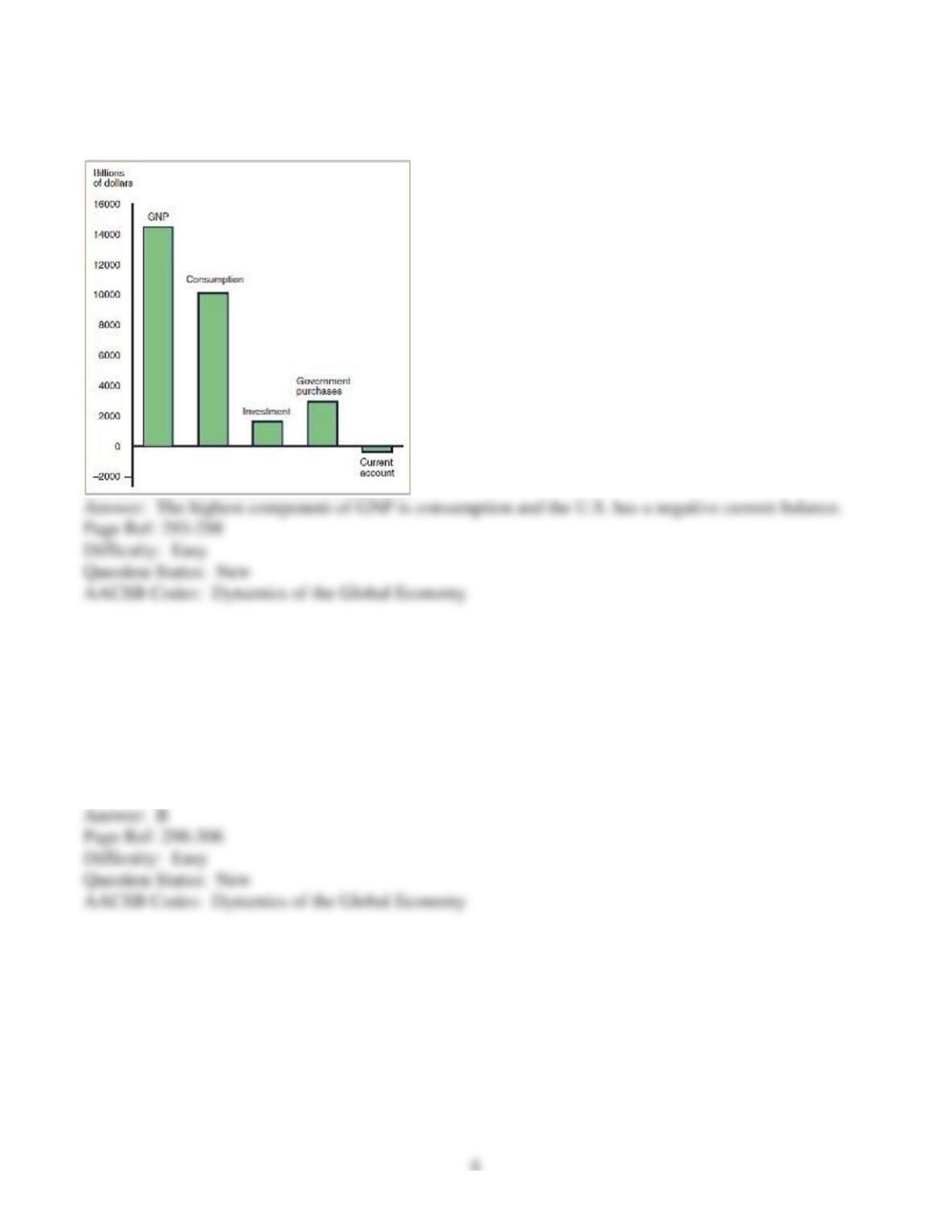
18) What can you learn from the figure below (Figure 13-1 from the text) which depicts the U.S. GNP
and its components for the year 2009?
13.2 National Income Accounting for an Open Economy
1) Movements in GDP
A) differ greatly from movements in GNP.
B) do not differ greatly from movements in GNP.
C) are not allowed to differ at all from movements in GNP by definition.
D) need to be inflation adjusted in order to match movements in GNP.
E) are not relevant to an examination of national income.
2) Purchases of inventories by
A) firms are not counted in investment spending.
B) firms are also counted in investment spending.
C) households are also counted in investment spending.
D) households and Firms are also counted in investment spending.
E) foreign consumers are counter in investment spending.
3) In open economies,
A) saving and investment are necessarily equal.
B) as in a closed economy, saving and investment are not necessarily equal.
C) saving and investment are not necessarily equal as they are in a closed economy.
D) saving and investment are necessarily equal contrary to the case of a closed economy.
E) investment always refers to the domestic stock market.
4) Investment is usually
A) more variable than consumption.
B) less variable than consumption.
C) as variable as consumption.
D) It is hard to tell from the data whether investment is more or less variable than consumption.
E) a larger component of the GNP than consumption.
5) Government purchases are defined as
A) only goods purchased by federal, state, or local governments.
B) all goods and services purchased by the federal government.
C) all goods and services purchased by the federal or state government.
D) all goods and services purchased by the federal, state, or local government.
E) goods and services purchased from the government.
6) Government transfer payments like social security and unemployment benefits are
A) included in government purchases.
B) not included in government purchases.
C) not included in government purchases, but they are included in the consumption component of GNP.
D) not included in government purchases, but they are part of the investment component of GNP.
E) included in government purchases but not in the GNP.
7) In 1929, government purchases accounted for
A) only 18.5 percent of U.S. GNP.
B) only 8.5 percent of U.S. GNP.
C) 28.5 percent of U.S. GNP.
D) 38.5 percent of U.S. GNP.
E) 48.5 percent of U.S. GNP.
8) Which one of the following expressions is the most accurate?
A) CA = EX – IM
B) CA = IM – EX
C) CA = EX = IM
D) CA = EX + IM
E) CA – IM = EX
9) A country’s current account
A) balance equals the change in its net foreign wealth.
B) balance equals the change in its foreign wealth.
C) surplus equals the change in its foreign wealth.
D) deficit equals the change in its foreign wealth.
E) balance equals its GNP.
10) The CA is equal to
A) Y – (C – I + G).
B) Y + (C + I + G).
C) Y – (C + I + G).
D) Y – (C + I – G).
E) Y + (C – I – G).
11) Which of the following is true?
A) A country with a current account surplus is earning more from its exports than it spends on imports.
B) A country could finance a current account deficit by using previously accumulated foreign wealth to
pay for its imports.
C) A country with a current account deficit must be increasing its net foreign debts by the amount of the
deficit.
D) We can describe the current account surplus as the difference between income and absorption.
E) All of the above are true of current account balances.
12) Over the 1980s,
A) there is no question that a large increase in U.S. foreign assets did occur.
B) there is a question whether a large decrease in U.S. foreign assets did occur.
C) there is no question that a large decrease in U.S. foreign assets did occur.
D) there is no question that there was almost no change in U.S. foreign assets.
E) there is no question that rising exports exceeded U.S. foreign debt.
13) In a closed economy, national saving
A) sometimes equals investment.
B) always equals investment.
C) is always less than investment.
D) is always more than investment.
E) is never equal to investment.
10
14) For open economies,
A) S = I.
B) S = I + CA.
C) S = I – CA.
D) S > I + CA.
E) S < I + CA.
15) An open economy
A) can save only by building up its capital stock.
B) can save only by acquiring foreign wealth.
C) cannot save either by building up its capital stock or by acquiring foreign wealth.
D) can save either by building up its capital stock or by acquiring foreign wealth.
E) can save by avoiding excessive imports.
16) A closed economy
A) can save either by building up its capital stock or by acquiring foreign wealth.
B) can save only by building up its capital stock.
C) can save only by acquiring foreign wealth.
D) cannot save either by building up its capital stock or by acquiring foreign wealth.
E) can save by avoiding excessive imports.
17) Disposable income is National income
A) less taxes collected from households and firms by the government.
B) plus net taxes collected from households and firms by the government.
C) less net taxes collected from households and firms by the government.
D) less net taxes collected from households by the government.
E) less net taxes collected from households and firms by the government.
18) Government savings, Sg, is equal to
A) T – G.
B) T + G.
C) T = G.
D) T + G – I.
E) T – G = I.
19) Which of the following is false about private savings and government savings?
A) SP = Y – T – C
B) Unlike private saving decisions, government saving decisions are often made with an eye toward
their effect on output and employment.
C) Total savings (S) = SP + Sg.
D) The national income identity can help us to analyze the channels through which government saving
decisions influence macroeconomic conditions.
E) None of the above; all statements are true.
20) In a closed economy, private saving, SP, is equal to
A) I – (G – T).
B) I + (G – T).
C) I + (G + T).
D) I – (G + T).
E) I + (G – T) + C.
21) In an open economy, private saving, SP, is equal to
A) I – CA + (G – T).
B) I + CA – (G – T).
C) I + CA + (G – T).
D) I – CA – (G – T).
E) I + CA + (G + T).
22) Ricardian equivalence argues that when the government cuts taxes and raises its deficit,
A) consumers anticipate that they will face lower taxes later to pay for the resulting government debt.
B) consumers anticipate that they will higher services from the government.
C) consumers anticipate that they will face higher taxes later to pay for the resulting government debt.
D) consumers anticipate it will affect their future taxes, in general in the direction of lowering future
taxes.
E) consumers anticipate that the low tax rates will continue.
23) Ricardian equivalence argues that when the government
A) increases taxes and raises its deficit, consumers anticipate that they will face higher taxes later to pay
for the resulting government debt, thus people will raise their own private saving to offset the fall in
government saving.
B) cuts taxes and decreases its deficit, consumers anticipate that they will face higher taxes later to pay
for the resulting government debt, thus people will raise their own private saving to offset the fall in
government saving.
C) cuts taxes and raises its surplus, consumers anticipate that they will face higher taxes later to pay for
the resulting government debt, thus people will raise their own private saving to offset the fall in
government saving.
D) cuts taxes and raises its deficit, consumers anticipate that they will face lower taxes later to pay for
the resulting government debt, thus people will raise their own private saving to offset the fall in
government saving.
E) cuts taxes and raises its deficit, consumers anticipate that they will face higher taxes later to pay for
the resulting government debt, thus people will raise their own private saving to offset the fall in
government saving.
24) In the United States over the past fifty years, the fraction of GNP devoted to consumption has
fluctuated in a range of about
A) 42 to 49 percent.
B) 32 to 39 percent.
C) 22 to 29 percent.
D) 82 to 89 percent.
E) 62 to 70 percent.
25) In the United States, (gross) investment has fluctuated between ________ of GNP in recent years.
A) 2 and 12 percent
B) 11 and 22 percent
C) 22 and 32 percent
D) 32 and 42 percent
E) 42 and 52 percent
26) Government purchases currently take up about
A) 20 percent of U.S. GNP, and this share has not changed much since the late 1950s.
B) 38 percent of U.S. GNP, and this share has not changed much since the late 1950s.
C) 18 percent of U.S. GNP, and this share has been increasing since the late 1950s.
D) 18 percent of U.S. GNP, and this share has been decreasing since the late 1950s.
E) 25 percent of U.S. GNP, and this share has been decreasing since the late 1950s.
27) The position of the United States current account balance in 2009 was
A) lent over 6 percent of its GNP, resulting in a large current account surplus.
B) borrowed over 9 percent of its GNP, leading to a large current account deficit.
C) achieved a currant account balance of zero.
D) borrowed over 10 percent of its GNP, leading to a large current account deficit.
E) borrowed less then 5 percent of its GNP, leading to a large current account surplus.
28) Which one of the following statements is false?
A) The United States had accumulated substantial foreign wealth by the early 1980s.
B) The 1980s witnessed a sustained current account deficit of proportions unprecedented in the
twentieth century opened up.
C) In 1987, the country became a net debtor to foreigners for the first time since World War I.
D) U.S. foreign debt has continued to grow and now stands at 25 percent of GNP.
E) The U.S. foreign debt was paid off in the 1990s, allowing the U.S. to attain a current account surplus.
However, the deficit has returned in recent years.
29) What is the national income identity for a closed economy?
30) What is the national income identity for an open economy?
31) Discuss the values of private saving in closed and open economies.