KEY: BLOOM’S: Comprehension
62. Suppose the exchange rate between the U.S. dollar and the Japanese yen is initially 90 yen per dollar.
According to purchasing power parity, if the price of traded goods falls by 5 percent in the United
States and rises by 5 percent in Japan, the exchange rate will become:
a.
72 yen per dollar
b.
81 yen per dollar
c.
99 yen per dollar
d.
108 yen per dollar
63. Suppose that the yen-dollar exchange rate changes from 85 yen per dollar to 80 yen per dollar. One
can say that the:
a.
Yen has appreciated against the dollar and the dollar has depreciated against the yen
b.
Yen has depreciated against the dollar and the dollar has appreciated against the yen
c.
Yen has appreciated against the dollar and the dollar has appreciated against the yen
d.
Yen has depreciated against the dollar and the dollar has depreciated against the yen
64. Given a floating exchange rate system an increase in ____ would cause the dollar to appreciate against
the euro.
a.
U.S. labor costs
b.
The U.S. money supply
c.
U.S. prices of goods
d.
U.S. real interest rates
65. Under a system of floating exchange rates, a Japanese trade surplus against Canada would result in a
(an):
a.
Rise in the dollar price of the yen
b.
Fall in the dollar price of the yen
c.
Rise in the yen price of the dollar
d.
Unchanged dollar/yen exchange rate
66. When deciding between U.S. and British government securities, an American investor typically
considers:
a.
U.S. and British interest rates and anticipated changes in the exchange rate
b.
Budget deficits of the U.S. government and British government
c.
Shifts in the demand for U.S. goods and British goods
d.
U.S. and British inflation rates and anticipated changes in the exchange rate
67. In the long run, exchange rates are primarily determined by:
a.
Agreements among governments of the world’s industrial countries
b.
Relative interest rates in developing countries and industrial countries
c.
Economic fundamentals such as relative productivity levels
d.
The rate at which country’s currencies exchange for gold
68. Increased tariffs on U.S. steel imports cause the dollar to ____ in the ____.
a.
Appreciate, long run
b.
Depreciate, long run
c.
Appreciate, short run
d.
Depreciate, short run
69. Lower tariffs on U.S. agricultural imports cause the dollar to ____ in the ____.
a.
Appreciate, long run
b.
Depreciate, long run
c.
Appreciate, short run
d.
Depreciate, short run
70. Relatively high interest rates in the United States causes the dollar to ____ in the ____.
a.
Appreciate, long run
b.
Depreciate, long run
c.
Appreciate, short run
d.
Depreciate, short run
71. The asset market theory of exchange rate determination suggests that the most important factor
influencing the demand for domestic and foreign securities is:
a.
Expected return on these assets relative to one another
b.
Ability of these assets to easily be converted into cash
c.
Riskiness of these assets relative to one another
d.
Level of government restrictions on trade and investment flows
72. With floating exchange rates, easy credit and low short term interest rates lead to
a.
Exchange rate depreciation in the short run
b.
Exchange rate appreciation in the short run
c.
Exchange rate depreciation in the long run
d.
Exchange rate appreciation in the long run
73. With floating exchange rates, relatively high productivity growth for a nation leads to
a.
Exchange rate depreciation in the short run
b.
Exchange rate appreciation in the short run
c.
Exchange rate depreciation in the long run
d.
Exchange rate appreciation in the long run
74. All of the following are important long-run determinants of exchange rates except
a.
Consumer tastes
b.
Trade policy
c.
Labor productivity
d.
Interest rates
75. The purchasing-power parity theory suffers from the problem
a.
Of choosing the appropriate price index
b.
That it overlooks the influence of capital flows
c.
That government policy may modify exchange rates
d.
All of the above
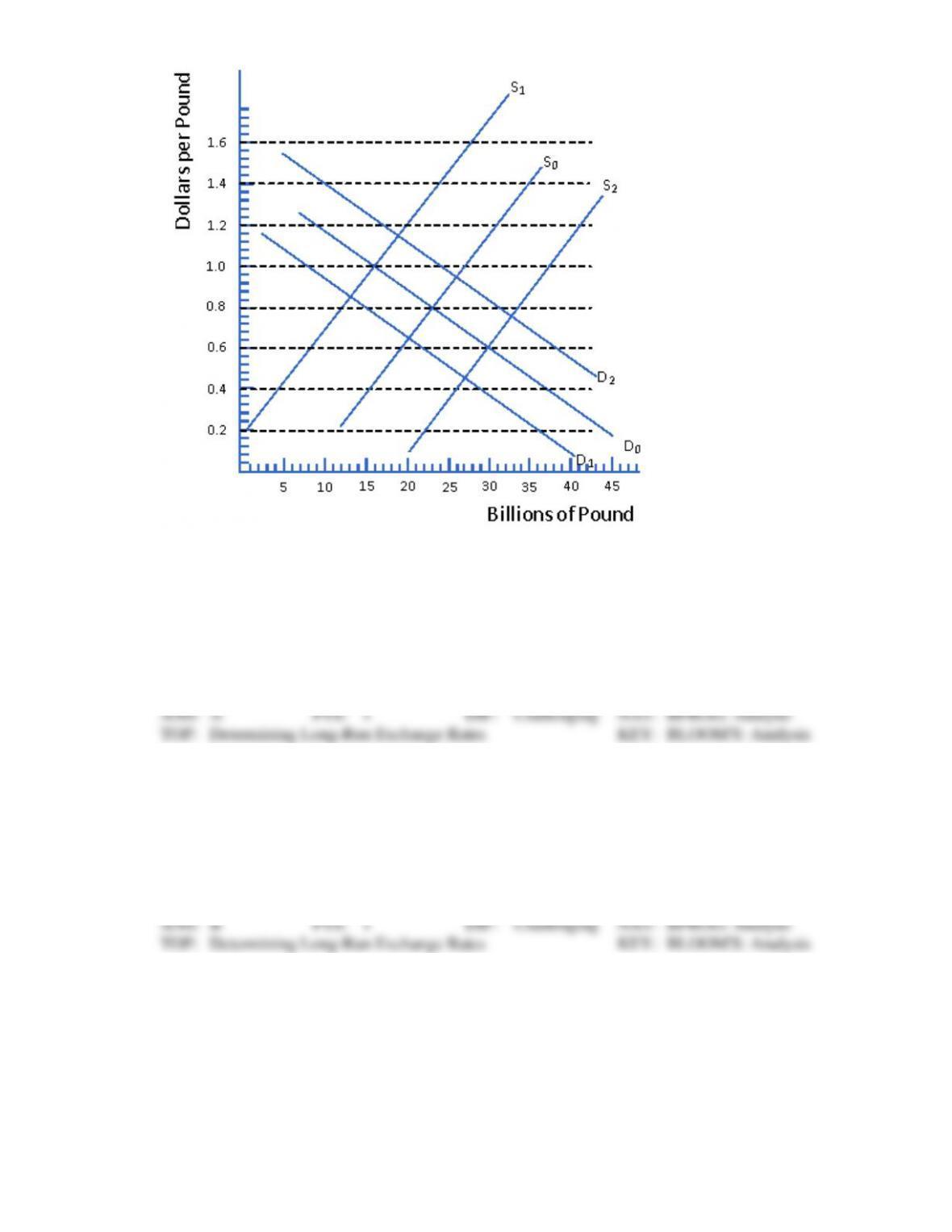
76. Consider Figure 12.3. The market is initially governed by demand curve D0 and supply curve S0.
Suppose the domestic price level rises rapidly in the United States but stays relatively constant in the
United Kingdom, which supply and demand curves depict the new situation?
a.
S1 and D2
b.
S2 and D1
c.
S0 and D2
d.
S0 and D1
77. Consider Figure 12.3. The market is initially governed by demand curve D0 and supply curve S0.
Suppose US productivity growth is faster than the UK, which supply and demand curves depict the
new situation?
a.
S1 and D2
b.
S2 and D1
c.
S0 and D2
d.
S0 and D1
78. Consider Figure 12.3. The market is initially governed by demand curve D0 and supply curve S0.
Suppose US consumers develop stronger preferences for UK made goods, which supply and demand
curves depict the new situation?
a.
S1 and D2
b.
S2 and D1
c.
S0 and D2
d.
S0 and D1
79. Consider Figure 12.3. The market is initially governed by demand curve D0 and supply curve S0.
Suppose the US government raises tariffs for UK made goods, which supply and demand curves depict
the new situation?
a.
S1 and D2
b.
S2 and D1
c.
S0 and D2
d.
S0 and D1
TRUE/FALSE
1. In a free market, exchange rates are determined by market fundamentals and market expectations.
2. Concerning exchange-rate determination, market fundamentals include inflation rates, productivity
levels, and speculative opinion about future exchange rates.
3. Market expectations include news about market fundamentals, speculative opinion about future
exchange rates, and profitability and riskiness of investments.
4. In a free market, the equilibrium exchange rate occurs at the point where the quantity demanded of a
foreign currency equals the quantity of that currency supplied.
5. Exchange rates are determined by the unregulated forces of supply and demand for foreign currencies
as long as central banks do not intervene in the foreign exchange markets.
6. Over the long run, foreign exchange rates are determined by transfers of bank deposits that respond to
differences in real interest rates and to shifting expectations of future exchange rates.
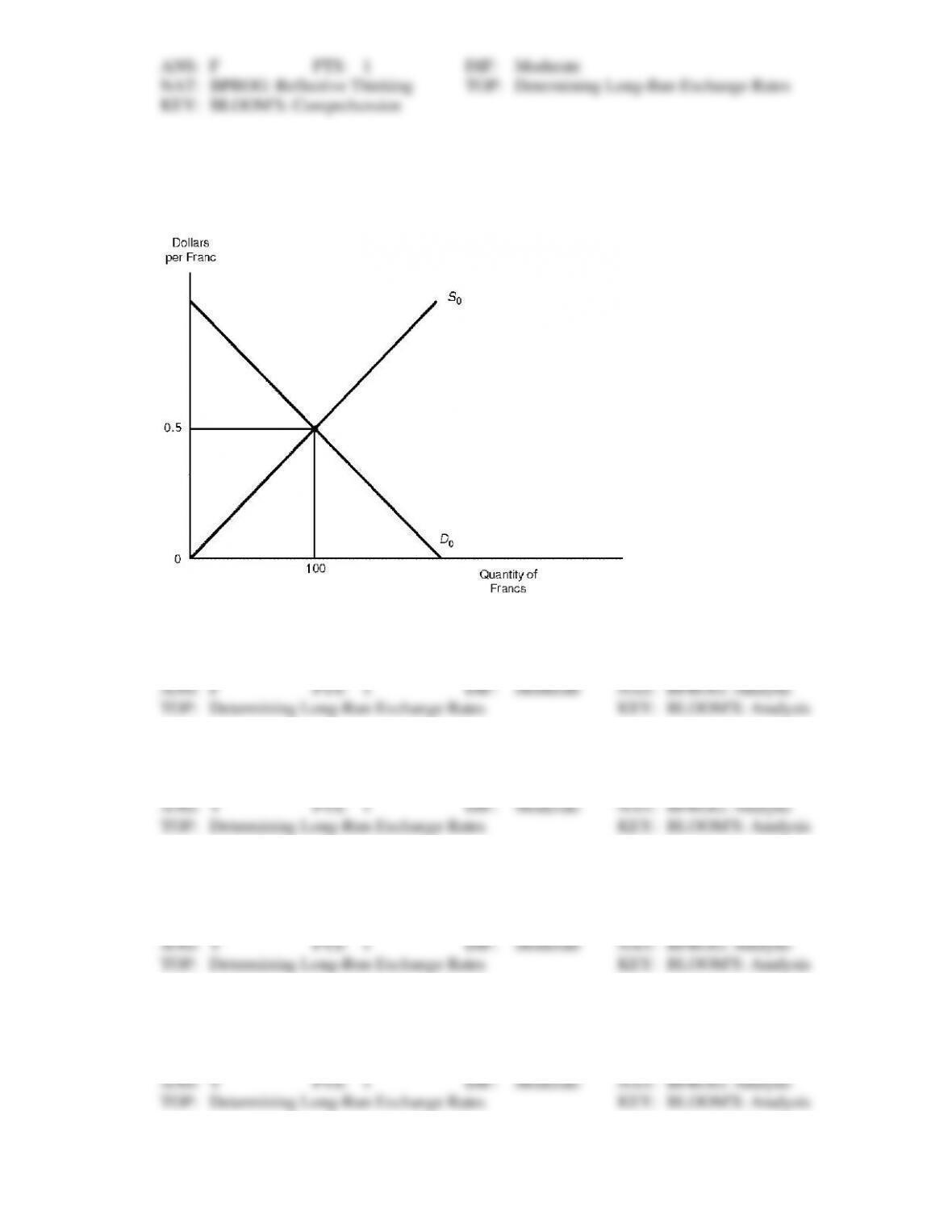
The figure below illustrates the supply and demand schedules of Swiss francs under a system of
floating exchange rates.
Figure 12.2. The Market for Swiss Francs
7. Refer to Figure 12.2. If the United States decreases tariffs on imports from Switzerland, there would
occur a decrease in the demand for francs and a decrease in the dollar price of the franc.
8. Refer to Figure 12.2. If Swiss manufacturing costs increase relative to those of the United States, there
would occur an increase in the supply of francs and an appreciation in the dollar’s exchange value.
9. Refer to Figure 12.2. If the Federal Reserve adopts a restrictive monetary policy that leads to relatively
high interest rates in the United States, the demand for francs would decrease, the supply of francs
would increase, and the dollar’s exchange value would appreciate.
10. Refer to Figure 12.2. As the profitability of assets in Switzerland rises relative to the profitability of
assets in the United States, U.S. residents make additional investments in Switzerland; this leads to an
increased demand for francs and a depreciation of the dollar’s exchange value.
11. Refer to Figure 12.2. If the rate of inflation in the United States is higher than the rate of inflation in
Switzerland, the demand for francs decreases, the supply of francs increases, and the dollar’s exchange
value appreciates.
12. Under floating exchange rates, short-run exchange rates are primarily determined by national
differences in real interest rates and shifting expectations of future exchange rates.
13. Day-to-day influences on foreign exchange rates always cause rates to move in the same direction as
changes in long-term market fundamentals.
14. With floating exchange rates, a country experiencing faster economic growth than its trading partners
find its currency’s exchange value appreciating.
15. If U.S. labor productivity growth is 2 percent per annum and Swiss labor productivity growth is 6
percent per annum, the dollar will depreciate against the franc under a system of floating exchange
rates.
16. In 1985 and 1986 U.S. interest rates fell relative to interest rates in Japan. Under floating exchange
rates, this would lead to the dollar’s exchange value depreciating against the yen.
17. A country having stronger preferences for imports than its trading partners have for its exports finds its
demand for foreign exchange rising more rapidly than its supply of foreign exchange.
18. Economies with relatively high growth rates in labor productivity tend to find their currencies’
exchange values appreciating under a floating exchange-rate system.
19. Under floating exchange rates, relatively low domestic interest rates tend to promote depreciation of a
currency’s exchange value while relatively high domestic interest rates lead to currency appreciation.
20. Suppose expansionary monetary policy in the United States leads to interest rates falling to 2 percent
while tight monetary policy in Switzerland leads to interest rates rising to 8 percent. With floating
exchange rates, the dollar would appreciate against the franc.
21. The purchasing-power-parity theory is used to predict exchange-rate movements in the short run.
22. According to the law of one price, identical goods should cost the same in all nations, assuming there
are no shipping costs nor trade barriers.
23. The purchasing- power-parity theory predicts that if the U.S. inflation rate exceeds the Japanese
inflation rate by 4 percent, the dollar’s exchange value will appreciate by 4 percent against the yen.
24. Assume the initial yen/dollar exchange rate to be 100 yen per dollar. If the U.S. inflation rate is 2
percent and the Japanese inflation rate is 7 percent, the exchange rate should move to 105 yen per
dollar according to the purchasing-power-parity theory.
25. Assume the initial dollar/pound exchange rate to be $2 per pound. If the U.S. inflation rate is 8 percent
and the U.K. inflation rate is 3 percent, the exchange rate should move to $2.10 per pound according to
the purchasing-power-parity theory.
26. If consumer tastes in the United States change in favor of goods produced in France, the demand for
francs will increase which causes an appreciation of the dollar against the franc under a floating
exchange rate system.
27. As the profitability of Japanese assets rises relative to the profitability of Australian assets, Australian
residents will make additional investments in Japan; this results in an increased demand for yen and a
depreciation of the dollar under a system of floating exchange rates.
28. If the United States experiences an enormous wheat crop failure, it will have to import more wheat and
the dollar’s exchange value will depreciate under a system of floating exchange rates.
29. If Japan realizes technological improvements in the production of automobiles, which lowers its
production costs relative to foreign producers, Japanese exports will rise and the yen’s exchange value
will appreciate under a system of floating exchange rates.
30. If Mexico applies tariffs to imports of manufactured goods, Mexico’s demand for foreign exchange
will rise and the peso will depreciate under a system of floating exchange rates.
31. According to the “Big Mac” index, if a Big Mac costs $2.28 in the United States and 25.75 krone in
Denmark (equivalent to $4.25), the Danish krone is an undervalued currency.
32. According to the “Big Mac” index, if a Big Mac costs $2.28 in the United States and 48 baht in
Thailand (equivalent to $1.91), the baht is an undervalued currency.
33. Long-run determinants of exchange rate include labor productivity levels, inflation rates, consumer
preferences for goods and services, and trade barriers.
34. In the short run, exchange rates are primarily determined by investor expectations of returns on assets
such as government securities and bank accounts.
35. Changes in market expectations have their greatest impact on exchange-rate changes over the long run
as opposed to the short run.
36. If it is widely expected that the British economy will experience more rapid inflation than the
Australian economy, the pound will depreciate against the dollar under a system of floating exchange
rates.
37. According to the asset-markets approach, adjustments among financial assets are a key determinant of
long-run movements in exchange rates.
38. The asset-markets approach views exchange-rate determination as similar to the stock market in which
prices are volatile and expectations are important.
39. According to the principle of exchange-rate overshooting, a short-run depreciation of a currency is
likely to be greater than a long-run depreciation of that currency.
40. Exchange-rate overshooting is based on the notion that the supply schedule of a currency is more
elastic in the short run than in the long run.
41. According to exchange-rate overshooting, an appreciation of the Australian dollar is likely to be
greater over a long time period than over a short time period.
42. Concerning exchange rate forecasting, fundamental analysis involves consideration of a variety of
macroeconomic variables and policies that tend to affect currency values.
43. Econometric models are best suited for forecasting long-run exchange rates rather than short-run
exchange rates.
44. Concerning exchange rate forecasting, technical analysis extrapolates from past exchange-rate trends
while ignoring economic and political determinants of exchange rates.
45. Given an efficient foreign exchange market, the spot rate is the rational approximation of the markets
expectation of the forward rate that will exist at the end of the forward period.
46. A forward premium on the British pound serves as a rough benchmark of the expected rate of
appreciation in the pound’s spot rate.
47. A forward discount on Mexico’s peso serves as a rough benchmark of the expected appreciation in the
peso’s spot rate.
48. If you were considering hiring a forecasting firm to predict future spot rates of the yen, you would
hope that the firm could predict better what would be implied by the yen’s forward rate.
49. Although the law of one price predicts that identical goods should cost the same in all nations,
transportation costs and tariffs tend to prevent this prediction from actually occurring.
50. If real interest rates decline in the United States relative to real interest rates abroad, the dollar’s
exchange value will appreciate under a floating exchange-rate system.
SHORT ANSWER
1. What is the purchasing power parity approach to exchange rate determination?
2. What is exchange rate overshooting?
ESSAY
1. In a free market, what determines exchange rates in the long run and the short run?
2. What is the asset market approach to exchange rate determination?