CHAPTER 12
INTERNATIONAL FACTOR MOVEMENTS
B. Multiple-Choice Questions
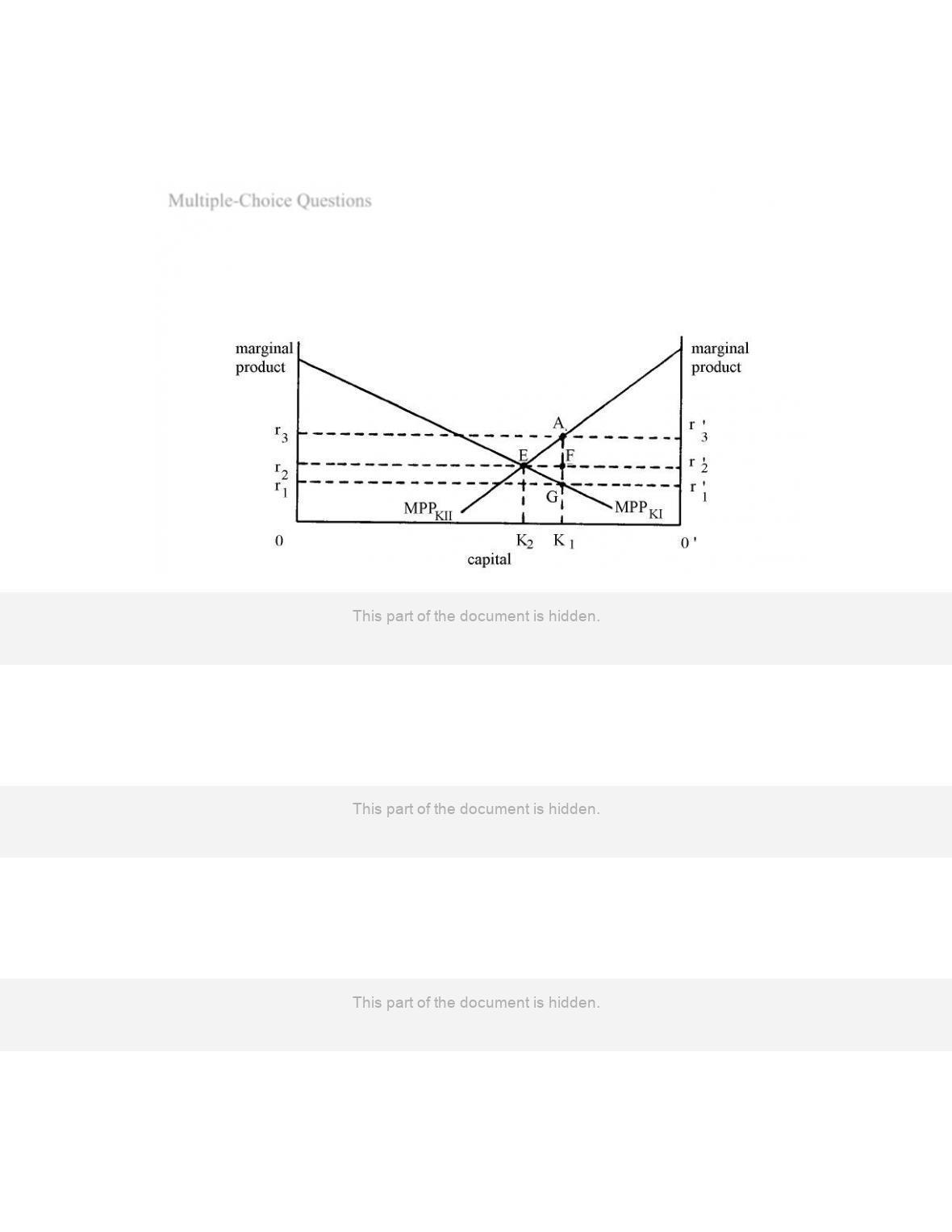
8. In the graph below, without capital movements between countries I and II, the capital
stock in country I is 0K1 and the capital stock in country II is K10’. The return to capital
in country I is thus __________ and the return to capital in country II is __________.
9. In the diagram in Question #8 above, if restrictions on capital flows were removed,
capital would move from__________, and this movement would reduce the return to
capital in __________.
10. In the diagram in Question #8 above, if restrictions on capital flows were removed and
capital was allowed to flow freely from the low-return country to the high-return country,
then world output would rise by the amount of area __________.
11. In the diagram in Question #8 above, if restrictions on capital flows were removed and
capital was allowed to flow from the low-return country to the high-return country, then
total output in country II would rise by area __________.
12. In the diagram in Question #8 above, if restrictions on capital flows were removed and
capital was allowed to flow from the low-return country to the high-return country, then
total output in country I __________.
13. In the diagram in Question #8 above, if restrictions on capital flows were removed and
capital was allowed to flow from the low-return country to the high-return country, then
national income (i.e., GNP) in country I would __________ by the amount of area
__________.
a. decrease; K2EFK1
14. In the diagram in Question #8 above, if restrictions on capital flows were removed and
capital was allowed to flow freely from the low-return country to the high-return country,
then national income (i.e., GNP) in country II would rise by the amount of area
__________.
d. K2EAK1
15. Suppose that, other things equal, labor moves from country A to country B. In a two-
factor world (capital and labor), this labor movement will lead to
a. an increase in the total return to owners of capital in country A.
16. If there is diminishing marginal productivity of labor in production (with other inputs
held constant), an outmigration of labor from low-wage country A to higher-wage
country B will lead, other things equal, to a __________ in per capita income in country
B and __________ in per capita income in country A.
a. rise; also to a rise
17. Consider a situation where a foreign investor firm in country A wishes to move recorded
profits out of country A to another plant location in country B. If the firm wants to utilize
transfer pricing, it would want to record the prices of its exported goods from country A
to country B at a __________ value than would be the case in an ordinary market
transaction, and the firm would, when recording the prices of goods that it imports into
country A from country B, __________ value than would be the case in an ordinary
market transaction.
18. According to the Department of Commerce information given in the textbook, the
country which is the recipient of the largest amount of U.S. foreign direct investment
(FDI) is __________.
19. Labor immigration
a. always produces a net social cost to society.
20. Foreign investment such as the purchase of foreign bonds or the deposit of funds in
a bank account in another country is called __________ investment; this type of
investment involves __________ control over production in the host country than does
the other type of investment.
21. In a perfectly-competitive world, restrictions placed by developing countries to halt a
“brain drain” would lead to __________ in efficiency and world output in a static sense;
over time, these restrictions might, other things equal, __________ in the per capita
income differences between developing countries and developed countries if skilled labor
has important production externalities.
22. According to the Department of Commerce information given in the textbook, the
country which has made the largest amount of foreign direct investment (FDI) in the
United States is __________.
23. According to the Department of Commerce information given in the textbook, the
industry in which the United States has made the largest amount of foreign direct
investment (FDI) abroad is __________.
24. If labor moves from a labor-abundant country to a capital-abundant country, other things
equal, consideration of the Rybczynski theorem suggests that the labor movement will
cause __________ production effect in the labor-abundant country.
25. If there is diminishing marginal productivity of labor in production (with other inputs
held constant), an outmigration of labor from low-wage country A to higher-wage
country B will lead, other things equal and if trade is taking place in accordance with the
Heckscher-Ohlin analysis, to __________ production effect in the capital-abundant
country.
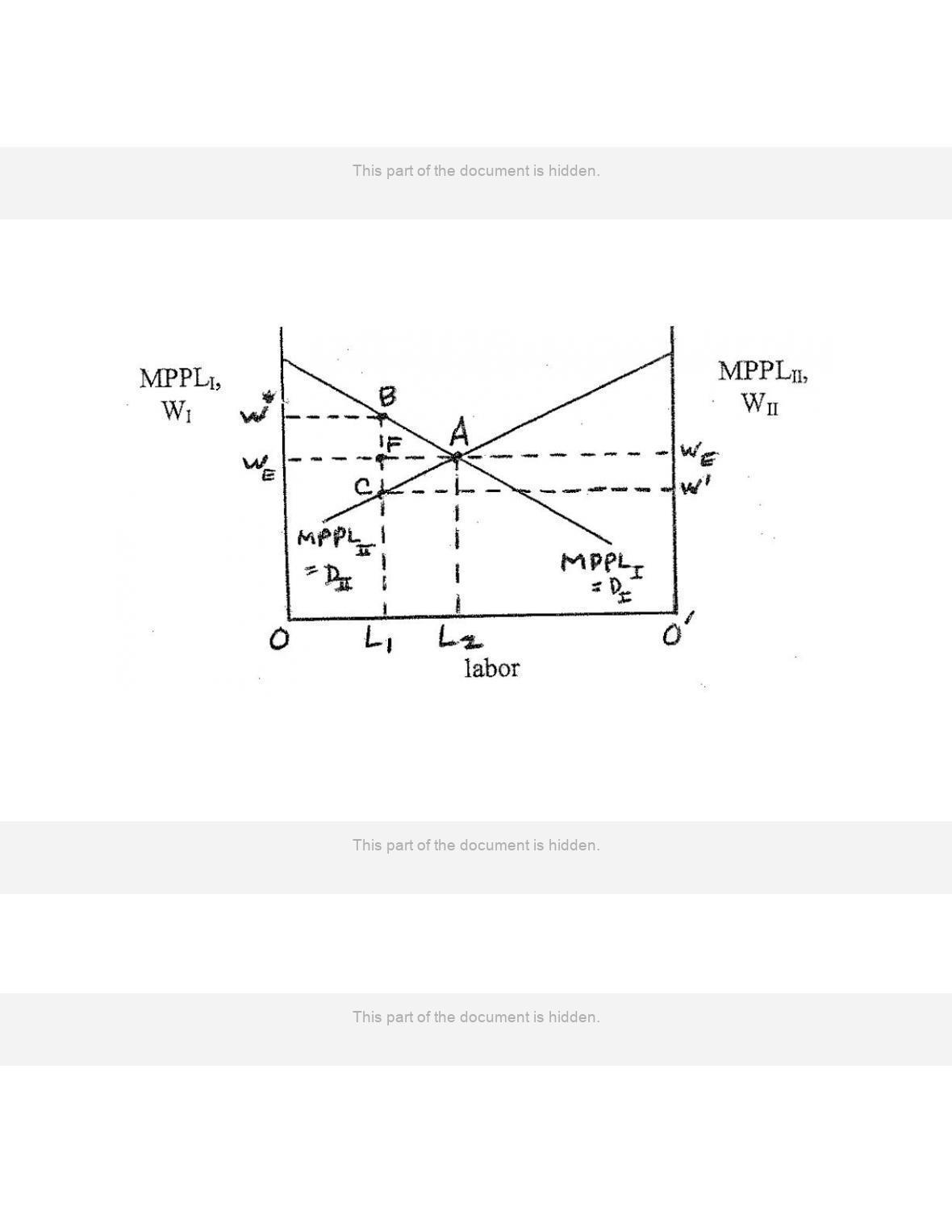
26. Consider the labor situation in countries I and II in a two-country world with the marginal
physical product schedules MPPLI (= demand for labor schedule DI) for country I and
marginal physical product schedule MPPLII (= demand for labor schedule DII) for country
II shown in the graph below (where the vertical axes also represent real wages):
Without any migration of labor between the two countries, the labor force is 0L1 in
country I and (in the leftward direction) 0’L1 in country II. If labor is now allowed to
flow freely between the two countries, labor would migrate __________. As a result of
the migration, world output would increase by the amount of triangle __________.
27. In the graph in Question #26 above, the migration of labor would result in __________ in
country I’s Gross Domestic Product of the amount of area __________
28. In the graph in Question #26 above, the migration of labor would result in an increase in
country I’s Gross National Product of the amount of area __________.
29. In the graph in Question #26 above, the migration of labor would result in __________ in
country II’s Gross Domestic Product and __________ in country II’s Gross National
Product.
30. According to the Department of Commerce information given in the textbook, the
industry in which the largest amount of foreign direct investment (FDI) in the United
States has been made is __________.