
Name:
Class:
Date:
chapter 12
Copyright Cengage Learning. Powered by Cognero.
Page 1
Indicate whether the statement is true or false.
1. Over the long run, foreign exchange rates are determined by transfers of bank deposits that respond to differences in
real interest rates and to shifting expectations of future exchange rates.
a. True
b. False
2. In the short run, exchange rates are primarily determined by investor expectations of returns on assets, such as
government securities and bank accounts.
a. True
b. False
3. Economies with relatively high growth rates in labor productivity tend to find their currencies’ exchange values
appreciating under a floating exchange-rate system.
a. True
b. False
4. Market expectations include news about market fundamentals, speculative opinion about future exchange rates, and the
profitability and riskiness of investments.
a. True
b. False
5. Concerning exchange-rate determination, market fundamentals include inflation rates, productivity levels, and
speculative opinion about future exchange rates.
a. True
b. False
6. A country having stronger preferences for imports than its trading partners have for its exports finds its demand for
foreign exchange rising more rapidly than its supply of foreign exchange.
a. True
b. False
7. Under floating exchange rates, short-run exchange rates are primarily determined by national differences in real interest
rates and shifting expectations of future exchange rates.
a. True
b. False
8. With floating exchange rates, a country experiencing faster economic growth than its trading partners find its
currency’s exchange value appreciating.
a. True
b. False
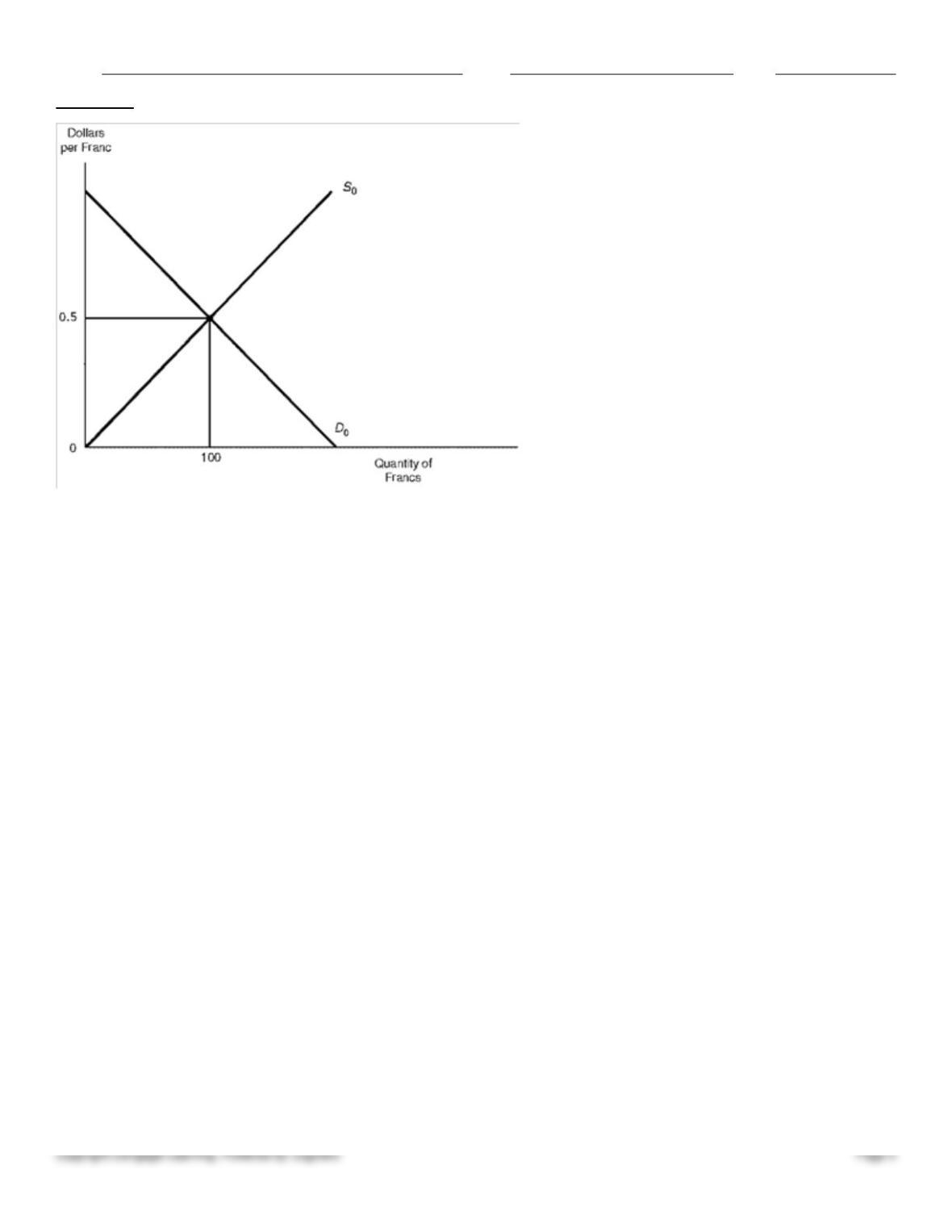
The figure below illustrates the supply and demand schedules of Swiss francs under a system of floating exchange rates.
Figure 12.2. The Market for Swiss Francs
Name:
Class:
Date:
chapter 12
Copyright Cengage Learning. Powered by Cognero.
Page 2
9. Refer to Figure 12.2. As the profitability of assets in Switzerland rises relative to the profitability of assets in the United
States, U.S. residents make additional investments in Switzerland; this leads to an increased demand for francs and a
depreciation of the dollar’s exchange value.
a. True
b. False
10. Although the law of one price predicts that identical goods should cost the same in all nations, transportation costs and
tariffs tend to prevent this prediction from actually occurring.
a. True
b. False
11. Under floating exchange rates, relatively low domestic interest rates tend to promote the depreciation of a currency’s
exchange value, while relatively high domestic interest rates lead to currency appreciation.
a. True
b. False
12. According to the asset-markets approach, adjustments among financial assets are a key determinant of long-run
movements in exchange rates.
a. True
b. False
13. According to the principle of exchange-rate overshooting, a short-run depreciation of a currency is likely to be greater
than a long-run depreciation of that currency.
a. True
b. False
14. A forward premium on the British pound serves as a rough benchmark of the expected rate of appreciation in the
pound’s spot rate.
Name:
Class:
Date:
chapter 12
Copyright Cengage Learning. Powered by Cognero.
Page 3
a. True
b. False
15. According to the “Big Mac” index, if a Big Mac costs $2.28 in the United States and 48 baht in Thailand (equivalent
to $1.91), then the baht is an undervalued currency.
a. True
b. False
16. If the United States experiences an enormous wheat crop failure, then it will have to import more wheat, and the
dollar’s exchange value will depreciate under a system of floating exchange rates.
a. True
b. False
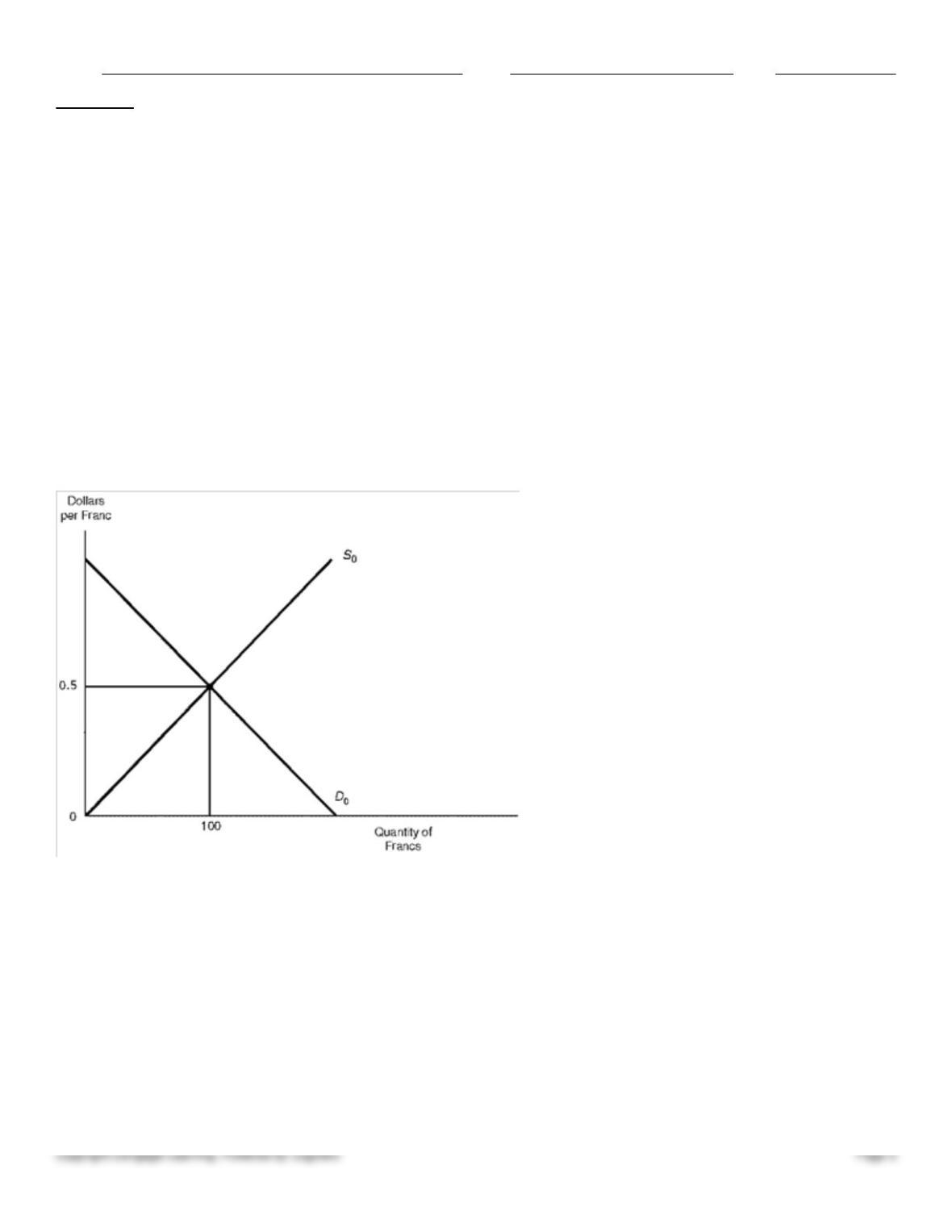
The figure below illustrates the supply and demand schedules of Swiss francs under a system of floating exchange rates.
Figure 12.2. The Market for Swiss Francs
17. Refer to Figure 12.2. If Swiss manufacturing costs increase relative to those of the United States, then there would
occur an increase in the supply of francs and an appreciation in the dollar’s exchange value.
a. True
b. False
18. Refer to Figure 12.2. If the Federal Reserve adopts a restrictive monetary policy that leads to relatively high interest
rates in the United States, then the demand for francs would decrease, the supply of francs would increase, and the dollar’s
exchange value would appreciate.
a. True
b. False

Name:
Class:
Date:
chapter 12
Copyright Cengage Learning. Powered by Cognero.
Page 4
19. Refer to Figure 12.2. If the United States decreases tariffs on imports from Switzerland, then there would occur a
decrease in the demand for francs and a decrease in the dollar price of the franc.
a. True
b. False
20. The theory of purchasing power parity broadens the law of one price to a group of goods.
a. True
b. False
21. If it is widely expected that the British economy will experience more rapid inflation than the Australian economy,
then the pound will depreciate against the dollar under a system of floating exchange rates.
a. True
b. False
22. According to the “Big Mac” index, if a Big Mac costs $2.28 in the United States and 25.75 krone in Denmark
(equivalent to $4.25), then the Danish krone is an undervalued currency.
a. True
b. False
23. If short-term interest rates rise in Germany, then the exchange value of the dollar will appreciate against the euro in
the long run.
a. True
b. False
24. In 1985 and 1986, U.S. interest rates fell relative to interest rates in Japan. Under floating exchange rates, this would
lead to the dollar’s exchange value depreciating against the yen.
a. True
b. False
25. According to the safe-haven effect, investors may be willing to sacrifice an amount of return if an economy offers
them a low risk repository for their funds.
a. True
b. False
26. For a country that imposes trade barriers, such as tariffs and quotas, the exchange value of its currency tends to
appreciate in the long run.
a. True
b. False
27. Exchange rates are volatile in the short run because expectations about the variables that affect exchange rates change
frequently.
a. True
b. False
28. The law of one price does not hold for differentiated products, such as automobiles.

Name:
Class:
Date:
chapter 12
Copyright Cengage Learning. Powered by Cognero.
Page 5
a. True
b. False
29. Assume the initial dollar/pound exchange rate to be $2 per pound. If the U.S. inflation rate is 8 percent, and the U.K.
inflation rate is 3 percent, then the exchange rate should move to $2.10 per pound according to the purchasing-power-
parity theory.
a. True
b. False
30. If apples sell for $50 per box in the United States and 2000 pesos per box in Mexico, then the law of one price asserts
that you should be able to exchange $1 for 25 pesos.
a. True
b. False
31. For the British pound, exchange rate overshooting is explained by the long run supply schedule of pounds being more
inelastic than the short run supply schedule of pounds.
a. True
b. False
32. The purchasing- power-parity theory predicts that if the U.S. inflation rate exceeds the Japanese inflation rate by 4
percent, then the dollar’s exchange value will appreciate by 4 percent against the yen.
a. True
b. False
33. According to the purchasing power parity theory, if the inflation rate in Mexico is greater than the inflation rate in
Switzerland, then the nominal exchange value of the peso will appreciate against the franc.
a. True
b. False
34. Econometric models are best suited for forecasting long-run exchange rates rather than short-run exchange rates.
a. True
b. False
35. In a free market, the equilibrium exchange rate occurs at the point where the quantity demanded of a foreign currency
equals the quantity of that currency supplied.
a. True
b. False
36. As the profitability of Japanese assets rises relative to the profitability of Australian assets, Australian residents will
make additional investments in Japan; this results in an increased demand for yen and a depreciation of the dollar under a
system of floating exchange rates.
a. True
b. False
37. In the short run, exchange rates are determined by the rate at which a country’s currency exchanges for silver and gold.
Name:
Class:
Date:
chapter 12
Copyright Cengage Learning. Powered by Cognero.
Page 6
a. True
b. False
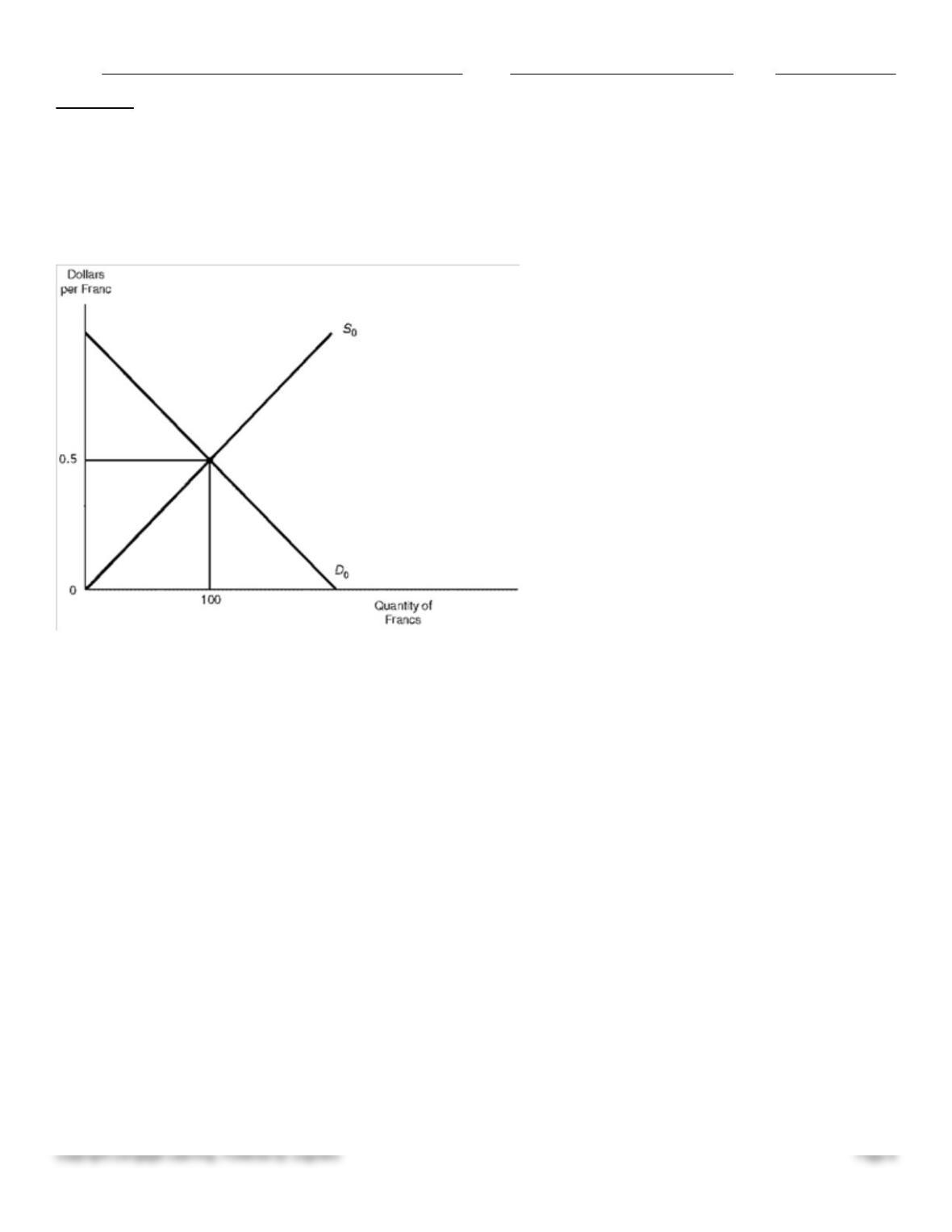
The figure below illustrates the supply and demand schedules of Swiss francs under a system of floating exchange rates.
Figure 12.2. The Market for Swiss Francs
38. Refer to Figure 12.2. If the rate of inflation in the United States is higher than the rate of inflation in Switzerland, then
the demand for francs decreases, the supply of francs increases, and the dollar’s exchange value appreciates.
a. True
b. False
39. According to exchange-rate overshooting, an appreciation of the Australian dollar is likely to be greater over a long
time period than over a short time period.
a. True
b. False
40. The purchasing-power-parity theory is used to predict exchange-rate movements in the short run.
a. True
b. False
41. If Mexico applies tariffs to imports of manufactured goods, then Mexico’s demand for foreign exchange will rise, and
the peso will depreciate under a system of floating exchange rates.
a. True
b. False
42. If investors anticipate that the exchange value of the euro will depreciate against the dollar in the future, then the
current exchange value of the euro will appreciate against the dollar.

Name:
Class:
Date:
chapter 12
Copyright Cengage Learning. Powered by Cognero.
Page 7
a. True
b. False
43. The nominal interest rate equals the real interest rate minus the inflation rate.
a. True
b. False
44. Day-to-day influences on foreign exchange rates always cause rates to move in the same direction as changes in long-
term market fundamentals.
a. True
b. False
45. If Japan realizes technological improvements in the production of automobiles, which lowers its production costs
relative to foreign producers, Japanese exports will rise, and the yen’s exchange value will appreciate under a system of
floating exchange rates.
a. True
b. False
46. In recent decades, the safe-haven effect has applied to the United States, with a long history of stable government,
relatively stable economy, and large and efficient financial markets.
a. True
b. False
47. If consumer tastes in the United States change in favor of goods produced in France, then the demand for francs will
increase, which causes an appreciation of the dollar against the franc under a floating exchange rate system.
a. True
b. False
48. Given an efficient foreign exchange market, the spot rate is the rational approximation of the markets expectation of
the forward rate that will exist at the end of the forward period.
a. True
b. False
49. Exchange-rate overshooting is based on the notion that the supply schedule of a currency is more elastic in the short
run than in the long run.
a. True
b. False
50. If you were considering hiring a forecasting firm to predict future spot rates of the yen, then you would hope that the
firm could predict better what would be implied by the yen’s forward rate.
a. True
b. False

Name:
Class:
Date:
chapter 12
Copyright Cengage Learning. Powered by Cognero.
Page 8
51. Assume the initial yen/dollar exchange rate to be 100 yen per dollar. If the U.S. inflation rate is 2 percent, and the
Japanese inflation rate is 7 percent, then the exchange rate should move to 105 yen per dollar according to the purchasing-
power-parity theory.
a. True
b. False
52. A forward discount on Mexico’s peso serves as a rough benchmark of the expected appreciation in the peso’s spot rate.
a. True
b. False
53. If real interest rates decline in the United States relative to real interest rates abroad, then the dollar’s exchange value
will appreciate under a floating exchange-rate system.
a. True
b. False
54. A country’s market fundamentals include economic variables, such as productivity, inflation, consumer preferences,
and real interest rates.
a. True
b. False
55. Concerning exchange rate forecasting, technical analysis extrapolates from past exchange-rate trends while ignoring
economic and political determinants of exchange rates.
a. True
b. False
56. Changes in market expectations have their greatest impact on exchange-rate changes over the long run as opposed to
the short run.
a. True
b. False
57. According to the law of one price, identical goods should cost the same in all nations, assuming there are no shipping
costs nor trade barriers.
a. True
b. False
58. The asset-markets approach views exchange-rate determination as similar to the stock market, in which prices are
volatile and expectations are important.
a. True
b. False
59. If American consumers increase their demand for British goods, then they are willing to pay fewer U.S. dollars per
British pound.
a. True
b. False

Name:
Class:
Date:
chapter 12
Copyright Cengage Learning. Powered by Cognero.
Page 9
60. Long-run determinants of exchange rate include labor productivity levels, inflation rates, consumer preferences for
goods and services, and trade barriers.
a. True
b. False
61. Exchange rates are determined by the unregulated forces of supply and demand for foreign currencies as long as
central banks do not intervene in the foreign exchange markets.
a. True
b. False
62. If the interest rate in Japan increases, investors increase their demand for yen, and the yen’s exchange value
appreciates.
a. True
b. False
63. If the rate of growth of labor productivity in the United States rises relative to the rate of growth of labor productivity
in other countries, then the dollar’s exchange value will depreciate.
a. True
b. False
64. Concerning exchange rate forecasting, judgmental forecasts are common sense models that rely on a wide array of
political and economic data.
a. True
b. False
65. If investors anticipate that the exchange value of the euro will appreciate against the dollar in the future, then the
current exchange value of the euro will appreciate against the dollar.
a. True
b. False
66. A rise in the expected rate of inflation in Canada will cause the exchange value of the Canadian dollar to depreciate.
a. True
b. False
67. Concerning exchange rate forecasting, fundamental analysis involves consideration of a variety of macroeconomic
variables and policies that tend to affect currency values.
a. True
b. False
68. If U.S. labor productivity growth is 2 percent per annum and Swiss labor productivity growth is 6 percent per annum,
then the dollar will depreciate against the franc under a system of floating exchange rates.
a. True
b. False
69. In a free market, exchange rates are determined by market fundamentals and market expectations.

Name:
Class:
Date:
chapter 12
Copyright Cengage Learning. Powered by Cognero.
Page 10
a. True
b. False
70. In the long run, exchange rates are mainly determined by economic fundamentals, such as the productivity levels of
different countries.
a. True
b. False
71. The volatility of exchange rates is reinforced by the phenomenon of overshooting, in which exchange rates depreciate
or appreciate more in the long run than in the short run.
a. True
b. False
72. Suppose expansionary monetary policy in the United States leads to interest rates falling to 2 percent, while tight
monetary policy in Switzerland leads to interest rates rising to 8 percent. With floating exchange rates, the dollar would
appreciate against the franc.
a. True
b. False
Indicate the answer choice that best completes the statement or answers the question.
73. The supply curve of dollars decreases (shifts to the left) in the foreign exchange market. This could be the result of
a. the current exchange rate of the dollar rising (appreciating).
b. the current exchange rate of the dollar falling (depreciating).
c. an increase in the U.S. inflation rate relative to the inflation rate in other countries.
d. a decrease in the U.S. inflation rate relative to the inflation rate in other countries.
74. With floating exchange rates, easy credit and low short-term interest rates lead to
a. exchange rate depreciation in the short run.
b. exchange rate appreciation in the short run.
c. exchange rate depreciation in the long run.
d. exchange rate appreciation in the long run.
75. Given a system of floating exchange rates, stronger U.S. preferences for imports would trigger
a. an increase in the demand for imports and an increase in the demand for foreign currency.
b. an increase in the demand for imports and a decrease in the demand for foreign currency.
c. a decrease in the demand for imports and an increase in the demand for foreign currency.
d. a decrease in the demand for imports and a decrease in the demand for foreign currency.
76. Suppose that Barclays Bank of the United Kingdom expects the exchange rate to be $1.40 per pound at the end of the
year. If today’s exchange rate is $1.50 per pound, then Barclays will
a. sell dollars today because it anticipates losses from buying dollars and holding them.
b. buy dollars today because it anticipates profits from buying dollars and holding them.
c. not buy dollars nor sell dollars because no profits can be realized.
d. stop transacting with both dollar and pound till they stabilize.

Name:
Class:
Date:
chapter 12
Copyright Cengage Learning. Powered by Cognero.
Page 11
77. When the price of foreign currency (i.e., the exchange rate) is above the equilibrium level,
a. an excess supply of that currency exists in the foreign exchange market.
b. an excess demand for that currency exists in the foreign exchange market.
c. the supply of foreign exchange shifts outward to the right.
d. the supply of foreign exchange shifts backward to the left.
78. Concerning exchange-rate determination, “market fundamentals” include all of the following EXCEPT
a. monetary policy and fiscal policy.
b. profitability and riskiness of investments.
c. speculative opinion about future exchange rates.
d. productivity changes affecting production costs.
79. Due to increased air travel, suppose that Saudi Arabian Airlines purchases forty jetliners from Airbus, a European
firm. This results in
a. a decrease in the demand curve (leftward shift) for euro.
b. an increase in the demand curve (rightward shift) for euro.
c. a decrease in the supply curve (leftward shift) of euro.
d. an increase in the supply curve (rightward shift) of euro.
80. Concerning exchange rate forecasting, ____ relies on econometric models that are based on macroeconomic variables
likely to affect currency values.
a. fundamental analysis
b. technical analysis
c. judgmental analysis
d. sunspot analysis
81. If German tastes for Microsoft software become stronger, then
a. the demand curve for dollars shifts to the right.
b. the demand curve for dollars shifts to the left.
c. the demand curve for euro shifts to the right.
d. the demand curve for both euros and dollars remains constant.
82. The theory of purchasing power parity states that changes in the nominal exchange rate arise from differences in
______ among countries.
a. nominal interest rates
b. real interest rates
c. inflation rates
d. productivity rates
83. If the United States reduces its tariffs on the import of natural gas, then
a. the dollar’s exchange value depreciates.
b. the dollar’s exchange value appreciates.
c. natural gas becomes more expensive for Americans.
d. natural gas prices do not change for Americans.
84. The relationship between the exchange rate and the prices of tradable goods is known as the
Name:
Class:
Date:
chapter 12
Copyright Cengage Learning. Powered by Cognero.
Page 12
a. purchasing-power-parity theory.
b. asset-markets theory.
c. monetary theory.
d. balance-of-payments theory.
85. Which of the following will result in a depreciation of the U.S. dollar against the Mexican peso?
a. an increase in the Mexican demand for U.S. imports
b. a decrease in the Mexican demand for U.S. imports
c. a decrease in the U.S. demand for Mexican imports
d. no change in the U.S. demand for Mexican imports
86. The quantity of Canadian dollars supplied to the foreign exchange market would increase if, other things remaining
equal
a. preferences for imports rise in Canada.
b. labor productivity increases in Canada.
c. prices of goods and services decrease in Canada.
d. import tariffs rise in Canada.
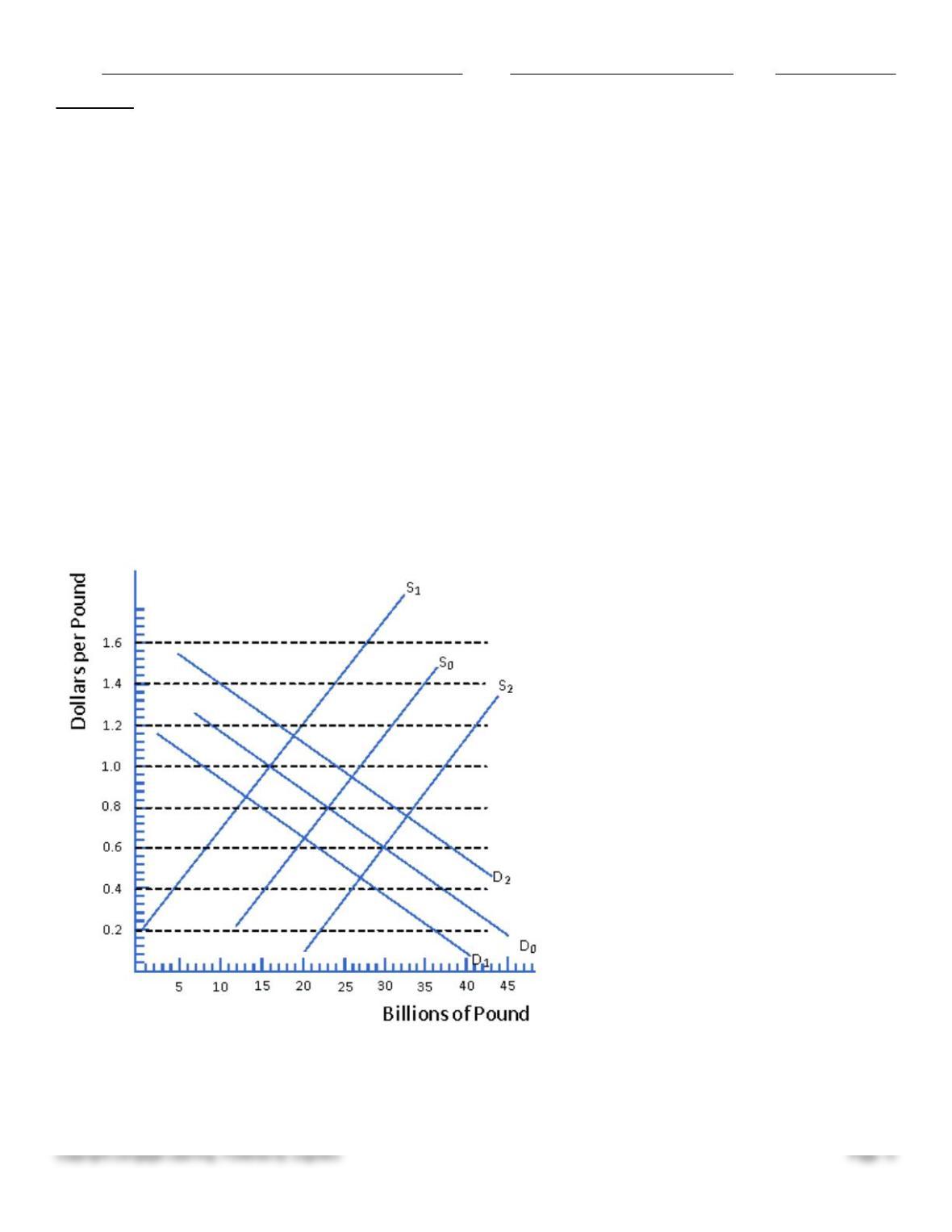
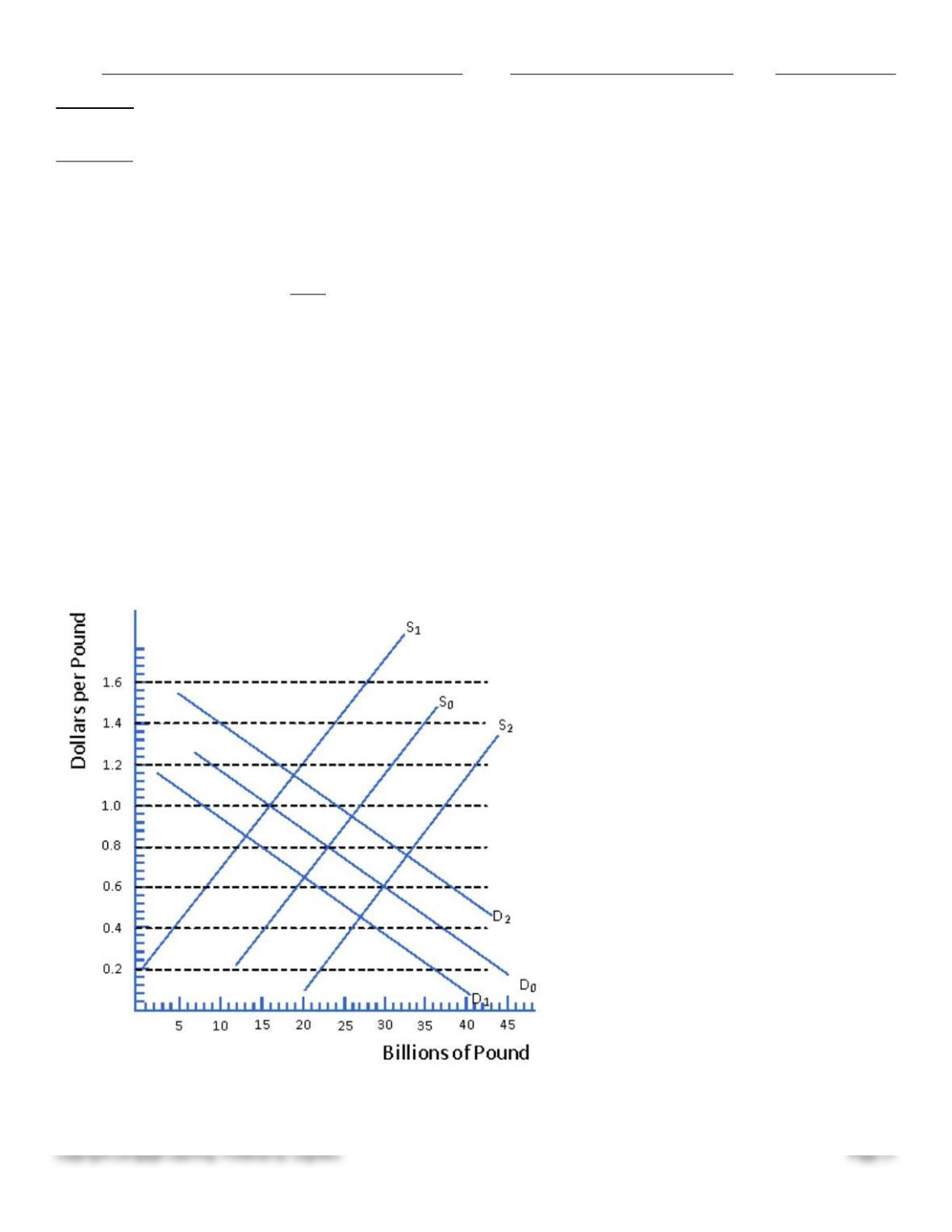
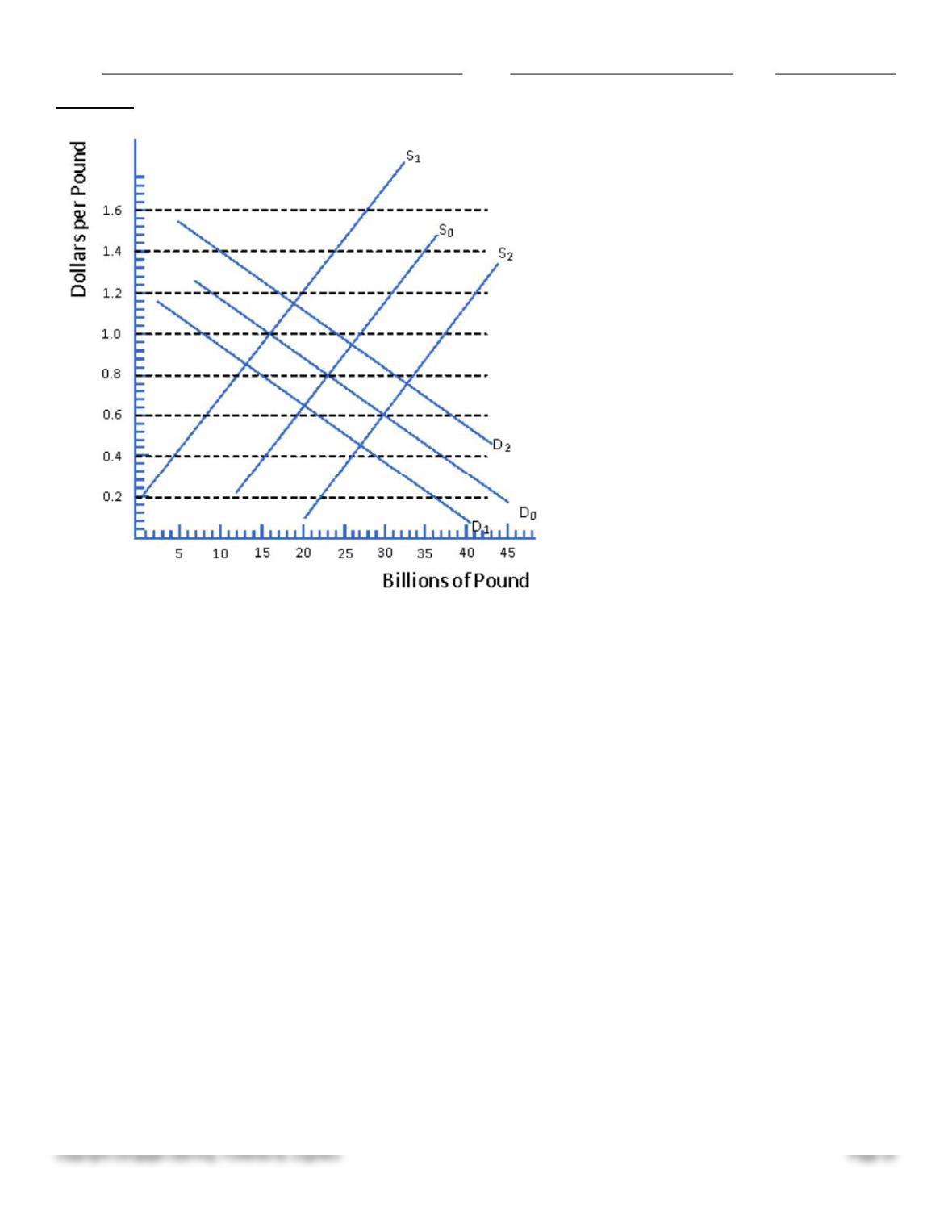
Figure 12.3 Market for British Pounds
87. Consider Figure 12.3. The market is initially governed by demand curve D0 and supply curve S0. Suppose US
productivity growth is faster than the UK, which supply and demand curves depict the new situation?
a. S1 and D2
b. S2 and D1

Name:
Class:
Date:
chapter 12
Copyright Cengage Learning. Powered by Cognero.
Page 13
c. S0 and D2
d. S0 and D1
88. An increase in the British demand for exports of American steel will ______ the demand for U.S. dollars and result in
a (an) ______ of the dollar.
a. increase; appreciation
b. increase; depreciation
c. decease; appreciation
d. decrease; depreciation
89. The demand curve for euros in the foreign exchange market will increase (shift rightward) if
a. European interest rates fall relative to foreign interest rates.
b. the current exchange value of the euro depreciates.
c. Europe increases tariffs and applies more stringent quotas on imported goods.
d. the rate of inflation in Europe is less than the rate of inflation throughout the world.
90. For an American investor, the expected rate of return on European securities depends on all of the following factors
EXCEPT the
a. rate of return on equivalent American securities.
b. current exchange rate between the dollar and the pound.
c. exchange rate anticipated to prevail when the securities mature.
d. interest rate paid on European securities.
91. According to the theory of purchasing power parity, if the price level in France rises by 6 percent and the price level in
the United States rises by 4 percent, then the dollar will
a. appreciate by 2 percent against the euro in the short run.
b. depreciate by 2 percent against the euro in the short run.
c. appreciate by 2 percent against the euro in the long run.
d. depreciate by 2 percent against the euro in the long run.
92. Increased tariffs on U.S. steel imports cause the dollar to ____ in the ____.
a. appreciate, long run
b. depreciate, long run
c. appreciate, short run
d. depreciate, short run
93. If the U.S. interest rate rises relative to the foreign interest rate, then in the foreign exchange market
a. the demand for dollars increases, and the supply of dollars increases.
b. the demand for dollars increases, and the supply of dollars decreases.
c. the demand for dollars decreases, and the supply of dollars increases.
d. the demand for dollars decreases, and the supply of dollars decreases.
94. In the presence of purchasing-power parity, if one dollar exchanges for two British pounds and if a VCR costs $400 in
the United States, then in Great Britain the VCR should cost
a. 200 pounds.
b. 400 pounds.

Name:
Class:
Date:
chapter 12
Copyright Cengage Learning. Powered by Cognero.
Page 14
c. 600 pounds.
d. 800 pounds.
95. In the long run, exchange rates are mainly determined by
a. the difference between short-run interest rates in each county.
b. the rate at which a country’s currency exchanges for silver or gold.
c. agreements among governments in the major banking countries of the world.
d. market fundamentals, such as productivity levels or price levels in various countries.
96. British investors will expect that the U.S. dollar will appreciate against the pound in the future if there are expectations
that
a. the U.S. price level will increase relative to the British price level.
b. U.S. labor productivity will increase relative to British labor productivity.
c. the U.S. demand for British imports will increase.
d. U.S. tariffs on British imports will decline.
97. All of the following are important long-run determinants of exchange rates EXCEPT
a. consumer tastes.
b. trade policy.
c. labor productivity.
d. interest rates.
98. Exchange rate determination in the short run is underlied by which of the following?
a. Tariffs and quotas affect trade patterns only in the short run.
b. Prices of goods and services affect trade patterns only in the short run.
c. Expected returns on financial assets affect investment flows in the short run.
d. Preferences for goods and services affect trade flows only in the short run.
99. Suppose that $1 will buy 0.8 Swiss francs in 2015 and 0.9 francs in 2016. This change would have occurred as a result
of
a. an increase in the demand for dollars in the foreign exchange market.
b. a decrease in the demand for dollars in the foreign exchange market.
c. an increase in the supply of dollars in the foreign exchange market.
d. no change in the supply of dollars in the foreign exchange market.
100. Which example of market expectations causes the dollar to depreciate against the yen? Expectations that the U.S.
economy will have
a. faster economic growth than Japan.
b. higher future interest rates than Japan.
c. less rapid money supply growth than Japan.
d. lower inflation rates than Japan.
101. For the United States, suppose the annual interest rate on government securities equals 8 percent, while the annual
inflation rate equals 4 percent. For Japan, suppose the annual interest rate on government securities equals 10 percent,
while the annual inflation rate equals 7 percent. These variables would cause investment funds to flow from
a. the United States to Japan, thus causing the dollar to depreciate.

Name:
Class:
Date:
chapter 12
Copyright Cengage Learning. Powered by Cognero.
Page 15
b. the United States to Japan, thus causing the dollar to appreciate.
c. Japan to the United States, thus causing the yen to depreciate.
d. Japan to the United States, thus causing the yen to appreciate.
102. If Americans develop stronger preferences for Canadian natural gas, then the likely result is that
a. the exchange value of the U.S. dollar will fall relative to the exchange value of the Canadian dollar.
b. the exchange value of the U.S. dollar will rise relative to the exchange value of the Canadian dollar.
c. the price of Canadian natural gas will decline when measured in terms of the Canadian dollar.
d. the price of Canadian natural gas will remain constant when measured in terms of the Canadian dollar.
103. Given floating exchange rates, if Japan increases its demand for Canadian goods at the same time that Canada
increases its demand for Japanese goods, then we would expect the yen’s exchange value to
a. appreciate against the dollar.
b. depreciate against the dollar.
c. remain constant against the dollar.
d. appreciate, depreciate, or remain constant against the dollar.
104. Factors that will shift the demand curve for pounds include all of the following EXCEPT
a. the expected future exchange rate of the pound.
b. inflation rates around the world.
c. interest rates around the world.
d. the current exchange rate of the pound.
105. When deciding between U.S. and British government securities, an American investor typically considers
a. U.S. and British interest rates and anticipated changes in the exchange rate.
b. budget deficits of the U.S. government and British government.
c. shifts in the demand for U.S. goods and British goods.
d. U.S. and British inflation rates and anticipated changes in the exchange rate.
106. High real interest rates in the United States tend to
a. decrease the demand for dollars, thus causing the dollar to depreciate.
b. decrease the demand for dollars, thus causing the dollar to appreciate.
c. increase the demand for dollars, thus causing the dollar to depreciate.
d. increase the demand for dollars, thus causing the dollar to appreciate.
107. Given floating exchange rates, a simultaneous decrease in the Canadian demand for British products and increase in
the British desire to invest in Canadian government securities would cause a(n)
a. appreciation of the pound against the dollar.
b. depreciation of the pound against the dollar.
c. unchanged pound/dollar exchange rate.
d. appreciation of both the pound and dollar.
108. Assume that interest rates in the United States and Britain are the same. If a U.S. resident anticipates that the
exchange value of the dollar is going to appreciate against the pound, she should
a. borrow needed funds from British banks rather than U.S. banks.
b. borrow needed funds from U.S. banks rather than British banks.

Name:
Class:
Date:
chapter 12
Copyright Cengage Learning. Powered by Cognero.
Page 16
c. convert U.S. dollars into British pounds.
d. use currencies other than dollars and pounds.
109. Long-run exchange rate movements are governed by all of the following EXCEPT
a. national productivity levels.
b. consumer tastes and preferences.
c. rates of inflation.
d. interest rate levels.
110. Under a system of floating exchange rates, relatively high productivity and low inflation rates in the United States
result in
a. an increase in the demand for foreign currency, a decrease in the supply of foreign currency, and a depreciation in
the dollar.
b. an increase in the demand for foreign currency, an increase in the supply of foreign currency, and an appreciation
in the dollar.
c. a decrease in the demand for foreign currency, a decrease in the supply of foreign currency, and a depreciation in
the dollar.
d. a decrease in the demand for foreign currency, an increase in the supply of foreign currency, and an appreciation
in the dollar.
111. Concerning exchange rate forecasting, ____ is a common-sense approach based on a wide array of political and
economic data.
a. econometric analysis
b. technical analysis
c. judgmental analysis
d. sunspot analysis
112. A shift in the U.S. supply curve of dollars in the foreign exchange market could be caused by all of the following
EXCEPT a change in
a. the current exchange rate of the dollar.
b. the expected future exchange rate of the dollar.
c. the rate of inflation in the United States.
d. productivity of the U.S. labor force.
113. When the price of foreign currency (i.e., the exchange rate) is below the equilibrium level,
a. an excess demand for that currency exists in the foreign exchange market.
b. an excess supply of that currency exists in the foreign exchange market.
c. the demand for foreign exchange shifts outward to the right.
d. the demand for foreign exchange shifts backward to the left.
114. Long-run determinants of the dollar’s exchange value include all of the following EXCEPT
a. preferences of Americans for foreign produced goods.
b. U.S. tariffs placed on imports of foreign produced goods.
c. productivity of the American worker.
d. interest rates in U.S. financial markets.
Name:
Class:
Date:
chapter 12
Copyright Cengage Learning. Powered by Cognero.
Page 17
115. Low real interest rates in the United States tend to
a. decrease the demand for dollars, thus causing the dollar to depreciate.
b. decrease the demand for dollars, thus causing the dollar to appreciate.
c. increase the demand for dollars, thus causing the dollar to depreciate.
d. increase the demand for dollars, thus causing the dollar to appreciate.
116. Lower tariffs on U.S. agricultural imports cause the dollar to ____ in the ____.
a. appreciate, long run
b. depreciate, long run
c. appreciate, short run
d. depreciate, short run
The figure below illustrates the supply and demand schedules of Swiss francs in a market of freely-floating exchange
rates.
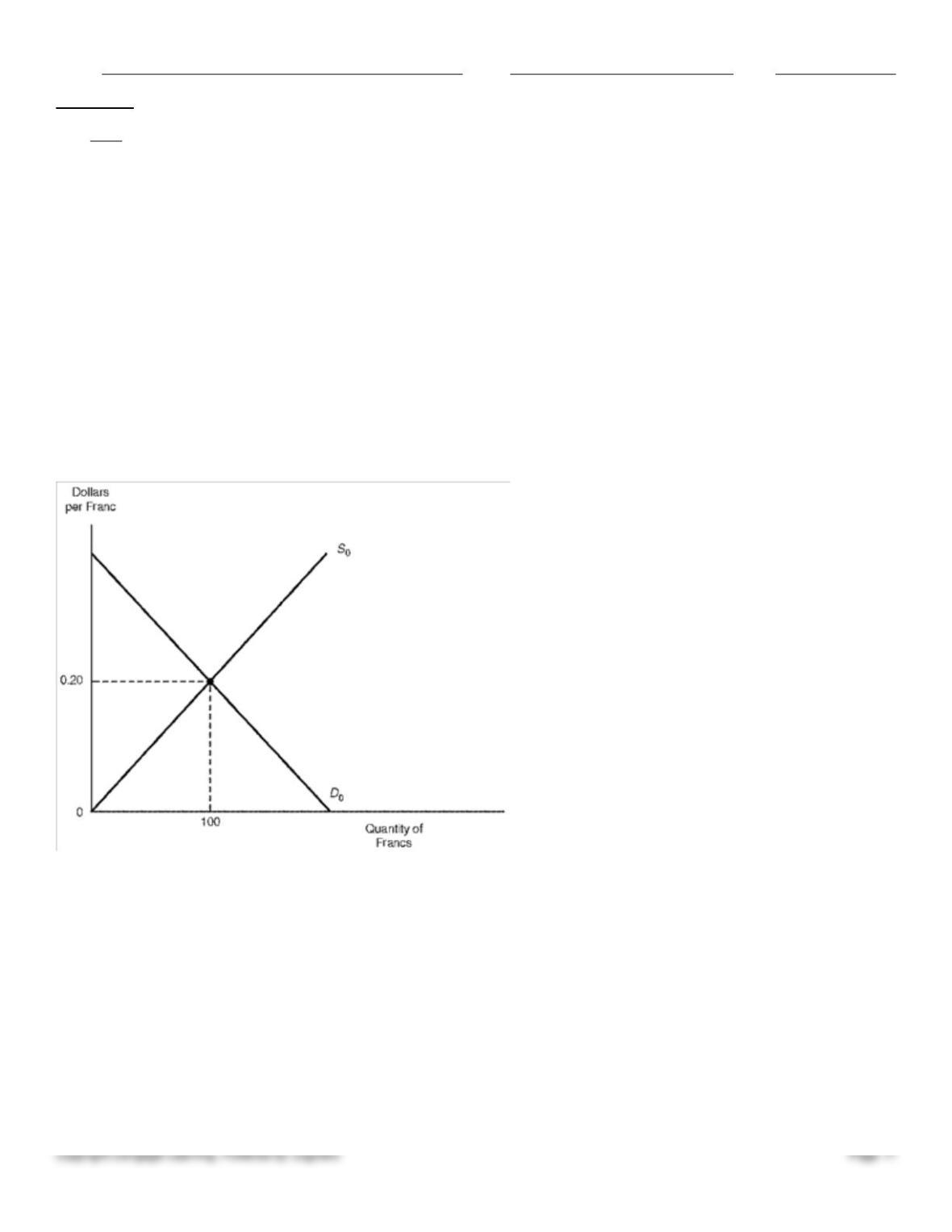
Figure 12.1 The Market for Francs
117. Refer to Figure 12.1. Should preferences for imports rise in the United States and fall in Switzerland, there would
occur a(n)
a. increase in the demand for francs and a decrease in the supply of francs-depreciation of the dollar.
b. increase in the demand for francs and a decrease in the supply of francs-appreciation of the dollar.
c. decrease in the demand for francs and a decrease in the supply of francs-appreciation of the dollar.
d. decrease in the demand for francs and a increase in the supply of francs-depreciation of the dollar.
118. When The Economist magazine runs articles using the Big Mac hamburger to value exchange rates, it is using the
principle of
a. exchange arbitrage.
b. market expectations.
c. purchasing power parity.
d. interest rate parity.

Name:
Class:
Date:
chapter 12
Copyright Cengage Learning. Powered by Cognero.
Page 18
119. Suppose the exchange rate between the U.S. dollar and the Japanese yen is initially 90 yen per dollar. According to
purchasing-power parity, if the price of traded goods rises by 10 percent in the United States and remains constant in
Japan, then the exchange rate will become
a. 72 yen per dollar.
b. 81 yen per dollar.
c. 99 yen per dollar.
d. 108 yen per dollar.
120. Given a system of floating exchange rates, weaker U.S. preferences for imports would trigger
a. an increase in the demand for imports and an increase in the demand for foreign currency.
b. an increase in the demand for imports and a decrease in the demand for foreign currency.
c. a decrease in the demand for imports and an increase in the demand for foreign currency.
d. a decrease in the demand for imports and a decrease in the demand for foreign currency.
121. If the exchange rate between Swiss francs and British pounds is five francs per pound, then the number of pounds
that can be obtained for 200 francs equals
a. 20 pounds.
b. 40 pounds.
c. 60 pounds.
d. 80 pounds.
122. The asset market theory of exchange rate determination suggests that the most important factor influencing the
demand for domestic and foreign securities is
a. expected return on these assets relative to one another.
b. ability of these assets to easily be converted into cash.
c. riskiness of these assets relative to one another.
d. level of government restrictions on trade and investment flows.
123. The law of one price would least likely apply to
a. steel.
b. oil.
c. corn.
d. computers.
124. A primary reason that explains the appreciation in the value of the U.S. dollar in the 1980s is
a. large trade surpluses for the United States.
b. relatively high inflation rates in the United States.
c. lack of investor confidence in the U.S. monetary policy.
d. relatively high interest rates in the United States.
The figure below illustrates the supply and demand schedules of Swiss francs in a market of freely-floating exchange
rates.
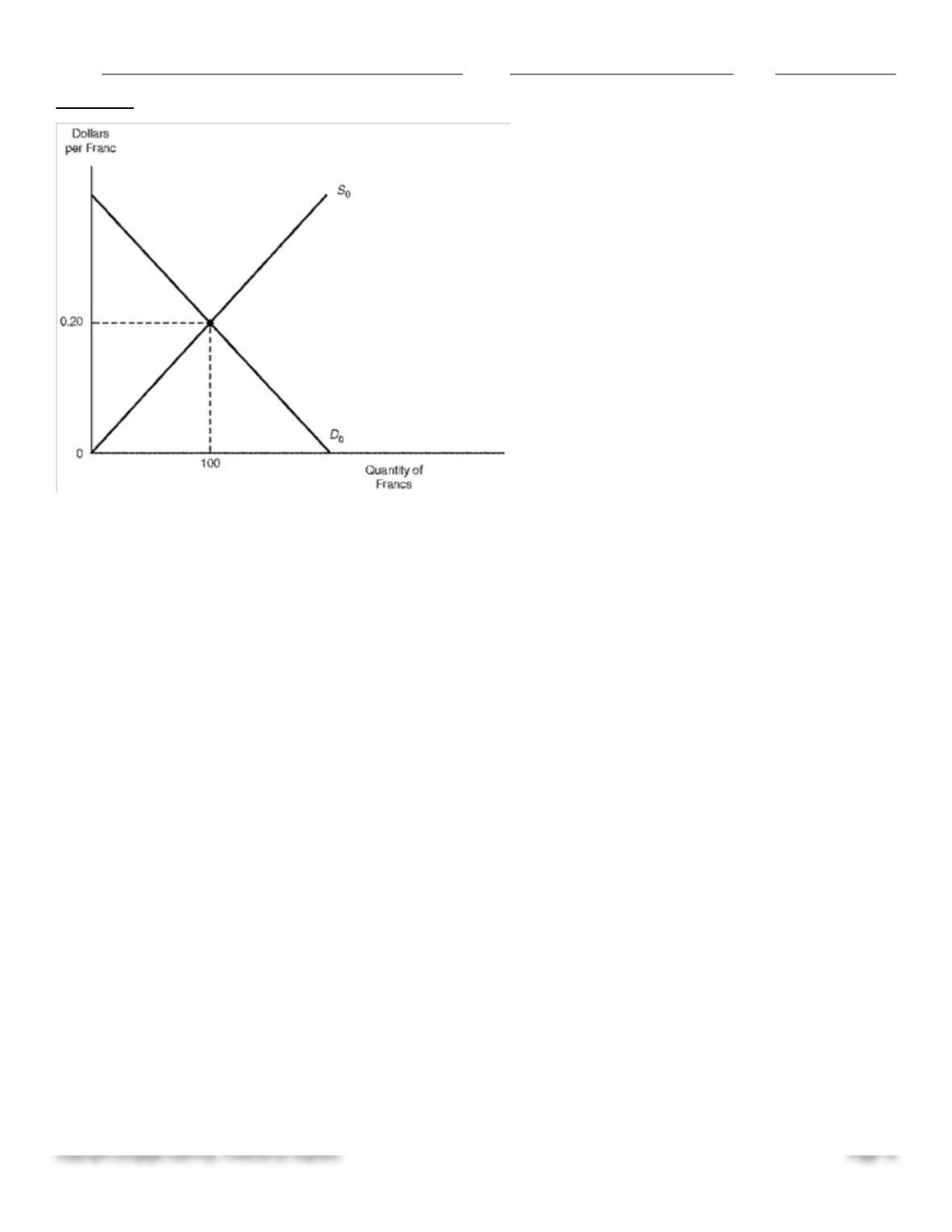
Figure 12.1 The Market for Francs
Name:
Class:
Date:
chapter 12
Copyright Cengage Learning. Powered by Cognero.
Page 19
125. Refer to Figure 12.1. Should real interest rates in the United States rise relative to real interest rates in Switzerland,
there would occur a(n)
a. increase in the demand for francs and a decrease in the supply of francs-depreciation of the dollar.
b. increase in the demand for francs and a decrease in the supply of francs-appreciation of the dollar.
c. decrease in the demand for francs and an increase in the supply of francs-appreciation of the dollar.
d. decrease in the demand for francs and a decrease in the supply of francs-depreciation of the dollar.
126. If the rate of growth in labor productivity in the United States increases relative to the rate of growth in labor
productivity in other countries, then
a. the dollar’s exchange value depreciates against other currencies.
b. the dollar’s exchange value remains constant against other currencies.
c. Americans are willing to pay more U.S. dollars per unit of foreign currency.
d. Americans are willing to pay fewer U.S. dollars per unit of foreign currency.
127. The U.S. demand for pesos would shift to the right if there occurred a(n)
a. change in preferences toward U.S. manufactured goods.
b. increase in the dollar/peso exchange rate.
c. decrease in the U.S. population.
d. increase in the U.S. price level.
128. Concerning exchange rate forecasting, ____ involves the use of historical exchange rate data to estimate future
values, while ignoring the economic determinants of exchange rate movements.
a. econometric analysis
b. judgmental analysis
c. technical analysis
d. sunspot analysis

Name:
Class:
Date:
chapter 12
Copyright Cengage Learning. Powered by Cognero.
Page 20
129. Given floating exchange rates, assume that the Swiss decrease their import purchases from Italy while the Italians
increase their purchases of Swiss government securities. The first action by itself would lead to a(n) ____ of the franc
against the lira while the second action by itself would lead to a(n) ____ of the franc against the lira.
a. appreciation, appreciation
b. depreciation, depreciation
c. appreciation, depreciation
d. depreciation, appreciation
130. If Canada runs a trade surplus with Mexico, and exchange rates are floating, then
a. the peso will depreciate relative to the dollar.
b. the dollar will depreciate relative to the peso.
c. the prices of all foreign goods will fall for Canadians.
d. the prices of all foreign goods will rise for Canadians.
131. A relatively high rate of inflation in the United States will result in
a. an appreciation of the dollar against foreign currencies in the long run.
b. a depreciation of the dollar against foreign currencies in the long run.
c. an appreciation of the dollar against foreign currencies in the short run.
d. a depreciation of the dollar against foreign currencies in the short run.
132. Which example of market expectations causes the dollar to appreciate against the yen? Expectations that the U.S.
economy will have
a. faster economic growth than Japan.
b. higher future interest rates than Japan.
c. more rapid money supply growth than Japan.
d. higher inflation rates than Japan.
133. Assume that the United States faces an 8 percent inflation rate, while no (zero) inflation exists in Japan. According to
the purchasing-power parity theory, the dollar would be expected to
a. appreciate by 8 percent against the yen.
b. depreciate by 8 percent against the yen.
c. depreciate by 7 percent against the yen.
d. appreciate by 7 percent against the yen.
134. If the Federal Reserve decreases interest rates in the United States relative to interest rates in other countries, then in
the foreign exchange market
a. the demand for dollars increases, and the supply of dollars increases.
b. the demand for dollars increases, and the supply of dollars decreases.
c. the demand for dollars decreases, and the supply of dollars increases.
d. the demand for dollars decreases, and the supply of dollars decreases.
135. The supply of francs would shift to the right for all of the following reasons EXCEPT
a. an increase in swiss real income.
b. an increase in swiss prices.
c. an increase in the swiss population.
d. an increase in swiss interest rates.
Name:
Class:
Date:
chapter 12
Copyright Cengage Learning. Powered by Cognero.
Page 21
136. According to the purchasing-power-parity theory, the U.S. dollar maintains its purchasing-power parity if it
depreciates by an amount equal to the excess of
a. U.S. interest rates over foreign interest rates.
b. foreign interest rates over U.S. interest rates.
c. U.S. inflation over foreign inflation.
d. foreign inflation over U.S. inflation.
137. Which of the following does NOT explain long-run movements in exchange rates?
a. productivity differences among nations
b. price level differences among nations
c. barriers to trade (tariffs and quotas) among nations
d. interest rate differences among nations
138. The Canadian dollar would depreciate on the foreign exchange market if
a. Canadian consumer tastes change in favor of goods produced domestically.
b. the profitability of assets in Canada rises relative to the profitability of assets abroad.
c. Canada experiences a disastrous wheat-crop failure, thus leading to imports of more wheat.
d. Canada realizes technological improvements in the production of manufactured goods, thus leading to relatively
low costs for Canada.
Figure 12.3 Market for British Pounds
139. Consider Figure 12.3. The market is initially governed by demand curve D0 and supply curve S0. Suppose the US
government raises tariffs for UK made goods, which supply and demand curves depict the new situation?

Name:
Class:
Date:
chapter 12
Copyright Cengage Learning. Powered by Cognero.
Page 22
a. S1 and D2
b. S2 and D1
c. S0 and D2
d. S0 and D1
140. If the current exchange value of the dollar is $1.25 per euro, then
a. European Investor #1 has less incentive to invest in the United States and thus demands fewer dollars.
b. European Investor #2 has less incentive to invest in the United States and thus demands fewer dollars.
c. European Investor #3 has less incentive to invest in the United States and thus demands fewer dollars.
d. all three European investors have less incentive to invest in the United States and thus demands fewer dollars.
141. In the long run, exchange rates are primarily determined by
a. agreements among governments of the world’s industrial countries.
b. relative interest rates in developing countries and industrial countries.
c. economic fundamentals, such as relative productivity levels.
d. the rate at which country’s currencies exchange for gold.
142. Under a system of floating exchange rates, a Japanese trade surplus against Canada would result in a(n)
a. rise in the dollar price of the yen.
b. fall in the dollar price of the yen.
c. rise in the yen price of the dollar.
d. unchanged dollar/yen exchange rate.
143. Given a floating exchange rate system, an increase in ____ would cause the dollar to appreciate against the euro.
a. U.S. labor costs
b. the U.S. money supply
c. U.S. prices of goods
d. U.S. real interest rates
144. If American consumers increase their demand for Mercedes Benz automobiles manufactured in Germany, then
a. the U.S. dollar’s exchange value appreciates against the euro.
b. the U.S. dollar’s exchange value remains constant against the euro.
c. Americans are willing to pay fewer U.S. dollars for the euro.
d. Americans are willing to pay more U.S. dollars for the euro.
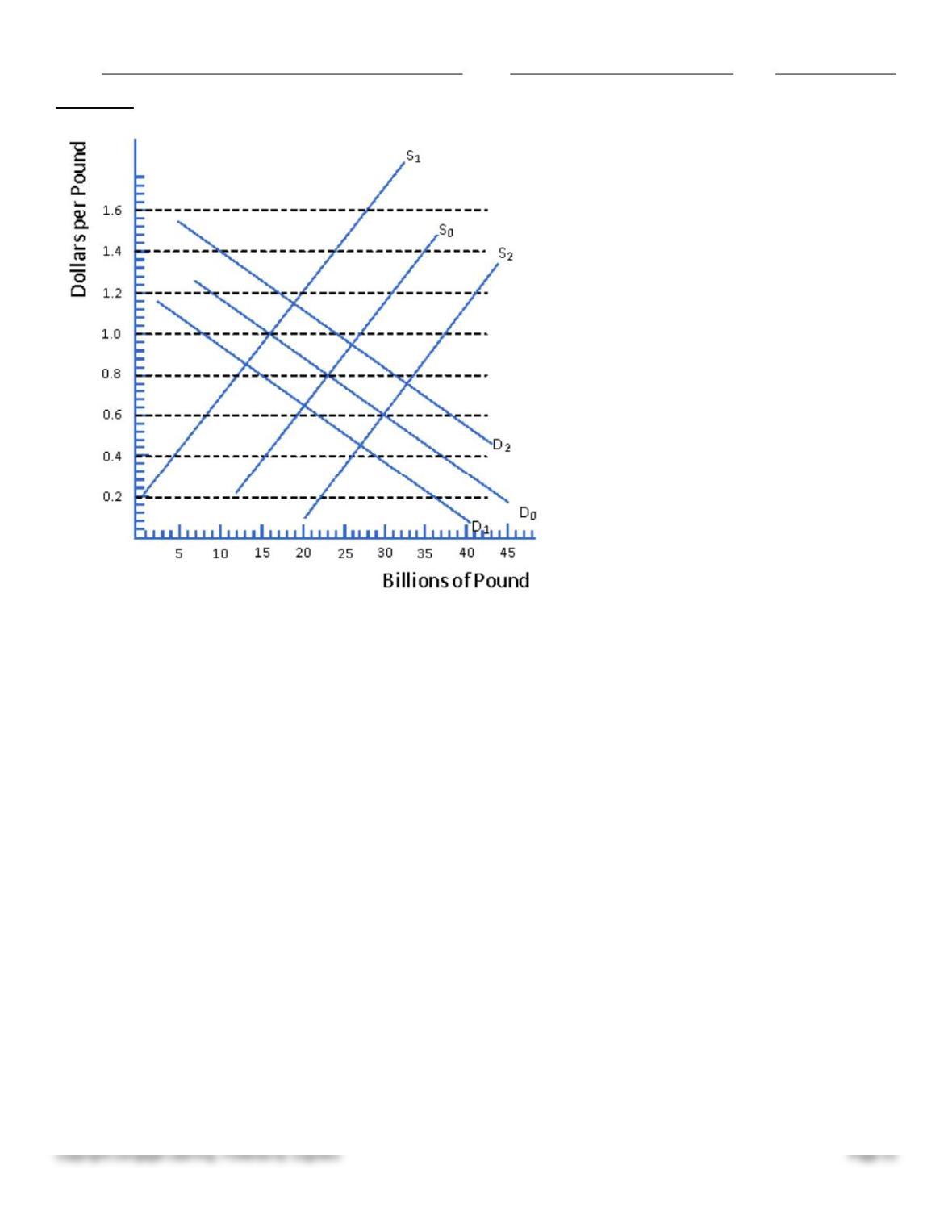
Figure 12.3 Market for British Pounds
Name:
Class:
Date:
chapter 12
Copyright Cengage Learning. Powered by Cognero.
Page 23
145. Consider Figure 12.3. The market is initially governed by demand curve D0 and supply curve S0. Suppose the
domestic price level rises rapidly in the United States but stays relatively constant in the United Kingdom, which supply
and demand curves depict the new situation?
a. S1 and D2
b. S2 and D1
c. S0 and D2
d. S0 and D1
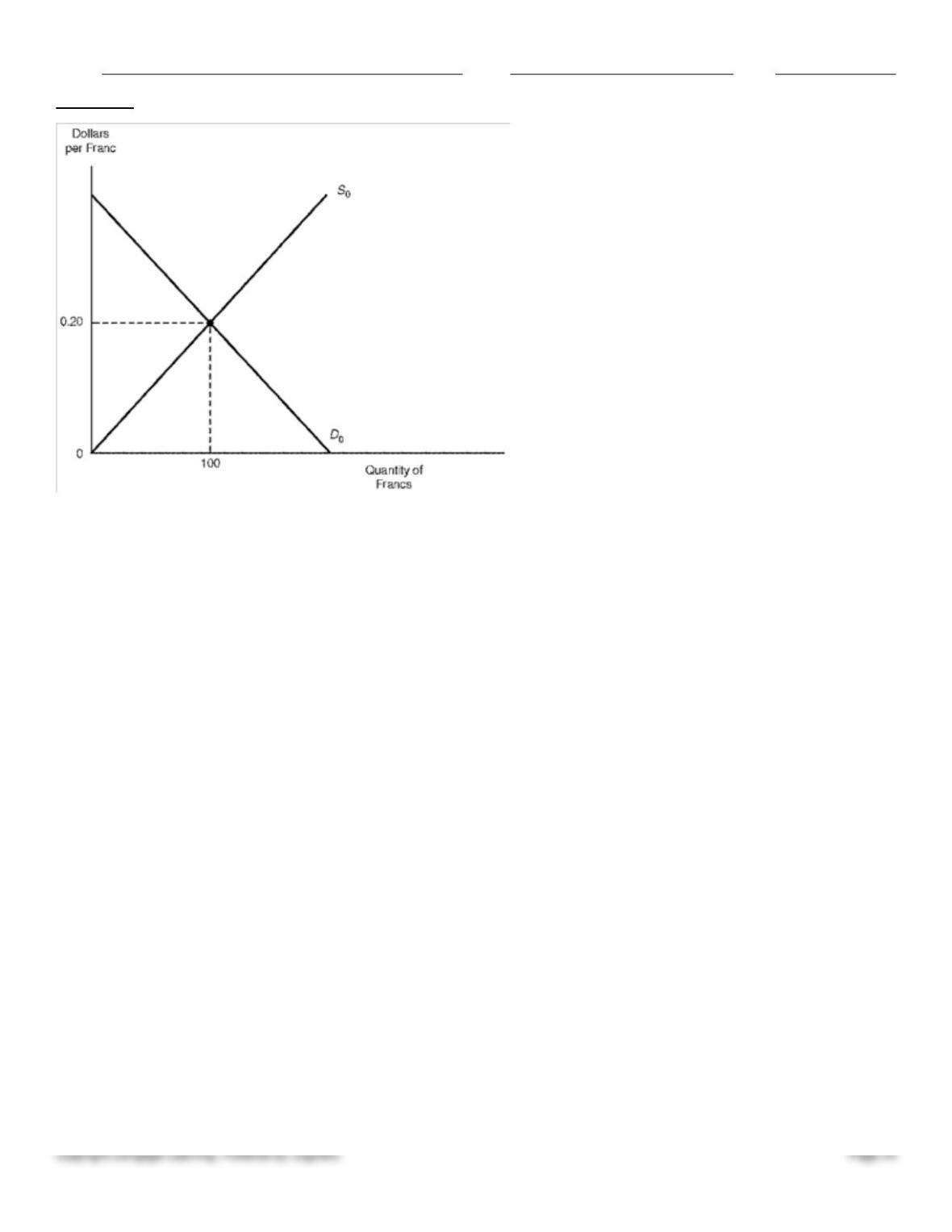
The figure below illustrates the supply and demand schedules of Swiss francs in a market of freely-floating exchange
rates.
Figure 12.1 The Market for Francs
Name:
Class:
Date:
chapter 12
Copyright Cengage Learning. Powered by Cognero.
Page 24
146. Refer to Figure 12.1. Should the U.S. price level rise relative to the Swiss price level, there would occur a(n)
a. increase in the demand for francs and an increase in the supply of francs-appreciation of the dollar.
b. decrease in the demand for francs and a decrease in the supply of francs-depreciation of the dollar.
c. increase in the supply of francs and a decrease in the demand for francs-appreciation of the dollar.
d. decrease in the supply of francs and an increase in the demand for francs-depreciation of the dollar.
147. If the rate of inflation in Japan dramatically increases while the rate of inflation in the United States remains
constant, then
a. the demand curve for dollars shifts to the left.
b. the demand curve for dollars shifts to the right.
c. the demand curve for yen shifts to the right.
d. the demand curves for both yen and dollars remain constant.
148. Suppose Mexico and the United States were the only two countries in the world. There exists an excess supply of
pesos on the foreign exchange market. This suggests that
a. Mexico’s current account is in surplus.
b. Mexico’s current account is in deficit.
c. the U.S. current account is in deficit.
d. the U.S. current account is in equilibrium.
149. During the Great Recession of 2008–2009, the dollar increasingly was viewed as a safe-haven currency, as investors
fled to it when they worried about the stability of the global economy. As investors fled to the dollar,
a. the demand for dollars increased and the dollar’s exchange value appreciated.
b. the demand for dollars increased and the dollar’s exchange value depreciated.
c. the demand for dollars decreased and the dollar’s exchange value appreciated.
d. the demand for dollars decreased the dollar’s exchange value depreciated.
150. In the short run, exchange rates respond to market forces, such as
a. inflation rates.

Name:
Class:
Date:
chapter 12
Copyright Cengage Learning. Powered by Cognero.
Page 25
b. expectations of future exchange rates.
c. investment profitability.
d. government trade policy.
151. If wheat costs four dollars per bushel in the United States and two British pounds per bushel in Great Britain, then in
the presence of purchasing-power parity the exchange rate should be
a. $.50 per pound.
b. $1.00 per pound.
c. $2.00 per pound.
d. $8.00 per pound.
152. Hyundai Inc is a South Korean company that manufactures automobiles. If Hyundai purchases sheet steel from U.S.
Steel Inc., then
a. the demand for dollars increases, and the dollar appreciates against the won.
b. the demand for dollars increases, and the dollar depreciates against the won.
c. the demand for dollars decreases, and the dollar appreciates against the won.
d. the demand for dollars decreases, and the dollar depreciates against the won.
153. Assume a system of floating exchange rates. Due to a high savings rate, suppose the level of savings in Japan is in
excess of domestic investment needs. If Japanese residents invest abroad, then the yen’s exchange value will ____ , and
the Japanese trade balance will move toward ____.
a. appreciate, deficit
b. appreciate, surplus
c. depreciate, deficit
d. depreciate, surplus
154. Relatively high interest rates in the United States cause the dollar to ____ in the ____.
a. appreciate, long run
b. depreciate, long run
c. appreciate, short run
d. depreciate, short run
155. In the foreign exchange market, the exchange value of the U.S. dollar will depreciate if
a. the demand for the dollar increases (shifts to the right).
b. the demand for the dollar decreases (shifts to the left).
c. the supply curve of the dollar decreases (shifts to the left).
d. the supply curve of the dollar remains constant.
156. The appreciation in the value of the dollar in the early 1980s is explained by all of the following EXCEPT
relatively high inflation rates in the United States.
a. the United States being considered a safe haven by foreign investors.
b. relatively high real interest rates in the United States.
c. confidence of foreign investors in the U.S. economy.
d. relatively high inflation rates in the United States.
Name:
Class:
Date:
chapter 12
Copyright Cengage Learning. Powered by Cognero.
Page 26
157. Which theory of exchange-rate determination best views the foreign exchange market as being similar to a stock
exchange where future expectations are important and prices are volatile?
a. balance-of-payments approach
b. purchasing-power-parity approach
c. asset-markets approach
d. monetary approach
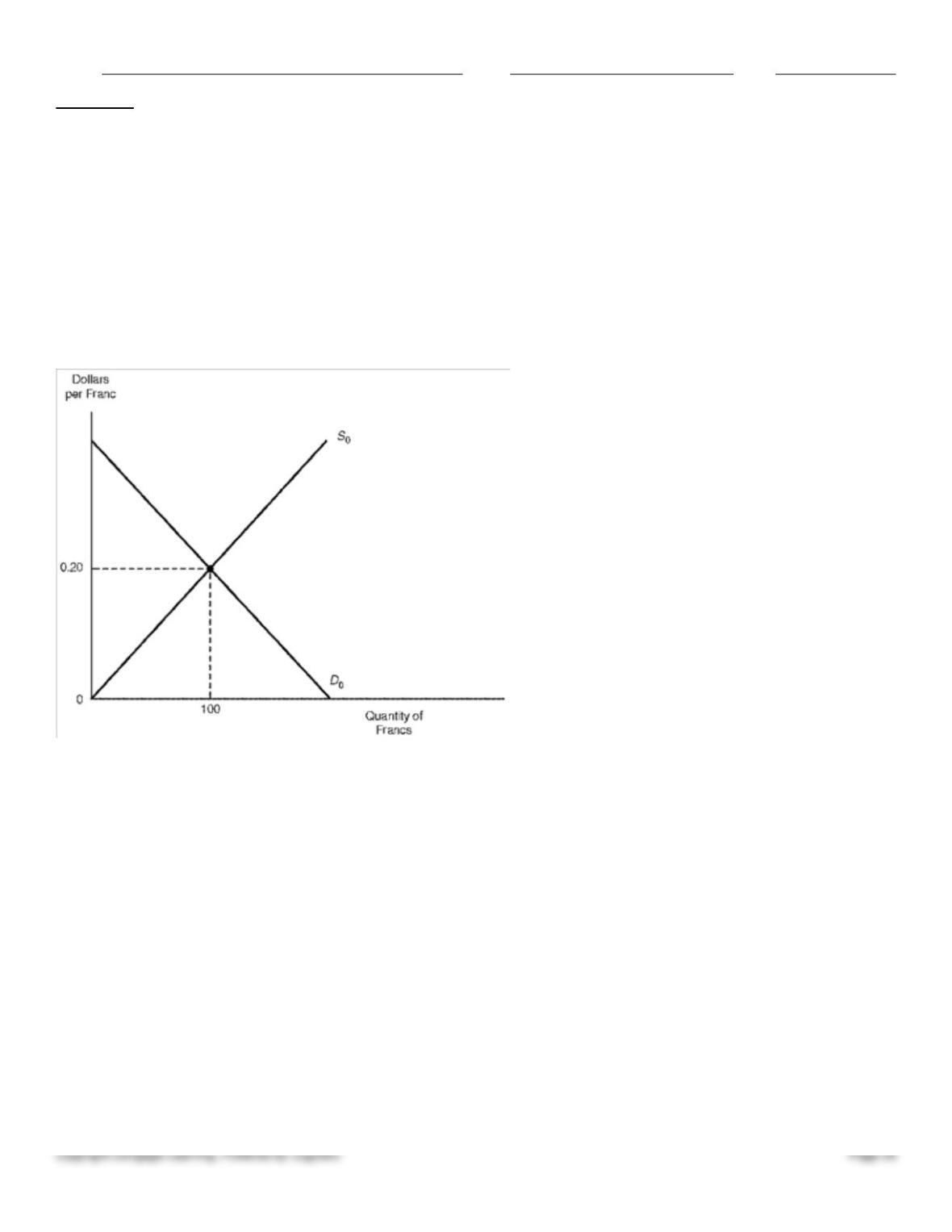
The figure below illustrates the supply and demand schedules of Swiss francs in a market of freely-floating exchange
rates.
Figure 12.1 The Market for Francs
158. Refer to Figure 12.1. Should the United States impose tariffs on imports from Switzerland, there would occur a(n)
a. increase in the demand for francs and a depreciation of the dollar.
b. decrease in the demand for francs and an appreciation of the dollar.
c. decrease in the supply of francs and an appreciation of the dollar.
d. increase in the supply of francs and a depreciation of the dollar.
Use the following table to answer the next two questions
European Expected value of the dollar in three months
Investor (dollars per euro)
Investor #1 $1.30
Investor #2 $1.20
Investor #3 $1.15
159. If the current exchange value of the dollar is $1.25 per euro, then
a. European Investor #1 expects a dollar depreciation against the euro, but European Investors #2 and #3 expect a
dollar appreciation.
b. European Investor #1 expects a dollar appreciation against the euro, but European #2 and #3 expect a dollar
depreciation.

Name:
Class:
Date:
chapter 12
Copyright Cengage Learning. Powered by Cognero.
Page 27
c. all three European investors expect that the dollar will depreciate against the euro.
d. all three European investors expect that the dollar will appreciate against the euro.
160. Which is NOT true about the purchasing-power parity theory?
a. The problem of choosing the appropriate price index exists.
b. It overlooks the influence of capital flows.
c. The government policy may modify exchange rates.
d. It is an infallible guide to exchange rate determination.
161. If Mexico’s labor productivity rises relative to Europe’s labor productivity, then
a. the peso tends to depreciate against the euro in the short run.
b. the peso tends to appreciate against the euro in the short run.
c. the peso tends to depreciate against the euro in the long run.
d. the peso tends to appreciate against the euro in the long run.
162. If the U.S. inflation rate rises to the foreign inflation rate, then in the foreign exchange market
a. the demand for dollars increases, and the supply of dollars increases.
b. the demand for dollars increases, and the supply of dollars decreases.
c. the demand for dollars decreases, and the supply of dollars increases.
d. the demand for dollars decreases, and the supply of dollars decreases.
163. Suppose that the exchange value of the dollar equals two British pounds. If in San Francisco a computer costs $1,000
and in London it costs 2,000 pounds, then
a. British consumers will buy computers in San Francisco.
b. Americans will buy computers in London.
c. purchasing power parity prevails.
d. purchasing power parity does not prevail.
164. A decrease in the U.S. demand for automobile imports will cause the supply curve of dollars to ______ and result in
a(n) ___________.
a. increase; appreciation of the dollar
b. increase; depreciation of the dollar
c. decrease; appreciation of the dollar
d. decrease; depreciation of the dollar
165. An exchange rate is said to ____ when its short-run response to a change in market fundamentals is greater than its
long-run response.
a. overshoot
b. undershoot
c. depreciate
d. appreciate
166. With floating exchange rates, relatively high productivity growth for a nation leads to
a. exchange rate depreciation in the short run.
b. exchange rate appreciation in the short run.
c. exchange rate depreciation in the long run.
Name:
Class:
Date:
chapter 12
Copyright Cengage Learning. Powered by Cognero.
Page 28
d. exchange rate appreciation in the long run.
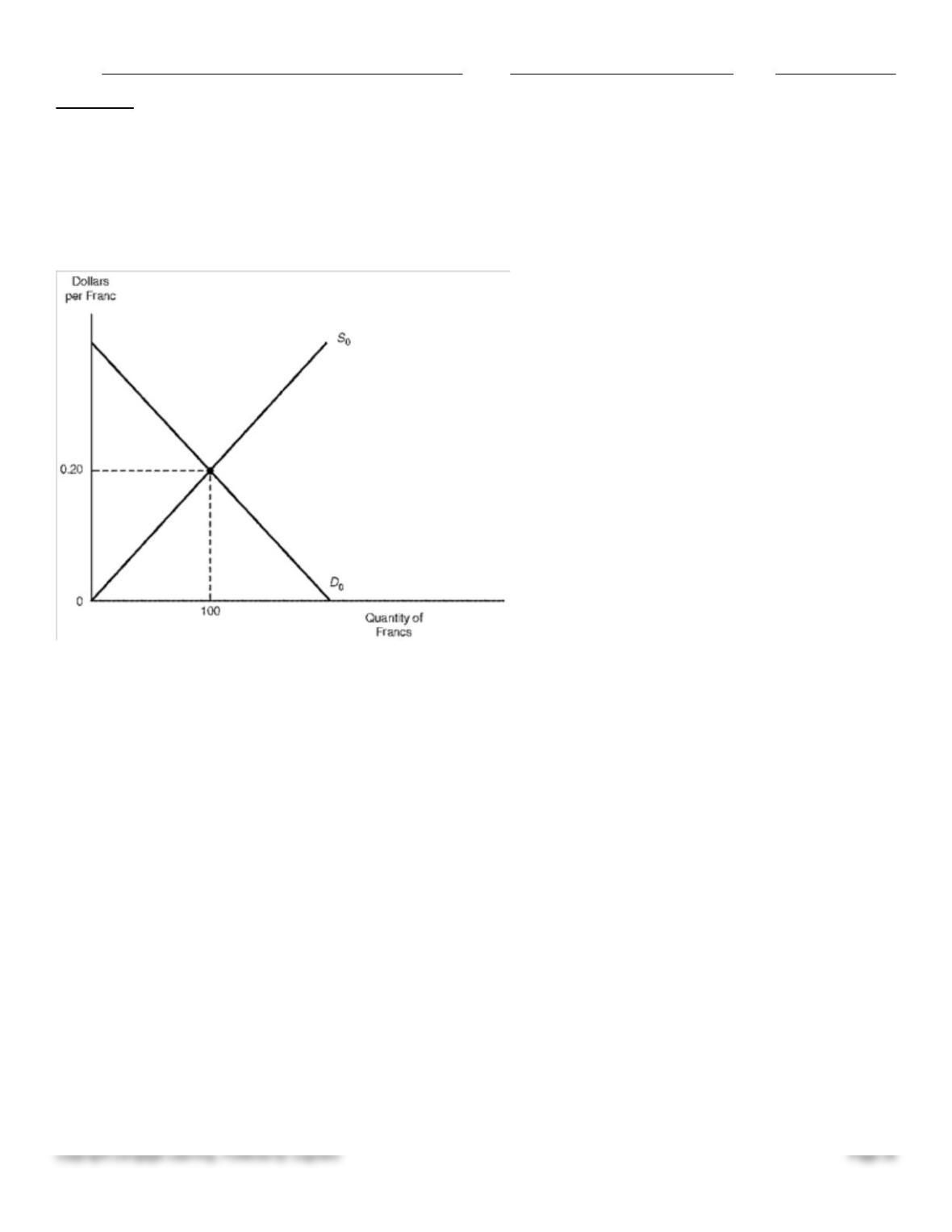
The figure below illustrates the supply and demand schedules of Swiss francs in a market of freely-floating exchange
rates.
Figure 12.1 The Market for Francs
167. Refer to Figure 12.1. Should Swiss labor productivity rise, leading to a decrease in Swiss manufacturing costs, there
would occur a(n)
a. increase in the supply of francs and a depreciation of the dollar.
b. increase in the supply of francs and an appreciation of the dollar.
c. decrease in the demand for francs and an appreciation of the dollar.
d. increase in the demand for francs and a depreciation of the dollar.
168. Which of the following would cause the demand curve for pounds to shift to the left?
a. a decrease in Britain’s rate of inflation relative to U.S. inflation
b. an increase in U.S. interest rates relative to British interest rates
c. a rise in British labor productivity relative to U.S. labor productivity
d. improving American tastes for British goods
169. When evaluating the financial investments in the home country and a foreign country, investors generally consider
a. labor productivity levels and rates of technological development.
b. budget surpluses or deficits of the home country and foreign country.
c. domestic and foreign interest rates and expected fluctuations in the exchange rate.
d. domestic and foreign price levels and the expected fluctuations in the exchange rate.
170. Suppose that the interest rate in Great Britain increases, while the interest rate in the United States remains constant.
As a result,
a. the demand curve for pounds decreases, and the pound depreciates against the dollar.

Name:
Class:
Date:
chapter 12
Copyright Cengage Learning. Powered by Cognero.
Page 29
b. the demand curve for pounds increases, and the pound depreciates against the dollar.
c. the demand curve for pounds increases, and the pound appreciates against the dollar.
d. the demand curve for pounds decreases, and the pound appreciates against the dollar.
171. Suppose the exchange rate between the U.S. dollar and the Japanese yen is initially 90 yen per dollar. According to
purchasing-power parity, if the price of traded goods rises by 5 percent in the United States and 15 percent in Japan, then
the exchange rate will become
a. 72 yen per dollar.
b. 81 yen per dollar.
c. 99 yen per dollar.
d. 108 yen per dollar.
172. The U.S. interest rate minus the foreign interest rate is called the U.S. interest rate differential. The U.S. interest rate
differential would increase if
a. the U.S. interest rate decreases, and the foreign interest rate remains constant.
b. the U.S. interest rate decreases, and the foreign interest rate increases.
c. the U.S. interest rate increases, and the foreign interest rate increases.
d. the U.S. interest rate increases, and the foreign interest rate decreases.
173. If economic growth perks up in the United States so that investors think they can realize larger profits from American
assets, then the
a. supply of U.S. dollars will increase in the foreign exchange market.
b. the demand for U.S. dollars will increase in the foreign exchange market.
c. the demand for U.S. dollars will decrease in the foreign exchange market.
d. the demand for U.S. dollars will remain constant in the foreign exchange market.
174. Under a system of floating exchange rates, relatively low productivity and high inflation rates in the United States
result in
a. an increase in the demand for foreign currency, a decrease in the supply of foreign currency, and a depreciation in
the dollar.
b. an increase in the demand for foreign currency, an increase in the supply of foreign currency, and an appreciation
in the dollar.
c. a decrease in the demand for foreign currency, a decrease in the supply of foreign currency, and a depreciation in
the dollar.
d. a decrease in the demand for foreign currency, an increase in the supply of foreign currency, and an appreciation
in the dollar.
175. Assume that labor productivity growth is slower in the United States than in its trading partners. Given a system of
floating exchange rates, the impact of this growth differential for the United States will be
a. increased exports and an appreciation of the dollar.
b. increased exports and a depreciation of the dollar.
c. increased imports and an appreciation of the dollar.
d. increased imports and a depreciation of the dollar.
176. Which of the following is likely to result in long-run depreciation of the U.S. dollar relative to the euro?
a. relatively low interest rates in the United States
b. relatively high labor productivity in the United States
Name:
Class:
Date:
chapter 12
Copyright Cengage Learning. Powered by Cognero.
Page 30
c. tariffs levied by the United States on steel imports from Europe
d. stronger American preferences for goods produced in Europe
177. Suppose that the exchange value of the dollar currently equals one hundred yen. As a result of changing economic
conditions, suppose that people anticipate that the dollar will be worth 120 yen in three months. This expectation results in
a. an increase in the value of U.S. exports to Japan.
b. an increase in the demand for the yen.
c. a decrease in the demand for dollars.
d. an increase in the demand for dollars.
178. Given a system of floating exchange rates, if Canada’s labor productivity rises relative to the labor productivity of its
trading partners, then
a. Canadian imports will fall, and the dollar will appreciate.
b. Canadian imports will fall, and the dollar will depreciate.
c. Canadian imports will rise, and the dollar will appreciate.
d. Canadian imports will rise, and the dollar will depreciate.
179. If the interest rate in Japan increases while the interest rate in the United States remains constant, then
a. the demand curve for dollars shifts to the left.
b. the demand curve for dollars shifts to the right.
c. the demand curve for yen shifts to the left.
d. the demand curves for both yen and dollars remain constant.
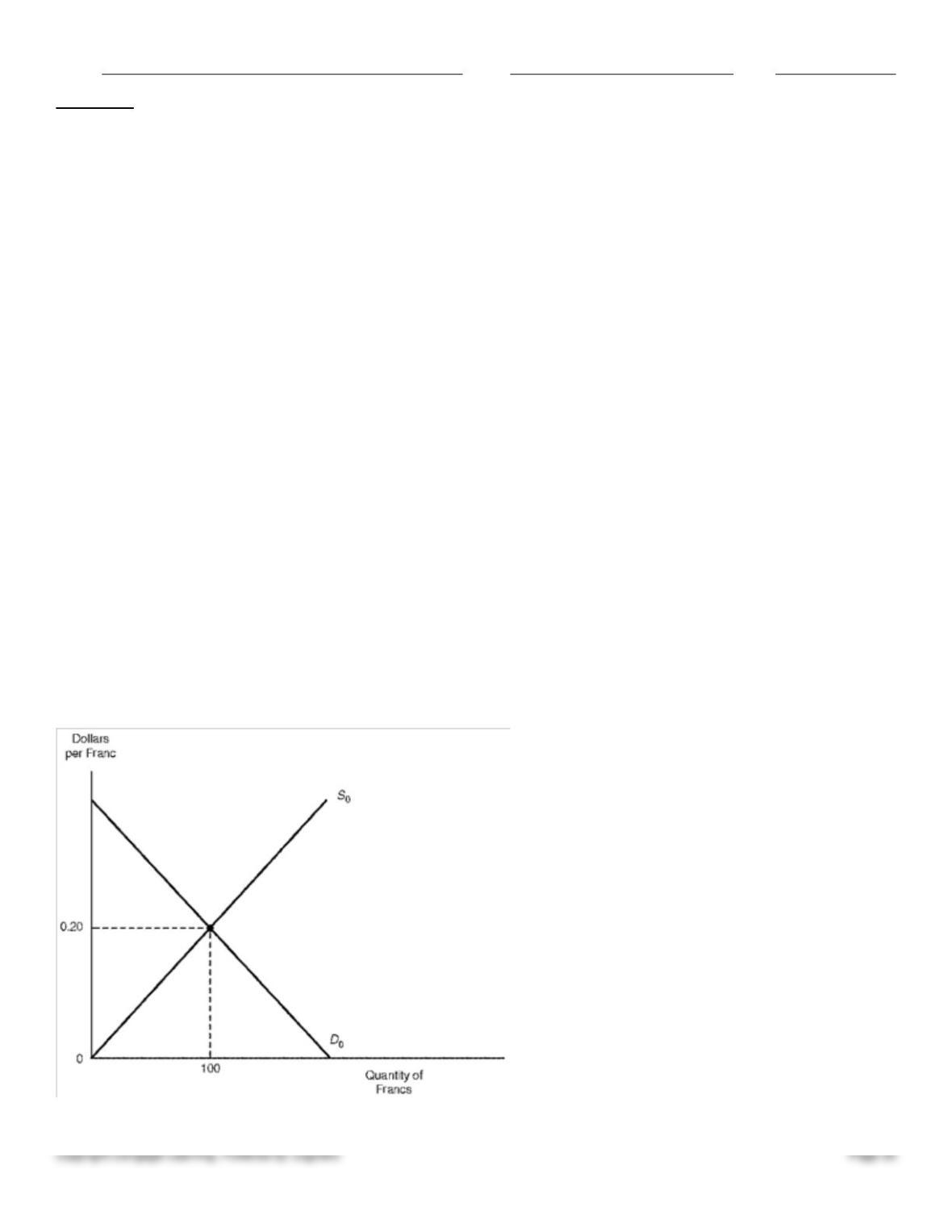
The figure below illustrates the supply and demand schedules of Swiss francs in a market of freely-floating exchange
rates.
Figure 12.1 The Market for Francs

Name:
Class:
Date:
chapter 12
Copyright Cengage Learning. Powered by Cognero.
Page 31
180. Refer to Figure 12.1. If Switzerland experienced a disastrous wheat-crop failure, leading to additional wheat imports
from the United States, there would occur an
a. increase in the supply of francs and an appreciation of the dollar.
b. increase in the supply of francs and a depreciation of the dollar.
c. increase in the demand for francs and a depreciation of the dollar.
d. increase in the demand for francs and an appreciation of the dollar.
181. Suppose that trade barriers and transportation costs are nonexistent. If the exchange rate is 0.9 Swiss francs per
dollar, then according to the law of one price, a refrigerator that costs $1,000 in the United States will cost
a. 1,900 francs in Switzerland.
b. 900 francs in Switzerland.
c. 1,300 francs in Switzerland.
d. 1,000 francs in Switzerland.
182. In the foreign exchange market, a decrease in the world demand for Japanese exports
a. shifts the demand curve for yen leftward, which causes the yen to depreciate.
b. shifts the demand curve for yen leftward, which causes the yen to appreciate.
c. shifts the demand curve for yen rightward, which causes the yen to depreciate.
d. shifts the demand curve for yen rightward, which causes the yen to appreciate.
183. Which of the following is likely to result in long-run appreciation of the U.S. dollar relative to the peso?
a. relatively high interest rates in Mexico
b. relatively high labor productivity in Mexico
c. tariffs applied by Mexico on computer imports from the United States
d. stronger Mexican preferences for goods produced in the United States
Figure 12.3 Market for British Pounds
Name:
Class:
Date:
chapter 12
Copyright Cengage Learning. Powered by Cognero.
Page 32
184. Consider Figure 12.3. The market is initially governed by demand curve D0 and supply curve S0. Suppose US
consumers develop stronger preferences for UK made goods, which supply and demand curves depict the new situation?
a. S1 and D2
b. S2 and D1
c. S0 and D2
d. S0 and D1
185. That identical goods should cost the same in all nations, assuming it is costless to ship goods between nations and
there are no barriers to trade, is a reflection of the
a. monetary approach to exchange-rate determination.
b. law of one price.
c. fundamentalist approach to exchange-rate determination.
d. exchange-rate-overshooting principle.
186. Suppose that the yen-dollar exchange rate changes from 85 yen per dollar to 80 yen per dollar. One can say that the
a. yen has appreciated against the dollar, and the dollar has depreciated against the yen.
b. yen has depreciated against the dollar, and the dollar has appreciated against the yen.
c. yen has appreciated against the dollar, and the dollar has appreciated against the yen.
d. yen has depreciated against the dollar, and the dollar has depreciated against the yen.
187. The demand in the United States for yen will increase if, other things remaining equal
a. labor costs rise in Japan.
b. income rises in Japan.

Name:
Class:
Date:
chapter 12
Copyright Cengage Learning. Powered by Cognero.
Page 33
c. prices rise in Japan.
d. interest rates rise in Japan.
188. For the United States, suppose the annual interest rate on government securities equals 12 percent, while the annual
inflation rate equals 8 percent. For Japan, suppose the annual interest rate equals 5 percent. These variables would cause
investment funds to flow from
a. the United States to Japan, thus causing the dollar to depreciate.
b. the United States to Japan, thus causing the dollar to appreciate.
c. Japan to the United States, thus causing the yen to depreciate.
d. Japan to the United States, thus causing the yen to appreciate.
189. If the Federal Reserve increases interest rates in the United States relative to interest rates in other countries, then in
the foreign exchange market
a. the demand for dollars increases, and the supply of dollars increases.
b. the demand for dollars increases, and the supply of dollars decreases.
c. the demand for dollars decreases, and the supply of dollars increases.
d. the demand for dollars decreases, and the supply of dollars decreases.
190. Concerning exchange rate forecasting, ______ are common sense models that require the gathering of a wide array
of political and economic data and the interpretation of these data in terms of the timing, direction, and magnitude of
exchange rate changes.
a. judgmental forecasts
b. technical forecasts
c. fundamental forecasts
d. econometric forecasts
191. Given a system of floating exchange rates, assume that Boeing Inc. of the United States places a large order, payable
in yen, with a Japanese contractor for jet engine parts. The immediate effect of this transaction will be a shift in the
a. supply curve of yen to the left, which causes the dollar to appreciate against the yen.
b. supply curve of yen to the right, which causes the dollar to depreciate against the yen.
c. demand curve for yen to the left, which causes the dollar to appreciate against the yen.
d. demand curve for yen to the right, which causes the dollar to depreciate against the yen.
192. For purchasing-power parity to exist,
a. flows of currency in the trade account must be offset by flows of currency in the capital account.
b. the nominal interest rate must be equal to the real interest rate in all countries.
c. converting a sum of funds from one currency to another does not alter its purchasing power.
d. a country’s trade account must always be in balance.
193. Suppose the exchange rate between the U.S. dollar and the Japanese yen is initially 90 yen per dollar. According to
purchasing power parity, if the price of traded goods falls by 5 percent in the United States and rises by 5 percent in Japan,
then the exchange rate will become
a. 72 yen per dollar.
b. 81 yen per dollar.
c. 99 yen per dollar.
d. 108 yen per dollar.

Name:
Class:
Date:
chapter 12
Copyright Cengage Learning. Powered by Cognero.
Page 34
194. The high foreign exchange value of the U.S. dollar in the early 1980s can best be explained by
a. additional investment funds made available from overseas.
b. lack of investor confidence in U.S. fiscal policy.
c. market expectations of rising inflation in the United States.
d. American tourists overseas finding costs increasing.
195. The international exchange value of the U.S. dollar is determined by
a. the rate of inflation in the United States.
b. the number of dollars printed by the U.S. government.
c. the international demand and supply for dollars.
d. the monetary value of gold held at Fort Knox, Kentucky.
196. What is the purchasing power parity approach to exchange rate determination?
197. What is exchange rate overshooting?
198. What is the asset market approach to exchange rate determination?
199. In a free market, what determines exchange rates in the long run and the short run?
Name:
Class:
Date:
chapter 12
Answer Key
1. False
2. True
3. True
Name:
Class:
Date:
Name:
Class:
Date:
Name:
Class:
Date:
Name:
Class:
Date:
Name:
Class:
Date:
Name:
Class:
Date:
Name:
Class:
Date:
Name:
Class:
Date: