61) Discuss the purpose of a classified balance sheet. Include a description of the major balance sheet
classifications including: current assets, plant and equipment, current liabilities, and long-term liabilities.
62) Determine the ending Capital amount of a business having:
Beginning Capital amount of $30,000
Withdrawals of $ 1,500
Net sales of $150,000
Net purchases of $80,000
Freight-in of $1,500
Beginning inventory of $6,000
Ending inventory of $7,000
Operating expenses of $ 32,000
$ ________
63) Determine the ending Capital balance of a business having:
Beginning Capital of $50,000
No investments or withdrawals
Beginning inventory of $10,000
Net Purchases of $90,000
Ending inventory of $12,000
Operating expenses of $72,000
Net sales $190,000
$ ________
64) Determine the ending inventory of a business having:
Beginning Capital $6,000
Net sales of $50,000
Net purchases of $30,500
Freight-in of $2,000
Beginning inventory of $4,000
Ending Capital of $10,000
Operating expenses of $14,000
$ ________
65) Determine the beginning inventory of a business having:
Beginning Capital balance of $11,000
No additional investments or withdrawals
Net sales of $43,500
Net purchases $26,000
Ending inventory of $4,250
Ending Capital balance of $10,000
Operating expenses of $16,500
$ ________
12.2 Learning Objective 12-2
1) How is Income Summary closed if the company had a net loss?
A) Credit Income Summary; debit Capital
B) Debit Income Summary; credit Capital
C) Debit Capital; credit Withdrawals
D) Debit Withdrawals; credit Capital
2) How is Income Summary closed if the company had a net income?
A) Debit Capital; credit Income Summary
B) Debit Income Summary; credit Capital
C) Debit Capital; credit Withdrawals
D) Debit Withdrawals; credit Capital
3) Adjusting entries from the worksheet:
A) are journalized and posted to the ledger.
B) are posted directly to the ledger.
C) are closed to the Income Summary account.
D) affect only balance sheet accounts.
4) The goal of closing entries is:
A) to clear revenue and expense accounts.
B) to update the Capital account balance.
C) to clear the Withdrawal account.
D) All of these answers are correct.
5) The first step in the closing process is to:
A) close all balances on the income statement debit column of the worksheet except Income Summary.
B) transfer the balance from the Income Summary Account to the Capital Account.
C) close all balances on the income statement credit column of the worksheet except Income Summary.
D) transfer the balance of the Owner’s Withdrawals Account to Capital.
6) After the closing entries have been posted:
A) the temporary accounts are zeroed out.
B) the Capital account includes the current net profit or loss.
C) the post-closing trial balance is prepared.
D) All of these answers are correct.
7) The amount shown in the balance sheet debit column of worksheet for Merchandise Inventory is:
A) the Cost of Goods Sold.
B) net purchases.
C) the ending inventory.
D) the beginning inventory.
8) Income Summary, before closing to Capital, contains a debit balance of $86 and a credit balance of
$100. What is the entry to close Income Summary to Capital?
A) Debit Income Summary $100; credit Capital $100
B) Debit Income Summary $86; credit Capital $86
C) Debit Capital $14; credit Income Summary $14
D) Debit Income Summary $14; credit Capital $14
9) The amount shown in the adjustments credit column for Merchandise Inventory on the worksheet is:
A) beginning inventory.
B) ending inventory.
C) total purchases.
D) Cost of Goods Sold.
10) Closing entries:
A) are posted to the general ledger.
B) are done to update Cash.
C) can be done before adjusting entries.
D) All of the above are correct.
11) The entry to close the Income Summary to Capital was omitted, there was a net income. This error
would cause:
A) the Capital account to be understated.
B) net income to be overstated.
C) net income to be understated.
D) the Capital account to be overstated.
12) The entry to close the Withdrawals account to Capital was omitted. This error would cause:
A) the Capital account to be understated.
B) net income to be overstated.
C) net income to be understated.
D) the Capital account to be overstated.
13) The entry to close the expense account(s) was entered in reverse—Income Summary was credited and
the expense account(s) was/were debited. This error would cause:
A) assets to be overstated.
B) liabilities to be overstated.
C) Capital account to be understated.
D) Capital account to be overstated.
14) The entry to close the Withdrawal account was entered in reverse—the Withdrawal account was
debited and Capital credited. This error would cause:
A) Capital to be understated.
B) net income to be overstated.
C) net income to be understated.
D) Withdrawals to be overstated.
15) The entry to adjust salaries was done twice. This error would cause:
A) liabilities to be understated.
B) liabilities to be overstated.
C) expenses to be understated.
D) Capital to be overstated.
16) When closing sales, which of the following accounts will also be closed?
A) Sales Returns and Allowances
B) Purchases Discount
C) Purchases
D) Owner’s Capital
17) When closing the expense account, which of the following accounts will also be closed?
A) Purchases Returns and Allowances
B) Merchandise Inventory
C) Sales Returns and Allowances
D) Owner’s Capital
18) The entry to close the Freight-In account will include which of the following?
A) Debit to Freight-In
B) Credit to Income Summary
C) Debit to Income Summary
D) Debit to Freight-Out
19) The entry to close the owner’s Withdrawal account will include which of the following?
A) A debit to Income Summary
B) A credit to Capital
C) A credit to Withdrawals
D) A debit to Withdrawals
20) Which of the following transactions could cause the Income Summary to be debited and Capital to be
credited?
A) The business earned a net loss for the period.
B) The business earned a net income for the period.
C) Closed the Owner‘s Capital account
D) None of these are correct.
21) Adjusting journal entries still need to be made after the worksheet; otherwise the account balances
will not be correct.
22) The adjusting entry to record rental income that is earned would be a debit to Rental Income and a
credit to Unearned Rent.
23) The entry to record the adjustment for depreciation on equipment would be a debit to Depreciation
Expense-Equipment and a credit to Equipment.
24) Beginning inventory is adjusted by debiting Income Summary and crediting Merchandise Inventory.
25) Ending inventory is adjusted by debiting Merchandise Inventory and crediting Capital.
26) After the closing process, the temporary accounts are set back to zero.
27) In closing entries, the Income Summary account is closed to the Capital account after Withdrawals.
28)
Column 1
Column 2
Column 3
Column 4
Cash
Column 1
Column 2
Column 3
Column 4
Cash
asset
debit
balance sheet
permanent
29)
Column 1
Column 2
Column 3
Column 4
Accounts
Receivable
Column 1
Column 2
Column 3
Column 4
Receivable
asset
debit
balance sheet
permanent
30)
Column 1
Column 2
Column 3
Column 4
Accounts
Payable
Column 1
Column 2
Column 3
Column 4
Accounts
Payable
liability
credit
balance sheet
permanent
31)
Column 1
Column 2
Column 3
Column 4
Merchandise
Inventory
Column 1
Column 2
Column 3
Column 4
Merchandise
Inventory
asset
balance sheet
permanent
32)
Column 1
Column 2
Column 3
Column 4
Prepaid
Insurance
Column 1
Column 2
Column 3
Column 4
Prepaid
Insurance
asset
debit
balance sheet
permanent
33)
Column 1
Column 2
Column 3
Column 4
Equipment
Column 1
Column 2
Column 3
Column 4
Equipment
asset
debit
balance sheet
permanent
34)
Column 1
Column 2
Column 3
Column 4
Accumulated
Depr. Equip.
Column 1
Column 2
Column 3
Column 4
Accumulated
Depr. Equip.
asset
credit
balance sheet
permanent
35)
Column 1
Column 2
Column 3
Column 4
Wages Payable
Column 1
Column 2
Column 3
Column 4
Wages Payable
liability
credit
balance sheet
permanent
36)
Column 1
Column 2
Column 3
Column 4
Wages Expense
Column 1
Column 2
Column 3
Column 4
Wages Expense
expense
debit
income statement
temporary
37)
Column 1
Column 2
Column 3
Column 4
Purchases
Column 1
Column 2
Column 3
Column 4
Purchases
expense
debit
income statement
temporary
38)
Column 1
Column 2
Column 3
Column 4
Purchases
Discounts
Column 1
Column 2
Column 3
Column 4
Purchases
Discounts
expense
credit
income statement
temporary
39)
Column 1
Column 2
Column 3
Column 4
Purchases
Returns &
Allowances
Column 1
Column 2
Column 3
Column 4
Returns &
Allowances
expense
credit
income statement
temporary
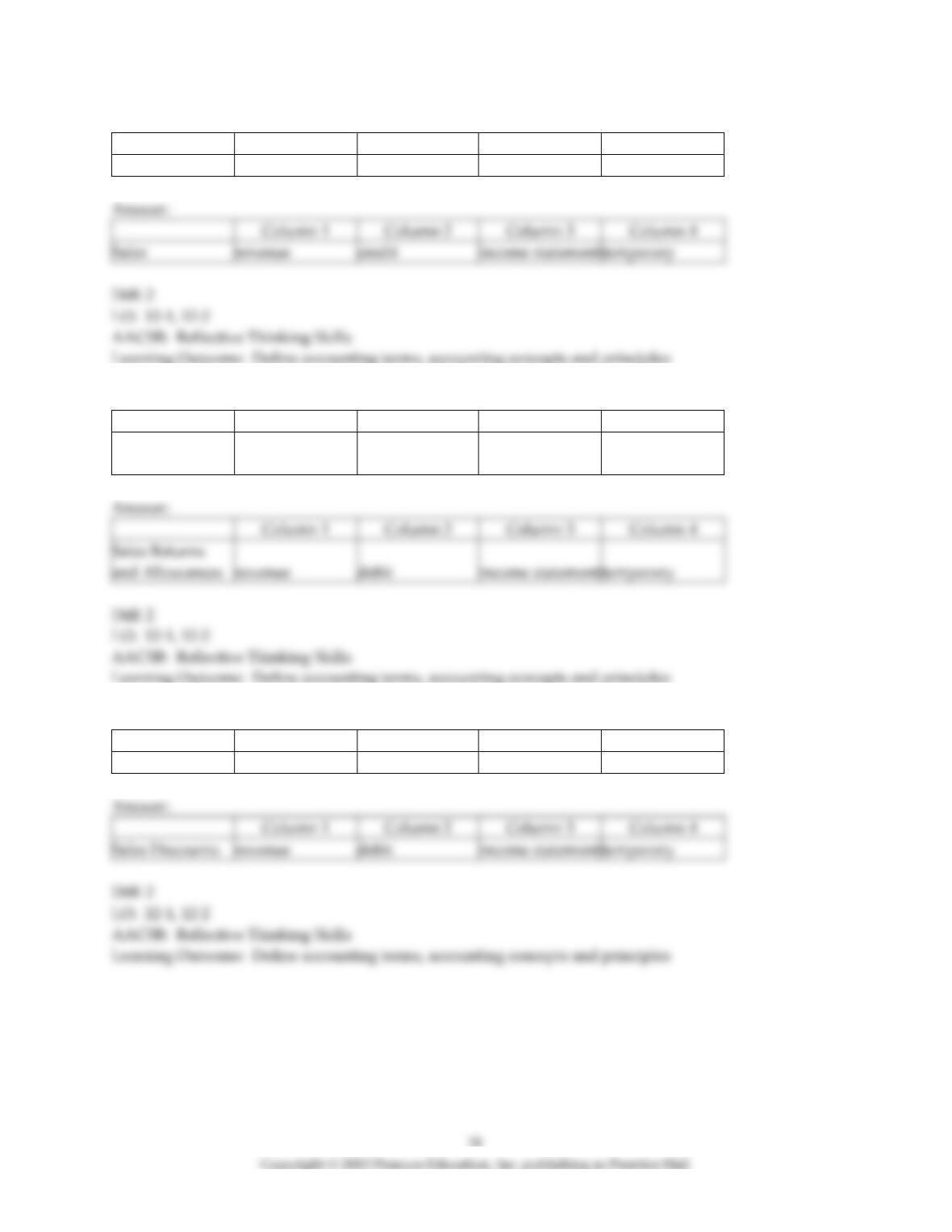
40)
Column 1
Column 2
Column 3
Column 4
Sales
Column 1
Column 2
Column 3
Column 4
Sales
revenue
credit
income statement
temporary
41)
Column 1
Column 2
Column 3
Column 4
Sales Returns
and Allowances
Column 1
Column 2
Column 3
Column 4
Sales Returns
and Allowances
revenue
debit
income statement
temporary
42)
Column 1
Column 2
Column 3
Column 4
Sales Discounts
Column 1
Column 2
Column 3
Column 4
Sales Discounts
revenue
debit
income statement
temporary
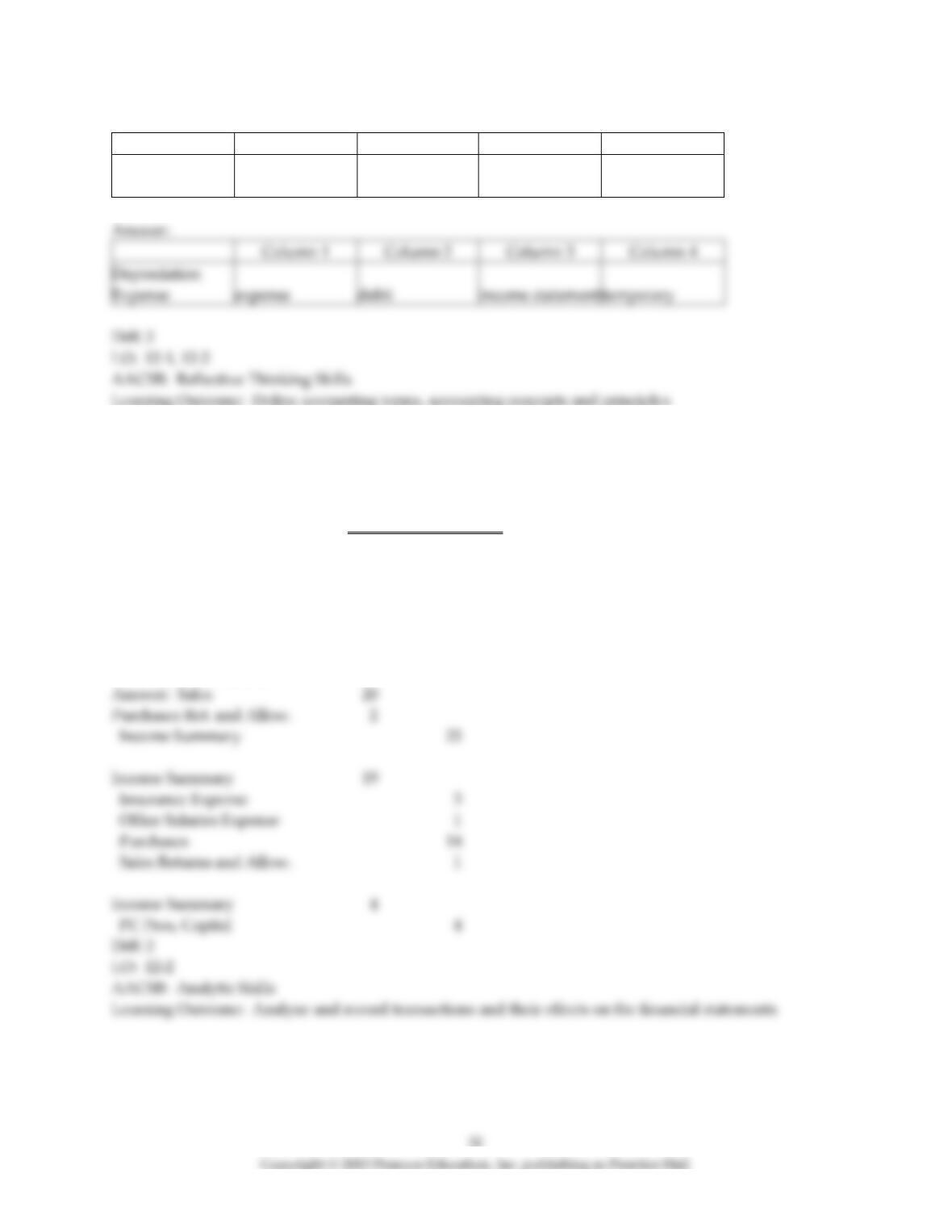
43)
Column 1
Column 2
Column 3
Column 4
Depreciation
Expense
Depreciation
44) Prepare the closing entries from the following information on the PC Pros Company worksheet
income statement columns.
Income Statement
Debit Credit
Sales 20
Sales Ret. and Allow. 1
Income Summary 5 6
Purchases 14
Pur. Ret. and Allow. 2
Insurance Expense 3
Office Salaries Expense 1
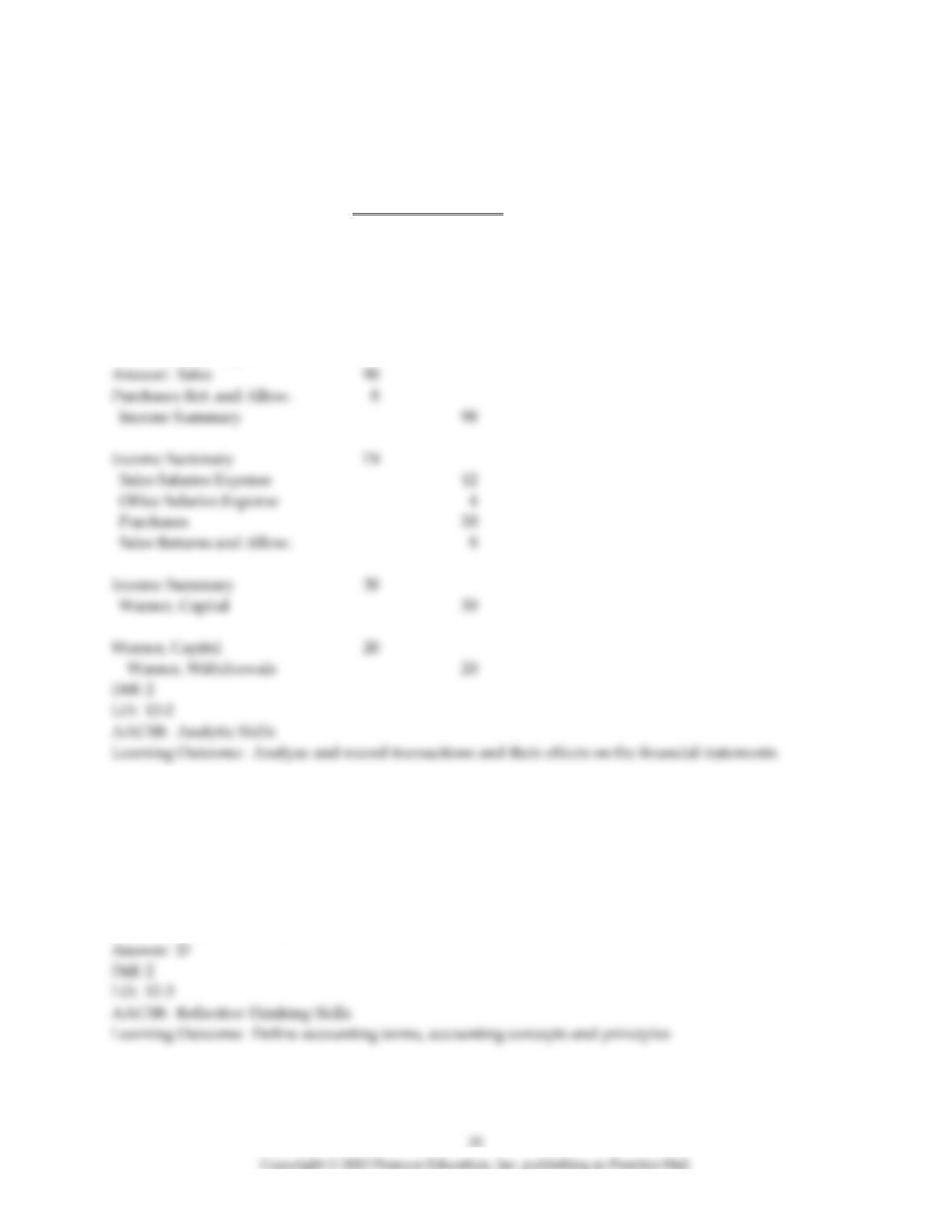
45) Prepare closing entries from the following information on the Warner Books worksheet income
statement columns. Additional information: Withdrawals equal $20 for the period.
Income Statement
Debit Credit
Sales 90
Sales Ret. and Allow. 8
Income Summary 16 22
Purchases 50
Pur. Ret. and Allow. 8
Sales Salaries Expense 12
Office Salaries Expense 4
12.3 Learning Objective 12-3
1) The post-closing trial balance contains:
A) assets and liabilities.
B) all accounts with balances.
C) only permanent accounts.
D) All of these answers are correct.
2) The post-closing trial balance is prepared from:
A) the income statement columns on the worksheet.
B) the balance sheet columns on the worksheet.
C) the trial balance columns on the worksheet.
D) the general ledger.
3) Which of the following accounts will not appear on the post-closing trial balance?
A) Capital
B) Cash
C) Accounts Payable
D) Withdrawals
4) Which of the following accounts will appear on the post-closing trial balance?
A) Capital
B) Purchases
C) Sales
D) Withdrawals
5) The general ledger balances are used to prepare the post-closing trial balance.
6) The post-closing trial balance would include Sales and Purchases.
12.4 Learning Objective 12-4
1) Which of the following could appear in an adjusting entry, closing entry, and reversing entry?
A) Salary Expense
B) Withdrawals
C) Depreciation Expense, Buildings
D) Accumulated Depreciation, Buildings
2) Reversing entries occur at the beginning of the accounting period and:
A) help to reduce potential errors.
B) simplify the bookkeeping associated with accruals from the prior period.
C) reverse the adjusting entries.
D) All of the above are correct.
3) Which of the following could be recorded as a reversing entry?
A) Depreciation of building
B) Accrual of interest expense
C) Allocation of prepaid rent in the current period
D) Correction of an error
4) Which of the following adjustments may be reserved?
A) The adjustment to Record Depreciation Expense
B) The adjustment to Allocate Prepaid Insurance to the current period
C) The adjustment to Accrue Salaries Payable
D) The adjustment to determine Supplies Expense for the period
5) The reversing entry for Salaries is:
A) debit Salaries Expense; credit Salaries Payable.
B) debit Salaries Payable; credit Income Summary.
C) debit Salaries Payable; credit Salaries Expense.
D) debit Salaries Expense; credit Cash.
6) Reversing entries are done when assets or liabilities are increasing and have no previous balance.
7) Reversing entries are the opposite of adjusting entries.
8) All adjusting entries can be reversed.
9) Reversing entries are recorded on the first day of the new accounting period.