International Economics, 9e (Krugman et al.)
Chapter 12 Controversies in Trade Policy
12.1 Sophisticated Arguments for Activist Trade Policy
1) The existence of positive externalities due to the impossibility of full appropriability
A) supports the conclusions of the Heckscher-Ohlin model.
B) rejects the usefulness of government protectionism.
C) supports the concept that the government should support only high-tech industries.
D) provides support for government protectionism.
E) supports arguments for free trade.
2) The United States
A) does not provide more support for R&D as compared to other forms of investment.
B) provides support for R&D by imposing high tariffs on R&D intensive products.
C) provides support for R&D by providing direct subsidies for such activities.
D) provides support for R&D through tax legislation.
E) provides support for R&D through grant incentives.
3) The Brander-Spencer model identified market failure in certain industries due to
A) unfair competition.
B) wildcat destructive competition.
C) environmental negative externalities associated with pollution.
D) limited competition.
E) lack of excess returns.
4) In the Brander-Spencer model the subsidy raises profits by more than the subsidy because of
A) the “multiplier” effect of government expenditures.
B) the military-industrial complex.
C) the forward and backward linkage effects of certain industries.
D) the deterrent effect of the subsidy on foreign competition.
E) the economies of scale once the company enters the market.
5) Criticisms of the Brander-Spencer model include all except which of the following?
A) the problem of insufficient information
B) the problem of likely foreign retaliation
C) the problem of harm to interests of consumers
D) the problem of adverse effects of trade policy politics
E) the problem of simultaneously causing harm to other industries
6) Japan’s protection of its semiconductor (RAM) producers is today seen as an object lesson in
A) how strategic planning may backfire and cause a large waste of resources.
B) how externalities may be successfully exploited by protectionist policies.
C) how excess returns may be successfully exploited by protectionist policies.
D) how government intervention may create a meaningful comparative advantage.
E) how monopolies can outlast government intervention.
7) The Heckscher-Ohlin, factor-proportions model lends support to the argument that
A) trade tends to worsen the conditions of unskilled labor in rich countries.
B) trade tends to worsen the conditions of owners of capital in rich countries.
C) trade tends to worsen the conditions of workers in poor countries.
D) trade tends to worsen the conditions of workers in rich countries.
E) trade tends to worsen the conditions of highly skilled workers in rich countries.
8) If firms in an industry are generating knowledge that other firms can use without paying for it, this
industry is characterized by
A) social costs that exceed private costs.
B) social benefits that exceed private benefits.
C) social costs that exceed social benefits.
D) private benefits that exceed social benefits.
E) social benefits that undermine private benefits.
9) It is argued that high-tech industries typically generate new technologies but cannot fully appropriate
the commercial benefits associated with their inventions or discoveries. If this is true then in order to
maximize a country’s real income, the government should
A) tax the high-tech firms.
B) subsidize the high-tech firms.
C) protect the high-tech firms.
D) outsource high-tech production.
E) discourage high-tech investments.
10) In effect, the U.S. does subsidize high-tech firms by subsidizing R&D. This is done through
A) the budget of the Department of Education.
B) systematic protection through the levying of tariffs.
C) systematic protection through the establishment of NTBs.
D) relatively accelerated “depreciation” of R&D investment in the Federal tax codes.
E) subsidies for high-tech firms.
11) The best economic case one can make for an active industrial policy involves
A) the national security argument.
B) the technological spillover argument.
C) the environment preservation argument.
D) the high value added argument.
E) raising the national income.
12) Spencer and Brander’s model highlights the existence of
A) aircraft industries.
B) excess returns present in highly competitive markets.
C) excess returns, or rents, available in non-competitive markets.
D) the futility of government bureaucrats’ attempts to build an airplane.
E) natural advantages in foreign technology firms.
13) Spencer and Brander’s model highlights the conventional assumption that
A) government involvement in business or in the economy tends to fail.
B) government subsidies tend to waste taxpayer’s money.
C) government subsidies cannot create a successfully competing export.
D) government tends to distort when it displaces Adam Smith’s Invisible Hand.
E) government subsidies can produce profits that exceed the subsidy’s value.
14) The reason Airbus succeeded in the Brander Spencer example is that
A) Boeing made the first move in this strategic game.
B) Europeans tend to be better strategists than corn-fed Americans.
C) the Airbus actually was a better plane than the Boeing 747.
D) U.S. laws actually prohibit U.S. exporters from bribing foreign officials.
E) the subsidy removed the advantage that Boeing gained with their head start in production.
15) The reason Airbus succeeded in the Brander Spencer example is that
A) the European government made an explicit subsidy offer, but the U.S. government did not.
B) Airbus’ prices were better when adjusted for quality and warranty services.
C) Boeing traditionally refused to undertake any exchange rate risk in its transactions.
D) the U.S. acted in accordance with its ideological reliance on market solutions, whereas the Europeans
ignored market and technological factors.
E) the Airbus plane benefited from more advanced technology.
16) The argument that strategic planning is not likely to be practical due to insufficient information
means that
A) because of trade secrets, the government does not know true cost relationships in any given industry.
B) if the government had all the relevant information in a given industry then it could decide whether a
subsidy would enhance the public’s welfare.
C) even if the government had all the relevant information in a given industry, it still could not decide
whether a subsidy would enhance the public’s welfare.
D) due to recent cuts in the Department of the Census’ sampling budgets, industry surveys are no longer
reliable, so that there is no way to determine if a subsidy is in the public’s interest.
E) the government would need to employ its intelligence agencies in order to gain a complete
understanding of the market.
17) The invocation of beggar-thy-neighbor arguments with respect to industrial policies
A) strengthens the argument for subsidies.
B) makes sense if the international Keynesian multipliers exceed unity.
C) applies only to rich countries most of whose trade partners are very poor countries.
D) weakens the argument for subsidies.
E) does not apply to rich countries who can influence relative world prices.
18) When the WTO met in Seattle to initiate a further move towards free international trade, thousands
of activists met
A) in order to promote the WTO’s goals of “Trade-not Aid.”
B) in order to laud the WTO policy orientation which would bust local monopolies and therefore help
ordinary relatively poor consumers everywhere.
C) in order to laud the WTO policy of disallowing government sweetheart deals, which typically meant
that corrupt governments subsidized their in-laws’ conglomerates on the backs of poor taxpayers.
D) in order to support the WTO efforts of bringing about a universal shift of resources in poor countries
to higher efficiency and productivity uses, which would raise the real incomes of everyone.
E) in order to protest WTO free trade policies that they believed hurt workers.
19) When one applies the Heckscher-Ohlin model of trade to the issue of trade-related income
redistributions, one must conclude that North South trade, such as U.S.-Mexico trade,
A) must help low skill workers on both sides of the border.
B) is likely to hurt high-skilled workers in the U.S.
C) is likely to hurt low-skilled workers in the U.S.
D) is likely to hurt low-skilled workers in Mexico.
E) is likely to help highly skilled workers in Mexico.
20) The evidence usually cited to prove that globalization hurts workers in developing countries
A) is inconclusive due to poor statistical design of the underlying samples.
B) is inconclusive due to the poorly funded Central Statistical Office of Mexico.
C) is inconclusive due to the ambiguous theoretical implications of the findings.
D) is conclusive.
E) does not take into account the Heckscher-Ohlin model.
21) The proposal that trade agreements should include a system which monitors worker conditions and
make the results available to consumers in the rich importing country
A) is consistent with the Invisible Hand paradigm.
B) is consistent with the market failure approach.
C) is consistent with the Ricardian theory of comparative advantage.
D) is consistent with the scale economies approach to trade theory.
E) is consistent with the principles laid out by the WTO.
22) Labor standards in trade are typically opposed by most developing countries who believe that they
will be used
A) to further neo-imperialist colonial exploitation.
B) to charge these countries with crimes against child-labor standards at the Hague.
C) as a protectionist tool by import-competing producers in industrial countries.
D) as a means of spreading U.S. Corporate Values and destroying local cultures.
E) to hinder investment in foreign-based multinational corporations.
23) The WTO seems at times to be interfering in domestic policy since
A) the line between domestic policies and de factor protectionism is often fuzzy.
B) it is a supra-national organization with the power to overturn governments.
C) it determines which nations may trade what with whom.
D) it punishes naughty nations.
E) it exempts the U.S. and other powerful member nations from many of its edicts.
24) It may be argued that Japan’s explicit promotion of its microchip industry was an excellent example
of successful industrial policy. What criteria would you apply to determine whether such a policy is or is
not successful? Judging from your own stated criteria, was Japan’s exercise successful? Why or why
not? What information would a government require in order to increase the probability that its industrial
policy would promote long term self-generated economic growth?
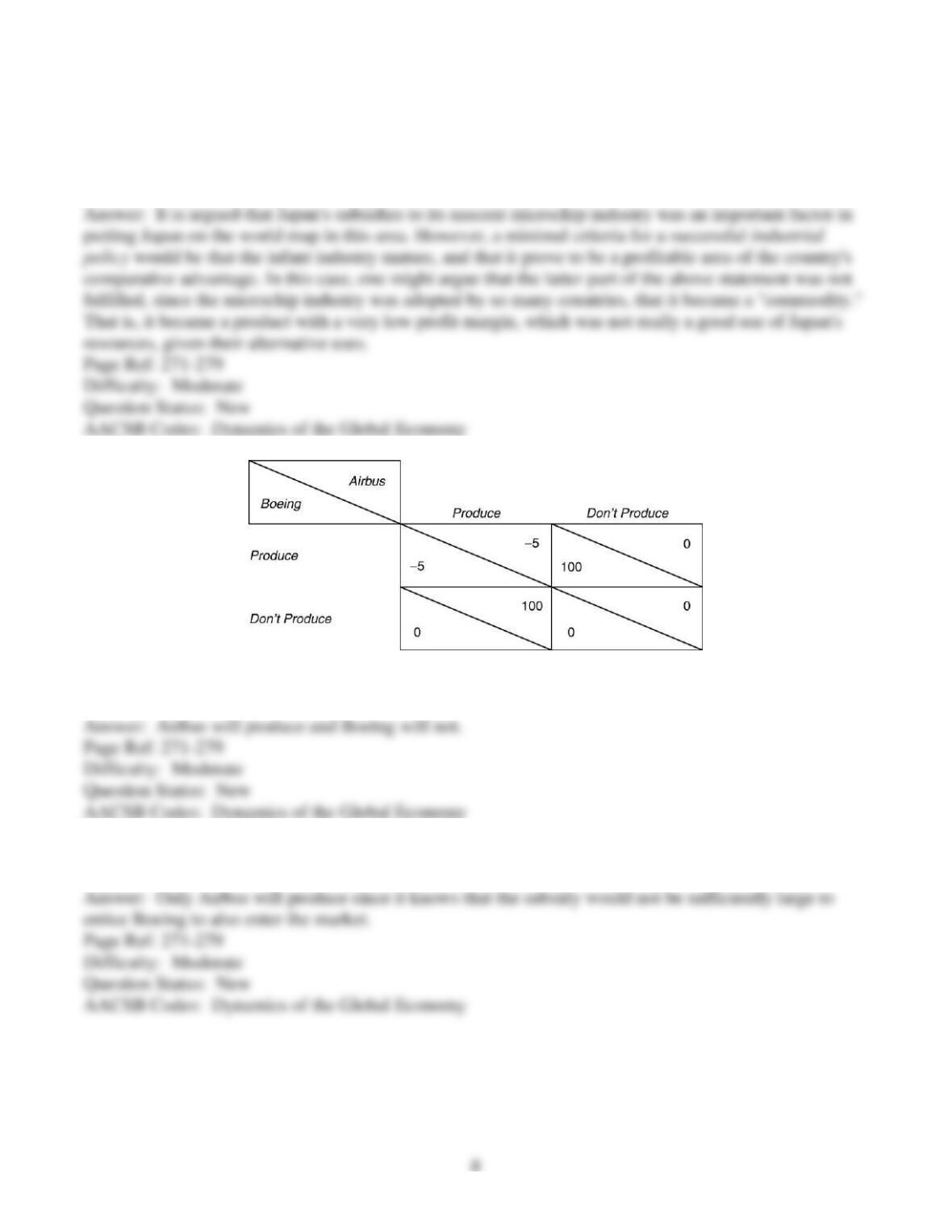
25) Refer to the above table. Suppose Airbus is set to produce the aircraft before Boeing. Which
company will enter the market?
26) Refer to the above table. Suppose both governments offer their respective company a subsidy of
$4(million).
27) Refer to the above table. Suppose both governments offer their respective company a $10 million
subsidy.
28) Refer to the above table. Suppose the U.S. government (but not Europe) offers a $10 million
subsidy?
29) Refer to the above table. How could the U.S. government justify its decision to offer a subsidy to a
profitable and successful business?
12.2 Globalization and Low–Wage Labor
1) In today’s world markets, poor developing countries tend to rely primarily on exports of
A) agricultural products.
B) primary products.
C) mineral products.
D) manufactured products.
E) high-tech products.
2) In the second half of the 1990s a rapidly growing movement focused on the harm caused by
international trade to
A) land owners in poor countries.
B) capital owners in rich industrialized countries.
C) land owners in rich industrialized countries.
D) production workers in both rich and poor countries.
E) terms of trade in developing countries.
3) The Ricardian model of comparative advantage lends support to the argument that
A) trade tends to worsen the conditions of unskilled labor in rich countries.
B) trade tends to worsen the conditions of owners of capital in rich countries.
C) trade tends to worsen the conditions of workers in poor countries.
D) trade tends to worsen the conditions of workers in rich countries.
E) trade is mutually beneficial to the countries that engage in it.
4) Most developing countries oppose including labor standards in trade agreements because
A) they believe this would involve a loss of their national sovereignty.
B) they believe this would limit their ability to export to rich markets.
C) they believe this would create an uneven playing field.
D) multinational corporations control them.
E) they do not want to improve wages for their workers.
5) When Japan’s MITI (Ministry of International Trade and Industry) focused resources on the
semiconductor industry, this was seen as a typically successful Japanese foray into a new dynamic
strategic sector. The results, as viewed by the late 1990s
A) justified this view.
B) led to similar structuring of industrial policy in the U.S.
C) lent support to the Brander-Spencer model.
D) helped shift the focus of economists away from Japanese-style industrial policy.
E) propelled Japan into the leading country in high-tech manufacturing.
6) Low wages and poor working conditions in many U.S. trade partners
A) prove that the gains-from-trade arguments of the Ricardian model are false.
B) may be a fact of life, but economists don’t care.
C) are facts emphasized by U.S. labor in its contract negotiations.
D) prove that the gains-from-trade arguments of the Ricardian model are true.
E) prove that international trade is exploitative.
7) The fact that clothing sold in Walmart are produced by very poorly paid workers in Honduras, is a
fact that if taken into account
A) would prove to economists that the Ricardian model of comparative advantage is false.
B) would prove to economists that the equal-value in trade concept summed up in the trade triangles is
incorrect.
C) proves to economists that trade is a negative sum game.
D) proves to the Anti-Globalization Movement that trade is a negative sum game.
E) proves that corporations are exempt from labor standards.
8) Faced with the evidence of poor working conditions and low wages in the border maquiladoras,
Economists
A) shrug their shoulders and ignore the issue.
B) agree that trade theory is thus proven hollow and internally inconsistent.
C) argue that U.S. consumers should not consume lettuce.
D) argue that the poor conditions and low wages are actually improvements for the Mexican workers,
and may be cited as gains-from-trade.
E) argue that Mexico’s generally high overall productivity offsets these conditions.
9) The Shipbreakers of Alang are
A) a metaphysical representation of the WTO, deriving from Edgar Rice Burroughs’ Princess of Mars.
B) an early version of the Russian Ice-breaker of the Dnieper-Alang class.
C) a capital-intensive industry.
D) competing with capital-intensive industries in countries outside of India.
E) doing environmentally conscious work.
10) The Shipbreakers of Alang utilize much labor and little capital, thereby supporting the applicability
of the
A) factor proportions explanation of the sources of comparative advantage.
B) specific factor theory of comparative advantage.
C) monopolistic competition theory of comparative advantage.
D) scale economies theory of comparative advantage.
E) basis of the non-dumping legislation.
11) The Shipbreakers of Alang arouse the ire of Greenpeace because of
A) India’s non-repentant nuclear stance.
B) India’s import-competing industrialization policies.
C) the difficulty of avoiding ship accidents between Greenpeace‘s sailboat and the reconstructed
Container ships of Alang.
D) the large amount of pollution associated with the operations at Alang.
E) their competition with capital-intensive industries.
12) The Shipbreakers of Alang represent a perfect example of how a developing country can apply the
principles of the Heckscher-Ohlin model, since
A) shipbreaking is generally considered to be a capital-intensive operation and India, being a large
country has much capital.
B) shipbreaking is a labor-intensive operation in India, and India has many workers since it is such a
large country.
C) shipbreaking is a labor-intensive operation in India, and India’s availability of capital per worker is
less than that of its trade partners.
D) shipbreaking is a capital-intensive operation elsewhere in the world, and therefore represents a case
of a factor intensity reversal.
E) India’s climate lends itself to the work involved in shipbreaking.
13) When one applies the Heckscher-Ohlin model of trade to the issue of trade-related income
redistributions, one must conclude that North South trade, such as U.S.-Mexico trade,
A) must help low skill workers on both sides of the border.
B) is likely to hurt high-skilled workers in the U.S.
C) is likely to involve higher overall national economic gains that will be greater than any harm done to
low-skilled workers in the U.S.
D) is likely to hurt low-skilled workers in Mexico.
E) gives no advantage to the workers in either country.
14) It has been claimed that the Chinese burst of modernization which has been propelling its
manufactured exports throughout the world at an unprecedented rate, is made possible by the use of
slave (penal) labor. If this is true should China have been accepted as a full fledged member of the
WTO? Why (or why not)?
12.3 Globalization and the Environment
1) Free trade and globalization is generally argued
A) to cause a degradation in the world’s environment.
B) to improve the environment by correcting for distortions caused by import competing policies.
C) to help spread the best of each country’s culture, so as to uplift global cultural standards.
D) to help each country safeguard the best of its own culture.
E) to make no difference in the economic welfare of the world.
2) It is still the conventional wisdom in the U.S. that compliance with NAFTA requirements is having a
deleterious effect on U.S. highway safety standards, on U.S. pollution and other environmental
standards, and on U.S. jobs. What facts would proponents of an expansion of NAFTA (e.g., to include
all of Central and South American countries) need to marshall in order to convince you?
3) Describe the environmental Kuznets curve.

4) What is a pollution haven?